Castlepook’s Uncertain Visitors31841 BCE
31,841 BCE is an imprecise modern label for Ireland during Marine Isotope Stage 3, when fluctuating Ice Age climates produced severe but intermittently habitable environments. Cave, sediment and climate evidence cannot identify events, peoples or permanent settlement. Castlepook Cave in County Cork preserves Ireland’s richest pre-Last Glacial Maximum vertebrate archive, including mammoth, giant deer, reindeer, bear and hyaena, though disturbed deposits and revised dates demand caution. A marked reindeer femur may indicate human butchery around 31,000 BCE, but lacks secure archaeological context. Ireland therefore supported mobile animal communities and perhaps transient hunter-gatherers, not documented societies, agriculture or established Palaeolithic occupation.
Dateline
The label 31,841 BCE is a modern way of locating a moment roughly 33.8 millennia before AD 1950; it was not a year recognised by anybody then. Ireland had no written records, rulers, states, calendars or named peoples that can be connected to such a precise date. Nor can archaeology distinguish what happened in one particular year at this depth of time. The responsible subject is therefore Ireland during the broader Late Pleistocene interval surrounding this nominal date: a fluctuating phase of the last Ice Age conventionally placed within Marine Isotope Stage 3 (MIS 3), before the Last Glacial Maximum.
Evidence is sparse, discontinuous and often difficult to date. It comes chiefly from animal bones in caves, deposits of silt and organic material trapped beneath later glacial sediments, cave calcite, landforms and the wider North Atlantic climate record. These sources can reveal changing environments and animal communities. They cannot furnish an annal of political events, a map of tribes, or a confident account of a settled human population. Around 31,841 BCE, Irish prehistory is best understood as a landscape and ecological history, with one especially provocative but still limited possible human trace.
A Date Range, Not an Event
Radiocarbon dates are normally expressed in years before AD 1950 and must be calibrated against independently dated records of past atmospheric carbon. Calibration produces ranges rather than a single exact historical year, and the uncertainties become especially important this far back. The modern IntCal20 calibration curve reaches to 55,000 calibrated years before present, but it does not convert an Ice Age bone into evidence for activity in one numbered BCE year. The numerical date in this article should thus be read as an approximate pointer within a much longer span.
MIS 3, broadly about 60,000 to 27,000 years ago, was not a uniform ‘cold age’. Greenland ice cores show repeated abrupt shifts between colder stadials and relatively milder interstadials. Irish evidence records the consequences only imperfectly. Speleothems from Crag Cave in County Kerry grew episodically during the last glacial period, with phases of deposition corresponding broadly to milder episodes. Organic deposits preserved beneath later glacial sediments in northern Ireland likewise show that, at some points in the Midlandian glaciation, parts of the island supported vegetation and freshwater environments rather than lying continuously beneath ice.
That does not permit a simple island-wide weather report for 31,841 BCE. The British–Irish Ice Sheet was dynamic before its later maximum, and its extent during MIS 3 remains less securely known than its Last Glacial Maximum history. The maximum cold-stage ice sheet belongs principally to the later interval of roughly 26,500–19,000 calibrated years before present. At the earlier horizon represented by this nominal year, conditions varied by region and through time. The safest conclusion is that habitable, though severe, terrestrial environments existed in Ireland during portions of MIS 3, while glaciers and periglacial conditions repeatedly reshaped the wider landscape.
The Castlepook Archive
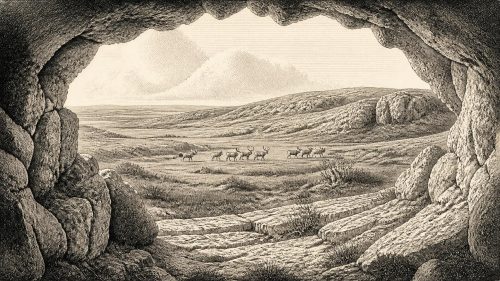
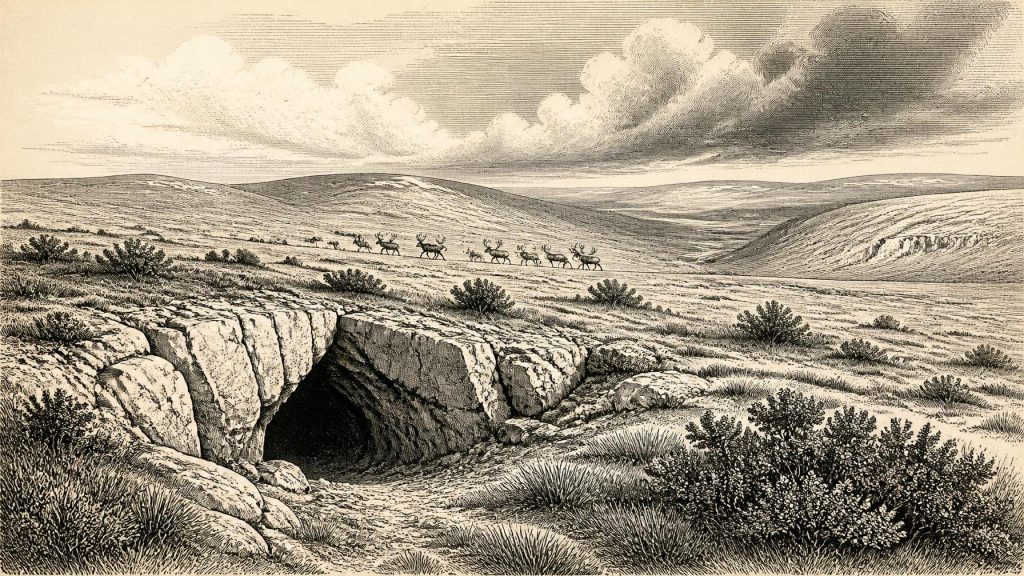
Castlepook Cave, also called Mammoth Cave or Doneraile Cave, near the Awbeg Valley in north County Cork, is central to this story. It is Ireland’s richest known cave archive for vertebrate life before the Last Glacial Maximum. More than 2,000 bones have been recovered from its chambers and galleries, including remains attributed to woolly mammoth, giant deer, reindeer, brown bear and spotted hyaena, as well as later cold-adapted animals such as Arctic fox, wolf and lemmings. These finds establish that Ireland was, at intervals, part of the north-west European world of large Ice Age mammals.
The cave’s importance is matched by its complications. Much of its material was excavated by antiquarians in the early twentieth century, before modern standards of stratigraphic recording, sieving and sampling. Water movement, roof openings, scavengers and later disturbance could move bones between deposits. A cave may be a carnivore den, a natural trap, a shelter, a drainage route and a sediment archive at different times. Consequently, the Castlepook animals did not necessarily live together, die together or enter the cave by the same route.
Modern re-dating has made this warning sharper. Reassessment of selected Castlepook, Foley and Shandon cave bones using improved pretreatment methods found that several earlier radiocarbon determinations were substantially too young. At Castlepook, some new results were between about 5,000 and 12,000 radiocarbon years older than the old measurements. The revision strengthens the case for a substantial MIS 3 fauna in southern Ireland, but it also demonstrates why older date lists must not be treated as fixed facts. Archaeological confidence here rests not on one spectacular specimen, but on repeated direct dating, secure provenance and careful taphonomic analysis.
Reindeer and a Single Incision
The closest possible human evidence to this broad period is a reindeer femur from Castlepook. It has been reported as approximately 33,000 years old and bears a deep mark interpreted by Ruth Carden as an incision made with a sharp stone implement during carcass processing. County Cork heritage material presents it as a possible Palaeolithic indication that hunters dealt with reindeer in the Doneraile area around 31,000 BCE. If that interpretation is sustained, the find would move the potential human story of Ireland far earlier than the better-known terminal-Pleistocene evidence from County Clare.
Yet this is not proof that people occupied Ireland permanently in 31,841 BCE, nor even that activity occurred in that exact year. The radiocarbon result dates the animal’s death, not automatically the cutting of the bone. The femur comes from an older cave collection rather than a modernly excavated occupation floor. No securely associated hearth, dwelling, stone-tool assemblage, human burial or camp surface of comparable age has been identified at Castlepook. The cave itself may have received discarded bones through animal scavenging after any butchery took place elsewhere.
It is therefore reasonable to describe the femur as a potentially momentous trace of human butchery, while retaining the word ‘potentially’. Ireland has no securely demonstrated Aurignacian or Gravettian settlement equivalent to the better documented Upper Palaeolithic sites of Britain or continental Europe. The contrast matters. A cut-marked brown-bear patella from Alice and Gwendoline Cave in County Clare has two independently obtained calibrated ranges of 12,810–12,590 and 12,810–12,685 cal BP, making it robust evidence for a much later, terminal-Pleistocene human presence. Castlepook’s possible human signal is older and more consequential, but currently less supported by an archaeological context.
Landscape of Mobile Animals
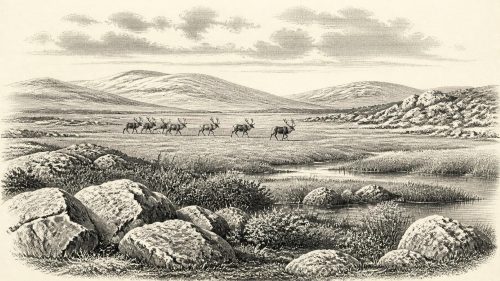
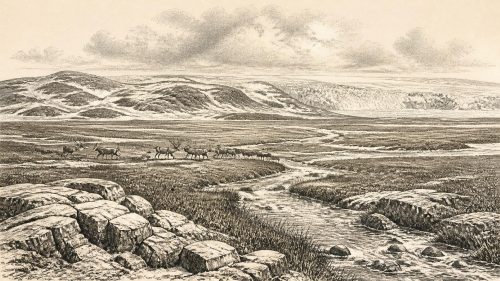
What, then, can be said about daily life? For animals, rather more than for people. Reindeer suggest open country with accessible forage, likely a mosaic of grasses, herbs, sedges, dwarf shrubs and patches of more sheltered vegetation rather than woodland comparable to modern Ireland. Mammoth and giant deer point to substantial grazing resources at some stages, while hyaena, wolf and Arctic fox testify to a food web in which carcasses were contested, scavenged and transported. Brown bears and smaller mammals complicate any simplistic picture of a wholly barren tundra.
These species should not be assembled into a single illustrated ‘day in the life’. Their dated remains span many millennia, and animal ranges alter with climate, season and geography. Some are more securely represented at Castlepook than elsewhere; absence from the small Irish fossil record is not always proof of ecological absence. Nevertheless, the faunal evidence decisively rejects the idea that pre-maximum Ireland was an empty, featureless wasteland. It contained changing habitats capable of supporting mobile mammals, although their populations may have been thin and vulnerable to climatic deterioration.
If people did reach the island during this part of MIS 3, they would have been highly mobile hunter-gatherers rather than farmers or village dwellers. A reindeer carcass could have supplied meat, marrow, hide, sinew and bone, but that is an inference from the animal and the proposed cut mark, not a directly excavated Irish camp economy. There is no evidence for cultivation, domesticated animals, pottery, metalworking, monuments, long-distance commercial exchange or permanent built settlement. Low sea levels altered coastlines, exposing land on continental shelves, but no demonstrated dry land bridge across the Irish Sea can simply be assumed. Any movement between Britain and Ireland remains an unresolved question of changing sea, ice and coastal conditions.
No Polities, No Recorded Religion
Political affairs, diplomacy and organised warfare leave no identifiable record for Ireland at this date. It would be misleading to invent clans defending territories, chiefs bargaining over herds or rival groups fighting for caves. Equally, no evidence identifies a religion, language, art tradition or formal learning system on the island. Caves can acquire ritual significance in later prehistory, but Castlepook’s Ice Age deposits are not evidence of ceremony. They are principally a record of geological processes, animal lives and possible brief human contact.
The cultural achievement visible to archaeologists is instead modern scientific work: direct accelerator radiocarbon dating, improved collagen purification, microscopic study of bone surfaces, ancient-DNA analysis, stable-isotope research, cave mapping and renewed excavation. These methods have transformed old museum collections from curiosities into testable evidence. They have also made the limits of those collections more apparent. At Castlepook, newly investigated and less disturbed deposits may eventually clarify whether the modified reindeer bone belongs to a genuine human episode, a particular climatic phase, or a more complex sequence of natural deposition.
An Island Before History
For Ireland around 31,841 BCE, the most important development was not a documented human event but the persistence of life in a volatile Ice Age setting before the great expansion of the last ice sheet. Southern cave archives show that mammoth, reindeer, giant deer, hyaena and other mammals reached the island during the wider MIS 3 world. Castlepook’s marked reindeer femur raises the possibility that people also arrived, perhaps only briefly, to exploit that animal-rich landscape.
That possibility deserves attention precisely because it remains uncertain. The evidence does not yet justify a story of continuous settlement, an ancestral population or a named Palaeolithic society. It does, however, make Ireland’s deep past more interesting: not an unchanging blank before the Mesolithic, but a sparsely preserved frontier where climate, animals, sea routes, ice and perhaps transient human visitors repeatedly shaped what could survive and what archaeology can still recover.
Primary Sources
- A reconsideration of the radiocarbon dating of the Marine Isotope Stage 3 fauna from southern Ireland
- The Irish Quaternary Fauna Project
- Castlepook Cave, County Cork: County Geological Site Report
- Heritage Artefacts of County Cork
- Archaeology Research Excavation Grant 2022: Final Report
- Castlepook Cave, Co. Cork, 2022
- New insights on the fauna of Ireland's Younger Dryas and Early Holocene from Alice & Gwendoline Cave
- First evidence of a Late Upper Palaeolithic human presence in Ireland
- First Evidence of a Late Upper Palaeolithic Human Presence in Ireland
- Phylogeographic, ancient DNA, fossil and morphometric analyses reveal ancient and modern introductions of a large mammal: the complex case of red deer (Cervus elaphus) in Ireland
- Episodic speleothem deposition tracks the terrestrial impact of millennial-scale last glacial climate variability in SW Ireland
- Episodic speleothem deposition tracks the terrestrial impact of millennial-scale last glacial climate variability in SW Ireland
- Trimlines, blockfields and the vertical extent of the last ice sheet in southern Ireland
- The timing and magnitude of the British–Irish Ice Sheet between Marine Isotope Stages 5d and 2: implications for glacio-isostatic adjustment, high relative sea levels and ‘giant erratic’ emplacement
- Growth and retreat of the last British–Irish Ice Sheet, 31,000 to 15,000 years ago
- Maximum extent and dynamic behaviour of the last British–Irish Ice Sheet west of Ireland
- Dimensions and chronology of the last ice sheet in Western Ireland
- The problem of a late Quaternary landbridge between Britain and Ireland
- Ireland: Submerged Prehistoric Sites and Landscapes
- The IntCal20 Northern Hemisphere Radiocarbon Age Calibration Curve (0–55 cal kBP)
- IntCal Publications
- The Greenland Ice Core Chronology 2005, 15–42 ka. Part 1: constructing the time scale
- The subdivision of the Quaternary Period in Ireland
- Advances in Irish Quaternary Studies