
Castlepook’s Hyaena Country31775 BCE
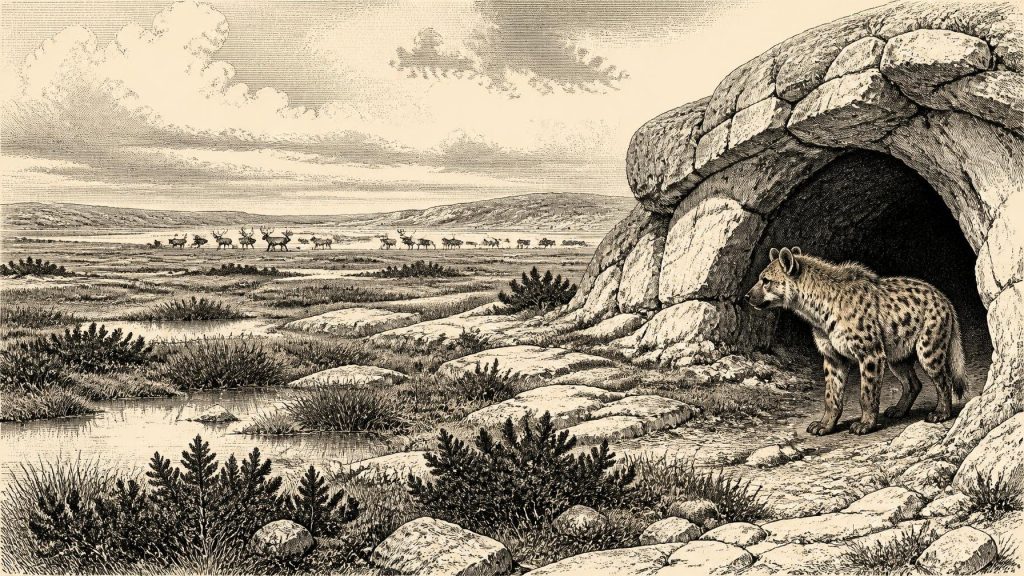
Around 31,775 BCE, Ireland lay within the climatically unstable Late Pleistocene MIS 3, before maximum glaciation. Evidence from Kerry speleothems and Fermanagh organic deposits indicates alternating milder phases and cold, treeless tundra with wetlands, grasses, mosses and juniper. Castlepook Cave, County Cork, preserves remains of mammoth, reindeer, giant deer, bear, wolf, fox, hare, lemming and spotted hyaena, demonstrating a rich open-country fauna. Revised dating places important remains before the Last Glacial Maximum. A marked reindeer femur may indicate human butchery, yet lacks associated occupation evidence. Ireland’s human presence therefore remains possible, not proven, while later ice advance obscured surviving traces.
Dateline
31,775 BCE is not a date that can be attached to a recorded Irish event. No calendar, settlement sequence or historical witness allows us to identify a happening in that particular year. It is a modern chronological label, equivalent to roughly 33,700 calibrated years before AD 1950, and even that conversion should be treated as an approximation rather than an anniversary. Radiocarbon results must be calibrated, often produce ranges rather than single years, and date particular organic specimens rather than whole landscapes or human communities. The responsible subject is therefore Ireland during the later part of Marine Isotope Stage 3 (MIS 3), within the Late Pleistocene: a cold, unstable interval before the Last Glacial Maximum.
A Landscape Between Cold Phases
Around this nominal date, Ireland was not the wooded island familiar from later prehistory. The available evidence instead points to an exposed, largely treeless world, subject to sharp climatic swings. Conditions varied across time and region: “MIS 3” does not mean one uniform climate. Shorter milder episodes alternated with severe cold, and southern and northern Ireland need not have experienced precisely the same environment at the same moment. The strongest evidence comes not from villages or tools, but from pollen, beetles, plant remains, cave deposits, animal bone and calcite formations in caves.
In south-west Ireland, uranium-thorium dating of broken and reworked speleothems from Crag Cave, County Kerry, records repeated phases of calcite growth during the last glacial cycle. Because water must remain liquid for such formations to grow in this shallow cave system, the deposits provide evidence for episodes when mean annual temperatures were probably above freezing. Their timing broadly corresponds with Greenland interstadials: abrupt, temporary ameliorations within an otherwise cold Ice Age. The result is important because it cautions against imagining Ireland as permanently frozen at 31,775 BCE. It was a climatically restless place, in which milder intervals could permit soil activity, surface water and limited vegetation before colder conditions returned.
Further north, buried organic deposits offer a different but complementary picture. At Derryvree in County Fermanagh, organic silts trapped between glacial tills preserve pollen, mosses and insect remains interpreted as evidence for open, treeless muskeg: wet, peat-forming ground with mosses, sedges, grasses, herbs, juniper and pools of standing water. Older conventional radiocarbon determinations placed the Derryvree deposits at about 30,500 radiocarbon years BP; calibration and later chronological work mean that they should not be converted mechanically into one exact BCE year. Nonetheless, they remain directly relevant evidence for the kind of cold, damp tundra environment that occurred in Ireland during MIS 3.
The North Cork Faunal Archive
The most evocative evidence for this period lies in north Cork, at Castlepook Cave near Doneraile, historically also called Mammoth Cave. Excavations there in the early twentieth century recovered a remarkable assemblage of Ice Age animal remains. Subsequent re-examination and improved dating have shown that some southern Irish cave fauna belongs much earlier than researchers once thought. Castlepook has yielded evidence of woolly mammoth, reindeer, giant deer, brown bear, wolf, fox, hare, lemmings and spotted hyaena. Not every species necessarily lived there simultaneously, and a cave accumulation is not a straightforward census of a landscape; bones may have been dragged in, scavenged, redeposited or excavated without modern stratigraphic recording. Even so, the assemblage demonstrates that Ireland could support a far richer cold-stage mammal community than its later historic fauna suggests.
Spotted hyaena gives the article its title, but not because a particular hyaena can be placed in 31,775 BCE. Rather, it represents the ecological character of the period. Hyaenas are predators and scavengers whose presence, alongside mammoth, reindeer and large deer, implies extensive open country capable of sustaining large herbivores and the carnivores that fed upon them. Caves may have served as dens, traps, shelters or natural sediment repositories. Tooth marks and bone breakage can result from carnivore feeding; water, frost and later disturbance can also alter remains. Archaeologists must therefore distinguish animal modification, geological damage and possible human work one specimen at a time.
That caution matters especially at Castlepook because revised radiocarbon work has transformed the chronology. A 2020 study redated identified bones from Castlepook, Foley Cave and Shandon Cave using improved pretreatment methods. Several Castlepook results proved substantially older than earlier determinations, placing important elements of the fauna in MIS 3 and suggesting that giant deer and spotted hyaena had disappeared locally before the Last Glacial Maximum, around 40,000 calibrated years ago. This does not place every Castlepook bone in the same brief interval, but it makes the cave an indispensable archive for the changing animal life of Ice Age Ireland.
A Reindeer Bone and a Serious Question
The possibility of people in Ireland at this time rests principally on a single, contested but potentially momentous object: a reindeer femur from Castlepook Cave. Zooarchaeologist Ruth Carden identified a deep linear mark on the bone as consistent with cutting or chopping by a sharp stone implement during the processing of a fresh carcass. The specimen has been publicised as evidence that humans may have handled reindeer in Ireland about 33,000 years ago. If that interpretation is sustained, it would extend the island’s known human story dramatically earlier than the securely dated terminal Pleistocene evidence from County Clare, dating to about 12,810–12,590 calibrated BP.
But “may” is essential. The femur was recovered during antiquarian excavations rather than from a modernly excavated occupation floor. There is no securely associated hearth, stone-tool assemblage, dwelling, burial, repeated camp surface or dated food-preparation area of comparable age at Castlepook. A radiocarbon measurement on the bone dates the death of the reindeer, not automatically the instant of marking, the place where it was killed, or the duration of any visit. Nor does one modified bone demonstrate a settled population. Current fieldwork at Castlepook is explicitly seeking the independent evidence—charcoal, lithics, further modified bone and intact stratified deposits—that could test this interpretation.
The most defensible conclusion is consequently modest but significant: around the broader period represented by 31,775 BCE, Ireland may have been visited by Upper Palaeolithic hunter-gatherers, perhaps following or exploiting reindeer. A brief hunting or scavenging episode is conceivable; permanent settlement, population size, language, kinship, seasonal round and social organisation are unknown. It would be wrong to describe a “Cork tribe”, a camp at Castlepook, or a continuous Irish population on this evidence.
No Polities, No Diplomacy
There is no evidence for political institutions, named leaders, territorial states, diplomacy, warfare or organised religion in Ireland at this date. These are not merely missing details: the present record is too thin to justify inference. If people did reach the island, they would have belonged to small mobile hunter-gatherer groups within wider north-west European networks, but that is a general archaeological comparison, not a demonstrated fact about Castlepook. No human remains, ornaments, carvings, pigments, structures or ceremonial places of this age have been securely identified in Ireland.
Likewise, there is no basis for describing trade in the later sense. The relevant question is mobility. During lowered sea levels, coastlines and shallow seas differed greatly from those of today, though this does not prove an easy or continuous land bridge from Britain to Ireland. The geography of the Irish Sea, ice margins, rivers, exposed shelves and possible sea crossings changed through time. Any human arrival would have required movement through a difficult, shifting north-west European environment, but the route remains unproven.
Approaching a Changed Ireland
The wider trajectory was towards greater cold and the expansion of the British–Irish Ice Sheet. Modern reconstructions place the ice sheet’s maximum extent later, broadly by about 27,000 years BP, with regional advances and retreats differing markedly. Thus 31,775 BCE belongs not to the maximum ice cover itself but to the preceding climatic and environmental transition. Landscapes then available to mammals—and perhaps occasional people—would later be overridden, eroded or buried by ice and glacial sediment. This helps explain why the archaeological record is so fragmentary.
For Ireland, then, this nominal year is best understood through a small number of durable traces: calcite that formed when water flowed through Kerry limestone; silts, pollen and insects preserved beneath later tills in Fermanagh; and bones accumulated in Cork caves. Together they reveal an island of open ground, marshy hollows, cold-season hardship and large mammals. The marked reindeer femur introduces the possibility of human action, but does not yet turn that possibility into a settled historical narrative. At 31,775 BCE, Ireland’s story is still one of evidence patiently extracted from caves, sediments and bone.
Primary Sources
- A Reconsideration of the Radiocarbon Dating of the Marine Isotope Stage 3 Fauna from Southern Ireland
- Episodic Speleothem Deposition Tracks the Terrestrial Impact of Millennial-Scale Last Glacial Climate Variability in SW Ireland
- Growth and Retreat of the Last British–Irish Ice Sheet, 31,000 to 15,000 Years Ago: The BRITICE-CHRONO Reconstruction
- Maximum Extent and Dynamic Behaviour of the Last British–Irish Ice Sheet West of Ireland
- Pattern and Timing of Retreat of the Last British-Irish Ice Sheet
- New Age Constraints for the Maximum Extent of the Last British-Irish Ice Sheet (NW Sector)
- The IntCal20 Northern Hemisphere Radiocarbon Age Calibration Curve (0–55 cal kBP)
- IntCal20 Northern Hemisphere Radiocarbon Age Calibration Curve PDF
- IntCal History
- Figure 6—The Subdivision of the Quaternary Period in Ireland
- ESCR Site Summary: Deposits of the Last Glaciation
- Cenozoic: Tertiary and Quaternary
- Archaeological Heritage of County Cork: A Guide
- Heritage Artefacts of County Cork
- 2022:564 — Castlepook Cave, Castlepook South, Cork
- Archaeology Research Excavation Grant 2022: Final Report
- Archaeology Research Excavation Grant Report 2023
- Mammoth Cave / Castlepook Cave, Irish Caves Database
- The Irish Quaternary Fauna Project
- First Evidence of a Late Upper Palaeolithic Human Presence in Ireland
- New Insights on the Fauna of Ireland’s Younger Dryas and Early Holocene from Alice & Gwendoline Cave
- The Problem of a Late Quaternary Landbridge Between Britain and Ireland
- Spatio-Temporal Dynamics of Speleothem Growth and Glaciation in the British Isles
- The Cave of Castlepook, County Cork