
Crag Cave’s Living Calcite31776 BCE
During later Marine Isotope Stage 3, around 31,776 BCE, Ireland experienced cold, unstable conditions as the British-Irish Ice Sheet developed, though southern areas retained habitable, intermittently ice-free environments. Crag Cave calcite growth indicates liquid water and absence of permanent local freezing during some episodes. Lower sea levels altered connections with Britain and Europe, enabling diverse mammals, including reindeer, mammoth and hyaena, to reach Ireland. A marked reindeer femur from Castlepook Cave may record human butchery about 33,000 years ago, but poor context prevents firm conclusions. Evidence supports environmental change and possible brief visits, not established human settlement, society or culture.
Dateline
Modern calendar-year precision is not available for prehistoric Ireland at this depth of time. “31,776 BCE” is a useful label in a modern sequence, roughly 33,725 years before AD 1950, but it does not identify a recorded year, season, generation, event or individual. The responsible historical frame is a broader one: later Marine Isotope Stage 3 (MIS 3), during the last Ice Age, when Ireland’s environments, ice margins and animal populations altered repeatedly. Radiocarbon results require calibration, carry statistical ranges and can date an animal’s death rather than every later event affecting its bone. The evidence therefore illuminates an interval around this date, not life on the island on a precisely known day.
A Changing Ice-Age Island
Ireland was not yet at the Last Glacial Maximum, the later phase when the British–Irish Ice Sheet reached its greatest overall extent, broadly between about 27,000 and 21,000 years ago. Around the horizon represented by 31,776 BCE, however, that ice complex was developing. Reviews of the ice-sheet record place its principal build-up after roughly 35,000–32,000 years ago, while emphasising that individual ice lobes advanced and retreated unevenly. It would be wrong, therefore, to picture either a wholly ice-covered Ireland or an entirely open island at this exact point. Conditions differed sharply between regions and changed over comparatively short geological intervals.
Southern Irish evidence is especially important because it demonstrates that parts of the island could support life before the glacial maximum. Cave deposits and animal remains show that mammals reached Ireland during MIS 3; revised radiocarbon work has pushed several southern Irish faunal records substantially further back than older measurements suggested. Meanwhile, a programme of uranium-thorium dating at Crag Cave near Castleisland, County Kerry, has found episodes of stalagmite growth through MIS 3. Calcite can form only when water percolates through the cave system and temperatures above it allow liquid water to persist. Such growth does not prove mild weather, forests or human occupation outside the cave, but it is strong evidence against permanent ground-freezing and complete local ice cover during the episodes represented.
The climate was nevertheless cold, variable and exposed to North Atlantic instability. The Irish landscape was not the green, wooded island familiar today. Open vegetation, sparse scrub and herb-rich ground are more plausible for many accessible areas than dense woodland, while wind, frost, seasonal snow and freezing rivers shaped both terrain and opportunity. The precise character of the countryside at 31,776 BCE cannot be reconstructed from one site or one date. Yet the combined cave, fossil and glacial records make clear that Late Pleistocene Ireland contained habitable ecological pockets before the advance of the great ice sheet erased, buried or reworked much of the earlier evidence.
Routes Across a Different Geography
Sea level was lower than today because enormous quantities of water were held in global ice sheets. Coastlines, estuaries and the Irish Sea basin consequently had a very different form. That did not necessarily make movement simple. Whether there was a continuous, usable land connection between Ireland, Britain and continental Europe at every point in MIS 3 remains uncertain, and the answer depends on changing sea level, local crustal movement, ice extent and the practical meaning of a “bridge” in a cold landscape. It is safer to say that the barrier separating Ireland today was reduced or differently configured, allowing animals to arrive by routes that are now drowned, glaciated or both.
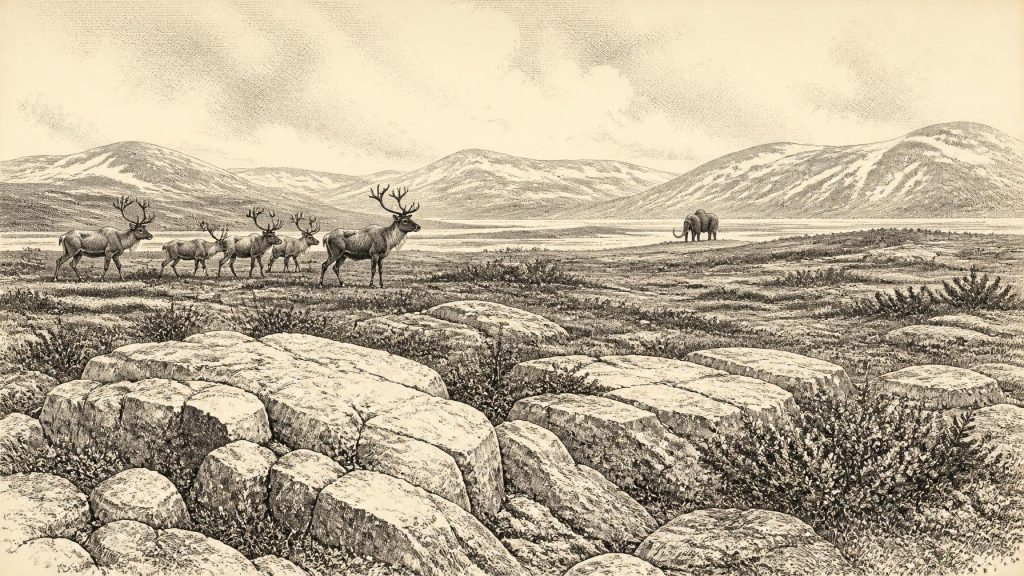
The faunal record proves that such connections, whether terrestrial or involving short crossings, mattered. Ireland was not an isolated biological world. Mammoth, reindeer, giant deer, wolf, brown bear, Arctic fox, mountain hare, lemmings and spotted hyaena are among the animals identified from Pleistocene contexts, particularly from the limestone caves of southern Ireland. Their presence should not be compressed into a single simultaneous menagerie: specimens may belong to different climatic pulses and deposits can have mixed histories. Still, the range reveals an island linked to wider north-west European ecological systems rather than cut off from them.
Castlepook’s Difficult Bone
The most arresting object for this period is a reindeer femur from Castlepook Cave near Doneraile, County Cork. Re-examined from an old collection, it has been reported as dating to about 33,000 years ago and bears a deep linear mark interpreted by zooarchaeologist Ruth Carden as damage made by a sharp stone implement during carcass processing. If that reading is ultimately sustained, it would be evidence that people handled a reindeer in Ireland far earlier than the securely established terminal-Pleistocene human trace at Alice and Gwendoline Cave in County Clare.
Its importance is matched by its limits. Castlepook was excavated by antiquarians and naturalists in the early twentieth century, before modern excavation standards. Caves are complicated archives: they can be dens for carnivores, traps for animals, places into which water moves sediment, and sites revisited across millennia. A date on the femur establishes the age of the animal’s remains, not an exact date for the incision, its location of death or the length of any human visit. There is no published, securely associated hearth, stone-tool assemblage, dwelling surface, burial or repeated occupation layer of this age from Ireland. The National Museum of Ireland’s long-standing public summary that no clear Palaeolithic human presence has yet been demonstrated reflects that evidential caution.
The proper conclusion is neither to dismiss the bone nor to turn it into a settled Ice-Age village. It is a potentially transformative trace of human butchery, preserved without the contextual security archaeologists would wish for. It may indicate a brief Upper Palaeolithic incursion by mobile people familiar with stone tools and large-animal carcasses. It cannot establish a resident population, an ancestral “first Irish” community, continuous occupation, or an Irish branch of any named continental archaeological culture. Further work at Castlepook, including renewed survey and excavation of undisturbed deposits, is valuable precisely because it may test these alternatives.
Animals, Predators and Seasonal Resources
Whatever the status of the marked femur, Castlepook’s fauna supplies a vivid, if time-averaged, picture of Ireland’s Ice-Age possibilities. Reindeer were suited to open, cold country and would have provided meat, fat, marrow, hide, sinew, antler and bone to any people able to exploit them. Giant deer, much larger than modern red deer, also occurred in Ireland during earlier Late Pleistocene phases. Mammoths signal the existence of extensive open habitats capable of sustaining huge herbivores, but their bones do not demonstrate that people hunted them. A carcass could have been scavenged by carnivores or humans, or its remains moved long after death.
Spotted hyaena is particularly revealing. Castlepook has produced the only well-known Irish evidence for this formidable social carnivore, and its presence helps explain why bone accumulations must be read critically. Hyaenas could drag prey into caves, gnaw bones and leave tooth damage that might resemble purposeful human action to an untrained observer. Wolves, foxes, bears and smaller mammals occupied overlapping food webs. The animals recorded in a cave may thus tell stories of hunting, scavenging, denning, accidental death and sediment movement rather than a single event.
For human visitors, if they were present, the economic logic would have been one of mobility and risk management rather than farming or trade in the later sense. There is no evidence for crops, domestic livestock, pottery, permanent houses, metalworking, markets or sea-borne exchange networks in Ireland at this time. People elsewhere in Upper Palaeolithic Europe possessed sophisticated stone technologies, clothing, shelters, fire use and social networks. Those wider comparisons make an Irish visit conceivable, but they cannot supply missing Irish artefacts. At Castlepook, the sole responsible inference is that a sharp stone edge may have been used on an animal bone; the wider toolkit remains unknown.
Society Beyond Recovery
Political affairs, diplomacy and formal conflict cannot be reconstructed for Ireland around this date. There are no rulers, territories, treaties, tribal names, languages, monuments or written traditions that can responsibly be assigned to it. Even “society” must be used carefully. A single possible butchery mark offers no secure count of people, no sex or age of those present, no family structure and no indication whether a visit lasted hours, days or a season. If people did reach Ireland, the most economical model is of small, highly mobile groups whose decisions were tied to weather, animal movements and safe routes, not of an organised polity.
The same restraint applies to religion, culture and learning. Human groups in Upper Palaeolithic Europe undoubtedly possessed knowledge, traditions and symbolic lives, but Ireland has yielded no contemporary art, ornaments, graves, ritual deposits or built ceremonial places that can be linked to 31,776 BCE. It would be unjustified to transfer cave art, burials or named traditions from France, Iberia or Britain onto Irish ground. The limestone caves themselves are natural features, not evidence that they were sacred places. They become historically meaningful here because they preserve fragments of a vanished environment.
What the Record Can Sustain
The central development around this broad date was environmental possibility under pressure: parts of Ireland supported Late Pleistocene mammals during an unstable cold phase, even as the British–Irish Ice Sheet was building towards its later maximum. Crag Cave’s dated calcite offers a climate-sensitive indication of episodes with liquid water in south-west Ireland. Castlepook offers a crucial mammal archive and a provocative, unresolved suggestion of human activity. Northern Irish deposits beneath later till sheets preserve another warning that landscapes and organic evidence could be sealed beneath advancing ice, then exposed only by modern quarrying and roadworks.
This is why the absence of ordinary archaeological sites is not proof that no person ever entered Ireland before the Last Glacial Maximum. Ice erosion, later sediment movement, drowned coasts and the small scale of any pioneering visits make discovery difficult. Conversely, absence cannot be converted into a population narrative. For 31,776 BCE, Ireland’s history is best told through its evidence: changing ice, exposed terrain, water moving through caves, migrating or resident animals, and one reindeer bone whose mark may yet alter the story. It is an age before political history, but not before history in the deeper archaeological sense.
Primary Sources
- A reconsideration of the radiocarbon dating of the Marine Isotope Stage 3 fauna from southern Ireland
- The Irish Quaternary Fauna Project
- Extent and timing of the Last Glacial Maximum (LGM) in Britain and Ireland: a review
- Growth and retreat of the last British–Irish Ice Sheet, 31,000 to 15,000 years ago: the BRITICE-CHRONO reconstruction
- Late Pleistocene chronostratigraphy and ice sheet limits, southern Ireland
- Pattern and timing of retreat of the last British-Irish Ice Sheet
- The deglaciation of the western sector of the Irish Ice Sheet from the inner continental shelf to its terrestrial margin
- Episodic speleothem deposition tracks the terrestrial impact of millennial-scale last glacial climate variability in SW Ireland
- Spatio-temporal dynamics of speleothem growth and glaciation in the British Isles
- Freshwater organic deposits and stratified sediments between Early and Late Midlandian (Devensian) till sheets, at Aghnadarragh, County Antrim, Northern Ireland
- Stoats (Mustela erminea) provide evidence of natural overland colonization of Ireland
- Sea-level change in the Irish Sea since the Last Glacial Maximum: constraints from isostatic modelling
- First evidence of a Late Upper Palaeolithic human presence in Ireland
- New insights on the fauna of Ireland's Younger Dryas and Early Holocene from Alice & Gwendoline Cave
- Archaeology Research Excavation Grant 2022: Castlepook Cave, Co. Cork
- Prehistoric Details
- Heritage Artefacts of County Cork
- Archaeological Heritage of County Cork
- Occurrence of mammalia relicts at site Castlepook Cave
- IntCal20 Northern Hemisphere Radiocarbon Age Calibration Curve (0–55 cal kBP)
- The exploration of Castlepook Cave, County Cork