
The Maguiresbridge Freshwater Lens31673 BCE
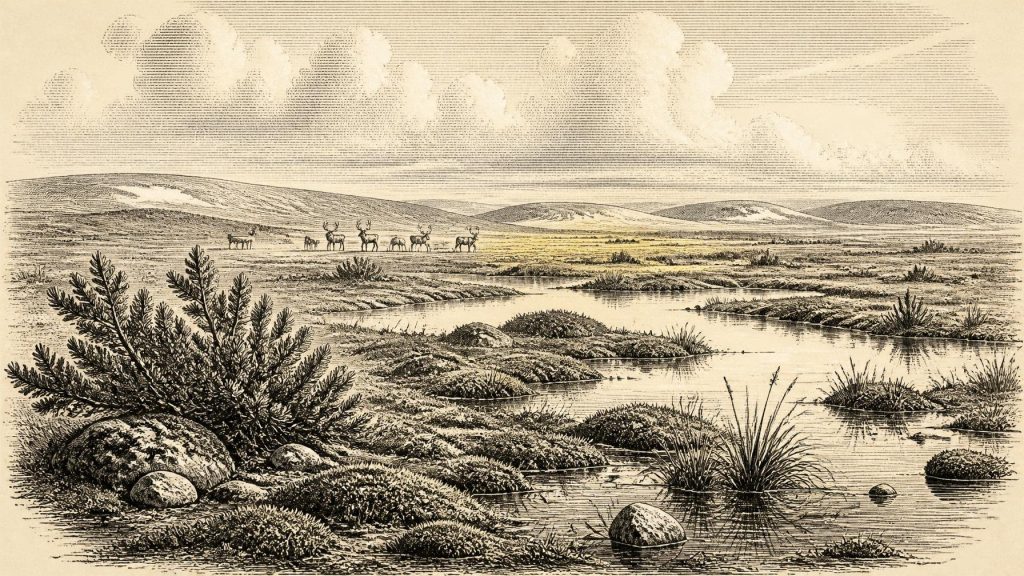
Circa 31,673 BCE, Ireland cannot be described through a dated event, but through a variable Marine Isotope Stage 3 environment. At Derryvree, near Maguiresbridge, freshwater silts between glacial tills preserve evidence of ice-free, treeless periglacial wetlands, with mosses, sedges, grasses, herbs and juniper. Castlepook Cave in Cork records mammals, including mammoth, reindeer, giant deer, bears, hyaenas, wolves and lemmings, across many millennia, demonstrating ecological links with north-west Europe. A marked reindeer bone may indicate human butchery, but remains contested. No settlements or social institutions are known. Together, these archives reveal dynamic, intermittently habitable landscapes, later overridden by advancing ice sheets.
Dateline
31,673 BCE is not a year that can be recovered from Ireland’s archaeological record in the ordinary historical sense. No Irish calendar, inscription, settlement sequence or human biography can be fixed to it. The number is a modern conversion: it corresponds roughly to 33,623 years before AD 1950, the conventional ‘present’ used in radiocarbon reporting. At this depth of time, radiocarbon results require calibration and carry substantial ranges. The responsible subject is therefore not an event in one named year, but Ireland during a broad Late Pleistocene interval that includes this notional date.
That interval belongs to Marine Isotope Stage 3, a climatically variable part of the last Ice Age. Ireland was moving towards the much more extensive ice cover of the Last Glacial Maximum, but it was not simply a uniformly frozen island. Geological evidence shows that parts of the country, including the south, remained ice-free for long periods before the major later advance. Conditions changed across centuries and millennia, and varied between coast, lowland, upland and the margins of ice. Any picture of 31,673 BCE must consequently be a cautiously drawn regional reconstruction rather than a national snapshot.
A Date Range, Not a Dated Event
The most relevant Irish chronological anchor lies at Derryvree near Maguiresbridge, County Fermanagh. Road cutting through a drumlin exposed freshwater silts and fine sands sealed between two distinct layers of glacial till. The organic deposit produced a radiocarbon determination of 30,500 years before present, with a large laboratory uncertainty. Published calibration places its possible age broadly around 36,900–31,700 calibrated years before present. That range embraces the modernly calculated position of 31,673 BCE, but it emphatically does not identify a particular season, generation or year.
This distinction matters. A date from a deposit measures the age of organic material within a layered environmental record; it does not announce that a single episode occurred everywhere in Ireland at once. Nor does the wide calibrated range mean that Derryvree remained unchanged throughout it. Sediment accumulated over time, plants grew and decayed, pools shifted, and cold-climate communities responded to fluctuating weather. The Derryvree sequence is valuable precisely because it offers a rare, securely located glimpse beneath later ice, not because it supplies annual news from prehistoric Fermanagh.
Wet Ground Beneath a Drumlin
The evidence from Derryvree supports an open, treeless and periglacial landscape. Pollen was poorly preserved, but the surviving record is dominated by herbaceous taxa associated with tundra-like vegetation. Plant macrofossils include mosses, while the broader assemblage has been interpreted as a muskeg: wet, peaty ground with pools, abundant plant matter and mossy margins. Sedges, grasses, herbs and juniper are among the plants used to reconstruct the surrounding cover. Such a landscape was not a barren white desert. It contained water, vegetation and ecological niches, though its growing season was short and its winters severe.
The word ‘tundra’ should not be made more precise than the evidence allows. It describes the open, cold-adapted character of the vegetation, not a complete modern Arctic scene transplanted unchanged to Ireland. Derryvree was one locality in south Fermanagh, and its freshwater basin had its own hydrology. Still, the combination of stratigraphy, plant remains and invertebrate evidence demonstrates that at least some Irish lowland ground could sustain wetlands and sparse terrestrial vegetation during this cold phase. It also demonstrates that later ice advanced over and preserved, rather than wholly erased, portions of that older landscape.
At the scale of the island, major regional change was under way. Ice-sheet reconstructions indicate that southern Ireland was ice-free before the main Last Glacial Maximum advance, while deposits along the south coast show that subsequent glaciation became extensive after roughly 24,000 calibrated years before present. The future of the Derryvree ground was therefore already implicit in its setting: organic silt lay between tills because glacier ice had passed before its formation and would pass again afterwards. Around the notional date, Ireland was an unstable North Atlantic edge-land, not a settled landscape on a stable climatic trajectory.
The Cave Record in North Cork
Castlepook Cave, near Doneraile in County Cork, provides the other major body of relevant evidence. Its chambers yielded Ireland’s richest known assemblage of vertebrate remains from the period leading up to the Last Glacial Maximum. Recorded animals include woolly mammoth, reindeer, giant deer, brown bear, spotted hyaena, wolf, fox, Arctic fox and lemmings. These finds show that Ireland formed part of a wider north-west European cold-stage ecological world, with animal movements possible during periods of lowered sea level and altered coastlines.
Yet Castlepook must not be read as if every listed animal stood together outside the cave in 31,673 BCE. The bones derive from different chambers, sediments and episodes; some were accumulated or altered by carnivores, water and earlier excavation. Modern radiocarbon re-dating has shown that several older determinations from southern Irish caves were substantially too young, underlining the difficulty of working with aged museum collections and disturbed cave deposits. Castlepook’s dated fauna spans a very long period, broadly from more than 45,000 to about 20,000 years before present. It is an archive of changing animal communities, not a single frozen moment.
Spotted hyaena are especially instructive. Their presence indicates that the cave could serve as a carnivore den or bone-accumulation place, as well as a geological trap and later archaeological repository. Tooth-marked and transported remains can reveal the behaviour of predators and scavengers, but they complicate simple claims about hunting or human occupation. Mammoth, reindeer and giant deer likewise establish that large herbivores reached parts of Ireland during the broader period; they do not prove their precise numbers, seasonal routes or coexistence at Derryvree. The strongest conclusion is ecological connectivity, not a detailed prehistoric census.
A Possible Human Trace
A reindeer femur from Castlepook has made this time unusually important for Irish archaeology. Re-examined material has been publicised as bearing a deep mark interpreted by zooarchaeologist Ruth Carden as damage made by a sharp stone tool during butchery, while the bone itself has been reported as about 33,000 years old. If that interpretation is sustained, it is potentially the earliest evidence that people handled an animal in Ireland, far earlier than the long-recognised post-glacial record.
Its limitations are equally important. The bone did not come from a modernly excavated occupation floor with a sealed hearth, stone-tool assemblage and associated food remains. It was recovered from a cave collection whose depositional histories are complex. The scientific date applies to the animal’s death, not automatically to the exact moment when the mark was made, and identifying a mark as human butchery is a specialist interpretation rather than a self-evident fact. There is no securely demonstrated dwelling, burial, workshop, art, durable camp or continuous Upper Palaeolithic population in Ireland from this broad period.
It would therefore be irresponsible to write of an Irish tribe, a named people or permanent settlers in 31,673 BCE. The most that can presently be said is that one or more human visitors may have reached the island and processed reindeer during a broad interval around the early thirty-third millennium BCE. If people were present, they would have been mobile hunter-gatherers operating within a larger north-west European world, not inhabitants of a known Irish polity. The evidence does not tell us their language, ancestry, social identity, clothing, beliefs or route of travel.
What Cannot Yet Be Written
There are no political affairs to report. No evidence identifies rulers, territories, assemblies, alliances, diplomacy, warfare or collective institutions on the island at this date. Nor is there evidence for farming, herding, metalworking, trade networks, towns, monuments, writing or formal religious practice. The absence of such evidence does not mean that any human visitors lacked social relationships, knowledge or spiritual ideas; it means that archaeology has not recovered material capable of describing them responsibly in Ireland.
Everyday life can be approached only indirectly, through environment and animal remains. A visitor able to butcher a reindeer would have needed cutting technology and practical knowledge of carcass processing, but the specific tools have not been found at Castlepook. The animals themselves would have been part of a difficult world of cold exposure, seasonal scarcity and dangerous predators. Freshwater basins such as Derryvree offered water and plant-rich wetland habitats; open ground may have aided the movement and visibility of grazing animals. These are ecological possibilities, not a recovered itinerary or camp routine.
The chief historical development illuminated around 31,673 BCE is thus neither a battle nor a dynasty, but the survival of evidence. Derryvree’s freshwater silts show an ice-free, cold and living Irish landscape within a period of glacial instability. Castlepook’s faunal archive shows that large mammals and carnivores entered that landscape across many millennia. The contested reindeer femur raises the possibility of a fleeting human encounter with it. Together they replace an older image of wholly empty Ice-Age Ireland with a more careful one: a changing northern environment, intermittently habitable for animals, and perhaps briefly visited by people, whose traces remain exceptionally rare.
Primary Sources
- A Middle Midlandian Freshwater Series at Derryvree, Maguiresbridge, County Fermanagh, Northern Ireland
- Irish Pleistocene Biostratigraphy
- Palaeoecology
- A Reconsideration of the Radiocarbon Dating of the Marine Isotope Stage 3 Fauna from Southern Ireland
- The Irish Quaternary Fauna Project
- Castlepook Cave
- Spotted Hyena Skull
- The Archaeological Heritage of County Cork
- 2022:564 – Castlepook Cave, Castlepook South, Cork
- Trimlines, Blockfields and the Vertical Extent of the Last Ice Sheet in Southern Ireland
- Response of the Irish Ice Sheet to Abrupt Climate Change During the Last Deglaciation
- Growth and Retreat of the Last British–Irish Ice Sheet, 31,000 to 15,000 Years Ago: the BRITICE-CHRONO Reconstruction
- Late Pleistocene Chronostratigraphy and Ice Sheet Limits, Southern Ireland
- The IntCal20 Northern Hemisphere Radiocarbon Age Calibration Curve (0–55 cal kBP)
- North GRIP – Greenland Ice Core Chronology 2005 (GICC05) 60,000 Year, 20 Year Resolution
- The Greenland Ice Core Chronology 2005, 15–42 ka. Part 1: Constructing the Time Scale
- The Colonization of Ireland: A Human Ecology Perspective
- New Insights on the Fauna of Ireland's Younger Dryas and Early Holocene from Alice & Gwendoline Cave
- Prehistoric Ireland
- Pattern and Timing of Retreat of the Last British-Irish Ice Sheet
- Hydrographic Survey Data Uncovers Preserved Glacial Landscape