
Crag Cave Calcite Pulses31571 BCE
About 31,571 BCE is a modern approximation, not a recorded Irish date, indicating a fluctuating MIS 3 glacial environment. Derryvree sediments in Fermanagh demonstrate an ice-free freshwater interval between glacial advances, supporting cold, open wetland vegetation. Crag Cave calcite records milder interstadials, when groundwater circulated, amid temperature swings exceeding 10°C. Castlepook Cave’s mixed fauna, including reindeer, mammoth and hyaena, confirms intermittent animal occupation of exposed grazing landscapes. A possibly tool-marked reindeer bone may indicate brief human presence, but lacks secure context. Later ice destroyed evidence; no settlements, polity, economy, ritual or culture can be established with confidence from present evidence.
Dateline
The label 31,571 BCE cannot identify a recorded Irish year. Nobody on the island used a calendar of that kind, and no excavated layer can be assigned responsibly to a single season, let alone a single day. As a rough modern conversion, the number points towards about 33,500 years before present (cal BP, where “present” is AD 1950), within the later part of the Last Glacial period. It is a useful point for examining a broad archaeological and environmental horizon, not a date for inventing an event. The evidence is sparse, uneven and often separated from this nominal year by centuries or millennia. What it can show is that parts of Ireland were intermittently habitable during Marine Isotope Stage 3 (MIS 3), in a climate that repeatedly swung between bitter stadials and less severe interstadials.
A Landscape Between Ice Advances
Ireland at this depth of time was not the familiar wooded island of later prehistory. It lay at the north-western edge of Upper Palaeolithic Europe, exposed to rapid climatic shifts across the North Atlantic region. Sea levels were far lower than today, so the modern coastline did not define the land available to animals or, potentially, people. Yet lower seas did not automatically create an easy, permanent route to Britain or continental Europe: the form of land, water, ice and estuaries changed repeatedly as glaciers grew and decayed. Any arrival in Ireland would have required movement through a difficult and mutable north-west European landscape.
By about 31,571 BCE, the great Late Midlandian ice-sheet maximum was still in the future in much of Ireland. Research on the Atlantic shelf indicates that grounded ice reached its outer western extent around 26,800 cal BP and was beginning to retreat by about 25,900 cal BP. That later expansion is important because it heavily reworked or buried older landscapes. It helps explain why Ireland has so few securely stratified traces of earlier human activity. Absence of sites is therefore not proof of an empty island; equally, it cannot be used as proof that people certainly lived here.
Derryvree’s Buried Wetland
The strongest direct environmental window onto this general era comes from Derryvree near Maguiresbridge, County Fermanagh. A road cutting through a drumlin exposed organic freshwater sediments and fine sands between two substantial layers of glacial till. The sequence matters more than its picturesque modern setting. First, ice deposited a lower till. Afterwards, open water and wet ground accumulated silts, plant material and insect remains. Later, renewed glaciation covered the deposit with another till. The buried freshwater layer is therefore physical evidence for an ice-free, non-glacial interval between two episodes of ice advance.
An old radiocarbon determination on the Derryvree organic material, Birm-166, was reported as 30,500 radiocarbon years BP, with a large uncertainty. Radiocarbon years are not calendar years: atmospheric carbon-14 has varied through time, so such measurements require calibration and become less precise at great age. Later discussion places the deposit broadly in the later MIS 3 interval, with calibrated estimates spanning a wide range rather than yielding a date for 31,571 BCE itself. The responsible conclusion is modest but valuable: south Fermanagh supported freshwater habitats during part of this cold age, before a subsequent ice advance sealed them beneath the material that now forms the drumlin.
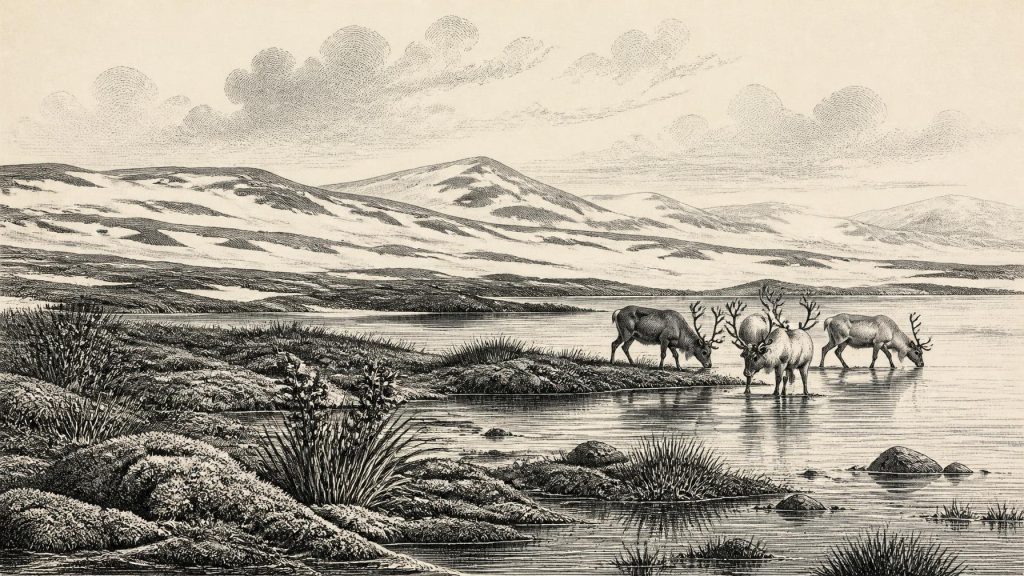
The fossils from Derryvree point to wet, open country. Freshwater mosses, sedges and aquatic plants indicate pools, saturated ground and slow-moving or standing water. Insect evidence had a cold northern aspect. This was not necessarily an unbroken, lifeless polar desert. Local hollows could retain water; sheltered banks and changing drainage created small ecological refuges. But it was a treeless or nearly treeless periglacial setting, in which low vegetation and exposed ground predominated. The later Irish landscape of dense woodland, fields, townlands and bogs lay far in the future.
Water Dripping at Crag Cave
Crag Cave in County Kerry provides a second, independent kind of climate evidence. Cave calcite, or speleothem, can grow only when water moves through the rock and temperatures permit liquid water to circulate. Uranium-thorium dating of broken and reworked calcite from the cave shows repeated phases of growth during the last glacial period, especially in MIS 3. The researchers link these episodes broadly with Greenland interstadials: relatively milder intervals within an otherwise severe glacial climate. Their work indicates temperature changes of at least 10°C between cold stadials and warmer interstadials at this ocean-margin location.
This does not mean that one can picture a temperate Kerry at the exact nominal year in this article. A speleothem date records a period of mineral growth, not a political or human calendar. Nor do conditions in a sheltered limestone cave stand for every Irish region. Nevertheless, Crag Cave reinforces the lesson of Derryvree: the island’s climate was dynamic. During ameliorations, frost could loosen its hold sufficiently for groundwater to feed calcite and for wetland vegetation to persist. During colder phases, these processes stopped. Ireland’s environments changed on timescales meaningful to animal populations and any mobile hunter-gatherers who may have ventured there.
Cork’s Cold-Climate Fauna
In north Cork, Castlepook Cave near Doneraile preserves Ireland’s most important assemblage of pre-Last Glacial Maximum animal remains. Its collections include reindeer, woolly mammoth, giant deer, brown bear, wolf, Arctic fox, mountain hare, lemmings and spotted hyaena. They did not necessarily occupy the cave, or even the surrounding countryside, at the same moment. Cave deposits can mix material accumulated over long periods, while carnivores, water, collapse and older excavation methods can disturb the original relationships between bones. The assemblage should therefore be read as a time-depth record of animal communities that reached southern Ireland during different portions of the Pleistocene, not as a single frozen scene.
Even with that qualification, Castlepook is decisive evidence that Ireland was not biologically empty throughout MIS 3. Reindeer and lemmings are consistent with cold, open habitats; mammoth and giant deer imply substantial herbivore resources during suitable phases; wolves and spotted hyaenas point to a wider predator and scavenger guild. Hyaenas may have used cave spaces as dens or brought carcass parts into them, which is one reason bones in caves do not automatically signal human hunting. The ecological picture is one of patchy, exposed grazing country and food webs capable of supporting large mammals, rather than an evergreen landscape or an isolated island ecosystem like that of modern Ireland.
The Reindeer Femur Question
A reindeer femur from Castlepook has made this era especially important to Irish archaeology. Ruth Carden’s reassessment identified a deep mark interpreted as damage made by a sharp stone tool while the bone was fresh. The bone has been presented publicly as being around 33,000 years old. If that interpretation and its broad chronological association withstand further testing, it would be evidence that people handled a reindeer in Ireland far earlier than the well-established terminal Pleistocene evidence from Alice and Gwendoline Cave in County Clare. It would be an extraordinary extension of the country’s known human story.
But the claim must be kept in proportion. The date concerns the animal bone, not an exact time of butchery; the mark requires taphonomic judgement; and the cave has not yielded a securely associated hearth, stone-tool collection, dwelling floor, burial or camp from this age. One modified bone cannot demonstrate a settled population, an enduring route of migration, or a separate Irish Upper Palaeolithic culture. It may represent a brief visit, a single episode of carcass processing, or evidence awaiting corroboration from renewed excavation and microscopic analysis. Archaeological significance lies precisely in that tension: it is a promising trace, not a licence for certainty.
People Without Polities
There is no evidence for political affairs, rulers, diplomacy, warfare between organised communities, permanent settlements or territorial divisions in Ireland around this point. Those categories belong to historical societies with much richer records. If people were present, they would have been highly mobile hunter-gatherers, probably moving in very small groups and making short-term decisions about weather, game, shelter and routes. Such a way of life can be inferred from the wider Upper Palaeolithic world, but it cannot be described as a demonstrated Irish social system. No contemporary Irish house, hearth, lithic workshop or human grave has been securely excavated.
The same restraint applies to economy and trade. There is no evidence for farming, herding, metalworking, markets, trade networks or sea-borne exchange. Subsistence, if humans did visit, may have included the use of large-animal carcasses, but there is no basis for reconstructing a regular reindeer-hunting economy in Ireland. Seasonal mobility is plausible for reindeer and for any people following them, yet plausible is not proven. The actual evidence remains a fauna, a wetland archive, cave calcite and one debated bone modification.
Silence on Belief and Learning
No Irish object from this horizon demonstrates ritual, art, spoken language, formal teaching or religious practice. Upper Palaeolithic communities elsewhere in Europe created remarkable art and sophisticated stone technologies, but it would be methodologically wrong to transfer those achievements automatically across the Irish Sea. A human presence at Castlepook, if confirmed, would establish contact with the wider human world of the period; it would not identify who those people were, what language they spoke, or what they believed.
For Ireland around 31,571 BCE, environmental history is therefore the main history. Freshwater sediments beneath a Fermanagh drumlin, calcite growth in a Kerry cave and Pleistocene bones in Cork reveal an island repeatedly altered by ice, water and climate. They also preserve the possibility that humans briefly entered that changing world. The most accurate portrait is not of a nation before history, but of unstable cold landscapes: sedge-fringed water in the north, limestone shelters in the south-west, grazing animals on open ground, and an archaeological record repeatedly thinned by the ice that came later.
Primary Sources
- A Middle Midlandian Freshwater Series at Derryvree, Maguiresbridge, County Fermanagh, Northern Ireland
- Early Midlandian–Middle Midlandian, Pleistocene, Northern Ireland
- Exploring Controls of the Early and Stepped Deglaciation on the Western Margin of the British Irish Ice Sheet
- Timing and Pace of Ice-Sheet Withdrawal Across the Marine–Terrestrial Transition West of Ireland During the Last Glaciation
- Late Pleistocene Chronostratigraphy and Ice Sheet Limits, Southern Ireland
- Episodic Speleothem Deposition Tracks the Terrestrial Impact of Millennial-Scale Last Glacial Climate Variability in SW Ireland
- Spatio-Temporal Dynamics of Speleothem Growth and Glaciation in the British Isles
- A Reconsideration of the Radiocarbon Dating of the Marine Isotope Stage 3 Fauna From Southern Ireland
- The Irish Quaternary Fauna Project
- Occurrence of Mammalia Relicts at Site Castlepook Cave
- Heritage Artefacts of County Cork
- UCD School of Archaeology Research Day 2022
- Ireland’s Palaeolithic Archaeology – Fleeting Footprints in a Frozen Land
- Proceedings: Postglacial Colonisation of Ireland
- References and Recommended Reading: Irish Quaternary Association Field Guide
- The IntCal20 Northern Hemisphere Radiocarbon Age Calibration Curve (0–55 cal kBP)
- IntCal20: Calibration Issue
- New Insights on the Fauna of Ireland’s Younger Dryas and Early Holocene From Alice & Gwendoline Cave
- A Revised Correlation of Quaternary Deposits in the British Isles
- The Mesolithic in Ireland: When Was It?