Cork’s Marked Reindeer Bone31097 BCE
Around 31,097 BCE, Ireland lay within the unstable Middle Midlandian phase of Marine Isotope Stage 3, not a recoverable historical year. Derryvree deposits in Fermanagh indicate ice-free, treeless tundra wetlands between glacial advances, while Crag Cave speleothems show milder conditions. Castlepook Cave, Cork, yielded a Late Pleistocene fauna including reindeer, mammoth and predators, though its disturbed deposits cannot reconstruct one contemporary ecosystem. A reindeer femur, possibly cut by a stone tool, may indicate human presence around 33,000 years ago, but proves neither settlement nor continuity. Glaciation and sea-level change erased evidence, leaving environmental traces rather than political or social history.
Dateline
The label “31,097 BCE” is a modern way of locating a remote point in deep prehistory, not a date preserved by any Irish community. There was no written calendar, named ruler, settlement record or event chronology from which an occurrence in this particular year could be recovered. In calendar arithmetic it lies roughly 33,046 years before AD 1950, the conventional “present” used in radiocarbon reporting; but that does not turn it into a radiocarbon date. For Ireland at this depth of time, responsible history works with broad calibrated ranges, stratigraphic sequences and changing environments. The closest evidence therefore illuminates a span of centuries or millennia around the notional year, rather than a single day or season.
A Middle Midlandian Landscape
About this time Ireland formed part of the Late Pleistocene world, within Marine Isotope Stage 3 (MIS 3), a long cold interval punctuated by abrupt climatic shifts. Irish Quaternary specialists have often used the regional term Midlandian for the last glacial cycle. This was not yet the fullest extent of the last British–Irish Ice Sheet, which developed later and reached major offshore limits in different sectors between roughly 30,000 and 22,000 years ago. Yet the distinction must not be mistaken for a benign age. Ice cover grew and retreated unevenly; local glacier margins, frozen ground, meltwater and harsh seasonal conditions made Ireland a highly varied landscape.
The best dated Irish environmental evidence relevant to this broad horizon comes from Derryvree, near Maguiresbridge in County Fermanagh. Roadworks there exposed organic freshwater silts and sands trapped between two tills: deposits laid down by glacier ice. The sequence records, in order, an earlier glaciation, an interval when the locality supported freshwater sediments and vegetation, and renewed ice advance that buried and protected those remains. Organic material from the intervening bed has been calibrated to approximately 36,900–31,700 years before present. That is a wide range, but it encompasses the broad timespan represented by 31,097 BCE. It does not prove that Derryvree looked precisely the same in that numbered year; it is a securely useful environmental bracket, not an annual snapshot.
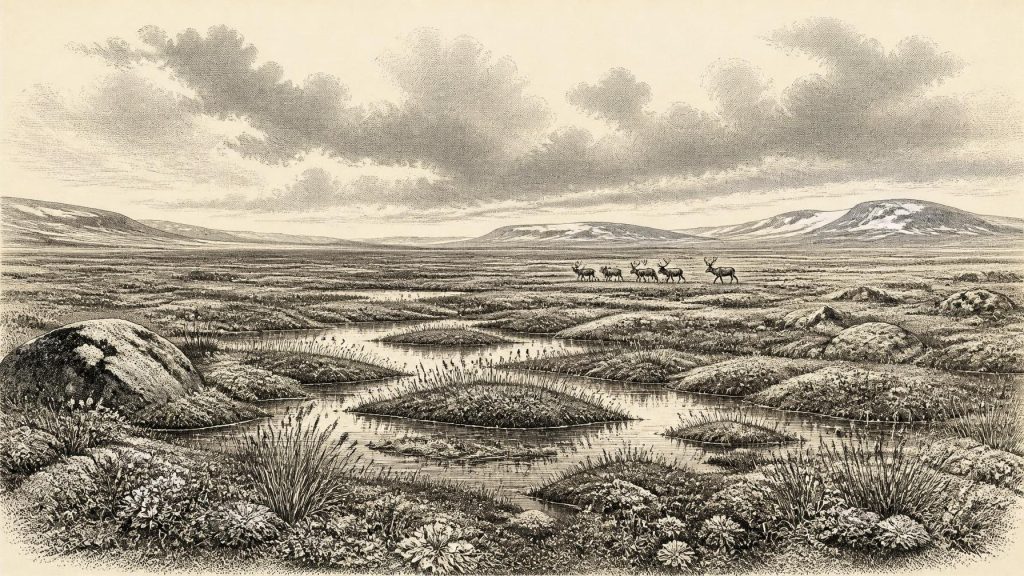
The Derryvree remains indicate open, treeless tundra-like ground with wet hollows and shallow freshwater. Mosses, sedges, bogbean, lesser clubmoss and other cold-tolerant plants, alongside insects of northern aspect, point to a periglacial setting: land strongly affected by frost, thaw and short growing seasons near glacial conditions, but not necessarily buried beneath ice. Older descriptions compare the habitat with muskeg, waterlogged vegetation and pools interspersed with exposed ground. This evidence rules out the familiar later Irish scene of dense oak and hazel woodland, enclosed fields or permanent farmsteads. It cannot, however, supply a uniform map of the whole island. Fermanagh’s buried wetland was a local environment, and Ireland’s coasts, uplands and ice margins would have differed greatly from it.
Ice, Water and Connected Faunas
The most important regional development was climatic instability. Speleothems from Crag Cave in County Kerry show that calcite sometimes grew during later MIS 3 milder episodes. Because such growth requires liquid water moving through a shallow cave system, it independently indicates that periods above freezing occurred in south-west Ireland during the wider cold stage. The record is episodic rather than continuous, and it cannot identify the weather of 31,097 BCE. Its significance is larger: Ireland was subject to rapid North Atlantic swings between harsher stadial conditions and comparatively milder interstadials, not an unchanging “Ice Age winter”.
Nor can modern shorelines be projected backwards. Lower global sea levels altered coastlines, and animals evidently reached Ireland repeatedly during the Late Pleistocene. How readily people or animals could move at any one moment depended on sea level, local topography, ice fronts and habitats, all of which changed. The fossil record demonstrates broad faunal connectivity with Britain and continental Europe over long periods; it does not license a precise reconstruction of a land route in this particular year. Recent genetic work on cave sediments from Castlepook is promising evidence for that wider connectivity, but it remains a preprint and should be treated as provisional rather than as the final word.
Castlepook’s Cave Fauna
In north County Cork, Castlepook Cave near Doneraile—historically also called Mammoth Cave—provides the most evocative evidence for southern Ireland in this part of the Late Pleistocene. Antiquarian excavations and later investigation recovered bones of woolly mammoth, reindeer, giant deer, brown bear, wolf, Arctic fox, mountain hare, lemmings and spotted hyaena. The assemblage makes clear that Ireland supported, at different times within the long cold stage, animals associated with open country and cold climates. It is powerful evidence against any assumption that the island was always completely sterile beneath ice.
But a cave collection is not a census of one living landscape. Castlepook’s deposits were excavated in the early twentieth century, before present-day standards of excavation, sediment recording and microscopic analysis. Bones may have accumulated through many episodes, been moved by water or carnivores, or been disturbed during excavation. Improved radiocarbon methods have also shown that some earlier Irish cave dates were too young: re-dating at Castlepook shifted certain animal remains thousands of radiocarbon years older and suggested that giant deer and spotted hyaena may have disappeared locally before about 40,000 calibrated years ago. Thus a list of species from the cave cannot be presented as a single herd-and-predator scene in 31,097 BCE. It establishes a changing regional fauna, not a perfectly contemporaneous ecosystem.
The named animal most closely associated with this article’s date is a reindeer femur from Castlepook. Public reporting in 2021 described it as about 33,000 years old and identified a deep linear mark as possible evidence of processing with a sharp stone implement. If that interpretation is confirmed by fuller publication, contextual assessment and further finds, it would be remarkably early evidence for human activity in Ireland: perhaps a brief Upper Palaeolithic visit in which a reindeer carcass was butchered. It would not show an established population, village or ethnic community. One modified bone cannot establish how many people arrived, how long they stayed, whether they returned, or whether they crossed from Britain, the continent or another direction.
The qualification matters because the femur is not accompanied by a securely excavated hearth, tool assemblage, dwelling floor, burial or repeated occupation horizon. The 2022 archaeological work at Castlepook was undertaken partly to establish whether intact Pleistocene deposits survived after the older excavations. It confirmed the cave’s importance but also demonstrated the difficulty of separating ancient deposits from later disturbance and modern material. The marked reindeer bone is therefore best understood as a serious research question and a potentially transformative trace, rather than proof of a settled Ireland 33 millennia ago.
People Without a Political History
No political affairs, diplomacy, chiefs, territorial boundaries or warfare can responsibly be described for Ireland around this point. There are no contemporary human remains, monuments, inscriptions or settlements from which social organisation could be reconstructed. If people did reach the island, their likely concerns were immediate mobility, shelter, fuel, weather, animal movements and food. Reindeer could have offered meat, fat, hide, sinew and bone; that is a general inference from hunter-gatherer economies, not a demonstrated description of a Castlepook group. There is no evidence for farming, livestock, crops, markets, long-distance trade networks or a permanent local economy.
The same restraint applies to religion, culture and learning. Ireland has yielded no securely dated cave art, ceremonial site, musical object, house or stone-tool industry for 31,097 BCE. It would be wrong to fill the silence with imagined beliefs or rituals merely because Upper Palaeolithic peoples elsewhere made art and maintained rich cultural traditions. Such wider European parallels show what was possible, not what happened in Ireland. At most, the possible cut-marked femur suggests technical knowledge of sharp stone tools and carcass processing; even that conclusion remains dependent on the interpretation of the mark.
What the Silence Means
The scarcity of evidence is itself historically important. Later glacial advances eroded and buried soils, land surfaces and shallow campsites across much of Ireland, while sea-level change removed or submerged former coastal landscapes. Caves and sediments sealed beneath till are unusually valuable precisely because they sometimes escaped that destruction. Absence of known camps is not proof that no person ever entered Ireland in MIS 3, but neither does it prove a settled population. The strongest account of 31,097 BCE is therefore environmental: a cold, unstable island or near-island landscape, with locally ice-free tundra wetlands, shifting ice margins and a fauna that included reindeer at some stage of the wider interval.
That setting gives the Castlepook femur its importance. It is not the beginning of a documented Irish nation, nor evidence for continuous occupation leading straightforwardly to later prehistoric communities. It is a fragment from a world repeatedly remade by climate and ice. Alongside Derryvree’s freshwater silts and Crag Cave’s mineral growth, it shows that the history of Ireland at this date lies in sediments, bones, plants and dating ranges—evidence sufficient to recover a changing Pleistocene environment, but not sufficient to invent an event for one exact year.
Primary Sources
- A Middle Midlandian Freshwater Series at Derryvree, Maguiresbridge, County Fermanagh, Northern Ireland
- Episodic Speleothem Deposition Tracks the Terrestrial Impact of Millennial-Scale Last Glacial Climate Variability in SW Ireland
- A Reconsideration of the Radiocarbon Dating of the Marine Isotope Stage 3 Fauna from Southern Ireland
- The Irish Quaternary Fauna Project
- First Evidence of a Late Upper Palaeolithic Human Presence in Ireland
- New Insights on the Fauna of Ireland’s Younger Dryas and Early Holocene from Alice & Gwendoline Cave
- Growth and Retreat of the Last British–Irish Ice Sheet, 31,000 to 15,000 Years Ago: The BRITICE-CHRONO Reconstruction
- The Timing and Magnitude of the British–Irish Ice Sheet Between Marine Isotope Stages 5d and 2
- Timing and Pace of Ice-Sheet Withdrawal Across the Marine–Terrestrial Transition West of Ireland During the Last Glaciation
- The Deglaciation of the Western Sector of the Irish Ice Sheet from the Inner Continental Shelf to its Terrestrial Margin
- Late Pleistocene Chronostratigraphy and Ice Sheet Limits, Southern Ireland
- Dimensions and Chronology of the Last Ice Sheet in Western Ireland
- Last Glacial Maximum Cirque Glaciation in Ireland and Implications for Reconstructions of the Irish Ice Sheet
- Early Midlandian–Middle Midlandian, Pleistocene, Northern Ireland
- Palaeoecology: IQUA Field Guide 16
- The Quaternary Period in Ireland: IQUA Field Guide 17
- 2022:564 — Castlepook Cave, Castlepook South, Cork
- Heritage Artefacts of County Cork
- Occurrence of Mammalia Relicts at Site Castlepook Cave
- Sedimentary Ancient DNA Reveals Late Pleistocene Faunal Connectivity Between Ireland and Eurasia