Doneraile’s Cave Fauna30753 BCE
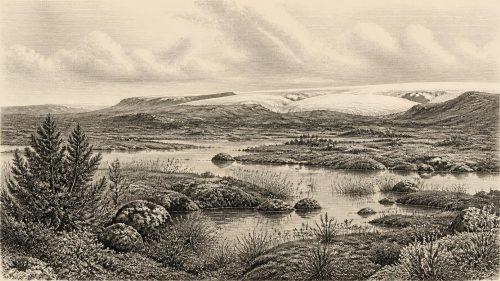
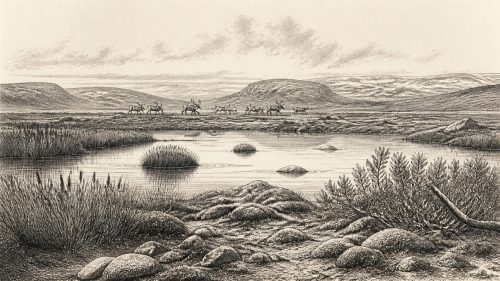
Around 30,753 BCE, Ireland experienced fluctuating MIS 3 Ice-Age conditions, not a precisely datable historical year. Lower sea levels intermittently facilitated animal movement from Britain and Europe, although routes remain uncertain. Castlepook Cave near Doneraile preserves Ireland’s richest Pleistocene fauna, including mammoth, giant deer, reindeer, bears, wolves, Arctic foxes, lemmings and spotted hyaenas. Its disturbed, long-lived deposits represent changing cold open landscapes rather than a single community. Revised radiocarbon dates confirm mammals in southern Ireland before and around glacial maximum conditions. A marked reindeer femur may indicate early butchery, but cannot prove settlement, permanent population or wider human activity there.
Dateline
30,753 BCE is a modern label for a point far beyond the reach of any Irish calendar, written record or year-by-year archaeological sequence. It should not be treated as the date of a recorded event. In simple elapsed time it lies about 32,700 years before 1950, the conventional “present” of radiocarbon dating, but that conversion does not create calendar-year precision. For this depth of time, archaeologists work with dated materials, statistical uncertainty and calibrated ranges expressed as cal BP—calendar years before present—not with exact ancient dates.
The responsible question is therefore not what happened in Ireland during one notional year, but what the surviving evidence can illuminate about the island around the later part of Marine Isotope Stage 3 (MIS 3), a highly variable phase of the last Ice Age. The answer is necessarily fragmentary. There were no known kingdoms, communities, monuments or named individuals; nor is there evidence for diplomacy, warfare, formal religion, writing or political institutions. Yet Ireland was not an empty geological abstraction. Its caves, sediments and animal bones preserve evidence of a cold, changing north-west European landscape in which large mammals intermittently reached the island.
A Changing Ice-Age Island
The period around this date preceded the fullest expansion of the last British–Irish Ice Sheet. Later ice growth was major after roughly 29,000 years ago, and the ice sheet reached extensive maximum limits during Marine Isotope Stage 2. That later glaciation profoundly reshaped Ireland and destroyed or buried much older evidence. It is consequently unsafe to draw a single, confident map of the island’s ice cover, coastline or vegetation for 30,753 BCE. Conditions changed rapidly over millennia and, during some phases, much faster.
What can be said is that Ireland lay on the Atlantic edge of a glacial Europe whose climate oscillated between severe cold stadials and relatively milder interstadials. Speleothems in Crag Cave, County Kerry, provide an important regional climate archive: their episodic growth required liquid water and therefore temperatures sufficiently mild for water to move through the cave system. The record demonstrates that last-glacial Ireland did not experience one uniform frozen condition. Warmer interstadial episodes alternated with much colder phases, with large shifts in temperature, vegetation and animal habitats.
Sea level was substantially lower than today because vast quantities of water were locked in continental ice sheets. The Irish Sea basin and Atlantic shelf were therefore differently configured, and crossings between Ireland, Britain and the adjacent European landmass were more feasible for mobile animals than they would be now. But the precise routes remain uncertain. Lower seas did not automatically produce a continuously dry, easily crossed land bridge at every moment, and fossils cannot by themselves tell us whether an animal travelled across open ground, a narrow water gap, seasonal ice, or a changing mosaic of coasts and channels.
The Castlepook Record
The strongest Irish evidence for this broad interval comes from Castlepook Cave—also called Mammoth Cave—near Doneraile in north County Cork. The cave is a limestone maze of narrow galleries and chambers in the foothills of the Ballyhoura Mountains. Excavations undertaken principally between 1904 and 1918 recovered more than 2,000 bones. The National Museum of Ireland now holds many of these remains, including a spotted hyaena skull collected through the Royal Irish Academy’s cave-exploration work.
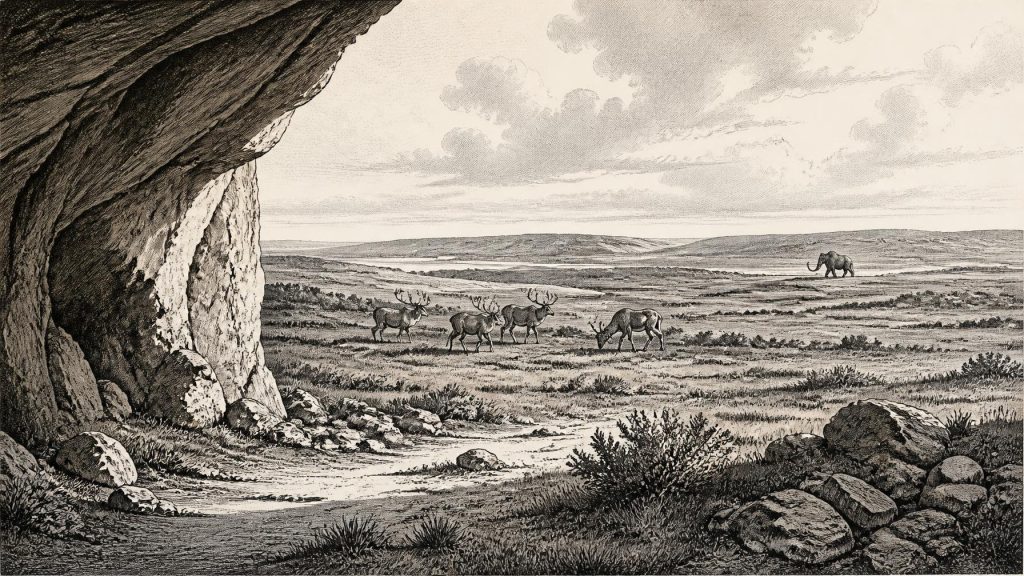
Castlepook is exceptional because it contains one of Ireland’s richest known assemblages of Pleistocene vertebrates. Its fauna includes woolly mammoth, giant deer, reindeer, brown bear, wolf, Arctic fox, Norwegian lemming, collared lemming and spotted hyaena. The catalogue does not mean that every species lived together at one moment. Individual bones derive from a long and complicated sequence, while water movement, carnivore activity and early excavation disturbed original deposits. Rather, the assemblage shows that a varied cold-stage fauna reached southern Ireland at different times before and around the Last Glacial Maximum.
Modern radiocarbon work has altered the chronology substantially. Improved pretreatment of bone collagen has shown that some older Castlepook determinations were too young by thousands of radiocarbon years. Re-dating supports a significant MIS 3 presence for mammals in southern Ireland and suggests that giant deer and spotted hyaena may have disappeared locally before the Last Glacial Maximum, perhaps around 40,000 calibrated years BP. Geological Survey Ireland summarises the currently known Castlepook dates as extending broadly from about 45,700 to 19,950 radiocarbon years BP. Such a span underlines why the cave is an archive, not a snapshot.
Open Country and Carnivore Dens
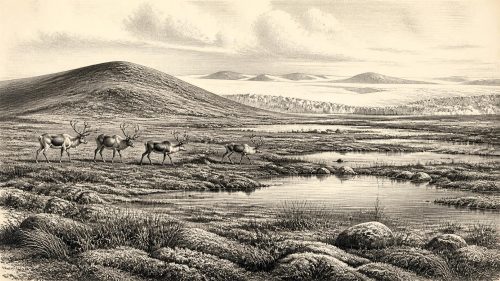
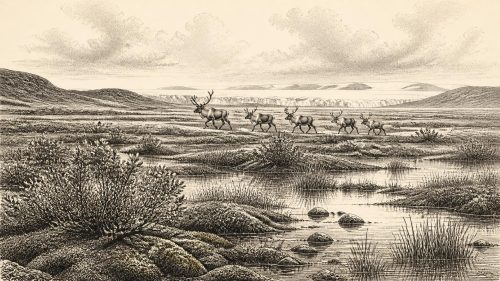
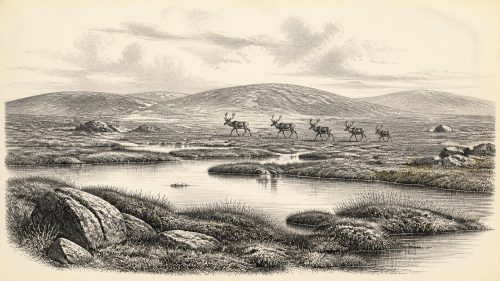
The animal evidence nevertheless gives a vivid, if incomplete, picture of the environments available around this period. Reindeer, lemmings and Arctic fox are consistent with cold, open or sparsely vegetated habitats. Mammoth and giant deer point to extensive grazing and browsing landscapes rather than the closed, temperate woodland now associated with Ireland. This need not have been featureless “tundra”: local ground conditions could have included grassland, herb-rich patches, dwarf shrubs, wetlands, exposed mineral soils and sheltered valleys. The exact balance shifted with climate, moisture, snow cover and the position of nearby ice.
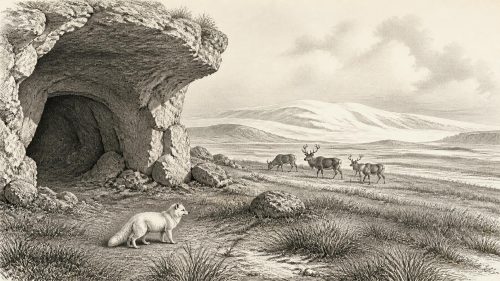
Spotted hyaenas are especially revealing. Castlepook is Ireland’s key hyaena site, and gnawing, scavenging and the accumulation of bones in the cave indicate that carnivores helped create the fossil deposit. A cave is therefore not necessarily a human home, hunting camp or place where every animal died. It can be a den, a refuge, a trap, a drainage route and a repository into which bones are carried or washed. The practical world visible at Castlepook is chiefly an animal one: herbivores moving through open country, predators and scavengers exploiting carcasses, and limestone cavities preserving remnants that would usually decay in the open.
The Reindeer Femur Question
One object gives this distant period unusual archaeological importance: a reindeer femur from the Castlepook collection has been reported as bearing a deep mark interpreted by zooarchaeologist Ruth Carden as having been made with a sharp stone tool during carcass processing. County Cork heritage material associates the bone with approximately 31,000 BCE. If that interpretation is confirmed, it would be the earliest known indication of human activity in Ireland by a very large margin.
Its implications must, however, remain narrow. The radiocarbon result dates the death of the animal within a range; it does not independently date the surface mark, identify the tool-user, establish where the animal was killed or show how long people stayed. No securely associated stone-tool assemblage, hearth, dwelling surface, burial, artwork or stratified hunting camp of this age has yet been published from Ireland. Moreover, the femur entered an old cave collection whose original context was affected by early excavation and natural disturbance. The bone is potentially momentous evidence of butchery, not proof of a permanent settlement or a continuous Irish population.
If people did visit, the most defensible interpretation is of brief, mobile Upper Palaeolithic activity linked to animal resources: perhaps following reindeer, processing a carcass, or exploiting hide, meat, sinew, marrow or bone. Those are possibilities rather than demonstrated acts. They do not warrant claims about language, ethnicity, social hierarchy, seasonal camps, ritual practice or trade. Nor can animal presence be equated automatically with human occupation. Ireland’s archaeological record for this time remains far thinner than that of neighbouring Britain and continental Europe.
No State, No Settlement Record
Accordingly, there is no political history to narrate for this date. No evidence identifies rulers, territories, alliances, disputes, raids or diplomacy. There is likewise no direct evidence for households, kin groups, clothing, food preparation, belief, art, teaching or exchange networks within Ireland. The absence is meaningful: later ice action, acidic soils and the scarcity of intact early deposits have made the island a difficult place in which to preserve Palaeolithic traces. It should not be mistaken for evidence that nothing occurred.
The most important development around 30,753 BCE was environmental rather than institutional. Ireland formed part of a fluctuating Ice-Age frontier, ecologically connected at intervals to Britain and north-western Europe and increasingly exposed to the approach of stronger glaciation. Castlepook’s bones show that mammoth, reindeer, giant deer and formidable carnivores belonged to that wider world. The disputed femur raises the possibility that people did too. Future excavation, microscopic study of bone modification, sediment analysis and further direct dating may refine the picture. For now, the history of Ireland at this date is properly a history of evidence: a cold landscape, mobile animals, a deep cave archive and one tantalising mark whose meaning is still being tested.
Primary Sources
- The Irish Quaternary Fauna Project
- A Reconsideration of the Radiocarbon Dating of the Marine Isotope Stage 3 Fauna from Southern Ireland
- Castlepook Cave, County Geological Site Report
- Heritage Artefacts of County Cork
- The Archaeological Heritage of County Cork
- Spotted Hyena Skull
- 2022:564 – Castlepook Cave, Castlepook South, Cork
- Archaeology Research Excavation Grant 2022: Final Report
- On the Cave of Castlepook, Near Doneraile, Co. Cork
- Episodic Speleothem Deposition Tracks the Terrestrial Impact of Millennial-Scale Last Glacial Climate Variability in SW Ireland
- Dimensions and Chronology of the Last Ice Sheet in Western Ireland
- Extent and Timing of the Last Glacial Maximum in Britain and Ireland: A Review
- Late Pleistocene Chronostratigraphy and Ice Sheet Limits, Southern Ireland
- Maximum Extent and Dynamic Behaviour of the Last British–Irish Ice Sheet West of Ireland
- Quaternary Deposits and Glacial Stratigraphy in Ireland
- Ireland Through Geological Time
- Geology of Ireland
- The IntCal20 Northern Hemisphere Radiocarbon Age Calibration Curve (0–55 cal kBP)
- New Insights on the Fauna of Ireland's Younger Dryas and Early Holocene from Alice & Gwendoline Cave
- Reconstruction and 36Cl Based Geochronology of the Deglaciation of Central Ireland
- 18) Castlepook Caves
- Irish Caves Database: Mammoth Cave