A Divided Lordship1205 CE
In 1205, Ireland remained a patchwork of Gaelic kingdoms, Anglo-Norman lordships, church jurisdictions and Irish Sea alliances. Severe winter weather disrupted rural life. King John created Hugh de Lacy earl of Ulster, but John de Courcy’s Manx-backed invasion showed the region remained contested. In Connacht, William de Burgh’s disappearance reduced pressure on Cathal Crobderg, who negotiated an emerging tributary accommodation with the Crown. Theobald fitz Walter founded Woney Abbey in Limerick, while annals recorded ecclesiastical appointments, local deaths and violence. These events demonstrate that authority depended on negotiation, warfare, kinship, patronage and maritime connections, with ordinary communities bearing political disruption.
Dateline
Ireland in 1205 was not a single political unit, nor was it simply a country divided between an English colony and an Irish remainder. It was a landscape of overlapping lordships, ecclesiastical jurisdictions, kin-groups and maritime connections. King John was lord of Ireland, but exercised power through officials and magnates; Gaelic kings retained substantial authority; and the Irish Sea connected Ulster as readily to Man and the Isles as to Dublin or England. The year is especially well illuminated in the north, where a new earldom was proclaimed and immediately tested, while annalistic notices preserve a hard winter, local deaths and the foundations of religious life.
A Severe Opening
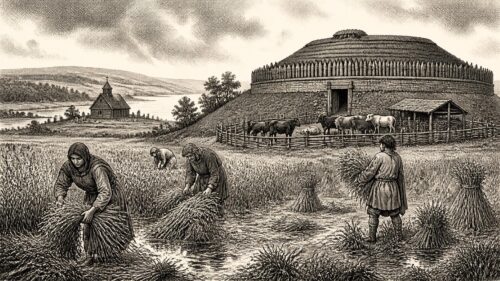
The Annals of Loch Cé record an unusually prolonged frost and snow, lasting from the Kalends of January—1 January—to the feast of St Patrick, 17 March. The notice does not quantify hunger, mortality or lost livestock, so it would be unsafe to turn it into a general famine. Nevertheless, more than ten weeks of severe winter weather mattered in a predominantly rural society. Travel over roads and tracks, movement of cattle, access to mills and markets, and the routine journeys of clerics, tenants and messengers would all have been more difficult. Its preservation in the annals is a reminder that weather was a political as well as a domestic fact: hosts could not easily move, and communities dependent upon stored food faced a demanding season.
The same annal dates the death of William de Burgh, calling him, in the hostile language of its compiler, a destroyer of Ireland’s nobility and chieftainship. William had been one of the most formidable Anglo-Norman adventurers in Munster and a recurrent interventionist in Connacht politics. The exact timing requires care. Other evidence and modern scholarship place his death between late 1205 and the early months of 1206, while some annals place it under 1204 or 1205. It is therefore best treated as a transition unfolding around 1205 rather than as a securely dated event within a particular month. His removal nevertheless eased a major immediate pressure upon Cathal Crobderg Ua Conchobair, king of Connacht, whose position had repeatedly been threatened by de Burgh’s ambitions and alliances with rival members of the Ua Conchobair dynasty.
Ulster and a New Earl
The clearest firmly dated act of the year occurred far from Ireland, at Winchester. On 29 May 1205, Whitsunday, King John invested Hugh de Lacy as earl of Ulster. A royal grant had already assigned him the land of Ulster held by John de Courcy when de Lacy defeated and captured him; the charter expressly reserved the churches to the Crown. The grant was more than a change of title. It gave royal endorsement to the displacement of de Courcy, the conqueror and long-standing lord of much of eastern Ulster, and elevated Hugh above nearly all other Anglo-Norman lords in Ireland except William Marshal, earl of Pembroke and lord of Leinster.
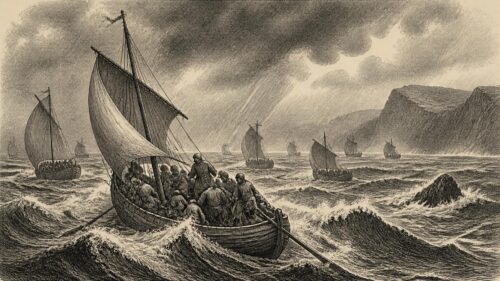
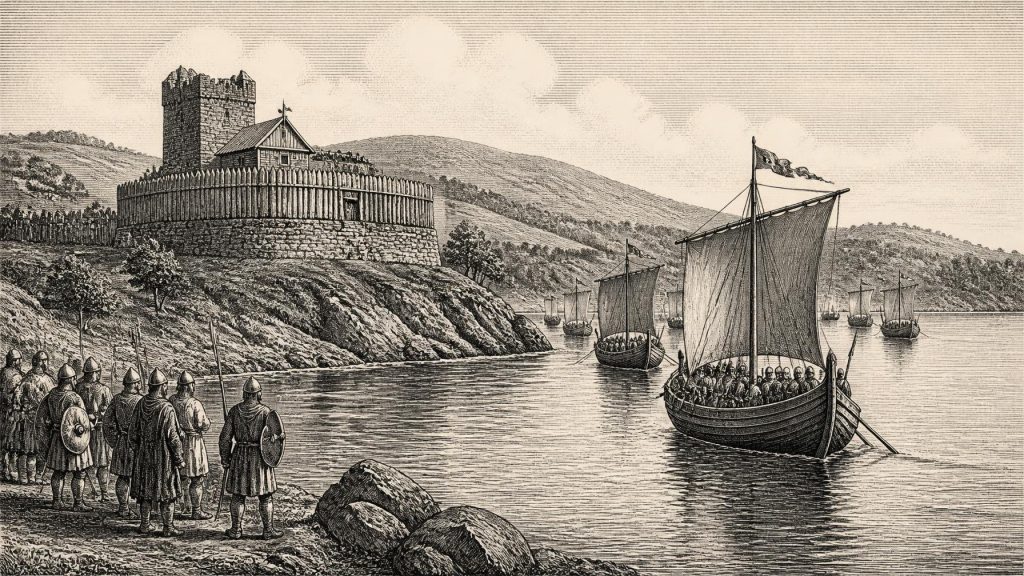
Yet parchment and ceremony could not make Ulster settled. De Courcy retained allies, personal prestige and connections across the sea through his wife Affreca’s Manx family. The Chronicle of the Kings of Man and the Isles, echoed by Irish annalistic tradition, records that during 1205 he assembled a substantial force and came from the Isles with Rǫgnvaldr, king of Man. The Manx narrative gives the striking figure of nearly one hundred ships. They entered Strangford and moved against the castle called Rath; the site is commonly, but not absolutely certainly, identified with Dundrum in present-day County Down. Walter de Lacy, Hugh’s elder brother and lord of Meath, arrived with an army and routed the expedition.
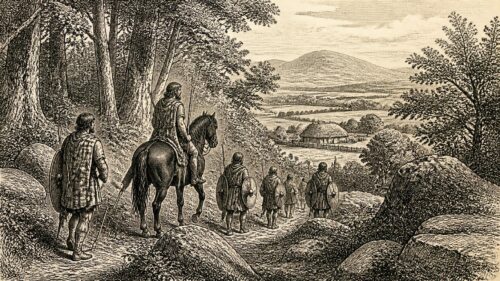
The Irish evidence adds a vital perspective. The Annals of Loch Cé say that de Courcy brought a fleet from Innsi-Gall, the Islands, to contest Ulster with the sons of Hugh de Lacy and the ‘Foreigners of Meath’. The campaign achieved no power, but it destroyed and plundered the country before the attackers withdrew. The phrase reveals the human cost that a dynastic narrative can obscure. Villages, farmsteads, stored provisions and livestock lay in the path of an expedition whose principal contestants were Anglo-Norman rivals, aided by forces from the Isles and opposed by men drawn from Meath. Control of Ulster was consequently neither an uncomplicated English advance nor an isolated local quarrel: it depended on shifting Irish Sea alliances and on the ability to command armed followers across several lordships.
After this failure, de Courcy sought security through an agreement with Áed Ua Néill and the Cenél nEógain of Tír Eógain, according to the Annals of Loch Cé. The wording gives no terms and no date within the year, so its significance should not be overstated. It does show, however, that Gaelic rulers were active diplomatic actors, not spectators to the de Lacy–de Courcy contest. De Courcy’s flight and the alliance also demonstrate the limits of Hugh’s new title: de Lacy had gained a royal earldom, but not automatic obedience throughout Ulster.
Connacht and Royal Calculation
In Connacht, Cathal Crobderg had recovered the kingship after years of bitter conflict within his own dynasty. His survival had involved dealings with Anglo-Norman neighbours, but William de Burgh’s death or impending disappearance from the political scene altered the balance. King John’s government was prepared to recognise Cathal’s position on terms which made Connacht part of a feudal relationship with the Crown rather than subject to immediate conquest. The standard account places John’s recognition of Cathal as tributary king in December 1205. Surviving administrative evidence is more complicated: it records proposals over tribute, a hereditary barony and the disposition of portions of Connacht, while the resulting charter is securely attested only by early 1207. The responsible conclusion is that negotiations and a significant political accommodation belonged to 1205, even if every element of the settlement cannot be assigned to that calendar year with equal confidence.
This was pragmatic statecraft on both sides. John could gain service, revenue and a recognised client ruler without the immediate cost of a large western campaign. Cathal could seek protection against rival claimants and encroaching magnates while retaining kingship within Connacht. Such an arrangement did not erase the distinction between Gaelic and English political traditions, nor did it guarantee peace. It did, however, acknowledge a reality central to 1205: authority in Ireland was negotiated through tribute, landholding, hostages, military service and personal alliance, rather than imposed uniformly from Dublin.
Personal loss ran beside high politics. The Annals of the Four Masters place the death of Cathal’s son Tadhg at Clonmacnoise in 1205, reportedly after a single night’s illness. The annals were compiled centuries later and their year assignments occasionally require checking against other evidence, but the notice is consistent with a year in which succession and family security were matters of pressing concern to Connacht’s king. A pilgrimage death at the great ecclesiastical centre of Clonmacnoise also points to the continuing spiritual geography shared by rulers and ordinary pilgrims.
Church, Patronage and Local Lives
One durable religious development can be placed in 1205. Theobald fitz Walter, the king’s butler in Ireland and a major lord, founded the Cistercian house known variously as Wotheney, Woney or Abington, beside the Mulkear in County Limerick. A surviving copy of his foundation charter is dated 1205, and the annalistic tradition also assigns the foundation to that year. The community was associated with monks transferred from Theobald’s earlier foundation at Arklow and, through its Savigniac-Cistercian connections, formed part of a wider religious network reaching beyond Ireland.
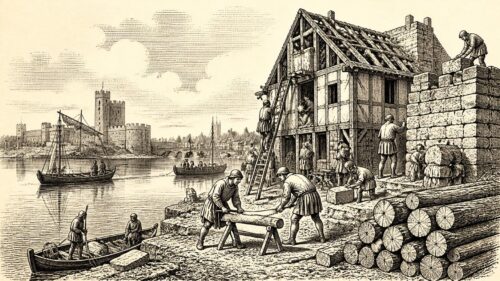
Such a foundation was an act of piety, commemoration and lordship at once. It endowed a religious community with land and resources, brought prayers and liturgical observance into a new estate, and helped organise settlement around a lord’s interests. Cistercian houses required labourers, food supplies, skilled building work and dependable access to land and water; their creation therefore connected spiritual patronage to the material development of a locality. It should not be imagined as an instant, fully built abbey in a single year. Rather, 1205 marks the legal and institutional beginning of a community whose buildings, estate and routines developed over time.
The year’s annals also preserve the texture of regional society. The Annals of Ulster note the death of Sitriuc Ua Sruithein, herenagh of Congbail, and the election of Máel Brigte Ua Éráin to the succession of St Brendan from the community of Derry. A herenagh was a hereditary ecclesiastical office-holder, linking church lands and local kinship. The notices show an Irish church sustained not only by bishops and reforming orders but by older local institutions, communities of clergy and hereditary custodians. The later Four Masters add deaths of a bishop in Tír Amhalghada, church officers, regional lords and a pilgrim, while reporting that the son of Gilla-Belach Ua Cellaigh, lord of Éile, was killed by English forces. These individual entries cannot describe the whole island, but they properly prevent the year from being reduced to the actions of kings and earls.
What 1205 Changed
By the end of 1205, Hugh de Lacy’s earldom had survived its first military challenge, but Ulster remained contested. Connacht was moving towards a formal accommodation between Cathal Crobderg and King John, while the demise of William de Burgh weakened one source of instability. In Limerick, a new monastery embodied the continuing expansion of religious patronage and estate organisation. The frost, raids, deaths and ecclesiastical appointments recorded alongside these events show why the year mattered beyond royal charters: political change was experienced through disrupted countryside, vulnerable households, religious obligations and local leadership. Ireland in 1205 was divided, but it was also deeply connected—by sea routes, churches, tribute and the consequences of war.
Primary Sources
- Annals of Loch Cé
- The Annals of Ulster
- Annals of the Four Masters, Part 4
- Annales Hiberniae, Text
- Annales Hiberniae, Introduction and Notes
- Calendar of Documents Relating to Ireland, 1171–1307
- Late Copy of the Charter of Theobald Walter Granting Land to Found Woney Abbey, 1205
- Rise: the Making of an Earl, 1201–05
- Ascendancy: Lordship in Ulster, 1205–10
- King and Magnate in Medieval Ireland: Walter de Lacy, King Richard and King John
- John, Lord of Ireland, 1185–1216
- fitz Henry, Meiler
- Ua Conchobair, Cathal Mór Crobderg
- Courcy, John de
- John
- The English Lordship of Ireland and the Gaelic World, c.1185–1245
- Appendix One: Context List
- County Wicklow Urban Archaeology Survey, 1989
- Annals of Inisfallen, Part 72
- King John’s Expedition to Ireland, 1210: The Evidence Reconsidered