Uncertain Femur31954 BCE
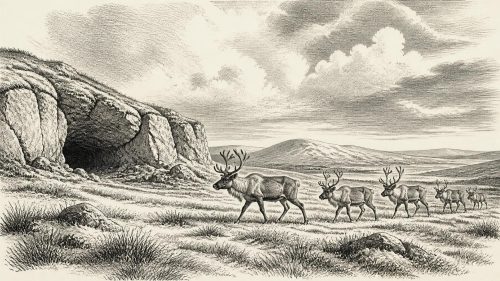
31,954 BCE is a notional date within MIS 3, not a recorded Irish year. Ireland then comprised volatile Late Pleistocene environments supporting cold-adapted fauna, including reindeer, mammoth, giant deer and carnivores, before the Last Glacial Maximum. Castlepook Cave, County Cork, provides a possible earliest human trace: a reindeer femur with a mark plausibly made by a stone tool during butchery. Poorly recorded early excavations, disturbed cave deposits and uncertain dating prevent stronger conclusions about settlement, hunting or access routes. No evidence supports communities, culture or politics. Later glaciation obscured evidence; secure sustained settlement begins only in the Mesolithic millennia later.
Dateline
The label 31,954 BCE cannot identify a recorded Irish year, an event, a ruler or even a season. No written calendar existed in Ireland, and archaeology cannot date activity of this age to a single modern calendar year. It is best treated as a notional point about 33.9 thousand calibrated years before present, within the Late Pleistocene and Marine Isotope Stage 3 (MIS 3), a climatically volatile interval of the last Ice Age. The responsible history of Ireland at this point is therefore a history of evidence, uncertainty and landscape rather than a conventional annual chronicle.
That evidence matters because it may include the earliest presently proposed sign of human activity on the island. Yet it is extremely slight. Ireland around this approximate date was not a land of documented settlements, tribes, trade routes or monuments. It was a northern Atlantic landscape in which animal populations, changing climate, ice expansion and possible short-lived human visits have left a sparse and difficult archaeological record.
A Date Range, Not a Dated Event
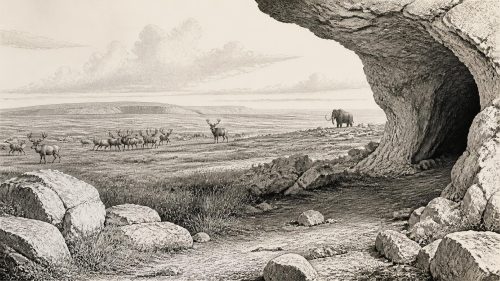
The closest evidence comes from Castlepook Cave near Doneraile in north County Cork. Excavations there in the late nineteenth and early twentieth centuries recovered a large assemblage of Ice Age animal remains, now principally in the National Museum of Ireland’s collections. Subsequent re-examination has shown why old museum collections remain important: bones once given broad or unreliable dates can be identified anew, sampled with improved methods and studied microscopically for traces of animal or human action.
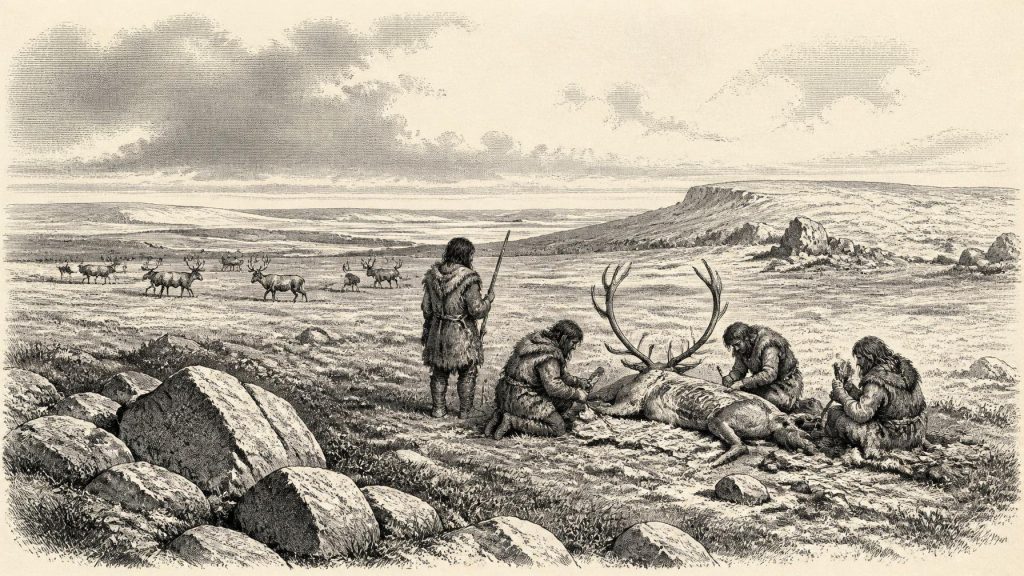
A reindeer femur from Castlepook has been publicised by its researcher, Ruth Carden, and by Cork heritage publications as bearing a deep mark interpreted as having been made by a sharp stone tool during butchery. The object has been assigned broadly to about 31,000 BC in public heritage material. If that interpretation is correct, it indicates that someone used a cutting edge on a fresh reindeer carcass in Ireland during the Upper Palaeolithic, far earlier than the island’s formerly accepted archaeological starting point.
However, this is not evidence for a village at Castlepook, let alone a permanent population. The original cave excavations were undertaken before modern standards of stratigraphic recording. Deposits in caves can be disturbed by water, frost, burrowing animals, collapses and carnivores dragging in carcass parts. A bone date establishes when the animal lived, not automatically when a mark was made or when people were present. The cave’s deposits also contain remains accumulated over long spans rather than a single frozen moment in time. The cut-mark interpretation is important and plausible, but it remains a narrow claim that requires more securely excavated, stratified corroboration.
Southern Ireland in MIS 3
At this time Ireland was in the Midlandian, the Irish name for the last glacial cycle. It was not yet at the Last Glacial Maximum, when the British-Irish Ice Sheet reached its greatest known extent, broadly between 27,000 and 23,000 calibrated years before present, and covered Ireland and much of its continental shelf. Around the notional year in question, the great ice advance lay ahead. Climate in north-west Europe nevertheless changed sharply over millennia and centuries, alternating between colder and relatively milder phases.
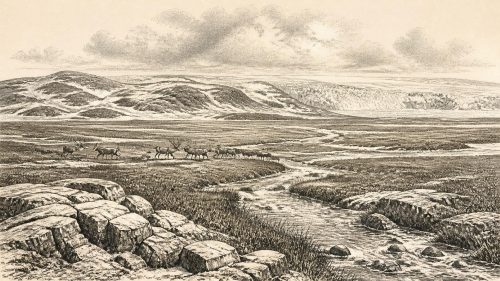
It would be misleading to picture the whole island as one uniform white expanse. The southern cave fauna demonstrates that at least some ice-free landscapes in Ireland supported cold-adapted mammals during MIS 3. Castlepook and other southern Irish caves have produced remains attributed to reindeer, woolly mammoth, giant deer, brown bear, Arctic fox, wolf, hare, lemmings and spotted hyaena. Their presence does not prove that every species lived side by side in County Cork in 31,954 BCE: specimens come from different contexts and ages, and direct dating has revised several older chronologies. It does, however, show that Ireland formed part of an Ice Age ecological zone rather than an empty geological stage.
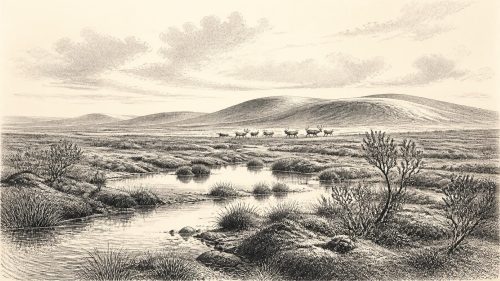
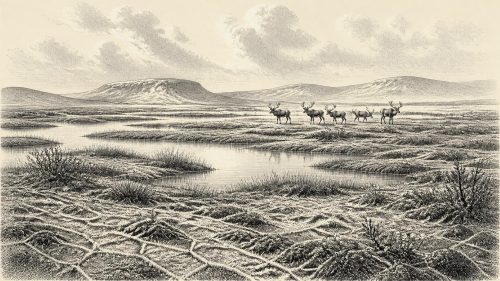
The likely environments around such animals were open, windswept and strongly seasonal: mosaics of grassland, herb-rich steppe, tundra-like vegetation, exposed rock, river valleys and scattered sheltered ground. Tree cover, where it existed locally during more favourable episodes, cannot be assumed to have resembled later Irish woodland. The familiar green, enclosed and heavily farmed appearance of modern Ireland is a much later creation. In this earlier world, large herbivores and their predators moved through landscapes periodically remade by cold, permafrost processes, erosion and advancing ice.
Animals, Carnivores and a Possible Hunt
Castlepook’s fossils provide the strongest evidence for everyday ecological relationships, but they must not be converted too quickly into a human story. Hyaenas, wolves and bears could hunt, scavenge, drag bones into caves and alter them with teeth. Caves were not necessarily human homes; many were carnivore dens, traps or places where bones accumulated after natural deaths. A mammoth bone from Castlepook, for example, bears damage consistent with carnivore activity. Such marks are a reminder that human modification must be distinguished carefully from trampling, weathering, excavation damage and animal gnawing.
If the reindeer femur was genuinely butchered with a stone edge, it offers a small but vivid insight into subsistence. Reindeer were valuable prey: a carcass could provide meat, fat, hide, sinew and bone, while antler could be worked elsewhere. Yet the evidence does not show whether people killed the animal, found it dead, took portions from a carnivore kill or processed it at another place before the bone reached the cave. Nor have stone tools securely associated with this episode been recovered. “Hunting party” is thus a reasonable possibility, not an archaeological fact.
There is equally no basis for claiming regular seasonal camps, family groups of a known size, dwellings, clothing styles or a stable Irish population. Upper Palaeolithic communities elsewhere in Europe possessed sophisticated stone technologies, tailored clothing, fire use, social networks and varied artistic traditions. These comparisons help explain what mobile hunter-gatherers were capable of, but they cannot fill Ireland’s evidential gap. No securely dated Irish hearth, built shelter, lithic workshop, personal ornament, burial, rock art or human bone currently provides such detail for this period.
Movement at the Atlantic Edge
The possible Castlepook trace raises an obvious question: how did people or animals reach the land now called Ireland? Sea level was far lower during the glacial world than it is today, exposing areas of the modern continental shelf. But the precise geography of passages, shallow seas, ice margins, islands and possible land connections changed through time and remains model-dependent. Later reconstructions indicate that Ireland became separated from Britain by roughly 16,000–15,000 calibrated years before present, but that later result cannot simply be projected backwards to every phase of MIS 3.
For about 33,900 calibrated years ago, the prudent conclusion is not that a proven land bridge existed, nor that people demonstrably crossed open sea. Rather, changing geography may have created routes or barriers that remain imperfectly understood. Animal dispersal and a possible human presence in southern Ireland show that access was possible at some stage, but they do not identify the route, the direction of travel or the frequency of contact. A single butchered bone cannot demonstrate diplomacy, exchange systems or a durable connection with Britain or continental Europe.
No Politics, No Recorded Conflict
There were no states, kingdoms, named peoples or written institutions in Ireland at this date. Political affairs and diplomacy are therefore beyond the evidence. It is also impossible to identify warfare. The presence of dangerous carnivores and the practical risks of cold, hunger and travel say much about environmental danger, but nothing securely about conflict between people.
Society can only be addressed conditionally. If small human groups entered Ireland during a milder interval of MIS 3, they were probably highly mobile hunter-gatherers whose survival depended on shared labour, detailed knowledge of animal movement, tool use and flexible responses to weather. That is an inference from the wider Upper Palaeolithic world, not a description recovered from an Irish camp. Ireland’s record does not yet reveal language, kinship, leadership, gender roles, childhood, healing practices or the treatment of the dead.
Culture Beyond Recovery
Religion, ceremony, music, visual art and formal learning leave no recognised evidence in Ireland around this point. It would be inappropriate to attach later Irish myths, Celtic identities, megalithic monuments or Christian traditions to people who may have passed through tens of thousands of years earlier. Even the word “Ireland” is a geographical convenience here, not the name of a known community or polity.
The most defensible cultural observation is methodological. The study of this deep past relies on several kinds of expertise working together: zooarchaeology to identify animals and surface marks; radiocarbon science to date surviving collagen; palaeogenetics to refine species identification; sediment and cave studies to reconstruct context; and glacial geomorphology to understand lost landscapes. Improved pretreatment of bone samples has already shown that some older Irish cave dates were too young, demonstrating that apparent certainties must be tested repeatedly.
An Interrupted Record
Any people who may have reached Ireland in this phase left no known continuous descendants or enduring archaeological sequence. The approaching Last Glacial Maximum transformed the island profoundly. Extensive ice later scoured and buried landscapes, while sea-level change drowned parts of the former coastal plain. These processes help explain why the archaeological record is so fragmentary, although erosion alone cannot be used to prove an unseen Palaeolithic population.
Much later, after deglaciation, a cut-marked bear bone from Alice and Gwendoline Cave in County Clare indicates another possible human visit in the Late Upper Palaeolithic, around 12,810–12,590 calibrated years before present. More sustained and unquestioned settlement is documented only in the Mesolithic, from roughly the eighth millennium BC, including the well-known site at Mount Sandel in County Londonderry. The gulf between those later communities and the possible MIS 3 visitors is immense.
For 31,954 BCE, then, Ireland’s history is not a tale of a named event. It is a cautiously framed picture of pre-maximum Ice Age landscapes, reindeer and other cold-climate fauna in the south, and one consequential bone from Castlepook Cave. The bone may preserve a fleeting human action: the cut of a stone tool on an animal carcass. It cannot yet tell us who made it, how long they stayed, or whether anyone returned. That restraint is not a failure of history; it is the central fact of Ireland’s deepest recoverable past.
Source References
Hover over a number to see the source. Select it to open the source.

- [1] A Reconsideration of the Radiocarbon Dating of the Marine Isotope Stage 3 Fauna from Southern Ireland
- [2] Phylogeographic, Ancient DNA, Fossil and Morphometric Analyses Reveal Ancient and Modern Introductions of a Large Mammal: The Complex Case of Red Deer (Cervus elaphus) in Ireland
- [3] First Evidence of a Late Upper Palaeolithic Human Presence in Ireland
- [4] New Insights on the Fauna of Ireland's Younger Dryas and Early Holocene from Alice & Gwendoline Cave
- [5] The Irish Quaternary Fauna Project
- [6] Castlepook Cave, Co. Cork: Excavation Report 2022
- [7] Archaeology Research Excavation Grant 2022
- [8] Heritage Artefacts of County Cork
- [9] Archaeological Heritage of County Cork
- [10] Prehistoric Details: Mell Flint Flake
- [11] Stone Age
- [12] Prehistoric Ireland
- [13] The Island of Ireland: Drowning the Myth of an Irish Land-Bridge?
- [14] Ireland: Submerged Prehistoric Sites and Landscapes
- [15] Pattern and Timing of Retreat of the Last British-Irish Ice Sheet
- [16] Growth and Retreat of the Last British-Irish Ice Sheet, 31,000 to 15,000 Years Ago: The BRITICE-CHRONO Reconstruction
- [17] Dimensions and Chronology of the Last Ice Sheet in Western Ireland
- [18] Last Glacial Maximum Cirque Glaciation in Ireland and Implications for Reconstructions of the Irish Ice Sheet
- [19] Late Pleistocene Chronostratigraphy and Ice Sheet Limits, Southern Ireland
- [20] Stratigraphic and Palaeo-Geomorphological Evidence for the Glacial-Deglacial History of the Last British-Irish Ice Sheet in the North-Western Irish Sea
Primary Sources
- A Reconsideration of the Radiocarbon Dating of the Marine Isotope Stage 3 Fauna from Southern Ireland
- Phylogeographic, Ancient DNA, Fossil and Morphometric Analyses Reveal Ancient and Modern Introductions of a Large Mammal: The Complex Case of Red Deer (Cervus elaphus) in Ireland
- First Evidence of a Late Upper Palaeolithic Human Presence in Ireland
- New Insights on the Fauna of Ireland's Younger Dryas and Early Holocene from Alice & Gwendoline Cave
- The Irish Quaternary Fauna Project
- Castlepook Cave, Co. Cork: Excavation Report 2022
- Archaeology Research Excavation Grant 2022
- Heritage Artefacts of County Cork
- Archaeological Heritage of County Cork
- Prehistoric Details: Mell Flint Flake
- Stone Age
- Prehistoric Ireland
- The Island of Ireland: Drowning the Myth of an Irish Land-Bridge?
- Ireland: Submerged Prehistoric Sites and Landscapes
- Pattern and Timing of Retreat of the Last British-Irish Ice Sheet
- Growth and Retreat of the Last British-Irish Ice Sheet, 31,000 to 15,000 Years Ago: The BRITICE-CHRONO Reconstruction
- Dimensions and Chronology of the Last Ice Sheet in Western Ireland
- Last Glacial Maximum Cirque Glaciation in Ireland and Implications for Reconstructions of the Irish Ice Sheet
- Late Pleistocene Chronostratigraphy and Ice Sheet Limits, Southern Ireland
- Stratigraphic and Palaeo-Geomorphological Evidence for the Glacial-Deglacial History of the Last British-Irish Ice Sheet in the North-Western Irish Sea