Derryvree’s Tundra Interval31733 BCE
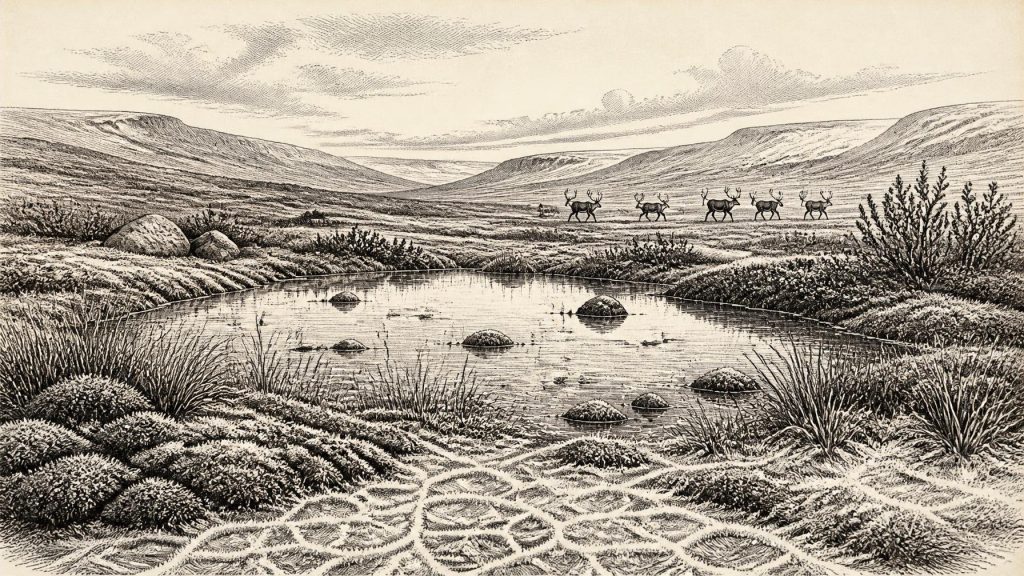
Approximately 31,733 BCE, Ireland lay within the unstable Late Pleistocene climate of Marine Isotope Stage 3, not a precisely datable historical year. Derryvree, County Fermanagh, preserves freshwater sediments between tills, indicating a cold tundra wetland interval before renewed glaciation. Mosses and sedges suggest open, treeless terrain, while Crag Cave records milder episodes permitting water flow. Castlepook Cave’s mixed fauna, including mammoth, reindeer and hyaena, demonstrates diverse Ice Age habitats but not contemporaneous populations. A cut-marked reindeer femur may indicate brief human activity, although evidence remains insecure. Overall, geological archives reveal changing ice margins, habitats and uncertainty rather than conventional history.
Dateline
“31,733 BCE” is a useful modern label, not a date at which events in Ireland can be placed with calendar-year precision. No contemporary written record, settlement sequence or annually resolved archaeological layer allows historians to say what happened on the island in that particular year. The responsible view is broader: this notional point falls about 33.7 thousand years before present, within the later part of the Late Pleistocene and broadly Marine Isotope Stage 3, a highly variable phase of the last Ice Age. Ireland’s story at this depth of time is reconstructed from cave bones, buried freshwater sediments, pollen, mosses, insects, calcite deposits and the landforms left by advancing ice.
Dating an Unwritten Landscape
The distinction between radiocarbon and calendar dating matters especially here. “Before present” conventionally counts back from AD 1950, while radiocarbon years measure the remaining carbon-14 in organic material. They are not identical to calendar years, because atmospheric carbon-14 has fluctuated substantially. Modern calibration curves make conversion possible, but the further back one goes, the broader and less exact the resulting calendar ranges become. A numbered BCE year can therefore be aligned only approximately with an archaeological horizon, never treated as a historical anniversary.
The most useful Irish comparison is Derryvree, near Maguiresbridge in County Fermanagh. Road works in 1969 exposed organic freshwater silts and fine sands trapped between two tills: glacial sediments deposited by ice. The organic horizon produced a radiocarbon determination of 30,500 BP, with a large laboratory uncertainty. Later syntheses have expressed its calibrated range at approximately 36.9–31.7 thousand calibrated years BP. That broad span includes the general timescale denoted by 31,733 BCE, but it cannot show that the Derryvree pool existed, or had precisely the same character, in that individual year. Its value lies in documenting conditions during a stretch of time, not in supplying a date-by-date narrative.
Ground Between the Ice Advances
Derryvree is important because its position beneath later till preserves a rare interval when north-central Ireland was not smothered by the ice that subsequently crossed the district. The lower till, freshwater deposits and upper till form a compressed geological sequence of major environmental change: glacial conditions, an ice-free or ice-margin landscape with standing or slow-moving freshwater, then renewed glaciation. This is evidence for changing ice extent, not proof that all of Ireland was simultaneously free of ice. Conditions varied considerably between regions, and later glaciers destroyed or disturbed many deposits that might otherwise have enlarged the picture.
Across the island, the last British–Irish Ice Sheet was not a single immobile blanket. It expanded and contracted in response to shifts in temperature, snowfall, sea level and the behaviour of ice streams. Research on Irish glacial chronology indicates that substantial parts of north-central Ireland remained ice-free until around 34,000 years ago, while the major expansion that carried ice to the southern coast occurred much later, after about 24,000 years ago. Around the broad interval represented here, Ireland was therefore a changing frontier of frozen ground, wetlands, open terrain and, in some places, encroaching ice rather than a uniformly white, lifeless island.
Mosses, Sedges and Shallow Water
The Derryvree sediments contain plant and animal remains which give this otherwise remote landscape texture. Pollen was poorly preserved, but plant macrofossils included mosses and plants associated with cold, open conditions. The assemblage has been interpreted as tundra or muskeg-like wetland vegetation: sedges, mossy ground and patches of low-growing plants around freshwater, with no evidence for a forest. Such a setting would have been shaped by severe seasonality. Long cold periods, repeated freezing and thawing, and short productive summers influenced soils, runoff and the availability of grazing.
This was not necessarily a barren plain. Open tundra can support a rich but low vegetation cover, especially where water, mineral sediment and summer light promote growth. Yet Ireland at this time did not resemble the later wooded island familiar from historical landscapes. Trees were absent or extremely scarce in the evidence from Derryvree. The few grains of pine and hazel pollen recovered there are not grounds for reconstructing local woodland: they may have travelled long distances or derived from redeposited material. The firmer conclusion is negative but significant—there was no established forest canopy at the site.
Crag Cave in County Kerry adds a different kind of environmental record. Stalagmites and other calcite formations grow only when liquid water can percolate through the cave system. Uranium-series dates show that such growth occurred episodically in south-west Ireland during the last glacial period, particularly during milder phases of MIS 3. This does not provide a weather report for 31,733 BCE, nor does it prove that Fermanagh and Kerry experienced identical conditions. It does demonstrate that Ice Age Ireland repeatedly experienced climatic ameliorations sufficient for unfrozen water and active soils, punctuating harsher intervals.
The Cave Fauna of North Cork
Animal bones from Castlepook Cave, also called Mammoth Cave, in the Awbeg Valley near Doneraile, County Cork offer the strongest evidence for the wider living world of southern Ireland before the Last Glacial Maximum. The cave has yielded one of Ireland’s richest Pleistocene vertebrate assemblages. Its recorded fauna includes woolly mammoth, reindeer, giant deer, brown bear, wolf and spotted hyaena, animals suited in differing ways to open, cold or seasonally cold landscapes. Carnivores are especially important to interpretation: a cave bone collection need not represent animals peacefully living together at the entrance. Hyaenas and other scavengers could carry carcass parts into dens, while water, sediment movement and early excavation methods could mix material from different episodes.
Recent redating has made the chronology more complicated but more reliable. Work on Castlepook and other southern Irish caves has shown that several older radiocarbon results underestimated the true age of specimens; improved pretreatment can remove contaminants that make ancient bones seem younger. Some key Castlepook fauna now appear to belong well before 40,000 calibrated years BP. Accordingly, the fauna establishes that such animals reached Ireland during portions of MIS 3, but it should not be used to claim that every listed species shared one valley in 31,733 BCE. The bones are a time-averaged archive, not a census.
The Reindeer Femur and Human Possibility
One Castlepook object bears directly on the question of people. A reindeer femur from the old cave collection has a deep linear mark interpreted by zooarchaeologist Ruth Carden as damage made by a sharp stone tool during carcass processing. County Cork heritage material places the bone at about 31,000 BCE. If that interpretation and dating relationship are sustained, it is potentially evidence that Upper Palaeolithic hunter-gatherers reached Ireland far earlier than the island’s securely documented Mesolithic settlement.
Potential is not the same as proof of a resident community. The bone was recovered from an antiquarian collection rather than a modern, tightly recorded excavation context. Its radiocarbon date is the age of the animal, while identifying the mark as a human tool cut is a separate specialist interpretation. No securely associated stone-tool assemblage, hearth, dwelling surface, grave, human bone, ornament or artwork has been published from Ireland for this early horizon. A marked femur could indicate a brief visit by hunters, the processing of a carcass, or activity whose location and duration cannot be recovered. It cannot establish a permanent population, a named people or an unbroken Irish human history from this time.
No Polities, but a Demanding Ecology
There is no evidence from Ireland around this date for political authority, warfare, diplomacy, law, farming, trade institutions, formal religion or learning in the later historical senses. Nor can ethnicity, language, kinship rules or gender roles be reconstructed from one possible butchery mark. It would be equally misleading to infer an absence of social knowledge if people did make short journeys to the island: Upper Palaeolithic groups elsewhere in Europe maintained learned technologies, social ties and adaptable ways of surviving in cold environments. But that European context cannot substitute for Irish evidence.
Economy, if humans were present at all, would have centred on immediate access to animals, fuel, shelter and raw materials rather than agriculture or market exchange. Reindeer would have offered meat, hide, sinew, antler and bone; large herbivores may have drawn predators and scavengers as well as hunters. These are reasonable ecological possibilities, not demonstrated activities at Castlepook. The exposed continental shelf and lower sea levels of the Ice Age altered routes and distances around Ireland, but they do not prove a continuous land bridge or regular traffic. Any movement into Ireland remained contingent on changing coasts, channels, climate and animal distributions.
An Archive Rather than an Annal
The most important development around 31,733 BCE was environmental instability on an island at the edge of an expanding ice-sheet system. Derryvree preserves a cold freshwater tundra interval later sealed beneath glacier-laid sediment; Crag Cave records episodes when liquid water returned to the south-west; Castlepook preserves a complex faunal record of Ice Age animals and a provocative possible human trace. Together they replace the tempting image of an empty frozen void with a more careful one: parts of Ireland supported dynamic, open habitats, but the evidence is fragmentary and its dates are ranges rather than moments. For this year, geology and palaeoecology speak more clearly than conventional history—and they insist on uncertainty as part of the story.
Primary Sources
- Trimlines, blockfields and the vertical extent of the last ice sheet in southern Ireland
- A reconsideration of the radiocarbon dating of the Marine Isotope Stage 3 fauna from southern Ireland
- A Middle Midlandian Freshwater Series at Derryvree, Maguiresbridge, County Fermanagh, Northern Ireland
- Palaeoecology
- Episodic speleothem deposition tracks the terrestrial impact of millennial-scale last glacial climate variability in SW Ireland
- Spatio-temporal dynamics of speleothem growth and glaciation in the British Isles
- Castlepook Cave: County Geological Site Report
- Karst of Ireland
- Heritage Artefacts of County Cork
- 2022:564 – Castlepook Cave, Castlepook South, Cork
- Castlepook Caves
- Mammoth Cave, County Cork
- Irish Pleistocene biostratigraphy
- The Irish Quaternary Fauna Project
- The IntCal20 Northern Hemisphere Radiocarbon Age Calibration Curve (0–55 cal kBP)
- IntCal Publications
- Prehistoric Details
- New insights on the fauna of Ireland's Younger Dryas and Early Holocene from Alice & Gwendoline Cave
- Dynamic cycles, ice streams and their impact on the extent, chronology and deglaciation of the British-Irish ice sheet
- Geoheritage