Castlepook’s Marked Reindeer31721 BCE
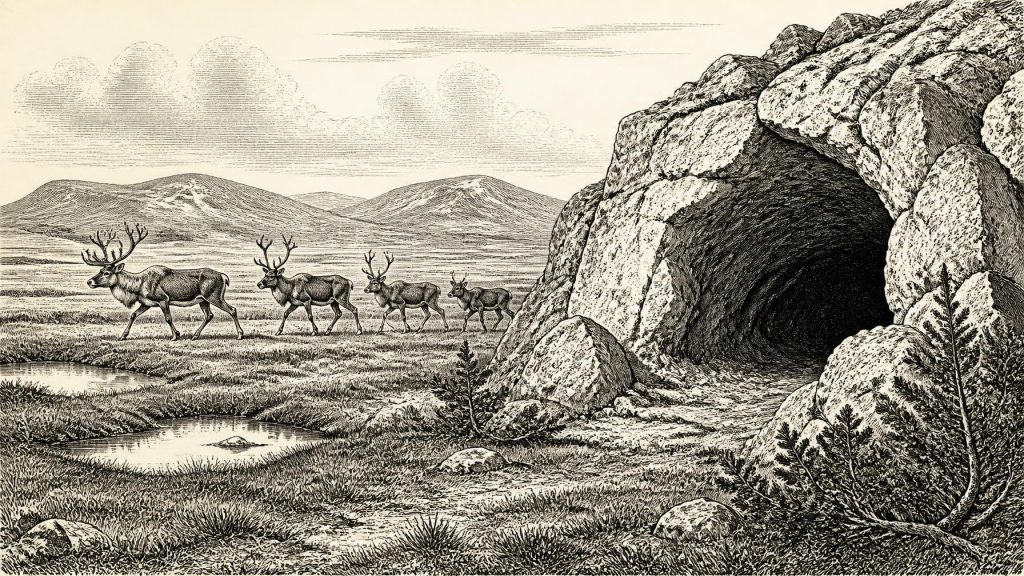
Rather than marking an exact event, 31,721 BCE falls within the uncertain, climatically unstable MIS 3 period. Derryvree sediments in Fermanagh show an ice-free, treeless tundra wetland with freshwater habitats, while Crag Cave calcite records intermittent milder conditions. Castlepook Cave, County Cork, preserves diverse fauna, including mammoth, giant deer, reindeer, hyaena and lemmings, demonstrating Ireland’s connection to wider European cold-stage ecosystems. A cut-marked reindeer femur may indicate Upper Palaeolithic butchery, but remains contested and cannot prove settlement. Later glaciation likely destroyed or buried earlier evidence. Ireland was a variable, biologically active landscape, perhaps only potentially briefly visited by mobile hunter-gatherers.
Dateline
31,721 BCE cannot be treated as an anniversary in Irish history. No written record, settlement sequence or precisely dated event permits modern calendar-year precision at this depth of time. Expressed in the archaeological convention, the nominal year falls roughly 33,670 calendar years before AD 1950, within Marine Isotope Stage 3 (MIS 3), a long and climatically unstable portion of the Last Glacial period. The responsible approach is therefore to examine dated ranges that overlap it, rather than claim that anything happened in Ireland in that exact year. The clearest relevant evidence comes from cold-stage sediments in Fermanagh, calcite deposits in Kerry, and, above all, animal remains from Castlepook Cave near Doneraile in north County Cork.
A Date Range, Not a Year
Radiocarbon measurements do not initially produce calendar dates. They measure the remaining carbon-14 in organic material and report an age in radiocarbon years before present, where “present” is conventionally AD 1950. That age must be calibrated against records of changing atmospheric carbon-14. At more than 30,000 years ago, calibrated results commonly span broad, sometimes irregular ranges. The international IntCal20 curve reaches back to 55,000 calibrated years before present, but its older section necessarily combines several environmental archives and retains substantial uncertainty.
This matters particularly at Derryvree, near Maguiresbridge, County Fermanagh. Organic silts and fine sands there lay between two tills: one left by an earlier advance of ice and another deposited later. A conventional radiocarbon determination of 30,500 radiocarbon years BP, with a large error margin, has been calibrated to approximately 31.7–36.9 thousand calendar years ago. That wide interval encompasses the notional year considered here. It demonstrates that an ice-free episode capable of sustaining freshwater and tundra habitats occurred in this part of Ireland during later MIS 3; it does not date a particular season, generation or historical occurrence.
Marsh Between the Ice
Derryvree is important because its sediments preserve more than bare geology. Pollen, plant remains and insects indicate a treeless, cold landscape with freshwater pools and wet, moss-rich ground. Sedges and grasses were prominent, with juniper and herbs in the wider vegetation. The older term “muskeg”, used in discussions of the site, conveys the probable character of the local environment: waterlogged, organic ground, shallow pools and low vegetation rather than forest or farmland. Insect evidence similarly points to northern, cold-adapted conditions.
Such evidence provides a local environmental reconstruction, not a map of the entire island. Ireland’s climate and ice margins were variable, and an exposed deposit near Maguiresbridge cannot simply be projected unchanged to Cork, Kerry or the western seaboard. Nevertheless, it decisively corrects the misleading image of a permanently uniform white wilderness. During MIS 3, ice advanced and retreated regionally, while cold, open habitats could form in ice-free or lightly glaciated areas. The landscape near Derryvree was harsh, seasonal and largely without trees, but it was biologically active.
Crag Cave, near Castleisland in County Kerry, adds a different kind of evidence. Uranium-thorium dating shows that calcite formations in this shallow cave grew episodically through the last glacial period, including intense phases in later MIS 3. Calcite growth requires liquid water percolating through the cave, and is therefore evidence for episodes when average annual conditions were sufficiently mild for water not to remain permanently frozen. It does not mean that Ireland was warm or wooded. Rather, it records sharp climatic oscillations in an Atlantic-margin landscape, in which comparatively favourable intervals alternated with much colder stadials.
The Castlepook Animal World
Castlepook Cave is the most vivid Irish archive for this broad period. Excavations led by Richard J. Ussher and colleagues in the early twentieth century recovered an exceptionally large cave-bone assemblage from limestone galleries north of Doneraile. Later research has identified a striking range of Pleistocene mammals: woolly mammoth, giant deer, reindeer, spotted hyaena, wolf, brown bear, foxes, stoat, mountain or Arctic hare, and lemmings. The combination is consistent with extensive open-country habitats and a food web able to support large herbivores, predators and scavengers during portions of MIS 3.
That list must not become a census for 31,721 BCE. Cave assemblages accumulate over long periods. Carnivores can drag carcass parts into dens; water can move bone and sediment; roof collapse can disturb deposits; and the methods of the original excavations did not provide the layer-by-layer recording expected today. Modern redating has also altered the chronology. A reassessment of bones from Castlepook and other southern Irish caves found that several older measurements had been thousands of radiocarbon years too young because of limitations in earlier sampling and pretreatment. The revised work securely places major elements of the southern Irish fauna in MIS 3, but it also makes caution more, not less, necessary when assigning individual bones to a narrow moment.
At the broad scale, Castlepook shows that Ireland was accessible to substantial cold-adapted fauna before the Last Glacial Maximum. Mammoths and reindeer imply productive vegetation over wide areas, even if that vegetation was low and seasonal. Giant deer, often misleadingly called “Irish elk”, were not uniquely Irish; their presence instead connects Ireland to a much wider north-west European Pleistocene world. Spotted hyaenas are especially revealing. They were formidable scavengers and hunters whose use of caves could create complicated bone deposits. A cave holding hyaena remains and herbivore bones may record a den, a scavenging place, a natural trap, several separate episodes, or a mixture of all these processes.
The Reindeer Femur
A fragment of reindeer femur from Castlepook has made this period central to debates about Ireland’s earliest human presence. Zooarchaeological re-examination identified a deep incision interpreted as consistent with cutting or chopping by a sharp stone tool. The bone has been reported as dating to about 33,000 years ago, and County Cork heritage publications place it broadly around 31,000 BC. If the mark is confirmed as anthropogenic, it is evidence that a person processed a reindeer in Ireland during the Upper Palaeolithic, far earlier than the island’s formerly accepted record of human activity.
The qualification is essential. A dated bone dates the animal’s death, not necessarily the time at which a person handled it. Nor is the femur from a securely excavated occupation floor accompanied by hearths, stone tools, a dwelling, burials or human remains. Natural marks, damage in a carnivore den and movement after deposition are all issues which must be tested when interpreting bone surfaces. The most defensible conclusion is limited but important: Castlepook preserves a plausible, potentially very early trace of human butchery, not proof of a permanent Irish population or a named archaeological culture at this date.
People Without a Settlement
There is no evidence for political authority, diplomacy, organised warfare, territory, trade routes, formal religion or literacy in Ireland at this horizon. Such subjects cannot responsibly be supplied with invented chiefs, tribes or rituals. If people did reach the island, they would have been mobile hunter-gatherers operating in a cold-stage landscape, a possibility compatible with Upper Palaeolithic lifeways elsewhere in north-west Europe. Yet comparison is not direct evidence. The Irish record lacks the camps, tools and repeated activity areas needed to reconstruct family size, language, social organisation, seasonal round or belief.
Nor should “island” be understood too literally in the modern sense. Lower global sea levels during the glacial period exposed large areas of continental shelf and changed the geography of the Irish Sea region. Animal and possibly human movement between Ireland, Britain and continental Europe could have been easier at some times than it is now, though the precise routes and water crossings varied with changing sea level, ice and local topography. Castlepook’s fauna supports connectivity in a broad biogeographical sense; it cannot identify a particular migration path or establish regular exchange.
Everyday life, if it occurred in Ireland around this time, would have been structured first by weather, mobility and animal availability. Reindeer could provide meat, fat, hide, sinew and bone; other herbivores offered potential resources but also required hunters to understand dangerous, shifting terrain. That is an inference from the animal evidence and the broader Upper Palaeolithic world, not something demonstrated at Castlepook itself. The cave’s main historical importance is precisely that it preserves the possibility of such encounters while refusing an easy narrative about them.
Before the Ice Peak
The nominal date lies well before the Last Glacial Maximum, when the British-Irish Ice Sheet later expanded dramatically, with maximum conditions broadly falling around 26,000–21,000 years ago and varying between sectors. Research on Ireland’s mountains, shelves and surrounding seas shows that this was not a single instant of uniform advance. Some sectors reached their maxima at different times, and subsequent retreat was equally uneven. By the glacial peak, all or almost all Irish low ground was ice-covered; the delicate evidence for earlier landscapes and possible human activity was therefore vulnerable to erosion, burial and destruction.
That later ice explains much of the silence. It is not proof that people were absent before it, but it helps explain why traces are rare, displaced and difficult to interpret. Around 31,721 BCE, Ireland was not a Gaelic homeland, a prehistoric kingdom or an empty stage awaiting later settlers. It was a changing cold-stage environment within a wider European ecological zone: sometimes open enough for freshwater wetlands, tundra vegetation and large mammals; climatically unstable; and perhaps visited by people whose presence is presently represented by no more than one contested mark on a reindeer bone. That small, demanding piece of evidence is the appropriate centre of the story.
Primary Sources
- A Middle Midlandian Freshwater Series at Derryvree, Maguiresbridge, County Fermanagh, Northern Ireland
- Early Midlandian–Middle Midlandian, Pleistocene, Northern Ireland
- The Subdivision of the Quaternary Period in Ireland
- Irish Pleistocene Biostratigraphy
- A Reconsideration of the Radiocarbon Dating of the Marine Isotope Stage 3 Fauna from Southern Ireland
- The Irish Quaternary Fauna Project
- Castlepook Cave: County Geological Site Report
- On the Cave of Castlepook, Near Doneraile, Co. Cork
- Occurrence of Mammalia Relicts at Site Castlepook Cave
- Heritage Artefacts of County Cork
- The Archaeological Heritage of County Cork
- 2022:564 – Castlepook Cave, Castlepook South, Cork
- Episodic Speleothem Deposition Tracks the Terrestrial Impact of Millennial-Scale Last Glacial Climate Variability in SW Ireland
- Growth and Retreat of the Last British–Irish Ice Sheet, 31,000 to 15,000 Years Ago: the BRITICE-CHRONO Reconstruction
- Pattern and Timing of Retreat of the Last British-Irish Ice Sheet
- Maximum Extent and Dynamic Behaviour of the Last British–Irish Ice Sheet West of Ireland
- New Age Constraints for the Maximum Extent of the Last British-Irish Ice Sheet (NW Sector)
- Extent and Deglacial Chronology of the Last British–Irish Ice Sheet: Implications of Exposure Dating Using Cosmogenic Isotopes
- Trimlines, Blockfields and the Vertical Extent of the Last Ice Sheet in Southern Ireland
- The IntCal20 Northern Hemisphere Radiocarbon Age Calibration Curve (0–55 cal kBP)
- New Insights on the Fauna of Ireland's Younger Dryas and Early Holocene from Alice & Gwendoline Cave
- The Colonization of Ireland: A Human Ecology Perspective