Hollymount Between the Tills31706 BCE
Although labelled 31,706 BCE, this period cannot be dated to a specific Irish year and belongs broadly to later Marine Isotope Stage 3. Freshwater sediments between glacial tills at Derryvree, Fermanagh, reveal treeless, tundra-like wetlands during fluctuating cold conditions, while Hollymount and Greenagho confirm varied non-glacial episodes. Castlepook Cave, Cork, preserves MIS 3 remains of mammoth, giant deer, reindeer, bear, hyena and other fauna, showing ecological links with Britain and Europe. Possible human modification of a reindeer bone suggests seasonal visits, but no secure occupation is known. Ireland’s record documents environmental change and animal life, not settlements, politics or culture.
Dateline
The label 31,706 BCE gives a misleading impression of precision. No written record, ruler list, settlement sequence or annual chronology exists for Ireland at this depth of time. In terms used by Quaternary scientists, it falls roughly 33,650 calendar years before present (where “present” is AD 1950), within Marine Isotope Stage 3 (MIS 3), a fluctuating phase of the last Ice Age. That conversion is only a modern chronological convenience. It does not mean that an excavator can identify what happened in Ireland in this particular calendar year.
The responsible subject is therefore Ireland during the broader later MIS 3 interval, perhaps around 37,000–32,000 calibrated years before present. The island’s evidence is fragmentary and uneven: a few buried freshwater deposits in Fermanagh, cave-bone assemblages in the south, glacial landforms and wider records of North Atlantic climate. These sources illuminate habitats, animals and changing ice conditions. They do not reveal named peoples, governments, battles, treaties, farms or villages.
Dating a Landscape, Not a Year
Radiocarbon dates are not calendar dates in themselves. The concentration of radioactive carbon in the atmosphere has varied over time, and especially so during the Pleistocene. Dates must therefore be calibrated against internationally maintained curves, including IntCal20. At around 30,000 radiocarbon years ago the relationship between radiocarbon age and calendar age is particularly complex. A result may calibrate to a broad range, sometimes with several possible intervals. Stratigraphy—the physical order of layers—remains as important as the numerical determination.
This matters greatly for the deposits at Derryvree near Maguiresbridge, County Fermanagh, and at nearby Hollymount and Greenagho. They are not annual snapshots. Rather, they preserve episodes within a long and unstable cold stage. The Derryvree sequence contained organic-rich freshwater sediments between two tills: a lower mass left by an earlier glacier and an upper deposit emplaced when ice returned. Organic material produced a radiocarbon determination of 30,500 years BP, with a large error range. Its calibrated age belongs broadly to later MIS 3, making it highly relevant to the world represented by 31,706 BCE, but not a direct date for that nominal year.
The order of layers is decisive. Before the freshwater silts accumulated, ice had affected the locality. Afterwards, enough open ground and liquid water existed for sediment, plants and insects to build up in a basin. Later glacial activity covered and protected the deposit. That sequence proves major environmental change in northern Ireland. It cannot, by itself, show the precise extent of ice across every county at one moment, nor demonstrate that people lived beside the water.
Cold Water and Open Ground
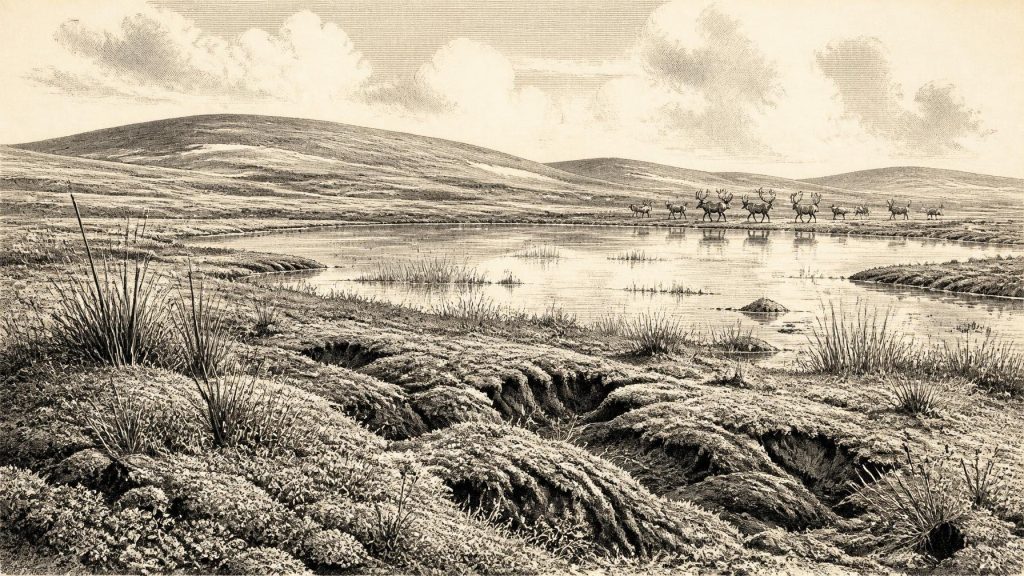
Derryvree provides Ireland’s clearest environmental window onto this broad period. Its mosses, sedges and other plant remains, together with pollen and an insect fauna of cold northern aspect, point to a treeless or nearly treeless landscape. The setting has been interpreted as tundra-like wet ground: mossy and sedgy margins, shallow freshwater, exposed mineral soils and frost-affected terrain. Finds linked to plants such as bogbean, mountain avens and water-milfoil suggest that local conditions included both wet hollows and open ground, rather than a single uniform plain.
This was not the wooded island familiar from later prehistory and modern Ireland. Oak woods, hazel scrub, enclosed pasture, fields and blanket bog lay far in the future. Growing seasons were short, winters severe and the weather subject to sharp change. In such terrain, topography mattered. Sheltered basins could retain water and vegetation while ridges, slopes and exposed surfaces experienced strong winds, seasonal freezing and sparse plant cover. Rivers and meltwater channels were not merely features of scenery: they sorted sediment, created local refuges and connected habitats across otherwise difficult country.
Hollymount and Greenagho reinforce the larger point while also demonstrating the limits of certainty. Each provides evidence for non-glacial deposits during the Middle Midlandian, the older regional term broadly corresponding to MIS 3. Their dates and fossil preservation differ, and correlation between them is not straightforward. Ireland was not a homogeneous climatic unit. A freshwater basin in Fermanagh cannot be made a complete map of conditions in Cork, the western uplands or the Irish Sea basin.
Castlepook’s Animal World
In north County Cork, Castlepook Cave near Doneraile supplies a different kind of archive. It is Ireland’s richest known cave site for vertebrate remains from before the Last Glacial Maximum. Excavations in the early twentieth century recovered a large collection, now much reduced and complicated by the methods of its recovery, water movement and disturbed deposits. Modern radiocarbon re-dating has nevertheless transformed its importance. It indicates that animal remains once attributed to younger phases can be substantially older, with parts of the assemblage belonging to MIS 3.
The cave fauna demonstrates that Ireland supported, at different points in this long interval, a far richer large-mammal community than the island would possess later. Woolly mammoth, giant deer, reindeer, brown bear and spotted hyena are all represented at Castlepook; wolf, Arctic fox and lemmings occur among the wider cold-stage fauna. This is evidence for animals in Ireland during the relevant climatic world, not proof that every species stood together outside the cave in 31,706 BCE. Individual bones have different ages, and caves often gather material over centuries or millennia through carnivore activity, natural deaths, water transport and collapse.
Spotted hyena is especially revealing. A hyena skull from Castlepook, held by the National Museum of Ireland, confirms that a large social carnivore now associated with Africa ranged through Ice Age Ireland. Hyenas could accumulate bones in dens, crush them and move them around, complicating any attempt to treat a bone deposit as a human food refuse heap. Their presence also implies sufficient prey and a landscape capable of sustaining large carnivores. But it does not establish a “hyena kingdom”, nor can it tell us how many animals lived on the island at once.
The most reasonable reconstruction is an open, mobile food web. Reindeer and perhaps giant deer would have exploited seasonal forage; mammoth, where present, required extensive plant resources; carnivores followed prey and competed for carcasses. Such animals could move widely when terrain and sea conditions allowed. Lower global sea levels altered coastlines and narrowed water barriers in the Irish Sea region, but the exact availability of land routes or crossings at any particular point remains debated. The faunal evidence shows connectivity with Britain and north-west Europe, not the exact route taken by every animal.
People: A Possibility, Not a Settlement
This is the point at which caution is most necessary. For decades, the accepted archaeological position was that no convincing Upper Palaeolithic occupation of Ireland had been demonstrated. Castlepook produced extraordinary animal remains, but no securely associated stone-tool assemblage, hearth, dwelling floor, burial or occupation surface. Early excavation was thorough in places but did not meet modern standards of recording; much stratified material was removed, mixed or left with uncertain provenance.
A reindeer bone from Castlepook has more recently been discussed as bearing possible human modification and has been presented publicly as potential evidence for people in Ireland about 33,000 years ago. If confirmed, it would be profoundly important: it could indicate that hunter-gatherers reached Ireland long before the better-established terminal-Pleistocene evidence from a butchered bear bone at Alice and Gwendoline Cave in County Clare. Yet one modified bone, especially from a disturbed cave archive, cannot establish a settled population, a camp at Castlepook, or an event in 31,706 BCE. Marks on bone must be distinguished from carnivore damage, trampling, sediment abrasion, excavation damage and other taphonomic processes.
The most defensible conclusion is therefore deliberately modest. Short, seasonal human visits are possible within an Irish landscape that supported large herbivores and predators, and the Cork find deserves further specialist testing and contextual study. Permanent residence at this time is unproven. We cannot responsibly describe family structures, language, clothing, ritual, artistic traditions or hunting practices in Ireland itself, however plausible comparisons with contemporary hunter-gatherers elsewhere in Europe may seem.
No Polities, No Diplomacy
There is no evidence for political affairs, diplomacy or organised warfare in Ireland at this date. There were no known territories, chiefs, boundaries, assemblies or institutions. Equally, no evidence supports trade in the later sense of regular exchange between settled communities. Animals and, possibly, people moved through a wider north-west European ecological zone, but movement is not commerce. The relevant “regional change” was environmental: repeated shifts between glacial advance, ice-free ground, wetland formation and renewed cold.
Religion and culture are similarly beyond direct recovery. Caves may have been shelters, carnivore dens, traps for sediment and repositories for bones; without secure human artefacts or activity surfaces, they cannot be identified as sacred places. There was no writing and no recoverable body of formal learning. What survives is another kind of record: spores, pollen, seeds, mosses, beetle fragments, bones, cave sediments and glacial tills. Together they show that Ireland was neither timeless nor empty of life. It was a dynamic Ice Age landscape whose human history, if present at all, remains on the threshold of demonstration.
For 31,706 BCE, that threshold is the history. The crucial development was not a recorded deed but the persistence, in a few protected deposits, of evidence that later ice did not erase: cold freshwater in Fermanagh, a complex large-mammal fauna in Cork, and a challenging question about whether people ever entered this demanding world.
Primary Sources
- Early Midlandian–Middle Midlandian, Pleistocene, Northern Ireland
- Castlepook Cave: County Geological Site Report
- A reconsideration of the radiocarbon dating of the Marine Isotope Stage 3 fauna from southern Ireland
- The Irish Quaternary Fauna Project
- Spotted Hyena Skull
- 2022:564 – Castlepook Cave, Castlepook South, Cork
- Pattern, style and timing of British–Irish Ice Sheet advance and retreat over the last 45,000 years: evidence from NW Scotland and the adjacent continental shelf
- Dimensions and chronology of the last ice sheet in Western Ireland
- New data for the Last Glacial Maximum in Great Britain and Ireland
- The evolution of the terrestrial-terminating Irish Sea glacier during the last glaciation
- Using novel methods to track British and Irish Ice Sheet dynamics since the Late Pleistocene, along the west Porcupine Bank, NE Atlantic
- The IntCal20 Northern Hemisphere radiocarbon age calibration curve (0–55 cal kBP)
- IntCal
- North GRIP – MIS3 CH4, d15N, and Temperature Data
- NGRIP GICC05modelext time scale and δ18O values
- Archaeological Heritage of County Cork
- Biogeography of Ireland: Past, Present, and Future
- BSBI: Menyanthes trifoliata
- BSBI: Dryas octopetala
- BSBI: Myriophyllum alterniflorum
- New insights on the fauna of Ireland's Younger Dryas and Early Holocene from Alice & Gwendoline Cave