
A Femur From Castlepook31591 BCE
Dateline
“31,591 BCE” is a modern chronological label, not a year that can be recovered from an Irish Ice Age archive. It corresponds approximately to 33,540 calendar years before AD 1950, the conventional “present” used in radiocarbon reporting, but archaeology cannot resolve events in Ireland to that individual year. The responsible frame is the later part of the Late Pleistocene, within Marine Isotope Stage 3, a long, climatically volatile interval before the Last Glacial Maximum. What survives is not an annual chronicle: it is a patchwork of cave bones, buried wetland sediments, pollen, seeds, mosses, insects, glacial deposits and laboratory dates, each with limits.
Ireland at this broad date was therefore neither the familiar green, wooded island nor necessarily an unbroken sheet of ice. The evidence indicates a severe, open and changing world in which ice-free terrain, permafrost, shallow water, bare ground and tundra vegetation could occur in different places and at different moments. That environment is the principal subject of Irish history at this depth of time. Questions of kingship, diplomacy and named peoples have no evidential footing here; the more revealing history concerns climate, animal movement, landscape transformation and a still-unsettled possibility of very early human activity.
Time Measured in Ranges
The distinction between radiocarbon years and calendar years is essential. Radiocarbon ages are measurements of residual carbon-14, not direct calendar dates. They must be calibrated against independently dated records, and calibration becomes less precise farther back in time. The internationally used IntCal20 curve reaches to 55,000 calibrated years before present, but it does not turn every Pleistocene deposit into a single-date event. Old excavations add further uncertainty because samples were sometimes collected without the stratigraphic detail and chemical pre-treatment expected today.
The most useful Irish comparisons are consequently ranges. A red-deer specimen from Ballynamintra Cave, County Waterford, has been placed at 32,930–31,280 calibrated years BP; another pre-Last Glacial Maximum specimen falls at 30,297–29,594 cal BP. These ranges establish that large mammals were present in Ireland during phases before the main ice-sheet maximum, but they do not prove that either animal was alive in 31,591 BCE. Nor should they be used to reconstruct a continuous population of any species. Fossil records are records of survival and discovery, not complete censuses of former landscapes.
An Island in Transformation
At roughly this point in the last Ice Age, the British–Irish Ice Sheet was developing rapidly but unevenly. Recent reconstructions stress that there was no single instant at which every sector reached the same extent. Ice growth was already under way in parts of the wider British–Irish system by about 31,000 years ago, and major expansion followed. The eventual maximum extent offshore from much of western Ireland belongs later, broadly around 26,000–24,000 cal BP. Thus 31,591 BCE should not be pictured simply as “before the ice” or “during the ice”: it lay within a drawn-out transition in which ice margins and habitable ground changed markedly through time.
Lower global sea levels altered the geography of north-west Europe, exposing portions of the continental shelf now under water. Yet it would be rash to draw a simple land bridge from this fact. The relationship between Ireland, Britain and the European mainland varied with sea level, ice configuration, rivers and local topography; routes usable by particular animals or people cannot be assumed from a map alone. Ice, sea crossings, exposed coastal plains and seasonal conditions could all have posed different obstacles. The old question of how Irish fauna arrived therefore remains a central scientific problem, not one with a universal answer.
Derryvree’s Buried Wetland
The clearest environmental archive relevant to this general era was found at Derryvree near Maguiresbridge in County Fermanagh. Roadworks in 1969 cut through a drumlin and exposed freshwater silts and fine sands enclosed between two thick tills. The sequence is historically eloquent. A lower ice advance laid down one till; an intervening non-glacial phase permitted sediment, plant remains and animal traces to accumulate in and around freshwater; then a later advance sealed the deposit beneath another till.
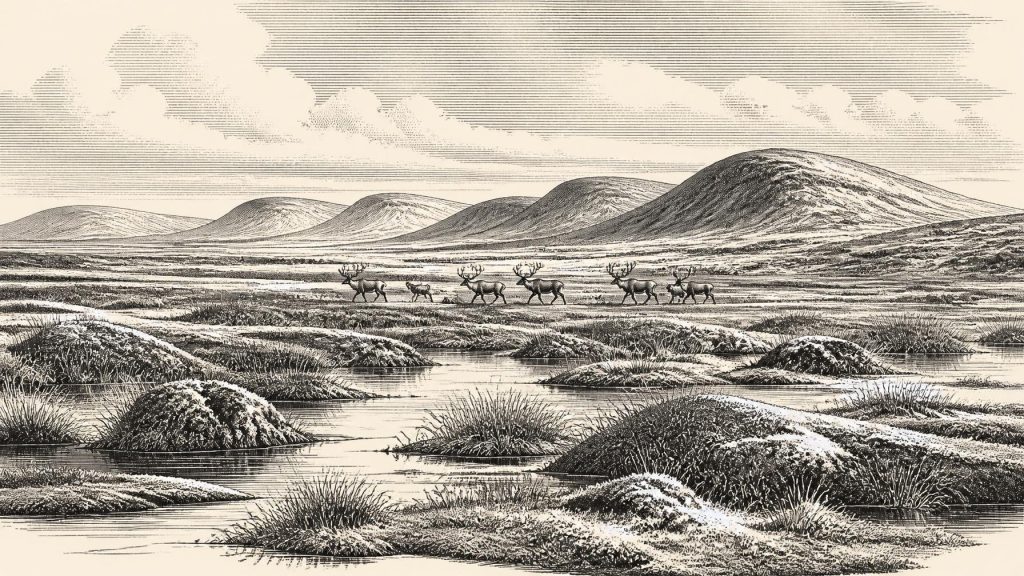
The original radiocarbon determination from Derryvree was 30,500 +1,170/−1,030 radiocarbon years BP. That legacy measurement should not be treated as a pinpoint calendar equivalent, particularly given later advances in calibration and dating practice. But its stratigraphic setting and ecological contents remain important. The assemblage included herb pollen, mosses and plant macrofossils associated with sedges, open water and wet ground. It has been interpreted as a treeless muskeg or tundra wetland under a periglacial regime: a landscape with cold winters, short growing seasons and ground frozen for at least part of the year.
This was not a frozen void. Mosses and low plants grew, organic matter accumulated and insects inhabited wet places. At the same time, it was not a benign lakeside meadow. The sparse pollen record and the character of the flora point away from closed forest. Wind, frost action, seasonal thaw and sediment washed into pools would have structured daily ecological life. Derryvree cannot stand for every part of Ireland, and its deposit cannot be assigned to 31,591 BCE precisely. It does, however, demonstrate that northern Ireland contained functioning cold-stage freshwater environments during the broader Middle Midlandian interval.
Caves and Cold-Adapted Fauna
In the south, Castlepook Cave near Doneraile in County Cork provides the richest Irish cave archive for pre-Last Glacial Maximum fauna. Its limestone passages lie in the Awbeg Valley below the Ballyhoura Hills. Antiquarian excavators recovered bones of woolly mammoth, reindeer, spotted hyaena, brown bear, wolf, Arctic fox, wild horse, hare and lemmings. Such a list evokes an open, largely treeless mosaic of grassland, herb-rich ground and sheltered limestone country rather than later Irish woodland.
But a cave is not a simple snapshot of the land outside it. Carnivores may drag carcass parts into dens; animals die in crevices; water and sediment move bones; later digging can mix deposits. Castlepook’s historic excavations produced a remarkable collection, but often without the contextual control of a modern excavation. The Irish Quaternary Fauna Project rightly transformed knowledge by directly dating specimens, yet subsequent work has shown that some older bone dates require reassessment because improved pretreatment methods can remove contamination that made samples seem younger. A specimen’s age, its species identification, the route by which it entered a cave and the date of any surface mark are related but separate questions.
What can be said securely is that animals adapted to cold and open environments reached Ireland in this long pre-LGM period. Reindeer were mobile grazers able to exploit tundra and steppe-like habitats; hyaenas and wolves were predators and scavengers; mammoths and horses suggest broader grazing landscapes. Their presence implies connections, whether intermittent or sustained, between Irish habitats and the larger north-west European faunal world. It does not show that every species lived together at the same moment, nor that the entire island supported the same ecological community.
The Castlepook Femur
A single reindeer femur from Castlepook has given this date unusual importance. County Cork heritage interpretation associates it with about 31,000 BCE and identifies a deep incision on fresh bone as a mark made by a sharp stone implement during butchery. If that zooarchaeological assessment is upheld, it would be a potentially momentous sign that Upper Palaeolithic people handled a reindeer in Ireland far earlier than the well-established terminal-Pleistocene evidence from County Clare.
The claim must nevertheless remain narrow. The bone came from an older collection, not from a recently excavated and intact hunting floor. No securely associated stone-tool assemblage, hearth, dwelling, human burial, art object or repeated occupation layer of comparable age has yet been published from Castlepook. A radiocarbon determination dates the animal’s death, not automatically the instant a mark was made, the location of the kill or the duration of a human visit. Moreover, carnivore activity and excavation damage make microscopic assessment of bone modification indispensable. Current excavation has sought surviving Pleistocene deposits, but its 2022 season recovered no cultural artefacts.
Society Beyond the Evidence
There is therefore no responsible basis for describing a settled Irish community, a tribal territory, political leadership, warfare, diplomacy, religious rites, language or formal learning in 31,591 BCE. There are no houses, graves, monuments, hearths or toolkits from this horizon on which to build such a narrative. Nor can a potentially butchered bone identify the sex, age, number, ancestry or destination of the people who may have handled it. To call them “the first Irish” would impose a later national category on a fleeting and unproven episode of Pleistocene movement.
If the Castlepook incision is human-made, the most that can be inferred is a practical encounter with a large animal. A sharp stone edge may have helped separate meat, hide, sinew, marrow-bearing bone or other useful material from a carcass. That is an inference from the action implied by the mark, not evidence for a particular hunting method or a camp at the cave. It is also possible that a carcass was processed elsewhere and bone later carried into Castlepook by hyaenas or other scavengers. The cave’s value lies precisely in preserving this difficult question rather than resolving it prematurely.
A Landscape, Not a Chronicle
For Ireland around 31,591 BCE, environmental change outweighs political history because it is what the evidence can illuminate. The island’s terrain was being reshaped by advancing ice and periglacial processes. In Fermanagh, freshwater basins sustained tundra vegetation between glacial episodes. In Cork, open-country animals entered a cave system that later became an archive of their bones. Across the wider region, lowered seas and changing ice margins affected possible routes, but did not guarantee passage. Life existed in these landscapes, yet survival was precarious and distribution uneven.
The most important historical lesson is one of scale and restraint. The calendar label offers a useful place in a modern sequence, but it cannot yield an event on a particular day, a ruler or a community’s story. Calibrated ranges, sediment layers and faunal assemblages give a more truthful account: a cold, dynamic Irish environment, large mammals moving through it, and a contested reindeer bone that may preserve an exceptionally early human touch. Future work at Castlepook and renewed dating of museum collections may sharpen that picture. For now, the evidence supports possibility, not certainty.
Primary Sources
- A Middle Midlandian Freshwater Series at Derryvree, Maguiresbridge, County Fermanagh, Northern Ireland
- The Irish Quaternary Fauna Project
- Phylogeographic, Ancient DNA, Fossil and Morphometric Analyses Reveal Ancient and Modern Introductions of a Large Mammal: The Complex Case of Red Deer (Cervus elaphus) in Ireland
- Irish Pleistocene Biostratigraphy
- Growth and Retreat of the Last British–Irish Ice Sheet, 31,000 to 15,000 Years Ago: The BRITICE-CHRONO Reconstruction
- The Deglaciation of the Western Sector of the Irish Ice Sheet From the Inner Continental Shelf to its Terrestrial Margin
- New Data for the Last Glacial Maximum in Great Britain and Ireland
- Quaternary Deposits and Glacial Stratigraphy in Ireland
- Introduction to the Late Quaternary and Holocene of Northern Ireland
- Figure 6.— The Subdivision of the Quaternary Period in Ireland
- Palaeoecology
- Castlepook Caves
- Heritage Artefacts of County Cork
- 2022:564 – Castlepook Cave, Castlepook South, Cork
- Archaeology Research Excavation Grant 2022: Final Report
- First Evidence of a Late Upper Palaeolithic Human Presence in Ireland
- New Insights on the Fauna of Ireland’s Younger Dryas and Early Holocene From Alice & Gwendoline Cave
- The IntCal20 Northern Hemisphere Radiocarbon Age Calibration Curve (0–55 cal kBP)
- IntCal
- The Mesolithic in Ireland: When Was It?