Derryvree’s Aquatic Refuge31120 BCE
Around 31,120 BCE, Ireland lay within a fluctuating Late Pleistocene environment rather than a datable historical year. At Derryvree, County Fermanagh, organic sediments between glacial tills preserve evidence of an ice-free freshwater wetland, with tundra vegetation, aquatic plants and insects indicating cold, open conditions. Castlepook Cave, County Cork, contains accumulated remains of mammoth, reindeer, giant deer, bears and other fauna, though not all lived simultaneously. A possibly cut-marked reindeer bone suggests brief human activity, but no secure settlement or occupation evidence exists. Later glaciation destroyed many surfaces while preserving rare deposits, leaving climate, habitats and fauna clearer than human history.
Dateline
The label 31,120 BCE cannot identify an eventful year in Irish history. It is a modern backward count, roughly 33,070 years before the conventional radiocarbon reference year of AD 1950, not a date that any person living then could have reckoned. No Irish evidence can be resolved to a named year, season, generation or political episode at this depth of time. The responsible historical frame is therefore a broad Late Pleistocene horizon: an unstable part of the last Ice Age, within Marine Isotope Stage 3, when climatic shifts, shifting ice margins and sparse preservation govern what can be known.
The nearest significant Irish environmental record is not a settlement but a buried freshwater deposit at Derryvree, near Maguiresbridge in County Fermanagh. It offers a rare view of a landscape that existed between phases of glaciation. Its evidence is powerful precisely because it is material and stratified: sediments, pollen, plant macrofossils and insect remains. But it remains a local archive. It cannot furnish a weather report for every part of Ireland, still less a narrative for one modern calendar year.
Calendar Labels and Deep Time
Modern calendar precision must not be imposed upon this period. The organic Derryvree deposit produced the radiocarbon determination BIRM-166, conventionally dated to about 30,500 radiocarbon years before present, with a substantial published uncertainty. Calibration, which translates radiocarbon ages against changing past atmospheric carbon levels, places the deposit broadly within about 36,900–31,700 calibrated years before present. The date 31,120 BCE falls within that wide range, but it was not the date of a particular pool, animal, human visit or climatic turn.
This distinction matters. A radiocarbon measurement dates the death of sampled organic material, subject to laboratory uncertainty and calibration; it does not date every grain of sediment, nor the entirety of a landscape. The deposits were also exposed in a road cutting through a drumlin, then interpreted through modern geological and palaeoecological methods. Their sequence nevertheless establishes a durable relative history: till from glacial activity below, freshwater organic sediments in the middle, and later till above. At Derryvree, therefore, ice had retreated or was absent long enough for a wetland ecosystem to form before renewed glaciation sealed it beneath another deposit.
A Wetland Between Ice Advances
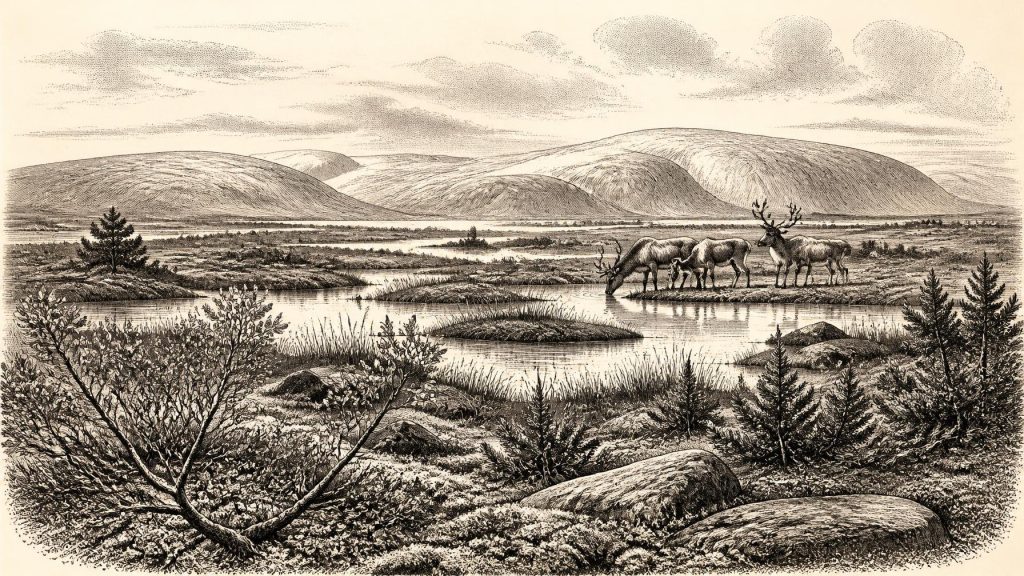
Derryvree was neither modern green Ireland nor a featureless snow desert. The combined botanical and insect evidence points to open, treeless tundra or muskeg: wet, plant-rich ground with shallow pools and mossy margins in a periglacial climate. Grasses, sedges, herbs and juniper were important components of the surrounding vegetation. Fossils also include plants associated with cold, open ground and freshwater edges, among them mountain-avens, dwarf willow, bogbean and alternate water-milfoil. The latter two are especially useful reminders that even a severe cold-stage landscape could contain standing or slow-moving freshwater.
That evidence supports an image of local ecological variety rather than uniform barrenness. Mosses and sedges grew where waterlogged soil allowed them to do so; low shrubs and herbs occupied better-drained ground; open water sustained aquatic plants. Insect assemblages reinforce the interpretation of cold wetland conditions with pools and substantial vegetable matter. Yet interpretation should stop there. The fossils do not reveal the exact extent of the marsh, the height of snow in a particular winter, or whether a plant population persisted continuously for centuries. They demonstrate habitats represented in, or very near, the sediment source.
The broader context was one of climatic deterioration before the Last Glacial Maximum. The British–Irish Ice Sheet did not reach its maximum extent until much later, broadly around 25,000–23,000 years before present in many reconstructions, though its growth and local margins were complex. At approximately 33,000 years ago, Ireland’s terrain was already shaped by cold climates and earlier ice, while conditions and ice cover varied strongly from place to place and through time. Derryvree’s intervening organic bed is important evidence against treating the whole island as continuously ice-covered throughout the period.
Animals in the Irish Landscape
County Fermanagh supplies the clearest environmental evidence close to this notional date, while north County Cork supplies the most evocative faunal archive. Castlepook Cave, near Doneraile, has produced more than two thousand Pleistocene bones and is Ireland’s richest known cave record for the period leading towards the Last Glacial Maximum. Direct dates from individual bones extend across a long span, approximately 45,700 to 19,950 radiocarbon years before present. This is not one animal community preserved in a single instant. It is an accumulated and disturbed cave archive spanning many millennia.
Its fauna nevertheless shows that Ireland could support, or at least receive, a remarkable range of large and small mammals during different parts of the late Ice Age: woolly mammoth, reindeer, giant deer, brown bear, wolf, Arctic fox, lemmings and spotted hyaena. Several Castlepook specimens fall broadly near the time horizon represented by 31,120 BCE, including bones of mammoth, reindeer, giant deer and bear. Such finds establish that these animals reached Ireland at various times in Marine Isotope Stage 3; they do not prove that all species grazed the same valley together, or that each ranged across the entire island.
Spotted hyaenas are particularly revealing, both ecologically and archaeologically. Their presence indicates a carnivore able to transport, gnaw and accumulate bones in caves. Water movement, slope wash, natural animal deaths and early excavation practices further altered the deposits. A bone in Castlepook Cave may therefore record a kill elsewhere, scavenging, denning, transport into the cave, or later redeposition. Cave faunas are vital evidence, but not straightforward inventories of a living landscape.
The Human Question
There is no securely excavated settlement, hearth, dwelling, burial, stone-tool assemblage or human skeleton in Ireland dated to around 31,120 BCE. There is consequently no basis for identifying a population, language, kin group, territory or continuous occupation. Political affairs, diplomacy, institutions and warfare belong to categories for which this period offers no Irish evidence. Nor can religious practice, learning, art, social rank or ritual be responsibly reconstructed from the available record.
The strongest reason not to dismiss human possibility altogether is a reindeer femur from Castlepook Cave, reported as dating to roughly 33,000 years ago and bearing a mark interpreted as a sharp stone-tool cut made while the bone was fresh. If that interpretation is upheld, it would indicate the butchery of a reindeer by people in Ireland long before the better-known terminal Pleistocene evidence. It would still be evidence for an action, not proof of a settlement. The cave’s old and disturbed collections lack the securely associated tools, hearths and intact occupation surface needed to turn one modified bone into a detailed social history.
A cautious interpretation is that brief human incursions were possible during favourable intervals, perhaps by mobile Upper Palaeolithic hunter-gatherers familiar with cold open environments elsewhere in north-west Europe. This is an inference, not a demonstrated Irish community. It remains uncertain how people or animals reached the island. Lower sea levels altered coastlines, but routes between Ireland, Britain and continental Europe were shaped by ice, sea, local topography and changing relative sea level; a simple, permanent land bridge should not be assumed. No evidence presently identifies a travel corridor used at this particular time.
Subsistence Without an Economy
If people did visit, reindeer would have offered meat, fat, hide, sinew and bone, and large herbivores may have drawn hunters into open country. But this is a statement of potential resource use, not evidence for a settled economy. No Irish assemblage of this age documents repeated hunting camps, food storage, exchange networks, tool manufacture or seasonal rounds. There is no basis for describing trade, farming, herding, maritime life or ownership of land. Agriculture lay tens of millennia in the future.
The most reliable ‘economy’ visible in the evidence is ecological. Wetlands accumulated organic matter; plants occupied niches determined by moisture and cold; herbivores fed in open landscapes; predators and scavengers moved carcass parts; water and sediment redistributed remains. The later advance of glacier ice then transformed preservation itself, covering and eroding many earlier surfaces while sealing a few exceptional deposits. Ireland’s apparent scarcity of sites may reflect genuinely intermittent human presence, but also the destructive force of later glaciation and the limited survival of Pleistocene landscapes.
What This Date Can Mean
For Ireland around this notional date, the central development was environmental precariousness. Derryvree records an ice-free freshwater refuge in a cold, treeless world, while Castlepook records animals that negotiated an island landscape before the great expansion of the last ice sheet. Together they show that Late Pleistocene Ireland was neither timelessly frozen nor continuously inhabited: it was a changing mosaic of wetland, open ground, caves, animals and advancing ice.
That is a more compelling history than an invented event for 31,120 BCE. The evidence preserves a world in which a bogbean seed, a dwarf-willow fragment, a beetle, a mammoth bone or a disputed cut on reindeer bone can carry historical weight. It also imposes discipline. The archive can illuminate climate, habitat and faunal presence; it can suggest, but not yet demonstrate, fleeting human activity. Everything beyond that must remain openly uncertain.
Primary Sources
- A Middle Midlandian Freshwater Series at Derryvree, Maguiresbridge, County Fermanagh, Northern Ireland
- The Quaternary of Ireland
- Menyanthes trifoliata
- Salix herbacea
- Dryas octopetala
- Myriophyllum alterniflorum
- Irish Pleistocene Biostratigraphy
- The Irish Quaternary Fauna Project
- A Reconsideration of the Radiocarbon Dating of the Marine Isotope Stage 3 Fauna from Southern Ireland
- Castlepook Cave
- Castlepook Cave, 2022:0032564
- New Insights on the Fauna of Ireland’s Younger Dryas and Early Holocene from Alice & Gwendoline Cave
- Growth and Retreat of the Last British–Irish Ice Sheet, 31,000 to 15,000 Years Ago: The BRITICE-CHRONO Reconstruction
- Stratigraphic and Palaeo-Geomorphological Evidence for the Glacial-Deglacial History of the Last British-Irish Ice Sheet in the North-Western Irish Sea
- Pattern and Timing of Retreat of the Last British-Irish Ice Sheet
- Early Deglaciation of the British-Irish Ice Sheet on the Atlantic Margin of the Irish Sea Basin
- The Island of Ireland: Drowning the Myth of an Irish Land-Bridge?
- The Problem of a Late Quaternary Landbridge Between Britain and Ireland
- Ireland: Submerged Prehistoric Sites and Landscapes
- Anthropogenic Changes to the Holocene Nitrogen Cycle in Ireland
- Irish Caves Database: Mammoth Cave
- Guide to the National Museum of Ireland – Natural History