Castlepook’s Gallery of Aged Carnivores30743 BCE
Thirty thousand seven hundred and forty-three BCE is not a recoverable Irish calendar year, but a modern label for a Late Pleistocene cold phase. Ireland was a treeless, unstable periglacial landscape, with tundra wetlands, sparse vegetation and fluctuating ice before the Last Glacial Maximum. Derryvree sediments in Fermanagh demonstrate freshwater habitats between glacial episodes. Castlepook Cave, Cork, preserves a mixed fauna including mammoth, reindeer, giant deer, hyena, wolf, bear, Arctic fox and lemmings. A cut-marked reindeer femur may indicate Upper Palaeolithic butchery, yet cannot prove settlement, occupation, travel routes, society or politics. Evidence supports intermittent ecological complexity, not precise events.
Dateline
The label 30,743 BCE is a modern chronological convenience, not a year that can be recovered from Irish evidence. No calendar, written record or archaeological sequence allows an event in Ireland to be fixed to this particular year. Counted from the conventional radiocarbon reference year of AD 1950, it falls roughly 32,692 years before present, within the Late Pleistocene and broadly within Marine Isotope Stage 3. At this depth of time, responsible history works with wide date ranges, sediments, animal remains and changing ice margins rather than anniversaries or individual lives.
A Cold-Stage Landscape
In the Greenland ice-core sequence, this broad period lies close to the opening of Greenland Stadial 5, an interval of pronounced North Atlantic cold beginning around 32,500 years before AD 2000. That designation belongs strictly to the Greenland ice record, not to an Irish layer, but it helps convey the wider climatic setting: the North Atlantic was unstable, with abrupt shifts between colder and comparatively milder phases. Ireland stood on the north-western edge of Europe, exposed to those changes and to the fluctuating growth of the British–Irish Ice Sheet.
It would be misleading to picture the whole island either as a single unbroken ice cap or as a uniform grassland at this precise moment. Research on the British–Irish Ice Sheet increasingly shows a complex history of regional advance, retreat and readjustment before the Last Glacial Maximum. The latter is generally dated to roughly 26,500–19,000 calibrated years before present, so it lay in the future of this nominal date. Ice was growing in the wider region, but the timing and reach of pre-maximum ice across individual Irish districts remain difficult to establish. Landforms and tills record former glaciers well; they rarely provide a view of one particular century, much less one calendar year.
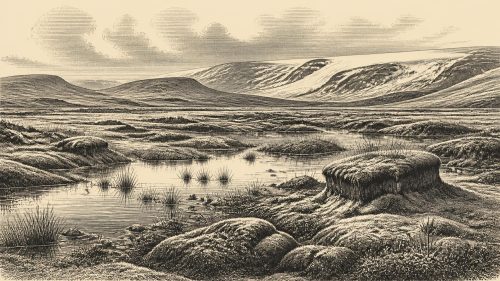
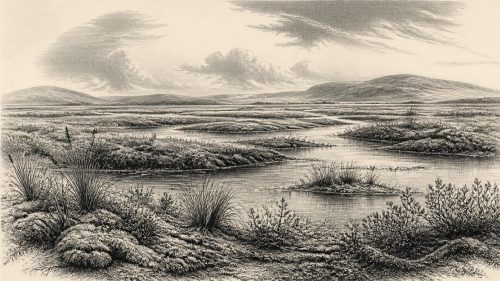
The best cautious reconstruction is therefore of a severe, changeable periglacial Ireland: areas of bare ground, gravel, frost-shattered rock, sparse vegetation, seasonal wetlands and, in some places, ice or ice-proximal terrain. Tree cover was absent from the evidence relevant to this cold world. The landscape was not permanently lifeless. Where water, soils and a short summer growing season permitted, tundra plants and grasses could sustain grazing animals, while valleys, caves and sheltered hollows created local ecological opportunities.
Derryvree’s Tundra Evidence
The most revealing Irish environmental archive for the wider middle part of the last glaciation is at Derryvree, near Maguiresbridge in County Fermanagh. Roadworks exposed freshwater silts and fine sands sealed between two distinct till sheets. Their organic material produced the radiocarbon determination BIRM-166, 30,500 radiocarbon years before present, with a substantial uncertainty range of +1,170/−1,030 years. Such a radiocarbon age is not a calendar age and must not be read as an exact match for 30,743 BCE; calibration and the measurement uncertainty place it across a broad span of millennia. Nevertheless, it remains directly relevant evidence for an earlier cold-stage Irish environment.
The Derryvree deposits preserve plants and small animals characteristic of open tundra and periglacial conditions. Mosses, sedges and other cold-tolerant taxa, alongside freshwater organisms, indicate that at least one Fermanagh basin held water in an otherwise treeless setting. This was not a modern bog transposed into the Ice Age. It was a cold, exposed wetland landscape, vulnerable to freezing, seasonal meltwater and sediment influx. Its significance lies in proving that parts of Ireland could contain functioning freshwater habitats between episodes of glaciation.
Derryvree also demonstrates why exact storytelling must be resisted. It provides a dated environmental episode, not a map of every Irish county and not a witness to a named community. The deposits were later overridden or enclosed by glacial sediments. Their flora can illuminate temperature, moisture and open ground; it cannot tell us whether people stood on their shores, what language anyone spoke, or whether north Cork and Fermanagh experienced precisely the same conditions at the same time.
Castlepook’s Cave Archive
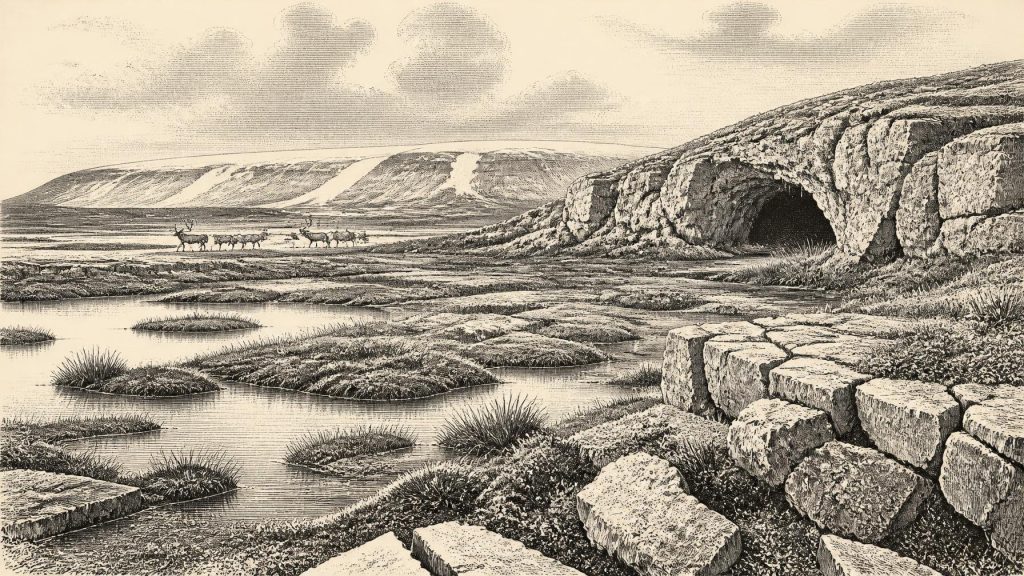
For animal life, Castlepook Cave near Doneraile in north County Cork is indispensable. The limestone maze has galleries known to earlier investigators as Elephant Hall, Hyenahall and the Gallery of Aged Carnivores. Excavations between 1904 and 1918 recovered more than 2,000 bones from deposits whose complexity is now central to their interpretation. Geological Survey Ireland describes Castlepook as Ireland’s richest cave archive for vertebrate fauna leading towards the Last Glacial Maximum. Direct dates from individual bones range widely, from about 45,700 to 19,950 years before present.
The assemblage includes woolly mammoth, giant deer, reindeer, brown bear, spotted hyena, wolf, Arctic fox and lemmings. It is a powerful corrective to the idea that Ice Age Ireland was simply empty. Reindeer and mammoth point to open grazing country; lemmings and Arctic fox point to cold conditions; predators show that herbivore carcasses and living prey formed part of a broader food web. Yet the cave was not a neat sample of an ordinary field. Hyenas could drag bones into den areas, water could move sediments, and early excavators did not have modern stratigraphic methods. Castlepook is a time-depth archive accumulated over many episodes, not a snapshot of 30,743 BCE.
The same caution affects every discussion of conflict. Predation undoubtedly shaped animal survival: hyenas, wolves and bears competed for carcasses and prey in ways that can be inferred from the fauna. But no evidence permits the translation of this ecological competition into human warfare. There are no fortifications, weapons caches, battle injuries or settlement boundaries from Ireland at this date. The island’s political history, in the usual sense of rulers, territories, diplomacy and institutions, has not yet begun in the archaeological record.
The Reindeer Femur Question
One Castlepook object makes the period unusually important for Irish human history: a reindeer femur carrying a deep linear mark that zooarchaeologist Ruth Carden has interpreted as damage made by a sharp stone implement during butchery. Public reporting associates the bone with an age of about 33,000 years. If this interpretation is sustained, it would push evidence for human activity in Ireland far back into the Upper Palaeolithic, long before the better-attested post-glacial occupation of the island.
That conclusion must be expressed narrowly. A modified bone could show that one or more people processed part of a reindeer carcass. It does not establish who those people were, whether they killed the animal, whether they entered Ireland as a group, how long they remained, or whether they returned. It does not prove a settlement at Castlepook. No securely associated hearth, stone-tool assemblage, built shelter, burial, human bone, art or repeated occupation surface of comparable age has been published from the cave.
The distinction between the bone’s date and the date of its mark matters too. A radiocarbon result estimates when the animal died, within a range. It cannot independently date a later incision. Cave deposits are especially liable to disturbance by animals, water, frost, collapse and earlier digging. Modern excavation at Castlepook has confirmed that deposits survive in parts of the system, but it has also demonstrated the hazards of mixed material: charcoal and hazelnut shell from one apparently promising layer proved modern. The marked femur is therefore a compelling lead, not a licence to invent Ireland’s first village.
Possible Lives, Missing Histories
If people did visit Ireland in this broad period, they were almost certainly mobile hunter-gatherers, using knowledge and technologies comparable in principle to Upper Palaeolithic populations elsewhere in Europe. A reindeer carcass could yield meat, fat, hide, sinew, bone and antler. Those possibilities are reasonable inferences from the animal and from wider hunter-gatherer practice, but Ireland has not supplied the accompanying tools or camp debris needed to reconstruct a local economy. There is no evidence here for farming, herding, cereal cultivation, pottery, metallurgy, long-distance exchange networks or permanent villages.
Nor is there evidence for religious practice or formal learning in Ireland at this date. Upper Palaeolithic people elsewhere created images, ornaments, musical objects and ritualised burials, but none can responsibly be assigned to an Irish population of 30,743 BCE. Cultural comparison can explain human capacities; it cannot substitute for Irish finds. The same restraint applies to language, kinship, clothing, boats and social rank. The archaeological silence is real, even if it is partly a result of glacial erosion, rising seas and the scarcity of surviving sites.
Travel remains an open question. Lower sea levels and altered coastlines made the geography of north-west Europe different from today, while ice and cold seas created formidable barriers. The animal record proves that mammal populations reached Ireland during parts of the Pleistocene, but it does not reveal a particular route used by people. There is no basis for describing a diplomatic contact, trade voyage or organised migration in this year. At most, the marked reindeer femur raises the possibility of a brief human presence at the edge of a changing Ice Age world.
A Responsible Portrait
Ireland around this nominal date was shaped less by politics than by climate, ice, water and animal movement. Derryvree preserves the environmental possibility of tundra wetlands between glacial advances. Castlepook preserves a richer but chronologically mixed record of mammals that inhabited, visited or were carried into a Cork cave over tens of thousands of years. Together they show a land with ecological complexity before the Last Glacial Maximum, not a blank space outside history.
The strongest year-by-year conclusion is also the most limited. Modern calendar-year precision is unavailable. There is no known Irish event for 30,743 BCE. There may be a tantalising trace of Upper Palaeolithic carcass processing at Castlepook, but not demonstrable continuous settlement. What can be responsibly described is an intermittently habitable, treeless and cold landscape, inhabited by remarkable animals and increasingly threatened by the expansion of ice. The evidence is fragmentary, but it is sufficient to make this deep prehistory part of Ireland’s story.
Primary Sources
- Castlepook Cave (CK032), County Cork Geological Site Report
- The Irish Quaternary Fauna Project
- A Middle Midlandian Freshwater Series at Derryvree, Maguiresbridge, County Fermanagh, Northern Ireland
- A Stratigraphic Framework for Abrupt Climatic Changes During the Last Glacial Period Based on Three Synchronized Greenland Ice-Core Records
- Growth and Retreat of the Last British–Irish Ice Sheet, 31,000 to 15,000 Years Ago: The BRITICE-CHRONO Reconstruction
- The Timing and Magnitude of the British–Irish Ice Sheet Between Marine Isotope Stages 5d and 2
- Maximum Extent and Dynamic Behaviour of the Last British–Irish Ice Sheet West of Ireland
- Character of Advance and Retreat of the Southwest Sector of the British-Irish Ice Sheet During the Last Glaciation
- New Insights on the Fauna of Ireland's Younger Dryas and Early Holocene from Alice & Gwendoline Cave
- 32564: Castlepook Cave, Coolclogh, County Cork
- Prehistoric Details: Mell Flint Flake
- Guide to the National Museum of Ireland
- Radiocarbon Dates from the Oxford AMS System: Archaeometry Datelist 31
- The IntCal20 Northern Hemisphere Radiocarbon Age Calibration Curve (0–55 cal kBP)
- Pleistocene Vertebrates in the British Isles
- Occurrence of Mammalia Relicts at Site Castlepook Cave
- Irish Quaternary Association Guide No. 16: References and Recommended Reading
- Pattern, Style and Timing of British–Irish Ice Sheet Advance and Retreat Over the Last 45,000 Years
- British–Irish Ice Sheet and Polar Front History of the Goban Spur, Offshore Southwest Ireland Over the Last 250,000 Years
- New Data for the Last Glacial Maximum in Great Britain and Ireland