Custom House1781 CE
In 1781, wartime pressures, commercial controls and constitutional unrest shaped Ireland. James Gandon began Dublin’s Custom House, a decade-long project intended to strengthen revenue collection and redirect trade eastwards along the Liffey. Embargoes, quarantine measures and maritime crime exposed ports to imperial conflict. The Protestant-led Volunteers, initially raised for defence, increasingly demanded commercial freedom and Irish legislative autonomy, while parliament acknowledged influence without granting settlement. An Armagh meeting prepared the 1782 Dungannon convention. Meanwhile, Granard founded its harp festival, supporting endangered traditional musicians. Measures associated with the parliamentary session did not establish the Bank of Ireland, which opened in 1783.
Dateline
In 1781 Ireland stood at a point of unusual tension: the kingdom was formally separate from Great Britain, with its own parliament in Dublin, yet its political and commercial freedom remained sharply constrained by Westminster, by Poynings’ Law and by the machinery of imperial government. The American war had made those contradictions harder to contain. Regular troops had been drawn away, fears of French or Spanish attack had helped to bring the Irish Volunteers into being, and the supposedly temporary citizen force had become a conspicuous voice in public affairs. Against that unsettled background, one carefully dated act of construction on Dublin’s quays announced both confidence in commerce and the reach of the state.
A New Customs Frontier
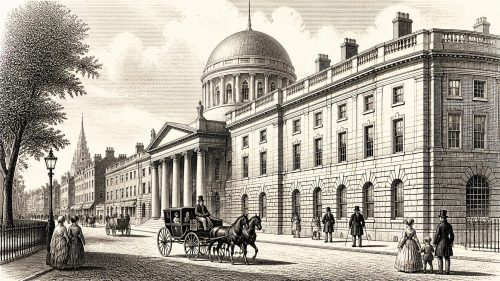
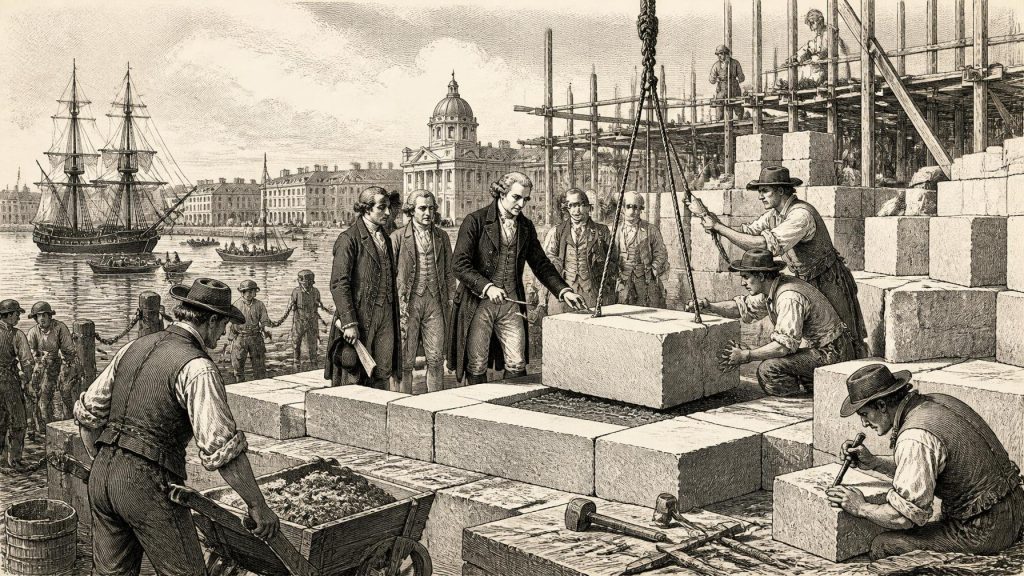
James Gandon, the English-born architect who would make Dublin his adopted home, arrived in the city in April 1781 to oversee the proposed new Custom House. The scheme was promoted by John Beresford, chief commissioner of Irish revenue. It was never merely an architectural exercise. Customs duties mattered enormously to the administration, while the location of the new building, farther east on the north bank of the Liffey, was intended to pull mercantile activity and official supervision towards the developing lower river.
The move was controversial. Merchants and Dublin Corporation had objected to transferring customs business away from the older commercial centre near Essex Bridge and Capel Street. Their resistance helps explain why Gandon’s arrival did not instantly produce a building site in full operation. Nevertheless, the chronology is unusually secure. Gandon turned the first sod on 16 July; on 8 August the foundation stone was laid. The Custom House would not be completed until 1791, so it should not be treated as a finished monument of 1781. What belonged to this year was the start of a vast project whose workshops, stonecutters, masons, carpenters and suppliers would shape the riverfront for a decade.
The named personnel convey something of that practical beginning. Henry Darley contracted for stonecutting, John Semple worked as bricklayer and mason, and Hugh Henry was appointed principal carpenter. Such work connected high architectural ambition to the skilled labour of Georgian Dublin. The eventual building would proclaim Commerce, Plenty and imperial connection in stone, but in 1781 it was still foundations, contracts, earthworks and the difficult relocation of public business. Its beginning nonetheless revealed the priorities of a revenue state: trade was to be encouraged, measured and taxed from an imposing new administrative centre.
War, Embargo and the Sea
Ireland’s ports were exposed to the wider war. Britain was fighting not only the rebelling colonies in North America but also France, Spain and, from late 1780, the Dutch Republic. On 6 January 1781 a proclamation placed an embargo on vessels in Irish ports laden with black cattle and other provisions for France, Spain and the United Provinces. This was an immediate reminder that livestock, foodstuffs and shipping were strategic assets as well as ordinary articles of commerce. It also shows why traders, farmers and port communities could experience distant diplomacy as a local constraint on markets and movement.
Official notices offer brief glimpses of other pressures at the coast. An order of 21 January sought the apprehension of people accused of boarding the Seignore Soledade in County Clare and carrying away much of its cargo. On 22 February the government lifted quarantine restrictions on ships arriving from ports around the Baltic. Neither notice tells a complete story of maritime life, but together they point to a world of wartime controls, vulnerable cargoes, disease precautions and official surveillance. For sailors, merchants, customs officers and consumers, the sea brought opportunity and insecurity in equal measure.
Religion also registered the war’s reach. A proclamation issued in January ordered a general fast throughout Ireland for 21 February. Such a day of humiliation and prayer belonged to the public culture of the established church and monarchy, intended to draw a kingdom at war into a ritual acknowledgement of danger and dependence upon providence. It did not erase Ireland’s confessional inequalities. Catholics remained excluded from the parliamentary franchise, while Presbyterians and other Protestant dissenters still faced disabilities despite the gradual loosening of some earlier restrictions. The fast was therefore a public observance in a society whose religious membership and political rights were far from equal.
Volunteers and Constitutional Pressure
The central political fact of 1781 was not a single declaration of independence but the continued growth in confidence of the Volunteers. Raised initially to defend Ireland when regular forces were scarce, the corps were locally organised, self-armed and largely Protestant in leadership and membership. Reviews, uniforms, drills and public resolutions made them highly visible. Under the general influence of Lord Charlemont, they increasingly treated commercial liberty and legislative autonomy as connected causes.
This did not mean that every Volunteer held the same programme, or that the movement represented all inhabitants of Ireland. Its social base was strongest among Protestant property holders, merchants, professionals and gentry; Catholics were still politically excluded, and many poorer people had no formal voice in the constitutional argument. Yet the movement gave organised, armed expression to an argument heard well beyond its ranks: that laws governing Ireland ought to be made by the king, lords and commons of Ireland, not imposed through British legislation.
The issue was sharpened by trade. Concessions won in 1779–80 had eased many restrictions, but they had not supplied a permanent guarantee. Irish commerce remained exposed to imperial war, to British policy and to foreign markets. In County Kerry during 1781, a jury refused to condemn a vessel carrying rum from the West Indies when the prohibition relied on by customs officers rested on a British rather than an Irish statute; the jury awarded damages against the officers. This was one local case, not a national legal revolution. Its importance lay in the principle it dramatised: the authority of external legislation was becoming difficult to enforce in Irish courts and communities.
Frederick Howard, fifth earl of Carlisle, had been lord lieutenant since late 1780, with William Eden as chief secretary. When parliament met on 9 October 1781, Carlisle faced a country in which Volunteer organisation and constitutional unease could not be ignored. The Commons thanked the Volunteers for their exertions and their loyal declarations during the recently expected invasion. The compliment was politically revealing. Government wished to retain order and discourage an independent armed force; parliamentarians could hardly deny the Volunteers’ patriotic service or their public standing.
Inside the House of Commons, ministers still possessed a working majority. Henry Grattan and Henry Flood pressed, in different styles, for stronger constitutional safeguards, including an annual mutiny bill and freedom from external legislation. Grattan also used the autumn to publish a case for legislative autonomy. No decisive constitutional settlement came in 1781. That restraint matters. The famous achievement commonly associated with ‘Grattan’s parliament’ belongs to 1782, not to this year. In 1781 the ground was being prepared through argument, mobilisation and the mounting difficulty of governing Ireland as if commercial concessions alone had settled the question.
An Armagh Invitation
The year ended with a particularly important Ulster initiative. On 28 December officers of the southern battalion of the first Ulster regiment met at Armagh, criticised the lack of attention paid by many representatives to Ireland’s constitutional rights, and invited Volunteer associations across the province to send delegates to Dungannon on 15 February 1782. The Dungannon convention itself therefore falls outside 1781. The Armagh meeting, however, is firmly part of the year and marks the transition from diffuse Volunteer opinion towards coordinated representative action.
That invitation also demonstrates the limits of simply describing the Volunteers as a military response to invasion. They were becoming a political network, using correspondence, meetings and printed resolutions to connect local companies with national questions. The coming convention would make that development unmistakable; by New Year’s Eve, its machinery had already been set in motion.
Harp Music and Public Memory
Political agitation was not the only form of organised public culture. At Granard in County Longford, the first harp festival was founded in 1781 through the support of James Dungan, a Granard man then living in Copenhagen. The event is significant because it brought traditional harpers into a public competition at a time when the old wire-strung Irish harp tradition was under severe pressure. Later accounts identify seven competitors, among them Rose Mooney, the only woman noted at the first gathering, and the harper Charles Fanning. The precise date and every detail of that first meeting are less secure than the fact of the festival’s foundation, so it is best understood as a documented cultural initiative rather than a perfectly reconstructed occasion.
Its importance reaches beyond a single prize competition. Granard’s festivals created a setting in which patrons, performers and listeners could value an older musical inheritance in public. They anticipated, without causing directly, the better-known Belfast harp meeting of 1792 and the collecting work associated with Edward Bunting. In 1781, however, the practical achievement was local and immediate: a market town in Longford became a meeting place for surviving harpers and their audiences.
A Year of Beginnings
Several statutes commonly styled as Acts of 1781 belong to the parliamentary session that opened in October but received royal assent in 1782. This includes the measure for a Bank of Ireland. It would be misleading to say that the bank began operating in 1781: it was chartered and opened only in 1783. The session did, however, indicate the administrative ambition of Carlisle and Eden’s government, which sought better public credit alongside political control.
Thus 1781 is best remembered not for a constitutional finale but for foundations of several kinds. Gandon’s stone on the Liffey began a new house for revenue and trade. The Granard festival gave public form to a threatened musical tradition. Volunteer reviews, parliamentary debate and the Armagh invitation made legislative independence a pressing political prospect. Ireland entered 1782 with no settled answer to its constitutional conflict, but with its commercial, cultural and political claims more visibly organised than before.

Primary Sources
- Custom House, Dublin, Custom House Quay
- James Gandon (1743–1823)
- Decade of Centenaries: Burning of James Gandon's Custom House, Dublin
- Bank of Ireland Act, 1781
- Bank of Ireland History
- Eden, William
- Howard, Frederick
- Caulfeild, James
- Grattan, Henry
- Flood, Henry
- Habeas Corpus Act, 1781
- Dublin Leases Act 1781
- Statute Law Revision Act 2015
- Part 12 of History of the Commercial and Financial Relations Between England and Ireland from the Period of the Restoration
- Meeting Ireland's Terms
- Granard Harp Festival
- The Irish Harpers in Belfast in 1792
- Statutes Passed by the Irish Parliament, 1692–1800: Relief of Protestant Dissenters
- The Dublin Gazette, Number 4071: Tuesday, 18 December 1781 to Thursday, 20 December 1781
- History: Ireland 1778–1803
- Carlisle Manuscripts: Catalogue Search
- The Irish House of Lords, 1780–1800: Politics and Ideology