Smerwick Landing1579 CE
In 1579, a small landing at Smerwick transformed Munster’s unrest into an international Catholic challenge to Elizabeth I’s government. James fitz Maurice FitzGerald returned from continental exile with Spanish and Italian soldiers, papal support and hopes of assistance. Their limited force mattered chiefly for the alliances and expectations it represented. Local grievances could now connect with European religious conflict. Gerald FitzGerald, earl of Desmond, hesitated before entering open rebellion, widening the crisis. The year marked the beginning of the Second Desmond Rebellion, linking regional lordship, exile politics and overseas intervention in a struggle with increasingly destructive consequences for Munster’s communities.
Dateline
In 1579 a small landing on the Kerry coast turned Munster into the centre of a new and far more dangerous phase of resistance to Elizabeth I’s government in Ireland. The immediate military force was tiny. Its significance lay instead in the connections it represented: an Irish exile returned from Europe, Spanish and Italian soldiers, papal money and religious encouragement, and the possibility that local discontent might join an international Catholic war against the English crown. By the end of the year, the hesitant Earl of Desmond had himself crossed into open rebellion. What began at Smerwick harbour became the opening crisis of the Second Desmond Rebellion.
A Landing at Smerwick
James fitz Maurice FitzGerald was a kinsman of Gerald FitzGerald, Earl of Desmond, and a veteran of the earlier Desmond rising. After leaving Ireland in 1575, he had spent years seeking assistance in France, Spain, Portugal and Rome. His project mixed several aims which were inseparable in the politics of the time: recovery of Geraldine influence, resistance to expanding royal government, and defence of Catholic worship against the religious settlement imposed by the English crown.
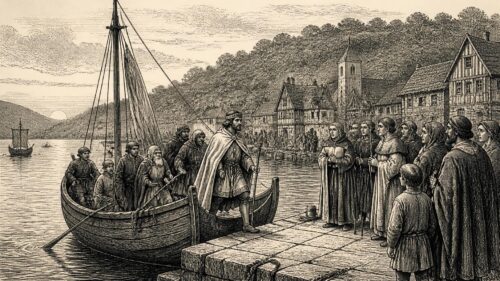
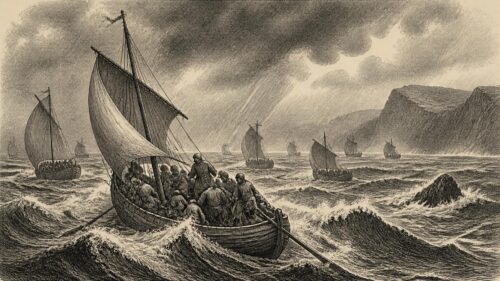
On 17 June 1579 Fitzmaurice sailed from Ferrol in Galicia with Nicholas Sander, an English Catholic priest and polemicist, and a handful of ships. The expedition had papal financial support, but Spain avoided open commitment. Contemporary and near-contemporary accounts differ in detail, but agree on the crucial fact: the company was far smaller than the continental army its organisers had hoped to bring. It included only some scores of foreign soldiers, chiefly Spanish and Italian, rather than the substantial intervention needed to transform the balance of power in Ireland.
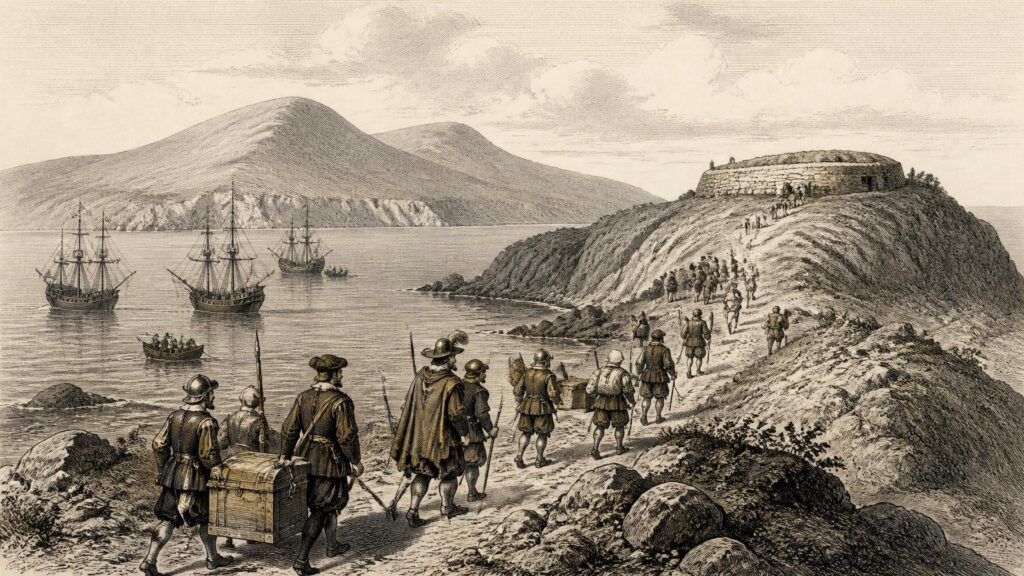
The flotilla reached the Kerry coast at Dingle on 17 July. On the following day Fitzmaurice’s party established itself at Dún an Óir, the promontory fort at Smerwick harbour on the Dingle peninsula. The sheltered Atlantic harbour and defensible headland made practical sense for men expecting further shipping and reinforcements. Yet the site also exposed the venture’s weakness. A maritime foothold could be held only if Irish allies gathered quickly, food was secured, and the sea route remained open.
Sander wrote in the name of the expedition to leading Catholic lords, inviting them to make common cause for religion and country. The letters gave the arrival a political reach well beyond Kerry. But few magnates came forward at once. Many had reason to resent the crown’s officials and the growth of garrisons, sheriffs and English legal authority; few were ready to gamble their lands and households on an under-strength force whose promised foreign support had not appeared. The expedition was therefore a spark, not an army capable by itself of conquering a province.
The Geraldine Country Moves
The first decisive local recruits were members of the Desmond family. On 1 August Sir John FitzGerald, the earl’s brother, and Sir James FitzGerald attacked a party at Tralee and killed Sir Henry Davells, constable of Dungarvan, with numerous companions. The episode was shocking even by the harsh standards of contemporary campaigning, since the victims were surprised while sleeping. Politically, it mattered because it committed prominent Geraldines beyond easy retreat and brought their followers, retainers and military clients into the rising.
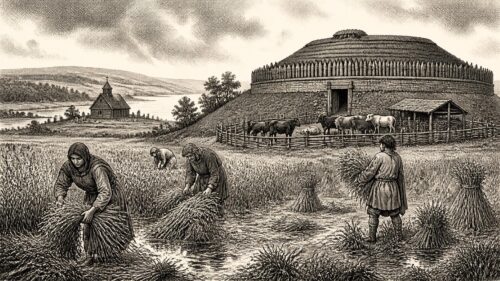
The affair also reveals how warfare touched ordinary communities. A lord’s military power did not consist only of castle walls or armoured gentlemen. It depended on tenants, kinsmen, mercenary gallowglass, light-armed kern, horsemen, food stores and cattle. Men moved through wooded country and across lordship boundaries; houses, corn and livestock could be seized to sustain a force or deny supplies to an opponent. In a countryside where a harvest, a herd or a mill mattered directly to survival, raids were attacks upon the social and economic foundations of households as much as displays of martial strength.
Fitzmaurice himself did not live to direct the revolt for long. On 18 August he was mortally wounded in a clash with the Burkes of Clanwilliam, apparently after his party had taken horses. Later Irish annals preserve a dramatic account of his resistance and of his followers concealing his head after death; English authorities recovered his body and displayed its dismembered remains as a warning. The precise narratives are shaped by hostile and sympathetic traditions, but the date and consequence are secure. The man whose continental diplomacy had made the landing possible was dead within a month of reaching Ireland.
His death did not extinguish the rebellion. Indeed, it demonstrated that the crisis had moved beyond one leader’s personal following. Sir John FitzGerald remained active, while Sander continued to supply the rebellion with an ideological language that linked Catholic allegiance to opposition to Elizabeth’s rule. The rising was never simply a religious war: dynastic rivalry, land, office, local grievances and the defence of regional autonomy were all involved. Religion nonetheless gave the movement an international horizon and made it especially alarming to English officials already anxious about Spain, the papacy and the wider European conflict.
Drury’s Failed Accommodation
Sir William Drury, lord justice and president of Munster, faced an acute shortage of reliable force and an even more difficult political problem: how to prevent the Earl of Desmond from joining his rebellious relatives. Gerald had not initiated the Smerwick landing. He initially protested loyalty and sought to avoid being held responsible for Fitzmaurice or his brothers. That position was plausible only while government officers treated him as a powerful subject to be managed rather than as an enemy already condemned.
In early September Drury met Desmond at Kilmallock. The earl surrendered his only son and heir as a hostage, a grave personal and dynastic guarantee of obedience. In return, he expected that his lands and people would not be ravaged. The later Annals of the Four Masters, writing from an Irish perspective, specifically record that cattle were destroyed and corn and buildings burned despite this assurance. The annals were compiled decades after 1579 and must not be read uncritically, but their emphasis corresponds with the practical logic of the war: devastation was becoming an instrument of government as well as rebellion.
Drury’s effort at accommodation rapidly collapsed. In mid-September royal troops suffered a serious reverse in the wooded country around Springfield in County Limerick, where several captains and many soldiers were reported killed. Drury’s health failed soon afterwards. He was carried to Waterford and died there on 3 October. His death removed the official most committed, however imperfectly, to keeping Desmond from open revolt, and it left Munster policy in the hands of men more willing to use coercion.
Religion was also made brutally visible that summer. Patrick O’Healy, Catholic bishop of Mayo, and the Franciscan friar Conn O’Rourke had arrived in Ireland in connection with the same Catholic networks surrounding Fitzmaurice. Arrested in Munster, they were interrogated and executed at Kilmallock in August; the surviving evidence places the executions between 10 and 22 August rather than allowing a wholly certain day. Later Catholic memory honoured them as martyrs. Their deaths show that allegiance to Rome was treated by the authorities not merely as a matter of private belief, but as a potential channel of political and foreign-backed rebellion.
Desmond Declared
Sir William Pelham was chosen lord justice on 11 October. He reached Cashel and opened negotiations with Desmond later that month, but the terms offered were demanding and distrustful. Desmond was ordered to appear by the morning of 2 November. When he did not, he was proclaimed a traitor. The proclamation made a negotiated return to loyalty vastly harder, while the pressure placed on his lordship — including the burning of his principal seat at Askeaton by Sir Nicholas Malby’s forces — helped drive him towards the insurgents.
On 13 November Desmond’s followers sacked Youghal, the walled port on the Blackwater estuary. This was a strategically charged target. Youghal was a centre of maritime trade, customs, imported wine and English civic influence in east Cork; it was also bound up with Desmond’s long-running disputes with the Butler earls of Ormond over the valuable prise of wines passing through Youghal and Kinsale. The assault brought killing, plunder and damage to the town’s defences, which later records describe as having been levelled during the rebellion. It announced that the earl, formerly the figure whom officials had hoped to detach from the crisis, now stood at its head.
By year’s end, conflict had spread through the Geraldine heartlands of Kerry, Limerick and Cork and was drawing in neighbouring lordships. Thomas Butler, Earl of Ormond, returned to Ireland in the autumn and became central to the crown’s response. His subsequent campaigning, like that of the crown’s captains, relied upon burning, seizure and the destruction of food resources. For civilians, the distinction between a royal punitive march and a rebel foray could make little difference: both threatened shelter, livestock, standing crops and the fragile security of market towns and rural settlements.
There is no responsible basis for attaching a major literary, educational or artistic event to Ireland specifically in 1579. The year’s surviving record is overwhelmingly one of war, diplomacy and religion. Yet its importance is plain. The landing at Smerwick showed that Ireland’s conflicts could be entangled with Catholic Europe; the killing at Tralee and the sack of Youghal showed how quickly regional politics could become violence; and the fate of Desmond showed the failure of a policy that tried to combine hostages, negotiation and military pressure. In 1579 Munster did not merely witness a rebellion. It entered a conflict that would remake its political landscape and inflict devastating human costs over the years ahead.

Primary Sources
- Fitzgerald, James fitz Maurice
- Fitzgerald, Gerald fitz James
- Drury, Sir William
- Pelham, Sir William
- Sander (Sanders), Nicholas
- O'Healy, Patrick
- O'Rourke, Conn
- Fitzgerald, Sir John fitz James
- Malby, Sir Nicholas
- Butler, Thomas
- Annals of the Four Masters, Part 8
- Annals of the Four Masters: Editorial and Bibliographical Information
- The Walsingham Letter-Book
- Calendar of the State Papers relating to Ireland, 1574–1585
- State Papers Foreign, 1509–1782: Government Papers on Foreign Affairs
- Political History in the Early Modern Era: An Overview
- Add MS 48015: British Library Archives and Manuscripts Catalogue
- British History Online: Institute of Historical Research
- Ireland under the Tudors, Volume III
- Youghal, Irish Historic Towns Atlas, No. 27
- Chapter 5: ‘War upon the rebel’
- Review of The Walsingham Letter-Book or Register of Ireland, May 1578 to December 1579
- State Papers Domestic 1547–1649: Tudor and Stuart Government Papers
- A Calendar of Manuscript Material Relating to Ireland, 1580–1602