Desmond Capture1370 CE
In 1370, Brian Sreamhach Ó Briain defeated and captured Gerald FitzGerald, earl of Desmond, near Monasternenagh, then pressured Limerick, which was burned and briefly placed under Mac Conmara control. King’s lieutenant William of Windsor secured Desmond’s release, recovered the city and agreed reparations of cattle and timber. His government, hampered by inadequate funds, also faced fighting in Wicklow. Elsewhere, Niall Mór Ó Néill consolidated Tyrone through hostages, land grants, marriage and victory over Brian Mór Mac Mathghamhna. Captures, succession disputes and raids in Breifne and Leinster further demonstrated that Irish power rested on local alliances, coercion, resources and negotiated settlements.
Dateline
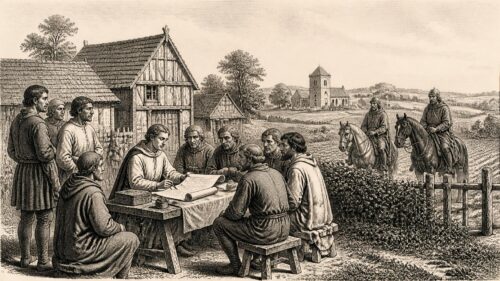
In 1370, military reverses and negotiated settlements showed how little of Ireland could be governed from one centre. The English crown’s administration still claimed an island-wide lordship, but its effective authority depended on the resources, loyalties and local knowledge of magnates, towns and ecclesiastics. Across Gaelic Ireland, meanwhile, kings and leading kindreds secured power through hostage-giving, marriage, clientship, castles and armed followings. The year’s best-attested events range from a major crisis around Limerick to rivalries in Tyrone, Oriel and Breifne. Together they reveal a political landscape in which control of a town, a river crossing or a captive lord could matter more than distant constitutional claims.
Battle at Monasternenagh
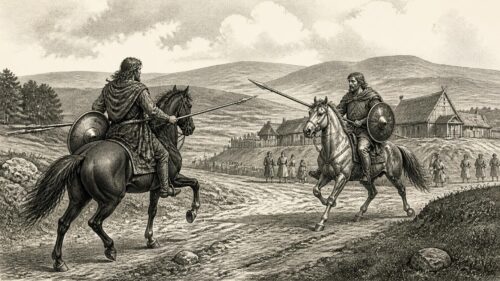
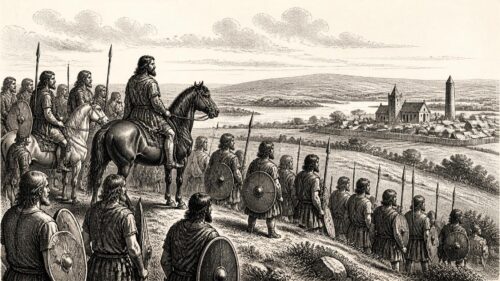
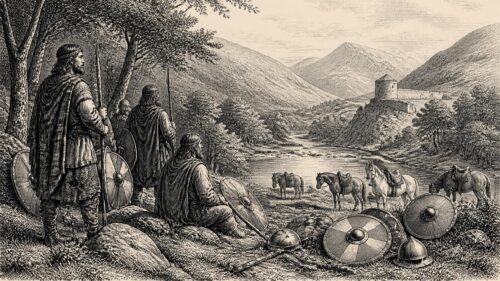
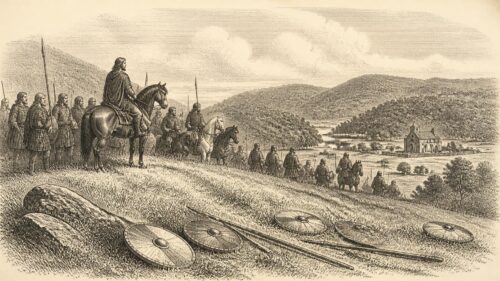
The year’s most consequential southern event was the defeat and capture of Gerald FitzGerald, third earl of Desmond, by Brian Sreamhach Ó Briain, king of Thomond. The encounter took place near the Cistercian abbey of Monasternenagh, close to the River Maigue in County Limerick. The precise day is reported differently in modern accounts drawing on medieval evidence, as either 10 or 11 July; the battle itself, its location and Desmond’s capture are secure. Gaelic annals describe an exceptionally heavy defeat for the Munster English, while later historical analysis cautions that such language is rhetorical even where the scale of the shock is unmistakable.
The combatants were not neatly divided into modern national camps. Brian Sreamhach led the Ó Briain power of Thomond and was supported by Mac Conmara allies. Desmond was an Anglo-Irish earl whose lordship extended through much of Munster, but whose political life was conducted in an Irish world of shifting alliances, Gaelic speech and regional warfare. His capture was therefore a severe personal and strategic blow, rather than simply a defeat for an outside invader. A leading magnate had been removed from the field, and the balance of power around the Shannon altered abruptly.
Monasternenagh was itself an eloquent setting. Founded in the twelfth century under Ó Briain patronage, it was a Cistercian house with deep connections to the rulers of Thomond. Its presence reminds us that church lands and religious communities stood within, rather than apart from, the political geography of medieval Ireland. There is no reason to treat the abbey as a battlefield fortress in 1370, but a confrontation beside such a prominent religious institution placed warfare amid cultivated estates, roads, tenants and ecclesiastical interests.
Limerick Under Pressure
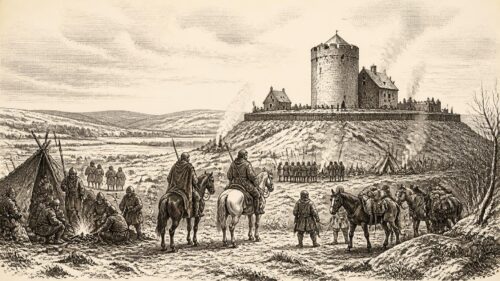
The victory was followed by an Ó Briain advance upon Limerick. The annalistic accounts state that the city was burned and submitted to Brian, who installed Shíoda Óg Mac Conmara as warden. This was a sharp demonstration of Gaelic military reach into one of the English lordship’s principal walled ports. Limerick’s importance lay not merely in its defences: it connected the Shannon estuary, the commercial life of Munster and the routes between Thomond and the lands east of the river. Holding or threatening it could disrupt trade, rents, supplies and the prestige of royal government.
Yet occupation did not produce permanent control. Once the main Ó Briain force had withdrawn, the town’s English inhabitants killed Mac Conmara. Sir William of Windsor, the king’s lieutenant in Ireland, had already been compelled to abandon an early-summer campaign in Wicklow and march south. He secured Desmond’s release by 8 August, based himself at Adare, and assembled support among factions hostile to Brian. The available evidence suggests that royal forces and their allies recovered Limerick only late in November, a date that should be treated as probable rather than exact.
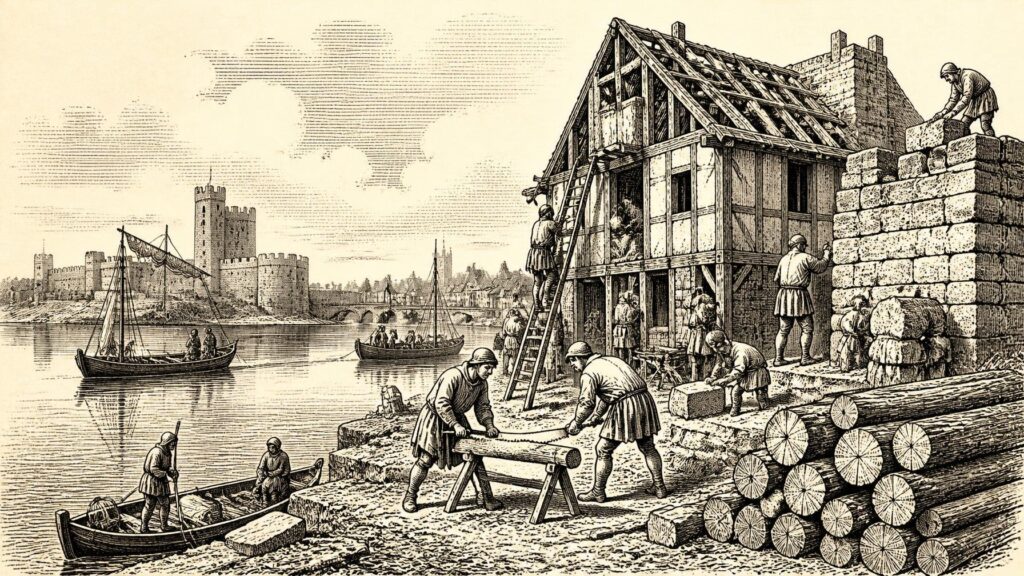
The settlement that followed gives unusually tangible evidence of the crisis’s material consequences. On 15 December Windsor made terms with John Mac Conmara. Mac Conmara was to remain west of the Shannon and not interfere with Limerick’s people; reparations were set at 1,000 fat cattle and 1,000 trees for rebuilding. Those terms were both punitive and practical. Cattle were portable wealth, food and the basis of lordly provisioning. Timber was essential to repair houses, defences, wharves and other structures damaged in the fighting. The agreement did not erase the rivalry between Thomond and the English of Munster, but it set a boundary intended to make urban recovery possible.
Windsor’s Strained Government
The Munster emergency exposed the limits of Windsor’s administration. He had arrived as lieutenant in 1369 with promises of financial support from England, but the wider Anglo-French war restricted what the crown could send. In Ireland he sought additional taxation and summoned a parliament at Dublin in April 1370. His heavy fiscal demands had already caused serious resentment among the English communities of the lordship. Military campaigning required paid troops, transport, victuals and garrisons; the government’s weakness was inseparable from its chronic shortage of revenue.
Before news from Munster drew him south, Windsor had campaigned against the Uí Thuathail or O’Tooles in the Wicklow mountains. During the summer, the Uí Bhroin or O’Byrnes seized Wicklow and Newcastle McKynegan castles and razed Wicklow town before the fortresses were recovered. These events should not be read as a single co-ordinated Irish revolt. Rather, they show several regional powers exploiting a government whose attention and military resources were finite. For residents of the marches, the practical effects included disrupted cultivation, insecurity on roads and the demand to support armed men.
Hostages and Hegemony in the North
Far north of Limerick, Niall Mór Ó Néill strengthened his position in Tír Eógain. The annals record a “firm and sincere peace” among the Cenél nEógain in which Domnall Ó Néill acknowledged Niall’s lordship and gave hostages as guarantees that he would not contest it. Niall, in return, granted Domnall a share of territory. This was not submission in a modern bureaucratic sense. It was a negotiated settlement within a ruling kindred, secured by persons whose custody guaranteed performance and by a redistribution of land and authority.
The agreement was soon tested by conflict with Brian Mór Mac Mathghamhna, king of Airgíalla or Oriel. Niall defeated Brian, and the Annals of the Four Masters emphasise losses through both killing and drowning. The exact site and circumstances are not supplied in that entry, so it would be unsafe to reconstruct the battle beyond its reported outcome. Brian was not eliminated: he recovered sufficiently to remain a troublesome neighbour until his assassination in 1372. But the defeat checked a ruler whose sons had raided the lands of the archbishopric of Armagh that same year, revealing how secular contest could directly endanger ecclesiastical property.
The Tyrone settlement also had a dynastic dimension. Around 1370 Niall Mór divided Tyrone with his brother Domnall and arranged the marriage of his son Niall Óg to Domnall’s daughter Úna. Such marriages were instruments of political ordering as well as family occasions. They created obligations between branches of a ruling house, while hostage arrangements and territorial grants supplied more immediate safeguards. In this setting, diplomacy, kinship and armed force were inseparable.
Captives, Succession and Local War
Other annalistic notices reveal the same political habits at a smaller scale. In Breifne, Manus Ó Raghallaigh was taken by rival members of his own extended family and confined in the castle of Cloughoughter on Lough Oughter. A lake castle was not simply a residence: it was an instrument for holding captives, commanding water routes and enforcing a contested succession. Teige Ó Ruairc likewise briefly assumed the lordship of Breifne, only to be expelled by the Clann Murchadha, Mac Tiernan and another rival claimant, and driven into the territory of Mac William Burke. Lordship could be claimed, but it had to be defended through allies and access to refuge.
In Leinster, Cahir Ó Conchobair, heir of Offaly, and Muircheartach Ó Mordha were killed while on a predatory expedition against the English of Leinster. The brief notice does not permit a fuller narrative, but it underlines the everyday military economy of raiding: livestock, goods and retaliatory violence moved across frontier zones, and heirs as well as established rulers were exposed to its dangers. The death of William Donn Burke, son of Uilleag Burke, in the same year is another reminder that changes in leading families continually reopened questions of inheritance and influence.
A Year of Contested Repair
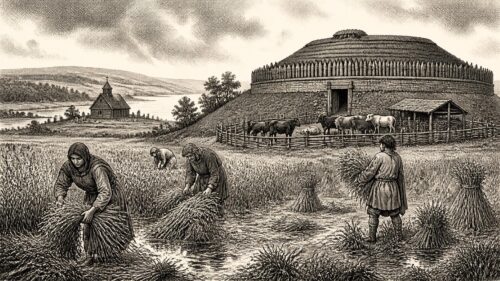
1370 was not a year in which one side decisively mastered Ireland. Brian Sreamhach’s triumph at Monasternenagh and the burning of Limerick demonstrated the renewed strength of Thomond; Windsor’s recovery of the city and December agreement demonstrated that the English administration could still mobilise allies and impose terms. In the north, Niall Mór’s compact with Domnall and victory over Mac Mathghamhna show a comparable combination of bargain and coercion. The evidence chiefly preserves rulers, castles and battles, but the cattle, timber, hostages and damaged town embedded in those records point towards the wider population who bore the costs of rivalry and whose labour made political recovery possible.
Source References
Hover over a number to see the source. Select it to open the source.

- [1] Annals of the Four Masters, Part 20: Annal M1370
- [2] Annals of the Four Masters, Volume 3 English Translation
- [3] Annála Connacht
- [4] Annála Connacht, Part 147: Annal 1370
- [5] The Annals of Ulster, Part 175: Year U1370
- [6] The Annals of Ulster, Volume 3 English Translation
- [7] Annals of Loch Cé A.D. 1014–1590
- [8] Windsor, William
- [9] O'Brien (Ó Briain), Brian Sreamach
- [10] FitzGerald, Gerald fitz Maurice (‘Gearóid Iarla’)
- [11] MacMahon (Mac Mathghamhna), Brian Mór
- [12] O'Neill (Ó Néill), Niall Óg
- [13] FitzGerald, Maurice fitz Thomas
- [14] Monasteranenagh Cistercian Abbey
- [15] Monasteranenagh Abbey, Monasteranenagh, Limerick
- [16] Annals of the Kingdom of Ireland: Library Catalogue Table of Contents
- [17] Add MS 40674: Annals of Ireland, 1162–1370
- [18] Crisis and Survival in Late Medieval Ireland: The English of Louth and Their Neighbours, 1330–1450, Chapter 2
- [19] The Earls of Desmond in the Fourteenth Century
- [20] Representation and Dissent: ‘Parliamentarianism’ and the Structure of Politics in Colonial Ireland, c.1370–1420
- [21] HRA Planning Chapter Eight: Cultural Heritage and Archaeology
- [22] Exploring the Irish Annals
Primary Sources
- Annals of the Four Masters, Part 20: Annal M1370
- Annals of the Four Masters, Volume 3 English Translation
- Annála Connacht
- Annála Connacht, Part 147: Annal 1370
- The Annals of Ulster, Part 175: Year U1370
- The Annals of Ulster, Volume 3 English Translation
- Annals of Loch Cé A.D. 1014–1590
- Windsor, William
- O'Brien (Ó Briain), Brian Sreamach
- FitzGerald, Gerald fitz Maurice (‘Gearóid Iarla’)
- MacMahon (Mac Mathghamhna), Brian Mór
- O'Neill (Ó Néill), Niall Óg
- FitzGerald, Maurice fitz Thomas
- Monasteranenagh Cistercian Abbey
- Monasteranenagh Abbey, Monasteranenagh, Limerick
- Annals of the Kingdom of Ireland: Library Catalogue Table of Contents
- Add MS 40674: Annals of Ireland, 1162–1370
- Crisis and Survival in Late Medieval Ireland: The English of Louth and Their Neighbours, 1330–1450, Chapter 2
- The Earls of Desmond in the Fourteenth Century
- Representation and Dissent: ‘Parliamentarianism’ and the Structure of Politics in Colonial Ireland, c.1370–1420
- HRA Planning Chapter Eight: Cultural Heritage and Archaeology
- Exploring the Irish Annals