Ballyshannon Victory1359 CE
In 1359 Cathal Óg Ó Conchobair defeated Cenél Conaill at Ballyshannon, capturing leading men and extending warfare into Tír Chonaill. The battle affected regional lordly networks across Connacht, Donegal and Breifne; the wounded claimant Matha Mag Samradháin later died. Ransom negotiations linked the victory to the transfer of Lebor na hUidre and Leabhar Gearr, demonstrating manuscripts’ political and learned value. In Desmond, Cormac Mac Carthaigh Mór died during a siege, succeeded by Domhnall Óg. Other deaths highlighted contested succession, while eminent judge Aed Mac Aedacáin’s death marked legal learning’s importance. James Butler became chief governor, reflecting Ireland’s divided political authority.
Dateline
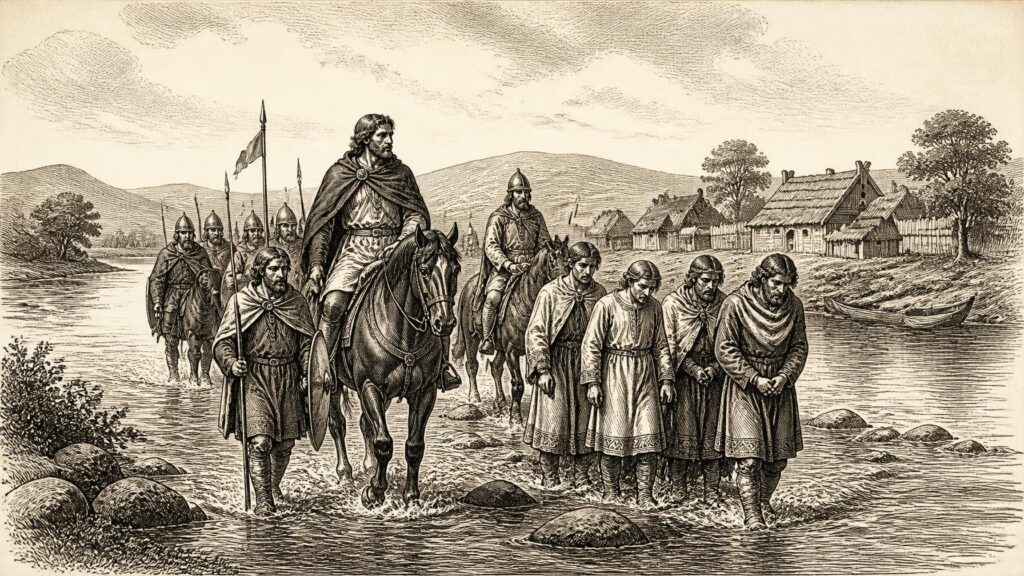
In 1359, the most clearly recorded Irish military event was a victory at Ballyshannon, or Áth Seanaigh, where Cathal Óg Ó Conchobair defeated forces of Cenél Conaill. The encounter belonged to the intensely local but far-reaching politics of the north-west: control of routes along the Erne, relationships between Connacht and Tír Chonaill, and the standing of leading kindreds whose authority depended on followers, hostages, cattle, land and reputation. Its consequences reached beyond the battlefield. Prisoners taken there became part of ransom negotiations, and a later manuscript note connects those negotiations with the movement of one of Ireland’s greatest surviving books.
A Connacht Victory at Áth Seanaigh
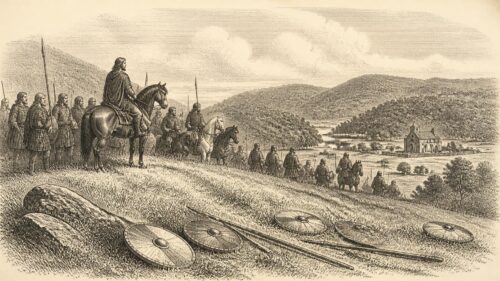
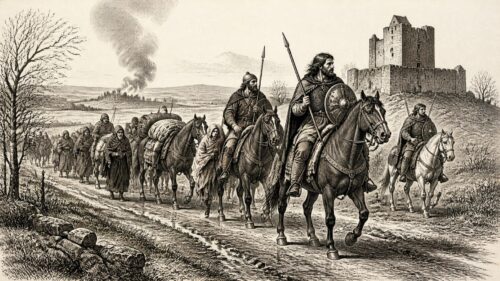
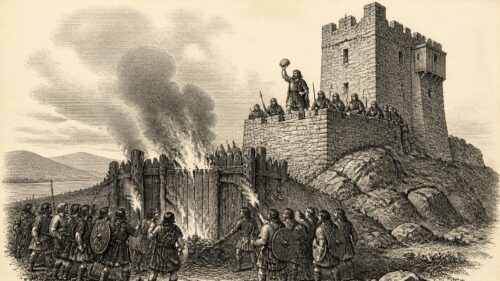
Annála Connacht, the fullest contemporary-style narrative for the year, states that Cathal Óg Ó Conchobair inflicted a severe defeat on Cenél Conaill at Ballyshannon. The annal does not supply a day, season, troop numbers, tactical description or a total of the dead. Those details should not be invented. It does, however, name prisoners of high status: Seoán Ó Dochartaigh, chief of Ardmire; Eogan Connachtach; and Toirrdelbach Mac Suibhne. It also says that there was great slaughter. The capture of such men mattered as much as the killing. In a political order held together by kinship, service and negotiated superiority, a captive lord or captain was a bargaining asset and a public demonstration of defeat.
Cathal’s opponents are called Cenél Conaill, the population and political community centred on Tír Chonaill in what is now much of County Donegal. The Ó Domhnaill were its leading dynasty, but the annal’s named captives show that power was distributed among allied or subordinate kindreds as well. Ó Dochartaigh’s position in Ardmire, and Mac Suibhne’s prominence, indicate that the engagement brought together figures whose influence extended across the northern seaways and inland lordships. Ballyshannon was a meaningful place for such a contest: it lay at the Erne’s outlet and on the threshold between Connacht and Tír Chonaill. Yet the evidence does not justify portraying it as a battle for all Ulster, or as a simple clash of two modern counties. It was a struggle between lordly networks whose territories overlapped, shifted and depended on personal allegiance.
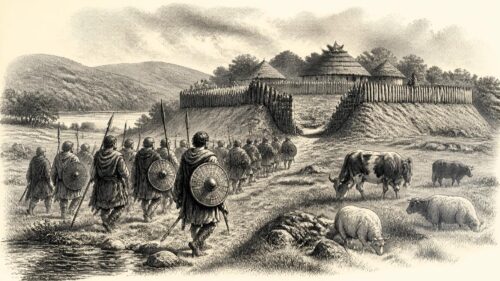
The annal gives the victory to Cathal Óg, son of Cathal Ó Conchobair. Later evidence identifies him with the Ó Conchobair Sligigh line, an important Connacht dynasty. His success was not apparently confined to one encounter. In the same year’s entry, he leads another hosting into Tír Chonaill. Some of his followers entered the territory of Ó Gairmleadhaigh. There Cathal Bodhar Ó Ruairc was killed by Maelsechlainn Ó Gairmleadhaigh, who was in turn killed in the same fight by Tigernán Ó Ruairc. The compressed wording does not permit a reconstruction of every alliance or manoeuvre, but it preserves the essential point: warfare continued after Ballyshannon, drawing in men from Breifne as well as Connacht and Tír Chonaill.
One casualty illuminates the human cost behind the annalists’ formulae. Matha Mag Samradháin, described as a possible or prospective chief of Tullyhaw, was wounded at Ballyshannon and died after reaching home. The phrase marks him as an heir or leading candidate rather than securely the ruling chief. His death could therefore alter a succession as well as deprive a fighting force of a commander. In a society where lordship was commonly contested among eligible members of a ruling kindred, the loss of such a man was political as well as personal.
Captives, Ransom and a Great Manuscript
The battle’s most remarkable afterlife lies in the history of Lebor na hUidre, the Book of the Dun Cow. Written around 1100 and associated with Clonmacnoise, it is the earliest surviving manuscript composed wholly in Irish. It preserves an exceptional collection of prose, poetry, religious material and saga, including texts associated with the Táin Bó Cúailnge. By 1359, therefore, it was already an old and prestigious object: not merely a book to be read, but a portable store of learned authority and ancestral culture.
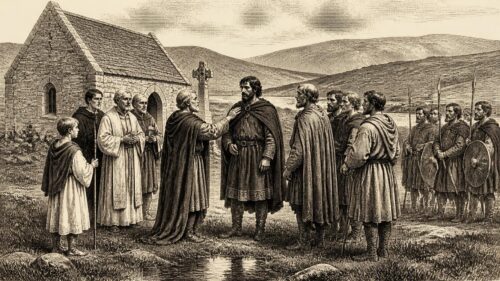
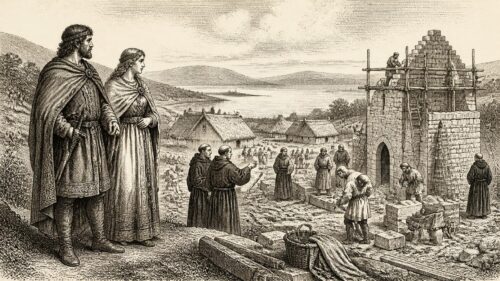
A later note in the manuscript itself records that Lebor na hUidre and a now-lost companion volume, the Leabhar Gearr, passed from the Ó Domhnaill sphere into Connacht in connection with Cathal Óg. The note says that the Leabhar Gearr went as ransom for Ó Dochartaigh, while Lebor na hUidre went for the release of the son of the Ó Domhnaill ollamh, or chief learned man, in history; that son had been taken by Cathal as a pledge from Cenél Conaill. The Irish Script on Screen description of the manuscript explicitly connects this account with Cathal’s capture of Seoán Ó Dochartaigh at Ballyshannon in 1359.
This evidence needs careful handling. The manuscript note is later than the battle, and its wording has required editorial correction in identifying the relevant Ó Domhnaill ruler. It should not be treated as a verbatim campaign diary. Nevertheless, it offers unusually direct testimony to the social meaning of the 1359 victory. Captives could be redeemed not only with livestock, coin or land, but with objects of intellectual and symbolic value. The transfer of a manuscript also reveals the standing of hereditary learned families. An ollamh in history was not an incidental scribe: historical learning, genealogy and the preservation of precedent were resources of lordship.
The episode does not mean that books were routinely exchanged after every raid, nor that literacy was widespread among the population. It does show that elite warfare and learned culture were not separate worlds. A manuscript could travel because a military victory created an obligation to ransom prisoners. In time, this particular book remained associated with Connacht before being recovered for the Ó Domhnaill in 1470. Thus a brief annal entry for 1359 helps explain one stage in the long and otherwise improbable survival story of a manuscript now central to the study of medieval Irish literature.
Deaths and Succession in Desmond
While the north-west was shaken by Cathal Óg’s advance, the annals record a major death in the south. Cormac Mac Carthaigh Mór, king of Desmond, died in 1359. The bare annalistic notice is expanded by later historical reconstruction: he died while besieging a castle belonging to the Uí Chairbre. The site and circumstances should not be embellished beyond that. What is clear is that Cormac’s death ended a reign conventionally dated from 1328 and brought his son Domhnall Óg Mac Carthaigh Mór to the kingship.
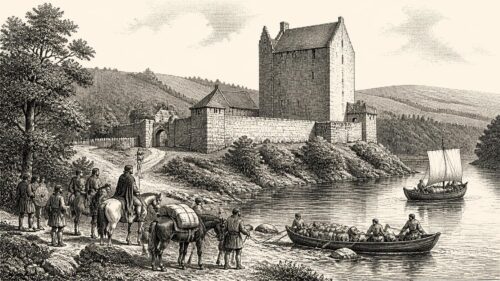
Cormac’s career reflects the fractured political landscape of Desmond. The Mac Carthaigh Mór remained kings of Desmond in Gaelic political language, but their authority had been reduced by rival branches of their own dynasty, by neighbouring Gaelic lords and by the Anglo-Irish earls and landholders of Munster. His succession in 1359 was therefore important, but it did not create a unified southern kingdom. Domhnall Óg’s long reign after 1359 is sparsely documented, itself a warning against filling the silence with assumptions of either stability or collapse.
Other entries underline how often politics turned on violent death and uncertain succession. Murchad Óg Mac Mathghamhna, a prospective ruler of Corca Baiscinn, was killed by the Síol mBriain. Brian Mac Donnchadha, a possible lord of Tír Fhiachrach or Tirerrill, was killed by Mac Sencha in the council of Ó Gadhra. Henry, son of Ulick son of Richard de Burgh, died. These notices are fragmentary, but together they show a political world in which the passing of a claimant, counsellor or dynast could change the balance within a lordship without appearing as a single national event.
Law, Learning and the Lordship Government
The Annals of the Four Masters also record the death of Aed mac Conchobair Mac Aedacáin, praised as one of the foremost judges of Ireland. The formula is brief but significant. It points to the continued prestige of professional legal learning within Gaelic society. Law was transmitted and applied through learned specialists, kin-based jurisdictions and recognised legal families; it was not absent simply because the island lacked a single effective government. Aed’s death is one of the few securely year-linked reminders that 1359 was not only a year of fighting, but of the loss of expertise on which settlements, inheritance and authority depended.
At the same time, the English lordship retained an institutional centre in Dublin. James Butler, second earl of Ormond, became chief governor in March 1359 and remained in office into 1360. His appointment did not make him ruler of all Ireland. Crown administration was strongest in and around the towns, lordships and routes where it could draw revenue, command service and maintain castles; beyond these areas, its authority depended on negotiation, military expeditions and the cooperation of local magnates. The coexistence of Butler’s government with Cathal Óg’s independent campaigning is a useful measure of Ireland’s political plurality.
Nothing securely dated to 1359 warrants a sweeping claim of island-wide famine, plague, religious reform, commercial transformation or environmental disaster. The surviving record is selective: annals favour lords, killings, successions and memorable transactions, while administrative records preserve a different, narrower view from the English lordship. But the year is not empty. Ballyshannon shows military power exercised through captives and follow-on hostings; the ransom of Lebor na hUidre shows learning entering the economy of lordship; and deaths from Donegal to Desmond show how succession remained a continual source of change. In 1359, Ireland’s history was made not at one national centre, but in the connected local worlds of ford, castle, household, manuscript and court.
Source References
Hover over a number to see the source. Select it to open the source.

- [1] Annála Connacht: Annal 1359
- [2] Annála Connacht
- [3] Annals of the Four Masters, Part 19
- [4] Annals of the Four Masters, Irish Text, Part 19
- [5] Annals of the Four Masters: Volume 3
- [6] Annals of Ulster, AD 1202–1378
- [7] Cormac MacCarthy Mór (Mac Carthaigh Mór), King of Desmond
- [8] Domhnall Óg MacCarthy Mór (Mac Carthaigh Mór), King of Desmond
- [9] James Butler, Second Earl of Ormond
- [10] Thomas Rokeby
- [11] Irish Script on Screen: RIA MS 23 E 25, Leabhar na hUidre
- [12] Lebor na hUidre: Digitised Edition and Bibliography
- [13] Lebor na hUidre, National Library of Ireland Catalogue Record
- [14] Book of the Dun Cow/Lebor na hUidre
- [15] Codices Hibernenses Eximii I: Lebor na hUidre
- [16] Calendar of Ormond Deeds, Volume II, 1350–1413
- [17] The Annals of Ulster, CELT English Edition
- [18] Calendar of the Close Rolls, Edward III, 1354–1360
- [19] Calendar of Patent Rolls, Edward III, 1358–1361
- [20] English Rule in Ireland, c.1272–c.1315
- [21] The English Lordship of Ireland and the Irish Sea World
- [22] The English Lordship of Ireland and the Irish Sea World: Article PDF
- [23] Lebor na hUidre: Historical Introduction and Notes
Primary Sources
- Annála Connacht: Annal 1359
- Annála Connacht
- Annals of the Four Masters, Part 19
- Annals of the Four Masters, Irish Text, Part 19
- Annals of the Four Masters: Volume 3
- Annals of Ulster, AD 1202–1378
- Cormac MacCarthy Mór (Mac Carthaigh Mór), King of Desmond
- Domhnall Óg MacCarthy Mór (Mac Carthaigh Mór), King of Desmond
- James Butler, Second Earl of Ormond
- Thomas Rokeby
- Irish Script on Screen: RIA MS 23 E 25, Leabhar na hUidre
- Lebor na hUidre: Digitised Edition and Bibliography
- Lebor na hUidre, National Library of Ireland Catalogue Record
- Book of the Dun Cow/Lebor na hUidre
- Codices Hibernenses Eximii I: Lebor na hUidre
- Calendar of Ormond Deeds, Volume II, 1350–1413
- The Annals of Ulster, CELT English Edition
- Calendar of the Close Rolls, Edward III, 1354–1360
- Calendar of Patent Rolls, Edward III, 1358–1361
- English Rule in Ireland, c.1272–c.1315
- The English Lordship of Ireland and the Irish Sea World
- The English Lordship of Ireland and the Irish Sea World: Article PDF
- Lebor na hUidre: Historical Introduction and Notes