Roscommon Castle Seized1341 CE
In 1341, Toirrdelbach Ó Conchobair, king of Connacht, captured Roscommon Castle, a royal English fortress, with annals differing over the role of his imprisoned rival Áed. The seizure strengthened him temporarily amid continuing Connacht dynastic conflict. Meanwhile, Edward III’s administration ordered investigations, resumed grants and proposed replacing locally connected officials, provoking resistance from the English of Ireland. Parliaments at Dublin and Kilkenny petitioned the king, defending lands, liberties and consultation while affirming loyalty. Elsewhere, violence and rapid successions marked Meath, Oriel and Connacht. Ecclesiastical deaths reflected institutional continuity. The year exposed fragmented, negotiated authority across overlapping Gaelic and settler societies.
Dateline
In 1341, political authority in Ireland was contested at several levels at once. In Connacht, Toirrdelbach Ó Conchobair seized the royal castle of Roscommon, a conspicuous assertion of Gaelic power at a fortress raised by the English crown. In the lordship governed from Dublin, Edward III’s ministers attempted an equally dramatic assertion of royal control: they ordered the resumption of grants and the removal of officials rooted in Irish society. The reaction of the English of Ireland, expressed at Dublin and Kilkenny late in the year, revealed how little confidence they had in a distant government’s remedies. The annals also preserve local conflicts and successions in Meath, Oriel and Connacht, reminding us that no single administration commanded the whole island.
A Crisis in the Lordship
The year opened with a change in government. Roger Outlaw, prior of the Hospital of St John at Kilmainham and a long-serving royal administrator, died on 6 February at the order’s preceptory at Any in County Limerick. Outlaw had repeatedly served as deputy justiciar and keeper of the great seal. His career illustrates the close overlap between religious institutions, landholding and royal administration in medieval Ireland: the Hospitallers were a religious order, but their prior could also be an important political servant of the crown.
On 16 March John Morice was appointed deputy justiciar for John Darcy, the justiciar, who was needed in England during Edward III’s war against France. Morice arrived in Ireland on 16 May. He was instructed to investigate the Dublin administration, including officials’ conduct, fees and performance since 1330. Such an enquiry was not merely a routine audit. The English crown regarded Ireland as financially burdensome at a time when it required money for continental war, while many landholders and officials in Ireland believed that Westminster did not understand the lordship’s military and political conditions.
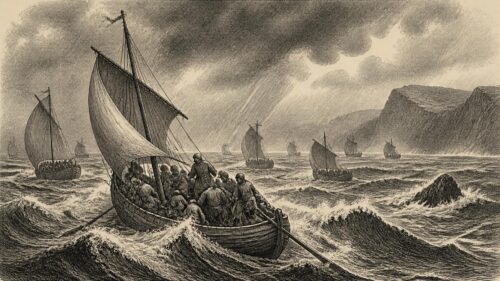
The most provocative measures came in July. On 24 July, an order enrolled on the Fine Rolls directed the justiciar or his lieutenant to take into the king’s hands lands and liberties granted in Ireland by Edward II and Edward III, pending examination of the grounds on which they had been made. The stated justification was that excessive grants might have been procured through false suggestions or importunate petitions. In practical terms, it threatened the legal security, income and local authority of many beneficiaries of royal favour.
A related royal instruction sought to displace Irishmen and Englishmen closely tied to Ireland from office, favouring English officials with estates and incomes in England. This was a remarkable vote of distrust in the very people who knew the country, maintained local connections and performed much of the crown’s work there. It also drew a sharp line between the king’s ministers in England and the community commonly described in contemporary sources as the English of Ireland. That phrase principally covered descendants of settlers and other subjects within the lordship; it did not mean that the Gaelic Irish shared in the political assembly now taking shape.
Morice summoned a parliament to Dublin in October. The session was then resumed at Kilkenny in November, where magnates, clergy and representatives of towns articulated a collective grievance. The surviving account in the Annales Hiberniae states that the king’s ministers did not attend the Kilkenny meeting, and that those assembled resolved to send messengers, complaint and petition to the king seeking correction of misgovernment and better rule. The annalist’s language is hostile to the administration, but the basic sequence is secure: the policies of 1341 united much of the English political community in Ireland against the government meant to enforce them.
This was not a declaration of independence. The petitioners professed loyalty to Edward III while arguing that the resumption was contrary to right and that incompetent ministers had helped bring the lordship into danger. Their objection was constitutional as well as financial: they expected to be consulted in matters touching their lands and liberties. The crown would retreat from the policy in 1342, but that later reversal should not obscure the significance of 1341. It demonstrated that Dublin government could not simply impose major reforms without the co-operation of the Irish-based political class.
Roscommon and Connacht
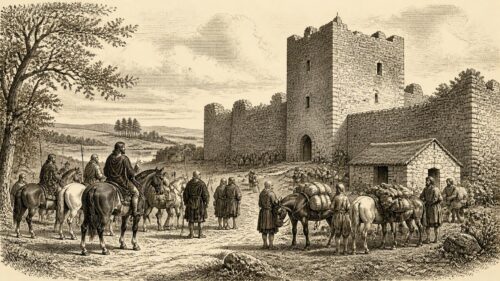
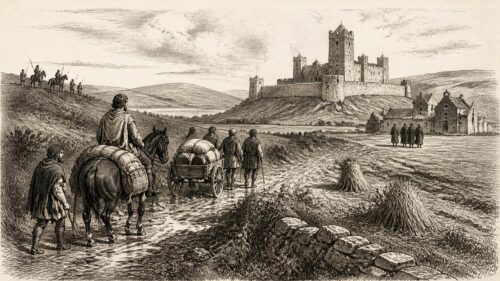
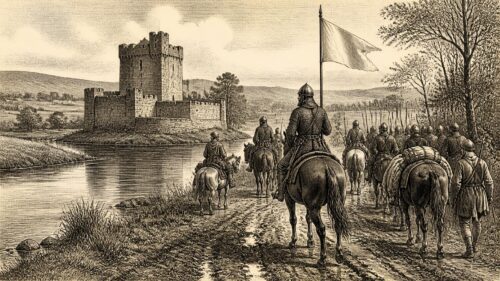
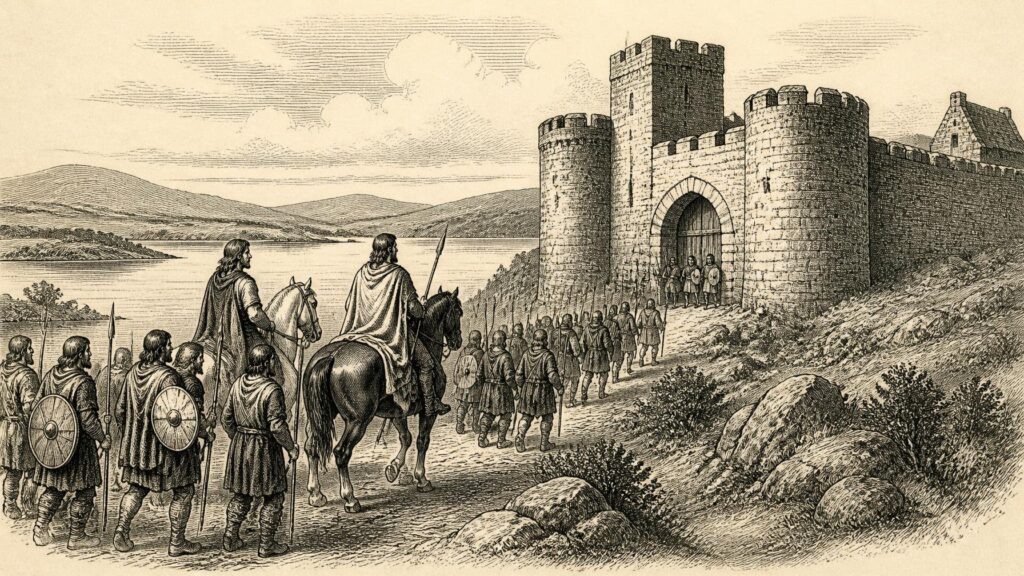
While the royal administration was alienating allies in the east and south, a decisive event occurred in Connacht. The annals record that Toirrdelbach Ó Conchobair, king of Connacht, captured Roscommon Castle. The Annals of Loch Cé give a vivid explanation: Áed, son of Fedlimid Ó Conchobair, who had been imprisoned in the castle, betrayed it to Toirrdelbach. The Annals of the Four Masters instead emphasise Áed’s liberation and the payment of a ransom. The accounts agree on the essential point—the castle was taken by Toirrdelbach in 1341—but differ in their accompanying detail. That difference is a useful warning not to treat a single annalistic notice as a complete battlefield report.
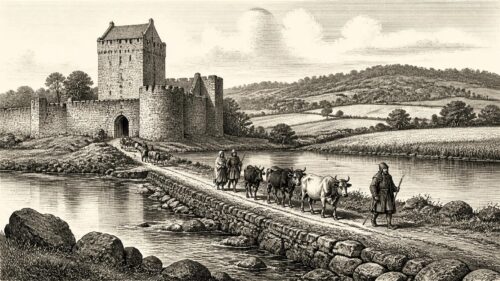
The capture mattered because Roscommon was no ordinary residence. Work on the stone royal castle had begun in 1269. Its moat, curtain walls, towers and commanding setting beside Loughnaneane advertised English royal power in a region where the Ó Conchobair dynasty retained deep political authority. The site had already been repeatedly attacked during the thirteenth century. Thus its seizure in 1341 was both militarily useful and symbolically charged: a king of Connacht had taken a fortress expressly built to secure crown influence in Connacht.
The episode also belonged to a continuing Ó Conchobair family struggle. Toirrdelbach had taken Áed son of Fedlimid prisoner in 1340 and placed him in Roscommon Castle. Capturing the castle therefore reversed a dangerous confinement while strengthening Toirrdelbach’s own hand. Yet the gain did not settle Connacht. By 1342, opposition involving Conchobhar Mac Diarmata, Sir Edmund Albanach Burke and other rivals drove Toirrdelbach from the province for a time. The events of the following year confirm that the 1341 capture was an important advantage, not a final conquest of Connacht.
Violence, Lordship and Succession
Another Connacht conflict is recorded in the annals without a securely named location. Mac William Burke inflicted a severe defeat on Clann Muiris or Clann-Maurice. Thomas Mac Maurice and Maurice, son of Seonac Ruadh, were among those killed. The Annals of Loch Cé say that seven score people died with them, while the later Four Masters gives seventy. The disagreement over numbers makes caution essential, but both sources attest a major defeat. It reflects the fragmentation of the de Burgh inheritance after the killing of William de Burgh, earl of Ulster, in 1333: descendants and followers of the settler aristocracy increasingly operated as regional powers, enmeshed in Connacht’s Gaelic political world rather than acting as a simple extension of Dublin rule.
The northern and midland annals record equally rapid changes. Art Ó Máel Sechlainn, king of Meath, was killed by Cormac Ballach Ó Máel Sechlainn, who was then made king in his place. In Oriel, Áed Mag Mathgamna died; Murchadh Óg Mag Mathgamna was chosen to succeed him but died within a week, and Magnús, son of Eochad son of Roalb Mag Mathgamna, assumed the kingship. These notices are brief, but their sequence shows that political succession could be violent, negotiated and highly contingent. Kingship was not automatically transmitted from father to eldest son; it depended on capacity, kinship and the support of a ruling kindred.
Churches and Communities
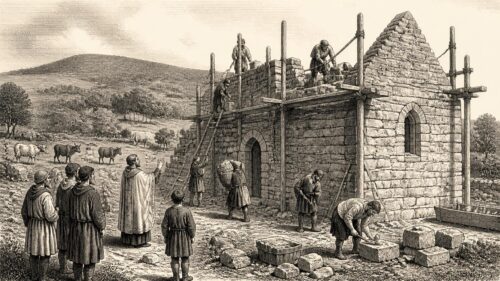
Religious life appears in 1341 chiefly through deaths and institutional continuity. Murtough Mac-an-Gowan, abbot of Clogher, died. The Annals of Ulster also record the death of the bishop of Luighne and of Murchadh son of Máelmuad Ó hEaghra, abbot of Buille and described as a prospective bishop of Luighne. Dermot Roe, son of Cormac Óg Mac Diarmata, died in the monastic habit at Boyle Abbey. These entries do not prove a general religious crisis, but they show monasteries, abbeys and episcopal churches as central places for burial, office, learning and aristocratic patronage.
For ordinary people, the sources are frustratingly reticent. No reliable annalistic notice permits a precise reconstruction of harvests, prices, weather or disease across Ireland in this calendar year. It would be wrong to project the Black Death backwards from its Irish arrival in 1348. What can responsibly be said is that communities lived amid exactions, military movement and insecure authority. A castle seizure affected prisoners, retainers and nearby cultivators; a dynastic feud could bring raids, cattle-taking and destruction of crops; and a royal resumption threatened the revenues on which officials, tenants and religious houses might depend. These were not separate worlds of ‘Gaelic’ and ‘English’ Ireland, but overlapping local societies connected by land, marriage, warfare, church patronage and trade.
In that sense, 1341 was a year of recovered strongholds and weakened confidence. Toirrdelbach’s seizure of Roscommon Castle showed that the crown’s physical monuments in Connacht could be captured and used by Gaelic rulers. At Kilkenny, meanwhile, the crown’s own settlers and magnates challenged ministers who presumed to reorganise the lordship from afar. Neither development created a new Ireland overnight. Together, however, they exposed a political landscape in which power had become intensely regional, negotiated and unstable.
Primary Sources
- Annals of Loch Cé, Annal LC1341
- Annals of Ulster, Year U1341
- Annals of the Four Masters, Annal M1341
- Annales Hiberniae
- Fine Rolls: 24 July 1341
- Morice (Moriz), John
- Outlaw (Outlagh, Outlawe, Utlagh, Utlawe), Roger
- O'Connor (Ó Conchobair), Toirrdelbach
- The Anglo-Irish Colony under Strain, 1327–99
- English Institutions in Medieval Ireland
- Law, Legislation, and Consent in the Plantagenet Empire
- The Administration of Ireland 1172–1377
- Roscommon Castle
- Exploring Roscommon Castle
- Roscommon Castle—South West Tower
- Roscommon Castle – A Visitor’s Guide
- County Roscommon Urban Archaeological Survey: Roscommon Castle
- Annála Connacht, Annal 1340
- Annála Connacht, Annal 1342
- Annales Dominicani de Roscoman, 1163–1314: Introduction
- Annals of the Kingdom of Ireland from the Earliest Times to the Year 1616
- Background: Chronology of Key Events 1169 to 1799
- The History of the County of Mayo to the Close of the Sixteenth Century