Two Nights at Clonmacnoise936 CE
In 936, Dublin-based foreigners plundered Clonmacnoise and occupied it for two nights, an exceptional affront to the major Shannon ecclesiastical and trading settlement. Chronicon Scotorum also records a further plundering by Cellachán of Cashel and Munster men. Foreign crews from Lough Erne reached Lough Ree, demonstrating waterways’ strategic value and exposing central Ireland to prolonged raiding. Donnchad Donn, king of Temair, burned Dublin, illustrating contested rather than centralised power. Armagh lost two successive senior church leaders, Ioseph and Máel Pátraic, while Aniudán, king of Corcu Modruad, died. These events reveal competing regional powers, vulnerable churches, and insecure communications throughout Ireland.
Dateline
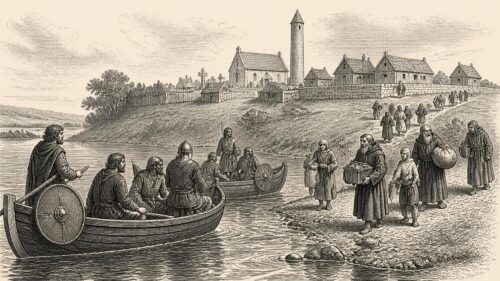
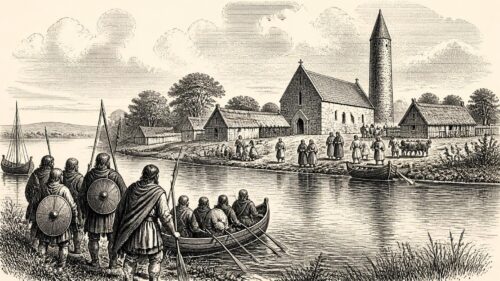
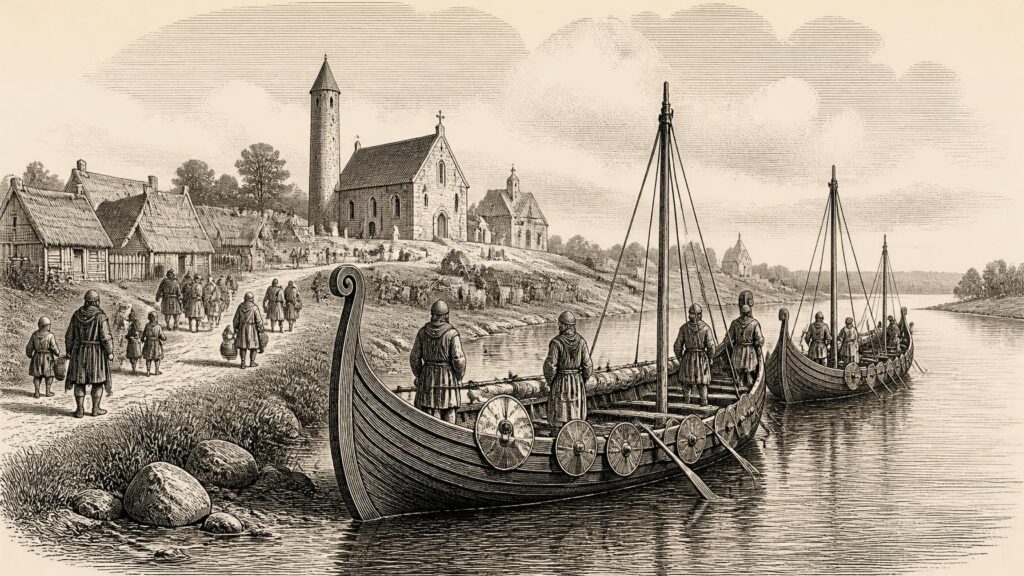
In 936, the River Shannon was both Ireland’s great inland road and a dangerous frontier. At Clonmacnoise, the famous ecclesiastical settlement on its eastern bank, the annals record an episode that their writers regarded as extraordinary: the foreigners of Áth Cliath, or Dublin, plundered the site and remained there for two nights. The Annals of Ulster add that this was something “unheard of from ancient times”. The phrase should not be read as a literal claim that Clonmacnoise had never before been attacked. It had suffered raids in earlier generations. Rather, it conveys the shock that a raiding force from Dublin could occupy so important a religious and political centre for long enough to make a sustained encampment or hold the place.
An Assault on a River Settlement
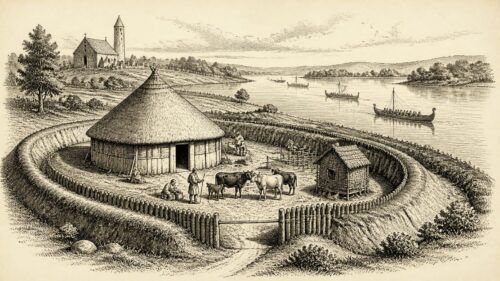
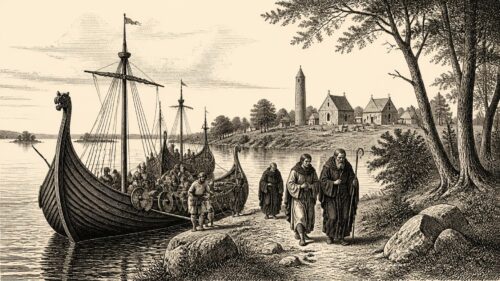
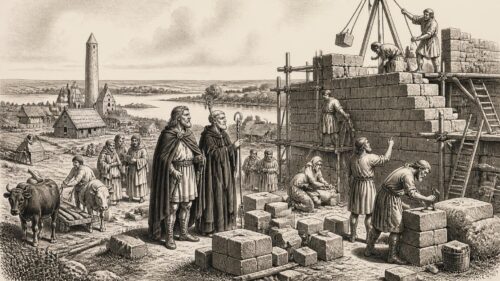
Clonmacnoise was far more than an isolated monastery. Founded in the sixth century in the meadowland beside the Shannon, it stood near the meeting of the river route running north and south and the east–west route over the Esker Riada. By the tenth century it was a large ecclesiastical settlement with churches, burial grounds, residences, storehouses, workshops and a substantial lay population. Archaeology indicates that domestic occupation and industrial activity flourished around the monastic core in the ninth and tenth centuries. Its community included clerics and scholars, but also craftspeople, tenants, labourers, travellers and dependants. A raid on Clonmacnoise therefore threatened people and resources as well as sacred buildings.
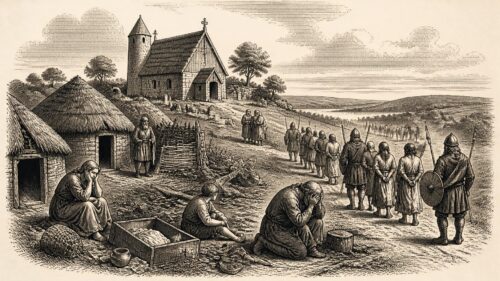
The annals do not itemise what was taken in 936, and it would be unsafe to supply a fictional inventory of treasure, manuscripts or captives. Yet plunder at a centre of this kind could encompass portable wealth, food stores, livestock, metalwork and valuables belonging to churches or lay households. The occupation of two nights also implies more than a swift strike: the raiders had time to control access to the river landing and surrounding routes, gather booty and intimidate those who had not fled or been seized. For the inhabitants, ordinary routines of worship, food preparation, craft work and river traffic would have been abruptly displaced by fear, flight and loss.
Chronicon Scotorum, a chronicle with particularly strong connections to the Clonmacnoise tradition, independently places the plundering of Cluain Muc Nóis by men from Dublin in 936. It further records that Cellachán of Cashel and the men of Munster plundered the place again. The wording is brief and does not establish whether the two attacks followed immediately upon one another, nor exactly who accompanied Cellachán. It does, however, show that the monastery lay in the path of more than one armed interest that year. The settlement’s strategic position, which had helped it become a centre of learning, craftsmanship and exchange, also made it exposed.
Ships on Lough Ree
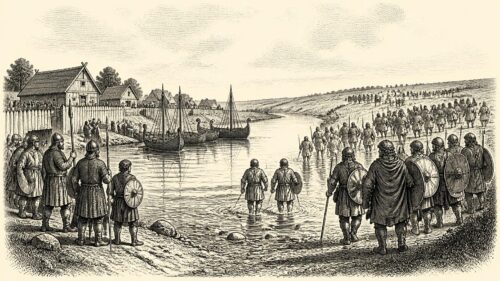
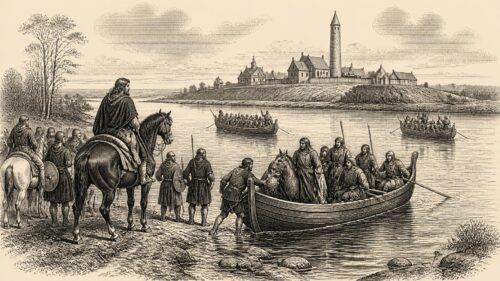
The same chronicle records that the “foreigners of Loch Érne” came onto Loch Rí, or Lough Ree. This was a serious movement through the inland waterways. From Lough Erne, vessels and crews could pass through Breifne towards the Shannon basin; on Lough Ree they stood close to the routes connecting Connacht, Mide and the midlands. The entry does not name their leader. A fuller, later annalistic account, preserved in the Annals of the Four Masters under a heading now recognised as chronologically early, names Amlaíb Cenncairech and says that the force came from Lough Erne across Breifne, reached the Shannon at Christmas and spent seven months in the region, devastating Mag Aí in Connacht.
That expanded account must be used with care. The Four Masters were compiled in the seventeenth century from earlier materials, and their numbering for this period is displaced from the modern calendar. Nevertheless, its central movement agrees with the properly placed 936 notice in Chronicon Scotorum: a foreign force transferred from the Erne system to Lough Ree. The name Amlaíb Cenncairech is not supplied by the nearer contemporary record, so his personal command cannot be treated as equally certain. Nor should the term “foreigners” conceal complexity. It was the Irish annalists’ usual label for Scandinavian and Hiberno-Scandinavian groups, men who by this date were deeply involved in Ireland’s politics, warfare, commerce and settlements rather than strangers passing briefly through.
The Lough Ree episode helps explain why Clonmacnoise was so vulnerable. A force operating from lake and river vessels did not need to march over difficult country to reach the monastery. Watercraft carried warriors, equipment and plunder, while the Shannon connected rich farming districts and major churches. Such mobility could make raids seasonal, but it also enabled a force to remain in a region, provisioning itself through seizure and tribute. If the report of several months’ activity is accepted as broadly reliable, communities around Lough Ree and Mag Aí faced not one isolated encounter but a prolonged disruption of grazing, travel, market exchange and agricultural security.
Dublin Burned, but Not Broken
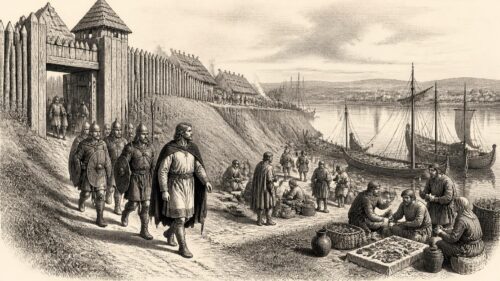
936 also produced an apparent reversal. Chronicon Scotorum records the burning of Áth Cliath by Donnchad son of Flann, king of Temair. Donnchad Donn, ruler of the southern Uí Néill and high king in the annalistic language of the period, had ruled from 919. The entry does not say whether he captured Dublin’s defended settlement, how long the attack lasted, or which quarter was burned. A burning need not have meant permanent conquest: it could damage suburbs, buildings outside the strongest enclosure, shipping facilities or stores while leaving the political community able to recover.
Its significance lies in the contrast. Dubliners could strike far up the Shannon at Clonmacnoise, yet the king of Temair could bring fire to Dublin. Neither side possessed effortless command of the island. Authority in tenth-century Ireland depended on negotiated loyalties, hostages, tribute, kin alliances, fleets and the ability to assemble a following. Dublin was an important maritime town and military power, but it was not an untouchable foreign enclave. Likewise, Donnchad’s royal title did not turn Ireland into a centrally governed kingdom. His reach had to be asserted repeatedly against provincial kings, rival Uí Néill branches and powerful urban rulers.
The attacks around the Shannon and the burning of Dublin should therefore not be simplified into a single national war between Irish and Vikings. Individual Irish dynasties fought one another, and Scandinavian-descended rulers made alliances with Irish kings when advantage required it. Still, the records of 936 reveal sharp competition for waterways, church wealth and strategic settlements. Control of routes was as important as a victory in open battle. Whoever could move ships on Lough Ree, raid a Shannon crossing or threaten Dublin’s riverine approaches possessed leverage far beyond the immediate scene of violence.
Armagh’s Brief Succession
Conflict was not the only change recorded in 936. The year brought a strikingly compressed succession crisis at Armagh, the principal church associated with Patrick. The Annals of Ulster report the death of Ioseph of the lineage of Garb Gaela, described as superior of Armagh, bishop, scholar and anchorite, at an advanced age. This accumulation of titles is revealing. His standing rested not merely on liturgical office but on learning, ascetic reputation and leadership of a major ecclesiastical community.
Máel Pátraic son of Máel Túile then held the succession of Patrick, but he too died in old age within the year. The Annals of Inisfallen explicitly say that Máel Pátraic succeeded Ioseph as abbot of Armagh; the Four Masters add the specific tradition that he held the office for five months. The latter detail comes through a later compilation, so it is best treated as a preserved annalistic claim rather than an independently verifiable calculation. What is secure is the rapid loss of two leading churchmen and the need to refill Armagh’s highest office.
To be successor of Patrick, or comarba Pátraic, was to hold an office of religious prestige with political and economic weight. Armagh’s churches, client communities, lands and learned personnel made its leadership consequential far beyond the settlement itself. The deaths of Ioseph and Máel Pátraic thus mattered to kings and local elites as well as to clergy. They remind us that tenth-century power was exercised through churches no less than through warbands. A church’s books, relics, hospitality, land rights and authority to commemorate the dead were material and social resources.
A Western Kingship Ends
The Annals of Inisfallen also record the death of Aniudán son of Máel Gorm, king of Corcu Modruad, the kingdom in the Burren district of north Clare. It is a small notice beside the dramatic events at Clonmacnoise and Dublin, but it is a useful corrective to any picture of Ireland as controlled only from Temair, Ailech or Cashel. The island was made up of many regional lordships. A local king’s death opened questions of succession, clientship and alliance even when the annals preserve no further detail.
No reliable source places a famine, epidemic, remarkable weather event or major artistic commission specifically in 936. Nor can the year safely be made a prelude to events of 937 simply because later history gives them prominence. The battle of Brunanburh in England belongs to the following year, as do later developments involving Dublin’s rulers. The evidence for 936 is narrower but vivid: a major Shannon church was occupied and plundered; foreign crews reached Lough Ree; Dublin itself was burned by the king of Temair; and the church of Armagh lost two successive leaders. Together, these entries show an Ireland in which rivers connected distant regions, churches concentrated wealth and influence, and no political centre could assume lasting security.
Primary Sources
- The Annals of Ulster
- Chronicon Scotorum
- Annals of the Four Masters, Volume 2
- Annals of Inisfallen
- Vikings’ Settlements in Ireland before 1014
- Vikings in Ireland
- Early Medieval Ireland: Archaeological Excavations, 1930–2009
- Clonmacnoise: Visitor Guide
- Clonmacnoise Monastic Site
- Clonmacnoise, County Offaly
- S. Ciarán’s Church and His Lands: A Study of the History and Development of Clonmacnoise
- The Economy and Industry of Early Medieval Clonmacnoise: A Preliminary View
- The Earliest Plans of Clonmacnoise
- Early Medieval Archaeology Project (EMAP)
- Revealing the Complexity of Early Ecclesiastical Networks: Cross-Slabs Within and Beyond the Hinterland of Clonmacnoise, Ireland
- Mobile Carvers and Mobile Monuments: A Geochemical Study of Early Medieval Cross-Slabs from Clonmacnoise and Outlying Sites, Ireland
- The Present and the Past in Medieval Irish Chronicles
- On Reconstructing Medieval Irish Chronicles
- Annals of Inisfallen to Go on Public Display in University College Cork
- Clonmacnoise