-
Shannon Retreat
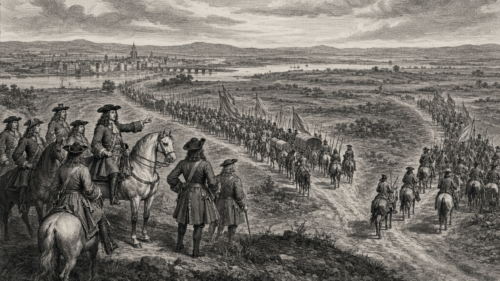
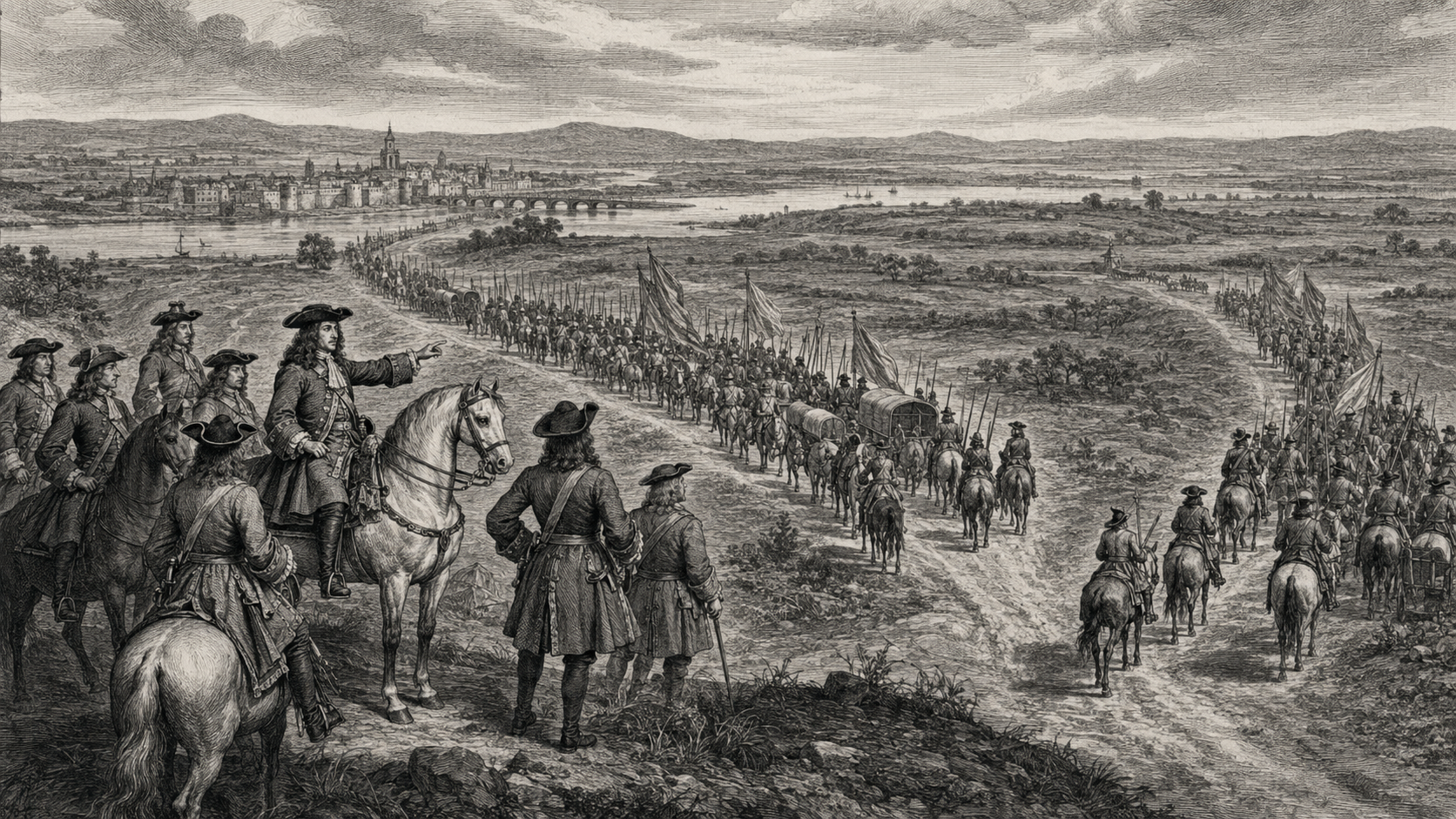
Read Article: Shannon RetreatLimerick became one of the principal centres of Jacobite resistance after William III’s victory at the Boyne on 1 July 1690 forced the Irish army to abandon the eastern approaches to Dublin. James II departed for France, but most of his surviving soldiers remained under arms and withdrew westwards towards the River Shannon. Some gathered around Athlone, which guarded an important crossing into Connacht, while the larger concentration developed around Limerick. The city’s walls, river position and access to the western counties offered the Jacobites a defensible base from which the war might continue despite the loss of Dublin.
William did not allow the retreating army to reorganise without pursuit. He divided his forces, sending Lieutenant-General James Douglas towards Athlone while leading the principal Williamite army along the southern approach towards Limerick. Later narratives differ over the exact number of regiments detached with Douglas, but the force included substantial bodies of cavalry and infantry. The division reflected William’s intention to threaten both major Shannon strongholds at once. Athlone controlled the central crossing, while Limerick commanded the lower Shannon and remained capable of receiving troops, provisions and assistance from the Jacobite-held counties of western Ireland.
Douglas appeared before Athlone on 17 July and demanded its surrender. Colonel Richard Grace, the veteran Jacobite governor, had abandoned the less defensible eastern portion of the town and destroyed part of the bridge connecting it with the fortified western bank. Douglas opened a bombardment and attempted to overcome the Shannon defences, but his artillery and supplies were insufficient for a prolonged operation. The Jacobite garrison resisted firmly, while reports that cavalry might be approaching from the direction of Limerick increased the danger of remaining before the town. Douglas withdrew on 24 July without capturing the western fortress.
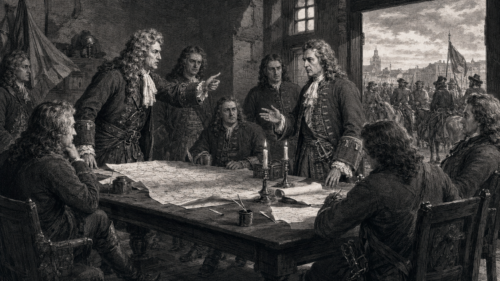
The resistance at Athlone gave the Jacobites valuable time to strengthen Limerick and gather the remnants of their field army. Within the city, military officers, French advisers, civic inhabitants and displaced supporters of James confronted difficult questions of command, defence and negotiation. Some senior figures doubted whether continued resistance could succeed, while others believed the Shannon line offered the only honourable and practical alternative to surrender. Limerick consequently became more than a refuge. Its possession determined whether the Jacobites could preserve an organised army, maintain authority across much of Connacht and Munster, and prevent William from claiming complete control of Ireland.
Douglas eventually moved south to rejoin William, whose main force reached the neighbourhood of Limerick in early August. The failure at Athlone demonstrated that the Shannon could not be crossed merely by appearing before its fortified towns, while the concentration at Limerick prepared the ground for the first great siege of the city. William expected that the retreat from the Boyne had broken Jacobite resistance, but the western army had not dissolved. Its withdrawal brought the war directly to Limerick, where soldiers and civilians would soon face bombardment, assault, hunger and the prospect that the city’s survival might determine the future of the Jacobite cause.
- George Warter Story, An Impartial History of the Wars of Ireland, with a Continuation Thereof, London: Richard Chiswell, 1693.
- John Stevens, The Journal of John Stevens, Containing a Brief Account of the War in Ireland, 1689–1691, edited by Robert H. Murray, Oxford: Clarendon Press, 1912.
- John Childs, The Williamite Wars in Ireland, 1688–1691, London: Hambledon Continuum, 2007, Chapter 14, “From Dublin to Limerick.”
- J. G. Simms, Jacobite Ireland, 1685–1691, London: Routledge and Kegan Paul, 1969.
- Pádraig Lenihan, “The Marquis de Boisseleau and the ‘Battle of the Breach’ at the First Siege of Limerick, 1690,” History Ireland, vol. 21, no. 4, July–August 2013.
-
Summit Disaster
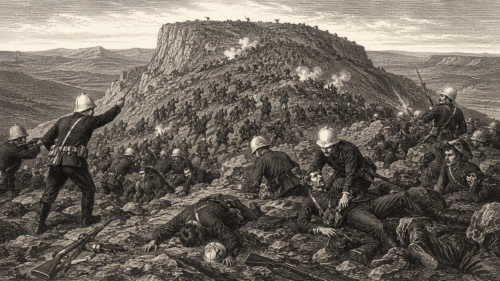
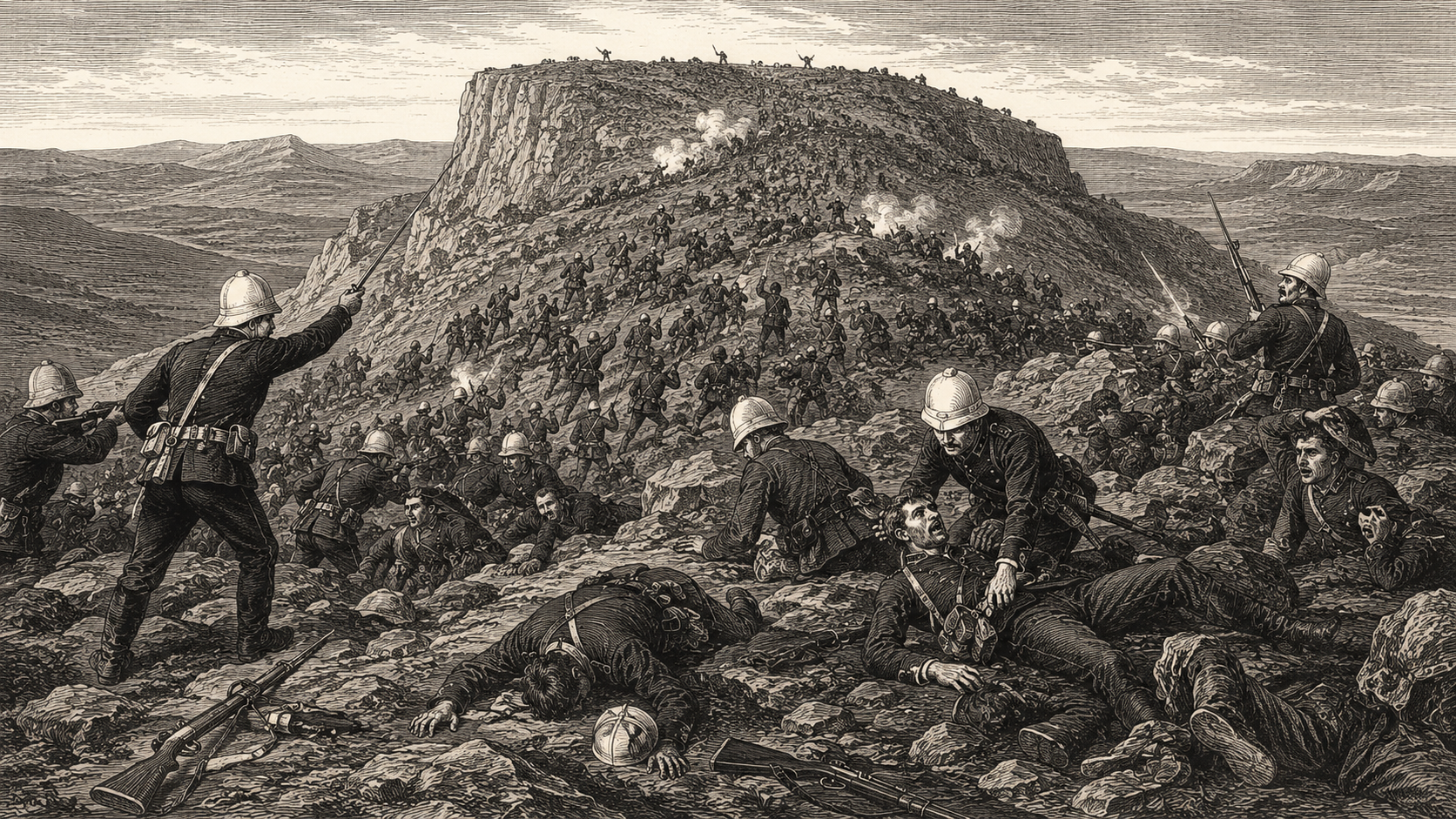
Read Article: Summit DisasterFor Limerick, whose city and county belonged to the recruiting region of the Royal Munster Fusiliers, reports from Spion Kop carried immediate human significance even though that regiment did not fight upon the summit. During the night of 23–24 January 1900, British troops commanded by Major-General Edward Woodgate climbed the steep hill in Natal as part of Sir Redvers Buller’s renewed attempt to relieve besieged Ladysmith. The attackers surprised a Boer outpost and secured part of the summit before dawn, but mist and darkness concealed the true shape of the ground and the stronger positions lying beyond them.
British engineers began digging defensive trenches, but the rocky soil prevented them from creating adequate protection. When the mist lifted, the troops discovered that they occupied only a cramped portion of the plateau and remained exposed to Boer rifles and artillery firing from several directions. Louis Botha rallied the defenders while Boer commandos advanced towards the summit from neighbouring ridges. Woodgate was seriously wounded early in the fighting, leaving authority uncertain among officers who lacked reliable information about neighbouring units, reinforcements and the plans of their commanders below. The captured height rapidly became a confined and increasingly dangerous position.
Reinforcements climbed the hill throughout 24 January, including men of the Middlesex, Dorset and Somerset regiments, the Imperial Light Infantry and other formations. Their arrival increased the number of rifles available but also crowded thousands of soldiers into ground offering little cover. Ammunition, water, medical assistance and clear orders moved slowly over the steep approaches. British artillery below could not effectively silence Boer guns concealed behind intervening ridges. Rifle fire, shells and rapid-firing weapons swept the summit for hours, while sections of trench changed hands and exhausted soldiers struggled to hold their positions amid wounded comrades and broken unit formations.
Lieutenant-Colonel Alexander Thorneycroft eventually assumed command on the summit, although the arrangements were poorly communicated and several senior officers remained uncertain about who held final authority. After nightfall, believing the shattered force could not endure another day without artillery, water and properly organised support, Thorneycroft ordered a withdrawal. Many Boer fighters had also become discouraged, but the British commanders did not know this. By dawn on 25 January, Boer forces had reoccupied the abandoned summit. The later official despatches criticised the failures of communication, organisation and command that allowed a position gained through a difficult night assault to be surrendered.
British losses at Spion Kop amounted to approximately 1,500 killed, wounded, missing or captured, while Boer casualties numbered several hundred. Warren’s force subsequently withdrew across the Tugela, and Ladysmith remained under siege until the end of February. For Limerick households following relatives and neighbours in South Africa, the defeat exposed the personal cost hidden behind imperial reports of advance and relief. It also entered an Irish political climate divided between military service within the British Empire and sympathy for the Boer republics. Spion Kop therefore reached Limerick not as a distant battlefield alone, but as news carrying anxiety, argument and possible bereavement.
- The London Gazette, issue 27183, 17 April 1900, pp. 2497–2503, War Office despatches concerning the Tugela operations and the capture and evacuation of Spion Kop.
- Winston S. Churchill, London to Ladysmith via Pretoria, London: Longmans, Green, and Co., 1900.
- Arthur Conan Doyle, The Great Boer War, London: Smith, Elder & Co., 1900, Chapter XV, “Spion Kop.”
- Frederick Maurice, ed., History of the War in South Africa, 1899–1902, vol. II, London: Hurst and Blackett, 1907.
- National Army Museum, “‘Spions Kop, Natal. Jan 26th 1900’, British Casualties, 1900,” collection accession 2006-09-2-2.
-
Drogheda Muster
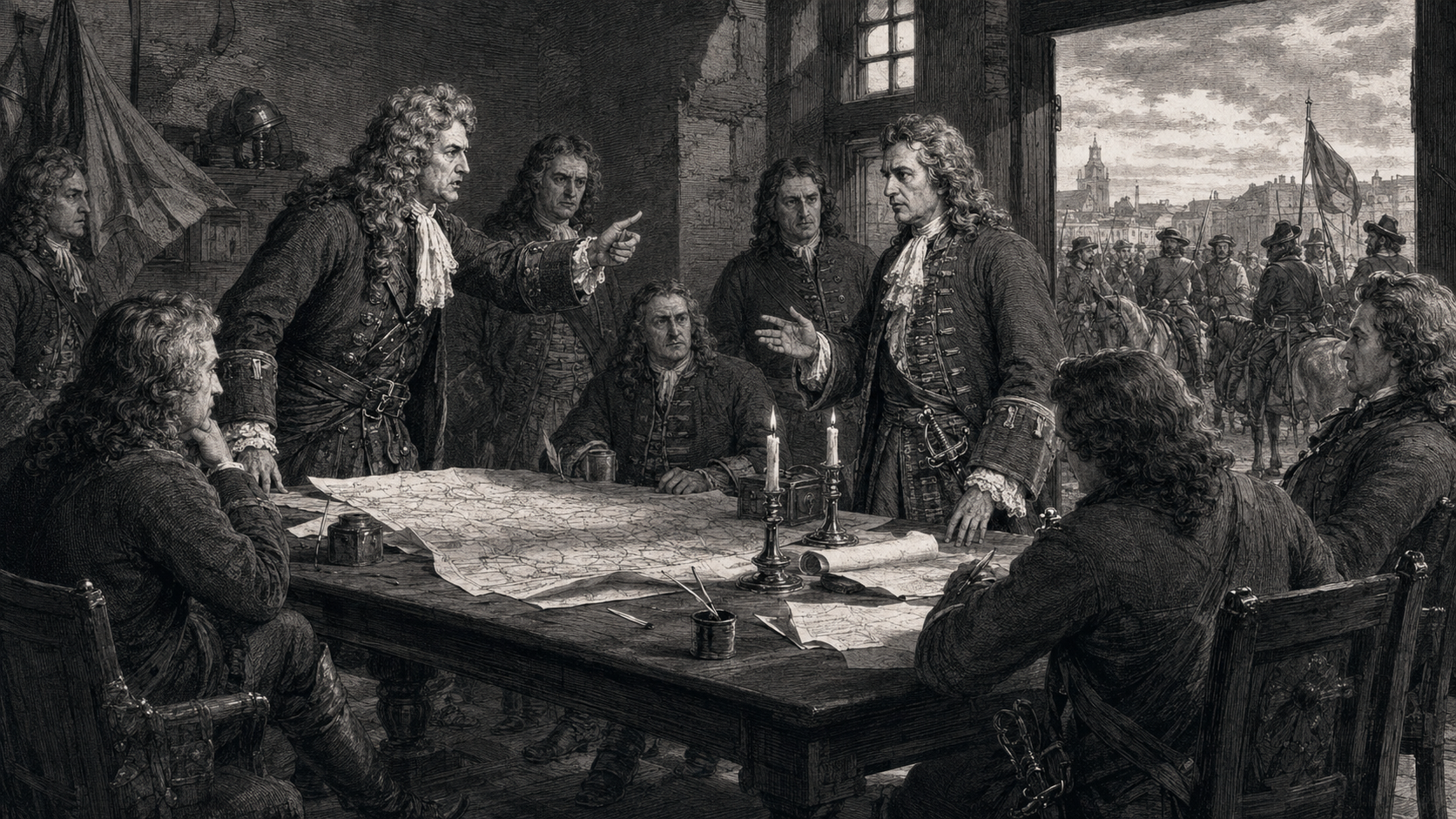
Read Article: Drogheda MusterLimerick entered the military calculations of the Jacobite leadership during the first half of September 1689, as Marshal Schomberg’s Williamite army advanced southwards through Ulster. French commander Conrad de Rosen regarded Dublin and Drogheda as dangerously exposed and favoured concentrating the Irish forces behind the Shannon, with Athlone and Limerick forming the principal defensive centres. The proposal revealed how rapidly Limerick had become important to the survival of James II’s cause. Richard Talbot, Duke of Tyrconnell, opposed an immediate abandonment of the eastern approaches and supported assembling the available Jacobite regiments around Drogheda to confront the advancing enemy.
Schomberg reached Dundalk on 7 September after taking Carrickfergus and passing through Newry. South of him, Jacobite units were gathering at Drogheda, where the eyewitness John Stevens had joined the Grand Prior’s Regiment. Stevens recorded that numerous regiments camped outside the town from 5 September, although many were weak, newly raised, poorly clothed and inadequately shod. He nevertheless described considerable eagerness among the soldiers to move against the Williamites. Their cavalry appeared in better condition than much of the infantry, which had received limited training and remained short of equipment despite the urgency created by Schomberg’s approach.
By the middle of September the Jacobite army moved north from Drogheda towards Ardee and the River Fane. Contemporary accounts differ slightly in their dating and estimates, but they agree that James II brought a substantial field army close to Dundalk. One Jacobite narrative placed the king at the Fane on 15 September and estimated his force at approximately 26,000 men. Stevens described the army advancing from Drogheda on 14 September, moving farther north over the following days, and approaching Schomberg’s entrenched position on 21 September in an unsuccessful effort to draw the Williamites into open battle.
The surviving evidence supports the broader picture of rapid mobilisation, strategic disagreement and the gathering of Irish regiments, although it does not securely confirm every dramatic detail found in later popular retellings. In particular, the precise council conversation, Tyrconnell’s alleged promise to assemble 20,000 men overnight, and the description of all Munster troops undertaking a single forced march should be treated cautiously. Limerick’s documented importance lies in its identification as a defensible western centre beyond the Shannon. That judgement proved perceptive, for the city subsequently became the principal Jacobite stronghold during the decisive campaigns of 1690 and 1691.
No major battle followed the September concentration. Schomberg remained within his entrenched camp at Dundalk, while James declined to order a costly assault upon prepared works. Disease, rain, poor ground and supply difficulties weakened both armies, although the Williamite camp suffered particularly severe sickness. The Jacobites eventually withdrew towards winter quarters, leaving the campaign unresolved. For Limerick, the episode marked an early recognition that the city’s walls, river crossings and western position might preserve resistance if Dublin and eastern Leinster became untenable. The proposed retreat was rejected in 1689, but the strategic importance assigned to Limerick would shape the remainder of the war.
- John Stevens, The Journal of John Stevens, Containing a Brief Account of the War in Ireland, 1689–1691, edited by Robert H. Murray, Oxford: Clarendon Press, 1912, pp. 78–82.
- Anonymous, possibly Nicholas Plunket, A Jacobite Narrative of the War in Ireland, edited by John T. Gilbert, Dublin, 1892; photolithographic facsimile, Shannon: Shannon University Press, 1971, pp. 87–89.
- John Childs, The Williamite Wars in Ireland, 1688–1691, London: Hambledon Continuum, 2007, pp. 157–160.
- Pádraig Lenihan, “Schomberg at Dundalk, 1689,” Journal of the County Louth Archaeological and Historical Society, vol. 27, no. 1, 2009, pp. 39–52.
- G. A. Henty, Orange and Green: A Tale of the Boyne and Limerick, London and Glasgow: Blackie & Son, 1888. Historical novel containing the supplied wording; used to identify the passage, not as independent evidence for its detailed claims.
-
Tabanyama Assault
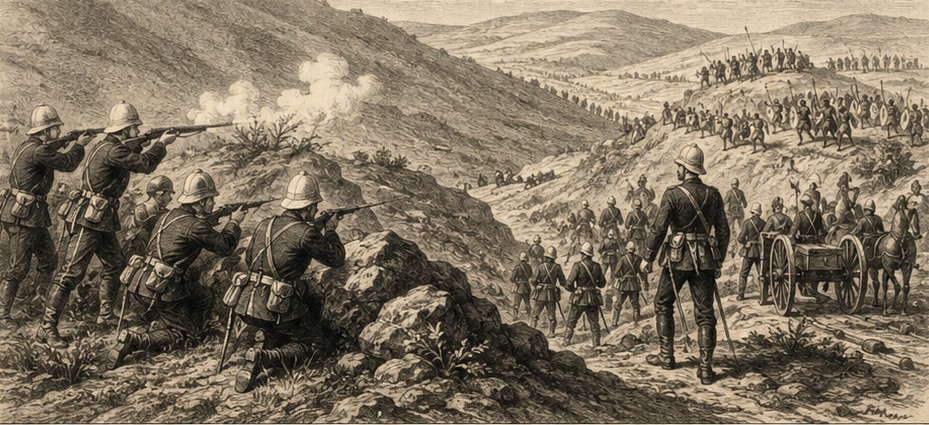
Read Article: Tabanyama AssaultNews of the fighting on the Tabanyama ridges carried particular weight in Limerick, where families with connections to British Army service followed the Natal campaign and the fortunes of Irish regiments abroad. Between 20 and 22 January 1900, Lieutenant-General Sir Charles Warren’s force attempted to break the Boer defensive line west of Spion Kop and open a route towards besieged Ladysmith. Major-General FitzRoy Hart’s 5th, or Irish, Brigade formed part of the attacking army, alongside Major-General Edward Woodgate’s Lancashire Brigade. The operation placed Irish soldiers within a difficult imperial campaign whose conduct and purpose remained politically contentious at home.
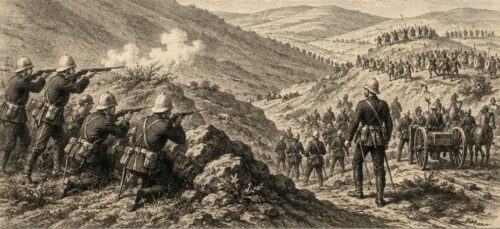
The principal assault began before dawn on 20 January, when Woodgate’s brigade climbed towards the forward crests and Hart’s troops followed. The lower slopes were partly concealed from Boer observation, allowing the British infantry to reach the first heights with comparatively little interference. Once there, however, the true strength of the position became apparent. The main Boer trenches lay farther across exposed ground on the higher ridge. Warren brought forward his field artillery and subjected the defensive line to a prolonged bombardment, but the burghers remained protected among prepared trenches, stone positions and folds in the terrain commanded by General Louis Botha.
During the afternoon, Lancashire units advanced with support from the Royal Dublin Fusiliers, Royal Inniskilling Fusiliers and Border Regiment. They captured advanced ground but then faced roughly a thousand yards of open veld before the principal Boer line. Rifle fire struck from the front and flanks, while Boer guns near Spion Kop began throwing shrapnel across the assaulting formations. The advance slowed and was halted before evening, leaving the troops to shelter among rocks and hastily constructed defences. The Royal Dublin Fusiliers recorded four men killed, twenty wounded, Captain Hensley mortally wounded and Major English wounded during the day’s action.
Rifle fire resumed at daylight on 21 January. Hart’s men moved across exposed ground to support the 2nd Brigade, but no decisive attack followed. Battalions gathered behind the southern crest, where bullets passed overhead and intermittent Boer shellfire struck the ridge. The fighting from 20 to 22 January was therefore not one uninterrupted charge. The first day brought the strongest advance; the following days were marked by skirmishing, bombardment, entrenchment and prolonged exposure. By the evening of the 22nd, the troops still held forward ground, but Warren’s attempt to turn the Boer right had stalled without securing the main crest.
The failure to force the Tabanyama position led British commanders towards the night assault on Spion Kop, ordered after the troops had spent days under fire on the ridges. That decision produced the far better-known battle of 23 and 24 January, but the earlier struggle explains why Spion Kop appeared to offer a way through the Boer line. For Limerick readers, the campaign joined military anxiety with Ireland’s divided response to the war: Irish soldiers served in British uniform while nationalist opinion often sympathised with the Boer republics. Tabanyama therefore belonged both to the battlefield outside Ladysmith and to a wider Irish argument over empire, service and allegiance.
- The London Gazette, issue 27183, 17 April 1900, pp. 2497–2503, War Office despatches concerning the Tugela operations and Spion Kop.
- Cecil Francis Romer and Arthur Edward Mainwaring, The Second Battalion Royal Dublin Fusiliers in the South African War, London: A. L. Humphreys, 1908, Chapter VI, “Venter’s Spruit.”
- Arthur Conan Doyle, The Great Boer War, London: Smith, Elder & Co., 1900, Chapter XV, “Spion Kop.”
- Frederick Maurice, ed., History of the War in South Africa, 1899–1902, vol. II, London: Hurst and Blackett, 1907.
- Donal P. McCracken, Forgotten Protest: Ireland and the Anglo-Boer War, Belfast: Ulster Historical Foundation, 2003.
-
Roberts Arrives
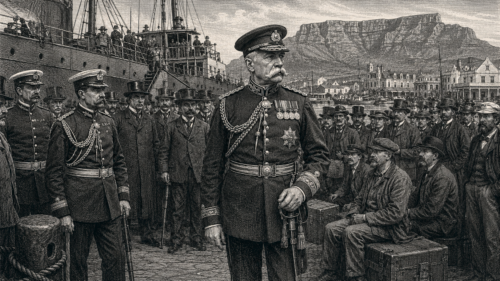
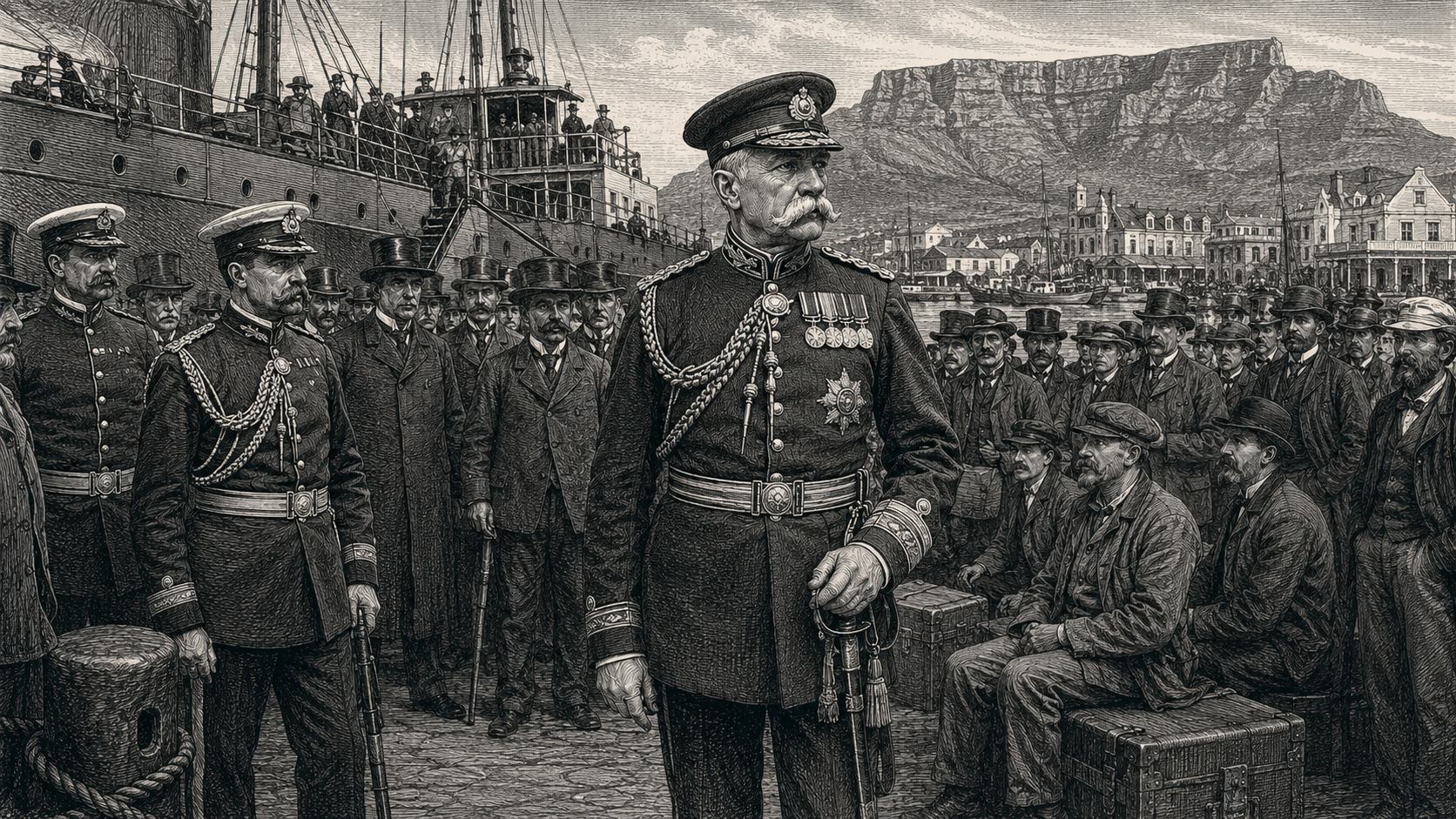
Read Article: Roberts ArrivesField Marshal Lord Roberts arrived at Cape Town on 10 January 1900 and assumed supreme command of British forces in South Africa. He travelled aboard the Dunottar Castle with Lord Kitchener, who became his chief of staff. Their appointment followed the defeats of “Black Week,” when British reverses at Stormberg, Magersfontein and Colenso exposed serious weaknesses in command, intelligence and battlefield preparation. Roberts received a formal welcome at the harbour, but the ceremony could not conceal the gravity of his task. British garrisons remained besieged, casualties were rising and reinforcements arriving from across the Empire required organisation.
Roberts replaced General Sir Redvers Buller as the senior British commander, although Buller continued directing operations in Natal and the attempts to relieve Ladysmith. The new command arrangement divided responsibilities while placing overall strategy under Roberts. His immediate priority was not a dramatic attack but the reorganisation of a large and disordered army. Transport, supply, intelligence, staff work and mounted forces all demanded attention before a sustained advance could begin. Lord Kitchener’s administrative energy complemented Roberts’s authority and experience, creating a headquarters intended to restore confidence after months in which Boer mobility and marksmanship had repeatedly frustrated British numerical superiority.
The arrival also signalled a major expansion of the war. Additional regular troops, reservists, militia battalions, colonial units and mounted volunteers were being assembled for service. Roberts planned to shift the principal British effort towards the western theatre, relieve Kimberley and advance upon Bloemfontein before moving deeper into the Boer republics. This approach reduced dependence upon repeated frontal assaults along the Natal railway. The change did not bring immediate relief to Ladysmith, Mafeking or Kimberley, but it indicated that Britain intended to replace improvised reactions with a coordinated offensive supported by overwhelming manpower, railway transport, artillery and supplies.
For Limerick readers, the appointment had an immediate human significance. The Royal Munster Fusiliers recruited throughout Limerick, Cork, Kerry and Clare, while other Irish regiments, reservists and individual soldiers were already serving in South Africa. Families awaiting letters or casualty lists understood that a change in command could determine where those men marched and fought. Some nationalists sympathised with the Boers and regarded Roberts as the instrument of a renewed imperial campaign. Yet political opposition to the war existed beside concern for relatives whose military wages supported households and whose survival depended upon decisions made at the new Cape Town headquarters.
Roberts’s arrival did not by itself transform British fortunes, but it marked the beginning of a more systematic phase of the campaign. During the following weeks he concentrated troops, improved mounted capacity and prepared the advance that relieved Kimberley and forced General Piet Cronje’s surrender at Paardeberg. The later occupation of Bloemfontein and Pretoria grew from the strategy developed after his arrival. News of the new supreme commander therefore carried both reassurance and foreboding to Limerick. Britain had acknowledged the inadequacy of its original plans, but its answer was not withdrawal. It was a larger army and a more determined prosecution of the war.
- Major-General Sir Frederick Maurice, History of the War in South Africa, 1899–1902, vol. I, chapter XXV, “Lord Roberts at Cape Town,” London: Hurst and Blackett, 1906.
- British Film Institute, The Arrival and Reception of Lord Roberts at Capetown, film recorded by Edgar Hyman for the Warwick Trading Company, 10 January 1900.
- Imperial War Museums, The Arrival and Reception of Lord Roberts at Cape Town, 10 January 1900, film collection object 1060000074.
- The Times, 11 January 1900, contemporary reporting on Lord Roberts’s arrival and assumption of command; page not confirmed.
- War Office, The Monthly Army List, January 1900, entries concerning British command and regimental establishments in South Africa.
- Military Archives of Ireland, Information Document on the Irish Regiments of the British Army, entry for the Royal Munster Fusiliers.
- National Army Museum, “The Royal Munster Fusiliers,” regimental history and South African War collection.
-
Ladysmith Assault
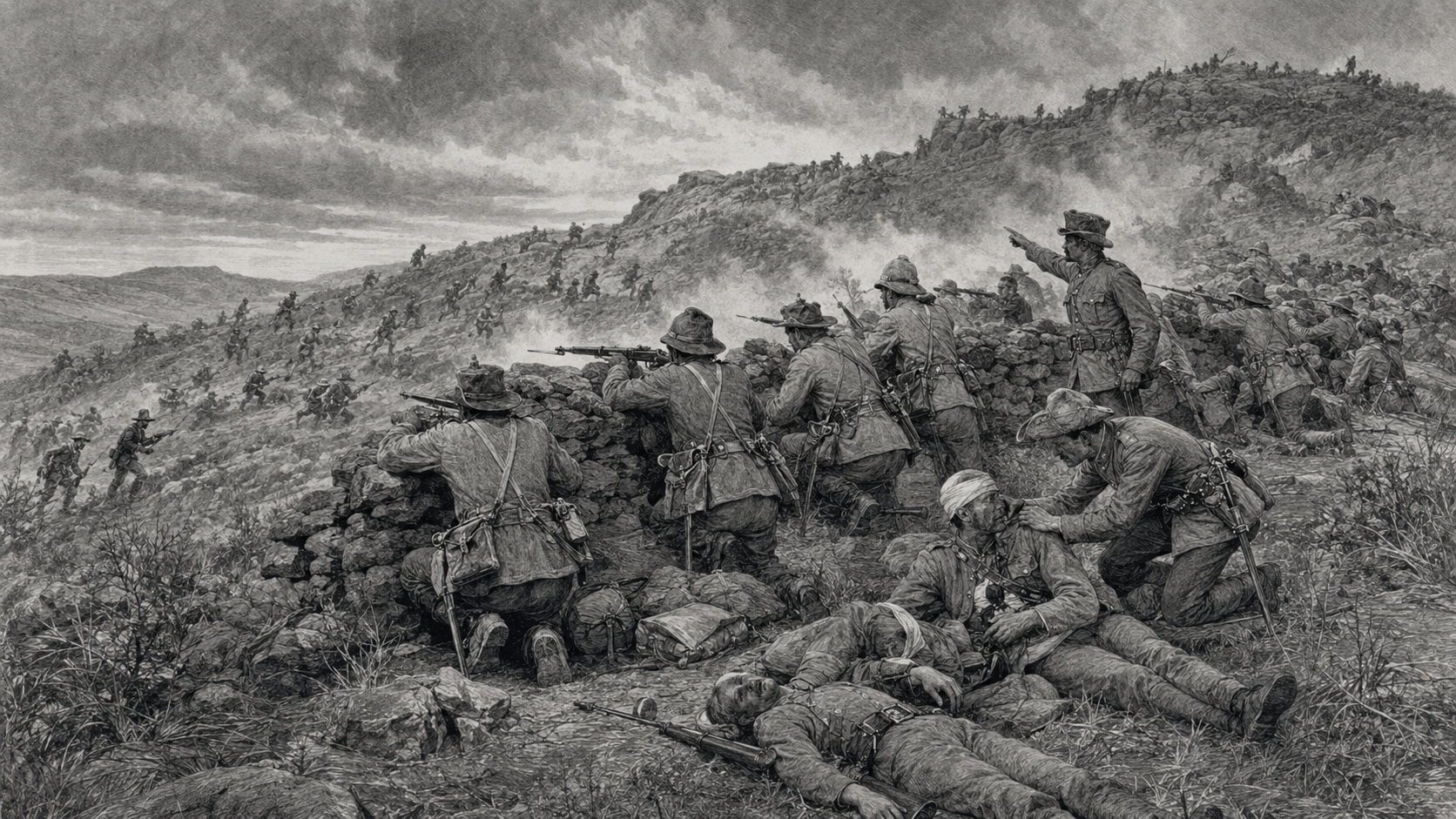
Read Article: Ladysmith AssaultBoer commandos launched a major assault upon the British defensive line south of besieged Ladysmith before dawn on 6 January 1900. Their principal targets were Wagon Hill and Caesar’s Camp, two positions on the ridge known locally as the Platrand. Advancing through darkness and broken ground, the attackers surprised several forward posts and gained parts of the crest before the defenders could organise effective resistance. Confused close-range fighting followed, with British and colonial troops struggling to distinguish friend from enemy among rocks, scrub and unfinished defensive works.
The battle continued throughout the day as reinforcements were sent towards the threatened ridge. Fighting was particularly severe around Wagon Hill, where Boer riflemen repeatedly challenged troops of the Imperial Light Horse, Royal Engineers, King’s Royal Rifle Corps, Gordon Highlanders and other units. At Caesar’s Camp, British and colonial defenders prevented the attackers from turning the position. Rain and hail swept across the battlefield late in the afternoon, but the struggle continued until a bayonet charge by the Devonshire Regiment finally helped clear the remaining Boer fighters from Wagon Hill.
The garrison retained possession of the Platrand, but the victory came at a heavy cost in killed and wounded men. The assault demonstrated that the Boer forces surrounding Ladysmith remained capable of mounting a determined attack upon the town’s defences. Although the attempt to storm the perimeter had failed, the siege was not broken. Food supplies were declining, disease was increasing and horses were eventually slaughtered to supplement rations. Ladysmith remained isolated until General Redvers Buller’s relieving army finally reached the town at the end of February.
Irish soldiers were involved in the wider defence and relief of Ladysmith. The 1st Battalion Royal Irish Fusiliers had entered the town during October 1899 and remained within the besieged garrison, while the Royal Dublin Fusiliers and other Irish regiments served with the forces attempting to break through from the south. The surviving evidence does not identify a particular Limerick unit as having fought upon Wagon Hill itself. Nevertheless, Limerick families with relatives serving in Natal would have followed reports of the assault closely while waiting for casualty lists, military correspondence and letters from individual soldiers.
The news carried a complicated emotional force in Limerick and elsewhere in Ireland. Many nationalists sympathised with the Boer republics and condemned Britain’s expansion in South Africa, yet thousands of Irishmen wore British uniforms and depended upon military pay. Political satisfaction at a British setback could therefore exist beside intense fear for a son, husband or brother trapped inside Ladysmith. The Platrand battle brought those conflicting loyalties into sharp focus. A distant imperial campaign was experienced locally through newspaper reports, interrupted wages, anxious households and the possibility that a familiar Irish name might appear among the dead or wounded.
- Major-General Sir Frederick Maurice, History of the War in South Africa, 1899–1902, vol. II, London: Hurst and Blackett, official military history covering the siege of Ladysmith and the fighting of 6 January 1900.
- National Army Museum, “The Boer Attack on Caesar’s Camp: A Hot Corner with the Border Mounted Rifles,” collection record concerning the assault of 6 January 1900.
- National Army Museum, “Boer War,” historical account of the siege, attacks upon Caesar’s Camp and Wagon Hill, and the relief of Ladysmith.
- Royal Dublin Fusiliers Association, Dublin Fusiliers in South Africa, regimental account of the attack upon Wagon Hill and Caesar’s Camp.
- Royal Irish Fusiliers Museum, “Under Siege at Ladysmith,” account of the 1st Battalion Royal Irish Fusiliers during the South African War.
- G. W. Steevens, From Capetown to Ladysmith: An Unfinished Record of the South African War, Edinburgh: William Blackwood and Sons, 1900.
- H. W. Nevinson, Ladysmith: The Diary of a Siege, London: Methuen, 1900.
- Luke Diver, Ireland and the South African War, 1899–1902, PhD thesis, Maynooth University, 2014.
-
Divided Loyalties
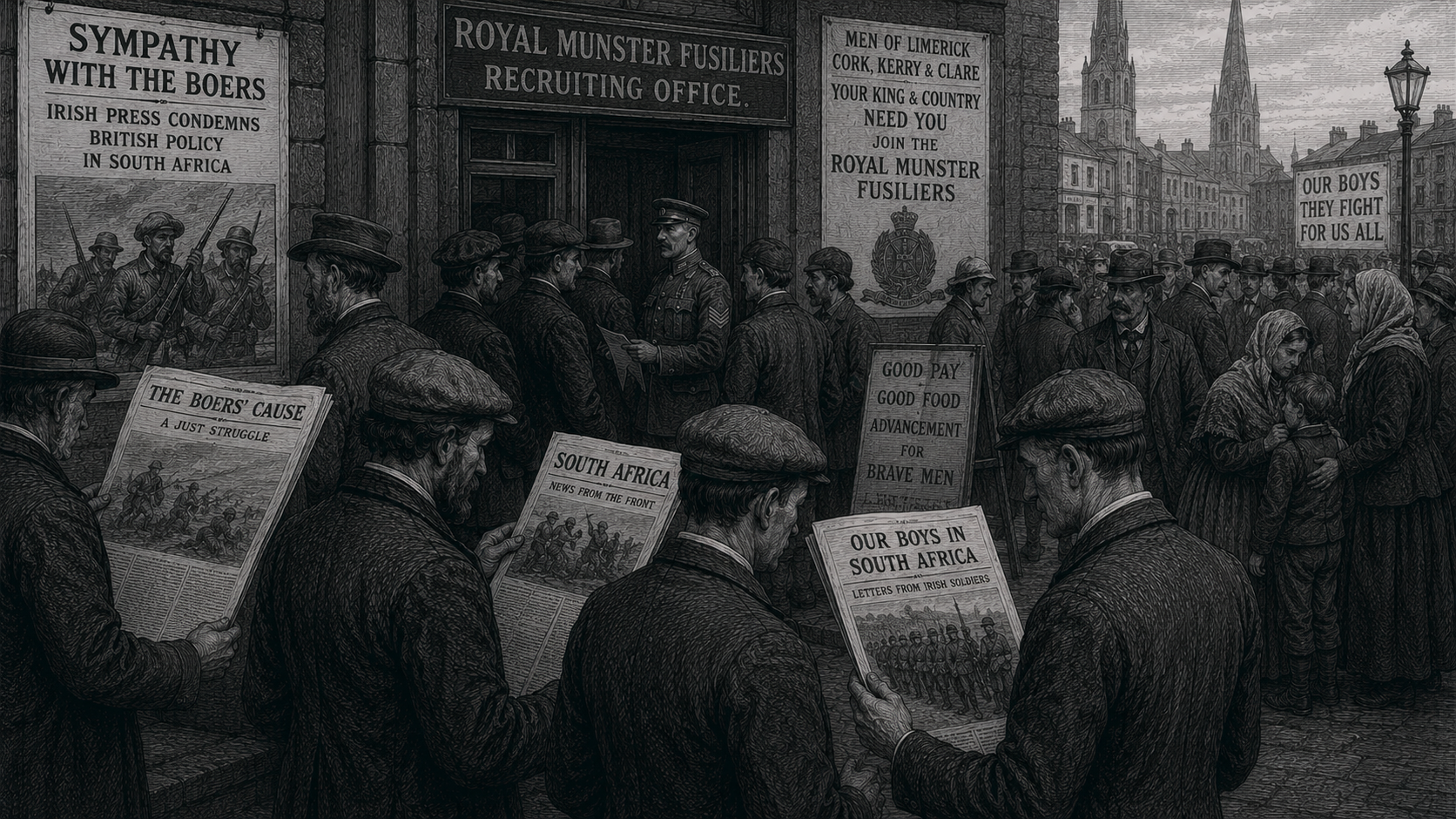
Read Article: Divided LoyaltiesIrish public opinion during the South African War was divided in a manner that exposed the complicated relationship between nationalism, empire and military service. Nationalist newspapers and political organisations frequently expressed sympathy for the Boer republics, presenting their resistance to British expansion as a struggle resembling Ireland’s own opposition to imperial rule. Boer victories were sometimes welcomed as humiliations for a government that continued to deny Irish self-government. Public meetings, songs, newspaper commentary and street demonstrations gave the pro-Boer cause considerable visibility, making Ireland one of the strongest centres of anti-war and pro-Boer feeling in Europe.
That political sympathy existed alongside substantial Irish participation in the British Army. Estimates differ, but historians agree that tens of thousands of Irishmen served on the British side during the conflict. Some were long-service regular soldiers, while others were reservists, militiamen or new recruits attracted by employment, pay, family tradition and the social standing associated with military service. Irish regiments fought in many of the campaign’s principal operations, even as nationalist newspapers criticised the policies those soldiers were ordered to enforce. The contradiction was not exceptional: opposition to the war could coexist with pride, anxiety and loyalty towards Irishmen serving within it.
The Royal Munster Fusiliers gave the conflict an immediate connection to Limerick. Its recruiting district included Cork, Limerick, Kerry and Clare, and its depot was at Tralee. The 1st Battalion served throughout the South African War, while the 2nd Battalion arrived during its later stages. Men from Limerick city and county entered the regiment through established recruiting networks, family connections and previous military service. The regiment consequently linked South African battlefields with streets, farms and barracks throughout Munster. Casualty reports or delayed letters could bring a distant imperial campaign directly into households that otherwise shared little enthusiasm for British political objectives.
Economic necessity complicated political feeling still further. Regular army wages were modest, but military employment provided food, clothing and a dependable income that could help support parents, wives and children. Reservists recalled to the colours left civilian jobs, while public bodies and private employers had to decide whether their positions would remain open. In working-class districts and rural communities, criticism of imperial policy did not remove dependence upon soldiers’ earnings. Families might sympathise with the Boers while praying for the safety of a son or husband wearing a British uniform. Such households experienced the war through separation, remittances, uncertainty and fear rather than through simple ideological loyalty.
The conflict therefore resisted any easy division between pro-British soldiers and anti-British civilians. Irishmen joined the army for many reasons, and relatives could honour their courage without accepting the justice of the campaign. Nationalist politicians likewise risked alienating soldiers’ families if opposition to recruitment became contempt for the men already serving. In Limerick and across Munster, the South African War revealed overlapping identities shaped by poverty, employment, regiment, family and national politics. Sympathy for the Boers and concern for the Royal Munster Fusiliers were not mutually exclusive; they were two parts of the painful reality through which many Irish communities understood the war.
- Military Archives of Ireland, Information Document on the Irish Regiments of the British Army, entry for the Royal Munster Fusiliers, identifying Tralee as the regimental depot, Cork, Limerick, Kerry and Clare as its recruiting counties, and South Africa among its pre-1914 theatres of service.
- National Army Museum, “The Royal Munster Fusiliers,” regimental history confirming that the 1st Battalion served throughout the South African War and the 2nd Battalion arrived in South Africa in December 1901.
- National Army Museum, “‘Royal Munster Fusiliers — A Bristling British Front,’ 1899,” collection record documenting the regiment’s South African service and wartime casualties.
- Luke Diver, Ireland and the South African War, 1899–1902, PhD thesis, Maynooth University, 2014.
- Donal P. McCracken, The Irish Pro-Boers, 1877–1902, Johannesburg: Perskor, 1989.
- Thomas Denman, “‘The Red Livery of Shame’: The Campaign Against Army Recruitment in Ireland, 1899–1914,” Irish Historical Studies, vol. 29, no. 114, November 1994, pp. 208–233.
- Stephen Lynn, Global Irish Nationalism and the South African War, 1899–1902, PhD thesis, University of Toronto, 2022.
- War Office, The Monthly Army List, January 1900, entries for the Royal Munster Fusiliers and Irish regimental establishments.
-
Mounted Volunteers
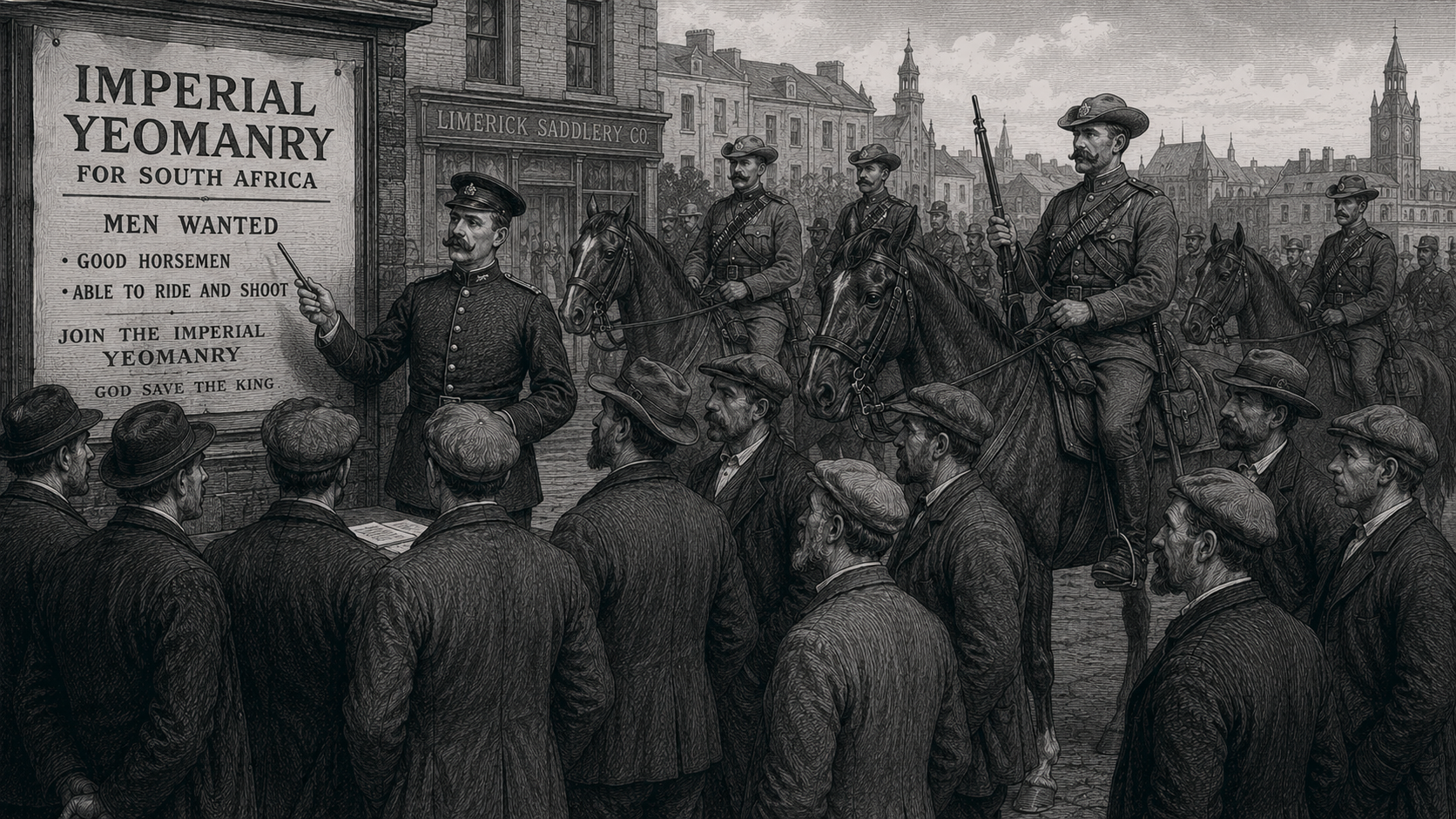
Read Article: Mounted VolunteersA Special Army Order issued at the beginning of January 1900 established the machinery for recruiting the Imperial Yeomanry, a volunteer mounted force intended for service in South Africa. The decision followed the British defeats of December 1899, when Boer commandos demonstrated the effectiveness of mobile riflemen operating across difficult country. Existing yeomanry units were invited to provide trained volunteers, while suitable civilians could also enlist for a limited period of overseas service. The new formation was organised as mounted infantry rather than conventional cavalry, emphasising movement, marksmanship and the ability to fight after dismounting.
Recruiting officers sought medically fit men who could ride confidently and handle a rifle. Applicants were generally expected to be between twenty and thirty-five years of age and to demonstrate practical proficiency before acceptance. The force was arranged in companies and battalions, reflecting its intended role as infantry transported rapidly by horse rather than cavalry trained primarily for mounted charges. Volunteers received higher pay than ordinary soldiers and enlisted for the duration of the emergency. The system allowed the War Office to draw upon horsemen, former servicemen, volunteers and civilians without relying entirely upon the overstretched regular army.
The creation of the Imperial Yeomanry revealed how seriously the military situation had deteriorated. British commanders had entered the war with insufficient mounted troops to match Boer forces that travelled swiftly, selected favourable ground and fired accurately at long range. Reinforcements were therefore required who could patrol, scout, protect communications and accompany mobile columns. By February, ministers reported that thousands of men had been raised. The new force did not replace regular cavalry or infantry, but it acknowledged that the campaign demanded a broader mobilisation of civilian skills, private horses, local military experience and voluntary enthusiasm.
The order held clear relevance for rural Limerick even where individual enlistments cannot be confirmed from the surviving notice. County Limerick possessed strong traditions of horse breeding, hunting, racing, farming and mounted travel, while former soldiers and reservists lived throughout the city and countryside. Men accustomed to handling horses or firearms would have recognised the qualifications being sought. Families and employers also understood the consequences of enlistment: an accepted volunteer could leave work and home for South Africa, while local communities absorbed the economic and emotional strain created by another expansion of wartime recruitment.
Imperial Yeomanry recruitment added a new layer to Limerick’s involvement in the South African War. Regular soldiers, reservists and militia units were already being mobilised or redistributed, and the mounted volunteer force widened the range of people who might be drawn into service. Its creation also challenged confidence in the existing army system. A government compelled to seek civilian horsemen and marksmen had effectively admitted that regular formations alone were insufficient for the campaign. For Limerick observers, the order connected distant battles with local horses, military experience, employment decisions and the possibility that familiar men might soon depart for war.
- War Office, Special Army Order, 2 January 1900, establishing the organisation and recruitment machinery of the Imperial Yeomanry; reprinted in the Army Orders for January 1900.
- Royal Warrant, 24 December 1899, authorising the creation of the Imperial Yeomanry for service during the South African War.
- House of Lords Debates, “South African War—Contemplated Military Measures,” 12 February 1900, discussion of the raising of approximately 8,000 Imperial Yeomanry volunteers.
- War Office, Annual Report of the Inspector-General of Recruiting for the Year Ending 30 September 1900, Parliamentary Papers, 1901, Cd. 519.
- The National Archives, Imperial Yeomanry soldiers’ documents, South African War, 1899–1902, WO 128.
- Irish Times, January 1900, reports concerning the selection and training of Irish Imperial Yeomanry recruits at Newbridge Cavalry Barracks.
- Luke Diver, Ireland and the South African War, 1899–1902, PhD thesis, Maynooth University, 2014.
-
University Demand
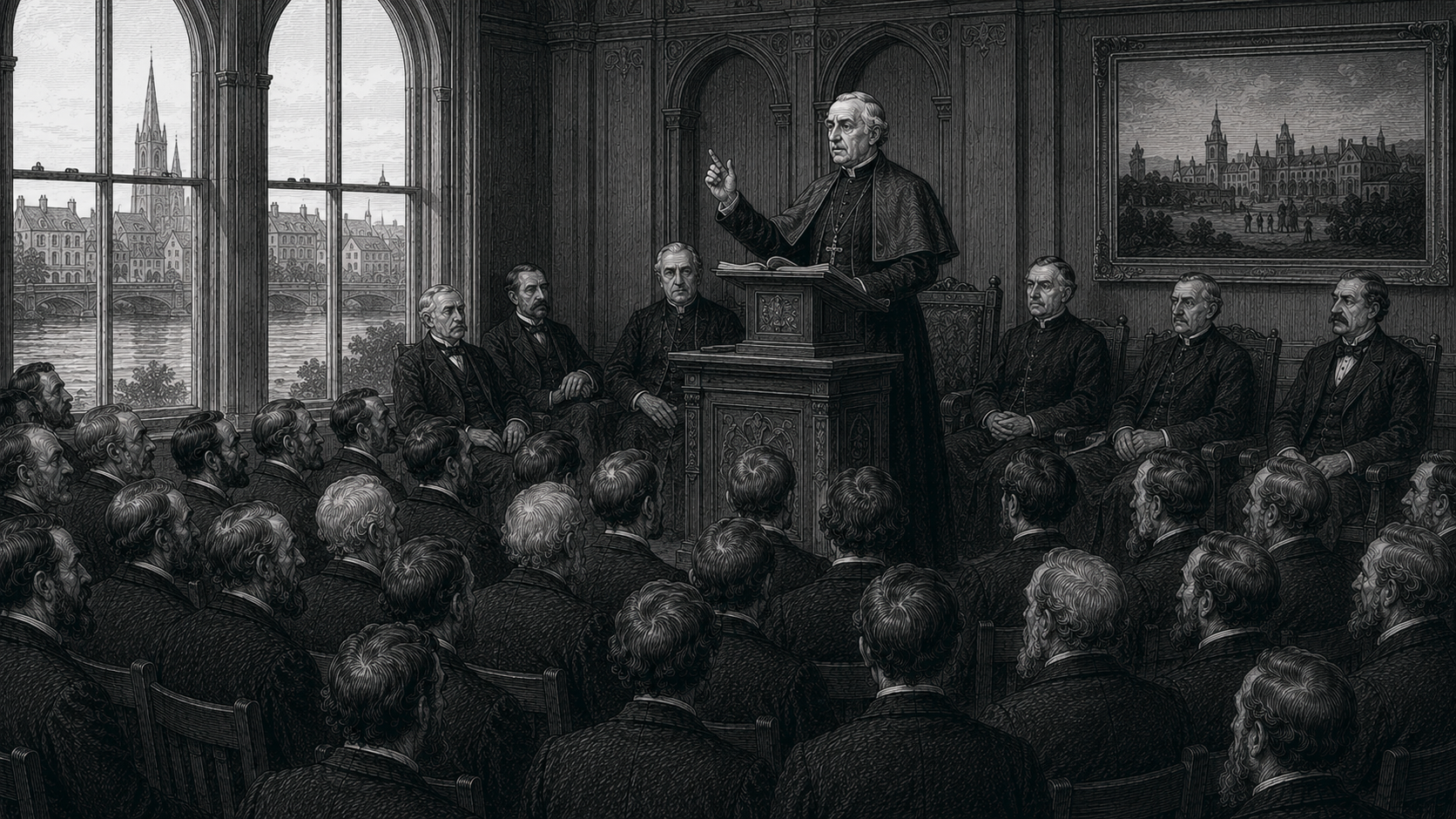
Read Article: University DemandBishop Edward Thomas O’Dwyer of Limerick delivered a prominent intervention in the continuing dispute over university education for Irish Catholics. He argued that the existing system failed to provide higher education on terms acceptable to the religious convictions of most of Ireland’s population. Catholic students could enter Trinity College Dublin or prepare for examinations through institutions connected with the Royal University, but church leaders maintained that neither arrangement offered a complete university environment shaped by Catholic belief and practice. O’Dwyer presented the question as one of educational equality rather than a request for clerical privilege.
The bishop rejected claims that a new university would merely use public money to strengthen ecclesiastical control. He maintained that Catholics sought access to secular learning under conditions that did not require students or families to disregard conscience. In his published explanation of the case, O’Dwyer accepted significant limitations upon the proposed institution, including safeguards surrounding governance and public funding. His argument was that Protestant and non-denominational opinion should distinguish between establishing a church and removing an educational disability. Catholics contributed to taxation, yet lacked a fully recognised university that reflected the religious atmosphere many parents considered essential.
The problem had serious consequences for professional advancement. University degrees increasingly opened routes into medicine, law, teaching, administration, science and other occupations requiring formal qualifications. Families who rejected existing institutions could send talented sons abroad, support them through less satisfactory arrangements or abandon university ambitions altogether. Each choice demanded money that many households could not provide. The absence of an acceptable Irish university therefore narrowed opportunity most severely for capable students from modest backgrounds. O’Dwyer warned that a country already weakened by poverty and emigration could not afford to leave much of its intellectual ability without suitable higher education.
For Limerick families, the question connected schooling directly with social and economic mobility. The city possessed respected secondary schools and ecclesiastical institutions, while O’Dwyer himself had supported educational development throughout his episcopate. Yet local students seeking advanced degrees usually had to continue their studies elsewhere. Travel, accommodation and fees placed university education beyond the reach of many households, even before religious concerns were considered. A recognised Catholic university could allow Limerick students to pursue professional careers within Ireland while reassuring parents that academic training would not separate education from the moral and religious formation valued within the home.
The university controversy remained unresolved at the opening of the twentieth century because it involved religion, finance, state authority and competing ideas of academic freedom. Catholic bishops did not always agree upon the exact structure they would accept, while British politicians feared denominational endowment and opposition from supporters of existing institutions. O’Dwyer’s forceful contribution ensured that Limerick’s voice remained prominent within the national debate. His central claim was difficult to dismiss: a system serving only a small proportion of Irish Catholics could not be described as equal merely because no law explicitly prevented them from entering institutions many regarded as religiously unsuitable.
- Edward Thomas O’Dwyer, “University Education for Irish Catholics,” The Nineteenth Century, vol. 45, January 1899, pp. 67–80.
- Royal University of Ireland Act 1879, 42 & 43 Vict., c. 63.
- University Education (Ireland) Act 1873, 36 & 37 Vict., c. 21.
- Senia Pašeta, “The Catholic Hierarchy and the Irish University Question, 1880–1908,” History, vol. 85, no. 277, January 2000, pp. 5–22.
- Thomas J. Morrissey, Bishop Edward Thomas O’Dwyer of Limerick, 1842–1917, Dublin: Four Courts Press, 2003.
- Michael V. Spillane, The 4th Earl of Dunraven, 1841–1926: A Study of His Contribution to the Emerging Ireland at the Beginning of the 20th Century, PhD thesis, University of Limerick, 2003.
-
Coal Dues
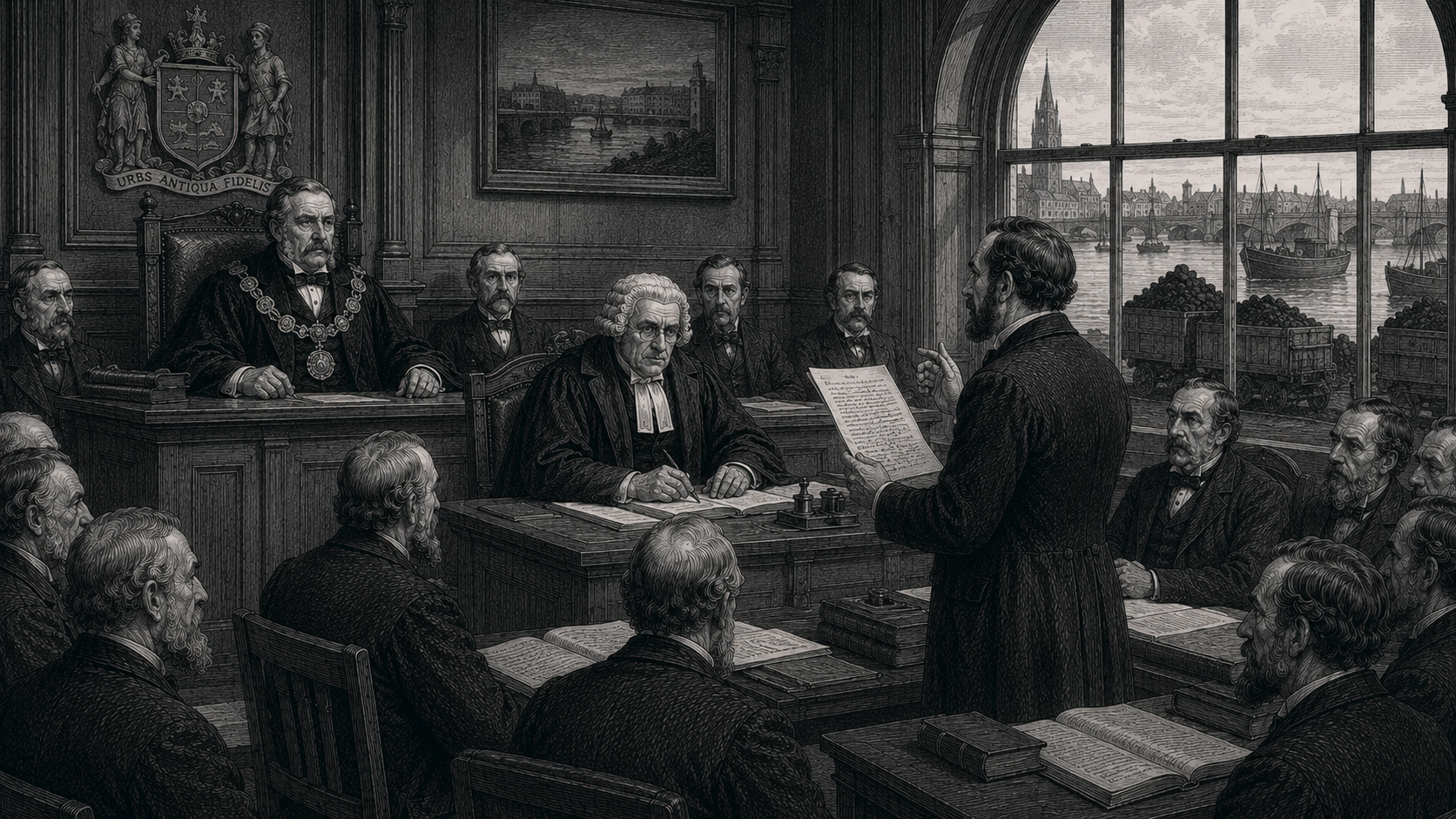
Read Article: Coal DuesA substantial case before Judge Richard Adams examined the Mayor of Limerick’s asserted right to receive dues upon coal brought into the city. The proceedings, reported on 12 January 1900, required the court to consider whether this inherited privilege rested upon royal charter, lease, long-established prescription or some combination of those authorities. Counsel disputed both the legal foundation of the claim and the capacity in which the Mayor exercised it. What appeared to be an obscure municipal custom therefore became a serious test of whether an ancient commercial right remained enforceable within Limerick’s modern port economy.
The evidence reached back through earlier mayoralties and the long history of Limerick Corporation. Ambrose Hall, who had served as Mayor in 1875, testified that he had received approximately 145 tons of coal as mayoral dues during his year in office. Such testimony was intended to demonstrate actual exercise of the alleged right within living memory. The court nevertheless had to distinguish repeated collection from lawful title. A practice might have continued for many years without conclusively proving whether it originated in a chartered privilege, a leasehold arrangement, ownership of quayside property or an established custom recognised by law.
Coal occupied a central place in Limerick’s economy at the beginning of the twentieth century. Households relied upon it for heating and cooking, while railways, factories, workshops, steam vessels and commercial premises consumed large quantities. Any duty imposed upon imported coal could increase costs for merchants and ultimately be passed to families and businesses. The case therefore concerned more than the personal entitlement of a serving Mayor. It affected the price of an essential fuel, the competitiveness of Limerick Harbour and the power of the Corporation to draw revenue from goods entering along the Shannon and city quays.
For the Corporation, inherited dues formed part of a wider body of privileges and revenues accumulated under successive royal charters and municipal arrangements. These resources helped support civic administration before modern systems of local taxation became fully established. Merchants, however, had an obvious interest in challenging charges whose legal origins appeared uncertain or whose commercial burden had become increasingly difficult to justify. Judge Adams’s examination of charter, lease and prescription reflected the complexity of municipal law in a city where medieval rights, private property, harbour regulation and nineteenth-century commerce continued to overlap within the same streets and waterfront.
The dispute illustrated how Limerick’s commercial modernisation repeatedly encountered institutions inherited from an older civic order. Steam transport and expanding industry increased demand for coal, yet every cargo could still become subject to rights traced through centuries of mayoral and corporate authority. A ruling upon the dues could influence municipal income, import expenses and the relationship between the Corporation and harbour traders. Whatever the final legal outcome, the hearing forced the city to ask whether an established custom remained a legitimate source of public revenue or had become an obstacle to affordable fuel and competitive trade.
- Freeman’s Journal, “The Mayor of Limerick and the Coal Dues,” 12 January 1900, p. 6.
- Limerick Corporation Pre-Reform Collection, 1719–1917, L/OC, charters, leases, legal papers, revenue records and council proceedings, Limerick Archives.
- Limerick Harbour Commissioners Collection, IE LA P2, Coal Dues Book, 1843–1847, Limerick Archives.
- Limerick Harbour Commissioners Collection, IE LA P2, records of imports and exports through Limerick Harbour, Limerick Archives.
- University of Galway, Landed Estates Database, “Hall (Limerick),” biographical record identifying Ambrose Hall as Mayor of Limerick in 1875.
-
Roads Dispute
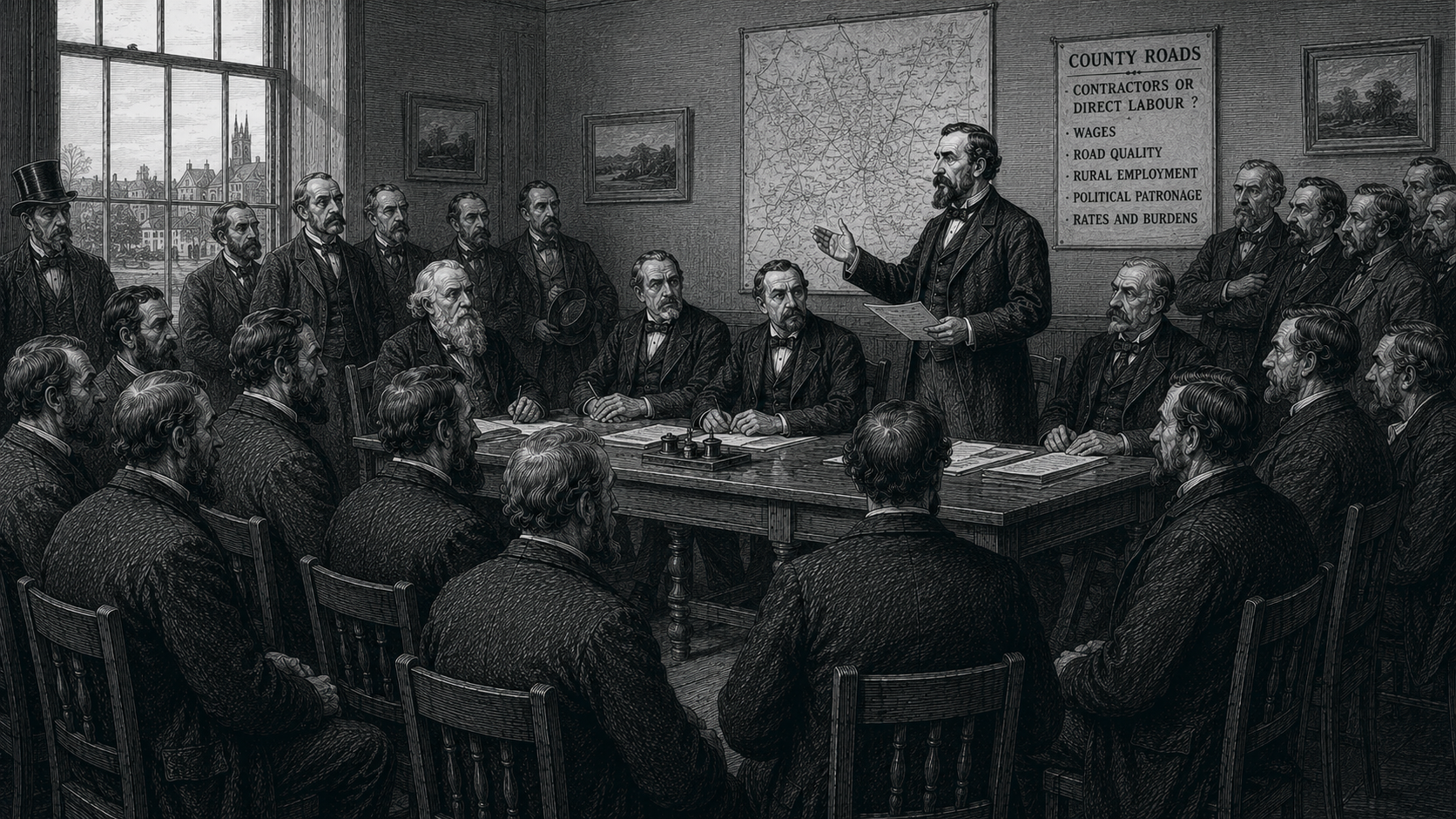
Read Article: Roads DisputeArguments continued across County Limerick over whether public roads should be maintained through private contracts or by labourers employed directly under elected local authorities. The Munster News criticised what it regarded as Limerick County Council’s unsatisfactory handling of road tenders and the developing direct-labour question. The dispute followed the transfer of road administration from the Grand Jury system to the newly elected county and rural district councils. Councillors were now responsible for deciding how public money should be spent, who should receive employment and whether established contractors continued to offer the most economical and reliable method of keeping roads in repair.
Under the contracting system, individuals tendered to maintain particular stretches of road for an agreed period and payment. Supporters believed competition between bidders could control expenditure and place responsibility upon an identifiable contractor. Critics argued that contractors might reduce wages, employ too few labourers or preserve profit by allowing roads to deteriorate. Where no satisfactory tender was received, Limerick County Council sought authority to place roads under the County Surveyor and employ workers directly. This alternative allowed public supervision of labour and materials, but it required councillors and officials to manage staffing, wages, equipment and daily work rather than merely inspecting a contractor’s performance.
Direct labour appealed strongly to rural workers facing irregular employment, particularly during winter and periods of agricultural inactivity. Council work offered wages financed from public rates and reduced dependence upon farmers or private contractors selecting labour according to personal preference. Supporters maintained that money voted for roads should reach the men performing the work instead of contributing to a contractor’s profit. Opponents feared that elected councillors might distribute jobs among political supporters, relatives or organised pressure groups. The choice between the two systems therefore became entangled with wider arguments about fairness, patronage, democratic authority and the proper limits of council involvement in local employment.
Ratepayers also had a direct interest in the outcome. Poorly maintained roads hindered access to markets, creameries, railway stations, churches and towns, increasing costs for farmers, merchants and carriers. Excessive expenditure, however, would appear in the county rates paid by property owners and occupiers. Councillors had to compare contract prices with the actual cost of wages, stone, tools, carts and supervision under direct labour. Newspaper criticism helped expose those decisions to public scrutiny. The controversy was not simply a quarrel about administrative procedure; it concerned the balance between affordable taxation, dependable roads, decent employment and transparent control over public money.
The debate became an early test of the powers transferred by the Local Government (Ireland) Act of 1898. Elected representatives had replaced landlord-dominated Grand Juries in many areas of county administration, but democratic control brought new responsibilities and new opportunities for dispute. Limerick County Council could no longer blame an unelected system for unpopular road decisions. It was required to advertise tenders fairly, supervise direct work, account for expenditure and explain its choices to labourers and ratepayers alike. The road question demonstrated that local self-government would be judged not merely by who held office, but by the quality, economy and fairness of the services delivered.
- Munster News, January 1900, criticism of Limerick County Council’s handling of road tenders and direct labour; exact issue and page not confirmed.
- Irish Times, “Limerick County Council and the Roads,” 5 January 1900, p. 3.
- Irish Times, “The Direct Labour Question,” 18 January 1900, p. 6.
- Limerick County Council minute books, 1899–1900, Limerick Archives; exact volume and folio for the relevant tender discussions not confirmed.
- Local Government (Ireland) Act 1898, 61 & 62 Vict., c. 37.
- Local Government (Procedure of Councils) Order 1899, provisions governing council meetings, contracts and financial administration.
- Martin Walsh, Limerick Local Government 1899–1942: An Online Exhibition Commemorating the 125th Anniversary of the Local Elections, 1899, Limerick Museum and Limerick Library Service, 2024.
- Arlene Crampsie, “A Forgotten Tier of Local Government: The Impact of Rural District Councils on the Landscape of Early Twentieth-Century Ireland,” Irish Geography, vol. 47, no. 1, 2014, pp. 21–48.
-
Shannon Resistance
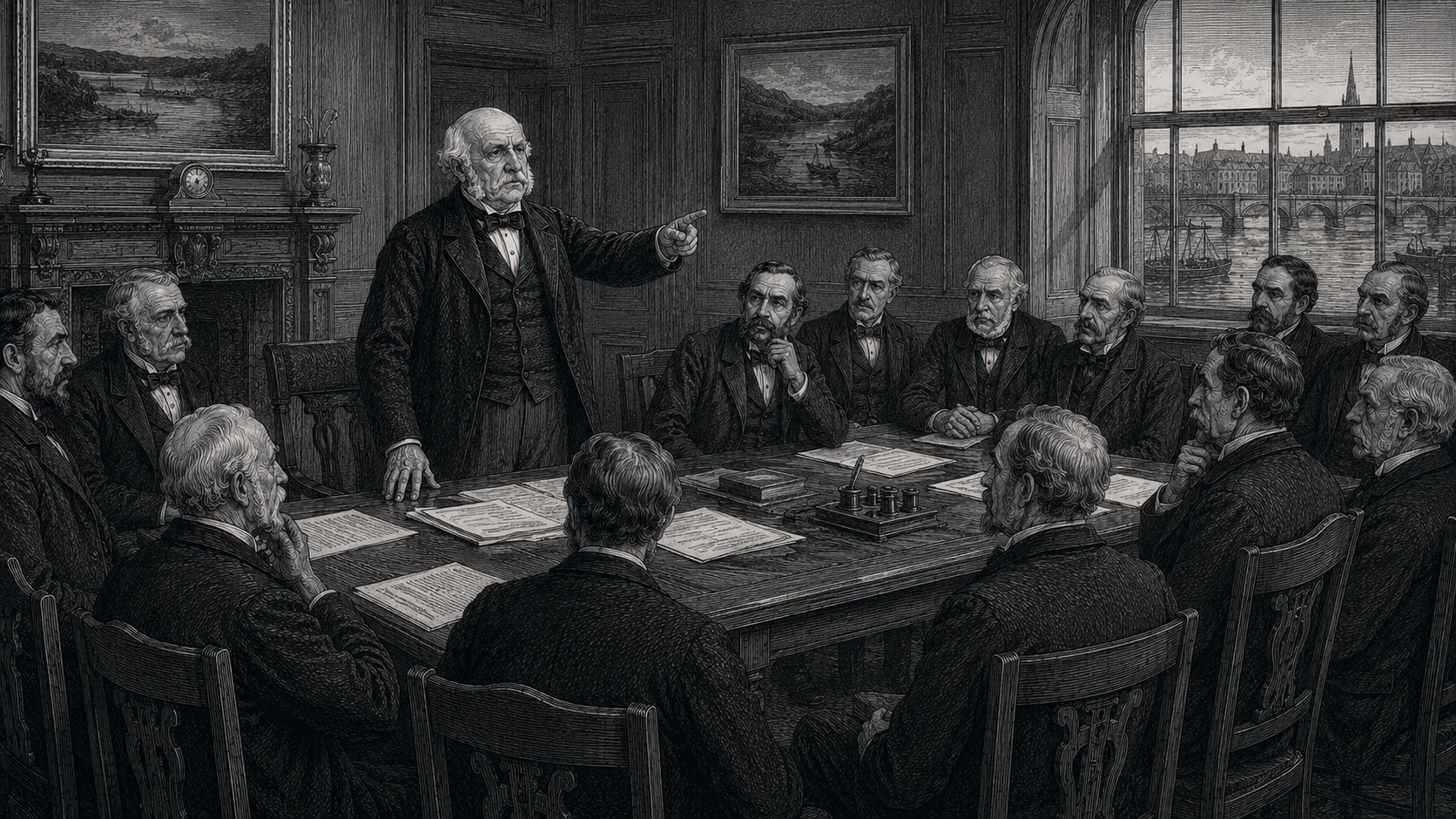
Read Article: Shannon ResistanceAt the opening of the twentieth century, Limerick’s fishery interests faced a proposal they believed could transform the River Shannon at enormous local cost. The Limerick Fishery Conservators, presided over by Lord Massy, met to consider the Shannon Water and Electric Power Company’s plan to secure parliamentary authority for works near Lough Derg and Clonlara. The promoters argued that Shannon water could be diverted through engineered channels to generate electricity for Limerick and surrounding districts. The Conservators unanimously resolved to oppose the measure, regarding it as a direct threat to the river upon which fisheries, navigation and established livelihoods depended.
Members rejected the suggestion that the proposed bill represented harmless industrial modernisation. They feared that lowering Lough Derg and diverting water away from the natural Shannon channel could obstruct boats, interfere with quays, reduce power available to riverside mills and damage commercial traffic. Salmon fishing caused particular anxiety. If altered water levels prevented fish from entering tributaries and reaching their spawning grounds, the effects might extend across future seasons rather than remain confined to the construction period. The Conservators therefore treated the scheme as a possible attack upon the river’s ecological and economic system rather than a single engineering project.
Limerick’s water supply gave the controversy an urgent public dimension. The city depended upon the Shannon system, and any substantial change in flow raised fears about the reliability of water reaching households, hospitals, institutions and businesses. Opponents described the proposed legislation as benefiting a small group of company promoters while transferring the risks to fishermen, mill owners, traders, ratepayers and the wider population. Their criticism did not deny that electricity could support industrial growth. It questioned whether one form of progress should be permitted to weaken several existing public and commercial services upon which Limerick already relied.
The Conservators believed that Parliament might reject a bill threatening navigation, fisheries and municipal water, but they also recognised that opposition would be expensive. Parliamentary bills required legal representation, technical witnesses, engineering evidence and organised cooperation among affected interests. The board therefore sought support from fishery owners, riparian proprietors, millers, local authorities and commercial bodies throughout the Shannon region. The struggle would not be won through indignation alone. Those resisting the company needed to demonstrate how the proposed works could alter river levels, obstruct traditional uses and impose losses that the promised supply of electricity might never adequately compensate.
The dispute forced Limerick to confront a question that would recur throughout the modern age: whether technological development could be trusted when its benefits were promoted more confidently than its risks were explained. Electricity offered civic lighting, industrial power and commercial expansion, yet the Shannon already supported fishing, milling, navigation, trade and public water. The Conservators’ unanimous resolution did not prevent further inquiries or parliamentary consideration, but it ensured that the company would face organised resistance. Their stand established that the river could not be treated merely as unused energy waiting to be captured without accounting for the people and industries already sustained by it.
- Irish Times, “Shannon Water and Electric Power Company,” 2 January 1900, p. 7.
- Irish Times, “Limerick Fishery Conservators: The Shannon Water and Electric Power Bill,” 5 January 1900, p. 3.
- Limerick Fishery Board of Conservators Collection, IE LA P48, Limerick Archives.
- House of Lords Debates, “Shannon Water and Electric Power Bill,” 23 July 1900, vol. 86.
- House of Lords Debates, “Irish Fisheries—Inspectors’ Reports,” 23 July 1900, vol. 86.
- Shannon Water and Electric Power Act 1901, 1 Edw. 7, c. cxxxvi, royal assent 26 July 1901.
-
Kincora Preparations
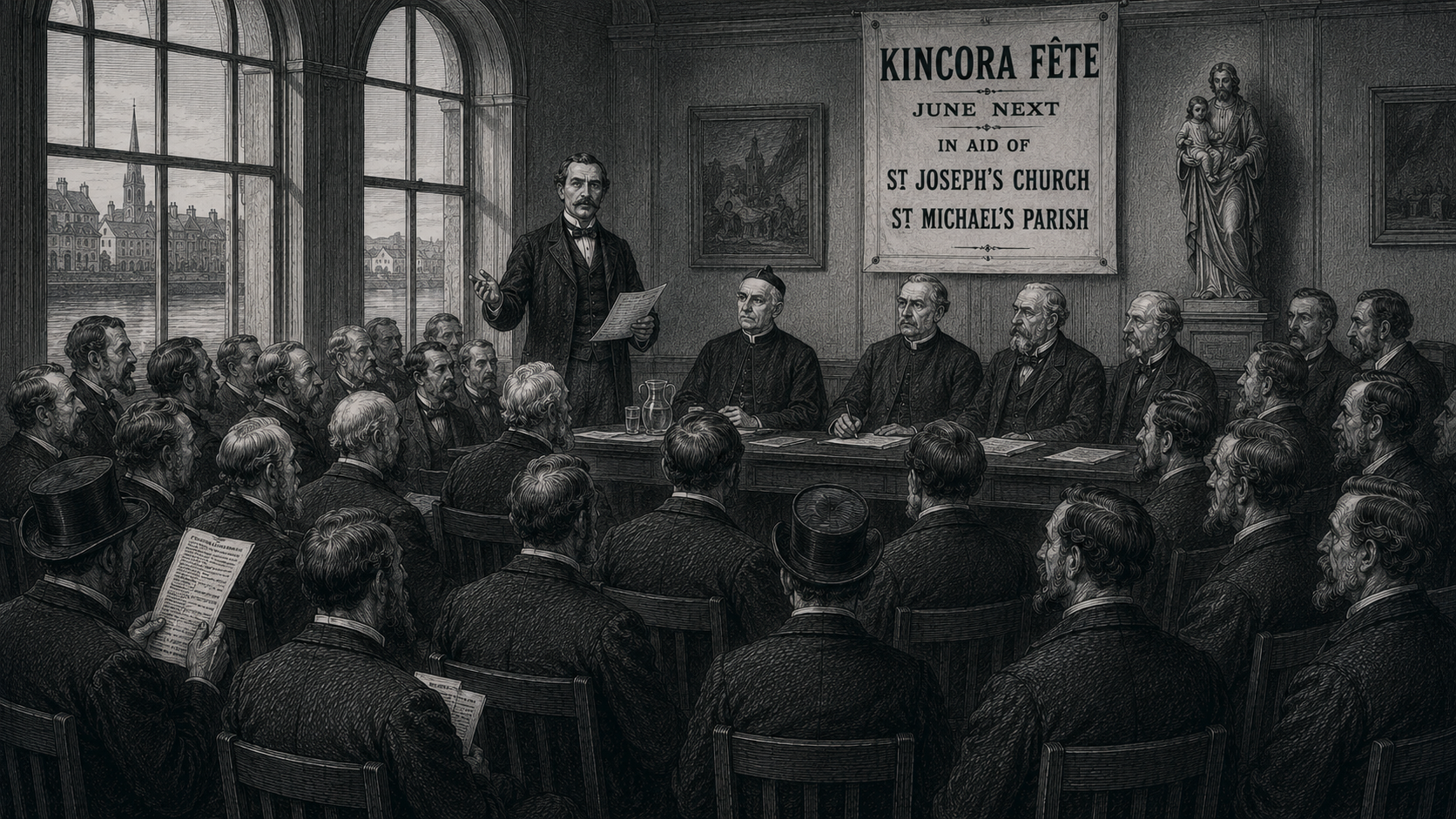
Read Article: Kincora PreparationsA large public meeting reported on 4 January 1900 gathered in the Lecture Hall of Limerick’s Catholic Institute to organise a fête and fancy fair in aid of the new St Joseph’s Church then under construction in St Michael’s Parish. Bishop Edward Thomas O’Dwyer presided over an attendance of clergy, women, merchants and other prominent citizens. The gathering agreed that the event should take place during June and established committees to undertake the considerable work involved. Their responsibilities included subscriptions, entertainments, stalls, decorations, publicity and the practical management of what organisers intended to become a major civic fundraising occasion.
Father O’Donnell, administrator of St Michael’s Parish, explained that the organisers had delayed making arrangements until they established whether Limerick’s hospitals intended to hold a fête during the same year. Once the hospital committees confirmed that no competing event was planned, the church committee selected June. The timing also allowed the celebrated Limerick tenor Joseph O’Mara to assist with the programme. The undertaking was named the Kincora Fête, invoking the royal residence traditionally associated with Brian Boru and giving the planned celebration a distinctively Irish historical character without limiting its appeal to one narrow religious or social constituency.
The most significant feature of the meeting was the reported promise of assistance from Protestant residents as well as Catholic supporters. Father O’Donnell welcomed these offers publicly and stated that the organisers would gladly accept them. This cooperation did not remove Limerick’s religious divisions, nor should it be interpreted as evidence that sectarian differences had disappeared. It nevertheless showed that charitable and civic occasions could create practical alliances across denominational boundaries. Merchants, professionals, performers and householders could contribute money, prizes, labour or influence to a project formally associated with Catholic parish life but presented as an important addition to the wider city.
Construction of St Joseph’s had begun because the existing church arrangements in the extensive St Michael’s Parish no longer adequately served its growing population. The new building on Military Road was designed by William Edward Corbett, with John Ryan and Sons engaged as builders. Raising the necessary funds required more than ordinary weekly collections. Large fêtes transformed charitable giving into public entertainment, drawing visitors through music, performance, novelty attractions, competitions and decorated stalls. They also generated temporary work for tradespeople, printers, caterers and performers while allowing social organisations and prominent families to demonstrate support for a visible civic undertaking.
The committees established at the Catholic Institute carried their preparations through to the Kincora Fête held at the Markets Field in June 1900. Cardinal Michael Logue opened the celebration, while a large choir and numerous attractions helped draw public attendance. Among the advertised novelties was the cinematograph, still unfamiliar to many Irish audiences. The fête produced valuable income for the church building fund, although St Joseph’s required further work before opening in 1904. The January meeting therefore marked the point at which a parish construction project became a citywide campaign involving religious leadership, commercial organisation, popular entertainment and limited but meaningful cross-community cooperation.
- Freeman’s Journal, “Proposed Fete in June,” 4 January 1900, p. 6.
- St Joseph’s Parish, St Joseph’s Parish: A History, Limerick, pp. 13–14, account of the church-building project and the Kincora Fête of June 1900.
- Denis Condon, Early Irish Cinema, 1895–1921, Dublin: Irish Academic Press, 2008, pp. 22–23, identifying the cinematograph among the attractions advertised for the Limerick Kincora Fête.
- St Joseph’s Parish, “Parish History,” account of the church’s construction, architect William Edward Corbett and builders John Ryan and Sons.
- Gerard Hannan, “Limerick — January 1900,” Irish Media Man, 28 February 2013, transcription of the contemporary Freeman’s Journal report.
-
Sessions Disputed
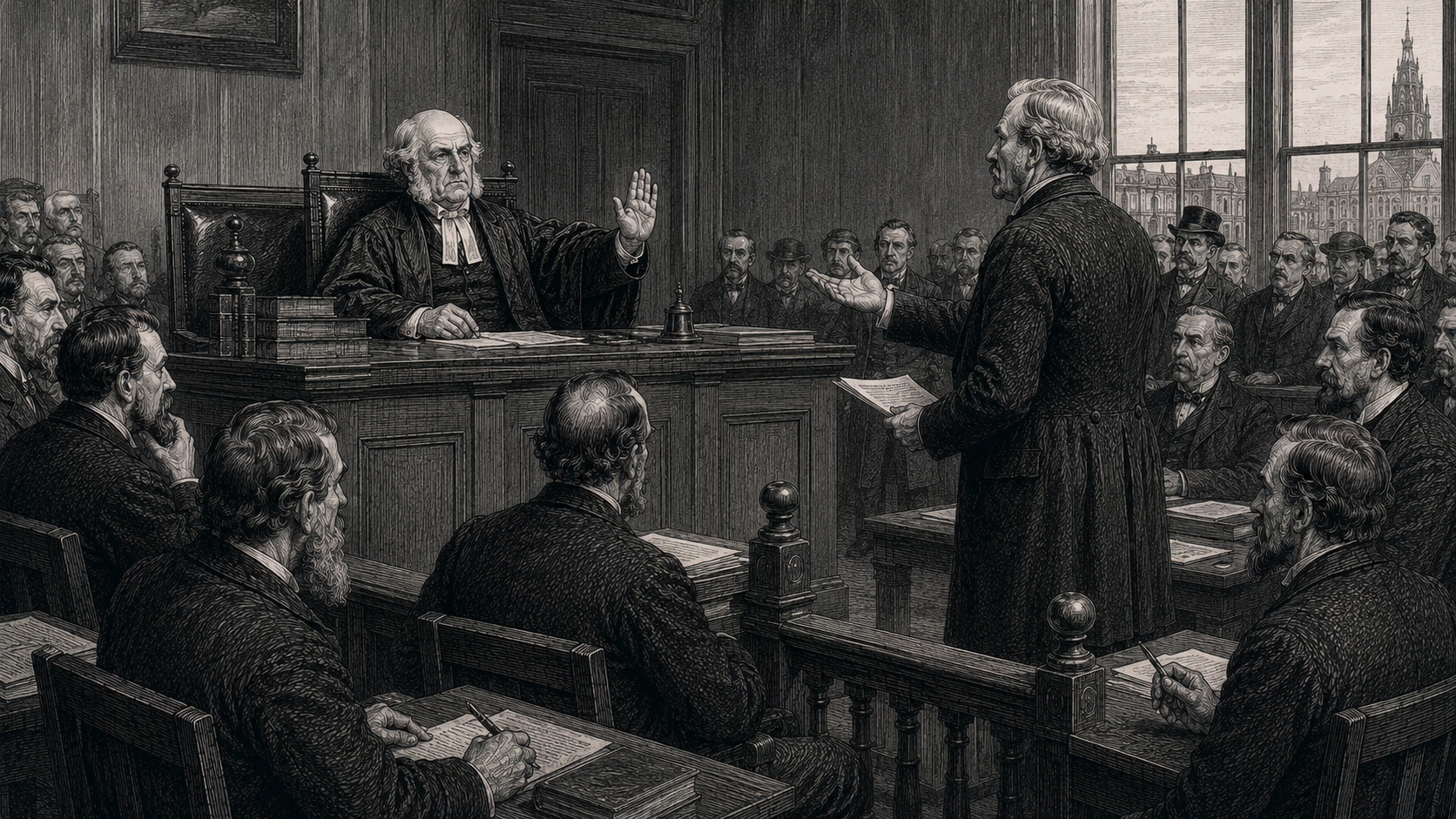
Read Article: Sessions DisputedJudge Richard Adams rejected demands that Limerick’s annual Quarter Sessions should be increased from four to eight when he opened the Hilary sittings at the County Courthouse. He asked the barristers and solicitors present whether any member of the local profession supported the proposed change. No one answered in its favour. Adams concluded that the agitation had arisen neither from those practising before the court nor from any clearly demonstrated public demand. He therefore refused to treat the requested increase as a necessary reform and declared that he would continue holding the four established sessions unless legislation compelled him to do otherwise.
The proposal concerned the practical administration of justice rather than ceremony. As County Court judge and chairman of Quarter Sessions, Adams exercised civil and criminal jurisdiction over a wide range of business. The court heard civil bills, debts, tenancy disagreements, compensation applications, malicious-injury claims and criminal cases serious enough to fall beyond the ordinary work of Petty Sessions. Doubling the number of sittings might have shortened waiting periods and spread the court’s workload more evenly across the year. It would also have required additional judicial attendance, legal preparation, jurors, officials and public expenditure.
Adams referred critically to a deputation that had approached the Lord Chancellor seeking the additional sittings. He contrasted the Limerick position with Galway, where the Recorder had reportedly agreed to hold eight sessions annually. The judge maintained that arrangements suitable for one place should not automatically be imposed upon another without evidence of need. His remarks combined humour with a firm defence of judicial independence. He made clear that informal pressure would not alter Limerick’s court calendar and suggested that any attempt to require additional sessions would need the direct authority of Parliament.
The dispute mattered to ordinary people throughout Limerick city and county. A delayed civil claim could leave a tradesman without payment, a tenant uncertain of possession or a family waiting for compensation after property had been damaged. Criminal proceedings also affected witnesses, defendants, victims and jurors required to attend the courthouse. More frequent sittings might improve access to justice, but they could equally increase legal expenses and county costs if the existing workload did not justify them. The silence of the assembled legal practitioners strengthened Adams’s argument that the demand had not emerged from those confronting the court’s delays and pressures every day.
No immediate alteration followed the judge’s declaration, and the traditional quarterly arrangement remained in place. The confrontation revealed an important tension within Irish administration at the beginning of the twentieth century: central authorities and public deputations could advocate uniform reform, while local judges claimed detailed knowledge of their own courts. Adams did not deny that access to justice mattered; he disputed the evidence that eight annual sittings would improve it in Limerick. His refusal placed responsibility upon reformers to demonstrate genuine local need before asking the county to support a larger and potentially more expensive judicial system.
- Irish Times, “Jurisdiction of Courts: Judge Adams’s Opinion,” 3 January 1900, p. 6.
- Freeman’s Journal, report on the opening of the Limerick Quarter Sessions and Judge Adams’s opposition to more frequent County Court sittings, 4 January 1900, p. 6.
- Munster News, report on Judge Adams opening the Hilary Quarter Sessions at Limerick County Courthouse, January 1900; exact issue and page not confirmed.
- County Officers and Courts (Ireland) Act 1877, 40 & 41 Vict., c. 56, provisions governing Irish County Courts, Civil Bill Courts and chairmen of Quarter Sessions.
- National Archives of Ireland, Court Records Pre-1922, Courts of Crown and Peace, Quarter Sessions and County Court records.
-
Terminus Tragedy
Read Article: Terminus TragedyA serious accident at Limerick railway terminus left labourer James Davoren requiring the amputation of his right leg. The Irish Times reported on 2 January 1900 that Davoren had gone to the station to see his brother, described as a solicitor, depart by train for Fermoy. During the farewell, he fell from the platform onto the permanent way and was caught beneath the passing train. Railway staff and bystanders found him lying on the rails after the carriages had cleared. He was removed without delay to Barrington’s Hospital, where surgeons determined that the injured limb could not be saved.
A second contemporary account described Davoren as being pulled from the platform while bidding his brother goodbye. The precise movement that caused his fall remains uncertain, but both reports agree that he passed beneath the train and suffered catastrophic injury to one leg. The Freeman’s Journal stated that he was progressing as favourably as could be expected following the amputation. Its report also declared that no blame attached to railway officials. That conclusion did not lessen the severity of the event, but it indicates that the newspapers treated the accident as a sudden personal misfortune rather than alleging negligence by station employees.
The same report identified Davoren’s injury as the third serious accident at the Limerick terminus during the Christmas and New Year holidays. The surviving account does not provide details of the two earlier incidents, so their causes and consequences cannot safely be reconstructed. The statement nevertheless suggests that the station had experienced an alarming concentration of accidents during a period of increased passenger movement. Families, friends, porters and travellers crowded platforms as trains arrived and departed, while steam, noise, smoke and moving carriages created hazards for anyone standing too close to the platform edge or attempting a final farewell.
Rail travel had become essential to Limerick’s social and commercial life by the beginning of the twentieth century. The terminus connected local passengers with towns across Munster and linked the city’s shops, industries, cattle trade and agricultural hinterland with wider markets. Stations were also public meeting places where relatives accompanied departing passengers and often remained on the platform until trains moved away. Davoren was not reported as a passenger or railway employee; he was present because of a family departure. His injury demonstrated that the risks of rail travel extended to visitors as well as to those holding tickets or working upon the line.
The accident also placed Barrington’s Hospital within the city’s emergency response to industrial and transport injuries. Surgeons faced the immediate task of preventing further blood loss and infection after damage too extensive for the limb to be preserved. For Davoren, survival came with permanent disability at a time when a labourer’s livelihood depended heavily upon physical strength and mobility. Contemporary reporting ended with his postoperative condition and offered no account of his later recovery, employment or family circumstances. His case remains a stark record of how expanding transport networks brought convenience and opportunity while exposing ordinary Limerick people to sudden, life-changing danger.
- Irish Times, “Accident at Limerick,” 2 January 1900, p. 6.
- Freeman’s Journal, “Train Accident,” 3 January 1900, p. 7.
- Gerard Hannan, “Limerick — January 1900,” Irish Media Man, 28 February 2013, transcription reproducing the two contemporary newspaper reports and identifying their dates and page numbers.
- Regulation of Railways Act 1889, 52 & 53 Vict., c. 57, contemporary statutory background concerning railway safety and regulation.
- Barrington’s Hospital records and administrative collections, Limerick Archives; no specific surviving patient record for James Davoren has been confirmed.
-
Legal Resistance
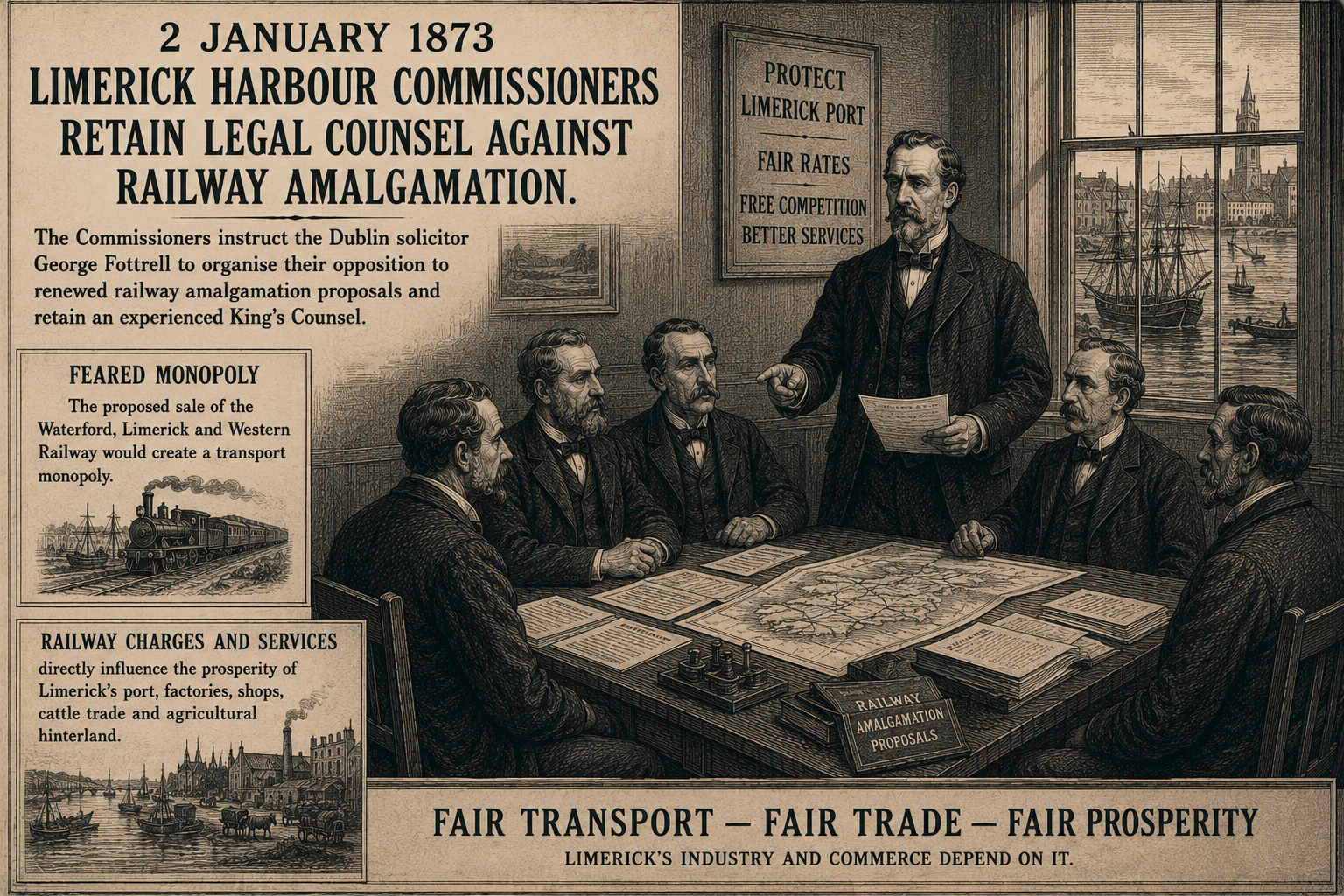
Read Article: Legal ResistanceLimerick Harbour Commissioners instructed the Dublin solicitor George Fottrell to organise formal opposition to renewed proposals for railway amalgamation. The decision, reported on 2 January 1900, also authorised him to retain an experienced King’s Counsel to represent the harbour authority during the expected parliamentary struggle. Commissioners had resisted a similar scheme during the previous year and regarded its revival as a direct threat to the commercial independence of Limerick. By securing legal expertise at an early stage, they ensured that the port’s objections would be supported by evidence, parliamentary procedure and professional advocacy rather than confined to local resolutions.
The proposed transaction would absorb the Waterford, Limerick and Western Railway into the Great Southern and Western Railway, already the largest railway undertaking in Ireland. The smaller company operated an extensive network linking Limerick with Waterford, Sligo, Tralee, Foynes and agricultural districts throughout the west and south. Opponents feared that its disappearance would remove an important element of competition and allow the enlarged company greater control over freight rates, timetables and routes. The Commissioners therefore treated amalgamation as a question affecting the balance of transport power across Ireland rather than a routine transfer between private companies.
Railway charges exercised a powerful influence upon Limerick Harbour because goods entering or leaving the port depended upon efficient inland connections. Grain, coal, livestock, dairy produce, manufactured goods and imported materials moved between ships, warehouses, factories, farms and railway sidings. Higher freight rates or poorer services could make Limerick less competitive than Dublin, Cork or Waterford and might encourage merchants to redirect trade through other ports. Commissioners responsible for the harbour’s revenue and development feared that a railway monopoly could determine commercial traffic according to the interests of its wider system rather than those of the Shannon port.
The appointment of Fottrell and senior counsel prepared the Harbour Commissioners to oppose the promoters before parliamentary committees examining the amalgamation bill. Legal representatives could challenge company witnesses, present freight comparisons and explain how earlier railway competition had reduced charges on routes serving Limerick and surrounding districts. The campaign would require cooperation with Limerick Corporation, County Council representatives, merchants and other bodies threatened by railway concentration. It would also involve considerable expense, but commissioners believed that the long-term cost of losing independent competition could exceed the immediate price of solicitors, counsel and parliamentary evidence.
The Commissioners’ action marked the beginning of an organised campaign that broadened across Limerick during January 1900. The Corporation later authorised formal opposition, while county and harbour representatives assembled evidence concerning trade, employment and transport. Parliament nevertheless approved the amalgamation in August, and the Waterford, Limerick and Western Railway ceased to exist independently at the beginning of 1901. The decision to retain Fottrell remains significant because it showed how strongly Limerick’s commercial leadership associated railway competition with the prosperity of its port, industries, shops, cattle trade and agricultural hinterland.
- Freeman’s Journal, “The Railway Amalgamation Proposals: Action of Limerick Harbour Commissioners,” 2 January 1900, p. 6.
- Limerick Harbour Commissioners Collection, IE LA P2, board and secretary records concerning opposition to railway amalgamation, Limerick Archives.
- House of Commons Debates, “Great Southern and Western and Waterford, Limerick, and Western Railway Companies Amalgamation Bill [Lords],” 1 August 1900, vol. 87.
- Reports from the Joint Select Committee on the Great Southern and Western and Waterford, Limerick, and Western Railway Companies Amalgamation Bill, Parliamentary Papers, 1900, paper 196, vol. X.
- Great Southern and Western and Waterford, Limerick and Western Railways Amalgamation Act 1900, 63 & 64 Vict., c. ccxlvii.
- C. E. J. Fryer, The Waterford and Limerick Railway, Headington: Oakwood Press, 2000.
- Ernie Shepherd, Waterford, Limerick and Western Railway, Hersham: Ian Allan Publishing, 2006.
-
Shannon Opposition
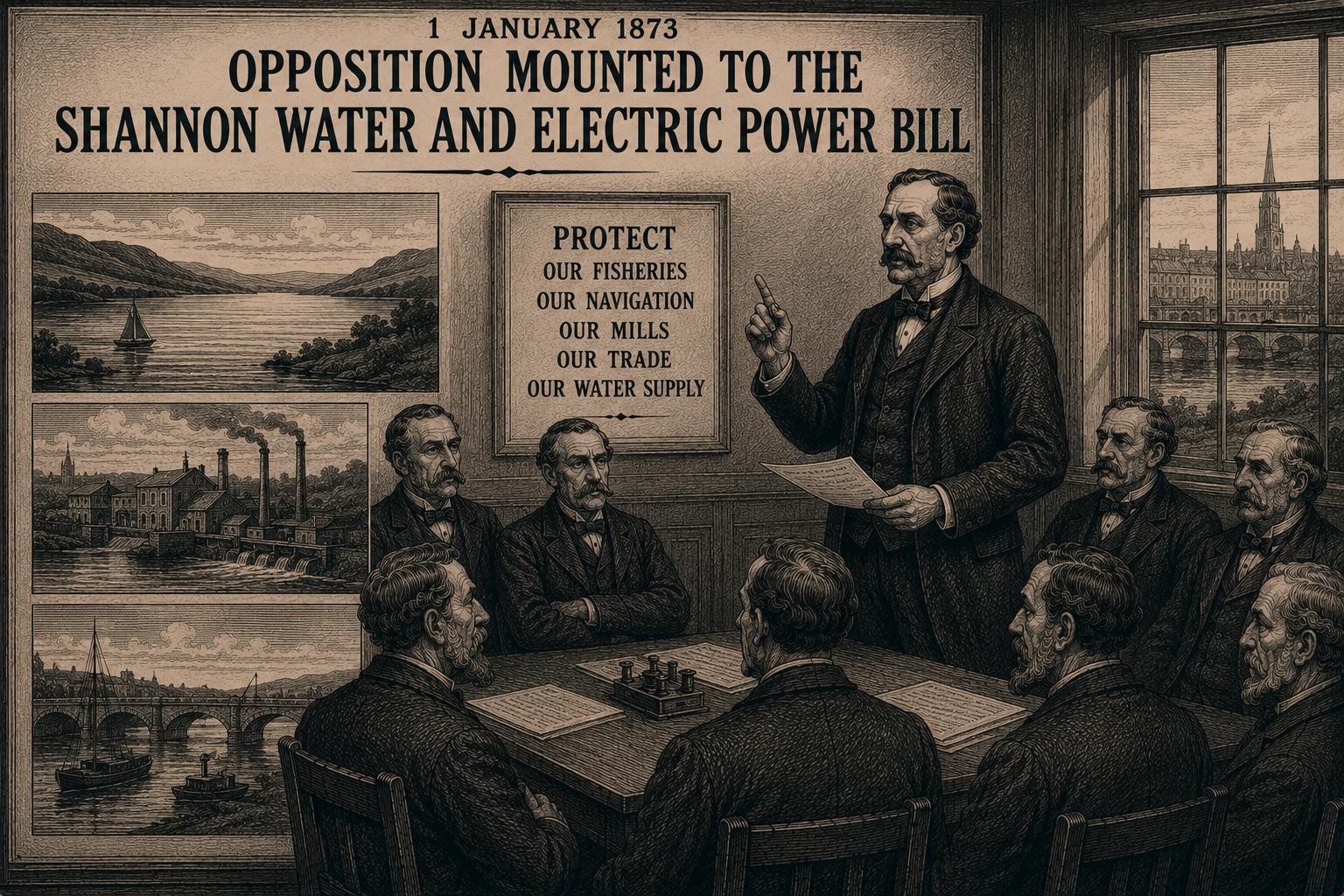
Read Article: Shannon OppositionThe surviving newspaper evidence dates this report to 2 January 1900 rather than 1 January, although the meeting itself may have occurred immediately beforehand. The Limerick Fishery Conservators, presided over by Lord Massy, unanimously resolved to oppose the Shannon Water and Electric Power Company’s proposed parliamentary bill. Promoters sought authority to harness Shannon water near Lough Derg and carry it through engineered channels to generate electricity at Clonlara. The Conservators regarded the project as a serious threat to interests already dependent upon the river and resolved to organise opposition before Parliament granted the company extensive powers.
Electricity promised cheaper power, new industry and improved municipal services, but opponents believed the proposed works placed established livelihoods at unacceptable risk. Diverting large quantities of water from the natural channel could alter the level of Lough Derg and reduce flows through important reaches of the Shannon. Fishery owners feared that salmon would be unable to reach tributaries and spawning beds, while mill and factory owners worried that machinery driven by river water might become unreliable. Navigation interests also questioned whether lower levels would obstruct boats, quays and commercial movement between lakeside communities and Limerick.
The Conservators’ resolution gathered several affected groups into a common campaign. Principal fishery owners, riverside proprietors, millers, factory owners and people using the Shannon for navigation were invited to resist the bill. Copies were to be sent to the Chief Secretary for Ireland, the Commissioners of Public Works, Limerick Corporation, parliamentary representatives and local authorities throughout counties connected with the river. The breadth of this circulation reflected the Shannon’s economic geography. A project centred near Clonlara could affect communities far beyond the generating station because fisheries, navigation, drainage and trade depended upon water conditions throughout the connected river system.
Limerick’s municipal water supply created another urgent concern. The city drew water from the Shannon system, and local officials feared that engineering works might interfere with the quantity or reliability of water reaching the urban population. Any disturbance could affect households, institutions, businesses and public health. The dispute therefore forced Limerick people to consider competing forms of progress. Electrical power might encourage industry and modern lighting, but the promised benefits appeared less attractive when measured against possible damage to drinking water, fishing employment, riverside mills, harbour traffic and the natural processes sustaining the river.
The campaign did not end the scheme. Official inquiries and parliamentary argument continued, while promoters later accepted clauses intended to preserve minimum river flows, fish passage, navigation and municipal water interests. Parliament eventually authorised a revised undertaking in 1901, though the private development was never completed. The Conservators’ unanimous opposition nevertheless established the central terms of Limerick’s early hydroelectric debate. Modern engineering would not be judged solely by the power it promised to generate. It would also be measured by whether fisheries, navigation, public water, existing industries and communities along the Shannon could survive the changes imposed upon the river.
- Irish Times, “Shannon Water and Electric Power Company,” 2 January 1900, p. 7.
- Irish Times, “Limerick Fishery Conservators: The Shannon Water and Electric Power Bill,” 5 January 1900, p. 3.
- Limerick Fishery Board of Conservators Collection, IE LA P48, Limerick Archives.
- House of Lords Debates, “Shannon Water and Electric Power Bill,” 23 July 1900, vol. 86.
- House of Lords Debates, “Irish Fisheries—Inspectors’ Reports,” 23 July 1900, vol. 86.
- Shannon Water and Electric Power Act 1901, 1 Edw. 7, c. cxxxvi, royal assent 26 July 1901.
-
Unity Resolutions
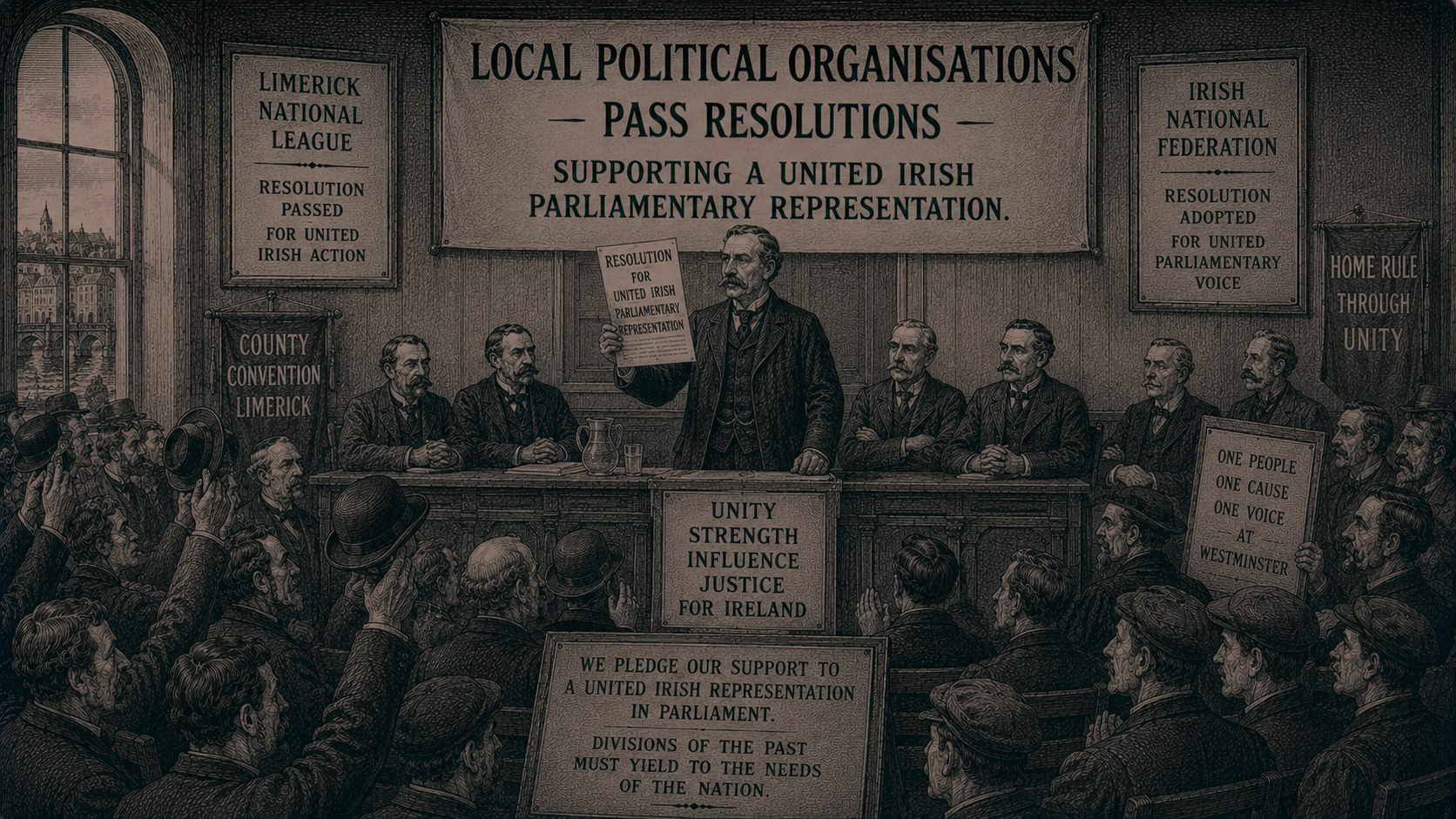
Read Article: Unity ResolutionsLocal political organisations passed resolutions supporting a united Irish parliamentary representation as impatience grew with the divisions inherited from the fall of Charles Stewart Parnell. United Irish League branches, nationalist associations and constituency bodies increasingly argued that rival parliamentary groups should place national interests above personal quarrels. Their declarations carried no direct authority over individual MPs, but they reflected the opinion of activists who organised meetings, raised subscriptions and supplied much of the labour required during elections. Continued factionalism therefore threatened not only parliamentary effectiveness but the willingness of local supporters to sustain representatives who refused to cooperate.
The resolutions were directed towards political leaders divided among several organisations. John Redmond headed the principal Parnellite body, John Dillon remained the most influential anti-Parnellite leader, and Timothy Healy commanded an independent following. William O’Brien’s United Irish League sought to force these figures towards reunion by building pressure from constituencies rather than waiting for agreement at Westminster. Local bodies demanded a common leadership, coordinated voting and disciplined support for agreed candidates. Their language of unity also contained an electoral warning: MPs who remained attached to factional rivalry might find themselves opposed by candidates enjoying the backing of a vigorous popular organisation.
Supporters connected parliamentary reunion with practical political objectives. Home Rule, land reform, the restoration of evicted tenants and improvements in local administration required Irish MPs to act together if they were to influence governments at Westminster. Separate factions allowed ministers to disregard nationalist claims or negotiate selectively with competing leaders. Local resolutions consequently presented reunion as the machinery through which public demands could be translated into legislation. They did not necessarily imply admiration for every proposed leader. Instead, they expressed the belief that elected representatives should accept collective discipline and use their combined voting strength on behalf of Irish constituencies.
The campaign had clear relevance for Limerick, whose city and county representatives depended upon wider parliamentary cooperation to advance local and national interests. The surviving evidence does not justify attributing a particular resolution to every Limerick political organisation, but local voters participated in the same culture of meetings, deputations and formal declarations. Questions involving land purchase, labourers’ housing, railway policy, harbour trade and Home Rule could not be pursued effectively by isolated MPs. For Limerick nationalists, a reunited party offered the prospect that constituency concerns would form part of a coordinated Irish programme rather than become weakened by disputes among rival leaders.
The accumulating pressure contributed to the formal reunion of the Irish parliamentary factions in January 1900. John Redmond became chairman of the reconstructed Irish Parliamentary Party, while Dillon, Healy, O’Brien and their followers entered a common organisation without abandoning every disagreement. Local resolutions had not settled disputes over leadership, finance, candidate selection or control of the United Irish League, but they had made continued division politically costly. Reunion therefore emerged from more than negotiation among prominent parliamentarians. It also reflected organised pressure from branches, associations and constituency workers who insisted that Ireland should again possess one disciplined representation at Westminster.
- Philip Bull, “The United Irish League and the Reunion of the Irish Parliamentary Party, 1898–1900,” Irish Historical Studies, vol. 26, no. 101, May 1988, pp. 51–78.
- John Redmond to John Dillon and T. M. Healy, 24 July 1899, John Redmond Papers, National Library of Ireland, MS 15,182/2/1.
- John Dillon to John Redmond, 26 July 1899, John Redmond Papers, National Library of Ireland, MS 15,182/2/2.
- Freeman’s Journal, 18 April 1899.
- Freeman’s Journal, 6 May 1899.
- Freeman’s Journal, 20 May 1899.
- Freeman’s Journal, 22 May 1899.
- Mayo News, 27 January 1900.
- William O’Brien, An Olive Branch in Ireland and Its History, London: Macmillan, 1910.
- F. S. L. Lyons, The Irish Parliamentary Party, 1890–1910, London: Faber and Faber, 1951.
-
Press Demands
Read Article: Press DemandsNationalist newspapers increasingly presented reunion as essential if Ireland was to recover influence at Westminster after almost a decade of parliamentary division. Since the split over Charles Stewart Parnell’s leadership in 1890, rival Parnellite, anti-Parnellite and Healyite groups had competed for authority, funds and constituencies while claiming allegiance to the same national cause. Editorials and political reports warned that British governments could disregard Irish demands when nationalist MPs lacked common leadership and discipline. Reunion was consequently framed not simply as reconciliation between prominent personalities, but as the practical means by which Ireland might again act as a recognisable parliamentary force.
The Freeman’s Journal remained one of the most influential voices within constitutional nationalism, although its position reflected the complicated loyalties created by the split. Other titles associated with nationalist opinion, including the Mayo News and William O’Brien’s Irish People, gave extensive attention to the United Irish League and the pressure for political reconstruction. These newspapers did not always agree about John Redmond, John Dillon, Timothy Healy or O’Brien, but their coverage helped establish a shared argument: factional rivalry had weakened the representation of Ireland at the precise place where legislation, taxation and administrative policy were decided.
The force of that argument depended upon the arithmetic and customs of the House of Commons. Irish MPs could bargain with governments, obstruct business and influence close divisions only when they voted together under an accepted leadership. Separate factions permitted ministers and opposition leaders to negotiate selectively or ignore nationalist demands altogether. Newspapers connected reunion with Home Rule, land reform, evicted tenants and administrative change, reminding readers that public meetings and constituency organisation could achieve little if elected representatives neutralised one another at Westminster. Parliamentary unity was therefore portrayed as political machinery rather than an act of personal forgiveness.
The debate mattered directly to readers in Limerick city and county, whose nationalist representatives required support from a disciplined Irish party to advance local and national concerns. Newspapers arriving through rail, postal and commercial networks carried reports of negotiations into homes, reading rooms, public houses and political organisations. The surviving evidence does not justify attributing one opinion to every Limerick reader, but the practical argument was readily understood. Land purchase, labourers’ housing, harbour interests, railway policy and Home Rule all depended upon coordinated representation capable of placing sustained pressure upon ministers rather than a collection of MPs divided by inherited personal loyalties.
Press advocacy contributed to the atmosphere surrounding the reunion meeting of 30 January 1900, when the parliamentary factions formally came together and later selected Redmond as chairman. Newspapers could celebrate the restoration of a common organisation, but they could not remove the mistrust accumulated since the Parnell crisis. Dillon, Healy, O’Brien and Redmond continued to disagree over leadership, electoral organisation and the authority of the United Irish League. Nevertheless, reunion gave nationalist journalism a single parliamentary body whose actions could be defended, criticised and measured against national expectations. Ireland again possessed a coordinated representation at Westminster, even though unity remained dependent upon compromise.
- Freeman’s Journal, 6 May 1899.
- Freeman’s Journal, 20 May 1899.
- Freeman’s Journal, 3 August 1899.
- Freeman’s Journal, 8 August 1899.
- Mayo News, 27 January 1900.
- The Times, 31 January 1900.
- Philip Bull, “The United Irish League and the Reunion of the Irish Parliamentary Party, 1898–1900,” Irish Historical Studies, vol. 26, no. 101, May 1988, pp. 51–78.
- F. S. L. Lyons, The Irish Parliamentary Party, 1890–1910, London: Faber and Faber, 1951.
- National Library of Ireland, The Freeman’s Journal, historical account identifying the newspaper’s relationship with the Irish Parliamentary Party at Westminster.
-
Factional Legacy
Read Article: Factional LegacyThe legacy of the Parnell split continued to govern personal relationships within Irish nationalism nearly a decade after the parliamentary rupture of December 1890. Charles Stewart Parnell’s refusal to surrender the party leadership during the O’Shea divorce crisis divided former colleagues into Parnellite and anti-Parnellite camps. Political argument became inseparable from accusations of loyalty, betrayal, clerical interference and personal ambition. Parnell’s death in October 1891 removed the leader around whom the conflict had formed, but it did not reconcile the men who had defended or rejected him. Those memories endured within parliamentary factions, newspapers, constituencies and private correspondence.
John Redmond became leader of the principal Parnellite group, while John Dillon emerged as the dominant figure among the anti-Parnellite majority. Timothy Healy, who had attacked Parnell with unusual force during the crisis, later broke from Dillon’s leadership and developed a separate following shaped by clerical, local and personal loyalties. Even Redmond’s supporters divided when Timothy Harrington disagreed with him over reunion. By the late 1890s, Irish parliamentary nationalism had fragmented into several rival bodies. Disputes over organisation, election funds and political strategy repeatedly carried the emotional force of the original split, making compromise difficult even when policy differences appeared negotiable.
William O’Brien’s United Irish League attempted to rebuild national organisation from outside the divided parliamentary groups. Its expansion after 1898 placed growing pressure upon leaders who feared that local branches might challenge sitting MPs and redirect nationalist funds. Reunion became politically necessary, yet negotiations exposed continuing mistrust. Redmond feared domination by former opponents, Dillon wanted central discipline, Healy guarded his independence, and O’Brien insisted that parliamentarians should remain answerable to organised opinion in Ireland. The League could compel rival leaders to discuss unity, but it could not erase the insults, broken friendships and competing ambitions accumulated throughout the previous decade.
Limerick’s connection to the split was embodied by William Abraham, a nationalist MP born in the city who had represented West Limerick. Abraham supported the anti-Parnellite cause and played a notable part in the parliamentary revolt against Parnell’s continued leadership. His career showed how the national quarrel entered local representation, forcing Limerick electors and political organisers to choose between competing bodies claiming the same nationalist inheritance. The division weakened coordinated advocacy for Home Rule, land reform and local interests at Westminster. Even after formal reunion, older loyalties continued to influence how politicians, newspapers and voters judged leadership and party discipline.
The Irish Parliamentary Party formally reunited in January 1900, with Redmond chosen as chairman of the reconstructed organisation. The settlement ended the visible existence of separate parliamentary factions, but it did not recreate the authority Parnell had once exercised. Redmond was obliged to balance Dillon’s influence, Healy’s independence and O’Brien’s control of a growing popular organisation. Personal rivalries continued to shape disputes over candidates, funds, policy and the relationship between MPs and the United Irish League. Irish nationalism entered the new century under one parliamentary name, yet the emotional inheritance of the Parnell split remained deeply embedded within its leadership.
- Frank Callanan, The Parnell Split, 1890–91, Cork: Cork University Press, 1992.
- Philip Bull, “The United Irish League and the Reunion of the Irish Parliamentary Party, 1898–1900,” Irish Historical Studies, vol. 26, no. 101, May 1988, pp. 51–78.
- F. S. L. Lyons, The Irish Parliamentary Party, 1890–1910, London: Faber and Faber, 1951.
- T. M. Healy, Letters and Leaders of My Day, 2 vols, London: Thornton Butterworth, 1928.
- William O’Brien, An Olive Branch in Ireland and Its History, London: Macmillan, 1910.
- John Dillon Papers, Trinity College Dublin Manuscripts, IE TCD MSS 6455–6909; Irish Parliamentary Party anti-Parnellite minute books, MSS 6500–6502.
- John Redmond Papers, 1878–1918, National Library of Ireland, Collection List No. 118.
- Patrick Maume, “Abraham, William,” Dictionary of Irish Biography, Royal Irish Academy.
- The Times, 31 January 1900, report of the reunion of the Irish Parliamentary Party.