-
Health Inquiry
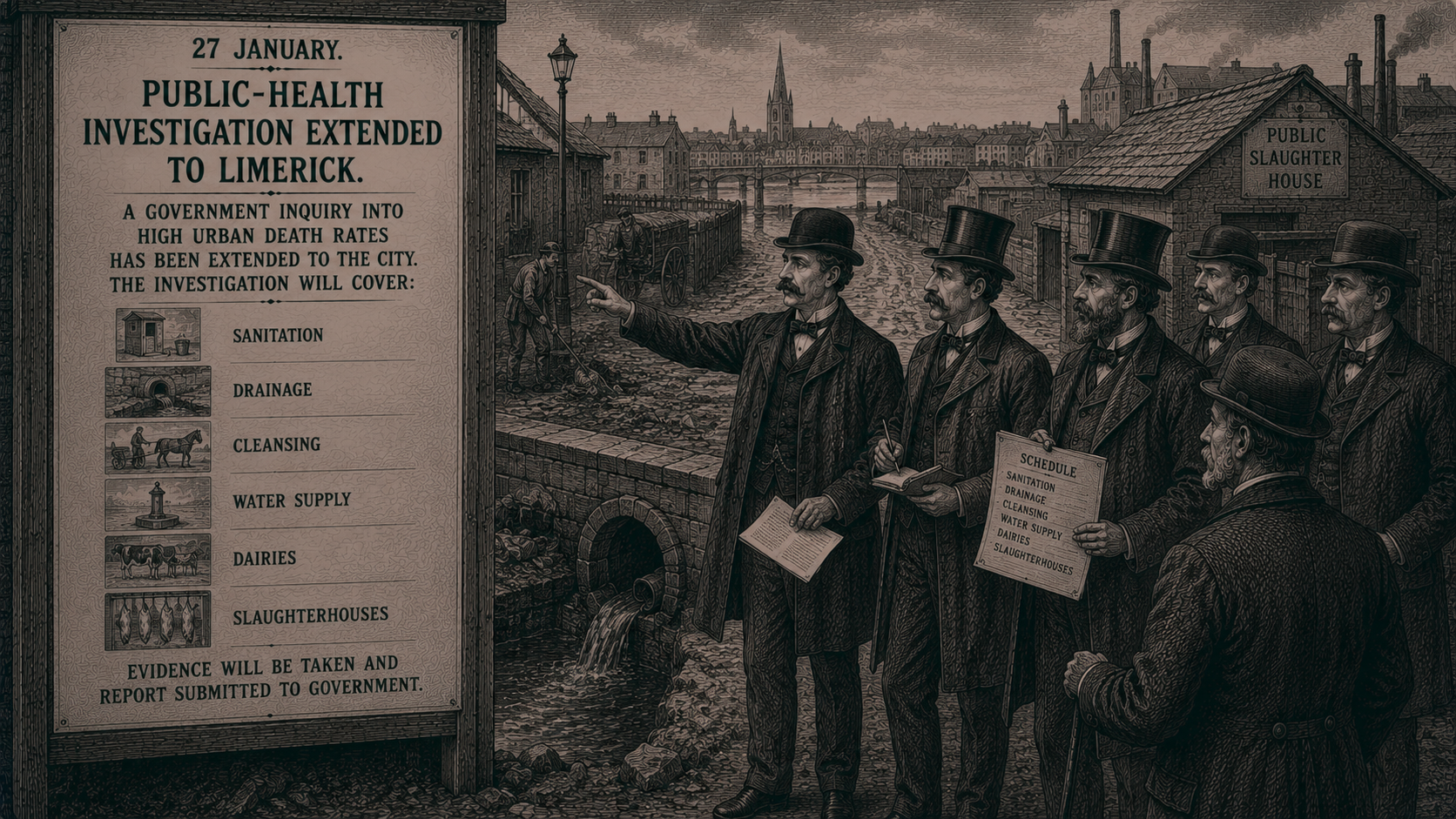
Read Article: Health InquiryA government investigation into the causes of exceptionally high death rates in Irish cities was extended to Limerick, according to an announcement published on 27 January 1900. The Local Government Board was expected to apply machinery similar to that already established for examining public health in Dublin. The proposed scrutiny would reach beyond mortality statistics and examine how Limerick Corporation discharged its sanitary responsibilities. Drainage, cleansing, water supply, dairies and slaughterhouses were all identified for investigation. The announcement placed the city’s everyday environment under official examination and signalled that preventable illness and premature death would be treated as failures of administration as well as private misfortune.
Limerick Corporation served as the urban sanitary authority under the Public Health legislation then governing Ireland. Its responsibilities included removing refuse, maintaining sewers and drains, regulating nuisances, protecting water sources and enforcing rules affecting businesses capable of endangering health. The inquiry was expected to test whether those powers were being used effectively and whether deficiencies in staffing, finance or enforcement contributed to mortality. The announcement did not provide a precise local death rate or identify particular officials as responsible. It promised instead a broad examination of the systems through which the city attempted to prevent disease within densely occupied streets, courts, lanes and institutions.
Drainage and cleansing were central concerns because human and animal waste could accumulate rapidly where sewers, yards and refuse removal were inadequate. Blocked drains, overflowing privies, damp dwellings and dirty thoroughfares created conditions in which infectious illness spread easily, particularly among families living in overcrowded accommodation. Water supply required equally close inspection, since contamination could carry disease through entire neighbourhoods. Investigators would need to consider not merely whether water reached the city, but whether its sources, storage, distribution and household use protected public health. The condition of streets and houses could not be separated from the municipal engineering and cleansing services supporting them.
Dairies and slaughterhouses brought food production within the inquiry’s scope. Milk could become contaminated through diseased cattle, unclean vessels, poor drainage or dirty cowsheds, placing infants and families at particular risk. Slaughterhouses created their own hazards when blood, offal and animal waste were handled close to homes or allowed to enter drains and waterways. Inspection therefore involved the health of animals, the cleanliness of premises and the Corporation’s willingness to enforce sanitary regulations against commercial operators. The inquiry promised to examine whether food reaching Limerick households was produced and prepared under conditions compatible with the city’s obligation to protect life.
The extension of the investigation marked a significant intervention in Limerick’s civic affairs, although the announcement itself contained no final findings. It recognised that urban mortality could arise from connected failures involving poverty, housing, water, refuse, food and local administration rather than from one isolated source. Any official recommendations could require new expenditure by the Corporation and its ratepayers, but neglect carried a heavier cost in illness, lost wages and family bereavement. By placing sanitation and food supervision under government scrutiny, the inquiry challenged Limerick’s authorities to demonstrate that public-health responsibilities were being exercised thoroughly throughout the city rather than existing only in legislation and committee reports.
- Weekly Irish Times, “London Notes,” 27 January 1900, p. 18.
- Local Government Board for Ireland, Report of the Committee Appointed by the Local Government Board for Ireland to Inquire into the Public Health of the City of Dublin, Dublin: Her Majesty’s Stationery Office, 1900.
- Public Health (Ireland) Act 1878, 41 & 42 Vict., c. 52.
- Registrar-General for Ireland, Thirty-Sixth Annual Report of the Registrar-General of Marriages, Births and Deaths in Ireland, covering 1899, Dublin: Her Majesty’s Stationery Office, 1900.
- Limerick Corporation Public Health Services Pre-1960 Collection, L/AH/PH/1, Limerick Archives.
- Ruth Quiry, Public Health and Housing in Limerick City, 1850–1935: A Geographical Analysis, MA thesis, Mary Immaculate College, University of Limerick, 2013.
-
Reservist Released
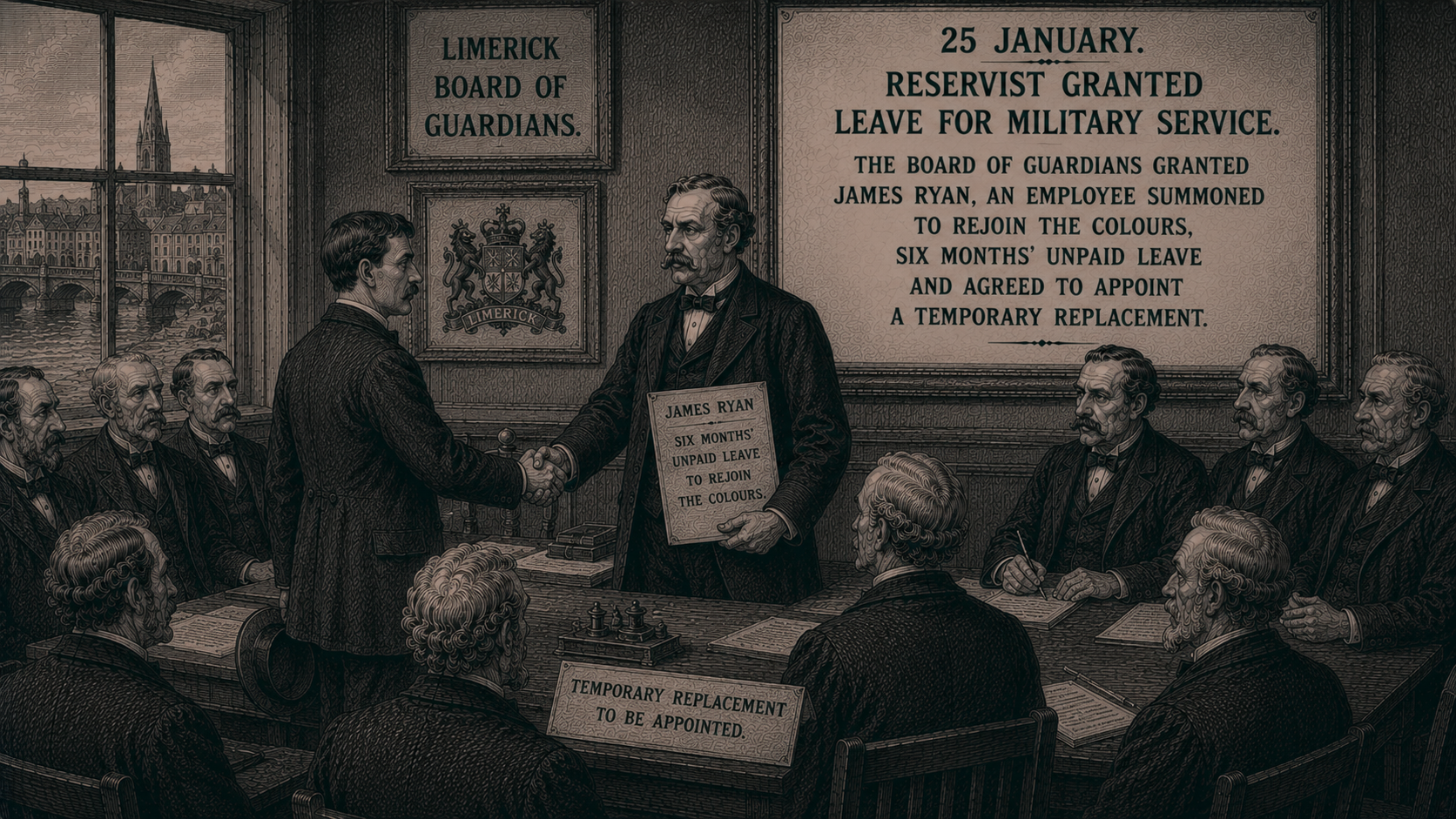
Read Article: Reservist ReleasedThe Limerick Board of Guardians granted six months’ leave without salary to James Ryan, an employee who had been summoned to rejoin the colours during the South African War. The decision, reported on 25 January 1900, allowed Ryan to answer his military obligation without immediately forfeiting his position under the Board. Guardians also agreed that a temporary worker should be appointed during his absence, ensuring that the institution’s daily duties continued without interruption. The arrangement balanced the demands of wartime mobilisation with the Board’s responsibility towards a member of staff called away from civilian employment.
Ryan’s summons formed part of the wider mobilisation of army reservists after British forces encountered heavy demands in South Africa. Men who had completed regular service frequently returned to civilian occupations while remaining liable for recall during a national emergency. Once summoned, a reservist was expected to report and could not treat military service as a voluntary absence. Employers throughout Britain and Ireland therefore faced difficult decisions about wages, replacements and whether returning soldiers would recover their former posts. The Guardians’ resolution acknowledged Ryan’s obligation while avoiding a permanent dismissal before the duration and outcome of his service were known.
The six-month period offered practical protection but no continuing income from the Board. Ryan would depend upon military pay while serving, and the surviving report does not state whether he had dependants or what position he held. Unpaid leave nevertheless preserved a formal connection with his civilian employer and created the possibility of resuming work when released from duty. The appointment of a temporary replacement also prevented another worker from assuming that the vacancy was permanent. The arrangement recognised both the reservist’s claim to consideration and the institution’s need for reliable staffing during an uncertain period.
The decision carried particular significance within the Limerick Union, whose Guardians administered the workhouse, outdoor relief, dispensary services and other Poor Law responsibilities. Employees performed essential work for people affected by poverty, illness and unemployment, making prolonged vacancies difficult to absorb. Wartime mobilisation could remove trained men with little warning, forcing public bodies to reorganise duties and expenditure. By approving a temporary appointment, the Guardians ensured that Ryan’s recall would not weaken services within the Union. Their action shows how an overseas conflict entered local administration through the employment circumstances of an individual Limerick worker.
The resolution was modest compared with the military decisions being taken by the War Office, yet it illustrated the domestic consequences of the South African campaign. Reservists moved from workshops, institutions and public employment back into uniform, while families and employers adjusted to their absence. Limerick’s Board of Guardians chose neither to pay Ryan during his service nor to terminate his employment outright. Instead, it adopted a limited compromise suited to the uncertainty of mobilisation. Six months’ unpaid leave and a temporary substitute protected the institution’s work while leaving open a place for the reservist after his military duty ended.
- Irish Times, “Limerick Guardians and the Reservists,” 25 January 1900, p. 6.
- Limerick Union Board of Guardians Minute Books, January 1900, Limerick Archives, reference IE LA BG110; exact volume and folio for the resolution not confirmed.
- Reserve Forces Act 1882, 45 & 46 Vict., c. 48, statutory provisions governing the recall and service obligations of army reservists.
- War Office, Army Orders and mobilisation notices relating to the recall of reservists during the South African War, 1899–1900.
- Poor Relief (Ireland) Act 1838, 1 & 2 Vict., c. 56, establishing Irish Poor Law unions, workhouses and Boards of Guardians.
-
Civic Compromise
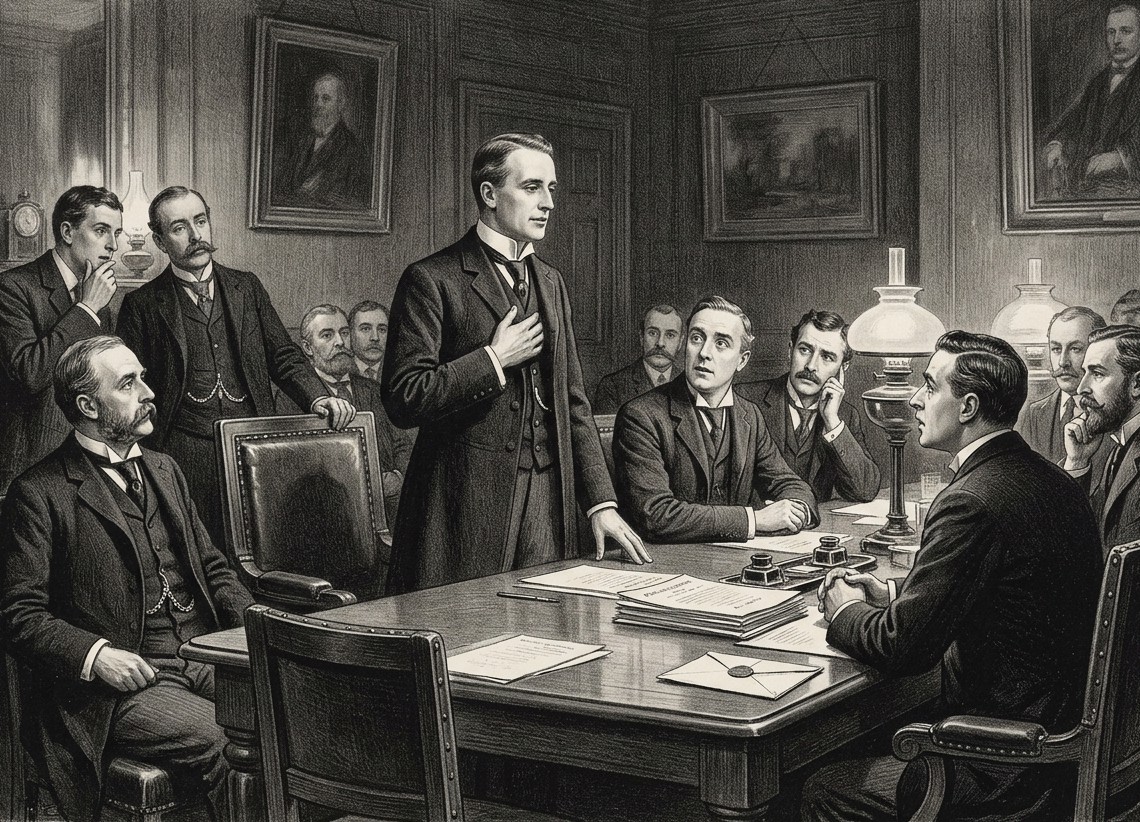
Read Article: Civic CompromiseMayor John Daly was returned unopposed when Limerick Corporation assembled for its quarterly election of civic officers. The council then proceeded to choose three qualified burgesses whose names would be submitted for appointment as City High Sheriff. The principal contest appeared likely to involve the serving sheriff, Thomas H. Cleeve, and John F. Power. Their disagreement arose from the proposed amalgamation of the Waterford, Limerick and Western Railway with the Great Southern and Western Railway, an issue that had united much of the Corporation, harbour administration and commercial community in organised opposition.
Cleeve’s position had become controversial because he had previously supported railway amalgamation, while Power presented his own candidacy as a defence of locomotive workers and citizens who feared a railway monopoly. Alderman O’Mara informed the council that a contest was no longer necessary because Cleeve had given a written undertaking. As a candidate seeking civic honour from the Corporation, Cleeve accepted that he should conform to its declared opposition to the takeover. He pledged that neither privately nor publicly would he give evidence supporting amalgamation if appointed to the shrievalty.
Power consequently withdrew his candidature after receiving the assurance. In a letter communicated to Alderman O’Mara, he stated that opposition to Cleeve had rested entirely upon the railway question and that the written guarantee had removed the reason for continuing the contest. Not every councillor accepted this interpretation. Councillor Dalton denied that Power represented the railwaymen and suggested that his support came from a small group of merchants. Councillor O’Brien objected more broadly to attaching conditions to a civic office, arguing that an honour bestowed by the Corporation should be given freely rather than through a political pledge.
Despite these objections, Cleeve’s name was placed first on the Corporation’s list by a unanimous vote. Councillors John Hayes and William Stokes occupied the second and third positions. The Corporation did not itself make the final appointment; the selection of a High Sheriff rested with the Lord Lieutenant from among the nominated burgesses. Cleeve’s leading position nevertheless made his appointment likely and resolved the immediate dispute without a divisive ballot. The settlement demonstrated that municipal honour in Limerick had become inseparable from the city’s struggle to influence railway policy and protect its commercial interests.
The council also agreed to hold a specially adjourned meeting to organise further resistance to the proposed railway sale. Mayor Daly had already given evidence against earlier amalgamation measures, and the Corporation’s continued opposition reflected fears that the disappearance of an independent railway would weaken competition, increase freight charges and redirect trade away from Limerick. Cleeve’s pledge therefore carried consequences beyond the shrievalty. A prominent industrialist who had favoured amalgamation accepted the Corporation’s contrary position, while civic leaders avoided an internal contest and presented a more united front against the railway companies promoting consolidation.
- Irish Times, “Limerick Corporation Railway Amalgamation Question,” 24 January 1900, p. 3.
- Limerick Corporation Council minute books, January 1900, Limerick Corporation Collection, Limerick Archives; exact volume and folio for the quarterly meeting not confirmed.
- Evidence of Alderman John Daly, Mayor of Limerick, opposing the proposed Railway Amalgamation Bills, 1899, Daly Papers, Special Collections and Archives, University of Limerick, P2/4/4/4.
- Great Southern and Western and Waterford, Limerick and Western Railway Companies Amalgamation Bill, Parliamentary Papers, 1900.
- Great Southern and Western and Waterford, Limerick and Western Railways Amalgamation Act 1900, 63 & 64 Vict., c. ccxlvii.
- Lawrence William White, “Cleeve, Sir Thomas Henry,” Dictionary of Irish Biography, Royal Irish Academy.
- Limerick City and County Council, A Retrospective: Limerick Local Government, 1899–2014, official list of Limerick mayors and high sheriffs.
-
Potato Findings
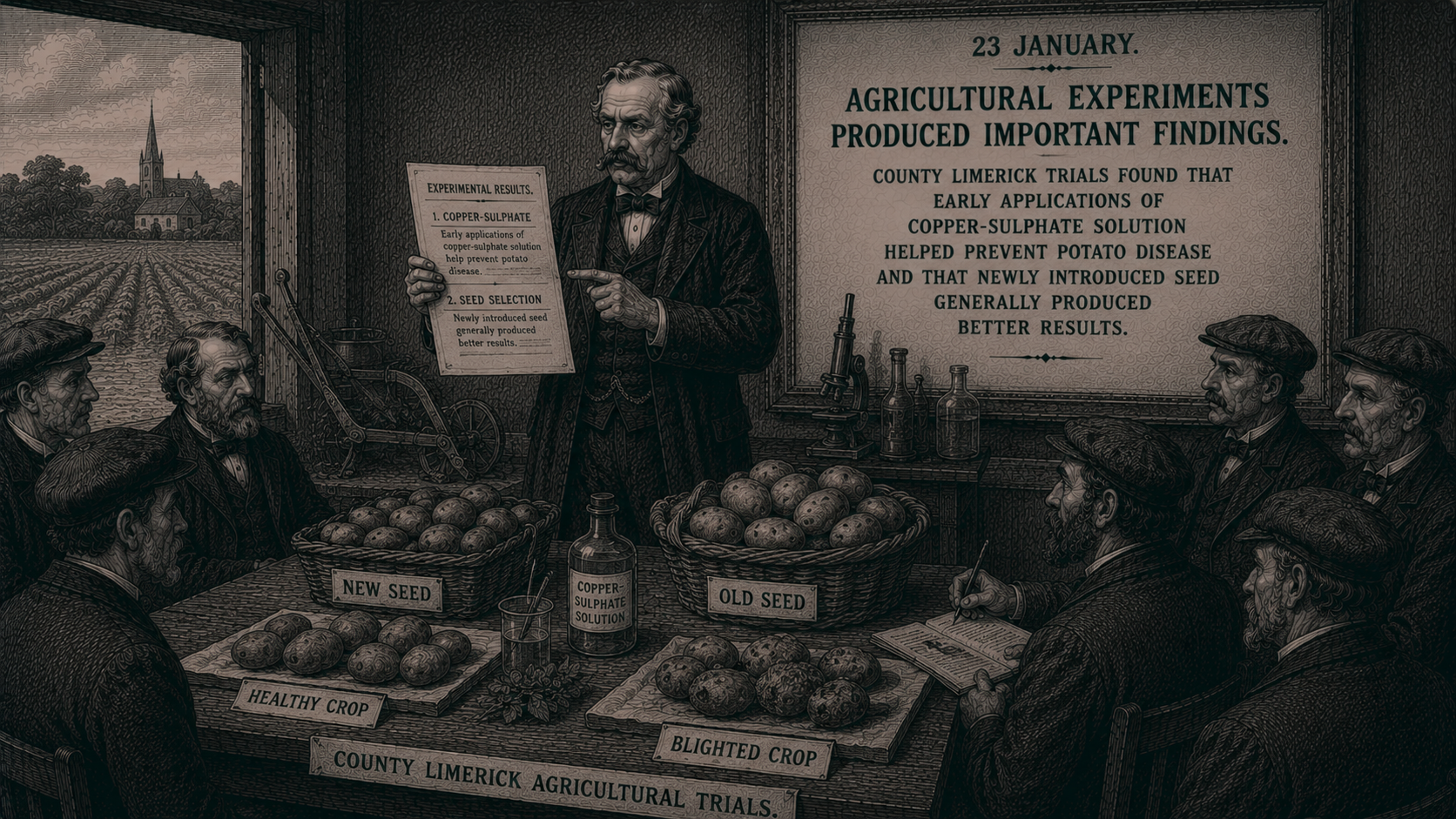
Read Article: Potato FindingsImportant results from agricultural experiments conducted across County Limerick were reported on 23 January 1900. The trials examined whether a copper-sulphate solution could protect potato crops against disease and whether freshly introduced seed performed better than potatoes repeatedly grown on the same farms. The findings were encouraging. Even during a season when blight had been comparatively limited, treated plots produced sufficient improvement to repay the expense of spraying. For farmers whose income and household food supply depended heavily upon the potato harvest, the experiments offered practical evidence that preventive treatment could reduce risk rather than merely respond after disease had appeared.
Timing proved central to the success of the copper treatment. The Limerick trials indicated that two applications made relatively early in the growing season were more effective than one heavier dressing applied later. This supported the principle that the solution worked best as a preventive coating upon healthy foliage rather than as a cure after infection had become established. Farmers therefore needed to act before obvious damage appeared, preparing the mixture, maintaining spraying equipment and treating fields while the crop still looked sound. The method required additional labour and expenditure, but the reported improvement suggested that prevention could protect both yield and quality.
The experiments were conducted over a considerable area, giving the findings greater value than results obtained from a single isolated plot. Potato disease varied according to weather, drainage, soil and local growing conditions, making comparison across several farms particularly useful. The preceding crop had been one of Ireland’s soundest for some years, although wet lands in Connacht had suffered more severely. The relative absence of widespread destruction did not weaken the Limerick evidence. Instead, the results suggested that spraying remained economically worthwhile even when disease pressure was moderate, allowing farmers to protect against sudden deterioration during damp summer weather.
A second series of tests compared old farm-grown seed with potatoes newly introduced from elsewhere. In almost every instance, the fresh seed produced substantially better results than stock that had been cultivated repeatedly upon the same holding. The finding encouraged farmers to renew their seed rather than relying indefinitely upon potatoes selected from previous harvests. Better seed could improve vigour, yield and resistance, although the surviving report did not identify the varieties or every farm involved. Combined with early spraying, periodic seed renewal offered County Limerick growers a practical programme for strengthening a crop still central to rural food, wages and farm income.
The trials reflected a growing effort to apply organised agricultural science to the ordinary problems of Irish farming. Demonstration plots and comparative experiments translated chemical and botanical knowledge into recommendations that cultivators could judge by visible results. In County Limerick, where mixed farming and dairying existed alongside widespread potato cultivation, the value of a healthier crop extended beyond human consumption because potatoes could also support livestock feeding and household economy. The findings did not eliminate the continuing threat of blight, but they showed that careful timing, copper-sulphate treatment and renewed seed could materially reduce the vulnerability inherited from older cultivation practices.
- Irish Times, “Sulphate of Copper Solution and Potato Disease,” 23 January 1900, p. 6.
- Farmer’s Gazette, account of agricultural experiments conducted in County Limerick during the 1899 growing season concerning copper-sulphate treatment, potato disease and old versus newly introduced seed; exact issue and page not confirmed, cited in the Irish Times, 23 January 1900, p. 6.
-
Contracts Shortened
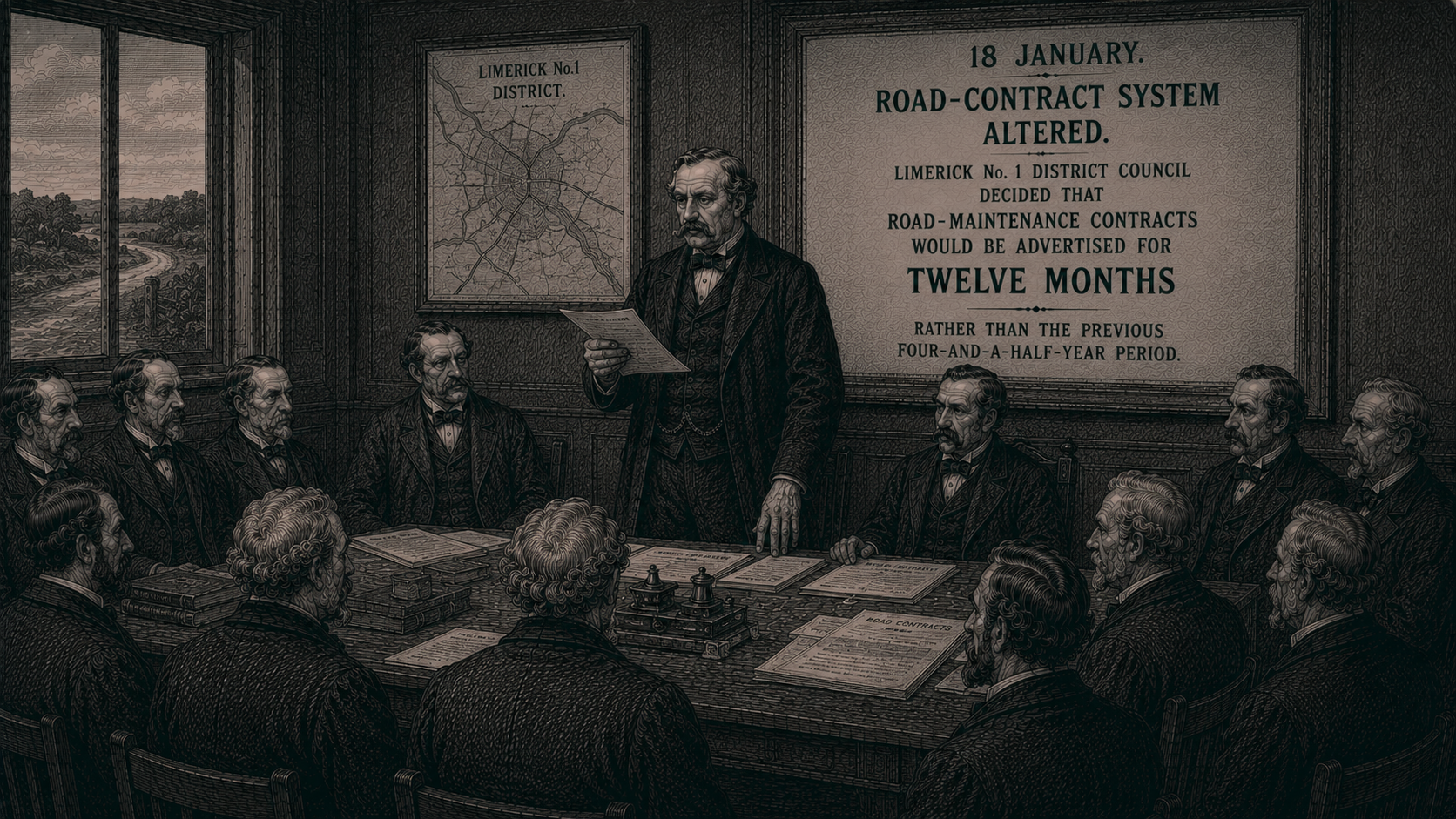
Read Article: Contracts ShortenedLimerick No. 1 District Council altered the system governing maintenance and repair contracts for public roads when members decided that future agreements would run for twelve months rather than the four-and-a-half-year term previously used. The decision followed an adjourned quarterly meeting held under the chairmanship of William Noonan and reported on 18 January 1900. Road tenders rejected at an earlier sitting had been referred to Limerick County Council, which declined to consider them and returned the entire question to the District Council. Members were therefore required to reconsider both the tenders and the basis upon which future road work would be awarded.
John Ryan moved that contracts should be advertised for one year from 31 March 1900. The shortened term represented a substantial departure from established practice and gave the Council greater opportunity to review costs, workmanship and the conduct of contractors before renewing agreements. Long contracts offered continuity but could bind a local authority to unsatisfactory arrangements for several years. Annual contracts provided more frequent competition and allowed councillors to respond to changing wages, road conditions and maintenance needs. Ryan’s motion reflected the uncertainty surrounding road administration during the first year of the new elected local-government system in County Limerick.
The resolution also required successful contractors to obtain security through a guarantee society. Mr Doyle, a solicitor representing intending contractors, argued that this condition could not be fulfilled. He stated that Mr Shee, MP, who had suggested the arrangement, had consulted guarantee societies whose managers indicated that they would refuse to act as sureties for road contractors. Chairman Noonan believed the resolution should be amended to meet this difficulty, but members did not accept his suggestion. The condition remained attached to the proposal, raising the possibility that otherwise suitable contractors might struggle to provide the form of financial security demanded by the Council.
The debate took place amid growing agitation for direct labour on County Limerick roads. Labourers and their supporters argued that councils should employ workers themselves rather than place public money in the hands of private contractors. The County Council had already received approval to put roads under the County Surveyor where no acceptable tenders were submitted. Shortening contracts to twelve months allowed the District Council to retain the contracting system while limiting the period for which it surrendered direct control. The decision therefore represented a compromise between long-established contracting arrangements and demands for more accountable public employment.
The motion was ultimately adopted unanimously. Its passage established a new annual rhythm for advertising, evaluating and awarding road-maintenance contracts within the Limerick No. 1 district. Councillors would have more frequent opportunities to compare contract prices with direct-labour costs and to judge whether contractors were keeping roads in satisfactory repair. For labourers, ratepayers and farmers, the consequences would be visible in employment opportunities, local taxation and the condition of routes used for markets, farms and everyday travel. The altered contract term became one element of a wider struggle over who should control public work under Ireland’s new democratic councils.
- Irish Times, “The Direct Labour Question,” 18 January 1900, p. 6.
- Limerick No. 1 Rural District Council minute books, January 1900, Limerick Archives; exact volume and folio for the meeting not confirmed.
- Local Government (Ireland) Act 1898, 61 & 62 Vict., c. 37.
- Local Government (Procedure of Councils) Order 1899, provisions governing meetings, contracts and financial administration by Irish local authorities.
- Limerick County Council minute books, 1899–1900, Limerick Archives, records concerning road tenders, direct labour and responsibility for county road maintenance.
-
Inquiry Announced
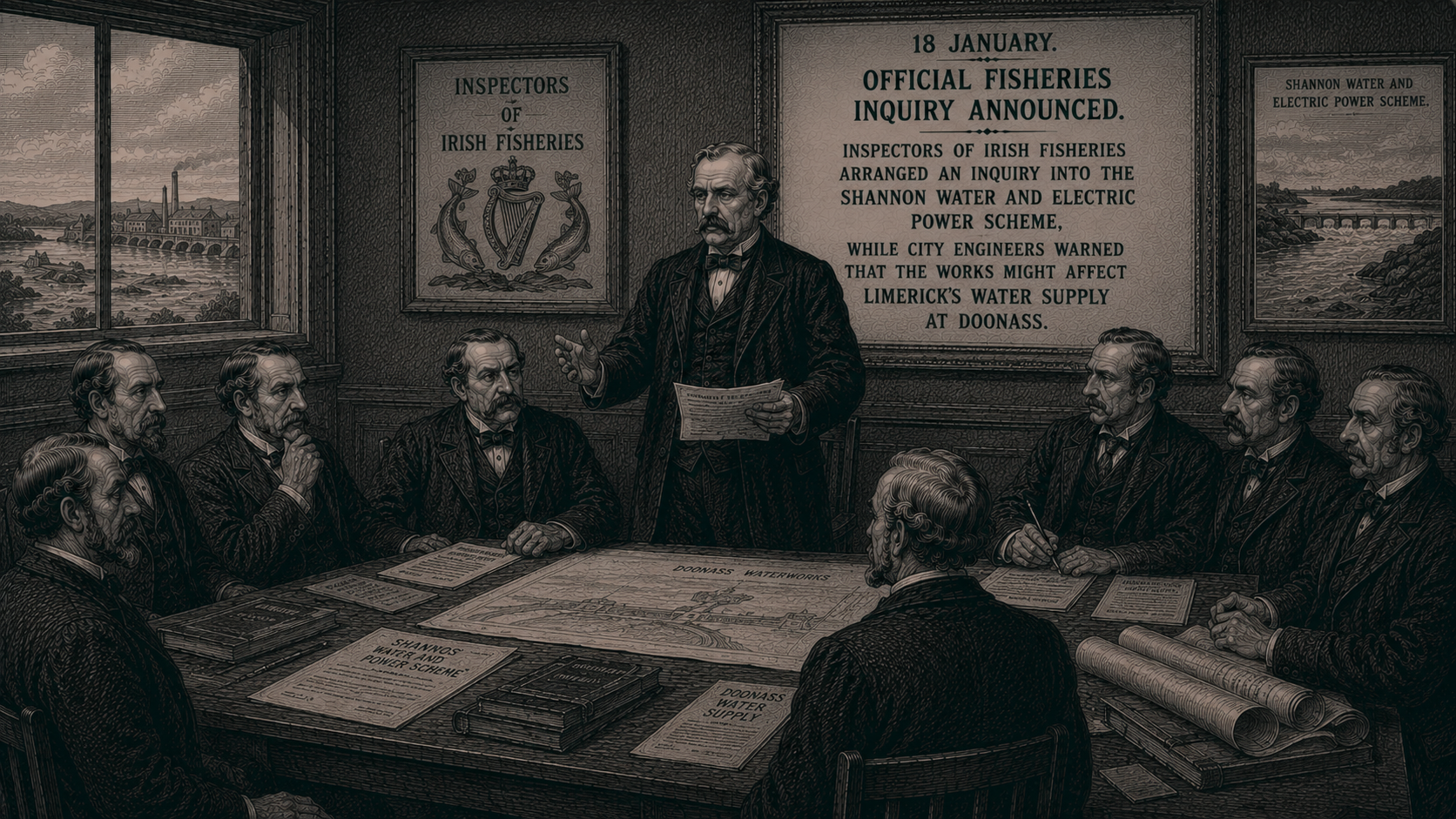
Read Article: Inquiry AnnouncedThe Inspectors of Irish Fisheries announced that they would hold an official inquiry in Limerick on 30 January 1900 into the works proposed by the Shannon Water and Electric Power Syndicate. Notice of the hearing was sent to Limerick County Council as opposition widened among fishery owners, navigational interests and public authorities. The inquiry offered affected parties an opportunity to place technical evidence and local objections before officials responsible for protecting Irish fisheries. It also moved the controversy beyond public resolutions, requiring the promoters to answer detailed questions about water diversion, river levels and the consequences of their proposed generating works.
The company sought parliamentary powers to harness the Shannon between Lough Derg and Limerick for the production of electricity. Its proposals involved canals, regulating works and the diversion of a substantial quantity of water from portions of the natural river channel. Supporters presented the undertaking as an opportunity to provide inexpensive power for factories, transport and municipal services. Opponents feared that engineering works designed primarily for electricity generation might damage existing uses of the river. The inquiry was therefore expected to examine whether industrial development could proceed without impairing salmon migration, spawning grounds, navigation and established water rights.
Limerick’s city engineers added a separate and urgent warning. They reported against permitting any works that might interfere with the municipal water supply drawn from the Shannon at Doonass. A reduction or alteration in the river’s natural flow could affect the quantity and reliability of water reaching the city’s system. This concern placed public health and everyday domestic need beside the commercial arguments surrounding the scheme. Electricity might offer cleaner streets, extended business hours and new industrial possibilities, but the Corporation could not accept those advantages if the price included uncertainty over the water required by households, institutions and businesses.
The fisheries inquiry formed part of a wider official examination extending beyond Limerick. Parliamentary discussion later confirmed that the Inspectors held hearings in Limerick on 30 January, Killaloe on 1 February and Athlone on 3 February. These locations reflected the geographical reach of the proposed works and the number of communities connected to the Shannon system. Evidence could therefore be gathered from fishery conservators, riparian owners, traders, engineers and local authorities above and below Lough Derg. Their competing claims demonstrated that the river was simultaneously a fishery, navigation, water source, industrial resource and foundation of local employment.
The Inspectors prepared a report for the Government, but later requests from the Limerick Board of Conservators and the promoting company for copies were refused on the ground that it was an internal official document. Suspicion consequently persisted that the findings were unfavourable to the scheme. Parliament ultimately sanctioned a revised undertaking through the Shannon Water and Electric Power Act of 1901, although the proposed private development was never completed. The January inquiry nevertheless marked an important stage in Limerick’s early debate over hydroelectricity, establishing that modernisation required formal examination of its possible effects upon fisheries, water supply and river communities.
- Irish Times, “News from the Provinces: Shannon Water and Electric Power Syndicate,” 18 January 1900, p. 6.
- Irish Times, “Limerick Fishery Conservators: The Shannon Water and Electric Power Bill,” 5 January 1900, p. 3.
- House of Lords Debates, “Irish Fisheries—Inspectors’ Reports,” 23 July 1900, questions concerning the inquiries held at Limerick, Killaloe and Athlone and the Government’s refusal to publish the Inspectors’ report.
- Limerick Fishery Board of Conservators Collection, IE LA P48, Limerick Archives.
- Limerick County Council minute books, January 1900, Limerick Archives.
- Shannon Water and Electric Power Act 1901, 1 Edw. 7, c. cxxxvi, royal assent 26 July 1901.
-
Observer Expelled
Read Article: Observer ExpelledThe Limerick Board of Guardians unanimously ordered a police constable to leave its meeting after members discovered that he was taking notes of the proceedings while dressed in civilian clothing. The incident, reported on 13 January 1900, interrupted the ordinary work of the board and immediately raised questions about why a police observer had entered the room without openly declaring his purpose. Mr Fitzgerald drew attention to the constable’s presence and proposed that the chairman require him to withdraw. Mr Kelly seconded the motion, which passed without dissent, leaving the officer no choice but to depart.
The surviving newspaper report does not name the constable or explain who instructed him to attend. His plain clothes and note-taking nevertheless caused particular offence because the Guardians were conducting the business of an elected public authority rather than holding a clandestine gathering. Mr Fitzgerald and Mr Kelly were identified as Nationalist guardians, but the unanimous vote showed that the objection extended beyond the two men who introduced the resolution. By insisting upon the officer’s removal, the board asserted that police observation of its deliberations required explanation and could not be accepted silently merely because the observer had gained admission.
The Limerick Union Board of Guardians administered the workhouse, outdoor relief, medical services and other responsibilities arising from the Irish Poor Law. Its members considered reports from officials, authorised expenditure, dealt with contractors and debated matters affecting poverty, public health and local administration. Meetings could also become political forums, particularly after wider electoral participation brought stronger nationalist representation into Irish local government. Notes taken by an unidentified constable might have recorded speeches, resolutions or the conduct of individual guardians. The board’s reaction reflected concern that legitimate public administration was being watched as though it represented a threat to public order.
The incident occurred within a political culture marked by distrust between nationalist representatives and the authorities responsible for policing Ireland. Police attended public meetings, political demonstrations and agrarian gatherings, sometimes preparing reports for their superiors. The Guardians did not claim that the constable had disrupted the meeting or threatened anyone; their complaint centred upon concealed observation and the recording of proceedings. The distinction was important. Uniformed attendance for an openly stated purpose might have been understood, but a plain-clothes officer quietly taking notes appeared to the board as surveillance. The unanimous resolution turned that suspicion into a formal defence of its institutional independence.
For Limerick, the confrontation demonstrated that local administrative bodies were becoming increasingly conscious of their democratic authority. The Guardians served a union containing the city and surrounding districts, with their decisions affecting the workhouse on Shelbourne Road and thousands of people dependent upon relief and medical provision. Their expulsion of the constable did not alter policing policy or produce a wider constitutional settlement, but it established a clear boundary within the boardroom. Public officials could report proceedings openly, and newspapers could record debate, yet covert police note-taking would not be tolerated without the knowledge and consent of the elected members.
- Irish Times, “Constable Present,” 13 January 1900, p. 8.
- Limerick Union Board of Guardians Minute Books, January 1900, Limerick Archives, reference IE LA BG110; exact volume and page for the incident not confirmed.
- Limerick Archives, Limerick Union Board of Guardians Minute Books, 1842–1922, collection description and administrative history, reference IE LA BG110.
- Poor Relief (Ireland) Act 1838, 1 & 2 Vict., c. 56, establishing Irish Poor Law unions, workhouses and elected Boards of Guardians.
- Local Government (Ireland) Act 1898, 61 & 62 Vict., c. 37, reforming local representation and the electoral framework within which Poor Law guardians operated.
-
Tenant Payments
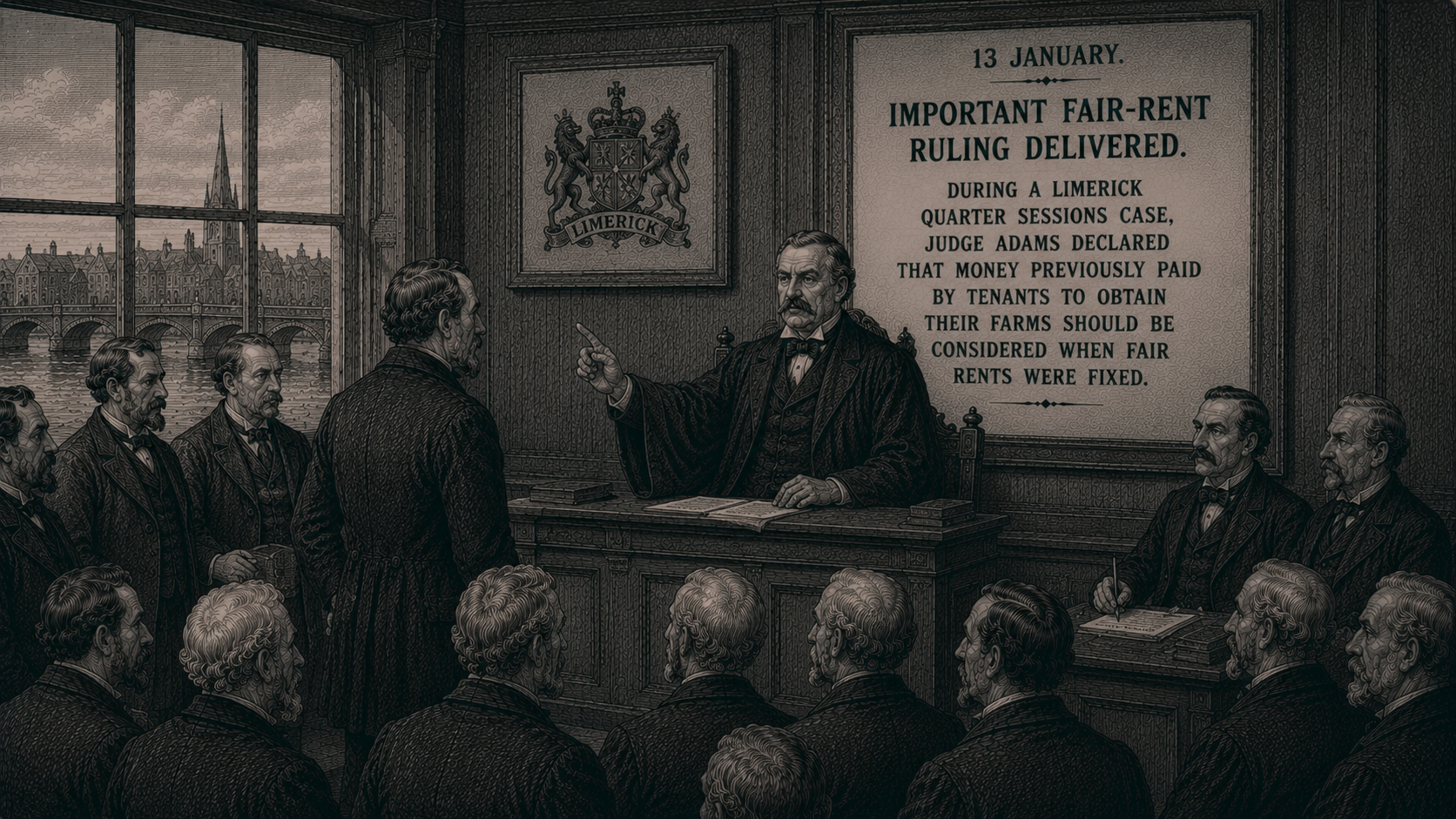
Read Article: Tenant PaymentsJudge Richard Adams delivered an important ruling during the Limerick Quarter Sessions concerning the fixing of fair rents on Irish agricultural holdings. He declared that money already paid by a tenant to obtain possession of a farm should be taken into account when the judicial rent was assessed. Such payments commonly represented the purchase of the outgoing tenant’s interest, goodwill or tenant-right rather than money paid directly to the landlord. Adams’s statement recognised that an incoming occupier might have invested a substantial sum before paying a single year’s rent and that this financial burden formed part of the true circumstances of the tenancy.
The ruling arose from the land-law system created after the agitation of the late nineteenth century. The Land Law (Ireland) Act of 1881 established the principles popularly known as fair rent, free sale and fixity of tenure. Tenants could apply to have a judicial rent fixed, while an outgoing occupier could sell an interest in the holding to an incoming tenant. This created a difficult question for the courts: whether a large payment made to secure a farm indicated that the holding was valuable, or whether the purchaser’s investment should protect him from being charged again through an excessive annual rent.
Adams’s approach favoured consideration of the complete transaction rather than the land alone. A tenant who paid heavily for possession had purchased more than bare occupation; the price could include improvements, security and the recognised value of the tenancy. Ignoring that payment when fixing rent risked allowing the landlord to benefit from value created or purchased by the tenant. The judge did not declare that every sum should automatically produce a particular reduction. His principle was that the court should examine the payment as one relevant circumstance when deciding what annual rent would be fair between landlord and occupier.
The decision carried particular importance in County Limerick, where tenant farmers frequently transferred holdings within families or purchased the interests of departing occupiers. Land remained the foundation of rural income, social standing and family security, making the price paid for entry into a farm a serious financial commitment. Judicial rents affected not only relations with landlords but the ability of households to employ labourers, improve buildings, maintain livestock and survive poor harvests. Adams’s ruling indicated that the fair-rent court should recognise the capital already committed by tenants instead of treating each holding as though it had been acquired without cost.
The judgment reflected the continuing effort to define fairness within a complicated land system that divided ownership, occupation and improvement among different parties. Landlords retained the legal estate, tenants possessed statutory protections, and incoming farmers could pay substantial sums for interests created by earlier occupants. By directing attention to those payments, Adams strengthened the argument that rent could not be calculated solely from acreage, soil and estimated productivity. The ruling did not end disputes over tenant-right or judicial valuation, but it offered Limerick tenants a significant legal principle: the money required to obtain a farm formed part of the economic reality the court was obliged to consider.
- Irish Times, report of the Limerick Quarter Sessions and Judge Richard Adams’s ruling concerning payments made by tenants to obtain farms, 13 January 1900; page not confirmed.
- Land Law (Ireland) Act 1881, 44 & 45 Vict., c. 49, provisions establishing fair rent, free sale and fixity of tenure.
- Land Law (Ireland) Act 1896, 59 & 60 Vict., c. 47, provisions governing the fixing of fair rents and the consideration of improvements and tenancy interests.
- House of Commons Debates, “Land Law (Ireland) Bill,” 4 April 1895, vol. 32, discussion of Judge Adams’s treatment of tenant-right purchase money in a Limerick fair-rent case.
- Adams, Tenant; Dunseath, Landlord (No. 2), Irish Reports, 1899, vol. II, pp. 504–519, Court of Appeal ruling on tenant improvements and the fixing of fair rent.
- Fair Rent Tribunal Collection, 1881–1916, P20, Limerick Archives, records of applications, valuations and judicial rents under the Irish Land Acts.
-
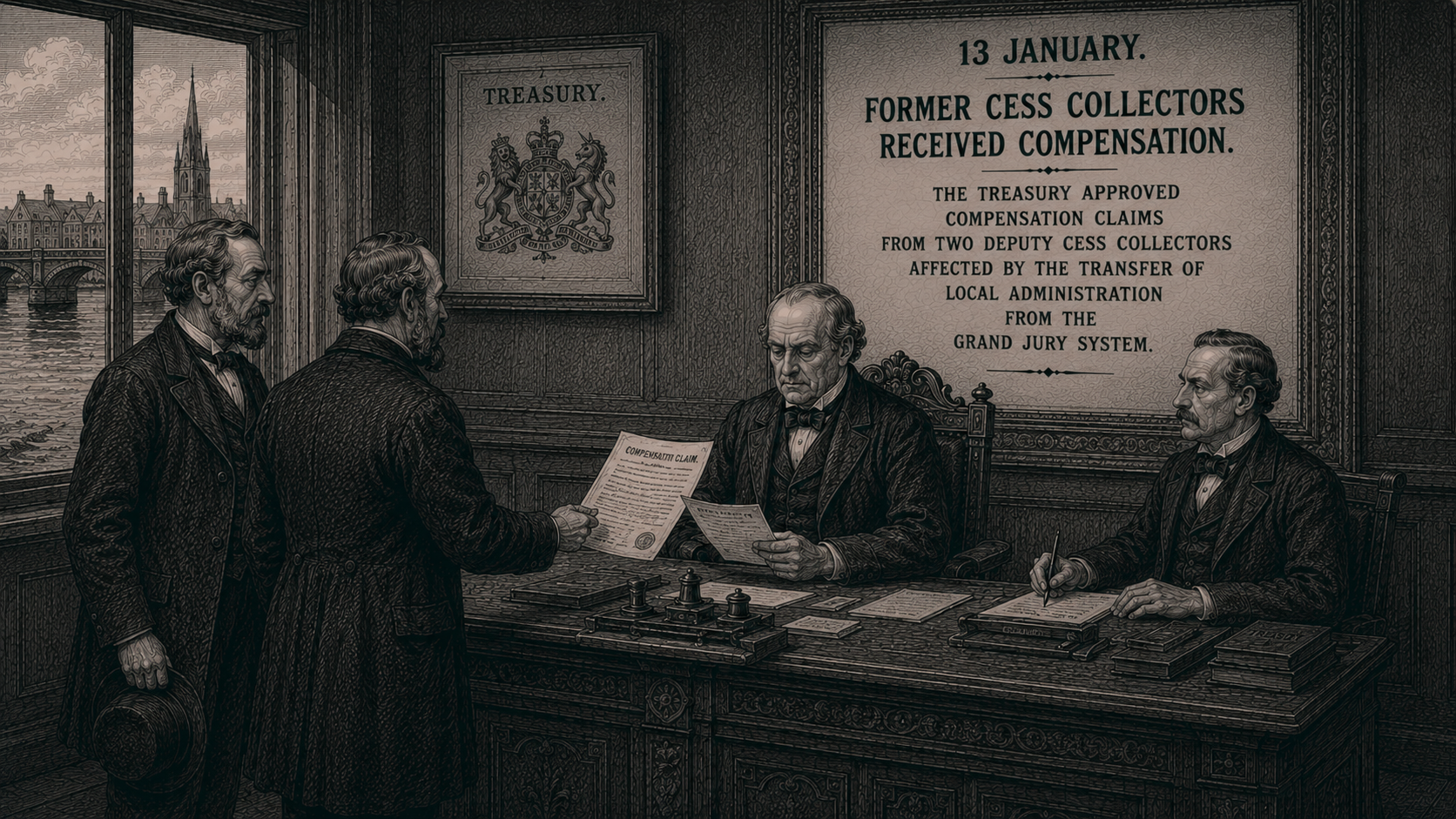
Claims Approved
Read Article: Claims ApprovedThe Treasury approved compensation claims submitted by two former deputy cess collectors whose employment had been affected by the transfer of local administration from the Grand Jury system. The decision, reported on 13 January 1900, reached Limerick County Council by telegram. Councillors had previously concluded that they possessed no legal authority under the Local Government (Ireland) Act of 1898 to compensate deputies who had not been formally appointed by the Grand Jury. The successful applicants therefore carried their cases beyond the Council, asking the Treasury to recognise the financial loss created when the older machinery of county taxation was replaced.
County cess was the local tax formerly raised to finance roads, bridges, courthouses and other services administered through the Grand Jury. Official collectors were responsible for gathering the assessment, but much of the practical work could be undertaken by deputies operating beneath them. The democratic county councils established under the 1898 legislation inherited many Grand Jury responsibilities and introduced new arrangements for collecting rates. Officers whose recognised posts disappeared or whose income was reduced could seek compensation, yet the position of deputies was less secure when their appointments had not been formally recorded by the outgoing authority.
Limerick County Council’s refusal appears to have rested upon this distinction rather than upon a denial that the men had performed useful work. The Council believed that the statutory compensation provisions applied to legally constituted officers whose positions had been abolished or diminished by administrative reform. The deputy collectors argued that the practical reality of their employment should carry weight even when formal appointment procedures had been incomplete. Their appeal exposed a weakness in the transition: public duties had often been performed through arrangements understood locally, but the new system demanded documentary proof before responsibility for compensation could be assigned.
The Treasury telegram confirmed that two claims would be allowed and encouraged expectations that other pending applications might receive similar treatment. No compensation amounts were stated in the surviving report, and the affected officers were not named. The ruling nevertheless mattered to former employees throughout County Limerick who had lost fees or positions when elected councils replaced the Grand Jury administration. It also relieved the County Council of having to stretch its interpretation of the Act beyond what members believed lawful, while acknowledging that central government could address hardship arising from gaps in the legislation’s treatment of subordinate officials.
The case illustrated the human cost of a reform generally celebrated for transferring local power from appointed landowners to elected representatives. New councils assumed responsibility for taxation, roads and public services, but the change also disrupted established livelihoods within the old administrative structure. Compensation disputes required officials to distinguish between recognised office, customary employment and informal delegation. By accepting the two Limerick claims, the Treasury recognised that administrative modernisation could produce genuine pecuniary loss even where legal status remained uncertain. The decision offered limited protection to displaced workers while leaving the broader question of similar deputy appointments to be resolved claim by claim.
- Irish Times, “Deputy Cess Collectors and Compensation,” 13 January 1900, p. 9.
- Local Government (Ireland) Act 1898, 61 & 62 Vict., c. 37, section 120 and Seventh Schedule, provisions governing compensation for existing officers suffering direct pecuniary loss.
- John J. Clancy, A Handbook of Local Government in Ireland, Dublin: Sealy, Bryers and Walker, 1899, commentary on the Local Government (Ireland) Act and compensation arrangements for transferred or displaced officers.
- Limerick Grand Jury Presentments Collection, P37, Limerick Archives, printed presentments and cess records relating to Grand Jury taxation and county expenditure, 1807–1900.
- Limerick County Council minute books, 1899–1900, Limerick Archives, records concerning the administrative transfer from the Grand Jury system and claims arising from displaced county officers.
-
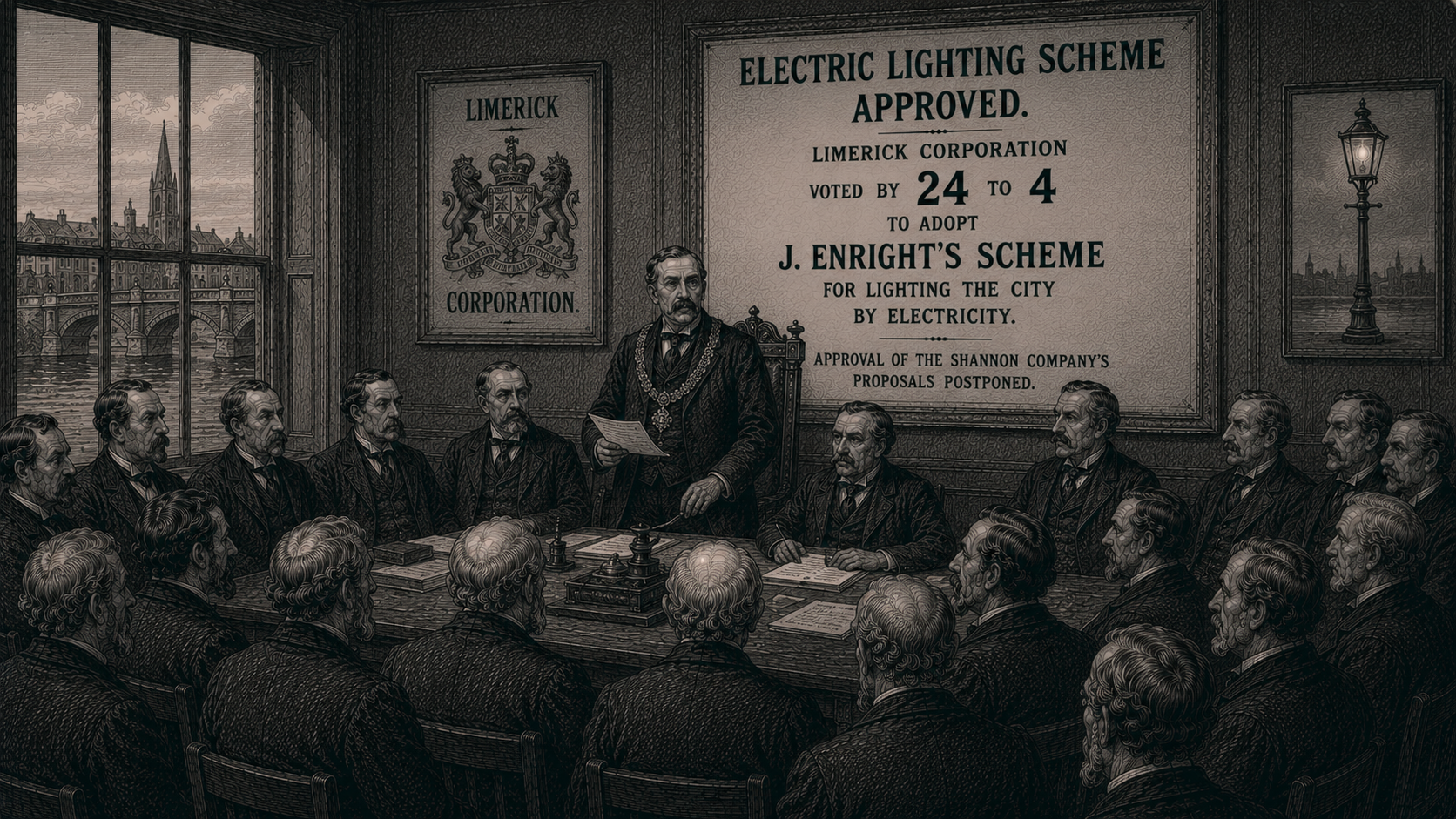
Electric Lighting
Read Article: Electric LightingLimerick Corporation voted by twenty-four members to four to adopt J. Enright’s proposal for lighting the city by electricity. The decision, reported on 12 January 1900, authorised a scheme designed to provide an installation meeting the technical requirements administered by the Board of Trade. Enright was described as being from London, suggesting that the Corporation had sought outside expertise for a modern undertaking of considerable engineering and financial importance. The decisive majority indicated that most councillors accepted electric lighting as a necessary civic improvement, despite continuing disagreement over how power should be produced and supplied.
The vote did not amount to approval of the separate Shannon Water and Electric Power Company scheme. Limerick’s engineer had advised against accepting that proposal without firm guarantees that the works would not interfere with the municipal water supply at Clareville. John Mackey, the company secretary, and Mr Fraser, its engineer, asked the Corporation to postpone a final decision until Fraser could explain the proposed undertaking and answer objections. Councillors agreed to defer consideration. Their response allowed the company another hearing while preserving the city’s freedom to resist any arrangement considered dangerous to its waterworks or other public interests.
Electric lighting promised changes extending far beyond the replacement of individual street lamps. Reliable illumination could improve movement after dark, assist policing, lengthen commercial activity and reduce dependence upon older lighting arrangements. Shops, workshops, public buildings and prosperous households might eventually draw power from the same developing network. Yet the undertaking required generating equipment, cables, lamps, maintenance and legal compliance, all of which would create substantial costs for ratepayers. The Corporation’s support for Enright’s plan therefore represented a decision to invest in civic infrastructure while accepting responsibility for supervising a technically complex service.
The debate was inseparable from Limerick’s dependence upon the Shannon. Promoters of the water-power company argued that the river could provide electricity and encourage industrial growth, but fishery owners, navigational interests, millers and municipal officials feared that alterations to the river might lower Lough Derg, damage spawning grounds and affect the city’s water supply. By approving Enright’s lighting scheme while postponing the Shannon proposal, the Corporation appears to have distinguished the immediate desire for electric light from the disputed means of generating it. Modernisation was welcomed, but not at any cost to existing public services and river users.
The vote marked an important stage in Limerick’s gradual transition towards a municipally supervised electricity service. Adoption of the scheme did not mean that every street and building would be illuminated immediately; detailed planning, finance, construction and official authorisation still had to follow. It nevertheless gave the project clear political support and established that the city intended to participate in the electrical transformation already under way elsewhere. The four dissenting votes showed that caution remained, but the large majority placed Limerick Corporation behind a technology expected to reshape commerce, public administration and everyday urban life.
- Irish Times, “Limerick Corporation,” 12 January 1900, p. 6.
- Limerick Corporation Council minutes, January 1900, Limerick Corporation Collection, Limerick Archives.
- Electric Lighting Act 1882, 45 & 46 Vict., c. 56.
- Electric Lighting Act 1888, 51 & 52 Vict., c. 12.
- Limerick Corporation Electrical Undertaking Collection, L/EL, Limerick Archives.
- Limerick Corporation Town Clerk’s Office letter books and rough minute books, 1899–1900, Limerick Corporation Collection, Limerick Archives.
-
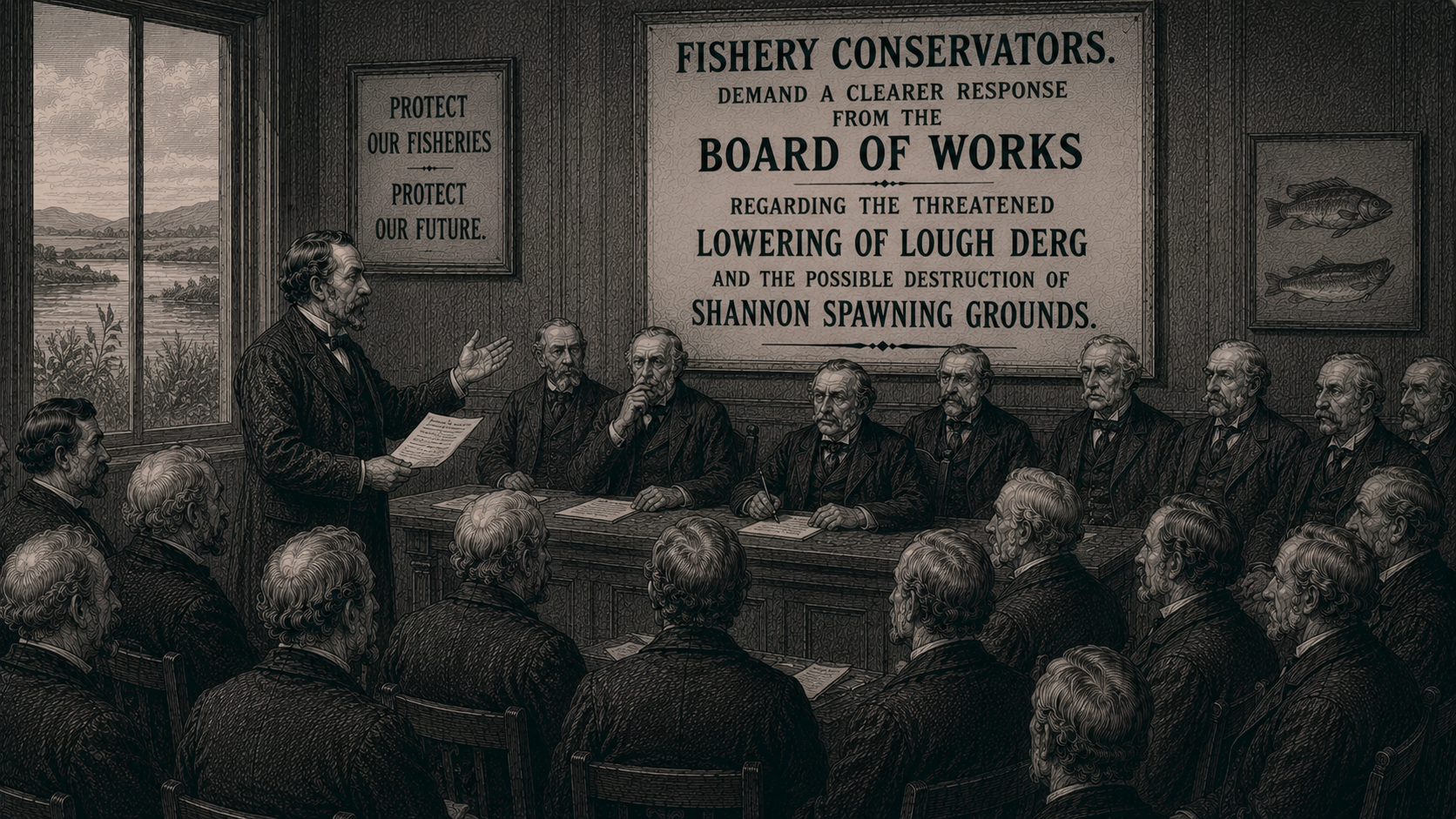
Fisheries Alarm
Read Article: Fisheries AlarmThe Limerick Fishery Conservators intensified their opposition to the Shannon Water and Electric Power Bill when the Board of Public Works failed to provide the clear assurance they sought. At the board’s monthly meeting, Secretary Mr Hosford read a reply stating that the Commissioners would take whatever steps were necessary to protect their responsibilities for Shannon navigation, drainage, revenue and property. Members considered the answer carefully worded but inadequate. It did not state whether the Board would oppose the proposed lowering of Lough Derg or whether the fisheries would receive protection independent of the navigation interests under its direct control.
The proposed company sought parliamentary authority to divert Shannon water through power canals and generate electricity near Limerick. Fishery representatives feared that the works might lower the summer level of Lough Derg by several feet and reduce the volume flowing through the natural river channel. Members argued that such a change could leave spawning beds exposed, prevent salmon entering tributaries and damage netting interests farther downstream. Their concern extended beyond the commercial value of catches. The Shannon’s tributaries formed the breeding system upon which future stocks depended, making water levels during migration and spawning seasons central to the survival of the fishery.
Discussion focused upon the possibility that the lake might be lowered by seven feet. Members stated that this would bring the water below the established summer level and approximately six inches beneath the sill of Victoria Lock above Portumna. They believed the consequences would reach navigation as well as fisheries, leaving shallow harbours difficult to use and disrupting movement across Lough Derg. The Conservators insisted that the Board of Works should say plainly whether it would permit any lowering of the lake. A promise to defend its own statutory interests did not answer whether spawning grounds and private fishing rights would be protected.
The chairman reminded the meeting of an earlier inquiry, held around 1890, into another proposal affecting Shannon water levels. The fishery inspectors had then warned that lowering the lakes would injure fisheries by making it difficult for salmon to enter tributaries, many of which served as principal spawning rivers and feeders of the Shannon. Members resolved that this finding should be sent to the Board of Works with a renewed request for clarification. Their campaign joined scientific observation, commercial interest and local experience, placing the possible destruction of breeding grounds at the centre of Limerick’s opposition to the power scheme.
The dispute revealed the divided responsibilities governing the Shannon at the beginning of the twentieth century. The Board of Works controlled navigation and drainage, while fishery conservators represented those responsible for protecting salmon stocks and fishing rights. A hydroelectric proposal affected both jurisdictions without ensuring that either body could safeguard the entire river system. By demanding a definite response, the Limerick Conservators sought to prevent uncertainty from becoming approval by default. Their action also asserted that industrial development should not proceed until promoters demonstrated that Lough Derg, the tributary spawning grounds and the livelihoods dependent upon the Shannon would remain secure.
- Irish Times, “Limerick Fishery Conservators: The Shannon Water and Electric Power Bill,” 5 January 1900, p. 3.
- Limerick Fishery Board of Conservators Collection, IE LA P48, Limerick Archives.
- Commissioners of Public Works to Mr Hosford, Secretary of the Limerick Fishery Conservators, reply concerning the Shannon Water and Electric Power Bill of 1900, reproduced in the Irish Times, 5 January 1900, p. 3.
- Report of the Inspectors of Irish Fisheries to the Lord Lieutenant concerning an earlier proposal to lower the Shannon lakes, circa 1890, extract reproduced during the Conservators’ meeting and reported in the Irish Times, 5 January 1900, p. 3.
-
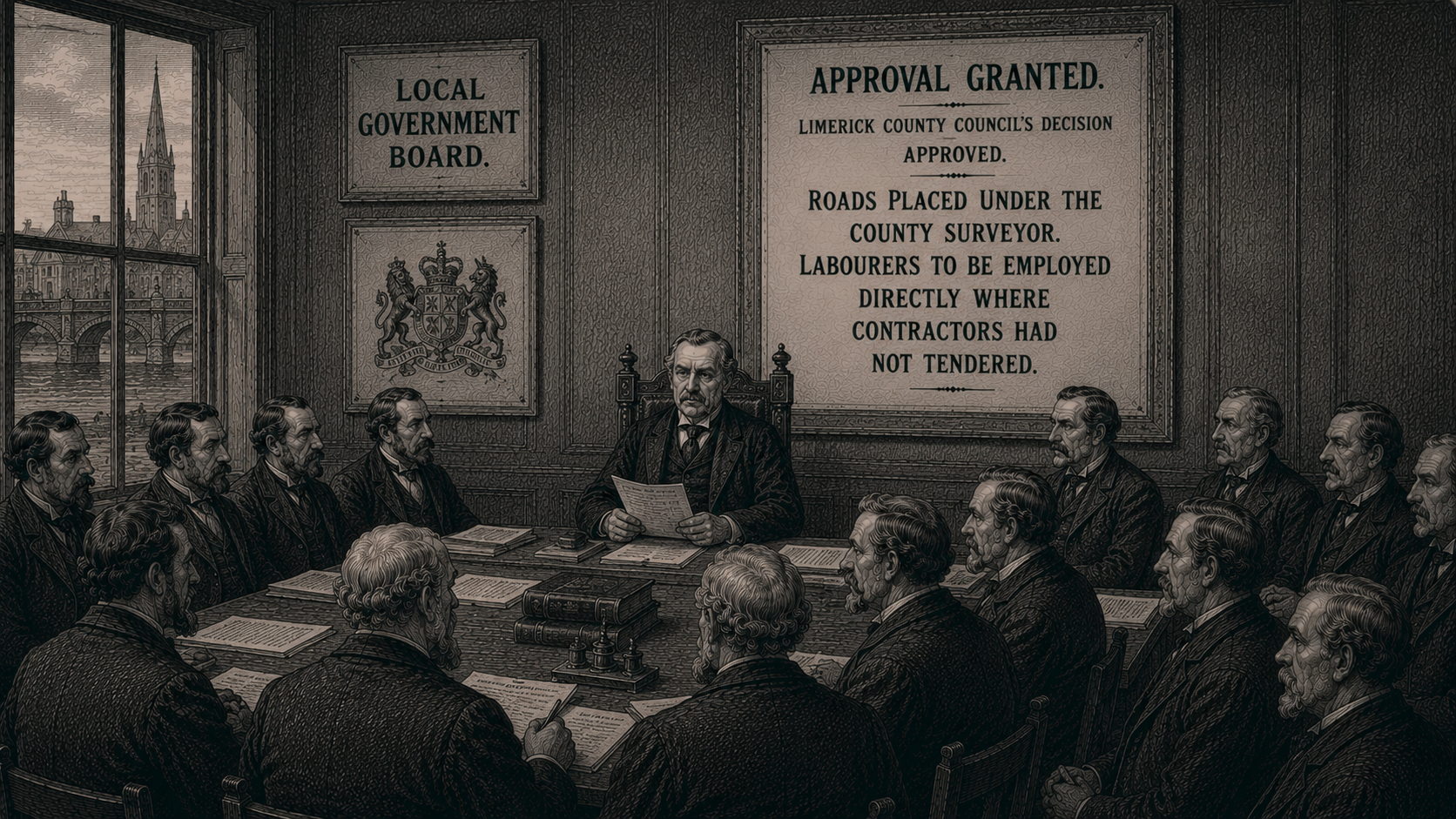
Labour Sanctioned
Read Article: Labour SanctionedThe Local Government Board approved Limerick County Council’s decision to undertake certain road works by direct labour where contractors had failed to tender. The ruling, reported on 5 January 1900, allowed the Council to place such roads under the County Surveyor and employ labourers without relying upon the customary contracting system. Approval did not introduce direct labour across every county road. It applied to works for which satisfactory private tenders had not been received, giving the newly established local authority a practical means of maintaining routes that might otherwise remain neglected.
Road maintenance had traditionally been divided into contracts covering particular stretches, with farmers and other local men tendering to keep surfaces, drains and verges in repair. The new county councils created under the Local Government (Ireland) Act of 1898 inherited responsibility for this extensive network. Where no contractor offered acceptable terms, officials faced the choice of postponing work or employing labourers under direct supervision. The Local Government Board’s sanction confirmed that Limerick County Council could use the second course, provided the County Surveyor controlled the work and the Council remained accountable for expenditure.
The decision carried particular importance for rural labourers, who frequently experienced unemployment during the winter months. Direct employment offered wages without requiring workers to depend upon a contractor who might retain part of the available payment or select labour according to private preference. Supporters also argued that public supervision could improve workmanship and ensure that money voted for roads reached the men performing the labour. Opponents feared that direct labour would prove more expensive, encourage political favouritism and expose councillors to organised pressure from groups seeking employment on publicly funded works.
The issue had already produced considerable conflict within County Limerick. Labourers attended district council meetings to demand direct employment, while farmers and ratepayers disputed whether the system would protect or burden local finances. Judge Richard Adams had recently connected the malicious burning of hay at Templebredin with agitation surrounding the road question, illustrating how an administrative dispute could become entangled with intimidation and rural resentment. The Board’s approval therefore gave legal and administrative support to a limited experiment while leaving the Council responsible for maintaining order, monitoring costs and preventing employment decisions from becoming instruments of coercion.
The sanction represented an early test of democratic local government in Limerick. Councillors elected under the new system were expected to balance efficient road maintenance, ratepayers’ interests and the urgent need for rural employment. Placing untendered roads under the County Surveyor created an alternative to dependence upon private contractors, but its success would be judged by cost, quality and fairness. The decision did not settle the wider argument between contract work and direct labour. It established, however, that the County Council possessed authority to employ workers directly when the contracting system failed to provide the necessary public service.
- Irish Times, “Limerick County Council and the Roads,” 5 January 1900, p. 3.
- Irish Independent, “Direct Labour on the Roads,” 5 January 1900; page not confirmed.
- Limerick County Council minute books, 1899–1900, Limerick Archives.
- Local Government (Ireland) Act 1898, 61 & 62 Vict., c. 37.
- Local Government (Procedure of Councils) Order 1899, sections 19–20.
- Diarmaid Ferriter, Cuimhnigh ar Luimneach: A History of Limerick County Council, 1898–1998, Limerick: Limerick County Council, 1998.
- Colm Moloney, “Limerick County Council, 1899–1932,” MA thesis, University College Cork, 1977.
-
Takeover Opposed
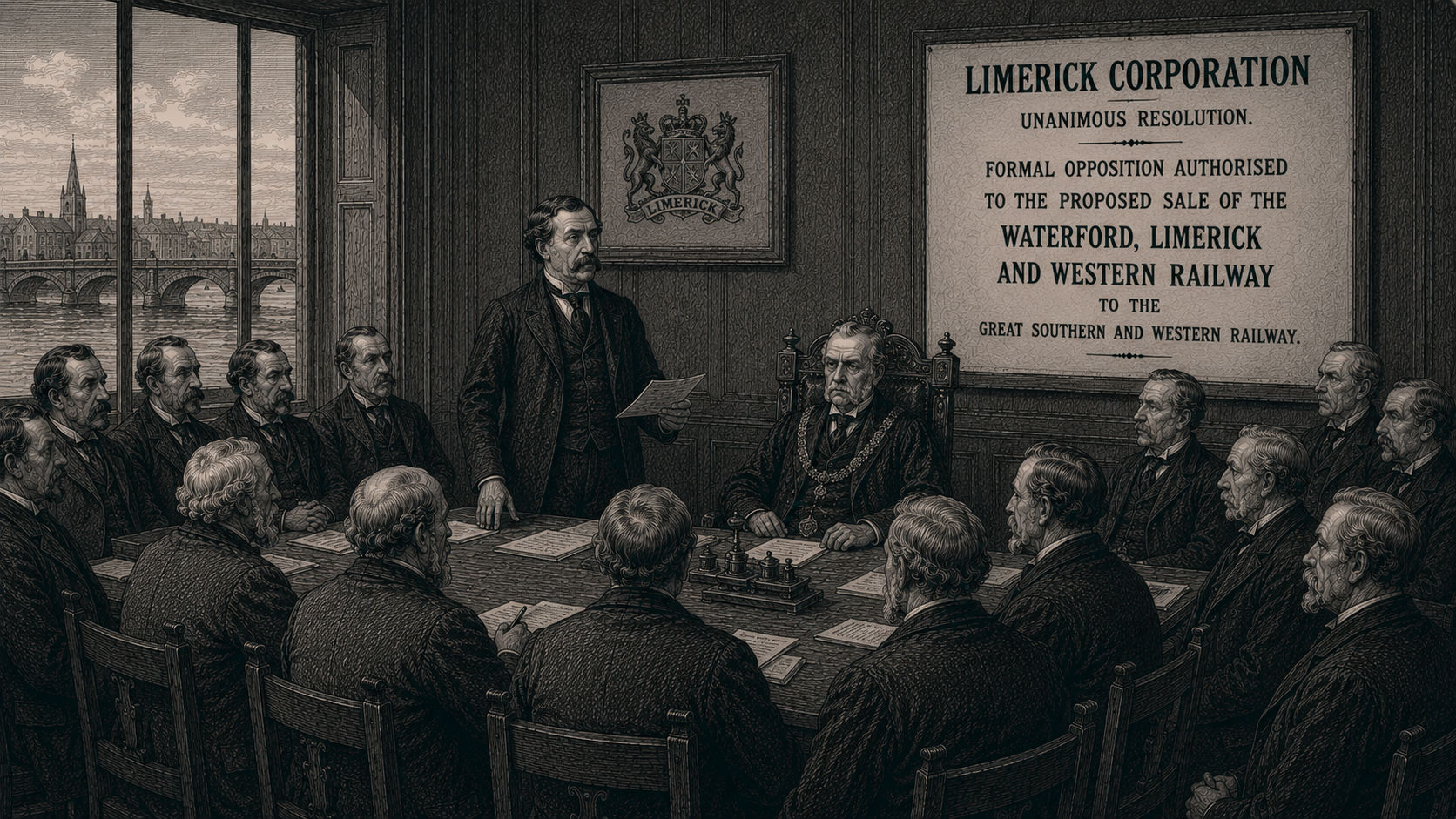
Read Article: Takeover OpposedLimerick Corporation unanimously authorised formal opposition to the proposed sale of the Waterford, Limerick and Western Railway to the Great Southern and Western Railway. At a special meeting reported on 5 January 1900, William L. Stokes, JP, moved that the Corporation’s solicitor be empowered to resist the scheme and take every necessary step on the city’s behalf. Councillor O’Brien seconded the motion. Several interested citizens attended beyond the council barrier, reflecting the strength of public concern surrounding the renewed amalgamation bill. The resolution was carried unanimously and received applause from those observing the proceedings.
The Corporation confined its decision to the Great Southern and Western proposal, rejecting a suggestion that the resolution should also cover a possible purchase by the Midland Great Western Railway or another company. Alexander Shaw, invited to address the meeting, argued that the new bill differed little from the unsuccessful measure promoted during 1899. He warned councillors against accepting promises and guarantees merely because they appeared reassuring in the company’s proposals. In his view, safeguards written into legislation might later prove ineffective, while the commercial consequences of surrendering an independent railway could endure for generations.
Opponents feared that absorption would strengthen the Great Southern and Western Railway’s control over transport throughout southern and western Ireland. The Waterford, Limerick and Western system connected Limerick with Waterford, Sligo, Tralee, Foynes and important agricultural districts. Its independence offered at least some competitive restraint upon freight charges, routes and commercial priorities. Corporation members were therefore concerned that a larger undertaking might favour Dublin or other ports, alter rates and direct traffic away from Limerick. The dispute involved more than railway ownership: merchants, harbour interests, workers and ratepayers believed the city’s future prosperity could be shaped by decisions made within a distant corporate headquarters.
John F. Power subsequently addressed the meeting in favour of amalgamation, demonstrating that opinion among prominent Limerick citizens was not entirely uniform. Supporters could point to the financial strength, integrated services and promised improvements available through a larger railway company. The Corporation nevertheless accepted the opposing case without a dissenting vote. Stokes claimed that an overwhelming majority of citizens resisted the sale, while Shaw urged cooperation with the Harbour Commissioners, chambers of commerce and other public bodies. Legal opposition would be costly, but councillors concluded that the expense was small compared with the losses the city might suffer under an effective railway monopoly.
The Corporation’s campaign did not ultimately prevent the takeover. Parliamentary debate continued through the summer, with opponents warning that amalgamation would extinguish useful competition and supporters arguing that the Waterford, Limerick and Western Railway lacked the strength to compete effectively. The Great Southern and Western and Waterford, Limerick and Western Railways Amalgamation Act received approval in August 1900, and the absorption took effect at the beginning of 1901. Limerick Corporation’s unanimous resolution nevertheless recorded a determined municipal defence of local commercial independence, placing the elected city authority alongside harbour and business interests resisting railway concentration.
- Irish Times, “Waterford Railway Purchase: Action of Limerick Corporation,” 5 January 1900, p. 3.
- Limerick Corporation Council minutes, January 1900, Limerick Corporation Collection, Limerick Archives.
- House of Commons Debates, “Great Southern and Western and Waterford, Limerick, and Western Railway Companies Amalgamation Bill [Lords],” 1 August 1900, vol. 87.
- Reports from the Joint Select Committee on the Great Southern and Western and Waterford, Limerick, and Western Railway Companies Amalgamation Bill, Parliamentary Papers, 1900, paper 196, vol. X.
- Great Southern and Western and Waterford, Limerick and Western Railways Amalgamation Act 1900, 63 & 64 Vict., c. ccxlvii.
- Limerick Harbour Commissioners Collection, IE LA P2, board and secretary records concerning opposition to railway amalgamation, Limerick Archives.
- Gerard Hannan, “Limerick — January 1900,” transcription and source notes reproducing the Corporation proceedings and identifying the Irish Times report of 5 January 1900.
-
Roads Conflict
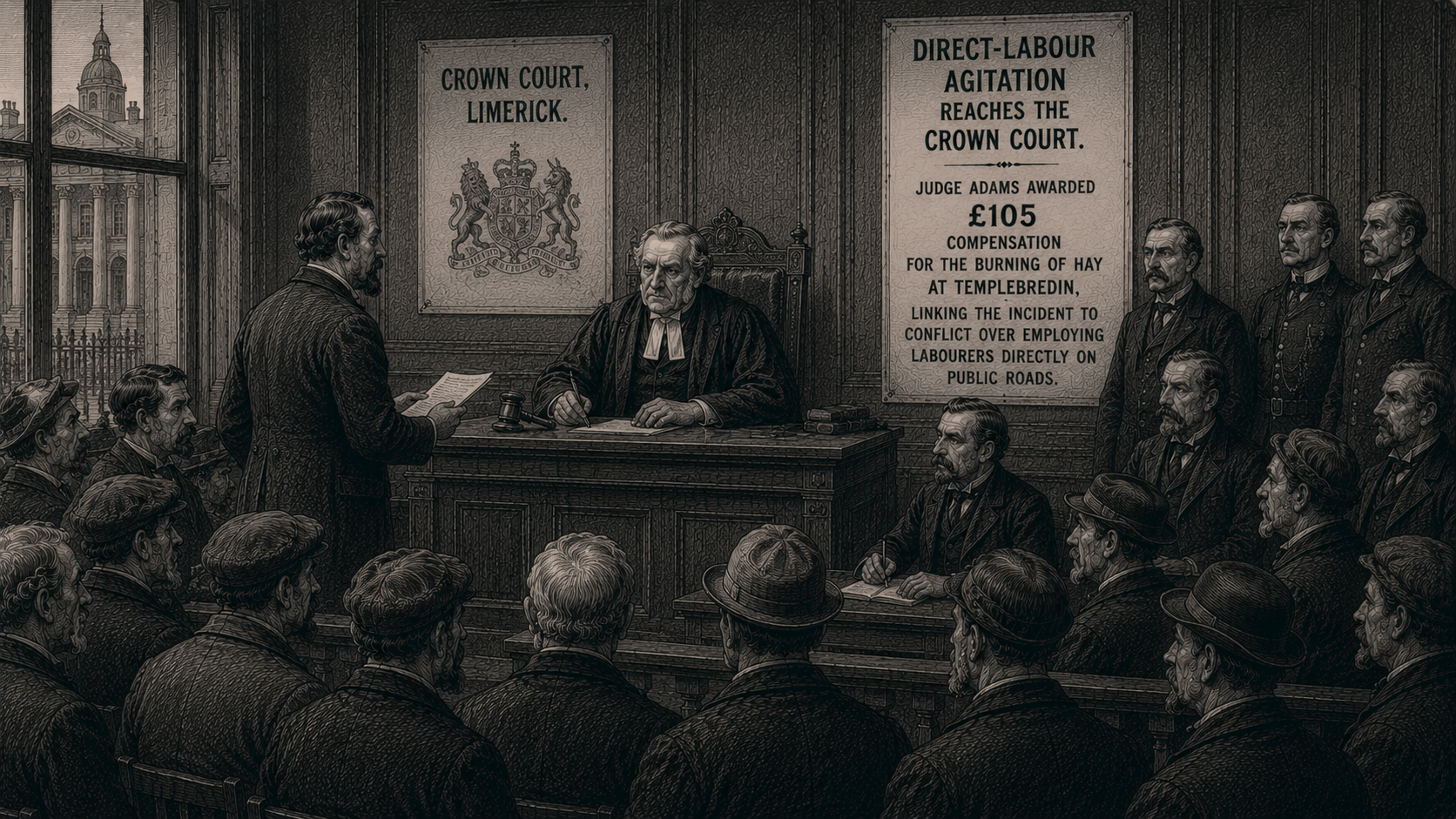
Read Article: Roads ConflictJudge Richard Adams awarded £105 compensation at Limerick County Crown Court for hay maliciously burned at Templebredin on the night of 6 December 1899. The claimant, T. M. English, had sought £116 for the destroyed property and argued that hostility arose from his position during a dispute over the maintenance of public roads. Evidence presented to the court connected the burning with an increasingly bitter campaign for the direct employment of labourers by the newly established local authorities. The case brought a rural employment controversy from council meetings into the formal machinery of criminal injury compensation.
English told the court that he had supported a limited experiment rather than the complete abandonment of road contractors. His proposal was that labourers should maintain half of the main roads for twelve months, allowing the council to compare the expense with the established contracting system. The remaining main roads and smaller roads would continue under contractors. At a district council meeting, however, labourers accompanied by a band and banners reportedly interrupted proceedings, groaned and hooted while English attempted to speak, and allowed one campaigner who was not a council member to address the gathering.
The claimant further alleged that two labourers later attempted to assault him while he was returning from Old Pallas Fair. The destruction of his hay followed soon afterwards, completing what the prosecution presented as an escalation from public obstruction to intimidation and malicious damage. Judge Adams accepted that the crime arose from the direct-labour agitation, though the surviving report does not identify the individuals responsible for setting the fire. His remarks were sharply hostile towards the conduct described in court, and he called for stronger protection of district councils when crowds attempted to disrupt their lawful proceedings.
Adams placed the compensation charge upon County Limerick at large rather than upon the immediate locality. He explained that he would have imposed the burden locally had evidence shown that neighbouring ratepayers supported or assisted the intimidation, but no such proof had been offered. The decision meant that the financial consequence of the burning would be shared through county taxation. It also distinguished ordinary ratepayers and elected councillors from the labourers whom the judge blamed for the agitation, although he criticised the local authorities for what he regarded as timidity in responding to organised pressure.
The case exposed the tensions created by the transfer of road administration to elected county and district councils under the Local Government Act of 1898. Direct labour offered rural workers the prospect of wages controlled through public bodies rather than private contractors, while farmers and ratepayers worried about costs, supervision and political pressure. A related County Council decision permitted roads lacking acceptable tenders to be placed under the county surveyor and worked directly by labourers. The Templebredin burning therefore arose during a wider struggle over employment, local democracy and control of public expenditure in the first years of the new system.
- Irish Times, “The Direct Labour Agitation: Strong Remarks by Judge Adams,” 5 January 1900, p. 2.
- Irish Times, “Limerick County Council and the Roads,” 5 January 1900, p. 3.
- Irish Times, “The Direct Labour Question,” 18 January 1900, p. 6.
- Local Government (Ireland) Act 1898, 61 & 62 Vict., c. 37.
- County Officers and Courts (Ireland) Act 1877, 40 & 41 Vict., c. 56.
-
Kincora Committees
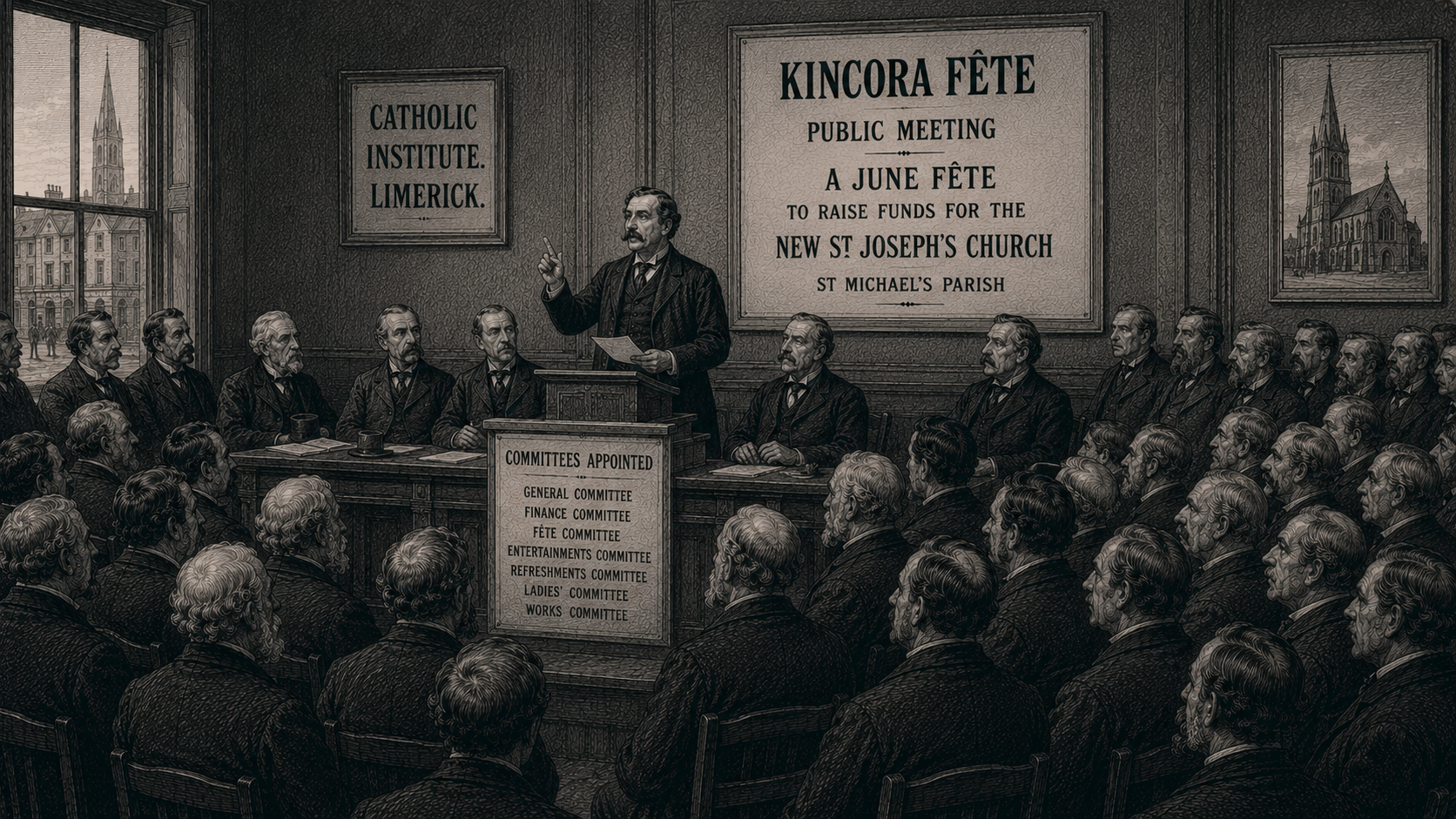
Read Article: Kincora CommitteesA large public meeting assembled in the Lecture Hall of Limerick’s Catholic Institute to organise a fête and fancy fair for the new church of St Joseph then rising within St Michael’s Parish. The gathering, reported on 4 January 1900, was promoted by the parish clergy and presided over by Bishop Edward Thomas O’Dwyer. Clergy, women and men attended in considerable numbers, demonstrating broad interest in completing the additional parochial church. The meeting agreed that the fundraising celebration would take place in June and established committees to undertake the detailed work required before the event could open.
The proposed church was intended to serve the extensive population of St Michael’s, which reached from central Limerick towards Ballinacurra. Bishop O’Dwyer and the parish clergy had decided in 1897 that an auxiliary church was necessary, and a site on Military Road was donated by Mr Byrnes. William Edward Corbett supplied the design, while John Ryan and Sons became the builders. Construction had advanced sufficiently for the organisers to confront the remaining financial burden. The fête was therefore conceived not as a minor parish entertainment but as a major city fundraising effort supporting an important addition to Limerick’s Catholic infrastructure.
The Reverend Father O’Donnell explained that the organisers had first ensured that their plans would not conflict with a proposed hospitals fête. Only after the hospital committees indicated that they would not stage such an event during the year did the parish proceed. June was selected partly to avoid competition with other public attractions and because the celebrated Limerick tenor Joseph O’Mara had offered to keep himself available to assist. Father O’Donnell also welcomed promised support from Protestant citizens, presenting the undertaking as an opportunity for cooperation extending beyond the congregation that would eventually worship in the new church.
Letters supporting the project were received from several people unable to attend, including Count Moore, who offered a prize. The meeting created a number of organising committees charged with preparing the entertainment, stalls, subscriptions, publicity and other arrangements. The celebration was named the Kincora Fête, drawing upon the royal residence traditionally associated with Brian Boru and giving the undertaking a recognisably Irish cultural character. The choice reflected the elaborate themes commonly adopted by large charitable fêtes, which relied upon spectacle, music, performances and carefully decorated attractions to encourage repeated attendance and generate substantial income.
The preparations culminated in the Kincora Fête at the Markets Field in June 1900. Cardinal Michael Logue formally opened the celebration, and a large choir performed under the direction of Vincent O’Riordan. Advertised attractions included the cinematograph, then still a striking novelty for many Irish audiences. The fête proved financially successful and strengthened the fund for St Joseph’s, although construction continued beyond that summer and the church was not formally opened until April 1904. The January meeting had nevertheless created the organisational structure that transformed a parish need into one of Limerick’s largest public fundraising enterprises of the year.
- Freeman’s Journal, “Proposed Fete in June,” 4 January 1900, p. 6.
- St Joseph’s Parish, St Joseph’s Parish: A History, pp. 13–14, account of the decision to build the church, its financing and the Kincora Fête of June 1900.
- Denis Condon, Early Irish Cinema, 1895–1921, Dublin: Irish Academic Press, 2008, pp. 22–23, identifying the cinematograph among the attractions advertised for Limerick’s Kincora Fête, 4–9 June 1900.
- St Joseph’s Parish, “Parish History,” account of the church’s construction as a chapel of ease for St Michael’s Parish, its architect William Edward Corbett and builders John Ryan and Sons.
- Patrick Comerford, “Saint Joseph’s, a Limerick Church that Features in Angela’s Ashes,” 13 January 2018, architectural and historical account of St Joseph’s Church.
-
Sessions Rejected
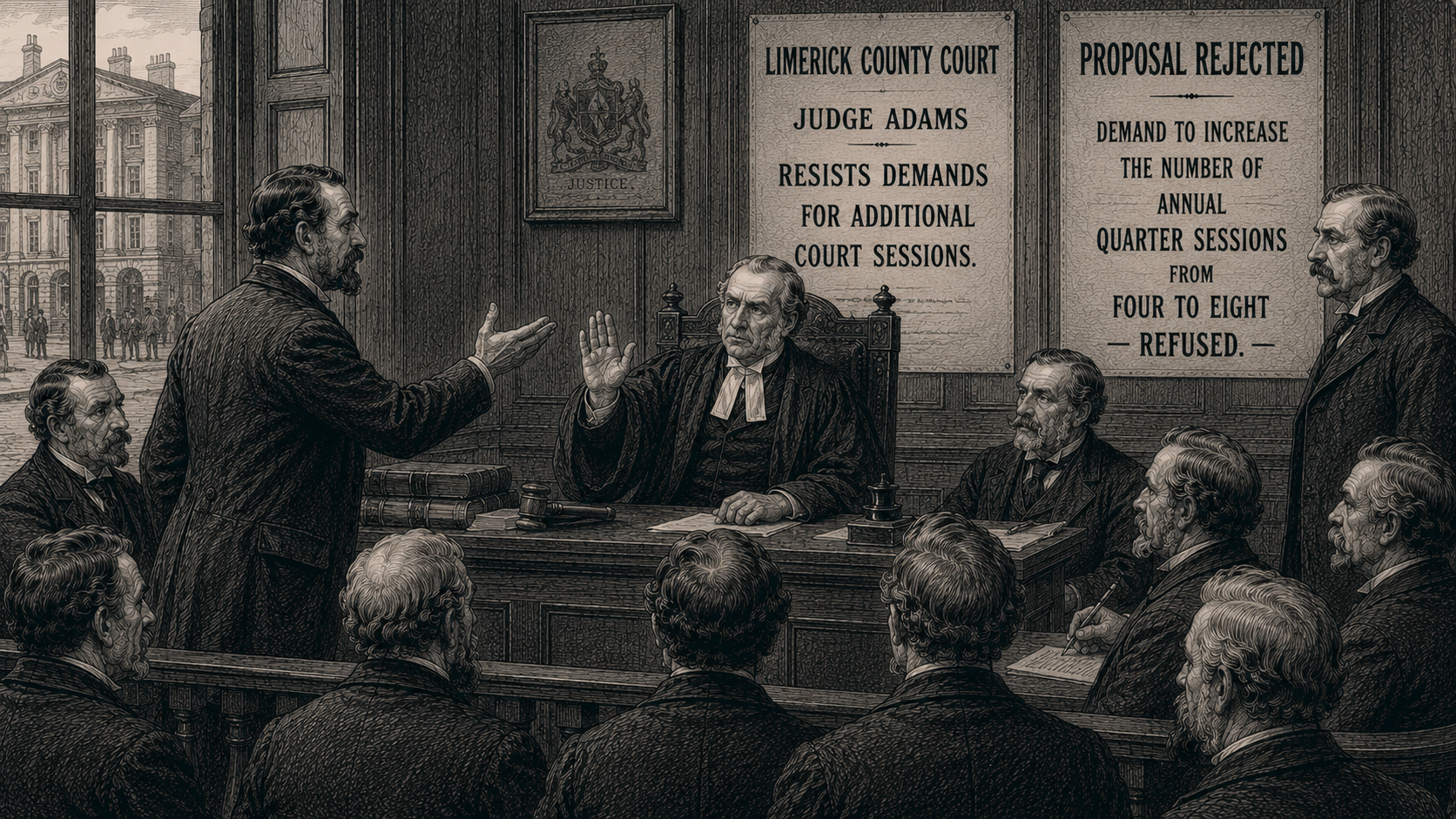
Read Article: Sessions RejectedJudge Richard Adams firmly resisted a proposal to double the number of annual Quarter Sessions held in Limerick from four to eight. At the opening of the Hilary sittings, reported on 3 January 1900, the County Court judge asked whether any members of the legal profession present supported the suggested increase. Receiving no affirmative response, he declared that the demand did not come from local barristers, solicitors or the wider public. Adams presented the proposal as the work of a small deputation seeking attention rather than as a reform arising from demonstrated pressure upon the court.
The Limerick County Court combined civil jurisdiction with the judge’s responsibilities as chairman of Quarter Sessions. These sittings dealt with civil bills and criminal business beyond the lesser matters heard at Petty Sessions, making their frequency important to litigants, witnesses, solicitors and court officials. Four annual sessions followed the traditional quarterly pattern. Supporters of additional sittings could argue that more frequent courts might reduce delays and distribute legal business more evenly, but Adams questioned whether Limerick possessed either the workload or the professional demand necessary to justify doubling the established schedule.
Adams referred sarcastically to efforts made before the Lord Chancellor and contrasted Limerick with Galway, where the Recorder had reportedly agreed to conduct eight sessions annually. His remarks displayed the independence and humour for which he became well known, but they also asserted a serious constitutional position. He maintained that he would not hold more than four sessions unless compelled by legislation. Even if Parliament attempted such a change, he suggested that opposition would be organised in both Houses. The judge therefore treated the proposed reform as an intrusion requiring statutory authority rather than an informal administrative adjustment.
The disagreement mattered directly to Limerick people whose property disputes, debts, compensation claims, tenancy matters and criminal cases entered the County Court system. Additional sessions might have offered earlier hearing dates, yet they would also have required more jurors, officials, legal attendance and public expenditure. The absence of support voiced by the professionals present strengthened Adams’s contention that the existing arrangement remained adequate. His response also exposed tension between local judicial experience and reform campaigns conducted through deputations to Dublin, where the Lord Chancellor exercised considerable influence over Irish court administration.
No immediate increase followed the confrontation, and the four-session arrangement remained the position defended by Adams. The episode offers a revealing picture of Limerick’s legal world at the beginning of the twentieth century: a powerful local judge, a courtroom attentive to public controversy and a central administration attempting to consider changes across different Irish towns. Adams’s refusal was characteristically outspoken, but it rested upon his claim that reform should answer a genuine public or professional need. Until Parliament directed otherwise, he intended to preserve the established rhythm of justice in Limerick.
- Munster News, “Limerick Quarter Sessions: ‘Soldiers of the Queen’—An Epidemic of Window Breaking,” 3 January 1900; page not confirmed.
- National Archives of Ireland, Court Records Pre-1922, Courts of Crown and Peace, finding aids and records relating to Quarter Sessions and County Courts.
- County Officers and Courts (Ireland) Act 1877, 40 & 41 Vict., c. 56, governing County Court judges, Quarter Sessions and Civil Bill Courts in Ireland.
- Cork Examiner, 6 April 1908, obituary and career appreciation of Limerick County Court Judge Richard Adams.
-
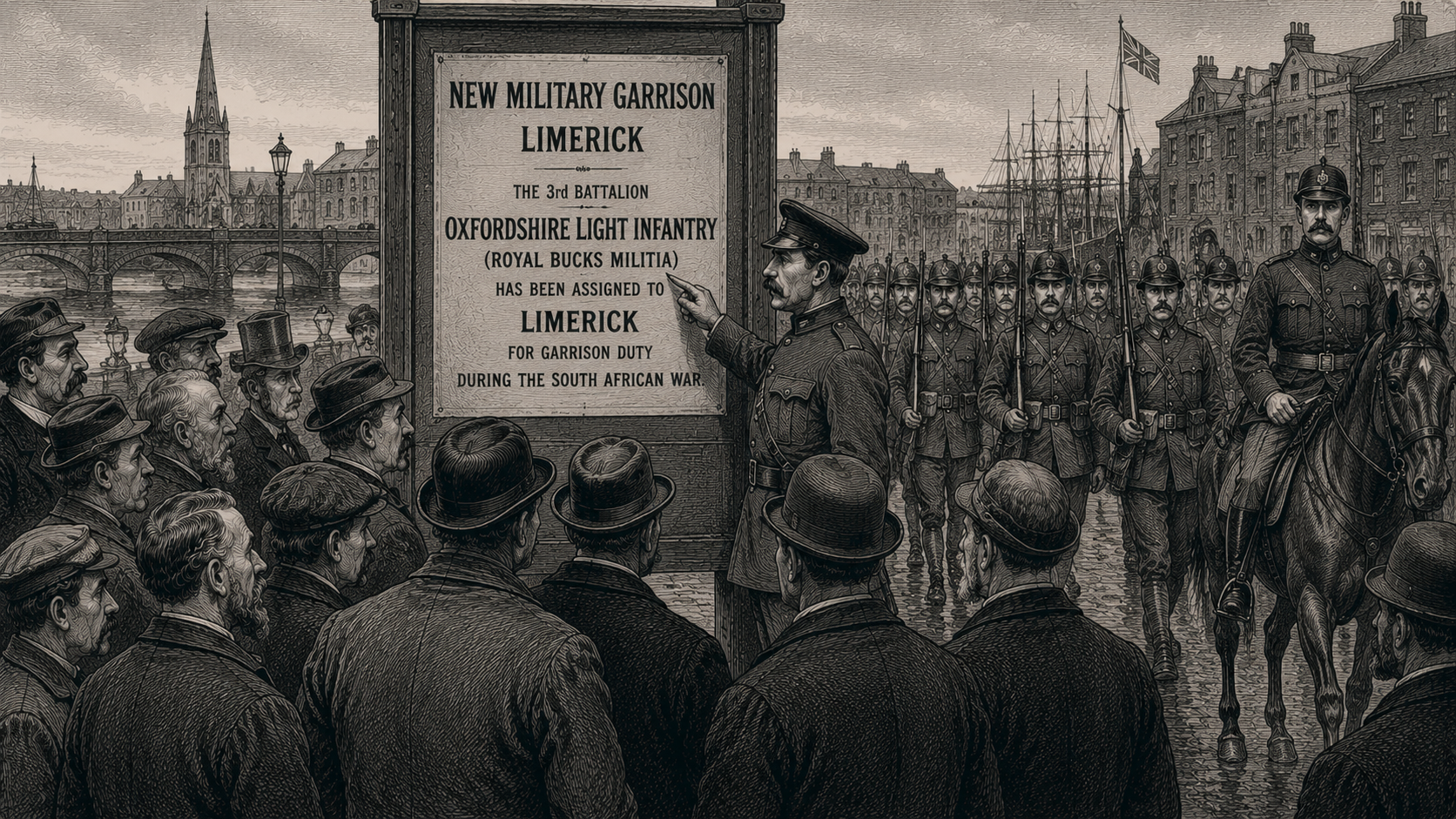
Garrison Announced
Read Article: Garrison AnnouncedA new military garrison was announced for Limerick on 2 January 1900, although the arrangement proved provisional. Contemporary reports stated that the 3rd Battalion, Oxfordshire Light Infantry, formerly the Royal Bucks Militia, would be embodied at High Wycombe and sent to Limerick for garrison duty during the South African War. The announcement also noted that the home details left behind by the regiment’s 1st Battalion, which had departed Aldershot for active service, had already reached the city. Within days, however, the proposed destination was altered, and the militia battalion was directed to Buttevant rather than Limerick.
The 3rd Battalion was not a regular-service formation but a militia unit attached to the Oxfordshire Light Infantry under the army reforms of 1881. Its older identity as the Royal Buckinghamshire Militia remained widely used, reflecting a history and recruiting base centred upon High Wycombe. Militia battalions were ordinarily raised for domestic defence, training and reinforcement rather than permanent overseas campaigning. The war in South Africa placed exceptional pressure upon the British Army, however, requiring auxiliary forces to assume duties at home and in Ireland while regular battalions were concentrated for service against the Boer republics.
For Limerick, the announcement demonstrated how a distant imperial war was reshaping the city’s military establishment. Barracks, railway facilities, supply arrangements and local services were required to accommodate troops passing through or replacing units dispatched overseas. The arrival of the Oxfordshire Light Infantry’s remaining details connected Limerick directly with a regiment preparing for active operations in South Africa. Soldiers stationed locally also affected civilian life through spending, transport requirements, discipline cases and relationships with employers and public institutions. Even an intended posting that was later changed required planning by military authorities and alerted the city to further wartime movements.
The revised order sent the Royal Bucks militiamen to Buttevant, County Cork, where they arrived after embodiment in January and joined a substantial concentration of auxiliary troops. They later trained at Kilworth before returning to Buttevant. During their service in Ireland, the battalion helped release regular soldiers for the war and supplied volunteers and reinforcement drafts to the 1st Oxfordshire Light Infantry in South Africa. The change of destination illustrates the speed with which War Office arrangements were revised during the early months of the conflict, when troop shortages and transport demands repeatedly altered previously announced plans.
Although the battalion itself did not take up the announced Limerick station, the episode remains significant within the city’s wartime history. It records Limerick’s place within the network of Irish garrisons used to sustain Britain’s overseas campaign and shows how regular and militia formations were redistributed to meet an emergency. The distinction between announcement and fulfilment is important: the Royal Bucks Militia was assigned publicly to Limerick, but the order was superseded before the battalion arrived. Limerick nevertheless received regimental personnel and remained affected by the broader movement of soldiers, reservists and military resources caused by the South African War.
- Irish Times, 2 January 1900, contemporary military report announcing the intended assignment of the 3rd Battalion, Oxfordshire Light Infantry, Royal Bucks Militia, to Limerick; page not confirmed.
- Daily Telegraph & Courier (London), 9 January 1900, report that the Royal Bucks Militia, previously intended for Limerick, would instead be stationed at Buttevant.
- Ian F. W. Beckett, Buckinghamshire: A Military History, Chapter Seven, “1899–1914,” Buckinghamshire Military Museum Trust, account of the battalion’s embodiment at High Wycombe on 17 January 1900 and subsequent service at Buttevant and Kilworth.
- The New Annual Army List, Militia List, and Yeomanry Cavalry List for 1900, entry for the Oxfordshire Light Infantry and its 3rd Battalion, Royal Bucks Militia.
- H. W. Base, The Regimental Records of the British Army, London: George Bell and Sons, 1901, entry for the Oxfordshire Light Infantry identifying the 3rd Battalion as the Royal Bucks Militia.
- War Office, Distribution of the British Army, May 1900, listing the 3rd Battalion, Oxfordshire Light Infantry, Royal Buckinghamshire Militia, as stationed in Ireland.
- House of Commons Debates, Army Supplementary Estimates, 1899–1900, 15 February 1900, vol. 79, discussion of militia mobilisation and the replacement of regular forces sent to South Africa.
-
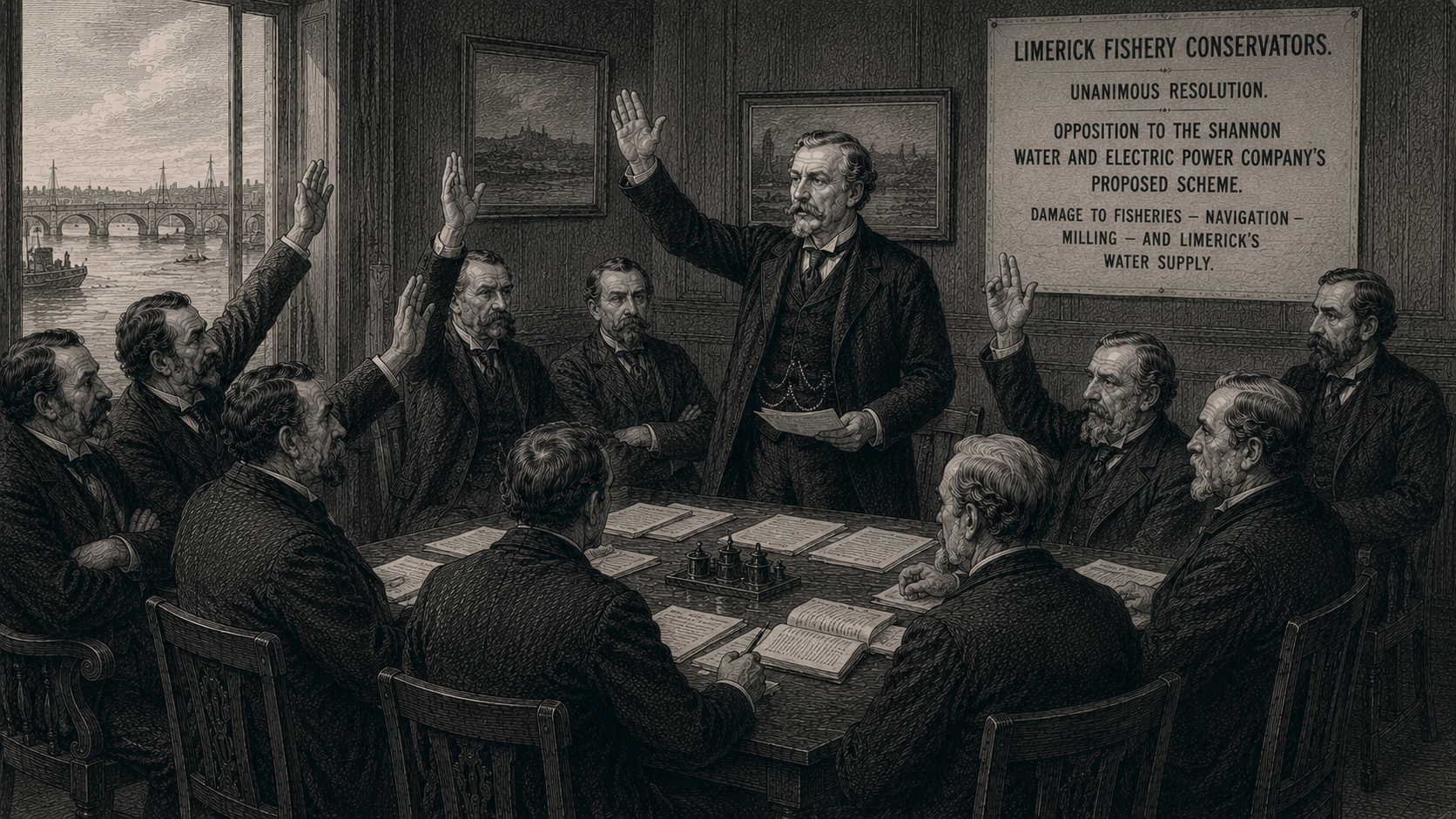
Shannon Defence
Read Article: Shannon DefenceOn 2 January 1900, the Limerick Fishery Conservators unanimously opposed the scheme promoted by the Shannon Water and Electric Power Company. Meeting under Lord Massy’s chairmanship, the members viewed the proposed parliamentary bill as a direct threat to interests dependent upon the river. Their objections extended beyond salmon fishing to navigation, milling and the public water supply of Limerick. The Conservators feared that private promoters seeking to harness the Shannon for electricity might secure broad powers before the consequences for existing river users had been fully investigated or adequately protected.
The company proposed to employ Shannon water for generating electrical power near Limerick, presenting the undertaking as a means of reducing industrial dependence upon costly imported coal. Parliamentary descriptions later placed the principal generating works at Clonlara and envisaged supplying electricity to factories, mills, tramways, public authorities and other consumers within a wide surrounding district. Supporters argued that unused water power could encourage manufacturing and employment. The Conservators did not reject electricity itself, but questioned whether the promised economic benefits justified altering water levels and flows upon which fisheries, transport, businesses and communities already relied.
Fishery representatives warned that changes to the river and Lough Derg could obstruct salmon moving towards tributaries and spawning grounds. Members also feared that a substantial lowering of water levels would damage quays, interfere with navigation and reduce the supply available to mills and factories below the lake. Limerick’s municipal water arrangements created a further concern, since any alteration affecting the river near the city’s intake could carry serious public consequences. The objections reflected the Shannon’s multiple roles as a fishery, navigable route, industrial resource and source of water rather than treating it merely as potential electrical power.
The Conservators resolved to bring their opposition before the Chief Secretary for Ireland and the Commissioners of Public Works, whose responsibilities included Shannon navigation and drainage. Copies were also to be sent to Limerick Corporation, parliamentary representatives and local authorities throughout counties connected with the river system. The Board of Works indicated that it would protect its statutory interests, while warning that other affected parties might need to act independently. This response reinforced the Conservators’ belief that fishery owners, millers, riparian proprietors, navigational users and municipal authorities required a coordinated campaign if their separate interests were to receive effective parliamentary protection.
The opposition did not immediately defeat the promoters. The bill proceeded through Parliament, where critics again warned of possible injury to fisheries and navigation, while supporters claimed that safeguards would preserve sufficient river flow. The Shannon Water and Electric Power Act received royal assent in July 1901, although the projected works were not completed and the private scheme was eventually abandoned. The Conservators’ unanimous stand nevertheless marked an important early Limerick dispute over hydroelectric development. It revealed the difficult balance between industrial ambition and the protection of a river already sustaining employment, food, transport, milling and public services.
- Irish Times, “Shannon Water and Electric Power Company,” 2 January 1900, p. 7.
- Irish Times, “Limerick Fishery Conservators: The Shannon Water and Electric Power Bill,” 5 January 1900, p. 3.
- Irish Times, editorial concerning the Shannon Water and Electric Power proposal, 6 January 1900, p. 4.
- Irish Times, “News from the Provinces: Shannon Water and Electric Power Syndicate,” 18 January 1900, p. 6.
- Limerick Fishery Board of Conservators Collection, IE LA P48, Limerick Archives.
- House of Lords Debates, “Shannon Water and Electric Power Bill,” 23 July 1900, vol. 86.
- Shannon Water and Electric Power Act 1901, 1 Edw. 7, c. cxxxvi, royal assent 26 July 1901.
- Commissioners of Public Works correspondence concerning the Shannon Water and Electric Power Bill, quoted at the Limerick Fishery Conservators’ meeting and reported in the Irish Times, 5 January 1900, p. 3.
-
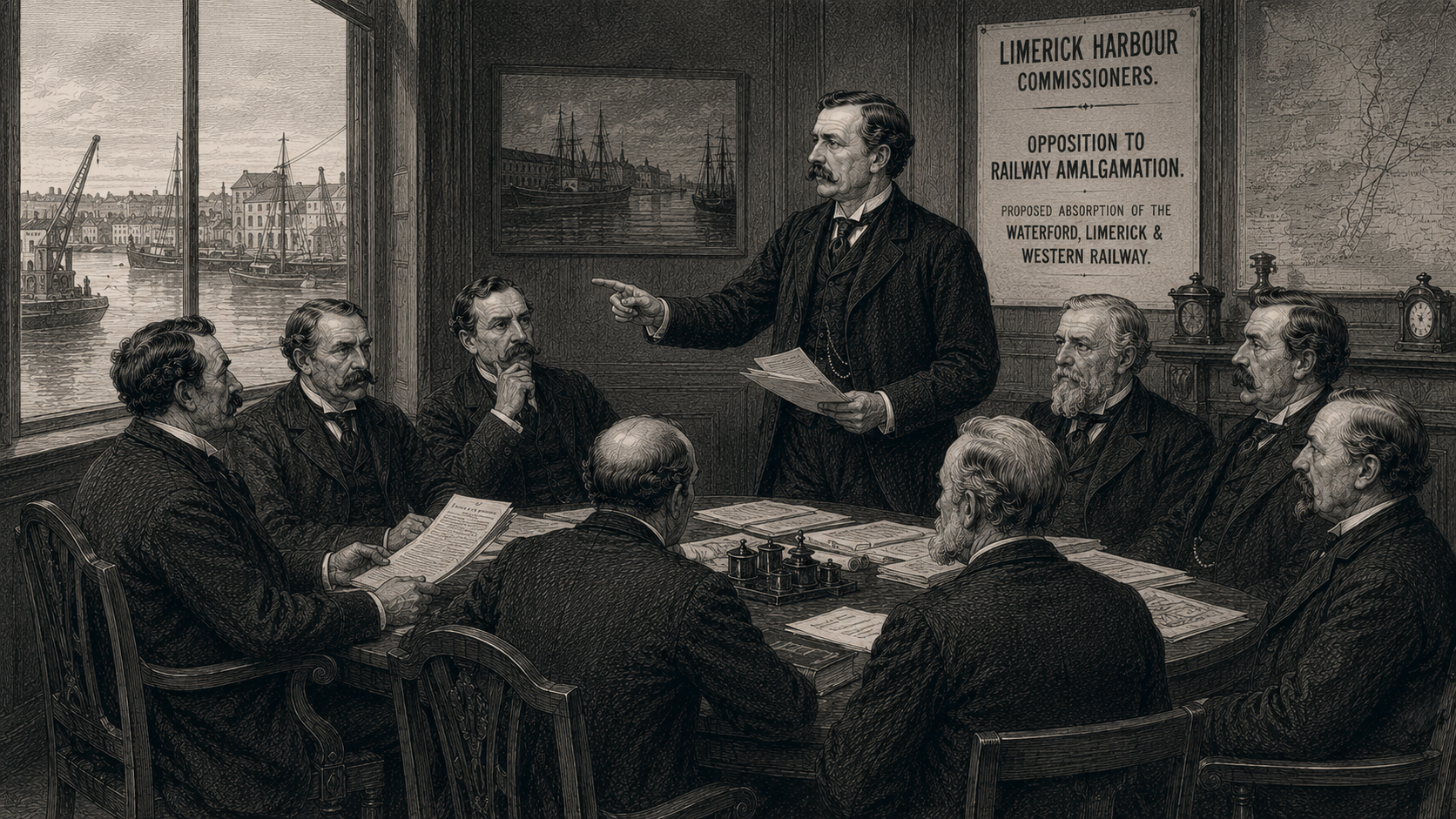
Railway Resistance
Read Article: Railway ResistanceOn 2 January 1900, the Freeman’s Journal reported that the Limerick Harbour Commissioners had again engaged Mr Fottrell, a Dublin solicitor, to organise opposition to the renewed railway amalgamation scheme. He was also instructed to retain senior counsel on the Commissioners’ behalf. The proposed arrangement would absorb the Waterford, Limerick and Western Railway into the larger Great Southern and Western Railway system. By appointing legal representatives before the parliamentary contest developed further, the Harbour Commissioners signalled that they regarded the scheme not as a private commercial transaction, but as a matter affecting the future prosperity of Limerick and its port.
The Waterford, Limerick and Western Railway provided a direct commercial artery between the Shannon and the south-east, while its branches connected Limerick with important agricultural and trading districts across the west. Opponents feared that amalgamation would remove one of the few substantial competitors to the Great Southern and Western Railway. Parliamentary debate had already highlighted the reductions in freight charges produced by competition on routes serving Limerick, Tuam, Thurles, Tralee and the Fergus district. Harbour interests consequently worried that a dominant railway company might increase rates, redirect traffic or favour routes and ports better suited to its wider corporate strategy.
The Commissioners’ intervention reflected the close relationship between rail transport and the working life of Limerick Harbour. Grain, livestock, provisions, coal and manufactured goods depended upon reliable connections between the docks, merchants, inland producers and distant markets. A railway monopoly could influence not only the price of carriage but the volume and direction of trade reaching the quays. Local merchants and public representatives therefore viewed railway competition as protection for employment, shipping and commercial independence. Their opposition was shared by other Limerick bodies, including the Corporation and County Council, although individual businessmen and commissioners differed over the merits of the proposed sale.
Retaining a Dublin solicitor and senior counsel transformed local resistance into an organised parliamentary campaign. The Commissioners required legal advice, statistical evidence and representation capable of challenging a private bill promoted at Westminster. Their expenditure later became controversial when the Irish Board of Works warned them against incurring further costs without authority. On 8 March 1900, Patrick O’Brien raised the matter in the House of Commons, arguing that the Harbour Commissioners should remain free to oppose legislation affecting Limerick. The Treasury acknowledged that their finances had recently been kept within revenue, while maintaining that the legality of the expenditure remained relevant.
The opposition ultimately failed to prevent amalgamation. Parliament passed the Great Southern and Western and Waterford, Limerick and Western Railways Amalgamation Act in August 1900, and the smaller company lost its independent existence at the beginning of 1901. The Harbour Commissioners’ decision nevertheless demonstrated how seriously Limerick regarded the danger of railway concentration. Their campaign joined commercial self-interest with a broader defence of competition across southern and western Ireland. By retaining legal specialists at the outset, the board ensured that the city’s concerns about freight charges, harbour traffic and economic dependence would be formally presented during the parliamentary struggle.
- Freeman’s Journal, “The Railway Amalgamation Proposals: Action of Limerick Harbour Commissioners,” 2 January 1900, p. 6.
- Limerick Harbour Commissioners Collection, IE LA P2, Board and Secretary records, including minute books P2/1/1–28, Limerick Archives.
- House of Commons Debates, “Irish Railway Amalgamation—Limerick Harbour Commissioners,” 8 March 1900, vol. 80.
- House of Commons Debates, “Great Southern and Western and Waterford, Limerick, and Western Railway Companies Amalgamation Bill,” 1 August 1900, vol. 87.
- Reports from the Joint Select Committee on the Great Southern and Western and Waterford, Limerick, and Western Railway Companies Amalgamation Bill, Parliamentary Papers, 1900, paper 196, vol. X, p. 19.
- Great Southern and Western and Waterford, Limerick and Western Railways Amalgamation Act 1900, 63 & 64 Vict., c. ccxlvii.
- Irish Times, “Limerick Corporation Railway Amalgamation Question,” 24 January 1900, p. 3.
- Irish Times, “Southern Railway Amalgamation Scheme,” 29 January 1900, p. 6; 30 January 1900, p. 7.
-
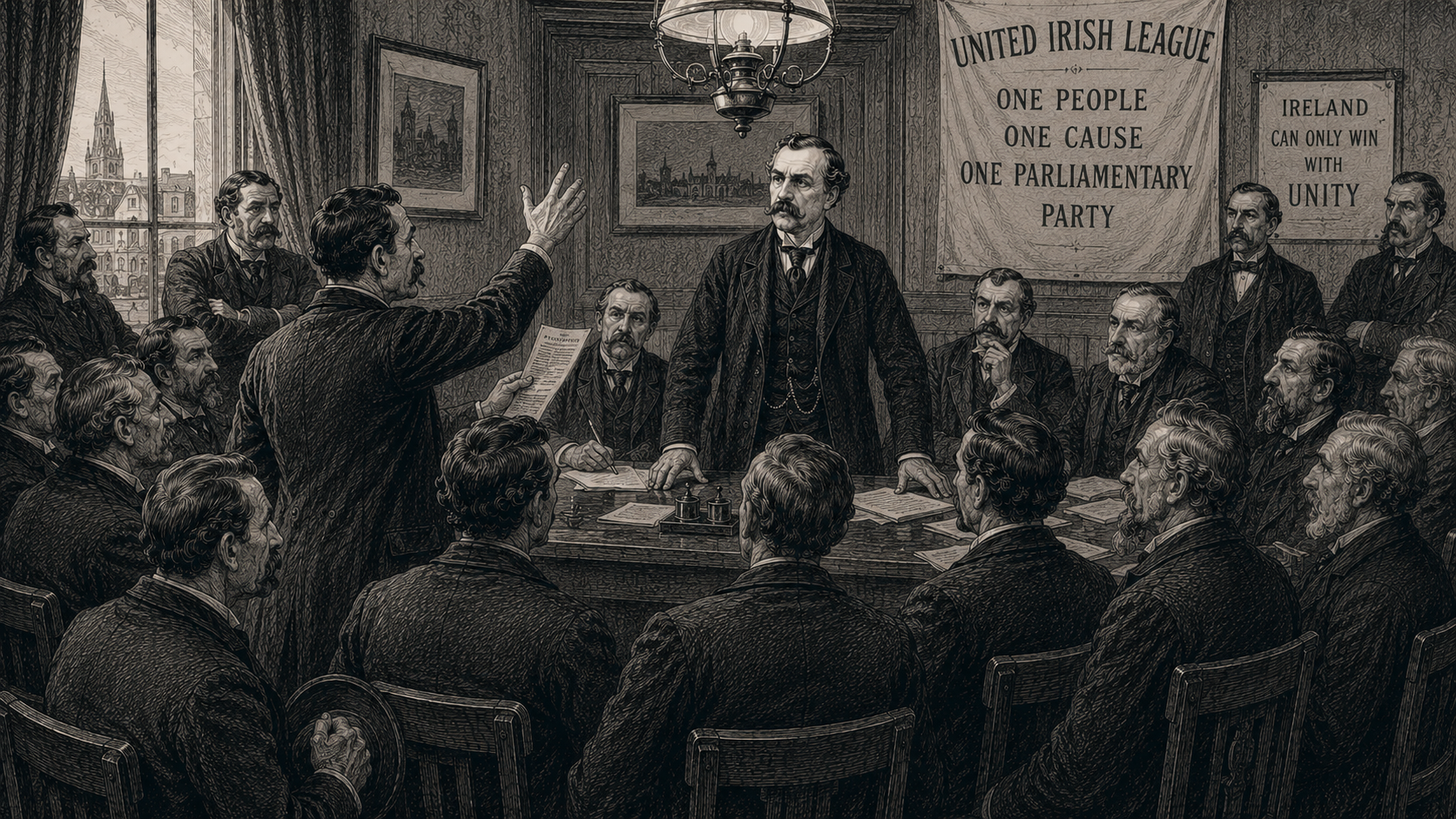
Branches Demand
Read Article: Branches DemandUnited Irish League branches pressed nationalist MPs to place national unity above personal disagreement as the organisation expanded during 1899. Founded at Westport in January 1898, the League combined agrarian agitation with a campaign to reconstruct the divided parliamentary movement. Local meetings and resolutions allowed tenant farmers, organisers and constituency workers to express impatience with leaders whose rivalries had weakened Irish representation since the fall of Charles Stewart Parnell. Branches possessed no constitutional power to command MPs, but their subscriptions, electoral labour and influence over candidate selection gave their appeals a force that Westminster politicians could not safely dismiss.
The demand for reunion was directed towards several competing groups. John Redmond led the principal Parnellite body, John Dillon dominated much of the anti-Parnellite majority, and Timothy Healy retained an independent following shaped by localism and personal hostility towards former allies. William O’Brien used the United Irish League to argue that these distinctions had become less important than the need for an effective national organisation. Resolutions favouring unity placed moral and electoral pressure upon representatives to accept common discipline. They also warned that members who prolonged factional conflict might face opposition from candidates supported by the growing network of League branches.
The branch campaign joined political unity to the practical needs of rural Ireland. League supporters demanded enlarged holdings, restoration of evicted tenants and stronger action against the concentration of grazing land, but such objectives required coordinated parliamentary pressure. A divided group of Irish MPs could be ignored, outmanoeuvred or courted separately by British parties. Local resolutions therefore treated reunion not as an act of personal forgiveness, but as the necessary machinery through which land reform and Home Rule might be pursued. The movement’s strength rested upon its ability to turn dissatisfaction in villages and market towns into instructions addressed directly to elected representatives.
The argument had a defensible connection to Limerick, where political participation broadened significantly during the first local elections held under the Local Government (Ireland) Act of 1898. Limerick City’s municipal electorate rose from 709 to 5,521, while elected county and rural bodies replaced institutions previously dominated by property and appointment. The surviving evidence does not establish which Limerick League branches passed particular reunion resolutions during this campaign. Nevertheless, nationalist MPs representing the city and county operated within a political culture increasingly shaped by organised voters who expected land, housing, public works and Home Rule to receive disciplined parliamentary representation.
The accumulated pressure helped bring the rival parliamentary sections together in Committee Room 15 at Westminster on 30 January 1900. John Redmond became chairman of the reunited Irish Parliamentary Party, although the agreement did not remove the tensions among Redmond, Dillon, Healy and O’Brien. League branches had succeeded in making continued division politically dangerous, but reunion opened another dispute over whether authority belonged primarily to MPs or to the organisation sustaining them in the constituencies. The settlement restored outward unity and coordinated representation, while confirming that local branches and ordinary supporters had become active participants in determining the direction of constitutional nationalism.
- Freeman’s Journal, 18 April 1899.
- Freeman’s Journal, 6 May 1899.
- Freeman’s Journal, 20 May 1899.
- Freeman’s Journal, 22 May 1899.
- Freeman’s Journal, 3 August 1899.
- Mayo News, 15 April 1899.
- The Times, 12 April 1899.
- Michael Davitt to William O’Brien, 6 April 1899, National Library of Ireland, MS 913, ff. 621–623.
- McInerney to William O’Brien, 3 and 6 May 1899, William O’Brien Papers, University College Cork, AJB.9 and AJB.11.
- John Dillon to William O’Brien, 1 June 1899, National Library of Ireland, MS 8555/11.
- T. P. O’Connor to John Dillon, 18 September 1899, John Dillon Papers, Trinity College Dublin, MS 6740/56.
- Philip Bull, “The United Irish League and the Reunion of the Irish Parliamentary Party, 1898–1900,” Irish Historical Studies, vol. 26, no. 101, May 1988, pp. 51–78.
- Local Government (Ireland) Act 1898, 61 & 62 Vict., c. 37.
- Martin Walsh, Limerick Local Government 1899–1942: An Online Exhibition Commemorating the 125th Anniversary of the Local Elections, 1899, Limerick Museum and Limerick Library Service, 2024.