
Year by Year
Explore Year by Year articles from the most modern historical year back to the oldest.
3,294 Articles Archived

Catholic Petition
Archived: 11 October 2026
In 1805, Irish Catholics petitioned Westminster for equal political rights after the Union abolished Dublin’s parliament. Introduced by Charles James Fox and Lord Grenville, the loyal, constitutional appeal sought admission to Parliament and major offices, while rejecting papal temporal authority and threats to the Protestant establishment. Parliament decisively rejected it, exposing Catholic exclusion and establishing a pattern of failed emancipation campaigns until 1829. The state simultaneously transported Wicklow insurgent Michael Dwyer and companions to New South Wales. Ireland shared in Napoleonic war’s consequences after Trafalgar, while cultural life included Mary Tighe’s Psyche, William Rowan Hamilton’s birth, and Brian Merriman’s death.
Grand Canal
Archived: 11 October 2026
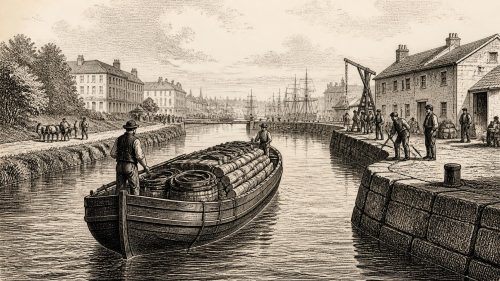
In 1804, Ireland remained shaped by the legacy of 1798, the Union and war with France. James Corcoran’s guerrilla band was destroyed near Enniscorthy, while transported Irish prisoners invoked Vinegar Hill during the failed Castle Hill rebellion in New South Wales. Invasion fears prompted a gun tower at Sutton and Edgeworth’s short-lived Dublin–Galway semaphore. Economic integration advanced when The Ranger completed the commercial Grand Canal passage from the Shannon to Dublin. Cork Street Fever Hospital admitted its first patients, providing isolation and care in the Liberties. These developments reveal governance, defence, infrastructure and philanthropy amid unresolved political and social grievances.

Robert Emmet
Archived: 11 October 2026
In 1803, amid post-Union discontent and renewed war with France, Robert Emmet organised a United Irish-inspired attempt to seize Dublin Castle and establish a provisional government. Conspirators produced pikes and explosives, while Anne Devlin carried messages, but weak coordination, limited firearms and absent regional support undermined the plan. On 23 July, the Thomas Street rising collapsed into confused violence; Lord Chief Justice Kilwarden and his nephew were murdered. Emmet was arrested, tried and executed, while Devlin and other suspects faced repression. Though militarily insignificant, the failure strengthened coercive government and preserved republican ideals of independence, popular sovereignty and inclusive citizenship.
Dublin Floods
Archived: 11 October 2026
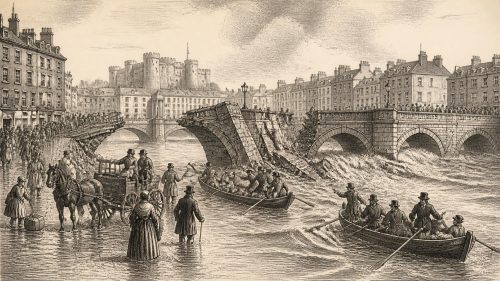
In 1802, Ireland adjusted to Union government as its first Westminster election exposed restricted representation and Catholic exclusion. The Treaty of Amiens briefly eased fears of French intervention, yet official vigilance persisted and Robert Emmet’s return signalled surviving revolutionary ambition. Social initiatives addressed poverty and disease: Edmund Rice began educating poor Catholic boys in Waterford, Cork opened a fever hospital, Dublin’s dispensary aided the poor, and Belfast’s library gained Linen Hall premises. In December, torrential rain flooded Dublin, bursting rivers and destroying Ormond Bridge. These events revealed a society experiencing constitutional change, unresolved grievances, voluntary reform, urban hardship and vulnerability.

Union Enacted
Archived: 11 October 2026
In 1801 the Act of Union abolished Ireland’s parliament and incorporated the kingdom into the United Kingdom, while Dublin Castle and local administration remained. Ireland received limited Westminster representation, dominated by property and borough influence. Catholic hopes of emancipation collapsed after George III’s opposition, strengthening the established Protestant church and prompting ministerial resignations. Lord Hardwicke became lord lieutenant amid fears after the 1798 rebellion. United Irishman James Napper Tandy, condemned for treason, was pardoned and spared execution. Food scarcity, high prices and uneven relief burdened households. Fiscal and trade integration proceeded gradually, while officials envisaged Ireland within an imperial framework.
Acts Union
Archived: 11 October 2026
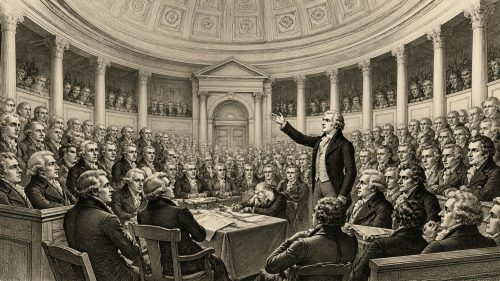
In 1800, Ireland remained a separate kingdom with its own parliament, courts and administration, but the Acts of Union passed in Dublin and London, ending its legislature from 1 January 1801. Cornwallis and Castlereagh secured support amid patronage, compensation and opposition led by Henry Grattan. The Union transferred limited Irish representation to Westminster, preserved the established Protestant church, and left Catholic emancipation unresolved. Post-rebellion repression continued, including Roddy McCorley’s execution, while food scarcity prompted controls on distilling and exports. Parliament also regulated trade, institutions and local improvements. Dublin retained political activity yet faced loss of its resident legislature and disruption.
Union Defeat
Archived: 11 October 2026
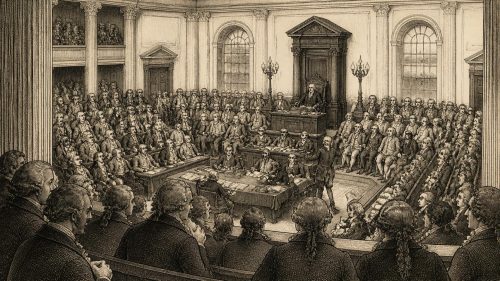
In 1799, post-rebellion Ireland remained militarised and insecure as Cornwallis and Castlereagh sought legislative union with Great Britain. Their proposal was defeated in the Commons, where Speaker John Foster led a narrow anti-union majority, although the Lords approved it. Public celebrations reflected resistance, but the unrepresentative Dublin parliament excluded Catholics. During the pause, government prepared to rebuild support through patronage. Courts martial, disturbed-district proclamations, prosecutions and transportation continued, tempered by Cornwallis’s commutations. Catholic bishops considered state oversight of appointments, while lay Catholics opposed union. Autumn rains damaged potatoes, raising subsistence fears amid wartime financial disruption. Ireland nevertheless faced constitutional change.
Irish Rebellion
Archived: 11 October 2026
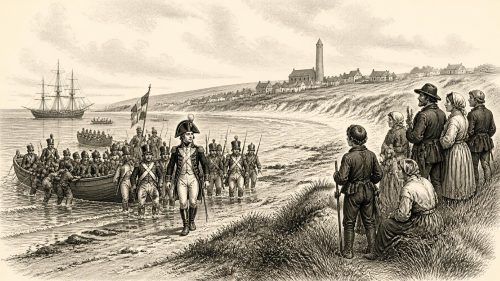
In 1798, the United Irishmen attempted a national revolution against British rule, seeking a representative Irish republic uniting Catholics, Presbyterians and reforming Anglicans with French support. Arrests, coercion and weak coordination fragmented the rising into regional conflicts. Wexford rebels captured Enniscorthy and Wexford town, but atrocities including Scullabogue accompanied fighting before defeat at Vinegar Hill. Ulster risings at Antrim and Ballynahinch failed. In August, General Humbert’s French force landed at Killala, won at Castlebar, then surrendered at Ballinamuck. Repression, executions and transportations followed. The rebellion’s violence and French intervention strengthened arguments for union, reshaping Irish politics and leaving divisive legacy.
William Orr
Archived: 11 October 2026
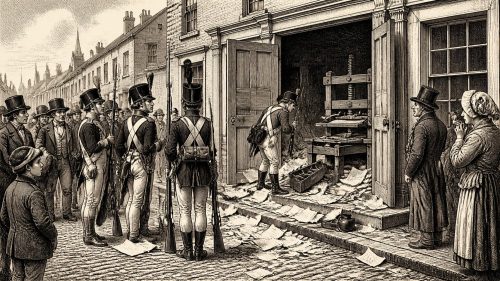
In 1797, Ireland faced mounting tension between the clandestine United Irishmen and a government anticipating rebellion and French invasion. General Gerard Lake’s Ulster disarmament campaign seized weapons, intimidated communities and weakened northern radical networks. After Monaghan militiamen implicated in United Irish activity were executed at Blaris, fellow soldiers destroyed Belfast’s Northern Star, silencing a major radical newspaper. Arrests also disrupted Cork organisers, while calls for constitutional conciliation gained little ground. William Orr’s contested conviction and hanging made him a powerful martyr. Meanwhile, parliamentary limitations and bank restrictions exposed wider political and economic insecurity, foreshadowing the 1798 rebellion in Ireland itself.
Bantry Invasion
Archived: 11 October 2026
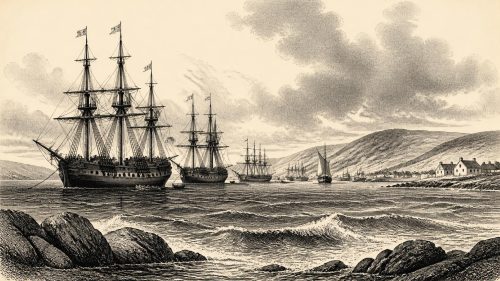
In 1796, Ireland faced an attempted French invasion that exposed the convergence of revolutionary politics, sectarian tension and wartime insecurity. Theobald Wolfe Tone helped secure French support for an expedition under General Hoche, but storms, dispersal and confused command prevented its 14,000 troops from landing at Bantry Bay. Dublin Castle answered unrest with the Insurrection Act and newly established yeomanry, while Orange organisation strengthened Protestant loyalism. Catholic responses varied, exemplified by Bishop Francis Moylan’s anti-revolutionary pastoral. Meanwhile, the Royal Canal reached Kilcock and Edward Bunting published Irish harp music. The failed invasion intensified repression, mobilisation and republican hopes before 1798.
Some records do not yet have a verified historical year and are awaiting chronological placement.