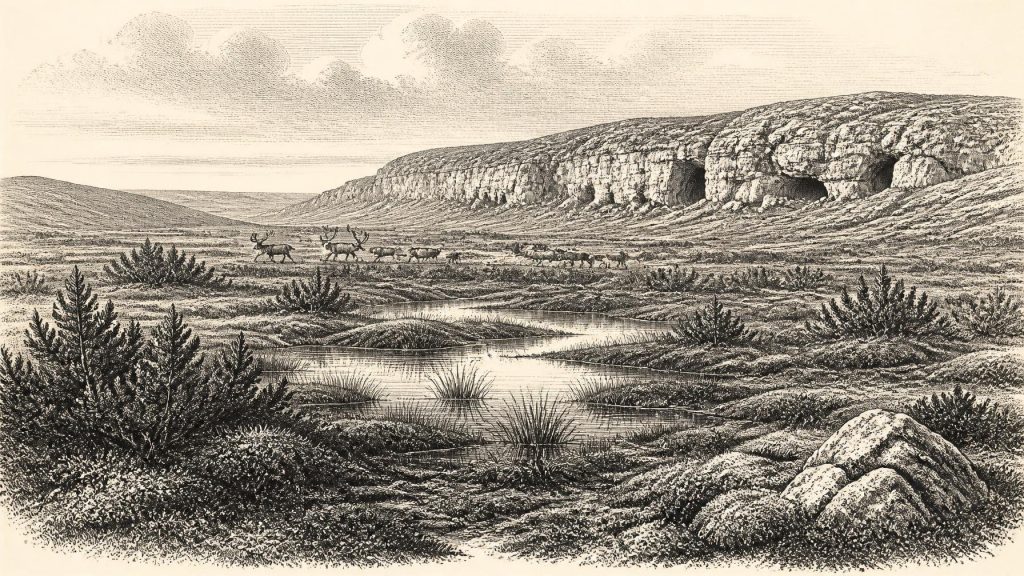
Reindeer by the Awbeg31863 BCE
At roughly 31,863 BCE, Ireland experienced an unstable MIS 3 cold phase, with open, wet, treeless tundra recorded at Derryvree and intermittent milder conditions indicated by Crag Cave calcite. The Last Glacial Maximum was approaching, but Ireland was not uniformly ice-covered. Castlepook Cave in County Cork preserves diverse cold-stage fauna, including reindeer, mammoth and hyaena, accumulated over extended periods. A reindeer femur, dated broadly around 33,000 years ago, bears a possible cut mark suggesting human carcass processing. Without secure context, tools or campsites, this indicates only tentative, mobile Upper Palaeolithic visits. Ongoing investigation may clarify Ireland’s fragmentary pre-glacial human record.
Dateline
The label 31,863 BCE is a modern way of locating a point deep in the last Ice Age, not a year that can be recovered from an Irish archive. No Irish event, individual or community can responsibly be assigned to that calendar year. Radiocarbon dates are reported with uncertainty and must be calibrated against changing atmospheric carbon; at this depth of time, the results are ranges rather than annual anniversaries. The most appropriate frame is the later part of Marine Isotope Stage 3 (MIS 3), before the full Last Glacial Maximum. Evidence from Ireland can illuminate a broad interval around this date, but it cannot yield a conventional year-by-year history.
A Landscape in a Cold Phase
At roughly 31,863 BCE, Ireland lay in a climatically unstable portion of the Late Pleistocene. The island’s landscapes did not resemble the green, wooded country familiar today. Deposits preserved at Derryvree near Maguiresbridge, County Fermanagh, are especially important. Organic silts and sands trapped between two layers of glacial till have produced a radiocarbon chronology calibrated broadly to about 36,900–31,700 years before present. That range overlaps the date in question, though it emphatically does not identify conditions in every part of Ireland in a single year.
The plants, mosses and insects from Derryvree point to open, treeless tundra or muskeg: a wet, uneven terrain of sedges, grasses, herbs, juniper and mosses, with pools and waterlogged ground. It was not necessarily a lifeless white desert. Short growing seasons could support vegetation sufficient for grazing animals, while severe winters and frozen ground imposed formidable limits. The evidence is regional and environmental, not a complete map of Ireland, but it firmly rules out imagining a forested or agricultural island.
Other records underline the variability. At Crag Cave in County Kerry, uranium-series dating of cave calcite shows that stalagmites formed episodically during MIS 3. Since calcite growth in such a shallow cave requires infiltrating liquid water and conditions generally above sustained freezing, these episodes register intervals of relative amelioration. They should not be inflated into a simple story of warm Ireland: a cave record captures particular hydrological circumstances, while the country as a whole experienced sharp shifts between colder and less severe phases.
Ice, Water and Changing Routes
Ireland was approaching, rather than already at, the greatest expansion of the last British–Irish Ice Sheet. Modern reconstructions show that the timing of advance, maximum extent and retreat differed markedly across the ice sheet’s sectors. Widespread advance occurred over a long span, while maximum ice volume came later, around 23,000 years before present in one major reconstruction. Thus 31,863 BCE should not be presented as a moment when all Ireland lay uniformly beneath ice. The Derryvree sequence itself preserves the larger rhythm: an older glacial episode, a period in which freshwater sediments accumulated, and a later advance that buried them.
This was nevertheless an increasingly precarious world. Glaciers and ice caps altered drainage, eroded earlier ground surfaces and ultimately removed or buried much evidence of any human activity. Lower global sea levels exposed far more of the continental shelf than exists today. Yet exposed land is not proof of an easy, continuous walking route into Ireland, nor does it demonstrate that people routinely travelled it. The exact configuration of water, ice and usable coastal terrain altered through time. Any movement of animals or people must be treated as a possibility constrained by a changing northern Atlantic environment, not as a known migration highway.
Animals at Castlepook
The strongest Irish evidence for life in this broad pre-maximum interval comes from caves, above all Castlepook Cave near Doneraile in north County Cork, in the Awbeg Valley. Its old collections include remains attributed to woolly mammoth, reindeer, wild horse, brown bear, wolf, Arctic fox, lemmings and spotted hyaena. This impressive list establishes that southern Ireland was reached by a diverse cold-stage fauna during portions of the Late Pleistocene. It does not mean that every listed species stood together outside the cave in 31,863 BCE. Cave collections are accumulated over long periods, often by carnivores, natural deaths, water movement and nineteenth- or early twentieth-century excavation practices that did not meet modern standards.
Redating has transformed the importance of Castlepook. Improved pretreatment of bone samples has shown that some faunal material previously thought much younger is substantially older, placing parts of the assemblage in MIS 3. Reindeer are particularly relevant to a cold, open landscape. Their presence fits a setting in which seasonal grazing was available, though it cannot tell us the size of a herd, its migratory route or the exact season when it visited north Cork. Mammoth and hyaena remains similarly demonstrate ecological possibilities, rather than a settled, stable fauna persisting unchanged through millennia.
Predators matter as much as prey in interpreting a cave. A hyaena may have carried bones inside; water may have shifted sediment; scavengers and later excavation may have broken the original associations. Archaeologists therefore distinguish a bone’s date from the date of its deposition in a particular layer, and both from the date of any human action upon it. This painstaking taphonomic work is central to the Irish Palaeolithic record, where a small number of objects bears an enormous interpretative weight.
The Reindeer Femur and Human Possibility
One Castlepook reindeer femur fragment has become the key item for this period. It has been reported as dating to about 33,000 years ago and as carrying a mark interpreted as the result of cutting fresh tissue with a sharp stone tool. If that interpretation is confirmed, it is evidence that a person, or a very small group, processed a reindeer in Ireland during MIS 3—far earlier than the formerly accepted evidence for human presence on the island.
Its significance is real, but so are its limits. The specimen comes from an old collection rather than a newly excavated occupation floor with recorded stratigraphy. No securely associated stone toolkit, hearth, shelter, human bone or repeated butchery surface has yet been recovered for this episode. A single possible cut mark is not evidence for a village, a permanent population or a named cultural group. It cannot establish whether the animal was hunted, scavenged after a natural death or encountered after a predator kill. Nor can it supply a date as exact as 31,863 BCE. The responsible conclusion is narrower: people may have reached Ireland, and handled animal carcasses, in a period broadly around the early thirties of millennia BCE.
That possibility changes the questions asked of Ireland’s earliest past. Rather than beginning only with the better documented Mesolithic settlement after the ice retreated, researchers must consider brief Upper Palaeolithic visits during earlier windows of ecological opportunity. Such visits may have been seasonal and highly mobile. A group capable of crossing or navigating the shifting landscapes between Ireland and neighbouring lands would have required knowledge, planning and cooperation. These are reasonable inferences from hunter-gatherer lifeways elsewhere in north-west Europe, not observations directly made at Castlepook.
Society Without States
There is no evidence for political institutions, chiefs, territories, diplomacy, warfare or formal trade in Ireland at this date. It would be misleading to fill the silence with imagined Ice Age tribes. If humans were present, their social world was almost certainly organised at the scale of small, mobile foraging groups rather than kingdoms or towns, but Ireland has not yielded the campsites needed to describe household size, gendered tasks, leadership or relations between groups.
Everyday survival, if it occurred, would have revolved around weather, mobility, food and fuel. Reindeer and other large mammals could provide meat, fat, hides, sinew and bone, while stone edges could be used to cut tissue. Yet even this practical picture is more securely supported by comparative archaeology than by an excavated Irish camp. There is no direct Irish evidence at 31,863 BCE for built houses, clothing, boats, exchange goods, food storage or the regular use of fire. Caves such as Castlepook are archives of bone and sediment, not automatically homes.
Likewise, there is no material basis for reconstructing religion, ritual, art, language or learning. The absence of evidence should not be mistaken for an absence of belief or culture among any visitors; all human communities possess social knowledge and symbolic practices. It means only that none can yet be identified in Ireland’s surviving record for this interval. Later Irish monuments, myths and languages have no demonstrable connection to these remote traces.
An Archive Still Being Tested
The most important development around this date is therefore archaeological rather than political: the recognition that Ireland’s pre-Last Glacial Maximum record may be richer, and more humanly relevant, than once thought. Recent investigation at Castlepook has sought undisturbed deposits and has applied modern excavation, dating and environmental methods to a cave first explored long ago. It is precisely the sort of work needed to test the reindeer femur interpretation and to identify whether in situ artefacts, hearths or repeated human activity survive.
For 31,863 BCE, certainty lies in the broader setting: parts of Ireland supported cold-adapted life; conditions were open, wet and treeless in the Derryvree evidence; and the great ice expansion was drawing nearer. The human story remains a tantalising, carefully qualified possibility centred on a marked reindeer bone near the Awbeg. It is a reminder that the earliest Irish past survives not as a chronicle, but as fragments—bone, silt, pollen, beetle and cave calcite—from which a disciplined history must be patiently assembled.
Primary Sources
- A reconsideration of the radiocarbon dating of the Marine Isotope Stage 3 fauna from southern Ireland
- Growth and retreat of the last British–Irish Ice Sheet, 31,000 to 15,000 years ago: the BRITICE-CHRONO reconstruction
- Pattern and timing of retreat of the last British-Irish Ice Sheet
- A Middle Midlandian Freshwater Series at Derryvree, Maguiresbridge, County Fermanagh, Northern Ireland
- Palaeoecology
- Landscapes and environments of the last glacial-interglacial transition: a time of amazingly rapid change in Ireland
- Episodic speleothem deposition tracks the terrestrial impact of millennial-scale last glacial climate variability in SW Ireland
- 18) Castlepook Caves
- The IntCal20 Northern Hemisphere Radiocarbon Age Calibration Curve (0–55 cal kBP)
- IntCal Publications
- Phylogeographic, ancient DNA, fossil and morphometric analyses reveal ancient and modern introductions of a large mammal: The complex case of red deer (Cervus elaphus) in Ireland
- New insights on the fauna of Ireland's Younger Dryas and Early Holocene from Alice & Gwendoline Cave
- Archaeology Research Excavation Grant 2022
- 32564 – Castlepook Cave, Co. Cork
- Archaeological Heritage of County Cork
- Heritage Artefacts of County Cork
- The Mesolithic in Ireland: when was it?
- Ireland's Palaeolithic Archaeology – Fleeting Footprints in a Frozen Land
- Archaeology
- New data for the Last Glacial Maximum in Great Britain and Ireland