Pleistocene Connections31491 BCE
31,491 BCE is a modern filing label within a broad, uncertain MIS 3 chronology, rather than a recoverable Irish calendar date. Derryvree, County Fermanagh, preserves freshwater sediments between tills, indicating an ice-free, treeless periglacial tundra with mossy wetlands during part of the Middle Midlandian. Castlepook Cave, County Cork, documents a wider, time-mixed fauna including mammoth, reindeer, giant deer, hyena and wolf, evidencing intermittent ecological connections with neighbouring lands. Climate fluctuated, with milder episodes and habitable niches before renewed glaciation. No securely dated human occupation exists; possible cut marks warrant investigation only. These archives illuminate environments, not events or prehistoric society.
Dateline
31,491 BCE is a useful modern filing date, not a date that can be recovered from Ireland’s prehistoric record. No community on the island counted years in this manner, and neither radiocarbon dating nor glacial stratigraphy can identify a particular calendar year so far back. In radiocarbon convention, which counts before AD 1950, the label lies about 33,440 years ago. It falls within Marine Isotope Stage 3 (MIS 3), a long and climatically unstable part of the last glacial cycle. The responsible history for this point is therefore not a chronicle of named events, rulers or settlements, but an account of landscapes, animal remains and the limits of what they can prove.
A Broad Chronological Window
The most directly relevant Irish environmental archive is the Derryvree freshwater series near present-day Maguiresbridge, County Fermanagh. Roadworks in 1969 cut through a drumlin and revealed organic silts and fine sands lying between two distinct layers of till: material deposited by glacier ice. The sequence establishes an important order of events. Ice had occupied the area; an interval followed in which freshwater sediment, plants and insects accumulated; later ice overrode and sealed the deposit. Organic material produced the conventional radiocarbon determination Birm-166, 30,500 +1,170/–1,030 BP.
Modern calibration does not turn that result into a precise anniversary. Published discussion places the Derryvree material broadly at about 36,900–31,700 calibrated years BP, approximately 34,950–29,750 BCE. The notional year 31,491 BCE lies inside that wide range, but it cannot be assigned to a particular layer, season or episode at the site. The date range has been correlated only approximately with several Greenland Interstadials, numbered GI-8 to GI-5. Such correlations are valuable for placing Ireland within North Atlantic climate history, but they should not be mistaken for a precise local weather record.
The Derryvree Landscape
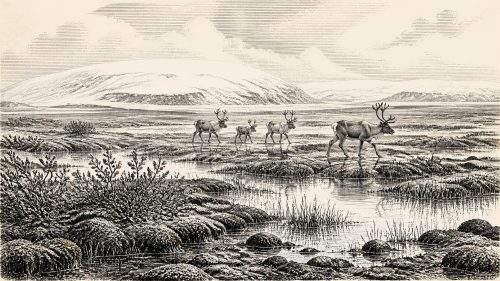
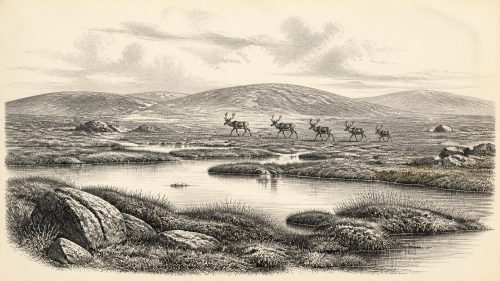
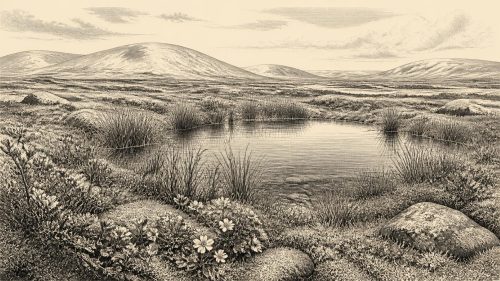
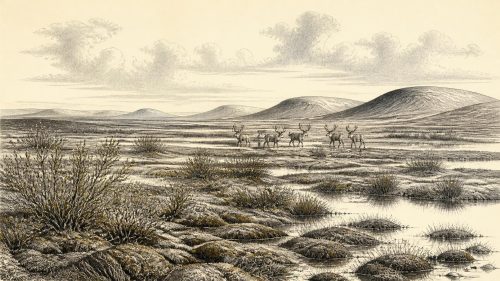
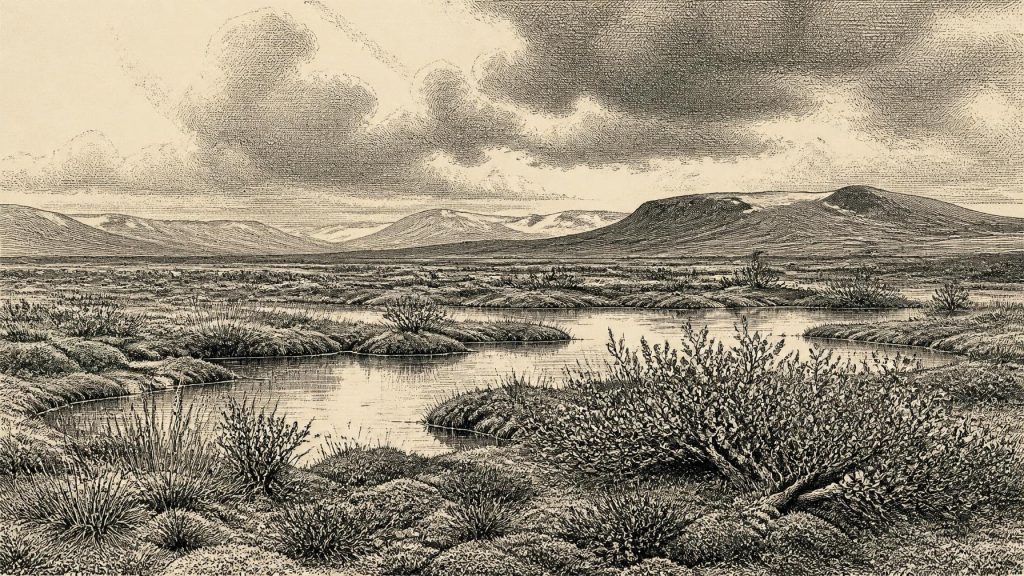
Derryvree offers a glimpse of an Ireland very unlike the later wooded island. Its pollen, plant macrofossils, mosses and insect remains point to an open, treeless tundra landscape under periglacial conditions. Dry ground was probably thinly vegetated. Wet ground held mossy, plant-rich margins and shallow pools: a muskeg-like mosaic rather than an unbroken sheet of snow or bare gravel. Fossil evidence includes plants associated with cold environments, while finds such as bogbean seed show that sheltered freshwater habitats could support aquatic and marsh vegetation. This was a hard climate, especially in winter, but not an utterly lifeless one.
That distinction matters. “Ice Age” does not mean that every part of Ireland was permanently buried beneath glacier ice at every moment. The Derryvree deposits demonstrate ice-free conditions in southern Fermanagh during part of the Middle Midlandian, the Irish name commonly used for this phase of the last glaciation. Yet the sediments were later sealed by ice, and the ice sheet would expand dramatically afterwards. The Last Glacial Maximum, generally placed around 26,500–19,000 calibrated years BP, erased or disturbed much older surface evidence. Ireland’s surviving record is consequently patchy, with caves and protected deposits carrying disproportionate historical importance.
Caves and the Animal Record
In the south, Castlepook Cave near Doneraile in County Cork is the foremost repository for Ireland’s pre-maximum Ice Age vertebrates. Excavations undertaken in the early twentieth century recovered more than 2,000 bones from its narrow limestone passages and chambers. The collection records a formidable fauna over a long span rather than a single living community: woolly mammoth, reindeer, giant deer, brown bear, spotted hyena, wolf, Arctic fox, hare and lemmings are among the animals represented. Their presence demonstrates that, at different times in MIS 3, Ireland could sustain or receive animals normally associated with open, cold environments and the wider north-west European mammoth-steppe zone.
The cave is especially important precisely because it demands caution. Early excavations removed much sediment, water disturbed deposits, and bones of widely different ages became mixed in some areas. Later accelerator radiocarbon dating improved the chronology, and a 2020 reassessment using improved pretreatment found that several earlier measurements had made specimens appear too young. Some Castlepook animals are now understood to be substantially older than formerly supposed; giant deer and spotted hyena may have disappeared locally before the Last Glacial Maximum. A bone’s discovery in the cave therefore cannot automatically establish that every listed species lived beside the Awbeg valley in 31,491 BCE.
Nevertheless, Castlepook and Derryvree complement one another. The Fermanagh deposit gives a locally preserved environmental setting whose calibrated range encompasses this article’s date. The Cork caves establish that Ireland formed part of a wider Late Pleistocene faunal world during the broader period. Mammoth and reindeer were not symbols of a romanticised wilderness but large grazing animals requiring extensive forage; hyenas and wolves indicate predators and scavengers within that food web. Their fossil record also suggests repeated opportunities for animals to move into Ireland when sea level was lower and the geography of the Irish Sea region differed greatly from that of today.
An Island in a Changing Region
Ireland’s position at Europe’s Atlantic edge was crucial. During colder phases, large volumes of water were locked in ice sheets, lowering sea level and exposing broad areas of the continental shelf. Ireland was not necessarily linked to Britain or continental Europe by one simple, continuous “land bridge”; routes changed with sea level, ice margins, rivers and local topography. The animal evidence proves that movement occurred, but it does not identify every route, season or population. It is safer to say that Ireland was intermittently more connected ecologically to neighbouring landmasses than it is today, while remaining exposed to rapid environmental change.
Climate also changed on a scale meaningful to animals and any visiting people. Speleothems from Crag Cave, County Kerry, show episodic growth during MIS 3. Since calcite deposition in that shallow cave requires liquid water and conditions generally above freezing, the record supports the conclusion that comparatively milder episodes punctuated the glacial climate of south-west Ireland. Derryvree’s freshwater sediments likewise show that cold-stage Ireland contained habitable niches. But neither archive allows a reconstruction of a particular summer, winter or storm in 31,491 BCE.
The Human Question
There is no securely excavated settlement, hearth, tool assemblage, grave or dwelling in Ireland that can be confidently assigned to this date. This absence is not proof that no person ever reached the island. Glacial erosion, later sediment movement and the limited investigation of surviving deposits make preservation unusually difficult. It does mean, however, that historical claims must remain modest. We cannot responsibly describe a resident tribe, a migration, a language, political authority, diplomacy, warfare, religious ceremony, art or teaching in Ireland at this time.
A reindeer femur from Castlepook, dated to roughly 33,000 radiocarbon years ago, has been reported as bearing possible human-made cut or chop marks. If that interpretation is confirmed, it would be major evidence for Upper Palaeolithic activity in Ireland far earlier than the island’s previously accepted human record. But the specimen derives from antiquarian cave excavation, rather than a modern, securely stratified occupation surface, and the identification and implications require continued critical assessment. It is evidence of a research question, not grounds for inventing a Palaeolithic Irish society. The most that can presently be said is that short visits by mobile hunters are possible and remain under investigation.
Everyday Life, Where Evidence Ends
If people did visit, their practical concerns would have been immediate: shelter, warmth, stone tools, food and safe passage through an unfamiliar cold landscape. Those are reasonable inferences from the lifeways of Upper Palaeolithic hunter-gatherers elsewhere in north-west Europe, but they are not observations from an Irish camp. No Irish evidence from around 31,491 BCE identifies trade, exchange partnerships or seasonal territories. Equally, the animal assemblages cannot tell us whether humans hunted reindeer, scavenged carcasses, avoided hyena dens, or never encountered these animals on the island at all.
The central development around this date was environmental rather than political: Ireland retained pockets of open tundra and freshwater habitat during a fluctuating glacial interval, while being drawn towards renewed extensive glaciation. Birm-166 is consequently more than a laboratory number. It is a reminder that the deep history of Ireland survives in fragile, local archives: silts beneath a drumlin, calcite in a cave and bones accumulated in dark limestone chambers. These sources can illuminate a cold, changing land. They cannot yet supply an annual human history for 31,491 BCE.
Source References
Hover over a number to see the source. Select it to open the source.

- [1] A Middle Midlandian Freshwater Series at Derryvree, Maguiresbridge, County Fermanagh, Northern Ireland
- [2] The Irish Quaternary Fauna Project
- [3] A Reconsideration of the Radiocarbon Dating of the Marine Isotope Stage 3 Fauna from Southern Ireland
- [4] Castlepook Cave: Cork County Geological Site Report
- [5] Palaeoecology
- [6] The Subdivision of the Quaternary Period in Ireland
- [7] Episodic Speleothem Deposition Tracks the Terrestrial Impact of Millennial-Scale Last Glacial Climate Variability in SW Ireland
- [8] The IntCal20 Northern Hemisphere Radiocarbon Age Calibration Curve (0–55 cal kBP)
- [9] Spotted Hyena Skull
- [10] New Insights on the Fauna of Ireland's Younger Dryas and Early Holocene from Alice & Gwendoline Cave
- [11] Mammoth Cave
- [12] Castlepook Cave, Castlepook South, County Cork: Excavation Report 2022
- [13] Salix herbacea
- [14] Menyanthes trifoliata
- [15] Episodic Speleothem Deposition Tracks the Terrestrial Impact of Millennial-Scale Last Glacial Climate Variability in SW Ireland
- [16] Publications
- [17] Field Guides
- [18] Our Ancient Landscapes: Hunter-Gatherers in Ireland
- [19] The Last Irish Ice Sheet: Extent and Chronology
- [20] Exploring Controls of the Early and Stepped Deglaciation on the Western Margin of the British-Irish Ice Sheet
Primary Sources
- A Middle Midlandian Freshwater Series at Derryvree, Maguiresbridge, County Fermanagh, Northern Ireland
- The Irish Quaternary Fauna Project
- A Reconsideration of the Radiocarbon Dating of the Marine Isotope Stage 3 Fauna from Southern Ireland
- Castlepook Cave: Cork County Geological Site Report
- Palaeoecology
- The Subdivision of the Quaternary Period in Ireland
- Episodic Speleothem Deposition Tracks the Terrestrial Impact of Millennial-Scale Last Glacial Climate Variability in SW Ireland
- The IntCal20 Northern Hemisphere Radiocarbon Age Calibration Curve (0–55 cal kBP)
- Spotted Hyena Skull
- New Insights on the Fauna of Ireland's Younger Dryas and Early Holocene from Alice & Gwendoline Cave
- Mammoth Cave
- Castlepook Cave, Castlepook South, County Cork: Excavation Report 2022
- Salix herbacea
- Menyanthes trifoliata
- Episodic Speleothem Deposition Tracks the Terrestrial Impact of Millennial-Scale Last Glacial Climate Variability in SW Ireland
- Publications
- Field Guides
- Our Ancient Landscapes: Hunter-Gatherers in Ireland
- The Last Irish Ice Sheet: Extent and Chronology
- Exploring Controls of the Early and Stepped Deglaciation on the Western Margin of the British-Irish Ice Sheet