Willow Hollows30888 BCE
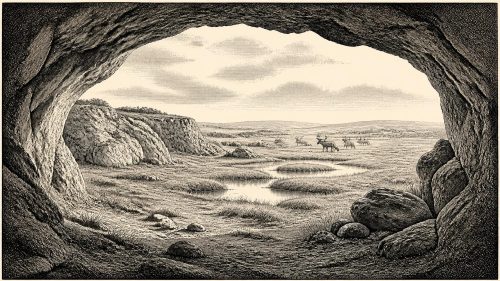
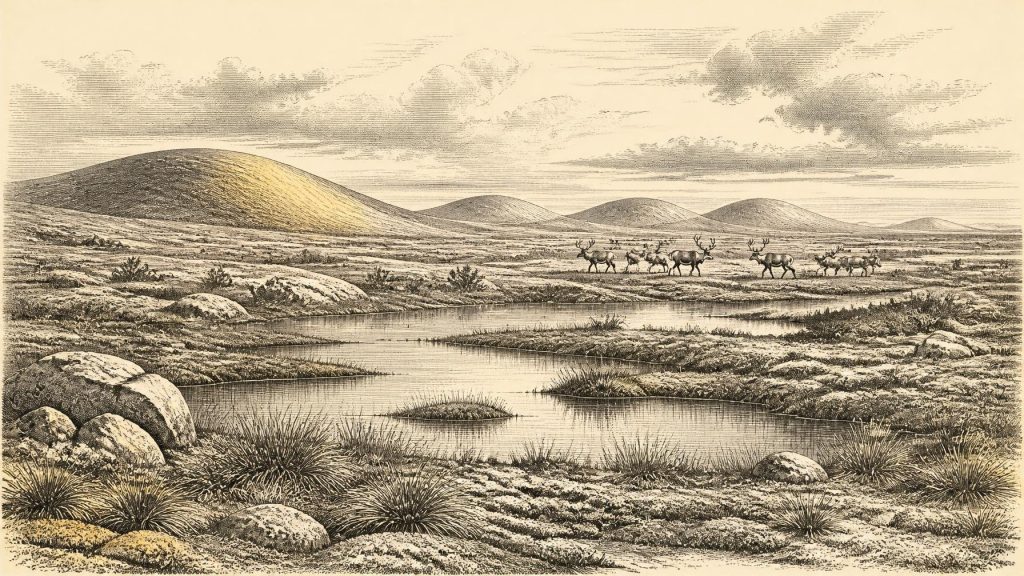
Although 30,888 BCE cannot be tied to a specific Irish event, it falls within the unstable MIS 3 Late Pleistocene. Derryvree, County Fermanagh, preserves freshwater organic sediments between glacial tills, indicating a cold, treeless mosaic of wet hollows and sparse vegetation during an ice-free interval. Other northern sites and Crag Cave confirm variable regional conditions. Castlepook Cave, County Cork, contains a diverse, chronologically mixed fauna including mammoth, reindeer, giant deer, hyaena and wolf. A cut-marked reindeer femur may indicate human carcass processing, but cannot prove settlement. Subsequent glaciation destroyed evidence; no polity, farming, trade or established human occupation is known.
Dateline
30,888 BCE is a modern chronological label, not a date that can be recovered from an Irish event record. No written calendar, named community, settlement sequence or archaeological layer can be assigned to that individual year. In simple arithmetic it lies about 32,837 years before AD 1950, the reference point used for “before present” dating, but radiocarbon ages and calendar ages are not interchangeable. The responsible setting is the later part of the Late Pleistocene, within Marine Isotope Stage 3 (MIS 3), a long and climatically unstable phase of the last Ice Age. The best available evidence is expressed in broad calibrated ranges, not in annual precision.
A Date Inside a Wide Window
The closest Irish environmental archive is the Derryvree freshwater series near Maguiresbridge, County Fermanagh. Roadworks exposed a remarkable sequence in a drumlin: glacial till at the base, then sands, silts and organic deposits formed in freshwater conditions, and finally a later cover of till laid down by renewed ice. The basic sequence is secure. A glacier occupied the site; for a time, ice no longer overrode it and water, plants and insects left traces; a later advance sealed the deposits. What cannot be secure is a claim that 30,888 BCE corresponds to one identifiable moment within that sequence.
An organic sample from Derryvree, BIRM-166, produced a conventional radiocarbon age of about 30,500 ± 1,170 radiocarbon years BP. Calibration converts such a result into a considerably wider and non-linear calendar range. It has been placed broadly within about 36,900–31,700 calibrated years BP, approximately 34,950–29,750 BCE. The requested year falls within that span, but the range covers millennia. It is therefore legitimate to use Derryvree to illuminate conditions around this point in time, but not to announce a year-specific Irish occurrence.
This distinction is more than technical. Radiocarbon measures the remaining carbon-14 in once-living material and requires calibration against independently dated records. At this depth of time, calibration curves contain plateaux and wiggles, while old deposits may have accumulated slowly, been disturbed, or have sampled a period rather than an instant. Derryvree is an unusually valuable local archive precisely because its organic sediments survived between two ice-laid deposits; it is not an annual diary of Fermanagh, still less a weather report for the whole island.
Fresh Water Between Ice Advances
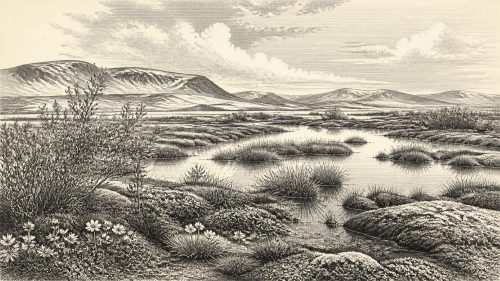
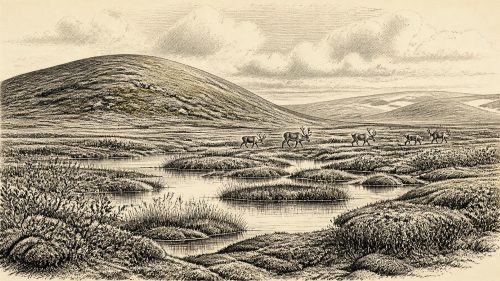
The Derryvree material gives direct evidence for a cold, treeless freshwater environment. Plant macrofossils, pollen and insect remains indicate mosses, sedges and other vegetation capable of living in damp ground and shallow water under severe northern conditions. The surrounding landscape is best envisaged as a mosaic rather than an unbroken frozen wilderness: pools and wet ground in sheltered hollows, sparsely vegetated open country beyond them, and terrain shaped by frost, runoff and earlier glacial action. It was not a later Irish landscape of enclosed fields, woodland and peat bogs.
Comparable northern Irish deposits strengthen, but do not erase the limits of, this reconstruction. Freshwater or organic layers at Hollymount and Greenagho in County Fermanagh, and the longer succession at Aghnadarragh, County Antrim, show that parts of Ireland experienced cold non-glacial intervals within the wider Midlandian, or Devensian, glacial cycle. Their evidence includes open-ground plant communities and beetles whose modern distributions are far to the north. Such sites demonstrate regional variety and repeated environmental change. They do not establish that every part of Ireland was simultaneously free of ice, equally habitable, or connected by a simple route to Britain or continental Europe.
The wider climate was volatile. MIS 3 contained rapid shifts recorded most clearly in Greenland ice cores and North Atlantic marine records. In south-west Ireland, uranium-thorium dates from Crag Cave show that stalagmites grew episodically during parts of the last glacial period. Since calcite growth requires water moving through the cave, those formations independently show that conditions were not uniformly locked in deep permafrost throughout the long cold stage. Yet cave growth at one location and freshwater sediment at another cannot be translated into a precise temperature, season or rainfall total for 30,888 BCE.
Castlepook’s Animal World
Far south of Derryvree, Castlepook Cave near Doneraile in north County Cork preserves Ireland’s most important assemblage of pre-Last Glacial Maximum animal remains. Early excavators worked there between 1904 and 1913, calling it Mammoth Cave because of the spectacular fossil material recovered from its limestone passages. Later reassessment and direct radiocarbon dating have shown that the collection is chronologically complex: bones from different cave galleries, layers and episodes cannot simply be treated as one simultaneous herd or one landscape scene.
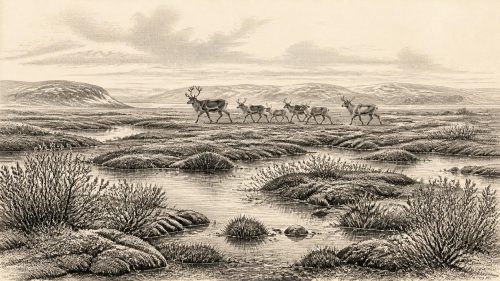
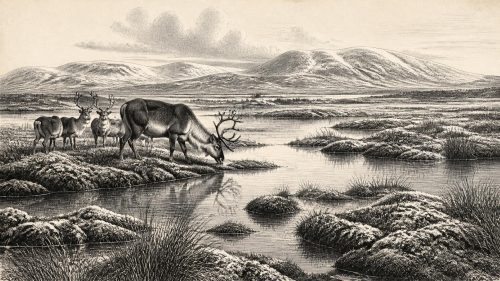
Nevertheless, the broad MIS 3 fauna is striking. It includes woolly mammoth, reindeer, giant deer, brown bear, wolf, Arctic fox, mountain hare, lemmings and spotted hyaena. Several newly redated specimens point to a substantially older pre-Last Glacial Maximum fauna than some earlier determinations had suggested. Mammoth, reindeer, giant deer and predators reveal that Ireland was intermittently part of a wider north-west European ecological network in which large herbivores and carnivores could reach the island. The animals need not all have occupied Castlepook at the same time, and their bones may have been moved or accumulated by scavengers, carnivores, water and cave processes.
Spotted hyaena is especially revealing. It was not merely an animal passing through an empty landscape: hyaenas could transport and modify carcass remains, complicating the archaeological record while also demonstrating a food web large enough to support major scavenging predators. Tooth damage on a mammoth bone from Castlepook supports this picture. The cave was not necessarily a human home or a straightforward hunting station. It was a changing animal den and bone trap as much as an archive for modern researchers.
The Reindeer Femur Question
One Castlepook find raises the possibility of human activity close to this broad horizon. A reindeer femur in the National Museum of Ireland’s Natural History collections has been interpreted by zooarchaeologist Ruth Carden as carrying a deep modification made on fresh bone by a sharp stone tool during carcass processing. County Cork heritage publications associate the specimen with roughly 31,000 BCE. If that interpretation is confirmed through continuing analysis and contextual research, it would be evidence that people handled a reindeer carcass in Ireland during the Upper Palaeolithic, far earlier than the better-established late-glacial evidence from Alice and Gwendoline Cave in County Clare.
Its importance demands restraint. The femur is not a human skeleton, a securely excavated occupation floor, a hearth, a dwelling, a group of stone tools or a repeated sequence of camps. No implement responsible for the mark has been recovered in an associated sealed context. The old Castlepook excavations produced a magnificent collection, but their deposits were not recorded to present-day standards and later work has confirmed that different ages occur within the cave system. A direct date on an animal establishes when that animal lived, not necessarily every detail of when, where or by whom a mark was made.
The sound conclusion is therefore modest but consequential. A person or people may have visited Ireland, encountered or obtained a reindeer, and processed part of its carcass during the broader MIS 3 interval. Mobile hunters following seasonal animal movements are a reasonable interpretation, particularly given the open-country fauna. Permanent settlement, population size, ancestry, language, social organisation, route of arrival and duration of any visit remain unknown. The finding should broaden the search for an Irish Palaeolithic, not be used to invent a settled Ice Age nation.
Sea, Ice and Movement
Lower global sea levels altered coastlines because vast quantities of water were stored in ice sheets. Exposed shelves and changed shorelines may have reduced some crossings and enlarged terrestrial habitats, but they did not create a simple, permanent land bridge that can be assumed for Ireland. The Irish Sea basin, changing ice margins, relative sea level and the physical condition of any exposed ground all mattered. The arrival of mammals shows that dispersal occurred at intervals; it does not reveal the exact route taken by a particular reindeer, hyaena or possible human party.
During the millennia after the Derryvree interval, the British–Irish Ice Sheet expanded towards its Last Glacial Maximum, conventionally dated broadly to about 26,000–19,000 years ago. The timing, thickness and limits of that ice remain actively researched, but its later advance transformed landscapes and likely removed, reworked or buried many older deposits. This destructive history helps explain why evidence from Ireland around 30,888 BCE is so sparse compared with better-known Upper Palaeolithic regions of Britain and continental Europe.
No Polity, No Proven Trade
There is no evidence from Ireland at this date for political institutions, rulers, diplomacy, warfare, territory held by a named group, farming, domestic animals, cultivated crops, trade networks, metalworking or built settlements. There is likewise no secure Irish evidence for formal religion, cave art, portable art, burial practice, language or systems of learning in this horizon. Such absences describe the limits of the surviving record, not the inner lives of any people who may have made a brief visit.
Everyday life can be discussed only conditionally. If humans were present, survival would have depended on mobility, close knowledge of animal behaviour, weather and terrain, and the use of perishable skills and equipment that have left no identified trace in Ireland. But those are inferences from wider Upper Palaeolithic practice, not direct observations of an Irish camp. The firm evidence is more elemental: cold freshwater habitats in Fermanagh; a diverse large-mammal and predator fauna in Cork; and one potentially transformative reindeer bone. Around this modernly numbered year, Ireland is best understood not as a documented human society, but as a fragmentary Ice Age landscape on the threshold of much harsher glaciation.
Source References
Hover over a number to see the source. Select it to open the source.

- [1] A Middle Midlandian Freshwater Series at Derryvree, Maguiresbridge, County Fermanagh, Northern Ireland
- [2] Early Midlandian–Middle Midlandian, Pleistocene, Northern Ireland
- [3] Aghnadarragh
- [4] Irish Pleistocene Biostratigraphy
- [5] A Reconsideration of the Radiocarbon Dating of the Marine Isotope Stage 3 Fauna from Southern Ireland
- [6] The Irish Quaternary Fauna Project
- [7] The Exploration of Castlepook Cave, County Cork
- [8] Occurrence of Mammalia Relicts at Site Castlepook Cave
- [9] Irish Caves Database: Mammoth Cave
- [10] Archaeological Heritage of County Cork
- [11] Heritage Artefacts of County Cork
- [12] 2022:564 – Castlepook Cave, Castlepook South, Cork
- [13] Archaeology Research Excavation Grant 2022: Final Report
- [14] First Evidence of a Late Upper Palaeolithic Human Presence in Ireland
- [15] The IntCal20 Northern Hemisphere Radiocarbon Age Calibration Curve (0–55 cal kBP)
- [16] Growth and Retreat of the Last British–Irish Ice Sheet, 31,000 to 15,000 Years Ago: the BRITICE-CHRONO Reconstruction
- [17] BRITICE-CHRONO Maps and GIS Data of the Last British-Irish Ice Sheet 31 to 15 ka
- [18] Timing, Pace and Controls on Ice Sheet Retreat: an Introduction to the BRITICE-CHRONO Transect Reconstructions of the British-Irish Ice Sheet
- [19] The Timing and Magnitude of the British–Irish Ice Sheet Between Marine Isotope Stages 5d and 2
- [20] Last Glacial Maximum Cirque Glaciation in Ireland and Implications for Reconstructions of the Irish Ice Sheet
- [21] Episodic Speleothem Deposition Tracks the Terrestrial Impact of Millennial-Scale Last Glacial Climate Variability in SW Ireland
- [22] Spatio-Temporal Dynamics of Speleothem Growth and Glaciation in the British Isles
- [23] Pleistocene Vertebrates in the British Isles
- [24] Figure 6.—The Subdivision of the Quaternary Period in Ireland
Primary Sources
- A Middle Midlandian Freshwater Series at Derryvree, Maguiresbridge, County Fermanagh, Northern Ireland
- Early Midlandian–Middle Midlandian, Pleistocene, Northern Ireland
- Aghnadarragh
- Irish Pleistocene Biostratigraphy
- A Reconsideration of the Radiocarbon Dating of the Marine Isotope Stage 3 Fauna from Southern Ireland
- The Irish Quaternary Fauna Project
- The Exploration of Castlepook Cave, County Cork
- Occurrence of Mammalia Relicts at Site Castlepook Cave
- Irish Caves Database: Mammoth Cave
- Archaeological Heritage of County Cork
- Heritage Artefacts of County Cork
- 2022:564 – Castlepook Cave, Castlepook South, Cork
- Archaeology Research Excavation Grant 2022: Final Report
- First Evidence of a Late Upper Palaeolithic Human Presence in Ireland
- The IntCal20 Northern Hemisphere Radiocarbon Age Calibration Curve (0–55 cal kBP)
- Growth and Retreat of the Last British–Irish Ice Sheet, 31,000 to 15,000 Years Ago: the BRITICE-CHRONO Reconstruction
- BRITICE-CHRONO Maps and GIS Data of the Last British-Irish Ice Sheet 31 to 15 ka
- Timing, Pace and Controls on Ice Sheet Retreat: an Introduction to the BRITICE-CHRONO Transect Reconstructions of the British-Irish Ice Sheet
- The Timing and Magnitude of the British–Irish Ice Sheet Between Marine Isotope Stages 5d and 2
- Last Glacial Maximum Cirque Glaciation in Ireland and Implications for Reconstructions of the Irish Ice Sheet
- Episodic Speleothem Deposition Tracks the Terrestrial Impact of Millennial-Scale Last Glacial Climate Variability in SW Ireland
- Spatio-Temporal Dynamics of Speleothem Growth and Glaciation in the British Isles
- Pleistocene Vertebrates in the British Isles
- Figure 6.—The Subdivision of the Quaternary Period in Ireland