Derryvree’s Moss Basin30546 BCE
30,546 BCE is a modern label within a broad Late Pleistocene range, not a recoverable Irish date. Derryvree, County Fermanagh, preserves freshwater silts and organic remains between glacial tills, demonstrating a local ice-free interval before renewed ice cover. Radiocarbon calibration places its deposits roughly between 34,950 and 29,750 BCE. Plants and insects indicate cold, treeless, periglacial wetland with mosses, sedges and open ground. Cave fauna elsewhere records mammoth, reindeer, giant deer and predators. A possibly cut-marked reindeer bone from Castlepook may indicate human activity, but cannot establish settlement. The evidence documents fluctuating ice, freshwater habitats and intermittent Ice-Age ecological possibilities.

Dateline
A Year Beyond Annual History
30,546 BCE is a useful modern label, not a date that can be recovered from an Irish Ice-Age calendar. It equates roughly to 32,495 years before AD 1950, the conventional “present” used by radiocarbon scientists, but neither people nor animals left evidence that can identify this particular year, season or day. No writing, monuments, named communities, political institutions or continuous settlement sequence survives from Ireland at such a depth of time. The responsible history of this point is therefore one of calibrated ranges, buried deposits and cautious comparison. It falls within the Late Pleistocene, broadly Marine Isotope Stage 3, an unstable interval of the last glacial cycle marked across the North Atlantic by abrupt climatic shifts. Ireland was not the green, wooded island familiar today, nor was it necessarily a single, uniformly frozen wilderness. Its landscapes changed as ice, water, vegetation and animals responded to changing conditions.
The closest especially relevant Irish record is the Derryvree freshwater series near Maguiresbridge, County Fermanagh. Roadworks in 1969 cut through a drumlin and revealed silts and fine sands, rich in organic remains, trapped between two distinct sheets of till: sediment deposited directly by glacier ice. The sequence establishes an important order of events. Ice had occupied the locality; later, local conditions permitted freshwater sediment, plants and small animals to accumulate; eventually, another glacial advance or renewed ice cover sealed that wetland beneath till. This is not an account of 30,546 BCE itself. It is, however, unusually direct evidence that an ice-free interval existed in this part of Ireland within the broad period to which the nominal year belongs.
A Date Range, Not a Moment
Organic material from Derryvree produced the conventional radiocarbon determination BIRM-166, about 30,500 radiocarbon years before present, with a substantial uncertainty. Radiocarbon years cannot simply be converted into calendar years: atmospheric carbon-14 has varied through time, and calibration curves have themselves improved as the underlying evidence has grown. Published calibrations place the Derryvree organic bed broadly at about 36,900–31,700 calibrated years before present, or approximately 34,950–29,750 BCE. The notional year 30,546 BCE lies within that wide interval, but cannot be pinned to a particular stratum, plant, animal or episode at the site. The range also spans climatic fluctuations that may have mattered greatly to life on the ground.
This distinction is more than technical. A radiocarbon result dates surviving carbon in a sampled object, within stated probabilities; it does not turn an ancient deposit into a dated chronicle. The Derryvree bed accumulated over time and has been studied through the remains preserved in it. It offers strong evidence for a local freshwater environment and for organisms that lived around it. It cannot prove precisely how extensive that habitat was across Fermanagh, still less describe every part of Ireland at once. Its greatest value is as a rare environmental archive between glacial deposits, showing that the island’s cold-stage history involved changes in ice cover rather than an unbroken, featureless freeze.
Wet Ground in a Treeless Country
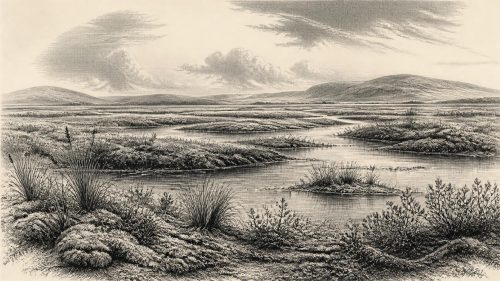
Derryvree’s plant and insect evidence points to a cold, open, largely treeless environment. Mosses and sedges occupied wet margins; aquatic or marsh plants, including bogbean and water-milfoil, indicate standing or slowly moving freshwater. Other botanical remains associated with northern or alpine conditions, among them mountain-avens and lesser clubmoss, support a picture of exposed ground, short growing seasons and severe winters. Fossil insects add to the evidence for periglacial conditions. In the warmer months, however, the basin was not lifeless. Liquid water collected, plants rooted in saturated silt, insects used aquatic and terrestrial niches, and organic matter accumulated in a setting that later ice would preserve.
The safest reconstruction is a mosaic rather than a single landscape label. Around the basin there were likely shallow pools, sedge-rich edges, damp mineral soils and sparsely vegetated ground affected by frost and seasonal thaw. Beyond the wetland, open herb-and-grass communities could have extended across suitable terrain, but the deposit cannot map their precise limits. There is no evidence here for oak woodland, cultivated fields, hedges, livestock, pottery or permanent villages. Nor should modern bogland be projected backwards unchanged: this was a Pleistocene freshwater and periglacial setting, formed under climatic and glacial conditions radically unlike those of present-day Fermanagh.
Animals at Europe’s Western Margin
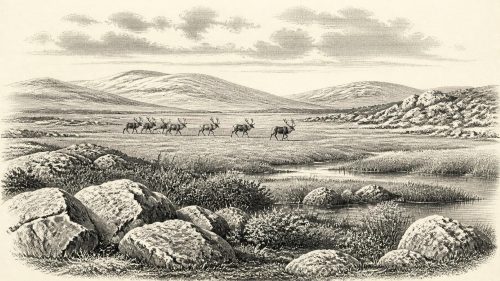
Cave collections elsewhere in Ireland make the wider ecological setting more tangible. The Irish Quaternary Fauna Project showed that a varied mammalian fauna reached or occupied Ireland between at least about 45,000 and 20,000 years ago. Material from caves, especially Castlepook Cave near Doneraile in north County Cork, includes remains attributed to woolly mammoth, reindeer, giant deer, brown bear, wolf, Arctic fox, lemmings and spotted hyaena. Not every specimen belongs to the same moment, and antiquarian excavation, carnivore activity, sediment movement and later disturbance complicate the record. Yet, taken cautiously, these finds demonstrate that Ireland formed part of a wider north-west European ecological world during parts of the pre-Last Glacial Maximum period.
That world had productive but demanding open habitats. Reindeer could exploit cold grassland, herb-rich ground and lichens; mammoth and giant deer signal the presence, at least intermittently, of substantial herbivore resources; wolves and spotted hyaenas indicate predators and scavengers within the food web. A cave bone proves only that an animal died, was transported or was deposited there. Hyaena dens in particular can gather, damage and redistribute bones, making them a warning against simple stories. Nevertheless, the fauna makes clear that the landscapes revealed by Derryvree’s wetland plants were connected to an Ice-Age animal community very different from Ireland’s later and modern fauna.
The Human Question
The possibility of people in Ireland during this broad period depends chiefly on a single, important but still limited find from Castlepook Cave: a reindeer femur from an old collection, reported to carry a deep modification interpreted as a stone-tool cut or chopping mark made while fresh bone was being butchered. The animal has been presented as dating to around 33,000 years ago in radiocarbon terms, and County Cork heritage material identifies the find as potentially evidence of Palaeolithic hunters around 31,000 BCE. If the mark is confirmed as humanly made, it would show that somebody processed a reindeer in Ireland far earlier than the better-established terminal-Pleistocene evidence from County Clare.
That is a major possibility, but not proof of a settled population at 30,546 BCE. The bone did not come from a modern excavation of an undisturbed camp with associated stone tools, hearths, dwelling floors, butchered refuse, human remains and repeated occupation layers. Its scientific age concerns the animal’s death; deciding whether the surface incision is cultural rather than natural is a separate zooarchaeological judgement. Even a confirmed human modification would establish an episode of activity, perhaps a short hunting visit or carcass-processing event, not a village, tribe, polity or continuous line of occupation. Current excavation at Castlepook is valuable precisely because it seeks securely stratified evidence capable of testing these questions.
No Polities, but Changing Possibilities
Accordingly, political affairs, diplomacy, warfare, religion and formal learning cannot responsibly be described for Ireland in this year. There are no named leaders, territories, ritual sites, graves or symbolic objects securely belonging to it. Nor is there evidence for an Irish economy in the later sense of farming, specialist craft, markets or long-distance trade. If people did reach the island in this phase, their practical economy would have depended on highly mobile knowledge: finding game, water, shelter, stone suitable for cutting tools, and routes through a cold, changing landscape. That is an inference from the possible butchered bone and the ecology of comparable Upper Palaeolithic groups elsewhere, not direct evidence for a specific Irish community.
The central development was environmental. Ice-sheet research now emphasises that the British–Irish Ice Sheet was dynamic, with growth, retreat and readvance occurring on different regional schedules. The later Last Glacial Maximum would bring far more extensive ice cover, but its full southern and western extent should not be projected unchanged onto this earlier date. At Derryvree, the two tills and intervening wetland offer a local demonstration of alternation: ice before, water and life during an exposed interval, then ice again. For an Ireland Year by Year account, this is the essential conclusion. Around the modernly assigned year of 30,546 BCE, the best evidence does not preserve an event in human history; it preserves a cold freshwater basin, an open Ice-Age ecosystem and the changing threshold between habitable ground and returning ice.
Primary Sources
- A Middle Midlandian Freshwater Series at Derryvree, Maguiresbridge, County Fermanagh, Northern Ireland
- The IntCal20 Northern Hemisphere Radiocarbon Age Calibration Curve (0–55 cal kBP)
- The Irish Quaternary Fauna Project
- Phylogeographic, Ancient DNA, Fossil and Morphometric Analyses Reveal Ancient and Modern Introductions of a Large Mammal: The Complex Case of Red Deer (Cervus elaphus) in Ireland
- The Timing and Magnitude of the British–Irish Ice Sheet Between Marine Isotope Stages 5d and 2
- Pattern and Timing of Retreat of the Last British-Irish Ice Sheet
- Growth and Retreat of the Last British–Irish Ice Sheet, 31,000 to 15,000 Years Ago: The BRITICE-CHRONO Reconstruction
- Timing, Pace and Controls on Ice Sheet Retreat: an Introduction to the BRITICE-CHRONO Transect Reconstructions of the British-Irish Ice Sheet
- Trimlines, Blockfields and the Vertical Extent of the Last Ice Sheet in Southern Ireland
- Last Glacial Maximum Cirque Glaciation in Ireland and Implications for Reconstructions of the Last Irish Ice Sheet
- Radiocarbon Constraints on the Age of the Maximum Advance of the British–Irish Ice Sheet in the Celtic Sea
- Oscillating Retreat of the Last British-Irish Ice Sheet on the Continental Shelf Offshore Galway Bay, Western Ireland
- New Data for the Last Glacial Maximum in Great Britain and Ireland
- Figure 6.— The Subdivision of the Quaternary Period in Ireland
- Middle Midlandian Interstadial Deposits at Greenagho, Near Belcoo, County Fermanagh, Northern Ireland
- The Stratigraphic Position and Age of the Gortian
- Heritage Artefacts of County Cork
- Archaeological Heritage of County Cork
- 2022:564 – Castlepook Cave, Castlepook South, Cork
- Ireland's Palaeolithic Archaeology – Fleeting Footprints in a Frozen Land
- First Evidence of a Late Upper Palaeolithic Human Presence in Ireland
- New Insights on the Fauna of Ireland's Younger Dryas and Early Holocene from Alice & Gwendoline Cave