Birm-166’s Tundra Pools30599 BCE
At 30,599 BCE, Ireland cannot be described through a precise historical event. Derryvree, County Fermanagh, preserves a freshwater wetland between glacial tills, radiocarbon-dated broadly to 36,900–31,700 years before present. Its fossils show treeless, periglacial tundra with pools, sedges, mosses and cold-adapted plants. The deposit demonstrates local ice-free conditions during unstable Marine Isotope Stage 3, not an island-wide landscape. Cave remains indicate intermittent mammals, including mammoth, reindeer and hyaena, but their contexts are fragmentary. A possibly tool-marked reindeer bone suggests human visits, yet secure evidence for people, settlement or society is absent. Later glaciation preserved and destroyed this rare, local record.
Dateline
30,599 BCE is not a year that can be narrated with calendar precision. It is a modern label for a point roughly 32,548 calendar years before AD 1950, the reference point used for “before present” chronology. No Irish chronicle, settlement sequence or securely dated event can be placed in that individual year. The responsible approach is to use broader calibrated ranges and ask what deposits, fossils and landforms can reveal about Ireland during the relevant part of the last Ice Age. The closest exceptionally informative record is the Derryvree freshwater deposit near Maguiresbridge, County Fermanagh: a buried wetland sequence whose calibrated span includes this notional date.
A Date Within Deep Time
Derryvree was exposed during roadworks in 1969, when a cutting passed through a drumlin. Beneath one mass of glacial till and above another lay silts, fine sands and organic material deposited in freshwater. The stratigraphy is the fundamental evidence. Ice had laid down the lower till; subsequently, local conditions allowed water, plants, insects and sediment to accumulate; later ice deposited the upper till and sealed the earlier landscape. Organic material from the freshwater bed produced radiocarbon determination Birm-166, 30,500 radiocarbon years before present, with a substantial uncertainty of +1,170/−1,030 years.
Radiocarbon years are not calendar years. Atmospheric carbon-14 has fluctuated, so measurements must be calibrated against independently dated records; even the modern IntCal20 curve gives probability ranges rather than an exact day, season or calendar year at this antiquity. Later synthesis places the Derryvree age broadly at 36,900–31,700 calibrated years before present, approximately 34,950–29,750 BCE. Thus 30,599 BCE falls within the range represented by the deposit, but it cannot be assigned to a particular grain of silt, plant, animal or episode in the pool’s history.
Open Ground at Derryvree
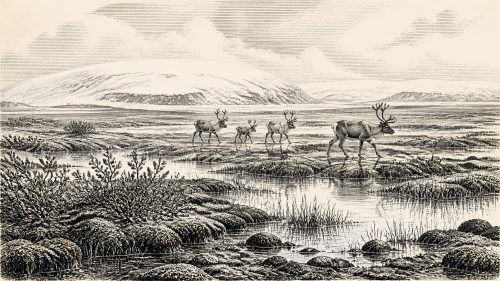
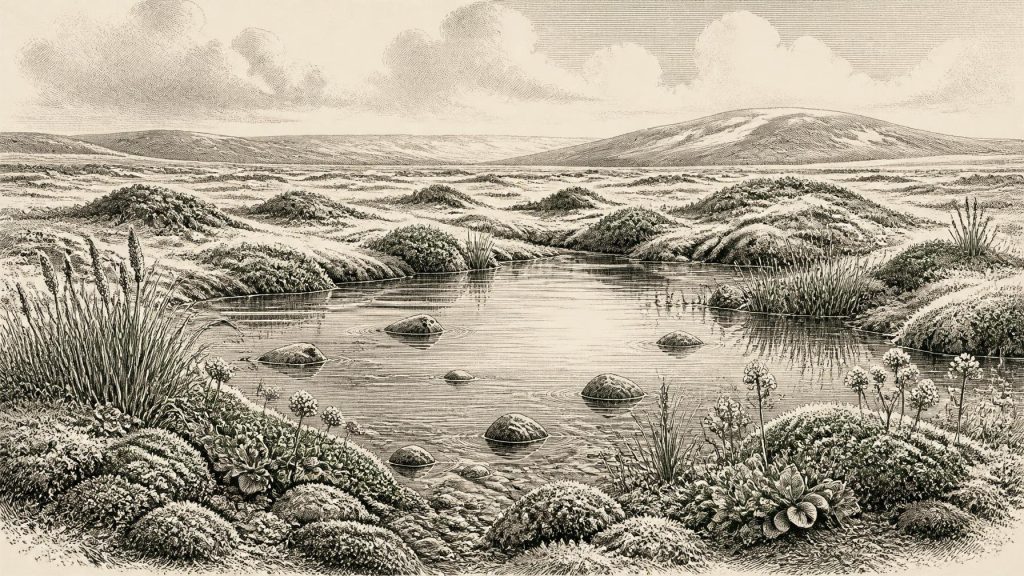
The Derryvree evidence offers a local environmental picture, not a photograph of the whole island. Its plant and animal remains indicate open tundra vegetation and a periglacial climate: ground subject to severe cold, frost action and seasonal thaw, rather than a wooded Irish landscape. Pollen, plant macrofossils, mosses and insects point to wet, organic-rich ground with shallow open water, mossy margins and surrounding sedge-rich vegetation. Earlier writers used the northern ecological term muskeg for this mosaic of saturated, peaty terrain, pools and plant matter.
Individual fossils make that reconstruction more tangible. Derryvree has yielded evidence for bogbean (Menyanthes trifoliata), a plant of freshwater or wetland margins, and for arctic-alpine species including mountain avens (Dryas octopetala) and lesser clubmoss (Selaginella selaginoides). These are evidence that suitable microhabitats existed in and around the basin; they do not mean that modern Fermanagh vegetation, rainfall or temperatures can be projected backwards unchanged. The best interpretation is a treeless, cold landscape in which wet hollows could sustain distinctive plant communities during an interval between glacial advances.
Ice, Water and Changing Coasts
This was Marine Isotope Stage 3, a climatically unstable portion of the last glacial period. Ireland’s ice history at this age remains difficult to reconstruct because later glaciers eroded, transported and buried much of the earlier record. Derryvree is therefore important precisely because it demonstrates ice-free conditions at one Fermanagh locality before renewed glaciation. It does not demonstrate that every region of Ireland was simultaneously ice-free, nor does it supply a simple island-wide ice margin for 30,599 BCE.
Speleothem dating from Crag Cave in County Kerry provides a different kind of evidence. Calcite growth in shallow caves requires liquid water and is associated there with episodes of climatic amelioration during MIS 3. Its timing broadly corresponds with Greenland interstadials, while the Derryvree calibrated range has been correlated approximately with Greenland Interstadials 8 to 5. Such correlations are useful for setting Irish evidence within North Atlantic climate change, but they are not a licence to turn a Greenland ice-core signal into a precise Irish weather report.
The wider landscape was also unlike modern Ireland. Sea level was generally far lower during glacial conditions, exposing land now submerged around the island, while coastlines, river routes and passages to Britain changed repeatedly as ice and sea level changed. This made animal dispersal possible at some times, but the exact geography of crossings and barriers around 30,599 BCE remains uncertain. The later maximum extent of the British–Irish Ice Sheet still lay ahead; current reconstructions treat the growth, extent and timing of ice before the Last Glacial Maximum with appropriate caution.
Animals in a Cold-Stage Ireland
Caves, especially in southern Ireland, preserve another fragmentary archive. Castlepook Cave near Doneraile, County Cork, has produced remains of mammoth, reindeer, spotted hyaena and other cold-stage animals. Re-dating has shown that several old cave determinations underestimated the antiquity of the fauna; the results indicate that some mammals occupied Ireland during MIS 3 and that giant deer and spotted hyaena may have disappeared locally before the Last Glacial Maximum. Cave collections nevertheless demand care: many were excavated long ago, deposits were disturbed, and bones from different episodes can be mixed.
It is therefore reasonable to envisage ecological links between Irish open country and the wider north-west European cold-stage world, with large herbivores and their predators entering or leaving as conditions permitted. It is not reasonable to claim a stable, island-wide “mammoth-steppe” community in this particular year. Derryvree’s wetland evidence and Castlepook’s cave fauna come from different places and record intervals, not one contemporary scene. Their value lies in showing that late Pleistocene Ireland contained varied habitats and intermittent animal populations before later ice reshaped the evidence.
The Human Question
The possibility of people in Ireland is the most arresting, and most contested, issue. A reindeer femur from Castlepook has been reported as about 33,000 years old and bears a deep mark interpreted by zooarchaeologist Ruth Carden as possible fresh-bone processing with a stone tool. If that interpretation is confirmed, it would suggest an Upper Palaeolithic human visit to Ireland long before the better-established post-glacial archaeological record. Yet the femur was not recovered from a modern, securely stratified excavation alongside a stone-tool assemblage, hearth, dwelling or human remains. A date on the animal’s death cannot, by itself, prove when the mark was made or who made it.
For that reason, no named people, resident community or cultural tradition can responsibly be placed in Ireland in 30,599 BCE. The National Museum of Ireland continues to state that clear evidence for human presence in the Irish Palaeolithic has not yet emerged. Current investigations at Castlepook are valuable because they seek intact deposits and new contextual evidence, not because they have already supplied a settled narrative of Ice Age settlement. The historical fact here is uncertainty: people may have made brief incursions, but permanent occupation, population size and routes of travel are unproven.
No Polities, No Recorded Beliefs
Accordingly, there is no evidence for political affairs, warfare, diplomacy, chiefs, law, trade networks, formal religion, art or learning in Ireland at this date. Nor can the routines of a household be reconstructed from Derryvree’s plants or Castlepook’s bones. If small human groups did visit, they would have depended on mobility, knowledge of seasonal terrain and access to animal and plant resources; that is a general inference from hunter-gatherer lifeways, not direct evidence for an Irish camp. It would be wrong to supply invented hunters, rituals or conflicts merely to make the period feel familiar.
The economy most securely visible is ecological rather than human: wetland plants growing, insects inhabiting pools, herbivores moving through suitable open terrain, and carnivores using caves or landscapes where prey was available. At Derryvree, sediment accumulated slowly enough to preserve this evidence; elsewhere, advancing ice and later erosion destroyed or scrambled much of the record. The absence of houses, tools and graves is not proof that no person ever crossed the region. It is, however, decisive against claiming a documented society in this numbered year.
A Buried Wetland’s Legacy
The most important development relevant to 30,599 BCE was environmental instability. In Fermanagh, a freshwater wetland existed during an ice-free interval, supporting a cold-adapted, treeless biota. It was later overridden or enclosed by renewed glacial deposition, preserving a rare sequence between tills. That sequence is richer than speculation: it establishes the order of ice, water, life and ice again. Ireland at this point is best understood not as a stage for known events, but as a changing Ice Age landscape whose surviving evidence is exceptionally sparse, local and precious.
Primary Sources
- A Middle Midlandian Freshwater Series at Derryvree, Maguiresbridge, County Fermanagh, Northern Ireland
- The IntCal20 Northern Hemisphere Radiocarbon Age Calibration Curve (0–55 cal kBP)
- A Reconsideration of the Radiocarbon Dating of the Marine Isotope Stage 3 Fauna from Southern Ireland
- The Irish Quaternary Fauna Project
- Episodic Speleothem Deposition Tracks the Terrestrial Impact of Millennial-Scale Last Glacial Climate Variability in SW Ireland
- Growth and Retreat of the Last British–Irish Ice Sheet, 31,000 to 15,000 Years Ago: the BRITICE-CHRONO Reconstruction
- The Timing and Magnitude of the British–Irish Ice Sheet Between Marine Isotope Stages 5d and 2
- Exploring Controls of the Early and Stepped Deglaciation on the Western Margin of the British–Irish Ice Sheet
- A Stratigraphic Framework for Abrupt Climatic Changes During the Last Glacial Period Based on Three Synchronized Greenland Ice-Core Records
- Irish Pleistocene Biostratigraphy
- Freshwater Organic Deposits and Stratified Sediments Between Early and Late Midlandian (Devensian) Till Sheets, at Aghnadarragh, County Antrim, Northern Ireland
- New Insights on the Fauna of Ireland’s Younger Dryas and Early Holocene from Alice & Gwendoline Cave
- Ireland’s Palaeolithic Archaeology – Fleeting Footprints in a Frozen Land
- Archaeology Research Excavation Grant 2022: Castlepook Cave Final Report
- 32564: Castlepook Cave, County Cork
- Prehistoric Details: Stone Age
- Figure 6.— The Subdivision of the Quaternary Period in Ireland
- Menyanthes trifoliata L.
- Dryas octopetala L.
- Selaginella selaginoides (L.) P. Beauv.
- The Irish Quaternary Fauna Project: Pleistocene Faunal Evidence
- Reindeer Bone Found in Cork Cave Shows Human Activity in Ireland 33,000 Years Ago