Peace at Fid Conaill1097 CE
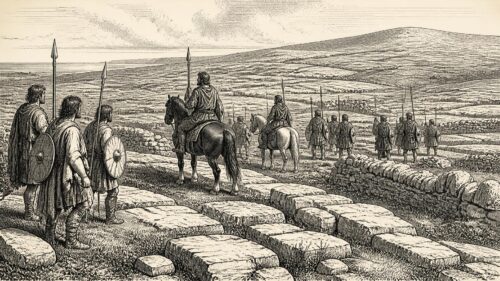
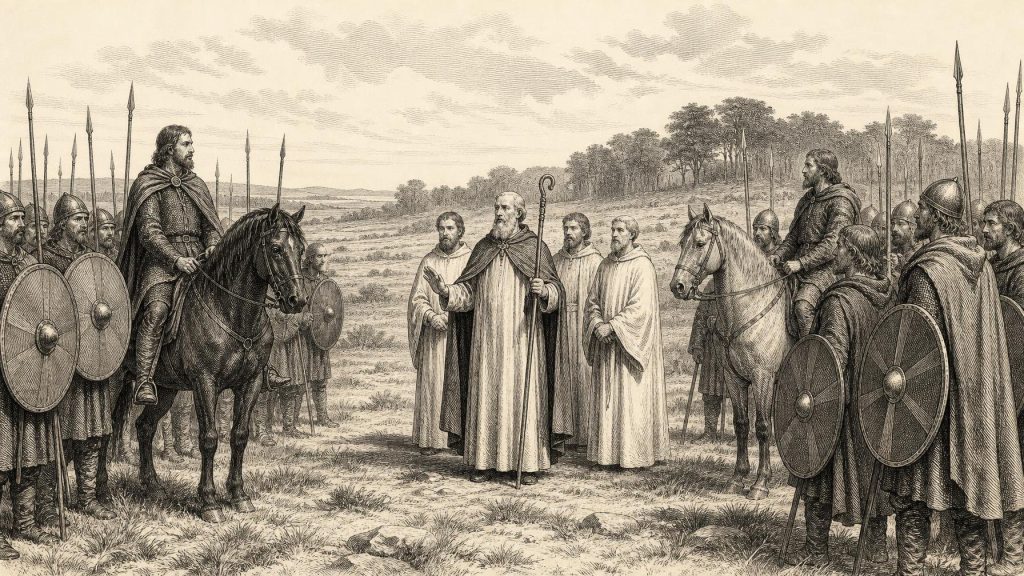
In 1097, Muirchertach Ua Briain led a southern coalition to Mag Muirtheimne, where Domnall Ua Lochlainn’s northern army confronted it at Fid Conaill. Abbot Domnall of Armagh brokered an uneasy peace, demonstrating ecclesiastical influence without ending royal rivalry. Connacht suffered renewed instability after Tadc Ua Conchobair’s killing and Flaithbertach Ua Flaithbertaig’s contested restoration. Regional rulers died or were killed, while notable churchmen also died. Fire destroyed books and treasures at Monasterboice. Exceptionally abundant nuts fattened swine, lowered prices and supported food supplies. The annals thus depict political conflict, cultural loss, church diplomacy and rural economic abundance across late eleventh-century Ireland.
Dateline
The surviving record of 1097 is unusually revealing. Ireland’s annalists noted a confrontation between the two strongest kings on the island, a violent succession crisis in Connacht, the death of prominent churchmen and regional rulers, and a disastrous fire at Monasterboice. They also preserved something rarer: evidence of an exceptionally abundant nut harvest and its effect on food supply and prices. None of these events can be assigned a securely known day or month. Together, however, they illuminate a country in which political authority was negotiated through military hostings, hostages, kinship and ecclesiastical intervention, while most people remained closely dependent on livestock, woodland and the seasonal harvest.
Two Kings Confront Each Other
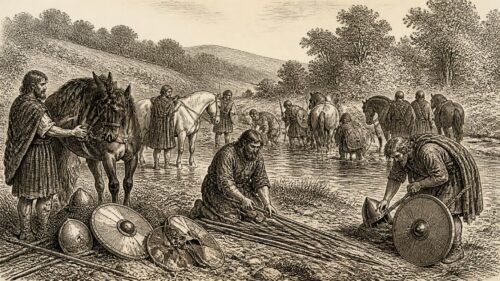
The year’s most important political event was the northern expedition of Muirchertach Ua Briain, king of Munster and the leading power in southern Ireland. The Annals of Ulster say that he advanced with Leth Mogha—the traditional southern half of Ireland—to Mag Muirtheimne in what is now County Louth. The later Annals of the Four Masters give a fuller coalition: the southern forces included the men of Meath and some Connachtmen. Such a hosting was more than a raid. By leading rulers and contingents far beyond Munster, Muirchertach publicly asserted a claim to authority over much of Ireland.
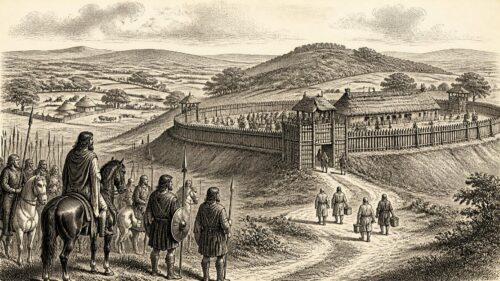
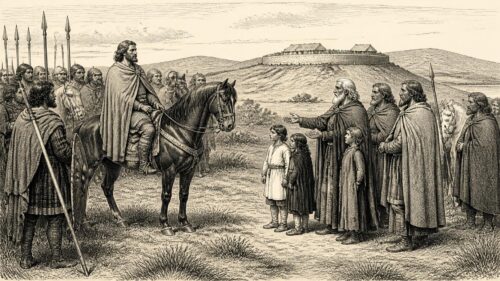
Domnall Ua Lochlainn, king of Ailech and leader of Cenél nEógain, answered by assembling the forces of the north. His army reached Fid Conaill, apparently intending to give battle. Mag Muirtheimne and the territory of Conaille Muirtheimne lay around the Dundalk plain and the approaches between the Irish midlands and Ulster. The encounter therefore occurred in a politically sensitive frontier zone rather than deep inside either king’s homeland. Muirchertach could advance there, but Domnall could meet him with a substantial army. Neither possessed an uncontested high-kingship; power depended upon maintaining alliances and repeatedly demonstrating military reach.
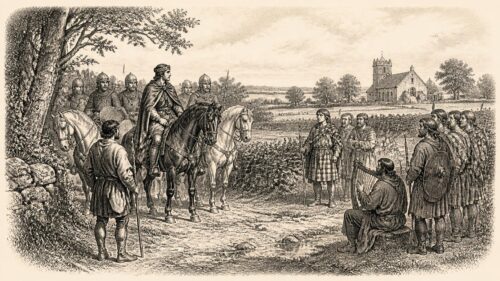
No battle followed. Domnall, abbot of Armagh and “successor of Patrick”, intervened between the armies. The Annals of Ulster cautiously describe what resulted as a “semblance of peace”, suggesting an armed stand-off settled without resolving the rivalry. The Four Masters more piously credited God and Patrick’s successor with making peace. This was the first of several recorded occasions on which the head of Armagh prevented Muirchertach Ua Briain and Domnall Ua Lochlainn from fighting. The settlement avoided immediate bloodshed, but it did not end their competition.
Armagh and Political Authority
Abbot Domnall’s intervention shows that major churches were active political institutions. Armagh claimed primacy through its association with St Patrick, and its head possessed influence extending far beyond the church’s landed community. An abbot who stood between two royal armies acted as negotiator, guarantor and representative of a sacred authority that neither king could lightly disregard. Muirchertach’s willingness to accept intervention also reflected political realism: recognition from Armagh could strengthen a southern ruler’s claim to kingship throughout Ireland, while hostility from Armagh would favour his northern opponent.
This does not mean that churchmen commanded kings or that Ireland was already organised into the territorial dioceses established during the twelfth-century reform movement. Older monastic offices, hereditary ecclesiastical families and emerging ideas of episcopal government existed together. The peace of 1097 belongs to that transitional world. Ecclesiastical authority rested upon saints’ cults, relics, learning, property and networks of patronage, but it could also produce a practical diplomatic result when rival armies faced one another.
Crisis in Connacht
Connacht experienced a more immediately violent political upheaval. Tadc, son of Ruaidrí na Saide Buide Ua Conchobair, was killed by his own people. The sources vary in describing his position: the Annals of Ulster call him the heir-designate of Connacht, while the Annals of Tigernach and Chronicon Scotorum treat him as king. The Four Masters describe him as lord of Síl Muiredaig and defender of the province. They add that he was only twenty-four and that the killing was carried out treacherously by members of Clann Conchobair and a trusted follower, the son of Cú Luachra Ua Mael Brenainn.
The conflicting titles reflect Connacht’s divided condition rather than a simple contradiction. Tadc’s father Ruaidrí had been blinded and displaced in 1092 by Flaithbertach Ua Flaithbertaig, ruler of western Connacht. Other dynasties and branches of the Uí Briúin also sought provincial authority, while Muirchertach Ua Briain exploited the fragmentation. Tadc may have been recognised as the legitimate Ua Conchobair claimant without exercising undisputed control over the whole province. His death removed an able young representative of Síl Muiredaig and deepened the uncertainty.
The annals next report that Flaithbertach Ua Flaithbertaig returned to his patrimony and went to Áed “of the Gapped Spear”, an Ua Conchobair dynast. Chronicon Scotorum says that Flaithbertach received the kingship of Síl Muiredaig, whereas the Annals of Tigernach describe him as taking the kingship of Connacht. The precise arrangement is unclear, but it was evidently an attempt to establish authority through accommodation with part of the Ua Conchobair dynasty. It proved temporary: Flaithbertach was killed in 1098 in vengeance for Ruaidrí’s blinding. That later outcome should not be projected backwards as inevitable, but it demonstrates how unstable the settlement of 1097 remained.
Regional Violence
Smaller kingdoms were caught in comparable struggles. Lochlainn Ua Duibdara, king of Fernmag, was killed by the Uí Briúin of Bréifne. Fernmag lay in the borderlands associated with modern County Monaghan, while Bréifne extended through parts of the north-west midlands. The terse notice gives neither location nor motive, so it would be unsafe to reconstruct a battle. It nevertheless shows that the great confrontation in Louth did not suspend local warfare. Regional kings continued to pursue their own claims, feuds and territorial interests beneath the broader rivalry of Ua Briain and Ua Lochlainn.
Aimhirgin Ua Mordha, ruler of Laois, also died during the year, apparently naturally, since the annals use the conventional language of repose rather than killing. The Four Masters additionally record the killing of Ua Carthaigh, described by them as chief poet of Connacht. As that detail is not shared by the earliest surviving notices, it should be treated with greater caution. Even so, the entry reflects the recognised public standing of professional poets, whose learning, praise, satire, genealogy and historical knowledge connected culture directly with aristocratic politics.
Loss at Monasterboice
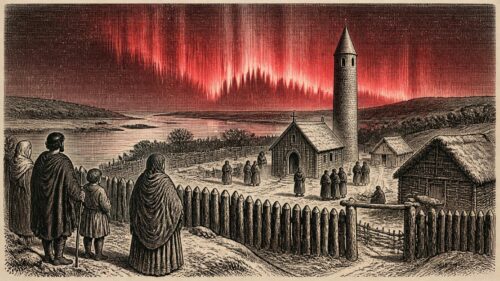
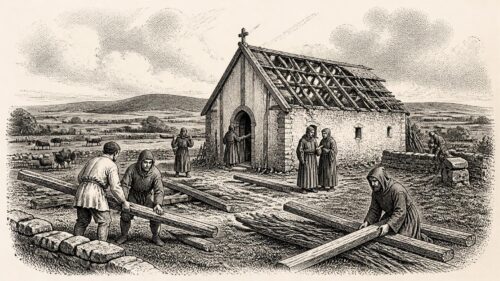
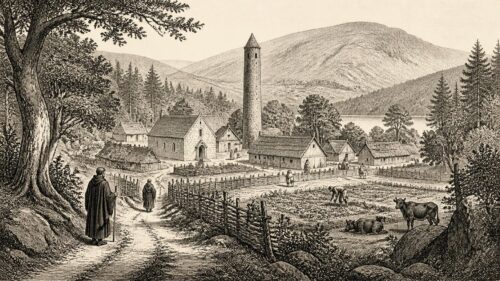
The most serious cultural loss was the burning of the bell-tower at Monasterboice, County Louth, together with its books and “many treasures”. The annals do not say whether the fire was accidental or deliberate. Nor is it certain that the surviving stone round tower is precisely the structure described; architectural interpretations allow for rebuilding or alteration. What is secure is that books and valuables were being kept within the tower complex when the fire occurred. This is exceptional direct evidence for the use of such towers as secure storage as well as belfries and conspicuous landmarks.
Monasterboice had long been a major centre of devotion, scholarship and artistic patronage. Its high crosses presented ambitious programmes of biblical imagery, while the scholar Flann Mainistrech, who died in 1056, had been celebrated for learning in literature, history, poetry and other disciplines. The destruction of manuscripts in 1097 was therefore not merely damage to property. Every handwritten book represented expensive materials and prolonged skilled labour; some texts may have survived nowhere else. The blaze offers a sobering reminder that the surviving corpus of medieval Irish writing is only a portion of what once existed.
Churchmen and Learning
Máel Brigte Ua Brolcháin, bishop of Kildare and of Leinster, died in 1097. The annals praise him as learned or noble, and the Four Masters call him a doctor. His title associates the ancient foundation of St Brigid at Kildare with authority across the wider province of Leinster. Flannacán Ruad, superior of Roscommon and, according to the Four Masters, lector of Tuam, also died. Máelán Ua Cuinn, an airchinnech connected with Clonmacnoise, appears in the later compilation. These notices reveal a landscape joined by educated clerics moving among important churches and holding offices that combined worship, teaching, estate management and family influence.
The Year of White Nuts
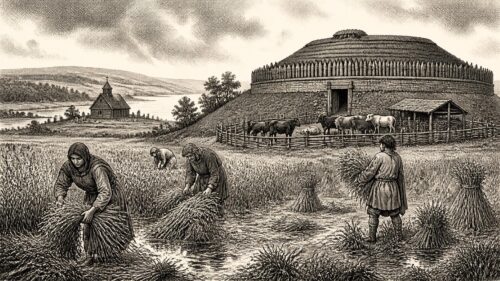
The annalists remembered 1097 as the “year of the white nuts”. Nuts were so abundant, the Four Masters say, that Ireland’s swine were fattened and part of the crop remained usable for two further years. The Annals of Ulster add that thirty years had passed since the previous comparable harvest. A measure of nuts, termed a seiseadhach in the later translation, could be obtained for one penny. The exact capacity of that measure is uncertain, but the price notice clearly conveys exceptional cheapness and plentiful supply.
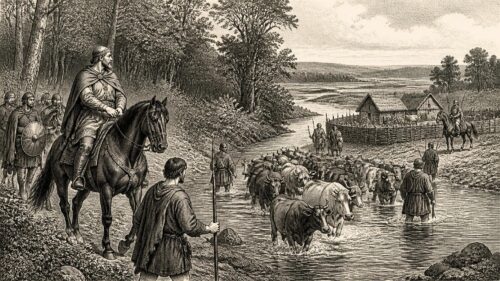
For ordinary households this mast year may have mattered more immediately than the meeting of kings. Pigs could be driven into managed woodland to feed upon hazelnuts, acorns and other fallen mast, converting a seasonal windfall into meat and preserved food. Archaeological and textual studies show that cattle remained central to wealth, dairying and farming, but pigs, sheep, cereals and gathered foods all contributed to subsistence. Most people worked in a rural landscape of farmsteads, enclosures, fields, woodland and routeways rather than in the coastal towns.
The mention of a penny does not prove that all rural exchange was conducted in coins. Silver pennies had been minted in Hiberno-Norse Dublin since around the end of the tenth century, and coin use was strongest in towns and trading networks. Elsewhere, cattle, food renders, precious metal and obligations remained important forms of value. Yet the annalist’s ability to express the nut glut as a market price shows that monetary reckoning formed part of late eleventh-century Irish economic life.
A Year Without Resolution
No ruler emerged decisively victorious in 1097. Muirchertach Ua Briain demonstrated that he could bring a composite army to Ireland’s northern approaches, but Domnall Ua Lochlainn prevented further advance. Armagh’s abbot preserved peace without eliminating the cause of war. In Connacht, murder and negotiated restoration rearranged authority but did not stabilise it. Monasterboice suffered an irreplaceable intellectual loss, while a remarkable natural abundance improved the prospects of farmers and swineherds. The year’s importance lies precisely in this mixture: ambitious kings and influential churchmen occupied the annals’ foreground, but books, woodland produce, livestock and prices reveal the material world upon which their power ultimately depended.
Primary Sources
- The Annals of Ulster – Year U1097
- Annals of the Four Masters – Part 20
- The Annals of Tigernach – Part 20
- Chronicon Scotorum – Part 134
- Annals of Inisfallen
- Ua Briain, Muirchertach – Dictionary of Irish Biography
- Domnall – Dictionary of Irish Biography
- Ua Conchobair, Ruaidrí na Saide Buide – Dictionary of Irish Biography
- Monasterboice Monastic Site – Heritage Ireland
- Monasterboice, County Louth – National Monuments Service
- Monasterboice – Corpus of Romanesque Sculpture in Britain and Ireland
- Monasterboice Conservation Study
- Early Medieval Louth: The Kingdom of Conaille Muirtheimne
- Early Irish Population-Groups: Their Nomenclature, Classification, and Chronology – Part 3
- The Mac Lochlainn High-Kingship in Late Pre-Norman Ireland
- The Practice of Irish Kingship in the Central Middle Ages
- The Cenél nEógain and their Expansion, 1000–1150
- The Political Development of the Mac Lochlainn Dynasty
- The Archaeology of Livestock and Cereal Production in Early Medieval Ireland, AD 400–1100
- Agriculture, Settlement and Society in Early Medieval Ireland
- Early Medieval Farming and Food Production: A Review of the Archaeobotanical Evidence from Archaeological Excavations in Ireland
- Pigs, People, and Proximity: A 6000-Year Isotopic Record of Pig Management in Ireland
- 950–1450: Vikings, Normans and Medieval Mints – National Museum of Ireland
- Viking Collections – National Museum of Ireland
- Early Medieval Ireland 400–1200
- Ireland Before the Normans