Tundra Juniper31474 BCE
31,474 BCE is a modern label rather than a recoverable Irish year, corresponding roughly to 33,400 calibrated years before present in climatically unstable MIS 3. Derryvree, County Fermanagh, preserves sediments between glacial tills, dated broadly 36,900–31,700 cal BP, revealing treeless tundra wetlands with grasses, sedges, juniper, insects and seasonal freshwater. Castlepook Cave, County Cork, yielded bones of mammoth, giant deer, reindeer, bear and hyaena, though its mixed deposits cannot establish contemporaneity. No secure evidence proves human settlement, culture or economy. A possibly tool-marked reindeer bone may indicate brief human presence. Later glaciation obscured much evidence from this shifting ice-age frontier.
Dateline
31,474 BCE is a modern chronological label, not a recoverable year in Ireland’s own past. No calendar, written record, named community or datable event allows historians to identify what happened during those particular twelve months. Converted into the archaeological convention of years before AD 1950, it falls at roughly 33,400 calibrated years before present (cal BP), within the Late Pleistocene and Marine Isotope Stage 3 (MIS 3). At this depth of time, radiocarbon determinations must be calibrated and reported as ranges with margins of probability, rather than treated as precise anniversaries.
The responsible subject is therefore Ireland during the broader interval around 33,400 cal BP: a cold, climatically variable country whose surviving history is preserved in exceptional deposits rather than in settlements or monuments. The clearest Irish evidence comes from buried wetland sediments at Derryvree near Maguiresbridge, County Fermanagh, and from the animal remains accumulated in Castlepook Cave near Doneraile, County Cork. Together they show a land of open vegetation, severe winters, freshwater hollows and large mammals. They do not provide evidence for a population, a polity or a continuous human occupation.
Dating a Landscape, Not a Year
The most useful chronological anchor is the Derryvree freshwater series. Roadworks in 1969 exposed a section through a drumlin in which fine sands, silts and organic layers lay between two thick sheets of glacial till. The sequence is significant because it records a period when water, vegetation and sediment accumulated after one episode of ice deposition and before a later glacial advance sealed the deposits beneath more till. Organic material from the sediments produced the radiocarbon determination BIRM-166, 30,500 radiocarbon years BP, with an uncertainty of roughly a thousand years. Modern calibration places it broadly between about 36,900 and 31,700 cal BP.
That wide range includes the modern label 31,474 BCE, but it cannot tell us whether a particular pool, plant or animal belonged to that exact year. Nor should the date be used to create a false impression that all the materials in the deposit formed simultaneously. What Derryvree provides is a securely ordered environmental archive: an interval of ice-free or locally ice-free ground in Fermanagh, later overridden or enclosed by glacial processes. Its evidence is especially valuable because subsequent ice action destroyed or deeply buried much of Ireland’s earlier surface record.
The wider climate was unstable. MIS 3 was not one unbroken winter, nor was it a warm interlude. Greenland ice-core records and Irish cave deposits indicate repeated shifts between colder stadial conditions and relatively milder interstadials on millennial scales. At Crag Cave in County Kerry, uranium-thorium dating of speleothems shows that calcite formed episodically during MIS 3. Because such growth requires liquid water moving through the cave system, it is evidence for intervals when local mean annual conditions were not permanently below freezing. It does not mean that all of Ireland was mild, wooded or ice-free at the same time.
A Treeless Wetland in Fermanagh
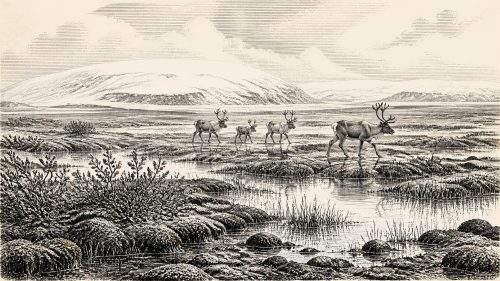
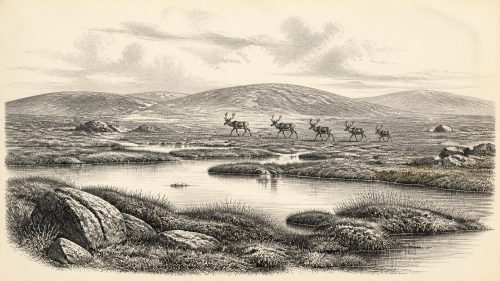
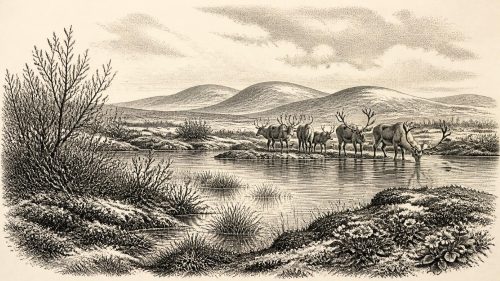
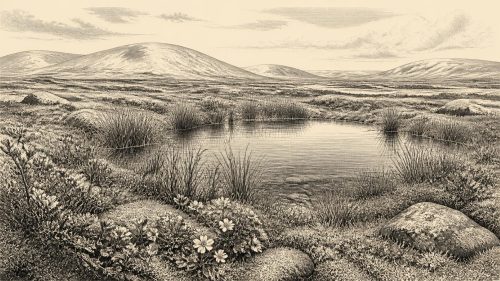
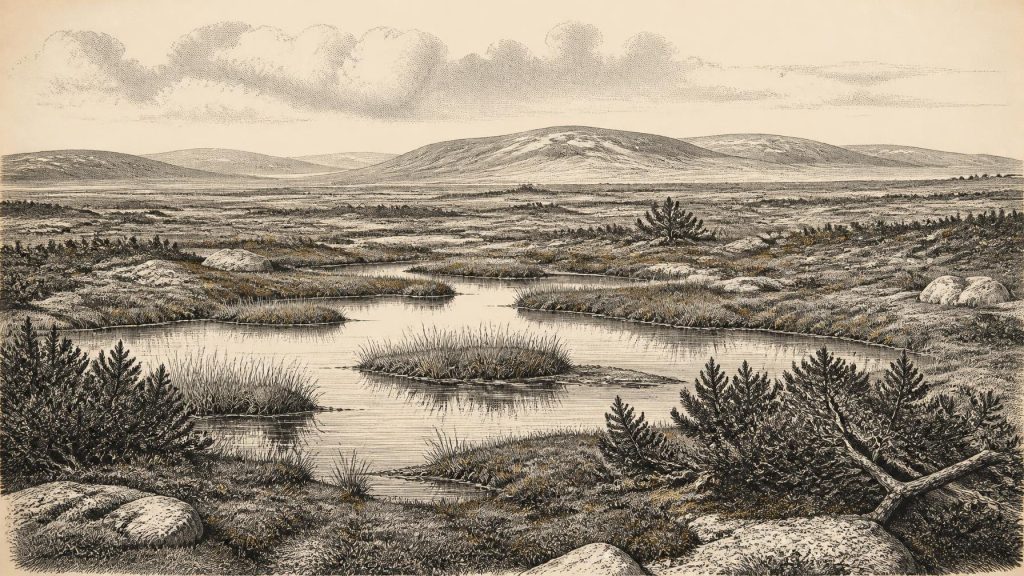
Derryvree’s pollen, plant macrofossils, mosses and insect remains point to an open, treeless tundra or muskeg landscape. Grasses and sedges were important components, accompanied by herbs and low shrubs including juniper. Plant evidence also includes species associated with cold, wet or arctic-alpine conditions, while the insects indicate shallow pools, abundant decaying plant matter and mossy wet ground. This was not a featureless snow desert. It was a patchwork of saturated hollows, open water, peat-forming vegetation, mineral ground and exposed terrain, changing with season and climate.
Winters were harsh, and periglacial conditions shaped the land. Frozen ground, seasonal thaw, strong winds and short growing seasons would have restricted trees and favoured plants able to exploit brief summers. Yet freshwater life and wetland vegetation demonstrate that water remained available for at least part of the year. The contrast matters. Ireland around this time should not be pictured as continuously buried under the maximum ice sheet of the later Last Glacial Maximum. That maximum lay ahead: the British–Irish Ice Sheet reached its most extensive Late Pleistocene limits broadly around 27,000–23,000 cal BP, when Ireland and much of its continental shelf were covered by ice.
Regional variation was probably pronounced. Fermanagh’s buried wetland says much about one northern inland locality, not everything about Cork, the west coast or upland districts. Local glacier margins, altitude, exposure to Atlantic moisture and changing sea levels would all have affected conditions. Nevertheless, the Derryvree archive establishes an important point: near this notional date, parts of Ireland could sustain terrestrial and freshwater ecosystems between glacial advances.
Castlepook’s Animal World
In north Cork, Castlepook Cave—also known as Mammoth Cave or Doneraile Cave—preserves Ireland’s richest known assemblage of vertebrate remains from the period leading towards the Last Glacial Maximum. Excavations undertaken largely in the early twentieth century, and later investigations, recovered more than 2,000 bones from its galleries. The cave has yielded woolly mammoth, giant deer, reindeer, brown bear and spotted hyaena, as well as later cold-stage animals including Arctic fox, wolf and lemmings.
The list is striking, but it demands careful reading. A cave is not a simple census of an ancient field. Carnivores may have dragged prey or carrion into it; water disturbed deposits; early excavations did not always preserve the detailed stratigraphic information expected today; and individual bones from the site span a long period. Radiocarbon dates from Castlepook include a mammoth specimen at about 33,500 radiocarbon years BP and a spotted-hyaena specimen at about 34,300 radiocarbon years BP, each with substantial uncertainty. These dates broadly connect the cave fauna with the Derryvree cold-phase environment, but they do not demonstrate that every species lived side by side, or that all were present in 31,474 BCE.
Even so, the fauna reveals an Irish landscape capable of supporting sizeable herbivores and their predators during favourable phases of MIS 3. Reindeer suggest open, cold-country grazing. Mammoth and giant deer indicate that parts of the wider landscape offered substantial forage, though their preferred habitats and seasonal movements need not have been identical. Spotted hyaenas, which chewed and accumulated some of the Castlepook bones, show that Ireland was part of a much wider north-west European ecological world. Their presence also explains why the cave is rich in bones: it was, at least at times, a carnivore-used repository rather than a human camp.
The Human Question
There is no secure evidence for a settled human community in Ireland at roughly 33,400 cal BP. No hearth, dwelling floor, stone-tool assemblage, burial, art or repeated occupation sequence of this age has been established. Consequently, there can be no responsible account of political affairs, diplomacy, organised warfare, chiefs, religious observance, formal learning or trade networks for Ireland in this year. These are not merely missing details; they are categories for which the evidence is absent.
One object makes the question of human presence worth keeping open. A reindeer femur from Castlepook has been reported as bearing a deep mark made on fresh bone by a sharp stone tool, and has been publicised as approximately 33,000 years old. If that interpretation and association are upheld, the mark could indicate that Upper Palaeolithic people processed a reindeer in Ireland during the pre-Last Glacial Maximum period. It would be an important sign of a brief visit or hunting episode, not proof of permanent settlement. The bone was recovered from a complex cave context, without an associated tool assemblage, and natural damage, carnivore activity, excavation history and dating associations all remain essential considerations.
The distinction between evidence and interpretation is crucial. It is reasonable to say that people may have entered Ireland during MIS 3 and that they may have butchered an animal. It is not reasonable to imagine a named band, a village, a seasonal camp at Castlepook or a developed Irish hunting culture from one marked bone. Nor can archaeologists yet specify how any visitors crossed the sea barriers and changing coastal landscapes around the island. Lower sea levels exposed more land than today, but routes, shorelines and crossings in this period remain poorly reconstructed.
Economy, Culture and the Long Silence
For non-human animals, the economy of the landscape was ecological: grazing and browsing on open vegetation; predation and scavenging; use of caves as shelter or dens; and movement through a changing mosaic of wetland and dry ground. If humans were present, their likely subsistence would have centred on mobile hunting, scavenging and butchery, but this remains an inference from the broader European Upper Palaeolithic, not a demonstrated Irish practice. There is no Irish evidence at this date for farming, herding, pottery, metalworking, monuments, long-distance exchange goods or built settlements.
Culture and religion are similarly beyond direct recovery. People elsewhere in Europe made sophisticated tools, ornaments, images and burials during the broad Upper Palaeolithic, but no such material can be assigned to Ireland around 31,474 BCE. The absence may partly reflect the destructive force of later glaciation and the difficulty of locating deeply buried or submerged landscapes. It may also reflect Ireland’s peripheral geography and genuinely infrequent human visitation. Archaeology cannot yet decide the balance between those explanations.
What can be said is both modest and remarkable. Around this point in the last Ice Age, Ireland was not yet the settled island of later prehistory. It was a shifting cold-world frontier, inhabited certainly by plants, insects and mammals, and reshaped repeatedly by ice and water. Derryvree’s silts preserve the intimacy of a tundra wetland; Castlepook’s bones preserve a wider animal community and a possible human trace. Their very scarcity is part of the history. They are fragments from a landscape in which survival, movement and environmental change mattered far more than the calendar year later generations would attach to it.
Source References
Hover over a number to see the source. Select it to open the source.

- [1] A Middle Midlandian Freshwater Series at Derryvree, Maguiresbridge, County Fermanagh, Northern Ireland
- [2] Irish Pleistocene Biostratigraphy
- [3] The Irish Quaternary Fauna Project
- [4] Castlepook Cave (CK032)
- [5] Heritage Artefacts of County Cork
- [6] Episodic Speleothem Deposition Tracks the Terrestrial Impact of Millennial-Scale Last Glacial Climate Variability in SW Ireland
- [7] Episodic Speleothem Deposition Tracks the Terrestrial Impact of Millennial-Scale Last Glacial Climate Variability in SW Ireland
- [8] The IntCal20 Northern Hemisphere Radiocarbon Age Calibration Curve (0–55 cal kBP)
- [9] IntCal Publications
- [10] IntCal History
- [11] Maximum Extent and Dynamic Behaviour of the Last British–Irish Ice Sheet West of Ireland
- [12] Ireland: Submerged Prehistoric Sites and Landscapes
- [13] The Colonization of Ireland: A Human Ecology Perspective
- [14] First Evidence of a Late Upper Palaeolithic Human Presence in Ireland
- [15] First Evidence of a Late Upper Palaeolithic Human Presence in Ireland
- [16] New Insights on the Fauna of Ireland’s Younger Dryas and Early Holocene from Alice & Gwendoline Cave
- [17] New Insights on the Fauna of Ireland’s Younger Dryas and Early Holocene from Alice & Gwendoline Cave
- [18] Mammoth Cave, County Cork
- [19] The Mesolithic in Ireland: When Was It?
- [20] Phylogeographic, Ancient DNA, Fossil and Morphometric Analyses Reveal Ancient and Modern Introductions of a Large Mammal: The Complex Case of Red Deer (Cervus elaphus) in Ireland
Primary Sources
- A Middle Midlandian Freshwater Series at Derryvree, Maguiresbridge, County Fermanagh, Northern Ireland
- Irish Pleistocene Biostratigraphy
- The Irish Quaternary Fauna Project
- Castlepook Cave (CK032)
- Heritage Artefacts of County Cork
- Episodic Speleothem Deposition Tracks the Terrestrial Impact of Millennial-Scale Last Glacial Climate Variability in SW Ireland
- Episodic Speleothem Deposition Tracks the Terrestrial Impact of Millennial-Scale Last Glacial Climate Variability in SW Ireland
- The IntCal20 Northern Hemisphere Radiocarbon Age Calibration Curve (0–55 cal kBP)
- IntCal Publications
- IntCal History
- Maximum Extent and Dynamic Behaviour of the Last British–Irish Ice Sheet West of Ireland
- Ireland: Submerged Prehistoric Sites and Landscapes
- The Colonization of Ireland: A Human Ecology Perspective
- First Evidence of a Late Upper Palaeolithic Human Presence in Ireland
- First Evidence of a Late Upper Palaeolithic Human Presence in Ireland
- New Insights on the Fauna of Ireland’s Younger Dryas and Early Holocene from Alice & Gwendoline Cave
- New Insights on the Fauna of Ireland’s Younger Dryas and Early Holocene from Alice & Gwendoline Cave
- Mammoth Cave, County Cork
- The Mesolithic in Ireland: When Was It?
- Phylogeographic, Ancient DNA, Fossil and Morphometric Analyses Reveal Ancient and Modern Introductions of a Large Mammal: The Complex Case of Red Deer (Cervus elaphus) in Ireland