Tuam’s Vacant Crozier1437 CE
In 1437, Ireland’s annals recorded regional transitions rather than a national event. Seoan Mac Peorais, Archbishop of Tuam, died, opening a contested ecclesiastical vacancy resolved neither quickly nor simply. Gormlaith Ó Duibgeannáin, wife of Brian Mac Aodhagáin, died as an anchorite at Loch Key, linking learned kinship and religious life. Ulster notices named three deaths, while a cautiously dated peace between Niall Garbh Ó Domhnaill and his brother Neachtan reflected strained northern lordship. Farming, trade and uneven royal authority shaped everyday life. News of James I of Scotland’s assassination demonstrated Ireland’s continuing Irish Sea connections across a politically fragmented island.

Dateline
The surviving notices for 1437 are brief, but they are revealing. This was not a year marked in Irish records by a single island-wide battle, parliament or royal progress. Instead, the annals preserve a cluster of deaths, a church vacancy, a woman’s religious retirement and a contested peace in the north. Read carefully, these small entries show how political power, ecclesiastical office, kinship and learning were distributed across late medieval Ireland: among regional lordships, monastic communities, cathedral sees and urban jurisdictions rather than through any central Irish state.
A Death at Tuam
The most consequential firmly dated Irish development was the death of Seoan Mac Peorais, Archbishop of Connacht, more usually described as Archbishop of Tuam. Both the Annals of Connacht and the Annals of the Four Masters record his death in 1437. Later episcopal reference works identify him with John de Bermingham or John Winfield, an archbishop installed in 1430. The different names are themselves a reminder that Gaelic and Anglo-Irish identities could overlap: a name rendered Mac Peorais in Irish annalistic usage could coexist with an English or Latin form in church administration.
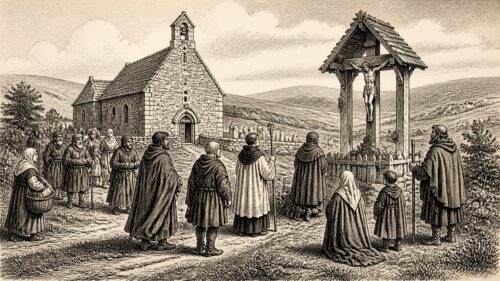
His death mattered beyond the cathedral town. Tuam was the metropolitan see for much of western Ireland, and an archbishop’s household sat at the meeting point of pastoral authority, landholding, patronage and regional politics. The office connected parishes and religious houses in Connacht with papal government, while its holder also had to operate among powerful local lineages, notably the Burkes, Ó Ceallaighs, Mac Diarmatas and several branches of the Ó Conchobairs. A vacancy therefore created practical uncertainty: revenues had to be safeguarded, clerical business continued, and rival interests could seek influence over the next appointment.
It is important not to imagine that the replacement was settled immediately in 1437. Tomás mac Muircheartaigh Ó Ceallaigh, a Dominican then associated with Clonfert, was translated to Tuam in July 1438, and later evidence indicates that he did not secure possession of the see. The gap between an appointment, papal provision and effective control was a real feature of late medieval church politics. Thus 1437 should be understood as the opening of an ecclesiastical transition, not as the year in which a new settlement at Tuam was completed.
Loch Key and the Anchorite
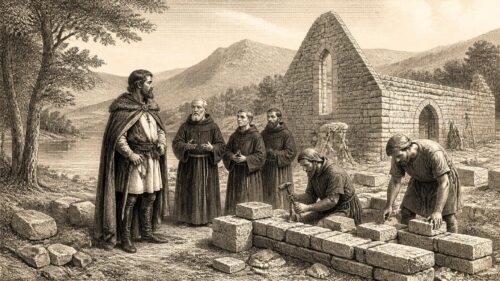
The Annals of Connacht also record the death of Gormlaith, daughter of Dáivid Ó Duibgeannáin and wife of Brian Mac Aodhagáin. The annalist adds a striking detail: she had eventually become an anchorite and died in the monastery of the Trinity on Loch Key. Her entry is unusually valuable because it places a woman within several overlapping worlds—her natal learned family, her marriage alliance and a religious vocation chosen or entered later in life.
An anchorite pursued a disciplined, enclosed devotional life, normally attached to a church or religious community. The terse notice does not tell us when Gormlaith entered this condition, whether she was formally enclosed, or what daily arrangements supported her. Those questions must remain unanswered. But the annal’s decision to remember her religious identity shows that such a transformation carried social meaning. The island monastery on Loch Key was not merely a secluded spiritual site: it formed part of the lived landscape of Moylurg, where lordly families, clergy, tenants, travellers and learned kindreds moved around the lake and its shores.
Gormlaith’s paternal surname is also suggestive. The Ó Duibgeannáins were among the hereditary learned families whose members served as historians, poets and legal experts in Gaelic Ireland. That does not prove that Gormlaith herself was literate or trained in those arts. It does, however, locate her in a milieu where pedigree, historical memory and ecclesiastical patronage carried weight. Her obituary preserves a rare, personal trace of women’s religious lives in a record otherwise dominated by male lords and clerics.
Names from the Northern Annals
The Annals of Ulster, whose chronological heading explicitly assigns these entries to 1437, list three deaths: Mael-Shechlainn Ua Maelconaire; Gilla-Padraig Ua Carmuic, son of Conchobur, on 19 November; and Cathal Ua Tresaigh on 10 October. The source gives no occupations or places for these men in its surviving brief notices. It would be irresponsible to enlarge them into invented careers. Yet their preservation is meaningful. Annals were selective records, compiled within clerical and learned networks; names entered into them had significance to communities whose concerns extended across Ulster, Fermanagh, Bréifne and Connacht.
The year heading in the Annals of Connacht additionally notes that 1 January fell on a Tuesday, according to its medieval computus. Such calendar formulae were not decorative. They situated local happenings within Christian time, calculated through lunar cycles, feast days and regnal dating. This was a society in which memory was organised not only by genealogy and territory but also by the liturgical year. The precise October and November dates in the Ulster record show the care with which some deaths could be located, even when the people concerned are otherwise elusive.
A Northern Peace, Carefully Used
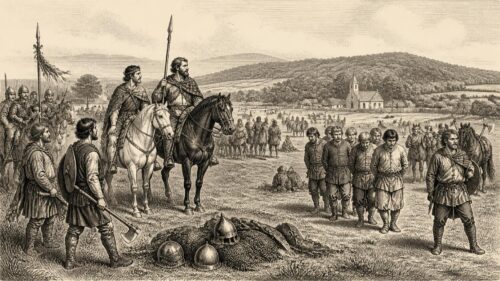
The Annals of the Four Masters place a peace between “O’Donnell” and Neachtan O’Donnell under their annal for 1437. In political terms, this fits the unstable situation in Tír Chonaill. Niall Garbh Ó Domhnaill was lord there, while Neachtan was his brother and a rival within the wider ruling kindred. Northern lordship was not a simple chain of command. It depended on the ability to sustain alliances, reward followers, secure hostages and contain competing eligible kinsmen. Agreements between members of a ruling family could be as consequential as open warfare.
However, the entry requires a chronological warning. CELT’s edition notes that the Four Masters chronology for this period diverges from historical chronology; the work was also compiled in the seventeenth century from earlier materials. The peace may preserve genuine tradition about the 1430s conflict, but its placement cannot be treated as independently confirmed to a particular day, month or even unquestioned modern calendar year. For 1437, it is best presented as annalistic evidence of a settlement associated with the year, not as a securely dated diplomatic event.
That caution does not make the notice unimportant. Niall Garbh’s wider position had already been damaged by conflict involving the Ó Neills and the MacDonalds of Antrim, and he would die in English captivity in 1439. In 1437, therefore, any reconciliation inside the Ó Domhnaill kindred belonged to a northern political world under heavy strain. Peace was not necessarily lasting harmony; it could be a tactical pause, a rearrangement of obligations or a response to military weakness.
Lordship, Work and Exchange
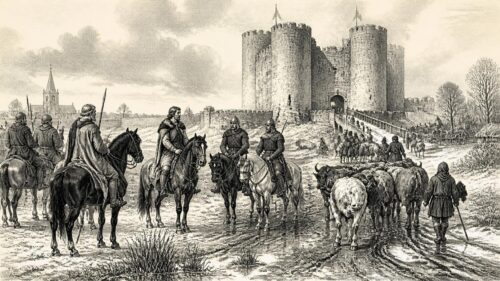
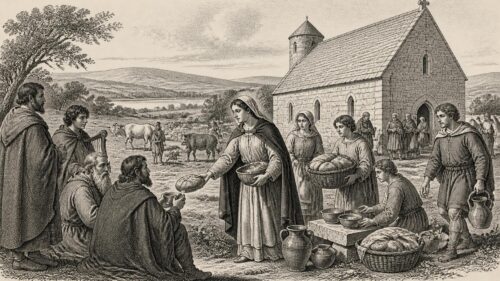
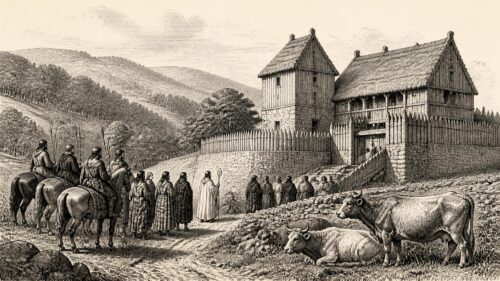
Most people in Ireland left no personal entry in the annals. Their year was shaped by livestock, crops, rents, food stores, labour services and local security. Across Gaelic lordships, cattle were a principal measure of wealth and a frequent target in coercive raiding; grain growing, fishing, woodland resources and small-scale craft production also supported households. Settlements ranged from dispersed farmsteads and ecclesiastical precincts to defended residences, castles and market towns. Conditions differed sharply between regions, and the evidence does not permit a single picture of everyday life for every part of the island.
Political geography mattered. The English crown claimed the lordship of Ireland through Henry VI, but effective royal administration was concentrated in and around the eastern colony and its towns. Elsewhere, Gaelic rulers and Gaelicised magnates exercised authority through their own territories, clientships and negotiated relations. This was not a division between a wholly “English” east and a wholly separate “Irish” west: people, goods, mercenaries, churchmen and ideas crossed those boundaries. But the reach of Dublin government was uneven, and its legal acts should not be mistaken for evidence of control over the whole island.
A statutory record conventionally dated 1437–38, in the sixteenth regnal year of Henry VI, placed foreign merchants coming to Ireland under the king’s protection. Because the record spans two calendar years, it cannot safely be treated as a measure enacted on a known date in 1437. It nevertheless belongs closely to this moment. Its existence points to official concern with the security and status of overseas traders in the ports within the lordship’s jurisdiction. It is evidence for the importance of maritime commerce and corporate towns, not proof that trade was tranquil or equally accessible throughout Ireland.
An Irish Sea Horizon
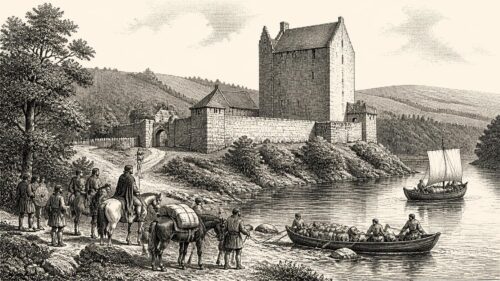
The Annals of Connacht also noted the killing of the king of Scotland, although it gives the name as “Sir John”. This plainly reflects news of the assassination of James I of Scotland in February 1437, even if the annalist’s naming is confused. The report deserves notice because it shows that Irish writers followed major events across the Irish Sea. Scotland was not distant from Irish politics: western Scottish and Ulster lordships were linked by sea routes, kinship, mercenary service and rivalry, especially in the orbit of the MacDonalds, Ó Neills and Ó Domhnaills.
Still, no surviving Irish source allows us to claim an Irish intervention in James’s death or to turn the notice into a decisive Irish event. Its value lies in the horizon it reveals. A Connacht chronicle could place a death at Tuam, an anchorite at Loch Key and the violent fall of a Scottish king within the same annual frame. Ireland in 1437 was regionally fragmented, but it was neither isolated nor politically inert.
A Year of Transitions
For all its apparent quietness, 1437 was a year of transitions. Tuam lost its archbishop; Loch Key’s religious community marked the passing of an anchorite with learned-family connections; northern annals registered deaths with careful calendrical precision; and an Ó Domhnaill peace, though chronologically uncertain, hints at the negotiations beneath Ulster’s conflicts. Around these events lay the continuing work of farming, lordship, worship, travel and exchange. The historical record is thin, but it is not empty. It captures an Ireland held together by local institutions and Irish Sea connections, where the death of one archbishop could matter more immediately than the distant policies of a king in England.
Primary Sources
- Annals of Connacht
- Annála Connacht
- The Annals of Ulster
- CELT Project: The Annals of Ulster
- Annals of the Four Masters, Part 7
- CELT Project: Annals of the Four Masters
- O'Neill (Ó Néill), Enrí | Dictionary of Irish Biography
- Ó Ceallaigh, Muircheartach (Mauricius, Maurice) | Dictionary of Irish Biography
- ‘Irish’ Ireland and ‘English’ Ireland | A New History of Ireland: Volume II, Medieval Ireland 1169–1534
- Gaelic society and economy | A New History of Ireland: Volume II, Medieval Ireland 1169–1534
- Colonial society and economy | A New History of Ireland: Volume II, Medieval Ireland 1169–1534
- English Lordship of Ireland and the Irish Sea World: Re-assessing the Origins of the Kildare Ascendancy, c.1390–c.1513
- The English Lordship of Ireland and the Irish Sea World: Re-assessing the Origins of the Kildare Ascendancy, c.1390–c.1513
- Gaelic Ireland: Land, Lordship and Settlement, c.1250-c.1650
- Factions, Feuds and Noble Power in the Lordship of Ireland, c.1356–1496
- An Irish Context to a Scottish Disaster: James IV, the O’Donnells of Tyrconnell and the Road to Flodden
- Military Service in the Lordship of Ireland 1290–1360: Institutions and Society on the Anglo-Gaelic Frontier
- Erenachs, Erenachships and Church Landholding in Gaelic Fermanagh, 1270–1609
- Statute Law Revision Act 2007
- Pre-Union Irish Statutes
- Politics and Religion in the Fifteenth-Century City
- ‘Geographical loyalty’? Counties, palatinates, boroughs and ridings