Glún Iarainn’s Armagh Raid895 CE
In 895, during the year, according to annalistic chronology, Dublin raiders led by Glún Iarainn plundered Armagh, reportedly carrying off 710 captives and damaging its church. The attack exposed the vulnerability of a major ecclesiastical and political centre. Elsewhere, Dub Lachtna of Caisel and churchman Máel Petair died; Cellach, Brega’s leading heir, was treacherously killed; and Muiredach of Ulaid fell in regional conflict. Heavy snowfall and great scarcity disrupted subsistence, likely worsening hardship without proving direct causes for violence. These fragmented records portray Ireland as interconnected kingdoms and churches, where sacred wealth, political succession, and ordinary survival remained precariously entwined.
Dateline
The events conventionally assigned to 895 are preserved most fully in the Annals of Ulster, whose chronological apparatus itself gives the year as “AD 894 alias 895”. That warning matters. Medieval Irish annals are indispensable near-contemporary records, but their year headings do not always align neatly with a modern 1 January–31 December calendar. The deaths of Dub Lachtna of Cashel and Máel Petair of Tír dá Glas are independently entered under 895 in the Annals of Inisfallen and Chronicon Scotorum. Other incidents, above all the attack on Armagh, belong securely to the annalistic dossier normally called 895, even where later compilations place them differently.
Armagh Plundered
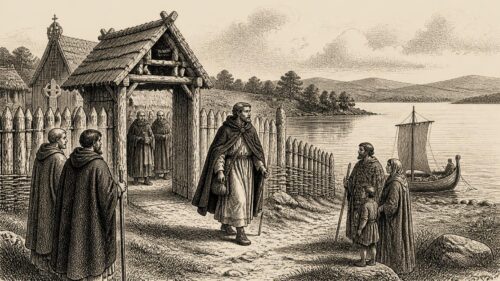
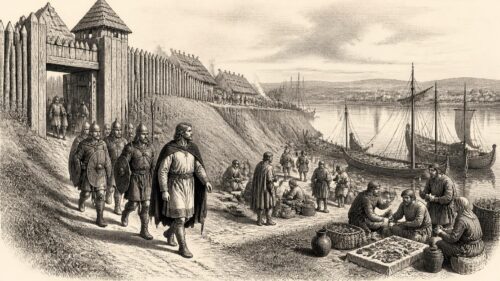
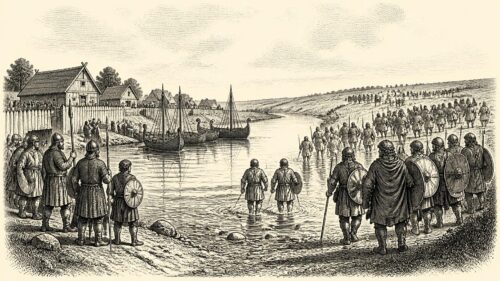
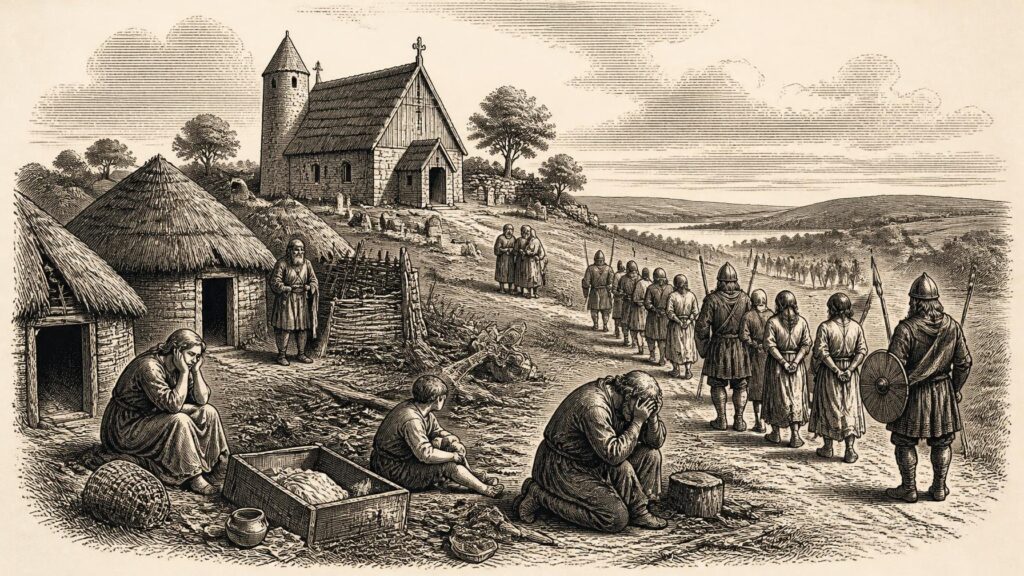
The year’s overwhelming event was the plundering of Ard Macha, Armagh, by the foreigners of Áth Cliath, Dublin. The Annals of Ulster name their leader as Glún Iarainn, “Iron Knee”, and state that 710 people were taken into captivity. The annalist’s unusually precise figure should be treated as the figure reported, rather than as a count that modern historians can independently verify; nevertheless, it conveys an assault on an alarming scale. A later annalistic tradition adds that part of the church was destroyed and the oratory broken. The accompanying verse imagines Patrick’s protection failing while raiders struck the oratory with axes.
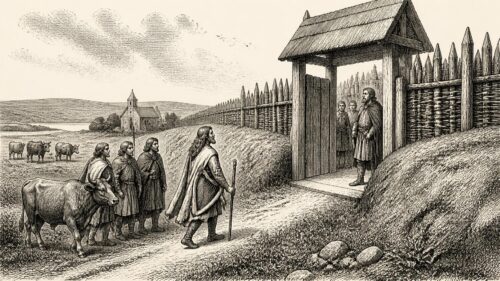
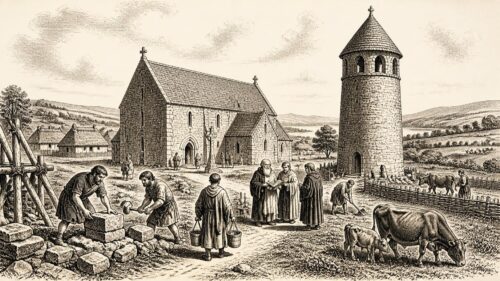
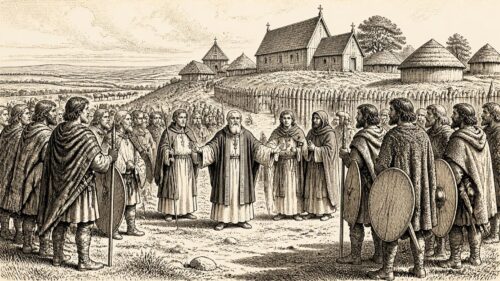
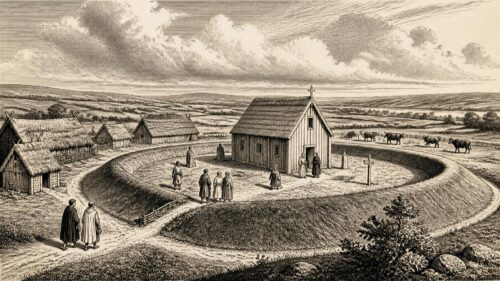
Armagh was no isolated shrine. By the late ninth century it was a large ecclesiastical settlement, a centre of learning, worship, estate management and political influence, whose leaders promoted its special association with Patrick. Its claim to primacy had long been intertwined with the interests of the Uí Néill dynasties dominant in the northern and central midlands. An attack on Armagh therefore carried a message beyond immediate loot. It struck a community rich in portable valuables, food stores, livestock and skilled people, but also a place whose sacred prestige reinforced wider structures of authority.
The captives were at the centre of the disaster. The sources do not identify them individually or tell us their destination. They may have included clergy, students, dependants, craftspeople and people from the surrounding countryside who had sought refuge or were caught in the raiders’ path. Captivity in the Viking-age Irish Sea world could lead to sale, forced service, ransom, or incorporation into another household. It would be irresponsible to assign every captive the same fate. Yet the entry is stark evidence that human beings, not only treasure, were a principal objective of organised raiding.
Nor should the episode be simplified into a struggle of “Irish” against outsiders. Dublin had been a Scandinavian-founded settlement for decades, embedded in Irish Sea routes and in the politics of neighbouring kingdoms. Its forces could raid, trade, take captives and make alliances with Irish rulers. Glún Iarainn is named only here in the surviving Irish annals, and his ancestry or formal title cannot safely be reconstructed from that single notice. What can be said is that he led Dubliners against one of Ireland’s most important churches at a moment when Dublin remained capable of projecting violence far beyond its harbour.
Deaths and Dangerous Successions
While Armagh suffered, several deaths exposed the fragility of regional power. Dub Lachtna son of Máel Gualae, king of Caisel, died. Caisel was the principal royal centre of the Eóganacht kings of Munster, although its authority over the wider province depended upon negotiation, tribute, hostages and military capacity rather than on a modern territorial state. The Annals of Inisfallen record that Cenn Gégáin took the kingship of Caisel in the following annal. That sequence establishes a change at the top, but it does not describe the selection, rivalry or agreements by which it was achieved. The silence is a useful reminder that succession was often consequential precisely where the annals are brief.
In Brega, the rich and politically charged plain around the lower Boyne and the old royal landscape of Tara, Cellach son of Flannacán was deceitfully killed by Fogartach son of Tolarg. The Annals of Ulster call Cellach the heir designate of all Brega; Chronicon Scotorum styles him king of Brega. The difference may reflect a change in status, variant local information, or the looseness with which later compilers handled titles. Both accounts agree on the essential point: a leading claimant was killed by treachery, not lost in an open battle.
A short poem preserved with the Ulster entry mourns Cellach as an incomparable “pillar of kingship” and praises his household. Such verse is not neutral reporting. It turns a political killing into a public statement about lost excellence, kinship and lordship. But that is exactly why it matters. A ruler’s household was a political institution: it comprised relatives, clients, fighting men, ecclesiastics and dependants, all tied to the fortunes of its head. The murder of an heir threatened not merely one man’s future, but a network of protection, reward and expectation across Brega.
Ulaid, in the north-east, witnessed another lethal contest. Muiredach son of Eochucán, described as one of two kings of Ulaid, was killed by Aidíth son of Laigne. The phrase “one of two kings” is especially revealing. Authority in Ulaid could be divided among rival lines and regional groupings; kingship was not necessarily exclusive, settled or inherited by straightforward primogeniture. Aidíth evidently emerged as a powerful figure, but his own position proved insecure: an annal for 898 records his deceitful killing by his associates. The violence of 895 was thus one episode in a continuing contest, not a clean transfer of power.
Snow and Scarcity
Between these political notices, the Annals of Ulster records “a heavy snowfall and great scarcity”. It is one of the year’s most important entries because it reaches beyond courts, churches and raiding parties. The annalist offers no month, no measurement of snow, no named crop failure and no death toll. “Great scarcity” should therefore not be inflated into a fully documented nationwide famine. Even so, the pairing of severe weather and want strongly suggests a broad disruption to food supplies and ordinary movement.
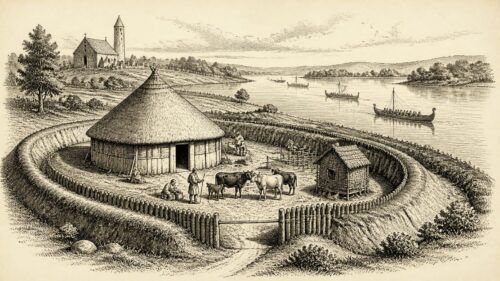
Most people lived from mixed farming, with cattle and dairying central to many households, alongside grain cultivation, pigs, smaller livestock, fishing and local exchange. A hard snowy season could impede travel, restrict access to pasture and fodder, damage winter survival among animals, and interrupt the movement of food, rents and dues. The consequences would not have been evenly shared. Kings and major churches possessed estates and stores; poorer households, tenants and dependants had far less margin against failed supplies or rising demands. The annal’s brevity leaves their experience unrecorded, but it points to hardship extending well beyond the named political elite.
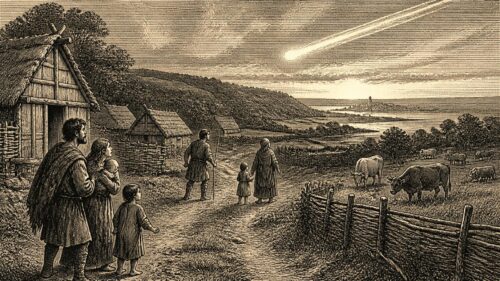
Scarcity also sharpened the dangers of conflict. Raiding parties needed provisions, local rulers had to sustain households and retainers, and ecclesiastical communities depended on contributions from their lands and clients. The sources do not say that snow caused the Armagh raid, Cellach’s killing or the struggle in Ulaid. Causation must not be invented. But in a year of severe want, the seizure of food, livestock, people and ecclesiastical wealth would have had consequences made harsher by environmental stress.
Churches, Offices and Memory
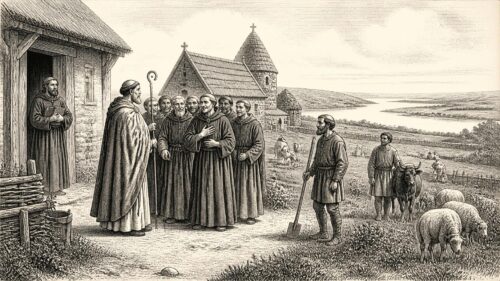
The death of Máel Petair son of Cúán shows the reach of leading churchmen across regions. The Annals of Ulster calls him bishop and superior of Tír dá Glas, Terryglass on Lough Derg. The Annals of Inisfallen identifies him additionally as abbot of Cluain Ferta Brénainn, Clonfert, while Chronicon Scotorum calls him successor of Brendan. These are not mutually exclusive descriptions: they present him through different institutional lenses. His career connected major churches in the Shannon region and illustrates how ecclesiastical office could combine spiritual standing, control of land and resources, learned authority, and responsibility for substantial communities.
The record of Máel Petair’s death stands in sharp contrast to the record of Armagh’s plundering, yet both concern the same social world. Churches were places of prayer and scholarship, but they were also estates with tenants, workshops, food stores, manuscripts, reliquaries and political connections. Their importance made them targets, patrons and mediators. The loss or replacement of a superior could alter local alliances; the violation of a church could become a statement about royal and sacred order.
Thus 895 cannot responsibly be presented as a year with a single national storyline. Ireland remained a landscape of many kingdoms, churches and communities, linked by waterways, roads, kinship and exchange, and exposed to violence from both local rivals and Dublin-based raiders. Yet the surviving entries fit together in one sobering picture: Armagh’s people carried into captivity, contested successions in Brega and Ulaid, a royal death at Caisel, an influential churchman’s passing, and weather severe enough to produce “great scarcity”. The annals preserve these events in fragments. Read carefully, those fragments reveal a society in which sacred institutions, political households and everyday subsistence were closely, and vulnerably, entwined.
Primary Sources
- The Annals of Ulster: Year U895
- Annals of Inisfallen: Annals AI890–AI899
- Chronicon Scotorum: Annals CS895–CS896
- Annals of the Four Masters: Annal M890
- The Annals of Ulster
- CELT Project: Annals of Inisfallen
- Chronicon Scotorum
- Vikings in Irish Chronicles, 794–902: Data
- Vikings in Irish Chronicles, 794–902: Introduction
- The Vikings in Ninth-Century Ireland: Sources and Settlements
- The Vikings in Ninth-Century Ireland: Sources and Settlements (doctoral thesis PDF)
- Vikings in Early Medieval Ireland: Church-Raiding, Politics and Kingship
- Vikings in Early Medieval Ireland
- Early Christian Ireland
- The Powers of Kings
- The Primatial Claims of Armagh, Kildare and Canterbury
- The Church and the World in Early Christian Ireland
- Reassessing the Irish ‘Monastic Town’
- Patrick (Patricius, Pátraic, Pádraig)
- The Archaeology of Early Christianity in the North of Ireland, Volume 2
- Transformation: Early Medieval Ireland, c. 430–1169
- The Annales Cambriae (Annals of Wales)