Kildare’s Burned Enclosure708 CE
In 708, Cill Dara, modern Kildare, suffered a destructive fire, although annals provide no cause, casualties or details of damage. The disaster followed the death of its bishop, Mael Dóbarchon, and required resources and patronage for recovery. Congal Cennmagair of Cenél Conaill, a leading Uí Néill overking, also died suddenly, prompting Fergal of Cenél nEógain’s accession around 708–709. Obituaries for the abbots of Iona and Lorrha demonstrate ecclesiastical networks extending across Ireland and the Irish Sea. These events reveal a rural, politically fragmented society dependent on churches, agriculture, kinship, tribute and personal leadership, vulnerable to fire, death and shifting alliances.
Dateline
In 708 CE, the Irish annalistic tradition places a destructive fire at Cill Dara, modern Kildare, alongside the sudden death of Congal Cennmagair, a leading overking of the northern Uí Néill. The surviving records are brief and their year-numbering is not wholly consistent: the Annals of the Four Masters explicitly group these events under 708, while the closely related notices appear under entries labelled 709 or 710 in other annals because of chronological displacement. The conjunction is nevertheless secure enough to define the year’s historical character: a major ecclesiastical settlement was burned, and a powerful ruler died just as Ireland’s shifting hierarchy of kingships was being renegotiated.
A Fire at Cill Dara
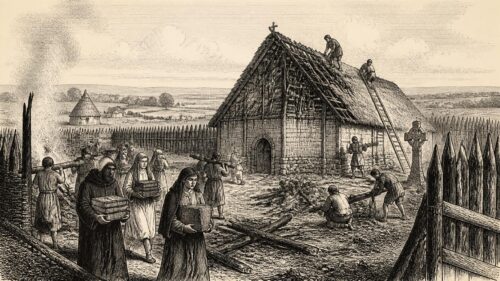
The annals say simply that “Cill Dara was burned”. That economy of language is frustrating, but important. They do not identify an attacker, date the blaze to a season, describe casualties, or specify whether the whole settlement or one principal complex was lost. It would therefore be wrong to turn the notice into a documented raid, accident or political reprisal. Fire was an ever-present danger in settlements whose churches, dwellings, workshops, fences and stores often relied heavily on timber, thatch and other combustible materials. Deliberate burning was also a familiar tactic in conflict. In this case, the evidence does not permit a choice between those explanations.
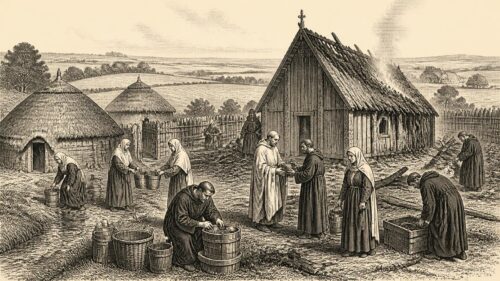
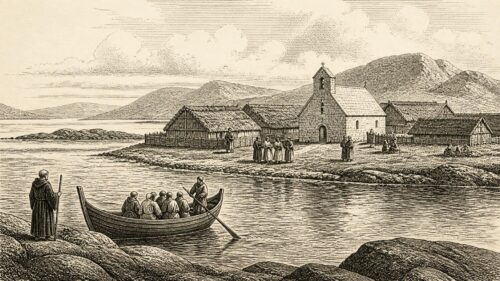
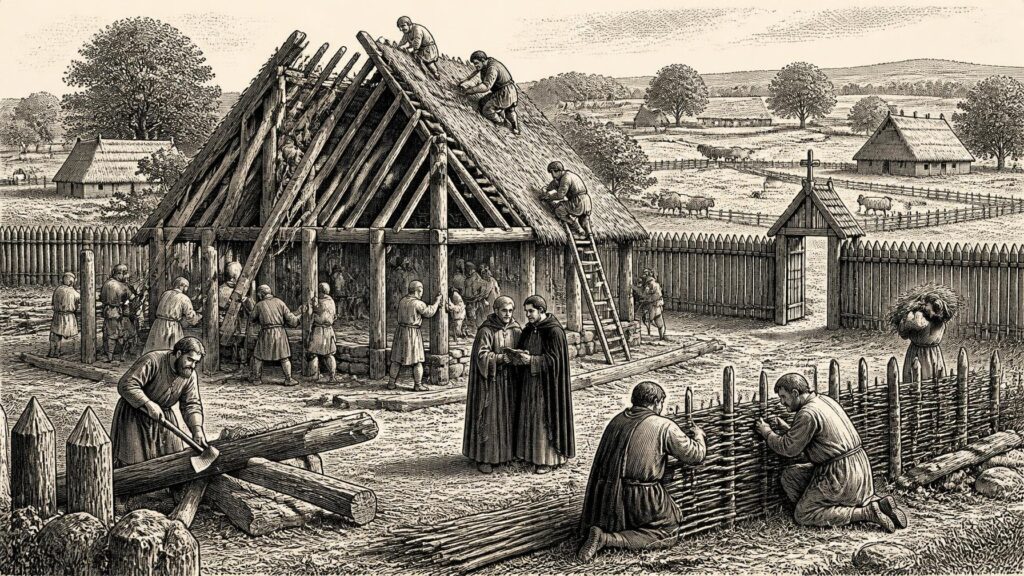
What can be said is that Cill Dara was no ordinary church. It was one of the leading religious centres of early medieval Ireland, associated with Brigit and embedded in the political world of Leinster. Such communities were not isolated compounds inhabited only by clergy. Their enclosures could contain churches and burial grounds, but also houses, guest accommodation, food-processing areas, workshops, fields and livestock. They acted as places of worship, learning, hospitality, production and lordship. A fire there could interrupt worship and daily routines while also damaging stores, books, crafted objects and buildings that embodied the status of the community.
The timing gives the entry additional force. Mael Dóbarchon, bishop of Kildare, had died on 19 February in the preceding annalistic year. His death need not have caused the fire, and no source says that it did. Yet the two notices reveal a community dealing, in quick succession, with the loss of a named ecclesiastical leader and a major material disaster. Recovery would have required labour, timber, food reserves and the backing of patrons. In a society where prominent churches depended on relationships with royal kindreds and local landholders, rebuilding was a practical statement of continuing influence as well as an act of devotion.
Congal’s Sudden Death
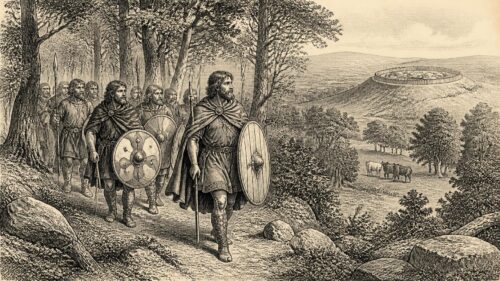
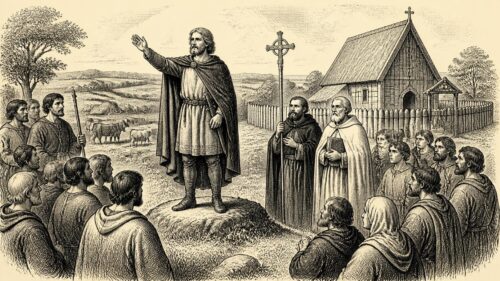
The same 708 cluster records the death of Congal Cennmagair, son of Fergus of Fánaid. One version calls him king of Temair, Tara; the Four Masters says that, after seven years in the sovereignty of Ireland, he died after an illness lasting only an hour. “High king of Ireland” is a convenient modern label, but it can mislead if it suggests a unified state. Congal’s standing rested on overlordship, kinship, tribute, military following and recognition by lesser kings, not on a permanent bureaucracy governing the island. Ireland consisted of many túatha, small kingdoms or peoples, arranged in uneven and changing networks of allegiance.
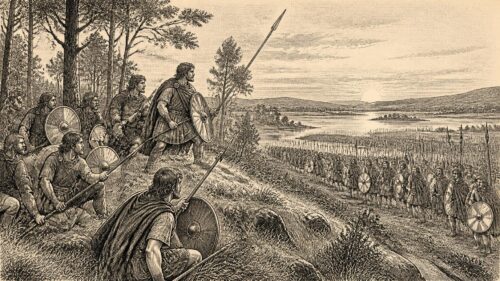
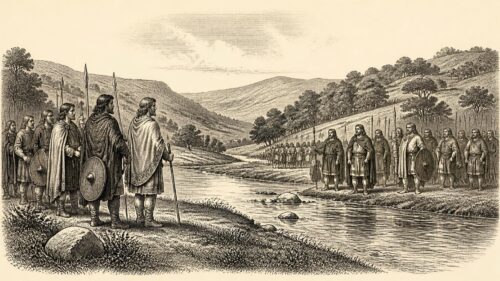
Congal belonged to Cenél Conaill, a northern branch of the Uí Néill associated with what is now Donegal. His death mattered because dominance among the major Uí Néill branches was competitive rather than automatic. Only a few years earlier, Congal had campaigned against Leinster, and the annals represent the Leinstermen as having submitted to his demands. In 705 he also defeated Cenél nEógain at Lethairbe, where Máel Dúin, lord of Cenél nEógain, was killed. Those earlier events form essential context for 708: Congal had not inherited a settled island, but had exercised authority through armed expeditions and political pressure.
The death of an overking could create danger without producing immediate open war. Rival branches watched for opportunities; local rulers assessed whether old obligations remained enforceable; churches weighed which patrons might best protect their lands and privileges. The annals do not record a battle in Ireland specifically for 708, and no invented succession struggle should be placed in the gap. But Congal’s sudden removal certainly left a contested political landscape, especially in the north where Cenél Conaill and Cenél nEógain both possessed royal ambitions.
Fergal and the Northern Balance
The annalistic sequence makes Fergal son of Máel Dúin the successor. The Four Masters enters his first year in 709, while the Annals of Ulster and Annals of Tigernach, using their own shifted chronology, attach his accession to the same event cluster as Congal’s death and Kildare’s burning. The responsible conclusion is that Fergal’s rise belongs immediately after Congal’s death, around 708–709, rather than that a coronation can be assigned to a particular day in 708.
Fergal was of Cenél nEógain, the very dynasty whose lord had fallen to Congal in 705. His accession thus marked more than a change of individual ruler: it transferred the foremost Uí Néill claim from Cenél Conaill to its northern rival. Later developments show how consequential that transfer became. Fergal soon campaigned among neighbouring peoples and eventually pressed Leinster hard for tribute and hostages. Those later campaigns should not be projected backwards as events of 708, but they show why the transition was not politically neutral. The balance of power had shifted northwards within the Uí Néill world.
Deaths at Iona and Lorrha
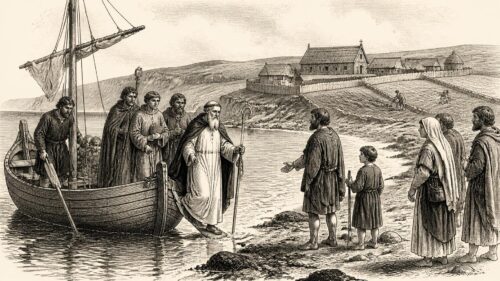
Two further obituaries recorded under 708 illuminate the breadth of Ireland’s ecclesiastical connections. Conamail son of Failbe, abbot of Í, died. Í is Iona, the Columban island monastery off the west coast of modern Scotland, founded from the Irish Sea world and closely tied to Irish churches, dynasties and travellers. Its inclusion in Irish annals is a reminder that the cultural geography of the period crossed the modern Irish Sea boundary. Clerics, manuscripts, relics, political news and kin connections moved between Ireland and Gaelic-speaking western Britain.
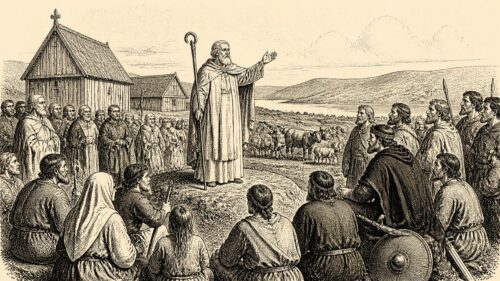
Colmán son of Sechnasach, abbot of Lothra, also died. Lothra, now Lorrha on the Shannon-side borderlands of Tipperary, stood in an inland landscape of routes, estates and smaller kingdoms rather than at the edge of the sea. These notices do not tell us what either abbot achieved, nor should silence be filled with invented literary or architectural accomplishments. Their recording does, however, indicate that the heads of significant churches were people whose deaths merited preservation in a historical record. Abbots could be spiritual superiors, estate managers, hosts, patrons of scribes and negotiators with secular rulers; offices at major churches were consequently entangled with regional power.
Ordinary Life Behind Brief Notices
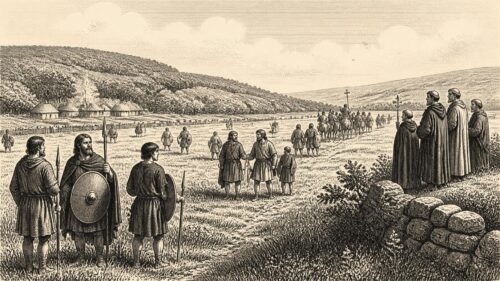
The annals preserve kings, bishops, abbots, fires and battles more readily than they preserve most people’s names. Yet the year’s events rested on the work of farming households. Most inhabitants lived in a thoroughly rural Ireland, often in ringfort farmsteads of timber or stone, with houses, animal shelters, stores, hearths and work areas inside enclosing banks or walls. Cattle were a principal measure of wealth and a source of food, dairy produce, hides and tribute; grain cultivation, milling and food storage were equally necessary. Kings drew resources from this agricultural base, while churches required tenants, labour, gifts and herds to maintain hospitality and religious life.
For the people of Kildare, a fire meant more than a dramatic annalistic phrase. It may have meant rebuilding roofs and walls, replacing vessels and tools, finding temporary space for worship and protecting food supplies. For craftsmen, it could create urgent demand for carpentry, iron fittings, textiles and perhaps ecclesiastical metalwork. For dependants of the church, recovery could bring obligations of labour or renders. These are historically grounded possibilities, not recorded particulars of the blaze; the sources do not identify individual victims, buildings or reconstruction projects.
Learning and art also belonged to this practical world. By the early eighth century, Irish ecclesiastical centres sustained Latin literacy alongside Irish-language learning, copied texts and preserved genealogies, law and historical memory. They supported skilled metalworkers and stone-carvers as well as clerics and scribes. The loss of an important church building was therefore potentially a loss of accumulated knowledge and prestige, even though no surviving source says that Kildare’s books or treasures were destroyed in 708.
A Year of Fragile Continuity
708 CE is not richly documented, but its few notices are revealing. Kildare’s burning exposes the vulnerability of even a foremost religious settlement. The deaths of Congal, Conamail and Colmán show how political and ecclesiastical institutions depended on particular office-holders. Fergal’s accession, securely connected to this moment but not safely datable beyond the 708–709 transition, signalled a new phase in northern Uí Néill leadership. Rather than presenting an Ireland ruled from a single centre, the evidence shows a densely connected island of local kingdoms and powerful churches, held together by obligation, travel, learning, livestock and force—and made precarious by a sudden death or a spreading fire.
Primary Sources
- Annals of the Four Masters, Annal M708
- Annals of the Four Masters, Irish text, Annal M708
- The Annals of Tigernach, Annals T708–T711
- The Annals of Tigernach
- The Annals of Ulster
- The Annals of Ulster, entries U710–U711
- Chronicon Scotorum
- Exploring the Irish Annals
- Annals of Tigernach, National Library of Wales Archives and Manuscripts
- Ireland in the Seventh Century: A Tour
- Kingship, Society, and Sacrality: Rank, Power, and Ideology in Early Medieval Ireland
- Religion and Society in Ireland
- Land Use and Economy AD 500–1100
- Ireland To 1170 (with Andrew Woods)
- Political Organisation in Dál Riata
- Early Christian Monasteries
- Churches and Ecclesiastical Enclosures
- Patrician and Early Christian Architecture
- Early Medieval
- Early Medieval Farmsteads
- Earthen Banks and Broken Walls
- High Crosses
- Brigit: The Goddess and The Saint