
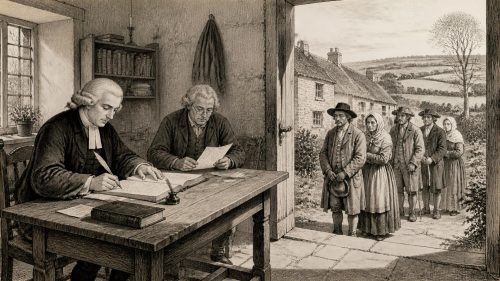
Sheehy and the Household Roll
In 1766, Ireland’s Protestant authorities ordered a religious return distinguishing Protestant and Catholic householders and listing Catholic clergy. Conducted unevenly by Church of Ireland ministers, it revealed confessional inequality but survives only fragmentarily. In south Tipperary, Father Nicholas Sheehy, sympathetic to agrarian grievances associated with the Whiteboys, became a target of anxious magistrates and gentry. Acquitted of rebellion charges, he was convicted of murder despite disputed evidence and executed at Clonmel. Further executions followed. These events exposed a state classifying an excluded Catholic majority while repressing rural resistance amid commercialising agriculture, constitutional constraints, Protestant dominance, and fears of Catholic disloyalty.
View Record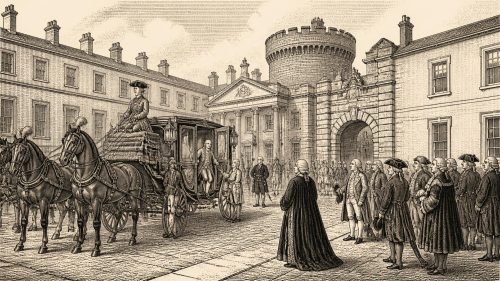
Townshend at Dublin Castle
In 1767 George Townshend became resident lord lieutenant, strengthening Dublin Castle’s presence and preparing conflict with parliamentary undertakers led by John Ponsonby. Parliament debated increased Irish funding for imperial troops alongside proposals for regular parliaments and secure judicial tenure, though settlement came later. In Belfast, Lord Donegall’s extensive leases reshaped property, encouraged development and served estate income within the expanding linen economy. Dublin’s Magdalen Asylum, founded by Lady Arabella Denny, provided Protestant women relief, work and strict moral supervision. John O’Keeffe’s theatrical debut reflected cultural vitality. Together, these developments exposed Ireland’s commercial and institutional change amid narrow Protestant political control.
View Record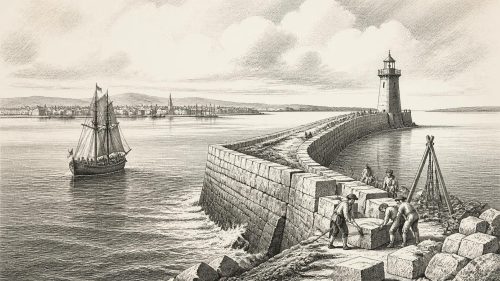
Lucas’s Eight-Year Parliament
In 1768, Ireland’s Octennial Act received royal assent, limiting parliaments to eight years and prompting dissolution of the 1761 parliament and summer elections. Championed by Charles Lucas, it established regular electoral expectations but preserved Poynings’ Law, Protestant dominance and Catholic exclusion. Lord Lieutenant George Townshend’s proposed expansion of the Irish army was narrowly rejected, exposing conflict between Dublin Castle and parliamentary undertakers and encouraging his later patronage strategy. The new parliament did not sit until 1769. Elsewhere, Frederick Hervey became bishop of Derry, John O’Brien’s Irish-English dictionary appeared in Paris, and Poolbeg’s maritime works advanced Dublin’s commercial access and navigation.
View Record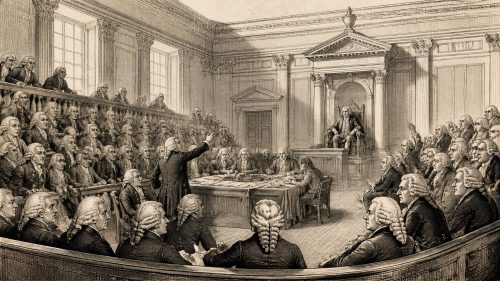
The Commons’ Rejected Supply
In 1769, Ireland’s octennial parliament confronted Dublin Castle when the Commons rejected a supply bill, 94–71, insisting that money measures must originate in the House rather than under Poynings’ Law. The dispute reflected Townshend’s effort to end dependence on undertakers Ponsonby and Shannon, while securing an enlarged army, approved in December. Catholic exclusion and borough franchises framed this Protestant contest. Elsewhere, James Agar was killed by Henry Flood in a Callan patronage feud; authorities suppressed labour combinations; Shannon navigation improvements culminated; and the Hibernian Society gained its charter. The supply vote exposed limits and prompted Castle plans to reshape administration.
View Record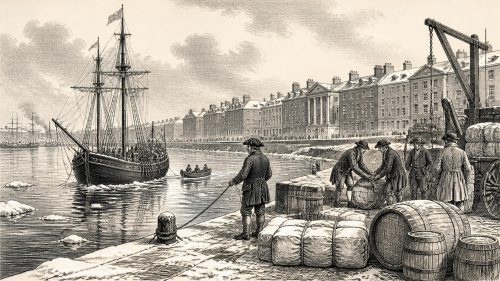
Townshend’s Provision Embargo
In 1770, Ireland was governed during Parliament’s prorogation as Lord Townshend used patronage to weaken parliamentary undertakers and strengthen Dublin Castle. Westminster sustained bounties supporting Irish linen, while the Dublin Society promoted economic improvement. Quarantine regulations monitored shipping routes and goods amid fears of plague. In December, authorities embargoed provision-laden vessels, reflecting concern over supplies without proving famine; butter received exemption in 1771. Catholic and Presbyterian exclusion, landlord power and dependence on agriculture and exports persisted. Trinity’s College Historical Society began meeting, while Burke and Goldsmith published works. The year reveals an unequal kingdom managed through law, commerce and patronage.
View Record
Robinson’s Library, Pery’s Chair
In 1771, Edmund Sexten Pery’s election as Speaker signalled Dublin Castle’s growing ability under Lord Lieutenant George Townshend to organise parliamentary support, though alliances remained fragile. The session beginning that autumn introduced improvement measures, including limited Catholic leases of reclaimed bog, later enacted in 1772. Belfast began building its poor-house and infirmary, later Clifton House, reflecting commercial growth, charitable discipline and medical provision. Archbishop Richard Robinson founded Armagh Public Library, extending learning beyond Dublin while expressing Church of Ireland authority. Grain imports and proposals for canals, navigation, streets, hospitals and reclamation revealed an economy dependent on trade, labour, uneven improvement.
View Record
Harcourt at Dublin Castle
In 1772, George Townshend’s departure and Simon Harcourt’s arrival as Lord Lieutenant altered Dublin Castle’s leadership without changing Ireland’s dependence on British imperial authority or its patronage-based, unrepresentative parliament. Ulster’s Hearts of Steel protest exposed rural insecurity over rents, leases, taxes and evictions; government answered with troops, targeted legislation and a later pardon, rather than structural reform. Parliament granted Catholics restricted long-term leases of bog land, a limited economic concession preserving wider penal disabilities. The London-Derry Journal’s foundation and revived siege commemoration illustrated print’s growing civic role. Meanwhile, linen, improvement and institutions coexisted with inequalities in land, religion and power.
View Record
Carriganima’s Lament
In 1773, the killing of Art Ó Laoghaire near Carriganima exposed the unequal legal position of Catholics in Ireland. His feud with magistrate Abraham Morris, involving a horse and penal legislation, inspired Eibhlín Dubh Ní Chonaill’s enduring Irish-language lament. Morris’s acquittal and the disputed burial reinforced perceptions of unequal justice. Nationally, Lord Lieutenant Harcourt’s unsuccessful absentee-tax proposal revealed financial strain, landlord influence and limits on Dublin’s parliament. Linen, woollen promotion and trade sustained a diverse but dependent economy, while volunteer corps reflected Protestant local society. Goldsmith’s success and Leland’s contested history illustrated Ireland’s contribution to, and disputes within, British culture.
View Record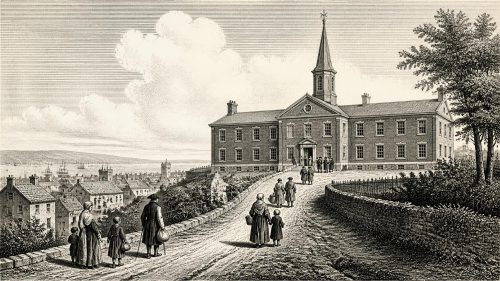
Clifton House Opens
In 1774, Ireland saw developments reflecting urban growth, religious inequality and economic ambition. Belfast’s Charitable Society was incorporated, opened its Poor House and Infirmary, later Clifton House, and began admitting residents, providing elite-supervised relief amid poverty generated by commercial expansion. Parliament allowed Catholics to swear allegiance instead of supremacy, but preserved penal restrictions on property, education and political participation. In Armagh, Archbishop Richard Robinson’s infirmary and Royal School extended an Anglican institutional landscape. Legislation promoted Lagan navigation to link Belfast with inland trade, despite difficulties. Cultural landmarks included Thomas Leland’s History of Ireland, Oliver Goldsmith’s death, and Francis Beaufort’s birth.
View Record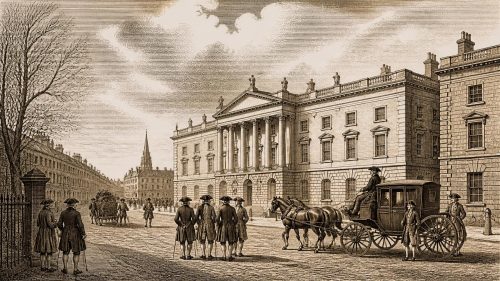
Flood’s Office, Grattan’s Entrance
In 1775, the American war exposed tensions within Ireland’s restricted Protestant political order. Troop departures depleted the garrison, while authorities pragmatically tolerated Catholic recruitment despite penal disabilities. Atlantic links encouraged both loyalism and sympathy for the colonists, expressed in Dublin and Edmund Burke’s conciliation arguments. Henry Flood accepted office, weakening the Patriot interest, while Henry Grattan entered parliament through Charlemont patronage. Parliament managed supply and revenue under strong British influence. Catholics and Presbyterians remained disadvantaged, and debate connected religion, trade and constitutional constraints. War threatened linen markets and sharpened commercial grievances. Cultural life and tower damage reflected wider uncertainty locally.
View Record