

Derryvree’s Sedge-And-Beetle Archive31418 BCE
31,418 BCE denotes a broad MIS 3 interval, not a recoverable Irish year. At Derryvree, County Fermanagh, organic sediments between glacial tills record a locally ice-free, treeless wetland of sedges, mosses, bogbean and cold-adapted insects, dated broadly within the relevant period. Comparable northern deposits confirm changing conditions between ice advances. Castlepook Cave, County Cork, preserves fragmentary remains of mammoth, reindeer, giant deer, hyena and other fauna, demonstrating intermittent connections with continental Europe. A possibly cut-marked reindeer femur may indicate human activity, but lacks associated artefacts or occupation evidence. Later glaciation destroyed much evidence, leaving cautious environmental rather than historical reconstruction.
Dateline
31,418 BCE is a modern chronological label, not a year that can be recovered from Ireland’s prehistoric record. No one on the island used a calendar of numbered years, and neither radiocarbon dating nor glacial stratigraphy can identify a particular season, journey or lifetime at such depth in time. In calendar terms the label falls about 33,400 years before AD 1950, within the later part of Marine Isotope Stage 3 (MIS 3), a long, unstable phase of the last Ice Age. The responsible historical subject is therefore an interval, not an event: a cold and changing Ireland represented by sediments, fossils and landforms rather than written testimony or settlements.
A Broad Date, Not a Diary Entry
The most relevant Irish evidence comes from Derryvree near Maguiresbridge in County Fermanagh. Roadworks exposed a remarkable sequence inside a drumlin: freshwater sands, silts and organic mud lay between two deposits of till, the unsorted material left by glacier ice. The order is decisive. Ice had occupied the area, then water and vegetation accumulated in a locally ice-free landscape, before a later glacial advance sealed the deposit beneath fresh till. This small survival is exceptionally valuable because later glaciers destroyed or buried so much older evidence across Ireland.
Organic material from the Derryvree sequence produced a conventional radiocarbon determination of 30,500 ± roughly 1,100 radiocarbon years BP. A radiocarbon year is not identical to a calendar year: atmospheric carbon-14 concentrations have varied, and a determination must be calibrated against independently dated records. Modern discussion places the Derryvree evidence broadly between about 36,900 and 31,700 calibrated years BP, approximately 34,950–29,750 BCE. The nominal date considered here falls within that wide bracket. It does not, however, date a specific layer to 31,418 BCE, still less prove that the whole island shared one identical landscape at that moment.
This distinction matters. Irish Quaternary deposits are often discontinuous, their dating uncertainties substantial, and their old terminology open to revision as new methods emerge. Derryvree records an environmental window between ice advances. It should not be turned into a precise annual chronicle or used to claim an island-wide thaw. Nearby Fermanagh sites at Hollymount and Greenagho also preserve inter-till organic deposits, suggesting that cold but non-glacial conditions existed in parts of the north at different points in MIS 3. Their dates and correlations remain less exact than a modern reader might wish.
Wet Tundra Between Ice Advances
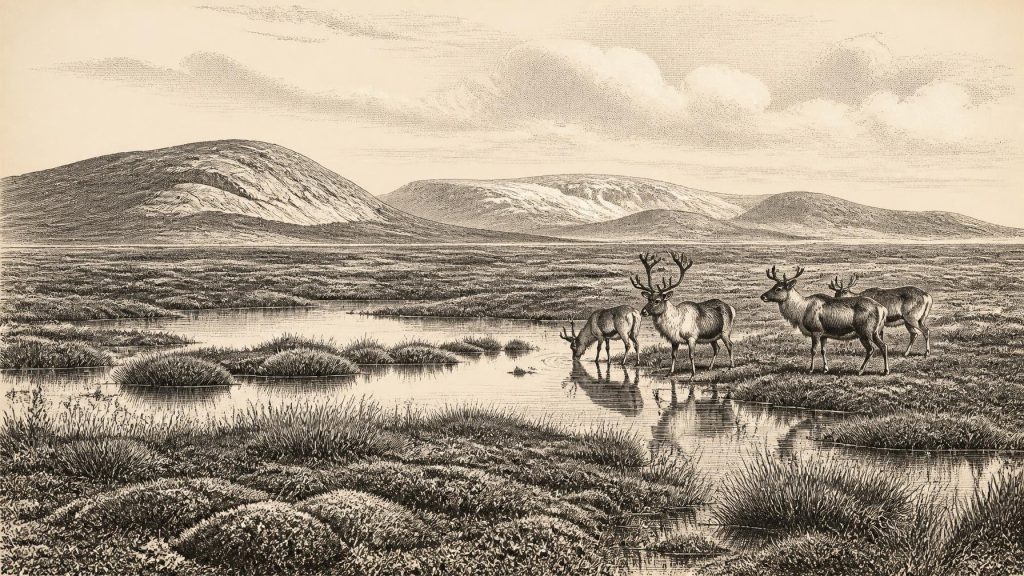
The Derryvree flora and insect fauna provide the clearest picture of everyday conditions in this broad interval. Freshwater mosses and sedges occurred in the organic beds, while insect evidence indicates a cold northern climate. These are traces of a treeless, periglacial wetland rather than of dense forest. Low vegetation, saturated ground, shallow pools, sedge margins and peaty mud would have formed a mosaic shaped by relief, drainage, snow cover and season. Bogbean, a plant of wet ground and water margins, is among the especially evocative fossil finds. Its presence demonstrates that even a severe landscape contained freshwater habitats and a short but real growing season.
“Tundra” should not conjure an unbroken, featureless sheet of snow. The evidence supports open country, but it also implies variation: sheltered hollows could retain standing water and organic sediment; exposed ridges would have been drier and more wind-scoured; streams and meltwater channels changed as frost, rainfall and seasonal thaw altered the ground. Permafrost may have affected drainage and soil movement, though its precise local extent cannot be reconstructed from Derryvree alone. The later drumlin that enclosed the archive is itself a reminder that the terrain was repeatedly reworked by moving ice.
At the wider North Atlantic scale, MIS 3 was marked by abrupt alternations between colder stadials and comparatively milder Greenland interstadials. Ice-core sequences provide the best-resolved chronology for these oscillations, but they should not be mechanically translated into an Irish weather report. Ireland lay on the Atlantic fringe, where shifts in temperature, precipitation, sea level and ice-sheet behaviour interacted. The essential point is secure: conditions were changeable on millennial scales, and an image of Ireland as either permanently ice-covered or permanently open is misleading.
Animals in a Fragmentary Record
Southern Irish caves add evidence for the fauna capable of occupying parts of the island before the Last Glacial Maximum. Castlepook Cave, near Doneraile in north Cork, is the richest known Irish repository of vertebrate remains from this broad period. Its collections include woolly mammoth, giant deer, reindeer, brown bear and spotted hyena, alongside later cold-stage animals such as Arctic fox, collared lemming, Norwegian lemming and wolf. Direct dating of individual bones shows that the cave accumulated animal remains over a long span rather than during one episode. It is therefore unsafe to place every species together in one herd or one landscape.
Nevertheless, reindeer, mammoth and hyena establish that Ireland was not biologically isolated from north-western Europe throughout MIS 3. During lower sea levels, the outlines of coasts and shallow seas differed greatly from those of today, and animals could move through changing routes when conditions allowed. That does not mean a simple, dry “land bridge” joined every shore, nor does it prove regular migration across a single corridor. Ice margins, sea basins, river systems and seasonal habitats continually altered the opportunities for dispersal.
The cave record also needs taphonomic caution. Castlepook was used or affected by carnivores, water movement and early excavations. Bones may have been dragged in, redeposited or disturbed long after an animal died. Recent re-dating has shown that some older Irish cave radiocarbon results were substantially too young because of limitations in previous preparation methods. Such corrections are not a weakness in the evidence; they show why direct dating, careful identification and re-examination of museum collections are indispensable.
The Reindeer Femur Question
One Castlepook find gives this period an important, but unresolved, human dimension: a reindeer femur has been reported as bearing a deep mark interpreted by zooarchaeologist Ruth Carden as having been made by a sharp stone tool while the bone was fresh. Its reported age, around 31,000 BC in public heritage interpretation, makes it broadly relevant to the chronological horizon considered here. If the mark is correctly identified as a butchery trace, it would indicate that people reached Ireland far earlier than the better-established terminal Pleistocene evidence from Alice and Gwendoline Cave in County Clare.
That conditional is essential. The femur is not a settlement site. No associated hearth, stone-tool assemblage, dwelling floor, burial, food store or securely stratified occupation surface has yet been found at Castlepook for this time. The cave’s complicated depositional history prevents archaeologists from reconstructing where the animal was killed, where any meat was processed, or whether people briefly visited the island, returned seasonally, or formed a resident population. A 2022 investigation recovered no cultural artefacts, although it identified areas where surviving deposits deserve further study.
The most responsible conclusion is therefore narrow but significant: the femur may preserve evidence of human handling of a reindeer in MIS 3 Ireland. It does not support claims for a named Palaeolithic community, a village at Doneraile, or continuous occupation. Nor can it establish the identity, language, ancestry or numbers of any visitors. The human story at this date remains a question posed by one modified bone, not a settled chapter.
No Politics, but Real Survival
There is no evidence from Ireland around this broad horizon for political institutions, territorial rulers, diplomacy, organised warfare, formal religion or artistic traditions. There are likewise no Irish data from which to infer marriage rules, social rank, ritual practice, trade in objects or systems of learning. Silence on these themes is not a failure of imagination; it is a necessary boundary between evidence and speculation.
If people did enter Ireland, comparison with Upper Palaeolithic hunter-gatherers elsewhere in north-west Europe suggests that movement, shelter, fuel, clothing, food and safe passage through severe weather would have been immediate practical concerns. But this is an interpretation from comparable societies, not a direct description of life at Derryvree or Castlepook. The known Irish record cannot demonstrate what tools were carried, whether hunting parties travelled by family groups, or whether reindeer were pursued rather than encountered opportunistically.
The economy that can be described with confidence is ecological. Wetland plants fixed the short season’s growth; grazing animals and predators occupied parts of a fluctuating open landscape; carnivores could transport bones into caves; water and ice shifted sediment from one place to another. For any human visitors, animal resources may have been attractive, but no excavated Irish assemblage yet proves a local hunting economy at this date. “Trade” is even less visible: there are no securely dated imported materials or exchange networks from Ireland around 31,418 BCE.
An Island Repeatedly Remade
Derryvree’s sediments preserve the central fact of Ireland at this depth in time: the country was repeatedly remade by climate and ice. During the later Last Glacial Maximum, after the Derryvree interval, much of Ireland was covered by an expanded ice sheet. That later expansion removed landscapes, altered drainage and buried earlier deposits, helping to explain why evidence for MIS 3 people is so scant. The archaeological absence is thus partly historical and geological, not simply proof that nobody ever came.
For 31,418 BCE, then, Ireland cannot be narrated through kings, battles or monuments. Its history is held in a moss-rich mud beneath a Fermanagh drumlin, in sedges and insects from a cold wetland, and in cave bones from Cork whose ages and routes into the ground require continual scrutiny. These modest archives tell a vivid story of open periglacial country, animals moving through a changing Atlantic world, and the possibility—still awaiting firmer corroboration—that human hunters briefly shared that world.
Primary Sources
- A Middle Midlandian Freshwater Series at Derryvree, Maguiresbridge, County Fermanagh, Northern Ireland
- Early Midlandian–Middle Midlandian, Pleistocene, Northern Ireland
- A Reconsideration of the Radiocarbon Dating of the Marine Isotope Stage 3 Fauna from Southern Ireland
- The Irish Quaternary Fauna Project
- Castlepook Cave, County Cork Geological Site Report
- 2022:564 – Castlepook Cave, Castlepook South, Cork
- Heritage Artefacts of County Cork: Reindeer Bone, Castlepook Cave
- Trimlines, Blockfields and the Vertical Extent of the Last Ice Sheet in Southern Ireland
- Late Pleistocene Chronostratigraphy and Ice Sheet Limits, Southern Ireland
- Extent and Deglacial Chronology of the Last British–Irish Ice Sheet: Implications of Exposure Dating Using Cosmogenic Isotopes
- Dimensions and Chronology of the Last Ice Sheet in Western Ireland
- Maximum Extent and Dynamic Behaviour of the Last British–Irish Ice Sheet West of Ireland
- Exploring Controls of the Early and Stepped Deglaciation on the Western Margin of the British Irish Ice Sheet
- A Stratigraphic Framework for Abrupt Climatic Changes During the Last Glacial Period Based on Three Synchronized Greenland Ice-Core Records: Refining and Extending the INTIMATE Event Stratigraphy
- The IntCal20 Northern Hemisphere Radiocarbon Age Calibration Curve (0–55 cal kBP)
- Freshwater Organic Deposits and Stratified Sediments Between Early and Late Midlandian (Devensian) Till Sheets, at Aghnadarragh, County Antrim, Northern Ireland
- Middle Midlandian Interstadial Deposits at Greenagho, Near Belcoo, County Fermanagh, Northern Ireland
- An Inter-Till Fresh-Water Deposit at Hollymount, Maguiresbridge, County Fermanagh
- First Evidence of a Late Upper Palaeolithic Human Presence in Ireland
- New Insights on the Fauna of Ireland’s Younger Dryas and Early Holocene from Alice & Gwendoline Cave
- Investigating Seasonal Mobility in Irish Giant Deer Megaloceros giganteus (Blumenbach, 1799) Through Strontium Isotope Analysis