The Fermanagh Muskeg30755 BCE
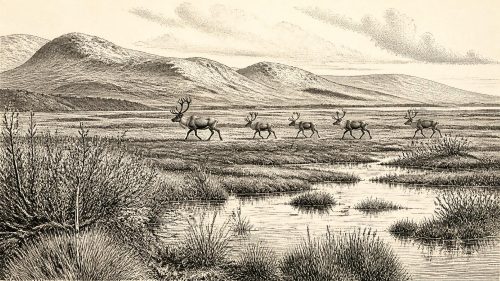
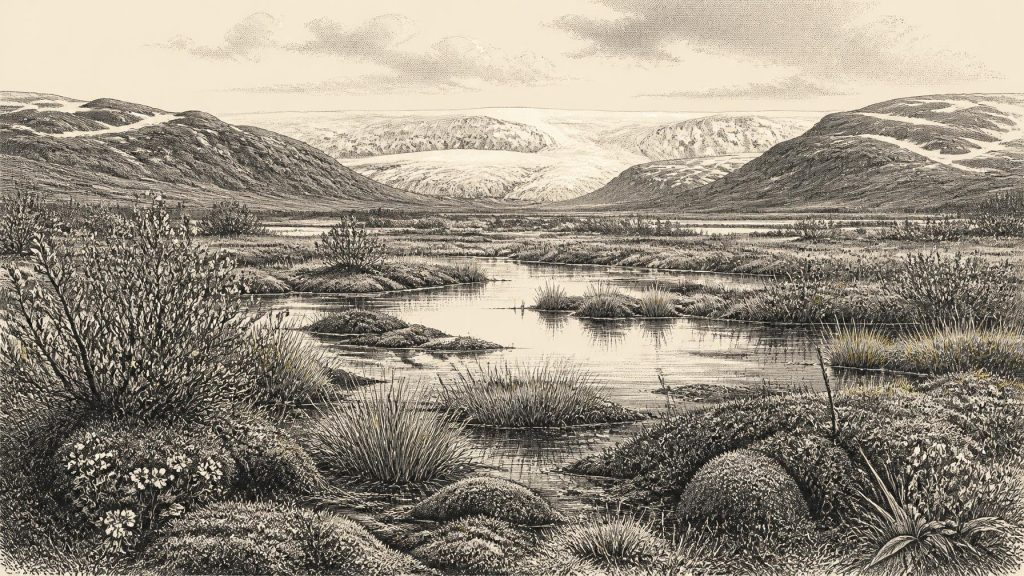
Around 30,755 BCE, Ireland lay in the unstable cold conditions of Marine Isotope Stage 3, but evidence cannot identify events in a single calendar year. At Derryvree, County Fermanagh, freshwater silts between glacial tills record an ice-free interval, with cold, treeless wetlands, pools and hardy vegetation. Castlepook Cave, County Cork, preserves remains of mammoth, reindeer, horse, giant deer and predators, demonstrating periodically suitable open habitats. Possible tool marks on a reindeer bone hint at human visitation, yet no secure settlement evidence exists. Later ice advances erased much earlier evidence, leaving only environmental and faunal records of a changing, habitable landscape.
Dateline
The label 30,755 BCE gives an impression of precision that the evidence cannot sustain. No Irish event, person, camp or season can be assigned to that modern calendar year. It is a backward-looking date calculated within a Christian-era calendar, whereas the archaeological and environmental evidence belongs to long radiocarbon ranges. In calendar terms, the notional year falls at roughly 32,700 years before AD 1950, during the Late Pleistocene and Marine Isotope Stage 3 (MIS 3), an unstable cold phase of the last Ice Age.
The responsible history of Ireland at this point is therefore not a chronicle of rulers or battles. It is a reconstruction from exceptionally fragmentary physical evidence: glacial tills, freshwater silts, pollen and plant remains, fossil insects, cave deposits and animal bones. The most revealing Irish record close to this broad horizon comes from Derryvree, near Maguiresbridge in County Fermanagh. Farther south, Castlepook Cave near Doneraile in County Cork preserves the remains of animals that occupied Ireland during overlapping parts of MIS 3. These sites do not supply a picture of one simultaneous Irish landscape, but together they show a cold, changing and intermittently habitable country at Europe’s north-western edge.
A Date Within a Range
At Derryvree, road cutting through a drumlin in 1969 exposed fine sands and freshwater silts lying between two thick beds of till, the unsorted debris laid down by glacier ice. The sequence is vital. Ice had covered the locality; an interval followed in which fresh water and wet ground developed; then renewed glacial activity buried the deposit beneath another till. It proves neither that all Ireland was ice-free nor that the wetland lasted continuously for millennia. It does demonstrate that this part of Fermanagh experienced an ice-free interlude before a later advance.
Organic material from the deposit produced a radiocarbon determination of about 30,500 radiocarbon years before present, with a substantial uncertainty. Radiocarbon years are not calendar years: atmospheric carbon levels varied through time, so measurements must be calibrated against independently dated records. Modern calibration places the Derryvree material broadly around 36,900–31,700 calibrated years before present, approximately 34,950–29,750 BCE. The notional year 30,755 BCE lies within that wide interval, but it cannot be used to date each layer, plant, insect or animal represented there. The evidence is close enough to illuminate the period, not exact enough to narrate a particular year.
Fresh Water Between the Ice
Derryvree’s sediments preserve an environment very different from the familiar green, wooded Ireland of later millennia. Plant macrofossils, pollen and insect evidence indicate cold, open and largely treeless ground, with wetland and shallow-water habitats sheltered in a local basin. Mosses, sedges and hardy northern or alpine plants are more informative than the occasional trace of tree pollen, which may have travelled far or been redeposited. Aquatic and waterside plants show that liquid water persisted locally despite severe winter conditions.
It is reasonable to picture a periglacial mosaic: wet hollows, sedge-rich margins, pools, frost-disturbed soils and expanses of low vegetation rather than continuous glacier cover. Such a setting would have changed with drainage, snowfall, frozen ground and shifting ice margins. Yet this is an interpretation built from the local fossil assemblage and regional comparison, not a photograph of Fermanagh in 30,755 BCE. We cannot safely specify the weather of a particular season, the depth of snow, or the extent of open water across the island.
The Derryvree sequence also explains why Irish evidence is so sparse. Later ice was not merely a backdrop: it overrode, eroded, mixed and concealed older surfaces. A campsite on exposed ground may never have existed, but if it did, subsequent glaciation could have destroyed much of what would identify it—hearths, stone tools, footprints, bone refuse or fragile structures. Preservation shapes the record. Absence of evidence does not prove that no person ever reached Ireland during MIS 3; it does mean that archaeologists cannot responsibly describe a settled human population here at this date.
Castlepook’s Animal Archive
Castlepook Cave, also known as Mammoth Cave, in the Awbeg Valley beneath the Ballyhoura Hills, supplies a striking complementary record. Excavations there recovered remains attributed to woolly mammoth, reindeer, horse, giant deer, brown bear, wolf, Arctic fox, lemmings and spotted hyaena. The hyaena material is particularly remarkable: Castlepook is Ireland’s principal recorded site for this predator. The collection demonstrates that Ireland was connected, ecologically at least, to the broader north-west European cold-stage world often enough for substantial mammals and carnivores to arrive.
That conclusion must not turn the cave into a single imagined scene. Caves gather material over long periods. Animals die there; predators drag in carcasses; water and sediment move bones; later excavators disturb deposits. Improved radiocarbon methods have shown that some earlier Irish cave dates were too young, and re-dating of Castlepook specimens has pushed elements of its fauna further back into MIS 3. Individual species from the cave need not have lived together, and the faunal collection cannot automatically be matched to the Derryvree wetland interval.
Even with that caution, large grazing and browsing animals imply that open habitats capable of supporting them existed somewhere in Ireland at favourable times. Predators and scavengers imply more complex food webs than the later historic Irish fauna. Reindeer and horse point towards open country; lemmings and Arctic fox suit severe northern conditions; mammoth and giant deer indicate the wider possibility of productive grass-and-herb landscapes. These are ecological inferences from species occurrences, not a census of animals roaming County Cork in one year.
People: Possibility and Proof
The human question is the most tempting and the least settled. A reindeer femur from Castlepook has been reported as bearing a deep mark interpreted as possible butchery with a stone tool; the bone has been associated with an age of roughly 33,000 years. If that interpretation is confirmed, it would be enormously important evidence for an Upper Palaeolithic human visit to Ireland. It would not, however, establish a permanent settlement, a named group, or activity precisely in 30,755 BCE.
No securely associated stone-tool assemblage, hearth, dwelling floor, burial, human bone, artwork or repeated occupation horizon has yet provided an unequivocal settlement record for Ireland at this horizon. A modified bone is not the same thing as a camp. The nearest firmly documented evidence for human activity in Ireland is much later: a cut-marked brown-bear patella from Alice and Gwendoline Cave, County Clare, dating to the terminal Pleistocene. The Mesolithic settlement record belongs later again, after the great ice sheets had retreated and new landscapes became available.
Accordingly, it is impossible to describe political affairs, diplomacy, warfare, social ranks, language, religious practice, learning, trade or artistic traditions for Ireland in this notional year. There are no monuments, graves, shrines, written signs, exchange goods or built settlements from which to infer them. If people did cross into Ireland during an MIS 3 interval, they would have done so as mobile foragers in a demanding landscape, probably following opportunities created by animal movements and changing terrain. That is a plausible regional model, not demonstrated Irish biography.
Coasts, Routes and Isolation
Sea level was lower during glacial phases, and the outlines of Ireland, Britain and the continental shelf differed greatly from those of today. But lower sea level did not automatically create an easy or continuous land route from continental Europe to Ireland. Ice, water, coastal change and the timing of sea-level fluctuations all mattered. The presence of mammals shows that crossings or connections were possible at certain times; it does not reveal their exact routes, frequency or seasonality. Nor does it prove human movement alongside them.
There was no economy in the later historical sense that can be recovered here: no evidence for farming, markets, metal, currency, long-distance commodity exchange or territorial control. The only securely visible economy is ecological. Plants captured water and soil nutrients; herbivores converted vegetation into animal biomass; predators and scavengers exploited the herds; caves and wet basins occasionally preserved the traces. For any human visitors, subsistence would have depended on knowledge, mobility and the chance availability of game, fuel and shelter—but such visitors remain unproven as a community.
Approaching the Glacial Maximum
The later history of the landscape gives the Derryvree evidence its pathos. After the interval represented by its freshwater silts, the British–Irish Ice Sheet expanded towards its Last Glacial Maximum, reached on a broad timescale around 27,000 years before present. Much of Ireland was subsequently covered or strongly affected by ice. Drumlins, tills, meltwater channels and other glacial landforms became the enduring architecture of the island, while earlier deposits survived only in unusual protected settings.
Thus Ireland around 30,755 BCE was neither a blank white void nor a country that can be furnished with invented hunters, clans and ceremonies. It was a climate-sensitive land of local ice-free basins, cold wetlands and open habitats, periodically accessible to an extraordinary Pleistocene fauna. Derryvree’s buried muskeg and Castlepook’s cave bones preserve brief, unequal glimpses of that world. Their real value lies in their limits: they allow a history of changing environments and animal life, while reminding us that calendar-year certainty, human settlement and social narrative remain beyond the evidence.
Primary Sources
- A Middle Midlandian Freshwater Series at Derryvree, Maguiresbridge, County Fermanagh, Northern Ireland
- A reconsideration of the radiocarbon dating of the Marine Isotope Stage 3 fauna from southern Ireland
- Extent and timing of the Last Glacial Maximum (LGM) in Britain and Ireland: a review
- The timing and magnitude of the British–Irish Ice Sheet between Marine Isotope Stages 5d and 2: implications for glacio-isostatic adjustment, high relative sea levels and ‘giant erratic’ emplacement
- Pattern and timing of retreat of the last British-Irish Ice Sheet
- Reconstructing the last Irish Ice Sheet 2: a geomorphologically-driven model of ice sheet growth, retreat and dynamics
- Dimensions and chronology of the last ice sheet in Western Ireland
- Advances in Irish Quaternary Studies
- The subdivision of the Quaternary Period in Ireland
- References and Recommended Reading
- Quaternary
- Ireland through geological time
- Geology of Ireland
- Spotted Hyena Skull
- 2022:564 – Castlepook Cave, Castlepook South, Cork
- Castlepook Caves
- Ireland’s Earliest Settlers: Evidence for an Irish Palaeolithic
- The IntCal20 Northern Hemisphere Radiocarbon Age Calibration Curve (0–55 cal kBP)
- Composition and consequences of the IntCal20 radiocarbon calibration curve
- NOAA/WDS Paleoclimatology – North GRIP – MIS3 CH4, d15N, and Temperature Data
- New insights on the fauna of Ireland's Younger Dryas and Early Holocene from Alice & Gwendoline Cave
- Freshwater organic deposits and stratified sediments between early and late Midlandian (Devensian) till sheets, at Aghnadarragh, County Antrim, Northern Ireland
- Irish Caves Database: Mammoth Cave