Sedge Mosses31272 BCE
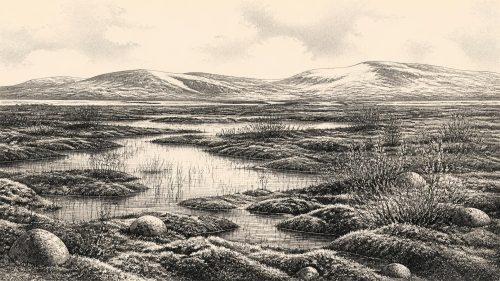
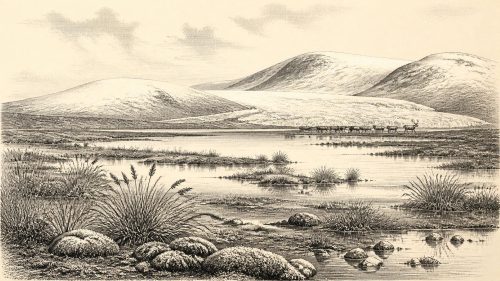
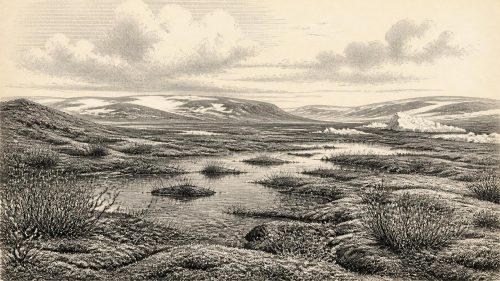
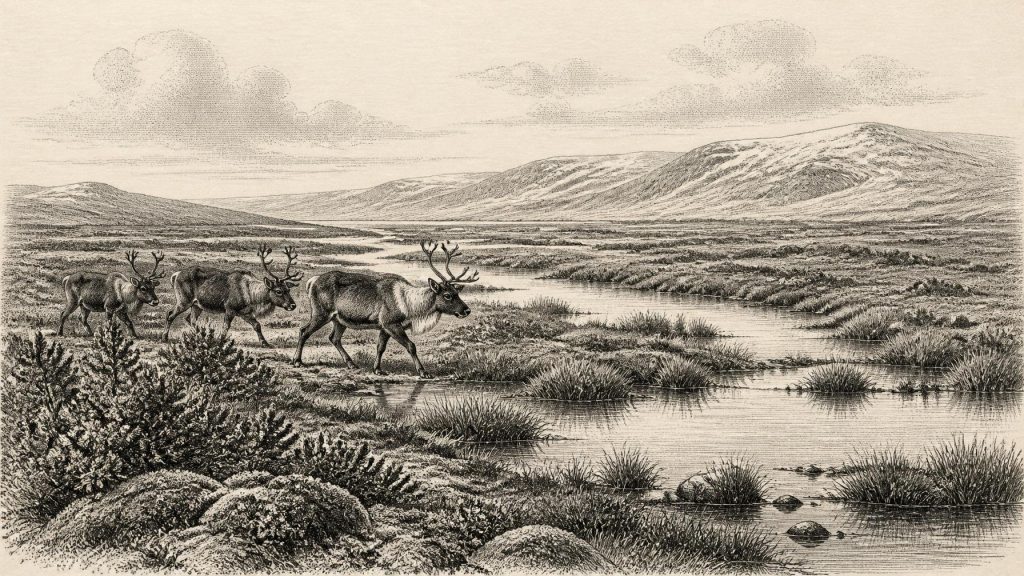
31,272 BCE is a notional date within uncertain Late Pleistocene chronologies, roughly 33,200 years before 1950. Derryvree, County Fermanagh, preserves freshwater organic deposits between glacial tills, indicating an open, treeless, sedge- and moss-rich wetland with pools, short growing seasons and periglacial cold during unstable MIS 3 conditions. Castlepook Cave, County Cork, contains remains of mammoth, reindeer, giant deer, hyaena and other fauna, showing intermittent habitats for cold-stage animals. A cut-marked reindeer bone may indicate early human butchery, but cannot prove settlement. No political, cultural or economic institutions are evidenced; Ireland’s recoverable history is environmental and fragmentary rather than event-based narrative.
Dateline
The label 31,272 BCE gives a false impression of precision. No Irish document, settlement layer or environmental record can tell us what happened in that individual modern calendar year. Expressed in the conventions used by Quaternary scientists, it falls roughly 33,200 calendar years before AD 1950, within the Late Pleistocene and Marine Isotope Stage 3 (MIS 3). At that depth of time, chronology is built from radiocarbon determinations, sediment sequences and correlations with ice-core climate records. Each has uncertainty. The responsible history of this moment is therefore not an anniversary narrative, but an account of a cold, changeable Irish landscape represented by wide calibrated ranges.
The closest important evidence comes from Derryvree, near Maguiresbridge in County Fermanagh, and from Castlepook Cave near Doneraile in north County Cork. They do not describe the whole island, and neither preserves a dated village of this age. Together, however, they show that parts of the landmass now called Ireland supported freshwater wetlands and substantial Ice Age animals during a phase before the Last Glacial Maximum reached its fullest extent.
A Date Within a Range
At Derryvree, roadworks exposed fine sands, silts and organic deposits caught between two tills: dense, stony sediments laid down by separate episodes of glacial ice. This order of layers is the crucial fact. It demonstrates that a biologically active freshwater environment existed after one advance of ice and before a later one. An organic sample, BIRM-166, produced a conventional radiocarbon determination of about 30,500 ± 1,100 radiocarbon years before present. Published calibrations have placed it broadly around 36,900–31,700 calendar years before present, while later regional discussions have proposed different modelled positions within that large span.
The nominal year in question lies within the older published calibrated range, but it cannot be identified as the start, height or end of the Derryvree deposit. Radiocarbon years are not calendar years, because atmospheric carbon-14 has varied through time; calibration curves convert one into a probabilistic calendar range, not a pinpoint date. Modern IntCal20 work has further refined the deep radiocarbon timescale, reinforcing the need to treat any apparent single-year correspondence with caution.
MIS 3 was neither a simple thaw nor an unbroken freeze. It was a long glacial interval marked by abrupt shifts in North Atlantic climate. Greenland ice cores divide it into colder stadials and comparatively milder interstadials. Those events provide an international climatic framework, but they cannot be mapped mechanically on to one Fermanagh pool or Cork cave. Ireland sat at the Atlantic edge of Europe, where ice, sea, wind and local topography could produce strongly regional conditions.
Wet Ground Between Ice Sheets
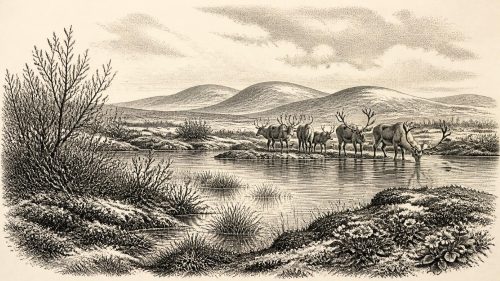
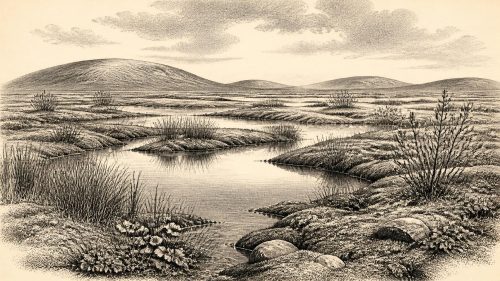
Derryvree is unusually eloquent because organic matter rarely survives repeated glaciation. Its plant remains, pollen and insect evidence point to an open, treeless and waterlogged environment often described as muskeg: mossy, sedge-rich ground with pools and abundant decaying vegetation. Grasses, sedges, juniper and herbs occur in the record. Aquatic and wet-ground plants, including bogbean and water-milfoil, indicate freshwater or saturated ground rather than a featureless frozen desert. Mosses and beetles add detail that pollen alone cannot supply.
That evidence supports a landscape of shallow water, peaty margins, frost-affected soils and short growing seasons. It does not establish that every part of Ireland looked the same. The west-facing uplands, limestone lowlands, river valleys and exposed coasts would have responded differently to snow cover, drainage and proximity to ice. Nor should the word ‘tundra’ conjure an empty white plain. Derryvree’s biological remains show summer growth and standing water, even in a climate severe enough for winter cold and periglacial processes to dominate.
Later ice covered, eroded and redeposited vast areas of Ireland. The two tills enclosing Derryvree are therefore more than geological backdrops: they explain why evidence for this period is so scarce and fragmented. They also warn against assuming continuity. A wetland visible in a favourable phase could be overwhelmed or buried when ice conditions changed. At around 31,272 BCE, Ireland was not approaching a stable post-glacial recovery; it remained within an unstable Ice Age world.
Castlepook’s Animal Archive
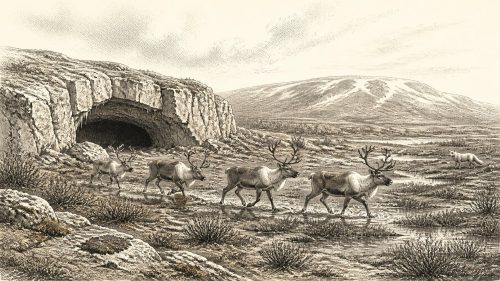
Far to the south, Castlepook Cave preserves Ireland’s richest known assemblage of vertebrate remains from before, during and after the last cold stage. The cave has yielded bones of woolly mammoth, reindeer, giant deer, brown bear and spotted hyaena, alongside wolf, foxes, hares and lemmings from different episodes. The species demonstrate that Ireland was, at least intermittently, accessible to animal populations also known from Britain and continental north-west Europe. They are powerful evidence against any image of an utterly lifeless island.
Yet the cave must be read carefully. Much of its material was excavated in the early twentieth century, before modern field recording, and water movement, animal activity and later disturbance have complicated the deposits. Individual bones have returned notably different radiocarbon ages. Improved pre-treatment and re-dating have shown that several earlier dates underestimated the antiquity of Castlepook material; one modern reassessment concluded that some large mammals were present in Ireland during MIS 3 and that giant deer and spotted hyaena may have disappeared locally before about 40,000 calibrated years before present.
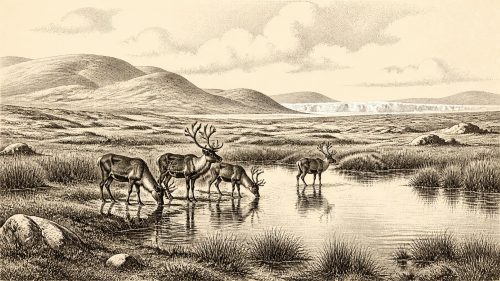
Thus Castlepook does not license a scene in which mammoths, hyaenas and reindeer are all placed beside one another on a particular day in 31,272 BCE. It does support a broader conclusion: during the relevant millennia, Irish habitats could sustain a varied cold-stage fauna. Reindeer were especially well suited to open country. Mammoths and giant deer imply extensive feeding grounds, while hyaenas and wolves signal predators and scavengers within that ecological network. Caves themselves may have served as dens, traps, shelters or repositories for bones moved by carnivores and water, rather than as neat snapshots of the countryside outside.
The Human Question
The most consequential, and most limited, evidence for people near this horizon is a reindeer femur from Castlepook. It has been presented as about 33,000 years old and bears a deep mark interpreted as having been made by a sharp stone tool during butchery. If that interpretation is sustained, it is potentially Ireland’s earliest evidence of human handling of an animal, immensely earlier than the long-established record of post-glacial settlement.
The appropriate conclusion remains modest. A marked bone can indicate an episode of carcass processing; it does not demonstrate a permanent population, a camp, a dwelling, a hearth, a tool-making floor, a burial ground or a route used year after year. The bone’s date is the age of the animal material, within a statistical range, not a timestamp for the cut itself. Nor has an associated Upper Palaeolithic stone-tool assemblage yet been recovered at Castlepook to describe the technology of whoever may have made the mark.
It is reasonable to infer that any visitors, if present, would have needed practical knowledge of seasonal weather, animal behaviour and sharp-edged stone tools. Reindeer could supply meat, marrow, hide, sinew, antler and bone. But these are possibilities derived from hunter-gatherer practice elsewhere in Upper Palaeolithic Europe, not direct observations of an Irish household. Archaeology presently supports transient human incursions more readily than a settled Irish community at this date.
No Polities, No Proven Religion
There were no known Irish kingdoms, chiefs, borders, treaties or wars in the political sense. There is no evidence from this period for a named people, language, ethnic identity or diplomatic relationship. It would be misleading to call the land ‘Ireland’ in a national sense: the term is used here only for the territory of the modern island and its changing surrounding shelf. Lower global sea levels altered coastlines and may have made crossings less formidable than today, but fossil animals alone cannot prove a continuous land bridge at this exact time.
Likewise, there is no Irish evidence for shrines, burials, ritual, figurative art, music, teaching institutions or formal learning around this date. Upper Palaeolithic groups elsewhere in Europe created art and used complex social knowledge, but importing such achievements into an undocumented Irish setting would turn comparison into invention. The same restraint applies to economy and trade. There is no evidence for farming, livestock, fields, pottery, metalworking, exchange networks or established trade within Ireland. If people reached the island, subsistence would have depended on mobile foraging and the opportunities of a seasonal landscape, not an agricultural economy.
A Recoverable Deep Past
The most important development around this notional year was environmental, not political: Ireland contained places where freshwater life persisted between advances of ice, while cold-adapted and large grazing mammals ranged through at least some landscapes. Derryvree records sedges, mosses, pools and short-lived biological productivity. Castlepook records animals whose bones survived in limestone chambers, as well as the tantalising possibility that people processed reindeer there.
That is a sparse record, but not an empty one. It shows an Ireland of open ground, wet hollows, severe winters and shifting ecological frontiers. It also sets a necessary limit on storytelling. Around 31,272 BCE, the island’s history cannot responsibly be told through rulers or events. It must be reconstructed from the sediments below a Fermanagh drumlin, the bones in a Cork cave, and the calibrated ranges that connect both to a changing Ice Age world.
Source References
Hover over a number to see the source. Select it to open the source.

- [1] A Middle Midlandian Freshwater Series at Derryvree, Maguiresbridge, County Fermanagh, Northern Ireland
- [2] Irish Pleistocene Biostratigraphy
- [3] The Irish Quaternary Fauna Project
- [4] A Reconsideration of the Radiocarbon Dating of the Marine Isotope Stage 3 Fauna from Southern Ireland
- [5] First Evidence of a Late Upper Palaeolithic Human Presence in Ireland
- [6] New Insights on the Fauna of Ireland’s Younger Dryas and Early Holocene from Alice & Gwendoline Cave
- [7] Growth and Retreat of the Last British–Irish Ice Sheet, 31,000 to 15,000 Years Ago: the BRITICE-CHRONO Reconstruction
- [8] BRITICE-CHRONO Maps and GIS Data of the Last British-Irish Ice Sheet 31 to 15 ka
- [9] The IntCal20 Northern Hemisphere Radiocarbon Age Calibration Curve (0–55 cal kBP)
- [10] A Stratigraphic Framework for Abrupt Climatic Changes During the Last Glacial Period Based on Three Synchronized Greenland Ice-Core Records
- [11] Castlepook Cave, County Cork Geological Site Report
- [12] Spotted Hyena Skull
- [13] Learn About: The Ice Age
- [14] Heritage Artefacts of County Cork
- [15] The Exploration of Castlepook Cave, County Cork, Being the Third Report from the Committee Appointed to Explore Irish Caves
- [16] Middle Midlandian Interstadial Deposits at Greenagho, Near Belcoo, County Fermanagh, Northern Ireland
- [17] Freshwater Organic Deposits and Stratified Sediments Between Early and Late Midlandian (Devensian) Till Sheets, at Aghnadarragh, County Antrim, Northern Ireland
- [18] An Inter-Till Freshwater Deposit at Hollymount, Maguiresbridge, Co. Fermanagh
- [19] The Late Quaternary History of East-Central Ireland
- [20] 2022:564 – Castlepook Cave, Castlepook South, Cork
Primary Sources
- A Middle Midlandian Freshwater Series at Derryvree, Maguiresbridge, County Fermanagh, Northern Ireland
- Irish Pleistocene Biostratigraphy
- The Irish Quaternary Fauna Project
- A Reconsideration of the Radiocarbon Dating of the Marine Isotope Stage 3 Fauna from Southern Ireland
- First Evidence of a Late Upper Palaeolithic Human Presence in Ireland
- New Insights on the Fauna of Ireland’s Younger Dryas and Early Holocene from Alice & Gwendoline Cave
- Growth and Retreat of the Last British–Irish Ice Sheet, 31,000 to 15,000 Years Ago: the BRITICE-CHRONO Reconstruction
- BRITICE-CHRONO Maps and GIS Data of the Last British-Irish Ice Sheet 31 to 15 ka
- The IntCal20 Northern Hemisphere Radiocarbon Age Calibration Curve (0–55 cal kBP)
- A Stratigraphic Framework for Abrupt Climatic Changes During the Last Glacial Period Based on Three Synchronized Greenland Ice-Core Records
- Castlepook Cave, County Cork Geological Site Report
- Spotted Hyena Skull
- Learn About: The Ice Age
- Heritage Artefacts of County Cork
- The Exploration of Castlepook Cave, County Cork, Being the Third Report from the Committee Appointed to Explore Irish Caves
- Middle Midlandian Interstadial Deposits at Greenagho, Near Belcoo, County Fermanagh, Northern Ireland
- Freshwater Organic Deposits and Stratified Sediments Between Early and Late Midlandian (Devensian) Till Sheets, at Aghnadarragh, County Antrim, Northern Ireland
- An Inter-Till Freshwater Deposit at Hollymount, Maguiresbridge, Co. Fermanagh
- The Late Quaternary History of East-Central Ireland
- 2022:564 – Castlepook Cave, Castlepook South, Cork