The Fords of Carrickfergus1333 CE
On 6 June 1333, William de Burgh, twenty-year-old earl of Ulster and lord of Connacht, was murdered near Carrickfergus by men associated with Ulster’s settler community. His death, following de Burgh family conflict, deprived vast, fragile lordships of an adult ruler. His widow fled to England with their infant heiress, while royal justice punished some killers but could not restore stability. Annals also record cattle-raiding, noble sureties, official campaigns and violence in Dublin, illustrating insecure aristocratic politics. The murder initiated divisions that later produced the Burke civil war and Mac William lordships, exposing limits of inherited power and English administration.
Dateline
On 6 June 1333, William de Burgh, third earl of Ulster and lord of Connacht, was murdered near Carrickfergus. He was only twenty years old, yet his inheritance joined two of the greatest aristocratic lordships in Ireland: the earldom of Ulster in the north-east and the de Burgh lordship of Connacht in the west. His death was therefore not simply a killing within a noble household. It removed the young figure through whom an exceptionally large and already troubled landed power was meant to be held together.
The event is firmly dated, unusually so for much fourteenth-century Irish history. Irish annals, English governmental material and later historical compilations converge on 6 June. Their narratives differ over precise circumstances and responsibility, but not over the larger fact: the earl was killed by men from the settler community of Ulster, and his murder rapidly altered the balance of power across Ireland.
An Heir Without a Protector
William was the grandson and successor of Richard de Burgh, the formidable ‘Red Earl’, who had died in 1326. The Red Earl’s authority had rested upon personal lordship, extensive affinities and the ability to operate in both English royal and Irish political worlds. His grandson inherited the title while still a minor. By 1333 William had reached adulthood, had been knighted and had served the English crown, but he had not acquired his grandfather’s long-established authority. His position was especially vulnerable because his lands extended across regions with their own rival dynasties, military traditions and local grievances.
Conflict within the wider de Burgh family had already made that weakness plain. In 1332 William’s cousin Walter Liath de Burgh was imprisoned and died of hunger in captivity, according to the Irish annals. That death supplied the immediate background to the following year’s murder. It should not, however, be reduced to a simple private vendetta. The quarrel concerned control of lordship, land, dependants and access to the earl’s power. In a world in which a magnate’s household was also a political and military instrument, family conflict could swiftly become a regional crisis.
Murder Near Carrickfergus
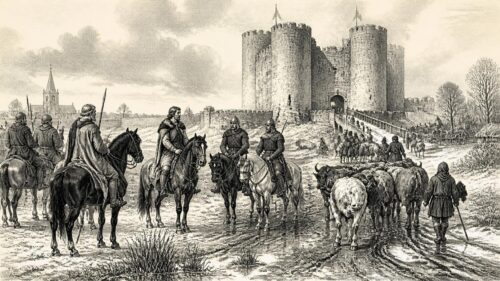
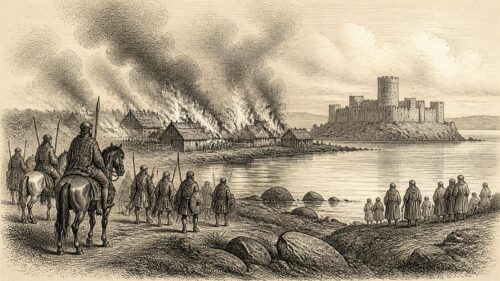
Friar John Clyn’s Annals of Ireland, written from within the English lordship, places the killing between the castle of the Ards and Carrickfergus. It says that William was slain in June by his own men while travelling towards Carrickfergus. The account associates members of the Logan and Mandeville connections with the attack and represents it as revenge for William’s treatment of Richard de Burgh, a relative of the Mandevilles. The Annals of the Four Masters offer a terser but powerful formulation: the earl was killed by the ‘English of Ulster’.
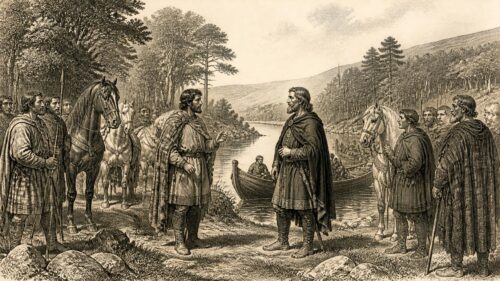
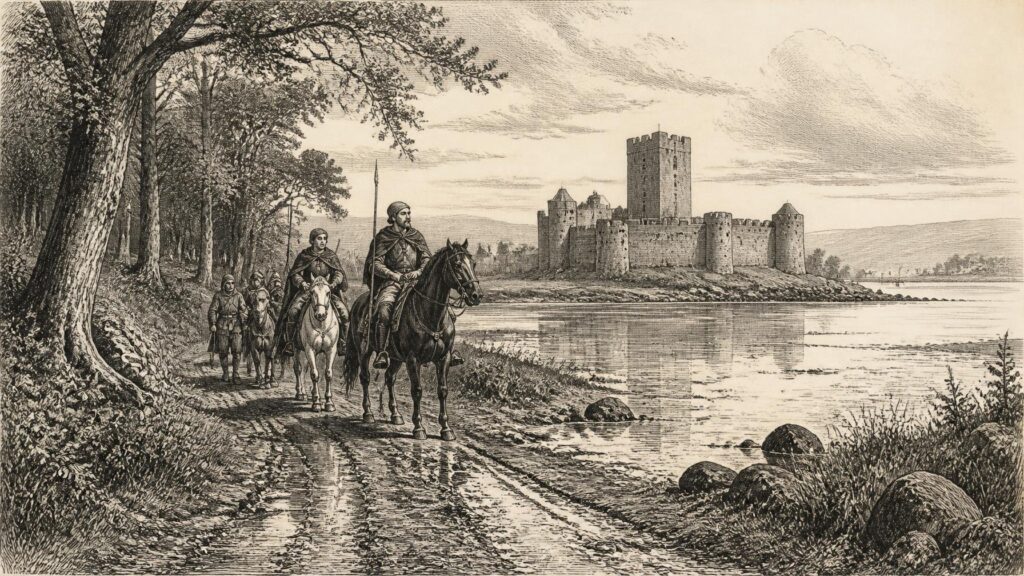
These accounts must be read carefully. Clyn provides a vivid sequence of motives, people and movements, but its detailed attribution of blame is not independently demonstrated in every point. Nor can the exact site be fixed with confidence. Later tradition connected the murder with a ford near the Lagan, in the area of later Belfast, while Clyn’s wording points more broadly to the route between the Ards and Carrickfergus. What can responsibly be said is that the earl was murdered in the Carrickfergus district, at the heart of the earldom he was supposed to command.
William’s widow, Matilda of Lancaster, fled from Ulster to England with their infant daughter Elizabeth, the recognised heir to the earldom. That departure was itself politically consequential. A resident earl, however young, had been replaced by a child heiress abroad and by uncertain royal supervision from Dublin and Westminster. The inherited de Burgh lands did not vanish, but no single adult lord immediately possessed the combination of title, local following and legitimacy required to command them.
Royal Justice and Its Limits
Sir John Darcy, the king’s justiciar in Ireland, moved against the killers. Clyn records that he defeated some of them in battle, captured others and killed others. The Four Masters likewise remembered punitive justice: some of the men held responsible were hanged, some slain and some subjected to the full penalties associated with treasonous crime. Such punishments advertised the crown’s claim to preserve the peace among its Irish subjects and tenants. They did not restore the earl’s political inheritance.
Darcy’s position illustrates the wider setting of 1333. As justiciar, he was the chief royal governor in Ireland; his administration had to negotiate magnate rivalries, campaigns, castles, revenues and the defence of settlements. Clyn records that he cut a pass at Etergouel in Offaly, an intervention in a difficult frontier landscape where routes and wooded or boggy ground could shape military movement as much as formal jurisdiction did. It was a practical assertion of government: making passage safer, or at least more usable, for armed men and official business.
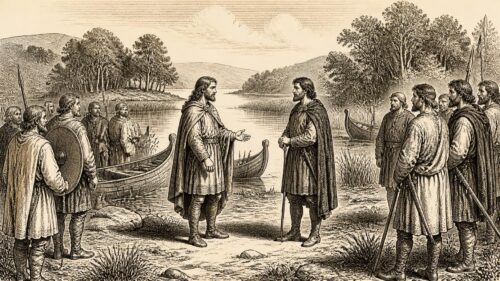
Yet the justiciar’s reach was uneven. Darcy could punish particular perpetrators in Ulster, but he could not conjure a new adult earl of Ulster or settle the competing expectations of the de Burgh kindred in Connacht. His own movements also reveal Ireland’s place within a wider archipelagic politics. Clyn says that, after acting in Ulster, Darcy crossed to Scotland to join the king, leaving Master Thomas de Burgh as deputy. Irish affairs were inseparable from the English crown’s continuing concerns in Scotland and from the demands that those wars placed upon Irish lordship.
Cattle, Hostages and Magnates
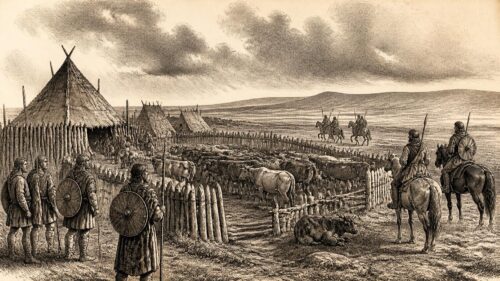
The year’s annals also show that political life did not stop at Carrickfergus. The Birminghams of Carbury carried off more than 2,000 cows from the O’Conors, according to Clyn. The figure may reflect annalistic emphasis, but it conveys the scale on which cattle-raiding could operate. Cattle were movable wealth: food, breeding stock, dairy produce, a source of rents and tribute, and a means by which victors could reward followers. A raid of this kind was both an economic blow and a public statement of military capacity.
Maurice fitz Thomas FitzGerald, earl of Desmond, was also released from custody in 1333 after sureties pledged their lives and property for his compliance. His liberation demonstrates that bonds of obligation underpinned aristocratic politics. Sureties were not a minor legal technicality. They made powerful men answerable for another magnate’s conduct and tied political reconciliation to personal risk. Desmond’s position mattered well beyond Munster, since he was one of the leading lords of the English colony and was connected by marriage to the de Burgh family.
At a meeting of nobles held at the Carmelites in Dublin, Clyn records the murder of Murchard fitz Nicholas O’Toole, with the culprit unknown. The entry is brief, but it is revealing. Even a gathering intended for counsel among leading men could be marked by lethal insecurity. Dublin was the administrative centre of the lordship, with its courts, records, religious houses and officials; it was not insulated from the feud, suspicion and violence that characterised aristocratic politics elsewhere.
The Beginning of a Division
It would be misleading to claim that every later consequence occurred at once in 1333. The prolonged struggle usually called the Burke or de Burgh civil war developed over the following years, and the emergence of powerful Mac William lordships in Connacht was a process rather than an overnight transformation. Nonetheless, the murder was its indispensable starting point. Without William, the vast inheritance was exposed to rival claims by branches of the de Burgh family, while Gaelic rulers and neighbouring lordships could exploit a dangerous vacancy in authority.
For people living on these estates, the consequences were likely to be immediate even where no chronicle names them: uncertainty over protection, rents and service; pressure to support a local lord; vulnerability to cattle-raids and retaliatory expeditions; and the disruption caused when armed households contested routes, manors and castles. The surviving sources chiefly preserve magnates and killings, but their notices of cattle, sureties, roads and fortifications disclose the material foundations of power.
Thus 1333 stands as a turning point not because Ireland suddenly became disorderly, but because the murder near Carrickfergus broke an already fragile arrangement of lordship. Royal retribution followed, officials continued their work, and noble assemblies still met. But the death of the young earl made clear that neither inherited title nor English governmental authority could by itself hold together the de Burgh world in Ulster and Connacht.
Primary Sources
- The Annals of Ulster (English translation)
- Annala Uladh: Annals of Ulster otherwise Annala Senait, Annals of Senat
- Annals of the Four Masters, Part 17 (English translation)
- Annals of the Four Masters, Part 17 (Irish text)
- Annales Hiberniae
- CELT Project: Annales Hiberniae
- CELT Project: Annals of the Four Masters
- CELT Project: Annals of the Four Masters (Irish text)
- Burgh, William de
- Darcy, Sir John
- FitzGerald, Maurice fitz Thomas
- Add MS 40674
- English Lordship in Ireland, 1318–1361
- English Lordship in Ireland 1318–1361
- Colonial Ireland, 1169–1369
- Plantagenet Ireland
- Ireland under the Normans, 1169–1333
- Ireland under the Normans
- Dromore: An Ulster Diocese
- The Hamilton Manuscripts: Containing Some Account of the Settlement of the Territories of the Upper Clandeboye, Great Ardes, and Dufferin
- The History and Antiquities of the County of the Town of Carrickfergus
- English Rule in Ireland, c.1272–c.1315
- The Political Role of English Noblewomen, c.1272–c.1377