Limerick’s Three Ordinances972 CE
In 972, Mathgamain son of Cennétig led a Munster coalition that imposed three ordinances on Limerick: expelling Norse officials, driving foreigners from the town, and burning their fortress. The action transferred control of a strategic commercial centre without ending Scandinavian influence. Elsewhere, Domnall Claen treacherously killed Murchad, overking of Leinster; Áed of Ulaid died in battle against Dál nAraide; and Domnall Ua Néill burned and plundered major churches. Tuathal, abbot of Clonmacnoise, died. These events demonstrate Ireland’s fragmented politics, where dynastic rivalry, alliances, military force, resources, routes and ecclesiastical institutions shaped contested regional power, although annalistic dating requires careful interpretation.
Dateline
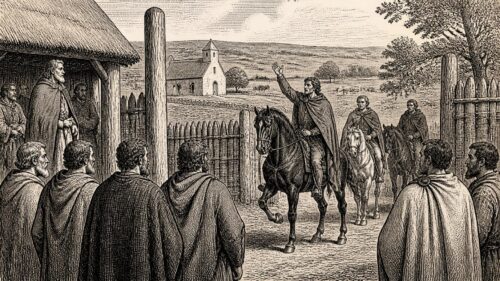
The most consequential Irish development securely associated with 972 occurred in Munster, where Mathgamain son of Cennétig consolidated control of Limerick and its Scandinavian political community. The Annals of Inisfallen, a source especially close to Munster interests, places the episode in a leap year and describes an extraordinary programme agreed by a council of provincial nobles. Its terms were remembered as three ordinances: the expulsion of Norse officials from Munster, the expulsion of the foreigners from Limerick, and the burning of their fortress. The same entry records that Dubchrón Ua Longacháin’s house was burned, with seventy people killed. The annal offers no date within the year, nor does it explain every relationship behind these events; nevertheless, it preserves a rare glimpse of a deliberate political settlement expressed as collective policy rather than simply as a battlefield victory.
A Council in Munster
Mathgamain was the leading figure of the rising Dál Cais dynasty of north Munster. His authority had been built through warfare against the Norse of Limerick and through competition with the older Éoganacht dynasties of the province. By 972 he was able to act with, rather than merely against, other powerful Munster interests. The annal names Mathgamain, Fáelán, “the son of Bran”, and other nobles as counsellors behind the ordinances. Later historical identification connects the unnamed son of Bran with Máel Muad, Mathgamain’s Éoganacht rival, while Fáelán represented the Déisi of eastern Munster. Their co-operation in this year should not be mistaken for lasting unity: alliances in tenth-century Ireland were practical and reversible, formed around hostages, tribute, local advantage and immediate military need.
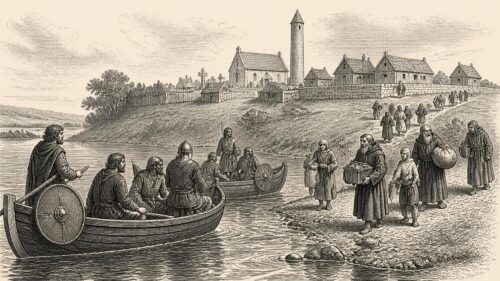
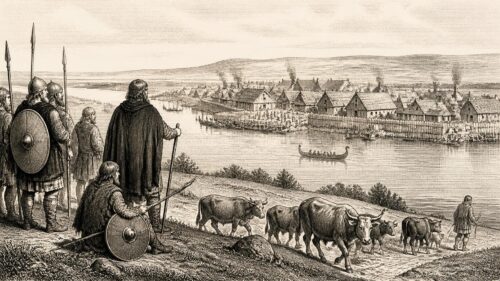
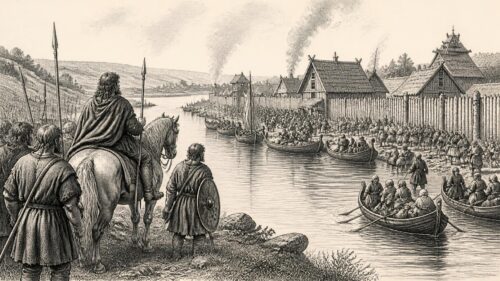
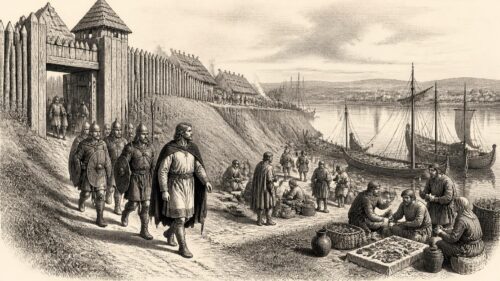
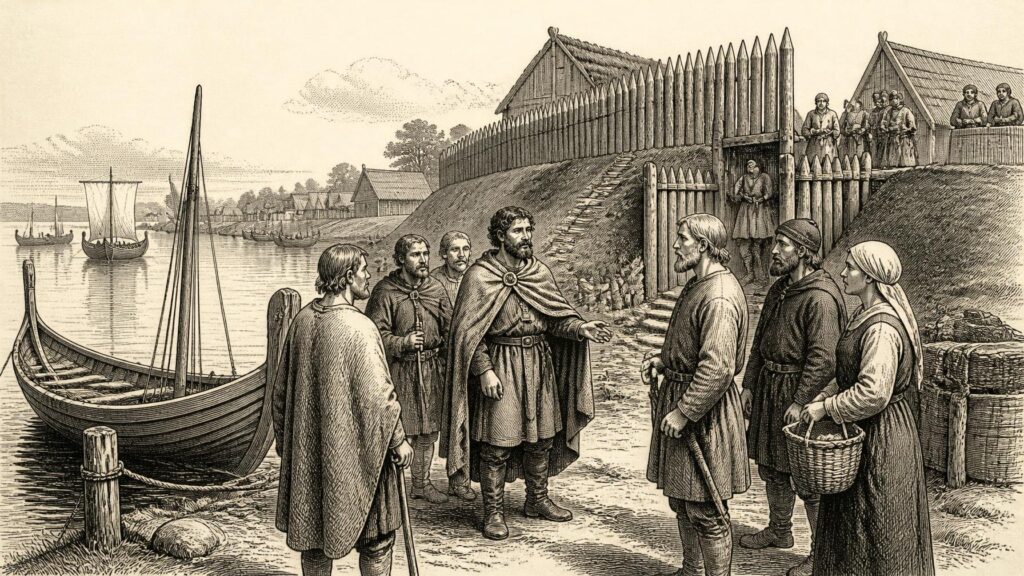
The language of the entry matters. It distinguishes Norse officials from the wider body of foreigners at Limerick. That distinction suggests a structured Scandinavian presence, not a transient raiding party. Limerick was a riverine settlement whose command of the Shannon gave it access to inland Ireland and to sea routes around the western coasts and Irish Sea. Its inhabitants and rulers had commercial as well as military importance: ships, imported goods, coin, labour and movable wealth could all circulate through such a place. Taking it was therefore an assertion of authority over communications and revenue as much as a blow against an enemy garrison.
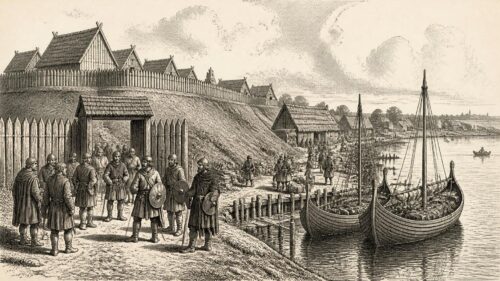
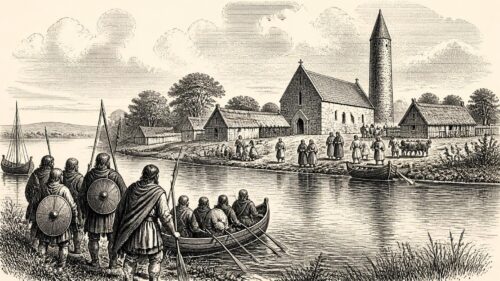
The burning of the fortress should likewise be read carefully. The annal does not permit a reconstruction of its plan or an estimate of the settlement’s population. It does, however, show that Mathgamain’s coalition intended to break a particular centre of armed and administrative power. Modern scholarship accepts that Mathgamain gained control of Limerick in 972 and that its Norse rulers were driven from the town, apparently withdrawing to King’s Island in the Shannon. Yet the Scandinavian presence in the region did not vanish. Norse leaders, Irish dynasties and mixed communities continued to make and unmake alliances; the year marked a change in control, not a simple national expulsion.
Leinster’s Violent Succession
Far to the east, the annals record the killing of Murchad son of Finn, overking of Leinster. The Annals of Ulster and Chronicon Scotorum agree that Domnall Claen killed him by treachery. Such wording is significant: it represents the killing not as an open encounter between armies but as a breach of expected conduct, perhaps of protection, hospitality or negotiated security. The sources do not provide enough detail to identify the setting or method, and it would be wrong to invent either.
Murchad belonged to Uí Fháeláin, one of the principal branches of Uí Dúnlainge, the dynasty which supplied Leinster’s provincial kings for generations. His death therefore exposed a central weakness of the province: kingship did not descend automatically from father to eldest son. Several royal kindreds possessed credible claims, and a successful contender needed the support of local rulers, ecclesiastical allies and, at times, Dublin’s Hiberno-Scandinavian rulers. The death of an overking could reorder these networks with alarming speed.
Leinster’s position was especially sensitive because it lay between Dublin’s maritime power, the midland ambitions of the Uí Néill and the kingdom of Osraige to the west and south-west. The killing in 972 did not settle those pressures. It instead belongs to the longer contest in which individual Leinster dynasties sought advantage while external kings exploited division. Murchad’s daughter Gormlaith, whose later marriages linked her to rulers of Dublin, Tara and Munster, illustrates how closely kinship and high politics could intersect, although those later associations must not be treated as events of 972 itself.
Conflict in Ulaid
The north-east also saw a major reversal. The Annals of Ulster records a battle between the Ulaid and Dál nAraide in which Áed son of Loingsech, king of the province, fell along with others; Eochaid was victor. Chronicon Scotorum preserves essentially the same notice. In this context Ulaid denotes the historic provincial and dynastic world of eastern Ulster, not the boundaries of any modern jurisdiction. Dál nAraide was a powerful population group and kingship in the area remained intensely contested.
The annal’s economy conceals the wider human cost. A provincial king had died in battle, and his defeat would have affected the claims, tribute demands and security of subordinate communities. Victors needed to turn military success into obedience: they might seek hostages, cattle, food renders and recognition from churches and local lords. Defeated families, meanwhile, retained followers and claims. The result was not necessarily a new stable order, but another redistribution of power in a region where several dynasties competed for pre-eminence.
Churches in the Line of March
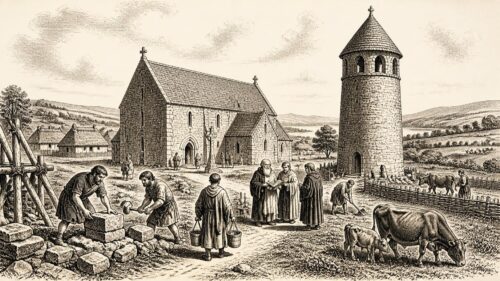
Churches and monasteries appear in the record both as communities of devotion and as assets within political conflict. Chronicon Scotorum says that Domnall son of Muirchertach burned and plundered Clonard, Fore, Lann Ela and Dísert Tola. Domnall was the northern Uí Néill ruler who held the kingship of Tara and made a broad claim to Ireland’s overlordship. The attack on these institutions demonstrates the material reality behind such claims. Major churches possessed land, livestock, food stores, skilled personnel and links with neighbouring rulers; they were places where authority could be displayed, resources seized and adversaries punished.
The wording “burned and plundered” should not lead to the assumption that each site ceased to exist. Irish ecclesiastical settlements were often extensive complexes of timber buildings, workshops, cultivated land, burial grounds and churches. Fire could be devastating, especially to roofs, books, stores and dwellings, but communities might rebuild if their land and patronage survived. Still, for monks, clergy, dependants and nearby farming households, the immediate effects would have included fear, displacement and the loss of provisions. The annals’ short notices preserve the political act, not the names of most people who endured it.
Another ecclesiastical notice, from the Munster annals, records the death of Tuathal, abbot of Clonmacnoise. His obituary reminds us that religious institutions remained connected across provincial boundaries even while kings fought. Clonmacnoise, on the Shannon route through the midlands, was an important religious and learned centre. Its abbot’s death was worth recording because leadership of such a community involved spiritual standing, property, patronage and public influence. The sparse notice says nothing of a succession dispute, so none should be presumed.
A Fractured Island
Ireland in 972 was not governed from a single administrative capital. Domnall Ua Néill’s senior kingship supplied a language of wider sovereignty, but Mathgamain’s actions in Munster, the killing of Leinster’s overking and the battle in Ulaid reveal how decisively provincial and local struggles shaped daily political reality. Kingship depended upon personal authority, military followings, negotiated alliances and the capacity to take or protect resources. A fortified port, a monastic estate, a royal household and a cattle-rich district could each become the object of coercion.
The sources also require chronological care. The principal contemporary-style annals attach the Munster, Leinster and Ulaid notices to 972, but medieval Irish annalistic dating is not mechanically uniform. The later Annals of the Four Masters labels its corresponding annal “972, correctly 974”, a warning against treating every item placed under its heading as evidence for this calendar year. The securely connected picture is nevertheless clear: in 972, Mathgamain’s coalition made Limerick subject to Munster power; Leinster lost a king through treachery; Ulaid lost a king in battle; and churches remained exposed to the demands of ambitious rulers. These were not isolated disturbances, but signs of a political landscape in which control of people, routes and sacred institutions remained contested.
Primary Sources
- Annals of Inisfallen: Annal AI972
- The Annals of Ulster: Year U972
- Chronicon Scotorum: Annal CS972
- Annals of the Four Masters: Annal M972
- Annals of the Four Masters
- Annals of Inisfallen
- Chronicon Scotorum
- CELT Project: Chronicon Scotorum Bibliography
- Mathgamain
- Brian Bórama (Bóruma, Boru)
- Ua Néill, Domnall
- Gormlaith
- Amlaíb (Óláfr) Cuarán
- Ireland: Dictionary of Irish Biography Search Results
- Mathgamain mac Cennétig and Limerick, Cambridge Core search extract
- The Vikings and the Fall of the Old Order
- Early Christian Ireland: Introduction to the Sources, Index
- Medieval Ireland, Index
- Brian Boru and the Rise to Provincial Kingship
- Kingship of Limerick
- Annals of the Kingdom of Ireland: Library Catalogue