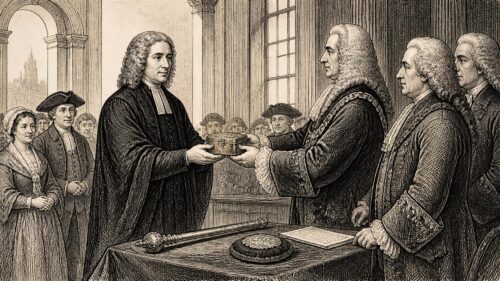
George’s Dublin Proclamation1714 CE
In 1714, Ireland experienced the formal succession from Queen Anne to George I, while Protestant rule remained insecure and unequal. A prorogued, restricted parliament left Dublin Castle dependent on proclamations, magistrates, clergy and military networks. Before and after Anne’s death, officials targeted robbery, Catholic arms and clergy, Jacobite recruitment, non-jurors, seditious print and rural violence, revealing fears rather than evidence of rebellion. George was proclaimed across Ireland on 6 August, followed immediately by Catholic disarmament and liturgical changes. Notices also regulated peace, foreign coin and public worship. The year’s records show Hanoverian authority consolidated through ritual, surveillance and penal control.
Dateline
In 1714 CE, Ireland passed from the last Stuart monarch, Queen Anne, to George I of Hanover. The transfer was formally smooth, but it occurred in a kingdom where power, property and public religion were already unequally distributed, and where officials treated Catholic allegiance and Jacobite sympathies as continuing dangers. The year’s surviving proclamations, printed in Dublin and ordered to be read across the country, offer an unusually close view of government priorities: a dormant parliament, policing and disarmament, the enforcement of religious penalties, trade and currency, and then the public declaration of a new king. They record the language of authority rather than the full experience of ordinary people, but they make clear that the Hanoverian succession was not merely a change of name at the top of government.
A Parliament Put Aside
Ireland began the year under Anne, with Charles Talbot, duke of Shrewsbury, still lord lieutenant. The Irish parliament elected in late 1713 had already exposed a sharp contest between political interests associated with Whig and Tory alignments. Its disputes involved personalities, church influence, public money and the management of office, not simply abstract English party labels. Shrewsbury had found little room for compromise. Parliament was prorogued repeatedly: first from January to later in that month, then on 1 February until 10 August, and in July again until 12 October. In practice, it did not resume useful business before the queen’s death changed the entire political setting.
This mattered because the Dublin parliament was neither a national representative assembly in a modern sense nor an institution fully free to determine its own programme. Its members were overwhelmingly Protestant men of property; Roman Catholics were excluded from parliamentary life. Under Poynings’ Law, proposed Irish legislation required prior approval through the English administration. Yet parliament still mattered greatly in raising revenue, regulating the kingdom and distributing influence. Its inactivity in 1714 left Dublin Castle reliant on proclamations, local magistrates, sheriffs, the army and established clerical networks to project authority beyond the capital.
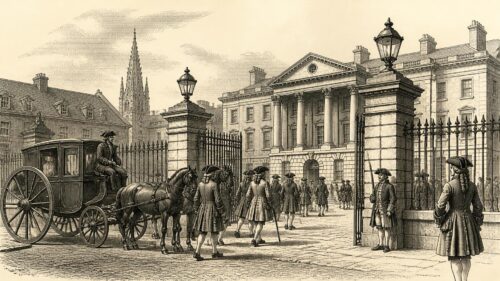
Shrewsbury returned to Britain in February. By June, the government was in the hands of two Lords Justices: Thomas Lindsay, Church of Ireland archbishop of Armagh, and Sir Constantine Phipps, lord chancellor. Their partnership itself reflected the political and ecclesiastical character of the regime. Lindsay was a senior Anglican prelate; Phipps was a prominent Tory lawyer whose conduct had been fiercely contested in the preceding parliamentary conflict. The crown’s Irish administration was therefore operating during a tense interregnum of parliamentary politics even before Anne’s failing health made the succession urgent.
Security Before the Succession
The official record from the first seven months of 1714 shows a government preoccupied with loyalty and order. On 8 February, a proclamation called for the apprehension of “tories, robbers and rapparees”. In this usage, “tory” could mean an outlaw or armed robber rather than a parliamentary Tory. The language bundled criminality, rural violence and political suspicion together. A further proclamation in March offered rewards concerning Walter Eustace and Christopher Everard. Such notices do not prove a nationwide emergency, but they show that the authorities wanted local officers and informers to treat disorder as a matter of state security.
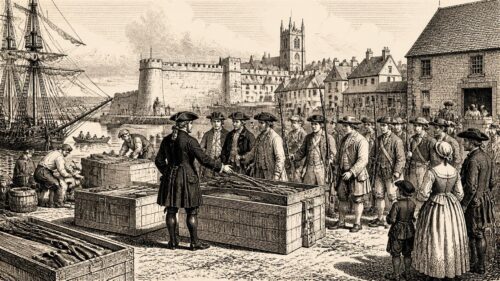
Religion lay at the centre of this security culture. On 18 March, government issued both a proclamation authorising the seizure of arms held by Catholics without licence and an alphabetical list of Catholics permitted to carry them. The pair demonstrates the practical machinery of the penal system: possession of weapons was not automatically impossible for every Catholic, but it was subject to exceptional permission, record-keeping and withdrawal. The state’s vocabulary called Catholics “papists”, a term preserved in the documents but inseparable from the hostility of the regime that used it.
On 19 April another proclamation was directed against Catholic priests, Jesuits and rebels. In May, government moved to prevent enlistment in the service of the Pretender, James Francis Edward Stuart, the Catholic son of the deposed James II. A reward for his apprehension followed on 7 July. These measures need careful reading. They do not demonstrate that an Irish Jacobite rising took place in 1714; it did not. They do demonstrate official fear that international tension, Catholic networks and the disputed Stuart claim might provide the conditions for one. For Catholic clergy and laypeople, the practical consequence was renewed uncertainty: surveillance, legal restrictions and the possibility that old prohibitions would be enforced more vigorously.
Peace, Money and Printed Authority
Not every measure concerned internal danger. On 27 March the Irish government published the peace between Britain and Spain, part of the wider settlement that followed the War of the Spanish Succession. The announcement linked Ireland to European diplomacy after more than a decade of war. Ireland did not negotiate the peace, but its ports, merchants, landlords and consumers lived within the commercial world shaped by it. A proclamation of 24 July declaring a new species of French coin current in Ireland similarly indicates the practical importance of foreign money in trade. It should not be inflated into evidence for a particular volume of Irish-French commerce; rather, it shows that officials considered the circulation and valuation of overseas coin a matter requiring public regulation.
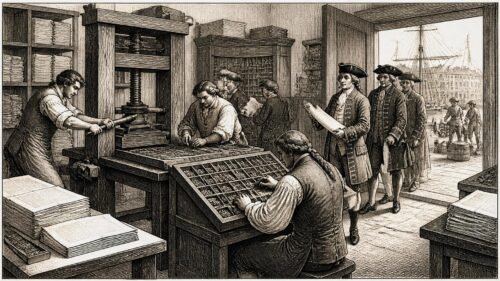
These proclamations also reveal how government reached the public. They were drafted at Dublin Castle or the council chamber, printed by Andrew Crooke in Copper Alley, reported through the Dublin Gazette, posted as broadsides, and transmitted through county and town officers. Their intended audience extended well beyond the relatively small reading public. Mayors, sheriffs, justices of the peace, clergy and military officers were expected to give orders local force. In market towns, churches, courthouses, inns and fairs, proclamations could be heard read aloud, discussed and resisted as well as obeyed.
The established Church of Ireland was integral to that system. A June proclamation ordered alterations to the Book of Common Prayer, and further instructions followed after the succession. The change was not simply editorial. Liturgical prayers named the monarch and royal family; each alteration of dynasty therefore had to be made audible in parish worship. In December, the Lords Justices and Council directed clergy to correct church books by hand until properly amended copies could be printed, while bishops were to ensure compliance. The instruction shows both the reach claimed by the established church and the practical limits of print supply. A new royal order had to be copied into worn local books before it could become routine worship.
Anne’s Death and George’s Accession
Queen Anne died on 1 August 1714. Her death ended the Stuart line in the direct Protestant succession. Under the settlement governing the crown, George, elector of Hanover and grandson of James I through his mother Sophia, became king of Great Britain and Ireland. The succession bypassed Anne’s Catholic half-brother, James Francis Edward Stuart. In Ireland, where the memory of the Williamite war and the Jacobite defeat of 1691 remained politically powerful, that religious exclusion was fundamental to the new dynasty’s legitimacy among supporters of the Protestant settlement and to the anxieties directed against its opponents.
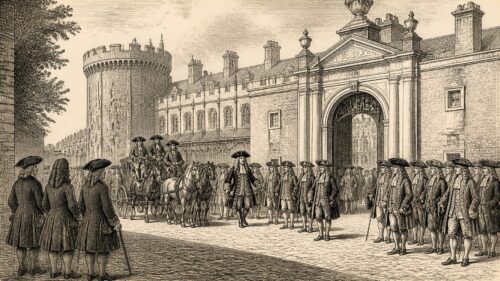
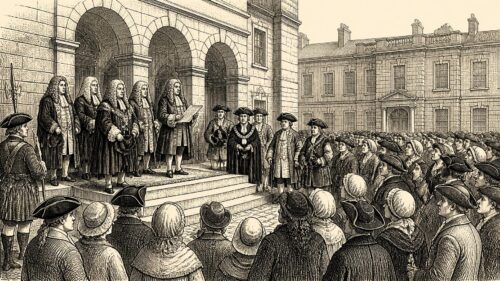
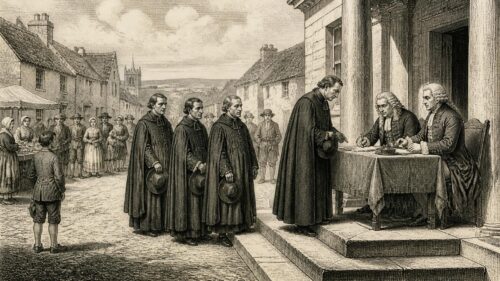
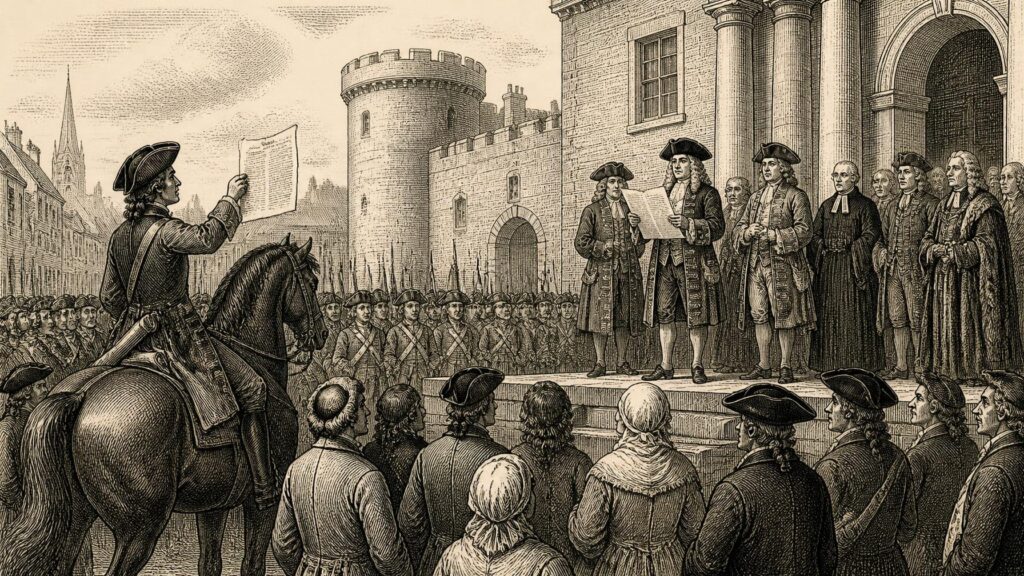
On 6 August, Lindsay and Phipps issued the Dublin proclamation declaring George king. It stated that the “imperial crowns” of Great Britain, France and Ireland had passed to him and that the Lords Justices, councillors, peers, principal gentlemen, lord mayor, aldermen and citizens of Dublin recognised him as their lawful ruler. Its claim to be made “with one full voice and consent of tongue and heart” was ceremonial rhetoric, not a neutral report of universal opinion. Still, the occasion was deliberately public. The proclamation ordered mayors, sheriffs and other officers to have it announced with due solemnity in cities, corporate towns and market towns throughout the kingdom.
The following day, 7 August, an additional proclamation required Catholics who had licences to keep and wear arms to surrender their weapons and ammunition to a justice or chief magistrate. The juxtaposition is revealing. George’s accession was proclaimed as an act of unanimous loyalty, but the administration immediately treated a substantial section of the population as a potential source of danger. The order was preventive rather than evidence that licensed Catholics had rebelled. Its political message, however, was plain: continuity of Protestant control would be secured through the state’s power to regulate arms.
Autumn Unease
By September, Charles Spencer, earl of Sunderland, had been appointed lord lieutenant, though like several eighteenth-century viceroys he governed largely from Britain. Day-to-day authority in Ireland remained dependent on resident officials. During the autumn, proclamations continued to register official concern. In October, government offered a pardon and reward for information about those who had damaged the equestrian statue of William III in Dublin. The monument was a charged symbol of the Williamite victory and Protestant political dominance; an attack upon it could be read as more than vandalism, though the surviving notice does not identify the culprits or prove a wider conspiracy.
In November, a reward was offered for robbers in Dublin City. On 30 November, the council issued a proclamation against people who hamstrung, or “houghed”, cattle. Maiming livestock was a direct assault on household wealth, food supply and rural livelihood. It had appeared in official notices before 1714, so the order should not be represented as a wholly new phenomenon. Its reissue nevertheless shows the continuing importance of cattle and the concern that agrarian grievances, revenge or criminal intimidation could be expressed through damage to animals.
December brought a proclamation enforcing laws against Catholics and non-jurors—those who would not swear the required oaths of loyalty—and another offering a reward for the author and publisher of a libellous print. The latter is a reminder that political conflict travelled not only in armed rumours and official broadsides but also in anonymous print. Control of public language mattered in a year when a new foreign-born king was being presented as Ireland’s unquestioned lawful sovereign.
Life Beyond Dublin Castle
For most inhabitants, the year’s great transition was encountered through local institutions rather than direct contact with royal ceremony. Most people lived in rural communities shaped by farming, leases, labour obligations, parish structures and the uneven authority of landlords, clergy and magistrates. Catholics formed the great majority of the population but lived under laws designed to limit their political, military and institutional position. Protestant dissenters also stood outside the privileges of the established church, although their circumstances differed greatly from those of Catholics. The official material records regulation and fear more readily than work, family life or belief; silence in the state archive must not be mistaken for silence in the countryside.
There were also quieter signs of urban and intellectual life. A Dublin edition of the English Bible appeared in 1714, a substantial undertaking in the city’s print trade and a cultural expression of Protestant religious life. Jonathan Swift, dean of St Patrick’s Cathedral since 1713, returned to Dublin after the collapse of his Tory political prospects in London following Anne’s death. Esther Vanhomrigh, remembered as “Vanessa”, likewise came to Ireland during 1714 after her mother’s death, establishing herself between Dublin and Celbridge. These were not national political events, but they place the succession year within a Dublin-centred world of books, cathedral institutions, patronage and correspondence.
Thus 1714 in Ireland was not marked by a battle or a parliamentary settlement of its own. It was a year in which an imperial succession was made real through proclamations, prayers, weapons registers, magistrates and public ritual. George I’s title was declared across the kingdom with elaborate confidence. The repeated orders against Catholic clergy, arms, Jacobite recruitment, cattle maiming, robbery and seditious print reveal the insecurity beneath that confidence. The Hanoverian regime arrived in Ireland not as a fresh beginning, but as the continuation—and tightening—of a Protestant political order already built after the Williamite wars.
Primary Sources
- The Proclamations of Ireland, 1660–1820, Vol. 3: George I, 1714–1727 and George II, 1727–1760
- Proclamations of Ireland, Vol. 3: Preview
- Statute Law Revision Act 2015
- By the Lords Justices and Council of Ireland, a Proclamation, 7 August 1714
- An Alphabetical List of the Names of All Such Persons of the Popish Religion within the Kingdom of Ireland, Who Have Licenses to Carry Arms
- By the Lord Lieutenant General and General Governor of Ireland, a Proclamation
- Talbot, Charles (1660–1718), 15th Earl and 1st Duke of Shrewsbury
- Succession to the Crown: King George I
- Securing the Hanoverian Succession in Ireland: Jacobites, Money and Men, 1714–16
- Tories and Whigs in Co. Cork, 1714
- The Crisis in Ireland and the Disintegration of Queen Anne’s Last Ministry
- Party and Management in the Irish House of Lords, 1713–15
- State Papers Ireland 1509–1782: Government Papers on Irish Affairs
- Anno Primo Georgii I, Chapter XIII
- The Seventh Year of William III
- Statutes in Chronological Order: The Reigns of King George I and II
- Sources: ‘We Hope That the Tempest Is Soon Calmed’—Early Irish Jesuits
- A New Map of Ireland, Divided into Its Provinces, Counties and Baronies
- Van Homrigh (Vanhomrigh), Esther (Hester)
- Swift, Jonathan
- The Holy Bible, Containing the Old Testament and the New
- George I, 1714–27