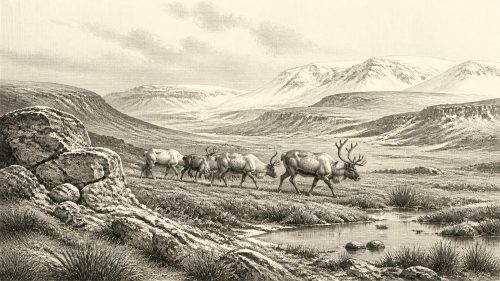
The Awbeg Reindeer Carcass
Around 31,341 BCE, Ireland lay within the climatically unstable Late Pleistocene, when the British–Irish Ice Sheet expanded unevenly. Deposits at Derryvree and Greenagho in Fermanagh demonstrate locally ice-free, freshwater periglacial conditions before later glaciation. Castlepook Cave in County Cork preserves MIS 3 fauna, including reindeer, mammoth, giant deer and predators, indicating varied cold-stage habitats. An incised reindeer femur may record carcass processing with a stone tool, potentially Ireland's earliest human evidence. However, its old collection context and uncertain interpretation preclude claims for settlement. Ireland was a severe, dynamic frontier, perhaps visited intermittently by mobile hunter-gatherers, whose presence awaits firmer confirmation.
View Record
Derryvree’s Drumlin Testimony
At the notional date of 31,342 BCE, Ireland lay within climatically unstable Marine Isotope Stage 3, not a year capable of precise historical dating. Derryvree, County Fermanagh, preserves wetland sediments between glacial tills, demonstrating a locally ice-free interval with treeless tundra vegetation, freshwater and severe seasonal cold. Castlepook Cave, County Cork, contains MIS 3 fauna including reindeer, mammoth and predators. An incised reindeer femur may indicate Upper Palaeolithic butchery, but cannot establish settlement or continuous occupation. Fragmentary evidence permits no conclusions about society, beliefs or politics. These sites instead reveal changing habitats, mobile animals and a possible brief human presence.
View Record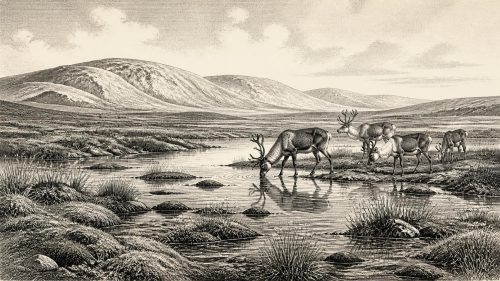
Crag Cave’s Distant Drips
31,343 BCE denotes an imprecise point during Marine Isotope Stage 3, when Ireland’s climate and ice cover changed rapidly. Derryvree, County Fermanagh, preserves sediments between glacial tills, showing a locally ice-free, cold wetland with tundra vegetation, insects and freshwater life. Castlepook Cave, County Cork, contains cold-adapted fauna; a marked reindeer femur may indicate human butchery, but cannot prove settlement or continuous occupation. No evidence supports Irish politics, farming, trade, religion or society at this date. Crag Cave speleothem growth in Kerry demonstrates episodic liquid water and milder intervals. Ireland was a harsh landscape, reconstructed from fragmentary environmental and archaeological evidence.
View Record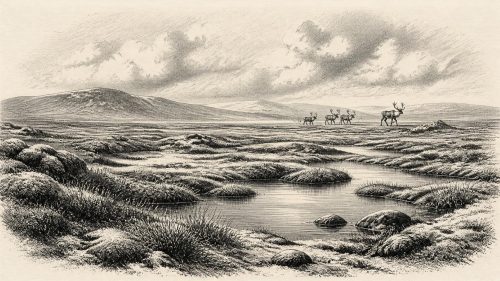
The Derryvree Interval
31,344 BCE is a modern label for an uncertain interval within MIS 3, rather than a datable Irish event. Environmental evidence is fragmentary because later glaciation disturbed or destroyed deposits. At Derryvree, Fermanagh, freshwater organic sediments between tills reveal a cold, treeless, wetland landscape during an ice-free episode. Castlepook Cave, Cork, preserves remains of reindeer, mammoth, giant deer and predators, accumulated over long periods rather than as a single fauna. A marked reindeer femur may indicate early human butchery, but cannot prove settlement. Calcite records and fossils underline fluctuating climates, varied habitats, and Ireland’s prehistory before farming, monuments or societies.
View Record
Awbeg’s Faunal Frontier
Around 31,345 BCE, Ireland experienced unstable Late Pleistocene conditions during the Midlandian glaciation. Derryvree, County Fermanagh, preserves sediments between tills, indicating cold, treeless wetlands during an ice-free interval broadly encompassing this date. The British–Irish Ice Sheet was expanding, although its precise Irish extent remains uncertain. Castlepook Cave, County Cork, contains remains of mammoth, reindeer, giant deer, bear, wolf, Arctic fox, lemmings and hyaena, demonstrating intermittent animal occupation. A modified reindeer femur may indicate Upper Palaeolithic butchery, yet cannot prove permanent human settlement. No contemporary Irish communities, polities, agriculture or cultural practices are securely evidenced. Later glaciation erased much surviving evidence.
View Record
Derryvree’s Tundra Seedbed
31,346 BCE is a modern nominal date within a broad Late Pleistocene range, rather than a recoverable Irish year. At Derryvree, County Fermanagh, organic sediments between glacial tills record an ice-free, cold, treeless tundra wetland with freshwater plants, mosses and sedges. Castlepook Cave, County Cork, preserves MIS 3 remains of mammoth, reindeer, giant deer, predators and other cold-adapted fauna, though these did not necessarily coexist. A marked reindeer femur may indicate brief human carcass processing, but cannot prove settlement. Lower sea levels may have enabled animal movement, while routes remain uncertain. Evidence reveals changing environments, not societies, events or polities.
View Record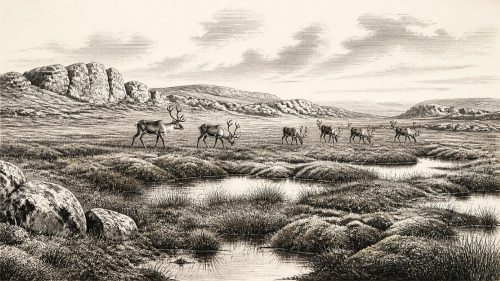
Castlepook’s Reindeer Groove
Around 31,347 BCE, Ireland lay within a cold, regionally varied Late Pleistocene landscape between ice advances. Derryvree in Fermanagh preserves freshwater sediments showing tundra-like wetlands with sedges, mosses, herbs and productive summers, rather than permanent ice cover. Castlepook Cave in Cork yielded reindeer, mammoth, giant deer and other cold-adapted fauna, although its disturbed collections cannot represent one moment. A grooved reindeer femur may record stone-tool butchery by an Upper Palaeolithic visitor, but does not prove settlement. Subsequent ice-sheet expansion erased or buried much early evidence, leaving a cautious environmental and palaeontological reconstruction rather than a recorded national history for Ireland.
View Record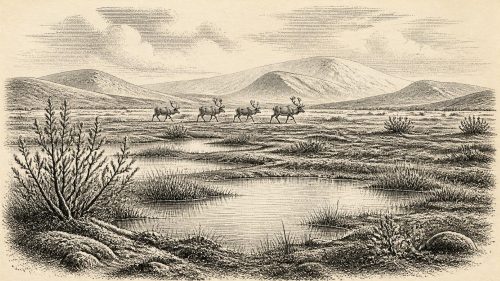
Hollymount’s Frozen Fen
31,348 BCE is a modern label for an uncertain MIS 3 horizon, not a recoverable Irish event. Between glacial advances, Fermanagh deposits at Derryvree, Hollymount and Greenagho preserve evidence of treeless, cold freshwater wetlands, with mosses, sedges, specialised plants and beetles. Ireland’s ice extent then remains uncertain, while frost, meltwater and later glaciation destroyed much evidence. Castlepook Cave bones demonstrate pre-Last Glacial Maximum large mammals, including reindeer, mammoth and predators, within open habitats. A possibly cut-marked reindeer femur may indicate brief human butchery, but cannot prove settlement. Ireland’s deep past is reconstructed cautiously from fragmentary sediments, fossils, stratigraphy and dating.
View Record
Derryvree’s Mossy Interlude
31,349 BCE is not a recoverable Irish historical year but a point within unstable Late Pleistocene MIS 3. At Derryvree, County Fermanagh, organic sediments between glacial tills record a locally ice-free, cold, wet, treeless landscape of freshwater pools, mosses, sedges, grasses, juniper and insects, later buried by ice. Comparable northern sites confirm alternating glacial conditions. Castlepook Cave, County Cork, preserves diverse Ice Age fauna, including mammoth and reindeer, while a possibly cut-marked reindeer bone suggests, but does not prove, human activity. No settlement or polity is evidenced. The date chiefly illuminates shifting habitats, uncertain chronologies and survival of environmental evidence.
View Record
Derryvree’s Cold-Water Biota
Circa 31,350 BCE, Ireland lay within the climatically unstable Late Pleistocene MIS 3, not a recordable historical year. At Derryvree, County Fermanagh, freshwater sediments between glacial tills, dated broadly to 36,900–31,700 cal BP, reveal treeless periglacial wetlands supporting grasses, sedges, juniper, mosses, aquatic plants and insects. Castlepook Cave, County Cork, preserves MIS 3 fauna including mammoth, reindeer, giant deer, bear, wolf, hare, lemmings and hyaena, indicating open habitats and ecological links abroad. A possibly cut-marked reindeer bone suggests fleeting human activity, but no settlement is proven. Later ice advances destroyed or buried much evidence, leaving only a fragmentary environmental record.
View Record