Hyaena Land at Castlepook31810 BCE
Around 31,810 BCE, Ireland lay within a changing Late Pleistocene landscape as the British–Irish Ice Sheet began expanding. Evidence from Derryvree, County Fermanagh, indicates treeless tundra, freshwater habitats and cold-adapted plants during an earlier ice-free interval. Castlepook Cave in north Cork produced remains of mammoth, reindeer, giant deer, bears, wolves, foxes, lemmings and spotted hyaenas, demonstrating intermittent links with continental fauna. A marked reindeer femur may indicate human butchery around 31,000 BCE, but lacks securely associated tools or occupation evidence. Any human presence remains hypothetical. Lower sea levels altered routes, while advancing ice later reduced habitable land and destroyed evidence.
Dateline
The label 31,810 BCE cannot identify an event in the modern sense. No calendar, written record, named community or dated human action survives from Ireland at this remote point in the Late Pleistocene. In archaeological terms it is best treated as an approximate position within a much broader span: roughly 33,800 calendar years before 1950, during Marine Isotope Stage 3, a fluctuating interval of the last Ice Age. The evidence relevant to Ireland consists not of annals or monuments but of cave bones, freshwater sediments, pollen and plant remains, insects, glacial deposits, radiocarbon measurements and reconstructions of changing ice margins. These sources can illuminate conditions across centuries and millennia; they cannot responsibly narrate a single year.
A Landscape Between Advances
At this horizon Ireland was entering a decisive phase in the growth of the last British–Irish Ice Sheet. That growth was neither simple nor simultaneous. Ice expanded and retreated in different regions at different times, responding to climate, sea level, topography and its own internal dynamics. Later parts of the glaciation covered or disturbed great areas of the island, eroding older surfaces and burying valuable deposits beneath till. Consequently, surviving evidence is patchy and local. It would be wrong to picture all Ireland as either a continuous ice sheet or an entirely open plain in 31,810 BCE.
The most useful chronological framework places the broad build-up of the last ice sheet after about 35,000–32,000 years ago, with major expansion over Ireland following later. Modelling based on the BRITICE-CHRONO project suggests that ice was building rapidly across the wider British–Irish region after 31,000 years ago and that much of Ireland became ice-covered by about 28,000 years ago. This does not yield a map for one numbered year, but it establishes the larger change: landscapes capable of supporting plants and animals were increasingly vulnerable to being overridden by ice.
Freshwater Beneath a Drumlin
Derryvree, near Maguiresbridge in County Fermanagh, gives the clearest Irish environmental glimpse of the broad period. There, organic-rich freshwater silts and sands were found between two separate sheets of glacial till. The deposit was sealed beneath the later, drumlin-forming ice deposit, making it an unusually important survivor from an earlier ice-free interval. A conventional radiocarbon determination of about 30,500 radiocarbon years before present has been calibrated in discussion of the site to a wide range of approximately 36,900–31,700 calibrated years before present. That range encompasses the notional date of 31,810 BCE, but it is a range, not a birthday for the deposit.
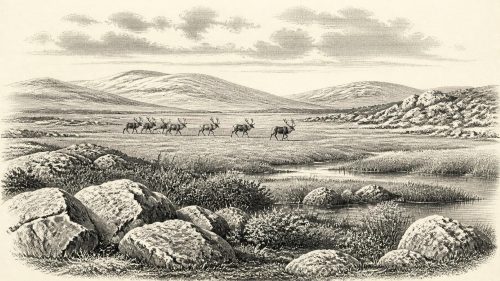
Its pollen, plant macrofossils and invertebrate evidence point to an open, cold, periglacial environment. The locality included freshwater or slow-moving water and wet ground, while the wider vegetation was treeless: tundra-like assemblages of grasses, sedges, herbs, mosses and low-growing plants rather than woodland. Finds reported from this deposit include Arctic-alpine plants such as mountain avens and bogbean. Such evidence shows that this northern landscape was not lifeless. Short summers could sustain a diverse, if low and exposed, vegetation cover around watercourses and pools; winters, by contrast, were likely long and severe, with frozen ground and powerful seasonal constraints.
Derryvree should not be made to stand for every coast, valley and upland in Ireland. It records a particular basin in Fermanagh, not the weather across an entire island. Nevertheless, it is strong evidence that at least some Irish ground supported freshwater habitats and open vegetation during part of late Marine Isotope Stage 3. It also demonstrates why the popular image of an Ice Age as unbroken snow and ice is inadequate. The Irish environment changed repeatedly, and productive patches could exist close to advancing or surviving ice.
The Fauna of North Cork
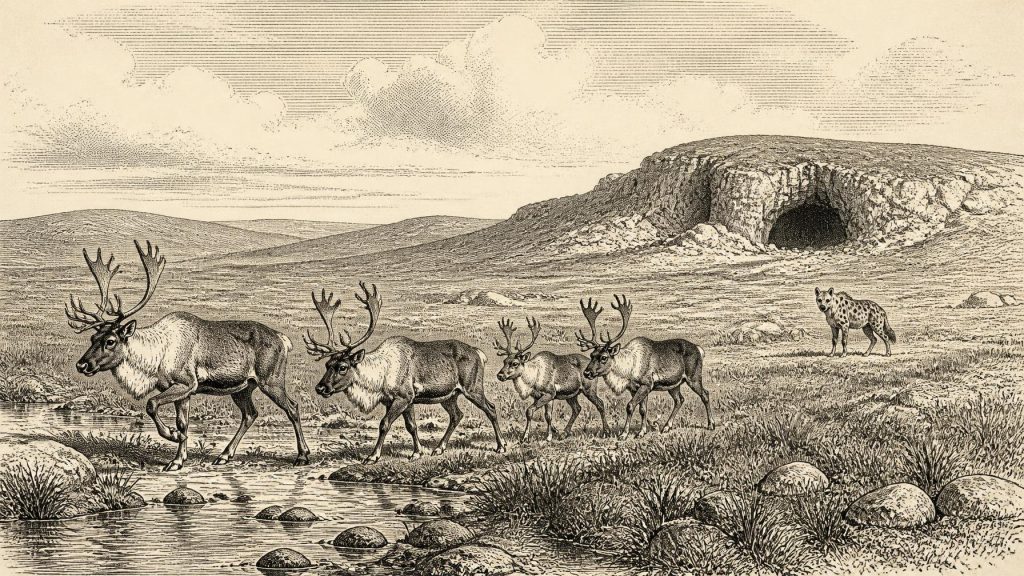
Castlepook Cave, also known historically as Mammoth Cave, near Doneraile in the Awbeg Valley of north County Cork, supplies the period’s most striking animal evidence. Excavations undertaken in the early twentieth century recovered a large and mixed assemblage of Pleistocene bones. Subsequent study has identified remains associated with cold-stage fauna including woolly mammoth, reindeer, giant deer, brown bear, wolf, fox, Arctic fox, lemmings and spotted hyaena. The National Museum of Ireland describes Castlepook as its most important Irish site for mammal remains of the last cold stage. Its fossils show that Ireland was, at least intermittently, within the range of continental European animal communities.
The cave itself was not an uncomplicated snapshot of a living valley. Carnivores could drag carcass parts underground; animals could die in or near passages; water and sediment could move bones; and the first excavators worked before modern standards of stratigraphic recording. Different galleries and layers may represent different episodes. Some finds are certainly younger than others, and old collections require re-examination with modern dating, zooarchaeology and taphonomic methods. A bone found in a cave therefore proves the presence or movement of an animal more readily than it proves exactly where it died, hunted or grazed.
Even with those qualifications, Castlepook changes the scale on which Ireland’s past must be imagined. Mammoths and reindeer imply open feeding grounds rather than dense forest. Hyaenas and wolves point to an active predator–scavenger community, while bears and smaller mammals occupied their own ecological niches. The cave’s traditional name, ‘Hyaena Land’, captures an important possibility: bones accumulated there partly through carnivore behaviour. It should not, however, become a claim that one particular hyaena clan dominated the valley in 31,810 BCE. The evidence supports an Ice Age fauna over a broad interval, not a scene fixed to a particular season.
The Reindeer Femur Question
One Castlepook specimen has made the question of people in Pleistocene Ireland especially important. A reindeer femur from the old cave collection bears a deep mark which zoologist Ruth Carden has interpreted as a cut made by a sharp stone tool during carcass processing. County Cork heritage material places the bone broadly at around 31,000 BCE. If the mark is indeed a human cut mark and belongs to the age of the animal bone, it would be potentially transformative evidence: it would indicate that a person handled a reindeer in Ireland far earlier than the previously secure Late Upper Palaeolithic evidence from County Clare.
The distinction between evidence and interpretation is crucial. The femur is material evidence; its radiocarbon age dates the animal’s death within a range; microscopic and anatomical assessment informs the interpretation of the incision. Yet the bone was not recovered from a securely excavated occupation floor alongside stone tools, hearth charcoal, shelters or a repeated sequence of human activity. No lithic assemblage of comparable age has been securely established at Castlepook. Nor does a single possible butchery trace demonstrate permanent settlement, a local population, a named Upper Palaeolithic culture or continuity with later inhabitants.
The responsible conclusion for around 31,810 BCE is therefore deliberately modest. Humans may have reached Ireland during a favourable phase of the Late Pleistocene and may have processed reindeer in north Cork. That possibility is important enough to guide further excavation and specialist analysis. It remains a hypothesis under active investigation, not a foundation for a detailed story of Irish settlement.
People, Movement and Absence
If people did visit Ireland at this time, their lives cannot be reconstructed from Irish evidence alone. Across north-west Europe, Upper Palaeolithic groups were highly mobile hunter-gatherers whose survival depended on seasonal knowledge, tools, clothing, fire, social co-operation and access to animal and plant resources. Such comparisons make a short hunting or scouting visit to an open Irish landscape conceivable. They do not prove it happened, and they must not fill the Irish record with invented camps, boats, family groups or rituals.
There is no evidence for political institutions, leaders, territorial states, diplomacy, organised warfare, trade networks, formal religious practice or artistic traditions in Ireland at this date. There are likewise no known Irish houses, graves, hearths or workshops securely dated to the period. The absence is meaningful, but not conclusive: ice erosion, rising seas, later sediment movement and the small scale of archaeological investigation all reduce what can survive and be found. Still, history must give absence its proper weight. For 31,810 BCE, no political narrative can responsibly be written.
Routes Across a Changing World
Animal colonisation shows that Ireland was not ecologically isolated throughout the period. Lower global sea levels exposed wide areas of the continental shelf around Britain and Ireland, but coastlines, channels and ice margins altered repeatedly. The evidence does not permit a confident assertion of a permanent dry-land corridor from continental Europe into Ireland at this exact time. Animals and any people may have moved during episodes when routes were more favourable, possibly through changing coastal and shelf landscapes; some crossings may still have involved water. This is a question for palaeogeography, not a licence to draw a single simple ‘land bridge’.
What mattered most was regional instability. Freshwater tundra in Fermanagh, large mammals in north Cork and expanding ice across the wider archipelago belong to the same long transformation. Within several millennia, the growth of the last ice sheet would profoundly reduce habitable ground and erase much of the evidence for the world that preceded it. Ireland around 31,810 BCE was therefore not yet the familiar island of later prehistory, nor an empty stage awaiting history. It was a changing northern peninsula-and-shelf environment, inhabited certainly by cold-adapted animals and perhaps, fleetingly, visited by people whose presence remains one of Irish archaeology’s most consequential unanswered questions.
Primary Sources
- Heritage Artefacts of County Cork
- Archaeology Research Excavation Grant 2022: Final Report
- A Reconsideration of the Radiocarbon Dating of the Marine Isotope Stage 3 Fauna from Southern Ireland
- The Irish Quaternary Fauna Project
- A History of the Irish Red Deer and its Potential as a Refugium Population for the Scottish Red Deer
- First Evidence of a Late Upper Palaeolithic Human Presence in Ireland
- New Insights on the Fauna of Ireland's Younger Dryas and Early Holocene from Alice & Gwendoline Cave
- Spotted Hyena Skull
- Castlepook Caves
- Castlepook Cave, Castlepook South, Cork: 2022 Excavation Report
- Inter-till Freshwater Deposit at Hollymount, Maguiresbridge, Co Fermanagh
- Menyanthes trifoliata
- Dryas octopetala
- Growth and Retreat of the Last British–Irish Ice Sheet, 31,000 to 15,000 Years Ago: the BRITICE-CHRONO Reconstruction
- Extent and Timing of the Last Glacial Maximum in Britain and Ireland: a Review
- Maximum Extent and Dynamic Behaviour of the Last British–Irish Ice Sheet West of Ireland
- Sedimentology and Chronology of the Advance and Retreat of the Last British-Irish Ice Sheet on the Continental Shelf West of Ireland
- Early Deglaciation of the British-Irish Ice Sheet on the Atlantic Shelf Northwest of Ireland Driven by Glacioisostatic Depression and High Relative Sea Level
- Pattern and Timing of Retreat of the Last British-Irish Ice Sheet
- Timing, Pace and Controls on Ice Sheet Retreat: an Introduction to the BRITICE-CHRONO Transect Reconstructions of the British-Irish Ice Sheet
- Exploring Controls of the Early and Stepped Deglaciation on the Western Margin of the British Irish Ice Sheet
- The IntCal20 Northern Hemisphere Radiocarbon Age Calibration Curve (0–55 cal kBP)