
Archived: 20 September 2026
Abstract
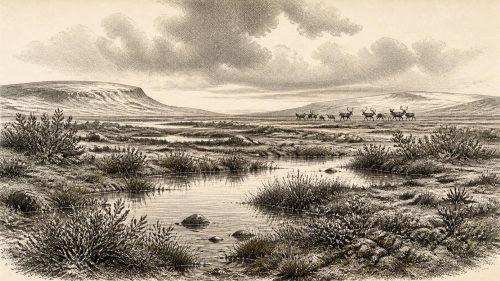
At the notional date of 31,099 BCE, Ireland was a cold, unstable Late Pleistocene landscape, not a settled country. Sediments beneath the Derryvree drumlin in County Fermanagh, dated broadly to 34,700–32,300 cal BP, show an ice-free freshwater wetland with tundra vegetation, insects and shallow water between glacial advances. Lower sea levels altered coasts, although no proven route into Ireland exists. Cave remains indicate reindeer and other cold-adapted fauna. A marked reindeer femur from Castlepook Cave may record human butchery, but cannot demonstrate residence. No settlements, artefacts, trade networks or polities are known; later ice probably destroyed much surviving archaeological evidence.
Read Article
Archived: 19 September 2026
Abstract
Around the notional date of 31,125 BCE, Ireland was an unstable Ice Age landscape, not a documented human society. Derryvree, County Fermanagh, preserves freshwater sediments between glacial tills, indicating cold, open wetlands with sedges, mosses, dwarf willow and aquatic plants during an ice-free interval. Other northern deposits confirm fluctuating local conditions. Castlepook Cave, County Cork, contains time-mixed remains of reindeer, mammoth, giant deer, hyaena and other cold-stage animals. A cut-marked reindeer bone may indicate Upper Palaeolithic human activity, but no settlement is proven. Lower seas did not guarantee easy routes; later glaciation obscured earlier evidence across much of the island.
Read Article

Archived: 19 September 2026
Abstract
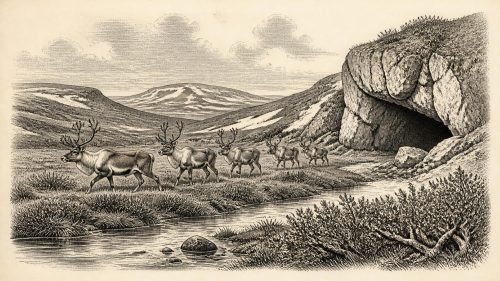
31,135 BCE is a label for a Late Pleistocene interval, not a recorded year. Evidence depicts a cold, changing landscape rather than a human society. Derryvree deposits in Fermanagh preserve tundra-like freshwater wetlands, with bogbean, mosses, sedges, insects and open vegetation between glacial advances. Ice accumulated unevenly across Ireland, while fluctuating climate, lower seas and changing connectivity shaped habitats. Castlepook Cave in Cork contains mammoth, giant deer, reindeer, predators and fauna accumulated through varied processes. A reindeer femur possibly cut by a stone tool may signal brief human activity, but cannot demonstrate settlement. Dating, deposits and bone contexts require caution.
Read Article
Archived: 19 September 2026
Abstract
Around 31,192 BCE, Ireland lay within the unstable, cold conditions of Marine Isotope Stage 3, before the Last Glacial Maximum. Evidence derives from broadly dated bones, sediments, plants and insects rather than year-specific events. Castlepook Cave in County Cork preserves fauna including reindeer, mammoth, giant deer, predators and cold-adapted smaller animals. A marked reindeer femur may indicate human butchery, yet cannot prove settlement or even a dated hunting episode. Derryvree, County Fermanagh, records an ice-free wetland interval between glacial advances. Together, these traces depict open tundra-grassland habitats and possible transient human visits, while confirming profound uncertainty about Ireland’s earliest inhabitants.
Read Article

Archived: 19 September 2026
Abstract
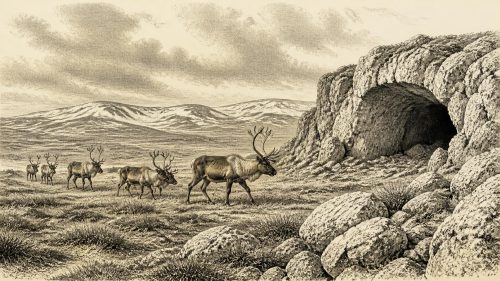
About 31,194 BCE is a modern chronological label, not a recorded Irish year. Ireland then lay in the Middle Midlandian cold stage, before maximum glaciation, with variable tundra-steppe, wetlands and sparse vegetation. Derryvree deposits in Fermanagh provide environmental evidence for this harsh, ice-free or ice-marginal landscape. Castlepook Cave near Doneraile contains remains of mammoth, reindeer, giant deer and other cold-climate animals, accumulated across long periods. A marked reindeer femur, possibly cut by a stone tool, suggests a brief Upper Palaeolithic human visit, but cannot prove settlement. Glaciation, erosion and rising seas have left Ireland's human record fragmentary, provisional and unresolved.
Read Article
Archived: 19 September 2026
Abstract
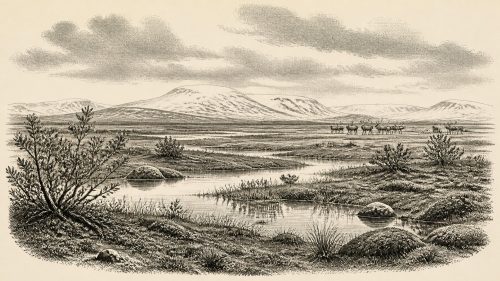
Around 31,205 BCE, an approximate modern label for a fluctuating MIS 3 interval, Ireland was a cold, changing landscape before the Last Glacial Maximum. Castlepook Cave, County Cork, preserves bones of mammoth, reindeer, giant deer, hyaena and animals, showing intermittent habitats for mammals but not a single contemporaneous community. A reindeer femur reportedly bears a possible stone-tool butchery mark and may represent Ireland’s earliest human activity, although dating, context and interpretation remain uncertain. No evidence establishes settlement or culture. Cave deposits, sediments and faunal remains instead reveal open tundra-like environments, mobile wildlife, shifting access, and records obscured by advancing ice.
Read Article
Archived: 19 September 2026
Abstract
31,206 BCE is a modern label for a Late Pleistocene interval, not a recoverable Irish historical year. Derryvree, County Fermanagh, preserves organic sediments between glacial tills, indicating an ice-free, treeless wetland of sedges, mosses, pools and cold-adapted insects during Marine Isotope Stage 3. Castlepook Cave, County Cork, contains a mixed fauna including mammoth, reindeer, giant deer, carnivores and small cold-climate mammals, though its deposits lack precise stratigraphic control. A marked reindeer femur may indicate butchery by people, potentially Ireland’s earliest human trace, but proves neither settlement nor permanent population. Climatic deterioration expanded the British-Irish Ice Sheet, destroying or concealing evidence.
Read Article

Archived: 19 September 2026
Abstract
31,215 BCE is a modern label for a point roughly 33,000 years ago, during the variable MIS 3 phase of the last Ice Age. Ireland contained shifting mosaics of ice, open tundra, wetlands and exposed ground, not a uniform ice cap. Derryvree deposits in Fermanagh preserve evidence of freshwater habitats, sedges, mosses and vegetation between glaciations. Castlepook Cave in Cork yielded Ice Age fauna, including mammoth, reindeer, giant deer, hyaena and bear. A possibly cut-marked reindeer bone may indicate Upper Palaeolithic human activity, but no tools, hearths or settlements confirm occupation. Evidence reveals ecological change, animal movement and archaeological uncertainty.
Read Article
Archived: 19 September 2026
Abstract
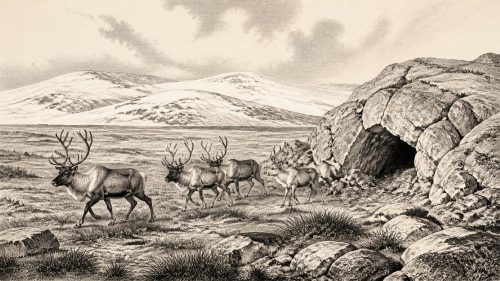
Circa 31,220 BCE is a notional date within the volatile Late Pleistocene, not a precisely recorded Irish year. Before the Last Glacial Maximum, Ireland contained shifting cold, open habitats supporting reindeer, mammoth, giant deer and carnivores. Castlepook Cave in County Cork preserves remains from this fauna, though early excavation and disturbed deposits limit interpretation. A reindeer femur, dated roughly 33,000 years ago, bears a possible stone-tool cut mark. If confirmed, it may indicate brief Upper Palaeolithic human carcass processing, rather than settlement. Expanding ice later transformed landscapes and erased evidence, leaving a rare record of prehistoric ecology and human presence.
Read Article
Archived: 18 September 2026
Abstract
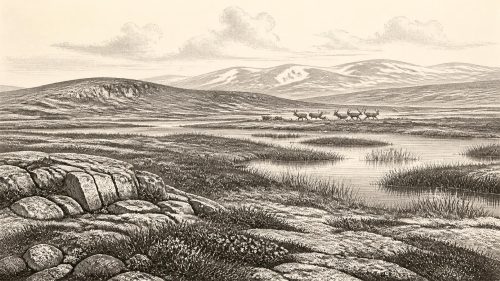
Around 31,245 BCE, Ireland was an unstable MIS 3 Ice Age landscape, not a datable historical year. Open tundra, wetlands and intermittent ice supported reindeer, mammoth, giant deer, predators and other fauna, while changing sea levels and ice margins affected access. Castlepook Cave in County Cork preserves varied Pleistocene remains, including a reindeer femur fragment dated to about 33,000 years ago with a possible stone-tool cut mark. If confirmed, it may indicate an early human visit, but not settlement or continuous population. Environmental deposits at Derryvree and Aghnadarragh show cold, treeless habitats. Evidence remains fragmentary, requiring cautious interpretation by researchers.
Read Article

Archived: 18 September 2026
Abstract
31,250 BCE is a modern label within variable Marine Isotope Stage 3, not a precisely dated Irish event. Ireland experienced fluctuating cold conditions, with ice, periglacial terrain and occasional ice-free habitats. At Derryvree, Fermanagh, an interglacial wetland deposit, dated broadly to 36,900–31,700 calibrated BP, preserves tundra-like plants and insects between glacial advances. Castlepook Cave, Cork, contains fauna accumulated over millennia, including reindeer, mammoth, predators and other cold-country species, indicating ecological connections with north-west Europe. A cut-marked reindeer femur may record Upper Palaeolithic butchery, but proves neither permanent settlement nor wider society. Together sites reveal changing environments and possible human visits.
Read Article

Archived: 18 September 2026
Abstract
Approximately 31,282 BCE represents a broad Late Pleistocene horizon, not a precise date, within unstable MIS 3 conditions preceding the Last Glacial Maximum. At Derryvree, County Fermanagh, organic freshwater deposits between glacial tills record cold, open tundra-steppe wetlands, although their dated range cannot define island-wide conditions. Lower sea levels connected Ireland ecologically with neighbouring regions, but routes varied. Castlepook Cave, County Cork, preserves diverse Ice Age fauna and a reindeer femur dated near this period, whose possible stone-tool cut mark may indicate human carcass processing. Disturbed contexts prevent certainty. Later ice erased evidence, leaving environmental change and possible human visitation.
Read Article
Archived: 18 September 2026
Abstract
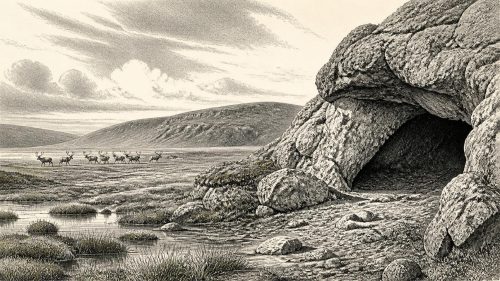
Around 31,303 BCE, Ireland experienced fluctuating Ice Age conditions during Marine Isotope Stage 3, not a precisely observable calendar year. Derryvree, County Fermanagh, preserves freshwater sediments formed between glacial advances, revealing treeless tundra, marshes, cold-adapted plants and seasonal freshwater habitats. Castlepook Cave, County Cork, contains a long, mixed bone archive of mammoth, giant deer, reindeer, brown bear and spotted hyaena, demonstrating intermittent access for cold-stage fauna. A marked reindeer femur may indicate brief human carcass processing with a stone tool, but cannot prove settlement. Evidence shows changing ice margins and productive open landscapes, not permanent communities, polities or cultural institutions.
Read Article
Archived: 18 September 2026
Abstract
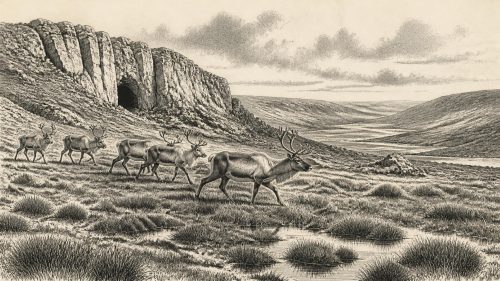
The modern label 31,327 BCE cannot identify a discrete Irish event, but denotes a fluctuating cold phase of Late Pleistocene MIS 3. Castlepook Cave near Doneraile, County Cork, yielded a reindeer femur bearing a stone-tool cut, potentially Ireland’s earliest claimed human evidence. Its age, provenance and interpretation remain uncertain, as early excavations and changing radiocarbon methods limit precision. Ireland comprised open, seasonal tundra-like habitats amid shifting ice and lower seas, supporting reindeer, mammoth, hyaena and fauna. Derryvree deposits indicate treeless environments between glacial advances. No settlement is proven: any visitors were mobile foragers, while cave processes may have redistributed bones.
Read Article
Archived: 18 September 2026
Abstract
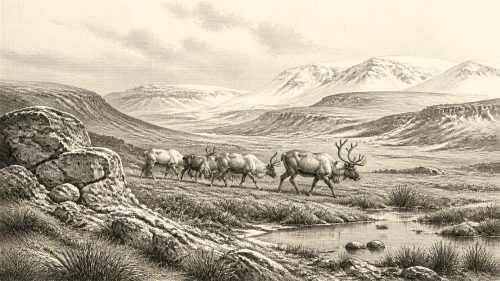
Around 31,341 BCE, Ireland lay within the climatically unstable Late Pleistocene, when the British–Irish Ice Sheet expanded unevenly. Deposits at Derryvree and Greenagho in Fermanagh demonstrate locally ice-free, freshwater periglacial conditions before later glaciation. Castlepook Cave in County Cork preserves MIS 3 fauna, including reindeer, mammoth, giant deer and predators, indicating varied cold-stage habitats. An incised reindeer femur may record carcass processing with a stone tool, potentially Ireland's earliest human evidence. However, its old collection context and uncertain interpretation preclude claims for settlement. Ireland was a severe, dynamic frontier, perhaps visited intermittently by mobile hunter-gatherers, whose presence awaits firmer confirmation.
Read Article

Archived: 18 September 2026
Abstract
Around 31,355 BCE, Ireland formed a climatically unstable, regionally varied landscape during Marine Isotope Stage 3, not a precisely datable historical moment. Ice advances and retreats created mosaics of tundra, freshwater basins and exposed ground; Derryvree in Fermanagh demonstrates ice-free, treeless ecosystems supporting plants and insects. Castlepook Cave, County Cork, produced Ice-Age fauna and a reindeer femur bearing a possible stone-tool cut mark, tentatively suggesting early human carcass processing. Poor stratigraphic records and uncertain mark interpretation prevent claims of settlement or cultural affiliation. Firmly dated human activity in Ireland still remains much later, making Castlepook an important but unconfirmed threshold.
Read Article

Archived: 17 September 2026
Abstract
Labelled 31,366 BCE only approximately, this period belongs to later Marine Isotope Stage 3, when Ireland formed a cold, unstable, seasonally severe western fringe of Ice Age Europe. Lower seas altered connections with Britain and the continent, while open ground, local ice and periglacial conditions formed a changing mosaic before major glaciation. Castlepook Cave near the Ballyhouras preserves bones of mammoth, reindeer, giant deer and carnivores, but disturbed deposits and revised dating limit certainty. A possibly tool-marked reindeer bone may indicate human butchery, not settlement. No Irish evidence supports reconstructed societies; environmental change and approaching ice dominate this remote history.
Read Article

Archived: 17 September 2026
Abstract
Around 31,375 BCE, a label rather than a precise Irish date, Ireland lay within cold conditions of Marine Isotope Stage 3. Treeless tundra-like landscapes and lower sea levels supported fauna, though advancing ice and later glaciation destroyed much evidence. Castlepook Cave near Doneraile preserves remains of reindeer, mammoth, giant deer, predators and cold-adapted animals, demonstrating intermittent access for mammals before the Last Glacial Maximum. A marked reindeer femur may indicate butchery by people, Ireland’s earliest human trace. However, it proves neither settlement nor continuous occupation. No evidence exists for farming, trade, politics or identifiable culture, only possible brief hunter-gatherer visits.
Read Article

Archived: 17 September 2026
Abstract
31,428 BCE is a notional date within Marine Isotope Stage 3, not a recoverable Irish year. Derryvree, County Fermanagh, preserves freshwater sediments between glacial tills, indicating a locally ice-free, periglacial wetland with tundra plants and animal life during a cold, unstable interval. Castlepook Cave, County Cork, contains remains of reindeer, mammoth, giant deer and predators, demonstrating a varied cold-stage fauna. A marked reindeer femur, dated broadly near this period, may record stone-tool carcass processing and Ireland’s earliest human trace. However, it proves neither settlement nor continuity. Later glaciation destroyed or buried evidence, leaving a fragmentary landscape archive for modern researchers.
Read Article

Archived: 17 September 2026
Abstract
Around 33,000–34,000 calibrated years before present, Ireland lay in climatically unstable Marine Isotope Stage 3, with changing ice, coastlines and open habitats. Castlepook Cave, County Cork, preserves Ireland’s richest pre-Last Glacial Maximum vertebrate fauna, accumulated over millennia rather than representing one moment. Bones of mammoth, giant deer, reindeer, bear, wolf, hyaena, Arctic fox and lemmings demonstrate periodically viable cold-climate ecosystems. Radiocarbon dates require caution, especially for old collections. A modified reindeer bone may indicate human carcass processing about 33,000 years ago, but remains unconfirmed and cannot prove permanent settlement. No evidence establishes contemporary institutions, rituals, language, or sustained occupation there.
Read Article
Archived: 17 September 2026
Abstract
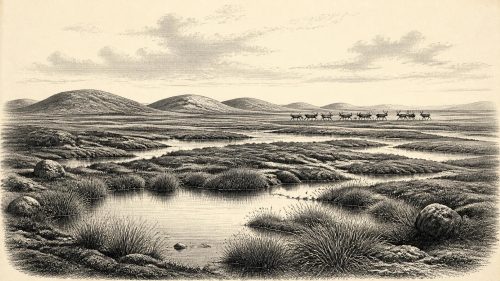
Around 31,459 BCE, Ireland was in the climatically unstable Late Pleistocene, not uniformly ice-covered. At Derryvree, County Fermanagh, a freshwater organic layer later buried by glacial till records mossy, sedgy tundra-steppe wetlands during a broad interval spanning the notional date. Castlepook Cave, County Cork, yielded reindeer, mammoth, giant deer, horse, carnivores and lemmings, demonstrating cold open habitats and intermittent animal access before major ice expansion. Cave deposits accumulated over time, however, so they cannot define a single community. A cut-marked reindeer femur may indicate human carcass processing, but lacks contextual evidence. No settlement, culture or political history can be inferred.
Read Article
Archived: 17 September 2026
Abstract
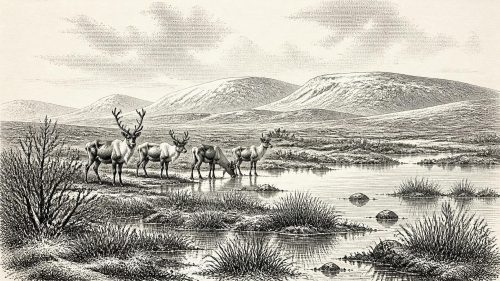
Around 31,463 BCE, Ireland lay within the unstable cold conditions of Marine Isotope Stage 3, not a precisely identifiable historical year. Derryvree, County Fermanagh, preserves freshwater sediments between glacial tills, showing an ice-free periglacial tundra of wetlands, sedges, mosses and grazing animals during a broadly relevant interval. Castlepook Cave, County Cork, contains a complex accumulation of cold-climate fauna, including mammoth, reindeer, predators and lemmings. A scored reindeer femur may record butchery by Upper Palaeolithic people, but cannot prove settlement. Routes into Ireland remain uncertain. The strongest evidence depicts environmental change as expanding ice increasingly transformed habitats across the island's landscapes.
Read Article

Archived: 17 September 2026
Abstract
Around 31,479 BCE, Ireland lay in the unstable, cold Late Pleistocene, before maximum glaciation. Much terrain was probably ice-free, supporting tundra, steppe-tundra, wetlands and sparse shrubs, while later ice destroyed much evidence. Deposits at Derryvree and Maguiresbridge show wetland habitats with cold-adapted plants. Castlepook Cave in County Cork yielded fauna including reindeer, mammoth, giant deer, hyaena and Arctic fox. An incised reindeer femur, dated broadly to about 31,000 BC, may indicate human butchery, but lacks a secure archaeological context. It cannot prove settlement. Ireland’s evidence instead suggests a changeable landscape, rich Ice Age fauna, and only possible brief human visits.
Read Article
Archived: 17 September 2026
Abstract
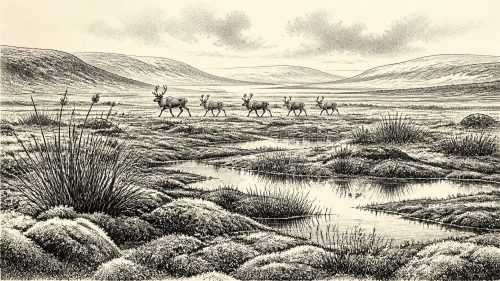
31,487 BCE is a modern label within unstable MIS 3, not a datable Irish event. At Derryvree, County Fermanagh, freshwater silts sealed between tills record a non-glacial interval of cold, treeless tundra wetland, dated broadly to 36,900–31,700 calibrated years before present. Castlepook Cave, County Cork, preserves a time-depth assemblage of Ice Age fauna, including reindeer, mammoth, hyaena and predators, demonstrating favourable open habitats during parts of MIS 3. A marked reindeer femur may indicate human butchery about 33,000 years ago, but insecure contexts prevent firm conclusions. Later glaciation erased evidence; no settlements, tools, burials, trade or political life are established.
Read Article

Archived: 17 September 2026
Abstract
Around 31,512 BCE, Ireland was a fluctuating, cold MIS 3 landscape rather than a uniformly ice-covered wilderness. Dating cannot identify events in a precise calendar year, and evidence is fragmentary after glacial erosion. Freshwater deposits at Derryvree, Fermanagh, show locally open tundra wetlands with hardy vegetation between 36,900 and 31,700 years ago. Castlepook Cave, Cork, preserves diverse fauna including reindeer, mammoth, giant deer, predators and smaller cold-adapted animals. Cutmarks on a reindeer femur, dated about 33,000 years ago, may record Ireland’s earliest human butchery. They suggest brief mobile hunter visits, not settlement, while routes, cultural identity and continuity remain unknown.
Read Article

Archived: 17 September 2026
Abstract
31,515 BCE is a modern, misleadingly precise label for a fluctuating Marine Isotope Stage 3 environment rather than a recordable Irish year. Castlepook Cave, north County Cork, preserves disturbed deposits containing mammoth, reindeer, giant deer, hyaena, bear, wolf and cold-adapted species, demonstrating a diverse Pleistocene fauna amid shifting open habitats and variable ice. Radiocarbon results require cautious calibration, and revised dating places elements of the fauna before the Last Glacial Maximum. A notched reindeer femur may indicate stone-tool butchery and a human visit, but cannot prove settlement. The evidence supports ecological history, not claims of communities, routes, culture or events.
Read Article

Archived: 16 September 2026
Abstract
Around 31,528 BCE, Ireland lay within the unstable cold conditions of Marine Isotope Stage 3, not a datable historical year. Castlepook Cave, County Cork, yielded diverse Pleistocene fauna, including reindeer, mammoth, giant deer, hyena and lemmings. A reindeer femur, radiocarbon dated to about 33,000 years ago, bears a mark interpreted as stone-tool butchery, potentially Ireland’s earliest human evidence. This does not establish settlement, as cave deposits are disturbed and the cut’s origin remains debated. Open tundra-steppe, wetlands and changing ice margins supported intermittent animal and possible human movement. Advancing glaciation later obscured evidence, leaving fragile traces of Upper Palaeolithic visits.
Read Article

Archived: 16 September 2026
Abstract
Around 31,529 BCE, Ireland was a cold Late Pleistocene landscape rather than a recognisable historical society. Calibrated dating places Derryvree’s freshwater deposits, preserved beneath glacial tills in County Fermanagh, within the broader period; their remains indicate open, mostly treeless wetlands with pools, sedges and cold-adapted plants. Castlepook Cave in County Cork yielded mammoth, reindeer, giant deer, predators and lemmings, showing episodic habitable open country before maximum glaciation. An incised reindeer femur may record butchery by Upper Palaeolithic people, but cannot prove settlement. No evidence supports claims of communities, institutions, farming, ritual, or human occupation. Later ice expansion transformed the island.
Read Article
Archived: 16 September 2026
Abstract
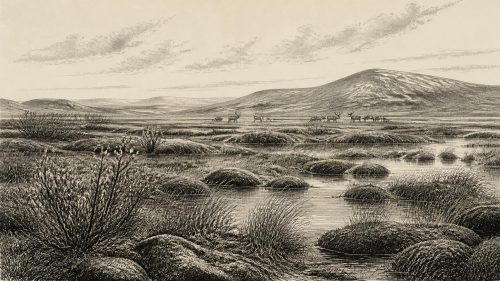
Around 31,565 BCE, Ireland’s record is environmental rather than historical, and cannot support calendar precision or claims of settlement. Derryvree, County Fermanagh, preserves a broadly dated MIS 3 interstadial deposit, indicating locally ice-free, periglacial tundra with freshwater wetlands, open vegetation and severe seasonal conditions. Castlepook Cave near Doneraile contains cold-stage fauna including reindeer, mammoth, giant deer, predators and lemmings, although deposits may combine separate episodes. A scored reindeer femur, perhaps 33,000 years old, may show stone-tool butchery and Ireland’s earliest human trace. It cannot establish a kill site, continuous occupation, settlement, society, travel routes or a single specific dated event.
Read Article

Archived: 16 September 2026
Abstract
At the modern filing date of 31,577 BCE, Ireland was a climatically unstable Ice-Age landscape, not a documented society. Derryvree, County Fermanagh, preserves evidence of a treeless, cold wetland existing between glacial advances, though its dated range cannot describe a single year. Castlepook Cave, County Cork, contains MIS 3 animal remains, including mammoth, reindeer, giant deer, hyaena and wolf, but its mixed cave deposits do not represent one community. A cut-marked reindeer femur, dated around 33,000 years ago, may indicate human butchery. It supports possible brief visits by hunter-gatherers, not continuous settlement, institutions or cultural traditions with certainty in Ireland.
Read Article




