
Ranks Mills(c.1930s)
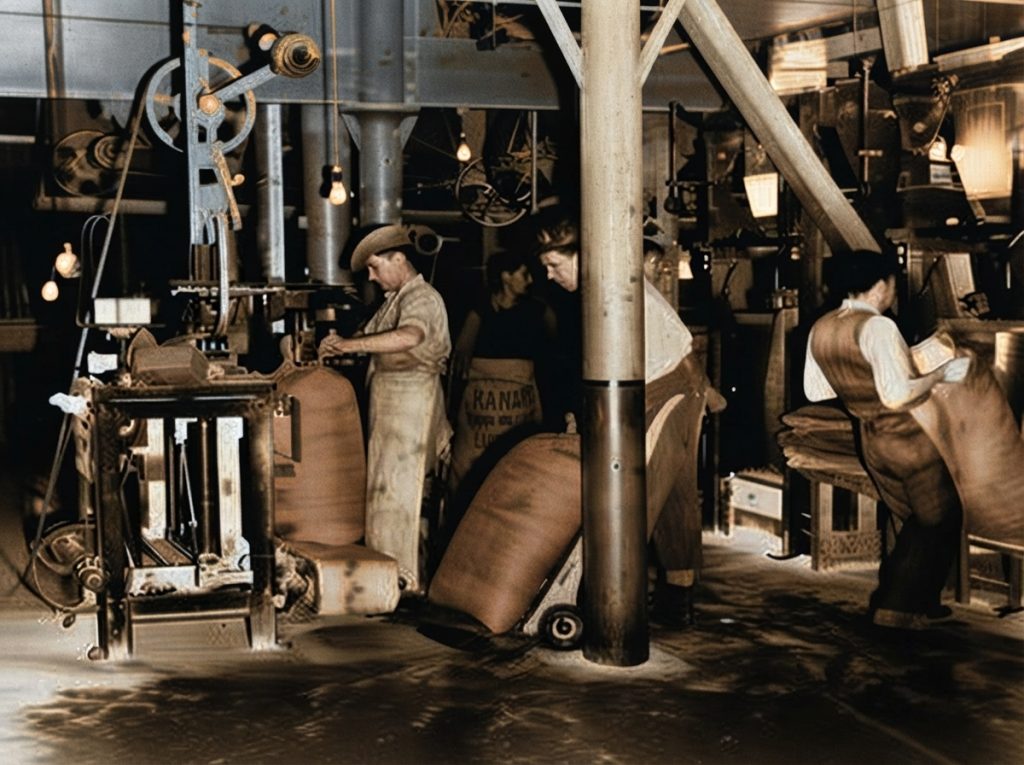
Ranks Mills became central to Limerick’s industrial life after Joseph Rank’s company acquired Goodbody’s existing flour works and redeveloped the Dock Road site in 1930. The new complex combined modern roller milling technology with large concrete silos and riverside receiving facilities for imported wheat and grain shipments. Its scale altered the city skyline and expanded dockside employment, drawing labour from Thomondgate and surrounding districts into regular wage labour. The development linked older milling traditions on the Lock Mills site to twentieth century corporate manufacturing and transformed working rhythms, seasonal hiring practices and civic identity and local oral histories attest regularly.
Lock Mills had operated nearby since the eighteenth century, established by Andrew Walsh and later expanded by John Norris Russell and other local millers who exploited weirs and navigation links to the Shannon. Early records describe water powered mill wheels, multiple pairs of French millstones and associated granaries serving local and export markets. Trade directories and eighteenth and nineteenth century newspapers record shipments of flour and meal bound for overseas trade routes. The industrial archaeology of the canal, quay and lock structures preserves traces of these operations in surviving masonry, sluices, culverts and bonded warehouses and nineteenth century plans survive.
Rank (Ireland) Ltd invested in mechanised processes and storage capacity producing output and employment through the mid twentieth century at the Dock Road complex. Contemporary company reports and local union records describe hundreds employed on site, with seasonal peaks during harvest and importing seasons and shift patterns. Oral histories collected by the Hunt Museum and local libraries recount canteen life, camaraderie among workers, family ties and occupational health concerns. Market liberalisation following Ireland’s EEC accession encouraged cheaper imports, squeezed domestic milling margins and contributed to decline. The Rank Dock Road complex closed in 1983, leaving dereliction and redevelopment debates ongoing.
After closure the Rank site became the focus of redevelopment proposals, conservation debates and community campaigns to record industrial heritage and consider adaptive reuse options for the Dock Road buildings. Planning applications, industrial surveys and Docklands strategies considered residential, commercial and mixed use schemes while preservationists emphasised the silo as an urban landmark and argued for retention of key fabric. Exhibitions such as Ranks — A Limerick Industry at the Hunt Museum and oral history projects recorded worker memories and family narratives. Photographs, company brochures, Port minutes and newspaper reporting document logistical operations, public meetings and correspondence about reuse options.
Today the Rank complex stands as a subject for local history and memory, prompting archival research in repositories. Researchers can pursue company ledgers, Port cargo manifests, employment registers and Limerick Chronicle reporting to reconstruct working lives and labour relations. Conservation plans and planning authority assessments provide material for built heritage analysis while Hunt Museum oral histories offer social context and family testimony. Mapping changes from nineteenth century estate plans to twentieth century aerial photographs reveals landscape transformation and dockside infrastructure. The story of Ranks Mills connects technical innovation, labour history and urban change within Limerick’s twentieth century industrial narrative today.
Primary Sources
- Limerick Chronicle, contemporary reporting on the purchase and redevelopment of Goodbody’s mill by Joseph Rank Ltd, 1930 (local edition, issues August–December 1930).
- Joseph Rank Ltd (Rank (Ireland) operations) annual report and accounts, 1931; company financial statements and directors’ report describing Dock Road investment. (Corporate archive or company registry).
- Port of Limerick Authority minutes and dock working registers, 1930–1935; records of ship arrivals, cargo manifests and berth allocations for Dock Road silos. (Port archives, municipal records).
- Photograph: Construction of the Rank silo, Dock Road, Limerick, 1932 (professional photograph reproduced in sale catalogue). Chris Phillips photographic print listing, 1932. Source Link
- Ordnance Survey and estate maps showing Lock Mills, Lock Quay and Dock Road, nineteenth century 25 inch to the mile series and associated apportionment plans (maps c.1880s–1890s). (National or local map collection).
- Canal Harbour Buildings and Lock Quay Conservation and Management Plan, containing historical account of Lock Mills and reference to Andrew Walsh and early mill structures, Limerick City Council conservation report (includes archival references and map extracts). Source Link
- Photographic and aerial image collection entries showing the Dock Road industrial complex and Rank silos, National Library of Ireland catalogue and other aerial photograph collections (photographs c.1950s–1970s). Source Link
- Hunt Museum exhibition catalogue and oral history compilation, ‘Ranks — A Limerick Industry’, exhibition materials, interviews with former Rank workers and families, Hunt Museum accession and exhibition files, 2012. Source Link
- Trade and commercial directories, Thom’s or Slater’s directories and local trade listings for Limerick, entries for Goodbody, Russell and Rank milling enterprises, nineteenth and early twentieth centuries. (Local studies library and national directory collections).
- Census and population returns for Dock Road and Thomondgate households, 1901 and 1911 census returns; employment and household schedules listing families of mill and dock workers. (National census returns, online catalogue).