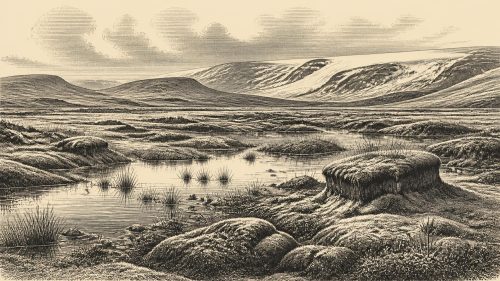
Crag Cave’s Broken Stalagmites31042 BCE
Around 31,042 BCE, Ireland lay within a fluctuating late Ice Age environment rather than a fixed ice sheet. Derryvree sediments in Fermanagh record treeless, waterlogged tundra wetlands between glacial advances, while Crag Cave stalagmites in Kerry indicate episodically milder conditions allowing calcite growth. Castlepook Cave, Cork, preserves diverse cold-stage fauna, including reindeer, mammoth, hyaena and lemmings, though cave deposits mix material from different times. A marked reindeer femur may indicate human butchery about 33,000 years ago, but cannot prove settlement. Later ice, sea-level change and early excavations obscured much evidence, leaving environmental possibility rather than documented society. Certainty remains limited.

Dateline
Modern calendar-year precision is not available for Ireland around 31,042 BCE. No contemporary people counted years, and the evidence does not identify an event that happened in that numbered year. The date is best treated as a point within a broad late Ice Age horizon, roughly 33,000 years before the present, during Marine Isotope Stage 3. Radiocarbon measurements and other scientific dates must be calibrated, and their uncertainties are substantial at this depth of time. The closest important Irish environmental range comes from Derryvree, near Maguiresbridge in County Fermanagh: organic sediments there have been calibrated to approximately 36,900–31,700 years before AD 1950. That range overlaps 31,042 BCE, but it does not turn the deposit into an annual chronicle.
A Cold, Changing Island
Ireland was in a severe glacial-age world, but it was not simply a single white expanse under permanent ice. The maximum development of the last British–Irish Ice Sheet lay in the future, broadly after about 27,000 years ago and especially around 25,000–23,000 years ago in many reconstructions. Around the date represented here, climate repeatedly shifted between colder and relatively milder episodes. The island’s landscapes, coastlines and routes for animals changed accordingly. Sea level was far lower than today, exposing broad areas of the Irish Sea basin; yet this did not necessarily create a simple dry-land bridge from Ireland to Britain or continental Europe. Travel, whether by animals or people, depended on the changing arrangement of sea, ice, shore, river valleys and seasonal conditions.
The most revealing Irish evidence for this interval is environmental rather than archaeological. At Derryvree, roadworks cut through a drumlin and exposed fine sands and freshwater organic silts trapped between two layers of glacial till. The lower till records an earlier ice advance; the organic bed records a later interval when open ground, freshwater and vegetation were present; the upper till shows that ice subsequently returned and overrode the landscape. The deposit is therefore a powerful warning against imagining either an unchanging tundra or an unbroken ice sheet.
Plant remains, pollen, mosses and insect evidence from Derryvree indicate a cold, treeless, waterlogged environment often described as muskeg or tundra wetland. Sedges, grasses, mosses and hardy arctic-alpine plants could grow around shallow pools and saturated ground. Sparse dry ground may have supported low herbs and dwarf shrubs, but there is no basis for picturing Irish woodland, cultivated fields or the later green pastoral landscape. Winters were harsh and seasons strongly marked. The sediments show an ecosystem capable of supporting life, yet vulnerable to renewed cold, snow accumulation and glacial expansion.
Caves and the Ice-Age Fauna
County Cork provides another important window. Castlepook Cave, near Doneraile in the Awbeg valley beneath the Ballyhoura Hills, has yielded Ireland’s richest known assemblage of pre-Last Glacial Maximum animal remains. Its fossils include reindeer, woolly mammoth, giant deer, brown bear, wolf, Arctic fox, hare, lemmings and spotted hyaena. Not every animal represented in the cave need have lived there at the same moment: bones accumulated over long periods, and a cave may serve as a carnivore den, shelter, trap, drainage route and sediment store. Nevertheless, the assemblage establishes that Ireland was repeatedly reached by a varied cold-stage fauna.
At about this broad period, open country was essential. Reindeer and lemmings are particularly suggestive of cold, largely treeless landscapes, while mammoth, giant deer, wolves and hyaenas indicate a wider north-west European ecological setting rather than an isolated biological backwater. Castlepook’s spotted hyaena is especially remarkable, because the species is otherwise unknown from Ireland. Its presence also complicates the story told by bones: hyaenas could carry carcass parts into caves, gnaw them, scatter them and mix material of different ages. A mammoth bone or reindeer femur in a cave is not, by itself, proof that people hunted that animal or used the cave as a home.
Crag Cave in County Kerry adds a different kind of evidence. Broken and displaced stalagmites from the cave have been dated by uranium-thorium methods. Their episodic growth during the later part of Marine Isotope Stage 3 implies intervals when liquid water could percolate through the shallow cave system and average annual conditions were sufficiently mild for calcite to form. This does not mean warm weather by modern standards, nor does it describe the whole island. It does reinforce the wider conclusion from Derryvree: Ireland’s Ice Age climate changed abruptly and repeatedly, with local habitats opening and closing across centuries or millennia.
The Castlepook Reindeer Question
The period has acquired special human importance because of one reindeer femur from Castlepook. Re-examined by zooarchaeologist Ruth Carden, the bone has been reported as carrying a deep mark interpreted as having been made by a sharp stone tool while the bone was fresh. A modern radiocarbon assessment has been publicly associated with an age of roughly 33,000 years, and County Cork heritage material gives the object an approximate date of c. 31,000 BC. If the surface modification is confirmed as anthropogenic and contemporary with the animal’s death, it would be a potentially momentous trace of Upper Palaeolithic people handling a reindeer in Ireland.
That conclusion must remain carefully qualified. The bone derives from historic cave excavations, not from a modern, intact occupation floor. The radiocarbon result dates the animal bone, not necessarily the exact moment of marking, the place where the animal was killed or the duration of any human visit. Castlepook has not produced a securely associated hearth, stone-tool assemblage, dwelling, burial, food store or stratified campsite of this age. Carnivore activity and water movement further complicate the original context. The responsible description is therefore not that a permanent Irish population is known at 31,042 BCE, but that a single exceptionally significant specimen may record human butchery during this broader interval.
If people did process the reindeer, they were almost certainly mobile hunter-gatherers operating within a much larger north-west European world. Reindeer could offer meat, fat, hide, sinew and bone; a successful encounter might support a small travelling group, but the femur alone cannot reveal group size, language, ancestry, season, tool type, travel route or whether the animal had been hunted, scavenged or found dead. It is likewise impossible to infer a camp at Castlepook. The cave’s animal-rich deposits make it valuable evidence for the landscape in which people might have moved, not a demonstrated Palaeolithic settlement.
No Polities, No Recorded Beliefs
Political affairs, diplomacy and warfare cannot responsibly be reconstructed for Ireland at this date. There were no states, kingships, tribes named in writing, borders or institutions known from the evidence. Nor is there Irish evidence for a shrine, burial rite, artwork, musical tradition, teaching system or ceremonial monument of this age. Wider Upper Palaeolithic Europe demonstrates that people elsewhere made sophisticated stone tools, ornaments, images and social networks, but those continental discoveries cannot be transferred automatically to Ireland. They provide context for possibility, not direct proof of Irish culture.
The same caution applies to economy and trade. There is no evidence for farming, livestock, pottery, metalworking, permanent villages or exchange systems in Ireland around this horizon. If people came, their economy would have depended on movement, local knowledge and the temporary use of wild resources in an unstable cold environment. Connections beyond the island are plausible because the fauna itself had reached Ireland, but no Irish artefact has yet demonstrated a specific route, trading relationship or cultural affiliation. “Ireland” is used here as a geographical term only; neither the modern island’s political divisions nor later identities existed.
Evidence Buried by Ice
The scarcity of human evidence is itself historically important. Later ice advances eroded, transported and buried older deposits, while changing sea levels drowned former coastal landscapes. In caves, nineteenth- and early twentieth-century excavation often removed deposits before modern recording standards existed. Recent research at Castlepook and other caves, including new dating and carefully targeted excavation, shows why museum collections and apparently exhausted sites remain scientifically valuable. It also shows why old claims must be retested as laboratory methods improve.
For this point around 31,042 BCE, the clearest picture is therefore one of environmental possibility rather than a documented society: treeless wetland in Fermanagh, intermittently milder conditions recorded in a Kerry cave, and cold-adapted mammals moving through open terrain in Cork. The reindeer femur from Castlepook may add a fleeting human action to that picture. It cannot yet supply a year-specific narrative, but it makes this deep interval one of the most consequential and actively investigated thresholds in Irish prehistory.
Primary Sources
- A Middle Midlandian Freshwater Series at Derryvree, Maguiresbridge, County Fermanagh, Northern Ireland
- The Irish Quaternary Fauna Project
- A Reconsideration of the Radiocarbon Dating of the Marine Isotope Stage 3 Fauna from Southern Ireland
- Episodic Speleothem Deposition Tracks the Terrestrial Impact of Millennial-Scale Last Glacial Climate Variability in SW Ireland
- Trimlines, Blockfields and the Vertical Extent of the Last Ice Sheet in Southern Ireland
- Maximum Extent and Dynamic Behaviour of the Last British–Irish Ice Sheet West of Ireland
- Stratigraphic and Palaeo-Geomorphological Evidence for the Glacial-Deglacial History of the Last British-Irish Ice Sheet in the North-Western Irish Sea
- Exploring the Coastal and Marine Evidence for the Last British-Irish Ice Sheet
- Oscillating Retreat of the Last British-Irish Ice Sheet on the Continental Shelf Offshore Galway Bay, Western Ireland
- Deglaciation Chronology of the Donegal Ice Centre, North-West Ireland
- The IntCal20 Northern Hemisphere Radiocarbon Age Calibration Curve (0–55 cal kBP)
- Figure 6: The Subdivision of the Quaternary Period in Ireland
- Palaeoecology
- Castlepook Caves
- Heritage Artefacts of County Cork
- Archaeological Heritage of County Cork
- 2022:564 – Castlepook Cave, Castlepook South, Cork
- New Insights on the Fauna of Ireland’s Younger Dryas and Early Holocene from Alice & Gwendoline Cave
- Freshwater Organic Deposits and Stratified Sediments Between Early and Late Midlandian (Devensian) Till Sheets, at Aghnadarragh, County Antrim, Northern Ireland
- Sedimentary and Foraminiferal Records of Late Quaternary Environmental Change West of Ireland and Implications for the Last British–Irish Ice Sheet
- Reconstruction and 36Cl Based Geochronology of the Deglaciation of Central Ireland
- The Castlepook Cave Excavations, 1904–1913