Editorial — Fid Eoin
Welcome to the Emerald Archives Gazette. In today’s issue we look back at the latest additions to the archive. Fragmented Ireland — Annalistic WorldsIrish political fragmentation is most securely approached through the survival of several annalistic traditions rather than through any single narrative of state formation. The Annals of Ulster extend from AD 431 to 1540 in printed form, while the Annals of Inisfallen preserve a distinct Munster-linked tradition. Their separate manuscript histories show that the keeping of records was not concentrated in one archive.
Dateline
The Day in Irish History
Welcome to the Emerald Archives Gazette. In today’s issue we look back at the latest additions to the archive.
Fragmented Ireland — Annalistic WorldsIrish political fragmentation is most securely approached through the survival of several annalistic traditions rather than through any single narrative of state formation. The Annals of Ulster extend from AD 431 to 1540 in printed form, while the Annals of Inisfallen preserve a distinct Munster-linked tradition. Their separate manuscript histories show that the keeping of records was not concentrated in one archive. That fact does not prove political division on its own, but it does support a dispersed pattern of memory.The wider CELT list strengthens that modest conclusion by naming several annalistic compilations, including Ulster, Inisfallen, Loch Cé, Connacht,…
Fid Eoin — Year EvidenceFor 632 CE, the safest starting point is the annal entry itself. In the Annals of Tigernach, the year is marked by a compact cluster of notices: the battle of Fid Eoin, the death of Eochaidh Buidhe son of Aedán, the battle of Dún Cethirn, and another death notice. Because annalistic dating is terse and often compressed, these entries form the secure core for the year. Anything beyond them depends on comparison and caution rather than direct statement.The broader annalistic landscape shows why restraint is necessary. Nearby years in the same tradition continue to list battles, deaths, and rulership…
Sovereignty Neutrality — National MemoryThomas Davis linked Irish freedom to historical consciousness rather than emotion alone. In the essay preserved in CELT, Ireland is described as beginning to compile a record of English crime and Irish suffering, and as a nation that must study as well as strive. The passage is interpretive rather than a constitutional programme, but it presents sovereignty as self-knowledge, discipline, and resistance instead of dependence on outside authority.The same text treats liberty as something to be made lasting and wise, not won in a single act. Davis argues that a nation without knowledge of its history and propensities to…
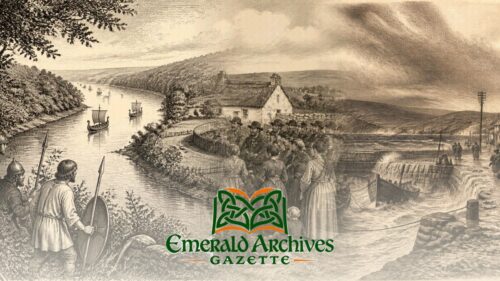
Raid Mechanics — River AssaultsThe clearest annalistic picture is of armed forces moving by river. One notice places two Norse fleets on the Boyne and the Liffey, each sixty ships strong, and says that they plundered the plain of Life and the plain of Brega. The same entry lists what was struck: churches, forts, and dwellings. This is direct evidence for waterborne access and immediate plunder, but it does not describe how the attackers crossed, landed, or organized themselves.That same notice also records resistance. The men of Brega routed the foreigners at Deoninne in Mugdorna of Brega, and six score of the Norsemen…
Reading Croker — Textual FrameThe phrase at issue is best treated as a reading problem rather than a settled identification. In the annals available here, entries are cast in a formal chronological style and name rulers, clerics, and military actors, yet no excerpt shows the surname Croker. The evidence therefore supports only a negative statement: the surviving annalistic passages do not verify that name. Any stronger claim would go beyond the text and would need the original note or image to be checked directly.The context of the name Croker belongs elsewhere in the record. The archival descriptions identify Thomas Crofton Croker as a…
Unionist Debate — Printed DebateThe bibliographic pages themselves present unionism and Home Rule as a printed controversy. One text lists works from Home government for Ireland through Isaac Butt, Gladstone, Redmond, Balfour, Dicey, and others, while another repeats a similar sequence with slight variations in title and ordering. The overlap shows that the debate was organized through named books, speeches, and pamphlets rather than a single authorial voice. The record is selective, but it clearly gathers antagonistic positions into one literary field.The same catalogues also show how civic controversy was preserved through editions and reprints. Several items are marked by publication dates, while…
Health Records — Plague Arrival — Plague ArrivalThe earliest notice in these excerpts places plague in Ireland on the first of August and adds that it first raged in Mag Itha of Fotharta. The same entry also records an earthquake in Britain, while another short notice in the same annal sequence says that darkness and a sky seeming to be on fire accompanied the year. The health detail is therefore brief but clear: plague is treated as a dated event and given an initial place of spread, not as a medical explanation.A later Ulster entry again connects health with travel and spread. It says that a…
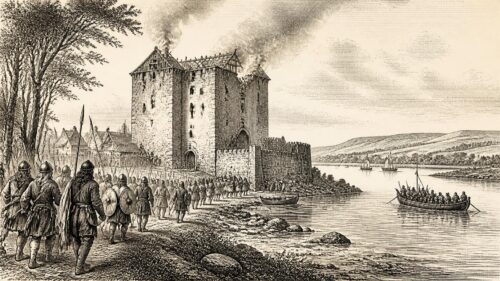
Glendalough Raids — Viking-age Ireland — Evidence LimitsThe materials gathered here do not directly state that Vikings raided Glendalough in any specific year. One database describes itself as a collection of Irish annal entries on Viking activity and says it covers the years up to 902, which already limits its usefulness for a later tenth-century episode. A separate annals index presents later entries, but the relevant passages cited below concern places other than Glendalough. The safest reading is therefore cautious: these excerpts illuminate the wider setting, not a confirmed Glendalough raid.The annal passages themselves show why restraint matters. They record captures, raids, battles, and burnings in…
Independence Records — Archive ScopeThe Bureau of Military History collection is described as a body of 1,773 witness statements, 334 sets of contemporary documents, 42 sets of photographs, and 13 voice recordings gathered by the State between 1947 and 1957. Its official brief was to assemble and co-ordinate material for the history of the movement for Independence from the formation of the Irish Volunteers in November 1913 to July 1921. The description presents the collection as a structured attempt to gather primary source material for that period.The same collection page also states that the Bureau was among the most important primary sources of…
Private Army — Archive ContextThe Military Archives describes itself as the official place of deposit for records of the Irish Defence Forces, the Department of Defence, and the Army Pensions Board. It also says its brief is to collect material from the foundation of the Irish State up to the present day, including records from overseas missions. In this account, the archive is presented as a continuing state repository rather than a closed historical storehouse.The same description states that, from as early as 1924, the National Army undertook to preserve historical documents from that period, in recognition of the importance of the War…
Royal Expulsion — Yearly RecordFor 631 CE, the surviving notices are short and uneven. The Annals of Tigernach preserves only the year heading for T631 in the excerpt here, with no event notice attached in the visible passage. By contrast, the Annals of the Four Masters and the Annals of Inisfallen both supply specific entries for the same year. This makes 631 visible chiefly as a moment of record, not as a year with many securely dated events.The same material also shows that the year was not recorded in only one way. The Four Masters assigns 631 to the eighth year of Domhnall…
Faction Fighting — Source ListsThe material places faction fighting within a wider documentary landscape rather than isolating it as a single, self-contained topic. One Irish historical bibliography lists annals, saints’ lives, chronicles, state papers, speeches, memoirs, and parliamentary records among the sources used for the study of Ireland. Another catalogue of Irish texts likewise groups annalistic and historicist writings together under historical, legal, and genealogical material. In that setting, faction fighting appears as one topic among many.The same lists also show how historical writing is organized by genre. The Irish-text catalogue identifies annalistic, historical, and historicist texts as a named category, while the…
Duma Aichir — Year EvidenceFor 630 CE, the evidence is annalistic rather than narrative, and the surviving notices are short. The Annals of Ulster provide a year-heading for AD 630 and attach to it only one battle notice and one death notice. That limits what can be said securely about the year itself. The surviving record here is not a continuous chronicle of political life, but a sequence of dated items whose scope depends on each annal's own entry for the year.The same year is represented more fully in the Annals of Tigernach and in the Annals of the Four Masters, both of…
Saint Patrick — Early YearsThe historical figure of Saint Patrick remains partially obscured by the passage of time, yet the most reliable evidence comes from his own writings. According to his Confessio, Patrick was born in Britain, likely in the southwest region or Wales, during the late fourth or early fifth century. He describes himself as the son of a deacon, indicating a background with some connection to the church, though modern scholars suggest he may have also been involved in Roman imperial administration or taxation. At the age of sixteen, his life took a dramatic turn when he was captured by Irish…
Hidden Cottage — Opening FrameThe excerpts open not with a cottage, but with people placed inside castles, prisons, churches, and towns. Hugh Roe O'Donnell is held in Dublin in chains, while later notices describe castles in Mayo under the governor's control and then passing to local submission and custody. The record repeatedly locates bodies within bounded spaces, where walls, gates, and guarded access matter more than domestic interiors. That frame leaves ordinary shelter largely implicit rather than described directly.The same pattern appears in other years. The Four Masters and the Annals of Ulster preserve many notices of burned sites, captured lords, and guarded…
Ard Corann — Year FrameFor 629 CE, the annalistic record opens only a narrow window. One Tigernach entry is placed under T629 and reports a battle at Ard Corann. A separate comparative notice says that the same event appears in the Annals of Ulster as 629, while Tigernach places it in 630. That is enough to discuss the year, but only by staying close to the wording of the texts and not by filling the gap with invented detail.The year can therefore be treated as a dated notice rather than a full narrative. The surviving wording names a battle, identifies a victor, and…
Mary Spring — Family OriginsMary Spring Rice was born in 1880 as the second child and only daughter of Thomas Spring Rice, 2nd Baron Monteagle of Brandon, and Elizabeth Butcher. The family seat was Mount Trenchard at Foynes in County Limerick, and the records place her childhood there. One later account adds that she learned fluent Irish at Mount Trenchard, making language part of the setting in which her early life is described.The surviving notices also connect her to an extended Spring Rice family archive. The National Library of Ireland describes a body of Spring Rice papers that includes personal and domestic material,…
Suibne’s Slaying — Year DatingThe clearest single marker for 628 comes from the Annals of Ulster, which labels the entry as the Kalends of January and states that it is AD 627, alias 628. In that same notice the year is attached to a sequence of events: a battle at Bolg Luatha, another at Both, the slaying of Suibne Menn, the repose of Colum son of Bairdéne, the killing of Cuiméne son of Colmán, the devastation of Laigin by Domnall, and Domnall son of Aed son of Ainmire beginning to reign. This is the firmest chronological anchor among the excerpts.That same cluster is…
Janesboro School — School OriginsThe school history places the Janesboro area within the early twentieth-century transformation of land once occupied by Janesboro House and later converted into housing. It says the new estate formed part of the parish of Donoughmore and that boys and girls from the area attended the Presentation School on Sexton Street before a local school became necessary. The same account states that in 1950 Canon Rice invited the Presentation Sisters to open a junior school in Janesboro.The same history describes the school site as two fields bought from Mr Joe Barry of Southill House, with the foundation stone laid…
Nicholas Street — Archive ContextThe surviving digital descriptions point first to archives rather than to a single named Nicholas Street series. Limerick Local Studies presents trade and street directories as a long-running resource for addresses and occupations, and it notes that the fully searchable table extends to 1969. That makes the directories a useful companion to photographs, because they can anchor where businesses were listed even when images are not immediately identified in the catalogue.The same description also warns that the directories are not exhaustive and that small traders and disadvantaged classes tend not to appear. That limitation matters when searching for shopfronts…
Private Commissions — Early YearsThe chronological record of Jobson’s commissions begins with a period labelled private commissions in Ireland and the United Kingdom from 1996 to 1999, followed by a private commission in Wicklow in 1999–2000. The same list places these entries beside education and exhibition milestones, making the private work part of a broader professional timeline rather than a separate career. On the page, the wording is concise and documentary, with no detail about form, subject matter, or patrons.Those early entries are followed by other dated engagements in 2004 and 2005, including two pieces for a private garden in Dublin, a private…
Irish Railways — Parliamentary OriginsIn early nineteenth-century parliamentary discussion, Irish railways were treated as a matter of national communication and public advantage. In 1842, a Commons motion sought measures that would secure Ireland the benefits of railway communication. The speaker contrasted government construction or assistance with reliance on private enterprise, and argued that private efforts in Ireland had been slight compared with those in Britain. The record presents this as debate over method, not as an account of completed railway policy.A Commons debate in 1839 shows similar uncertainty about what the government intended to do. Members complained that a railway commission had reported…
Clerical Figures — Office NamesIn the Loch Cé annals, clerical identity appears in office titles. One entry for 1116 names Cellach as comarb of Patrick and says that he went on a visitation of Connacht and obtained his full tribute. The wording places a senior church figure inside a chronological record of secular and ecclesiastical affairs. The same sequence also sets his action beside burned churches and other disturbances in the year, without explaining any connection between them.The same annalistic section also records ecclesiastical damage around Cellach’s visitation. It notes the burning of Cill-Dalua, Corcach-mor of Mumhan, Imlech-Ibhair, the oratory of Maelisa Ua…
Gerald Griffin — Early LifeGerald Griffin was born in Limerick on 12 December 1803. The chronology describes him as the twelfth of fifteen surviving children, born into a middle-class Catholic farming household. His father, Patrick Griffin, is identified as a brewery farmer, while his mother, Ellen Griffin, came from the ancient Gaelic family of the O'Briens. The same entry notes that she was cultivated and strongly interested in literature.Around 1810, when he was seven or eight, the family moved about twenty-eight miles west of Limerick to a house called Fairy Lawn. The chronology describes his childhood there as close-knit and idyllic. It also…
Election Record — Election PhraseThe clearest election language in these excerpts appears in the Connacht material for 1293. After Manus O'Conor's death, Hugh, son of Owen, is described as receiving the kingdom of Connaught and being inaugurated as successor through the influence of the Lord Justice. The same notice says that, on the tenth day after his election, he was captured by Fitzgerald and his followers suffered losses. The entry ties election, inauguration, and rapid reversal together.The surrounding 1293 notices help fix that election within a wider sequence of deaths and transfers. In the same year the annals record the death of Manus…
Humanitarian Diplomacy — Opening ContextThe surviving material places humanitarian diplomacy inside formal Irish foreign relations rather than outside them. One source describes an illustrated history of Irish foreign policy and notes that it was intended to combine text with images, ephemera, and documents. Another explains that CELT is a digital repository of Irish historical and literary texts. Taken together, these records show a modern scholarly and archival frame for studying Irish diplomacy through written traces rather than through broad summary alone.Within that frame, the word diplomacy covers different kinds of action. Some passages concern official correspondence in 1921, others postwar foreign policy after…
Mayo Records — Textual GroundingThe CELT listing shows that Irish historical texts are gathered under several named categories, including annalistic, historical, and historicist texts. Within that listing appear the Annals of Ulster, the Annals of Tigernach, the Annals of Inisfallen, the Annals of Connacht, and the Annals of the Kingdom of Ireland by the Four Masters. For a study centred on Mayo, this matters because the repository offers a structured entry point into the kinds of writing that preserve dated notices and sequence.The Annals of Tigernach page gives more precise manuscript information than the general list. It identifies two manuscript witnesses of the…
Dublin Corridors — Programme ScopeBusConnects Dublin is described as the National Transport Authority’s programme to greatly improve bus services, and as part of a wider BusConnects programme that also operates in Cork, Limerick, Galway, and Waterford. The Dublin programme is identified as the most advanced of the national set. The documents also state that it is funded by Project Ireland 2040 and that it delivers on several policy frameworks named in the materials.The same material lists eight programme initiatives: redesigning the bus network, building new bus corridors and cycle lanes, changing ticketing and payment systems, introducing a simpler fare structure, new livery, new…
Irish Names — Naming TraditionsThe passages present Irish naming as a mix of inherited forms and later modification. One discussion of early modern naming notes that Irish genealogies were written down within a clerical literary culture and continued over many centuries, while a separate piece on surnames explains how Gaelic family names generated later variants. Together they show continuity in family identity and change in spelling, language, and form. The evidence is descriptive rather than exhaustive, but it repeatedly links names with descent and lineage.A surname example makes the process visible. The Molony name is explained as deriving from Ó Maoldomnaig, with later…
Neutrality Papers — Archive ContextThe archival setting is itself part of the record. The National Archives describes Documents on Irish Foreign Policy as a partnership with the Royal Irish Academy and the Department of Foreign Affairs, hosted by the archives for research and publication. The same institution says the project draws on thousands of files and selects a smaller body of documents for each volume. That framing shows a curated diplomatic series rather than a single private file, and it places these texts within a wider access programme.A second archival collection helps define the broader documentary landscape. The National Archives says its Dáil…
Pier Remembering — Pier SettingBuncrana Pier is described as a slipway on the shorefront beside Lough Swilly, with ferry activity and a scenic westward view across the water. One report notes that the pier looks ordinary apart from occasional floral tributes, while another describes the sunset over the Fanad Peninsula as a feature that draws visitors. The setting is therefore both practical and commemorative, because people come for travel, scenery, and remembrance together.The harbour context reaches back beyond the memorial events. A 1929 statutory order created Buncrana Harbour Commissioners and vested the pier and harbour in them, showing formal management of the harbour…
Saint Brigid of Kildare — Saint Brigid of Kildare remains one of the most enduring and venerated figures in Irish spirituality. Often regarded as a pillar of Irish faith alongside Saint Patrick, she is celebrated as the foundress of the monastery at Kildare. While her popular image is steeped in hagiography and folklore, the historical Brigid is reconstructed through a series of early Latin and Old Irish texts, most notably the Vita Prima and the Vita II by Cogitosus. These documents portray her not only as a pious woman but as a powerful leader who navigated the complex social and religious landscape of early medieval…
Irish Passage — Irish AbroadThe available material presents Irish people abroad mainly through migration records and personal documents. One database is described as containing about 26,000 transcripts relating to Irish emigration to North America across the eighteenth, nineteenth, and twentieth centuries. Its contents include emigrant letters, passenger lists, newspaper articles, advertisements, official government reports, family papers, and extracts from books and periodicals. The description also shows that the collection is searchable by name, subject, or date, which makes comparison between different kinds of record possible.The same database description also lists large counts for several record types, including letters, newspaper articles, official documents, and…
Private Dwellings — Legal FrameThe modern RTB description treats a private residential tenancy as an agreement or lease between landlord and tenant, with the landlord entitled to receive rent and the tenant entitled to live in the property in return. It also states that a private landlord may be an individual, a company, or a trustee of a trust. This description narrows the topic to tenancies leased by private landlords and separates them from university, student-specific, and Approved Housing Body arrangements.The same RTB page also says that a written tenancy agreement is called a lease and that the agreement sets out the terms…
Pension Welfare — Pension FoundationsThe 1908 pension text describes a state pension framework with stated weekly payments. It gives 5 shillings per week for a single claimant and 7 shillings and 6 pence for married couples, while also noting that the pension was meant to supplement income rather than provide a full living. A later passage in the same commentary says the 1911 act allowed a universal pension for everyone over seventy. These are the only pension terms directly visible in the retrieved material.The statutory record for the 1908 act confirms that the legislation exists as a defined public general act in the…
Cork Delays — Project OriginsThe public record places the project’s beginnings in 2014, when State aid was awarded for a 6,000-capacity venue in Cork city. Later reporting identifies the site as the former Beamish and Crawford area near South Main Street. One account also says the sod was turned in February 2016, which shows that ceremonial commencement came after the tender stage but before any completed building work appeared in the reports.The stated purpose was consistently broad. Reporting described the venue as multipurpose, intended for concerts and conferences, while a later procurement notice called it a multifunctional civic venue. That same notice says…
Thank you for reading today’s Gazette. Follow any of the links above to read the full article and explore its sources.