-
Farming Progress
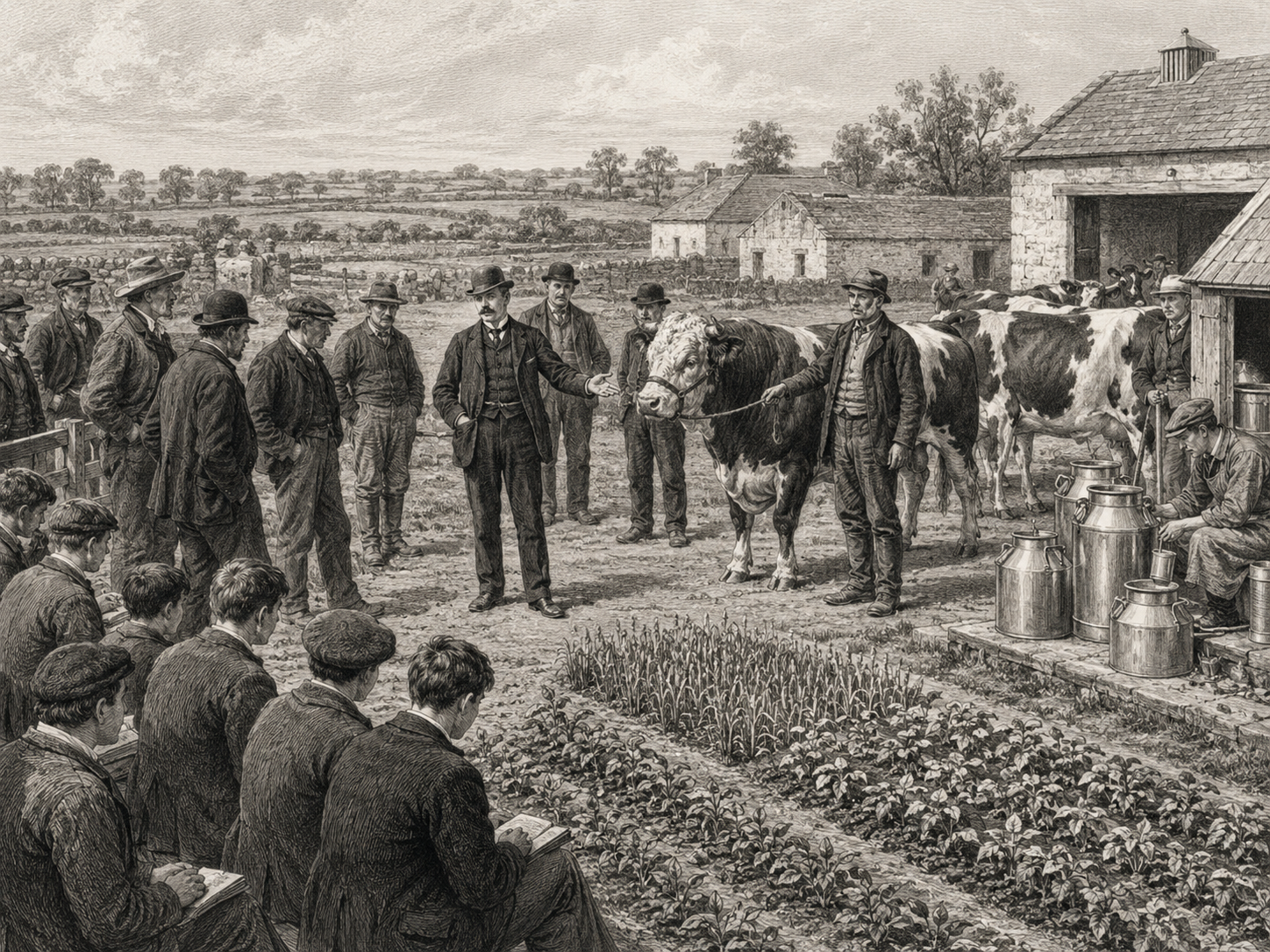
Read Article: Farming ProgressThe Department of Agriculture and Technical Instruction is promoting improved farming methods, livestock breeding, dairying and practical education as part of its new programme for Irish rural development. Established under the Agriculture and Technical Instruction Act of 1899, the Department has begun bringing agricultural advice, scientific knowledge and technical training under one central authority. Farmers in County Limerick are watching closely, particularly in districts where cattle raising, milk production and butter making sustain local households, creameries, merchants and labourers. The initiative promises a more organised relationship between government, local committees, agricultural societies and the people working directly upon the land.
Improved methods are expected to reach farms through instructors, demonstrations, experiments and publications explaining crop cultivation, animal care and the efficient use of land. Traditional experience remains valuable, but the Department argues that tested scientific methods can help farmers recognise disease, improve soil, select seed and obtain better results from limited holdings. County committees may adapt schemes to local conditions, allowing instruction to reflect the importance of dairying and livestock in Munster. The practical value of the programme will depend upon whether advice reaches small farmers as readily as prosperous landowners and whether recommended improvements can be afforded by households possessing little spare capital.
Livestock breeding forms another important branch of the Department’s work. Better bulls, improved herd management and closer attention to animal health may increase the quality and value of Irish cattle. Stronger breeding practices could benefit County Limerick farmers selling animals at fairs or supplying milk to local creameries. The Department’s responsibilities also extend towards controlling animal disease and supervising regulations affecting livestock. Farmers have often suffered severe losses when illness spreads through a herd, making veterinary knowledge and early detection economically important. Scientific breeding, however, must be introduced carefully so that useful local breeds are strengthened rather than displaced without regard for regional conditions.
Dairying has become increasingly important to agricultural improvement. Cooperative creameries are demonstrating that organised production, machinery and careful handling can raise butter quality and improve access to larger markets. By the end of 1900, Ireland possessed 193 central creameries and seventy-seven auxiliaries, while cooperative dairy societies had attracted more than 26,000 members. The new Department is assuming responsibility for technical instruction that had previously been undertaken by voluntary agricultural organisations. In Limerick, where milk, butter and cattle already occupy a major place in rural commerce, improved dairy education may affect household income, creamery employment and the reputation of local produce.
Technical education is intended to connect rural schooling with useful employment rather than confine instruction to abstract subjects. Classes in dairying, poultry keeping, horticulture, machinery and domestic economy may help young people develop skills suited to farms, creameries and local industries. The Department’s success will be measured by whether instruction produces visible improvements in output, income and living conditions. For Limerick families, better farming cannot be separated from secure work, affordable housing and the possibility of remaining at home. Agricultural education offers no immediate cure for poverty, but it may give farmers and labourers practical tools with which to confront it.
- Agriculture and Technical Instruction (Ireland) Act, 1899, 62 & 63 Vict., c. 50. The Act established the Department, Council of Agriculture, Agricultural Board and Board of Technical Instruction.
- Department of Agriculture and Technical Instruction for Ireland, Journal, Volume I, Dublin: His Majesty’s Stationery Office, 1900–1901. Exact issue, article and page should be confirmed before formal citation.
- Department of Agriculture and Technical Instruction for Ireland, Agricultural Statistics of Ireland with Detailed Report for the Year 1900, Dublin: His Majesty’s Stationery Office, 1901. Exact section, table and page should be confirmed before formal citation.
- Horace Plunkett, Ireland in the New Century, London: John Murray, 1904. Consult the chapters discussing agricultural cooperation, technical instruction and the Department’s early work.
- Report from the Recess Committee on the Establishment of a Department of Agriculture and Industries for Ireland, Dublin, 1896. Exact edition and page should be confirmed before formal citation.
-
Farming Department
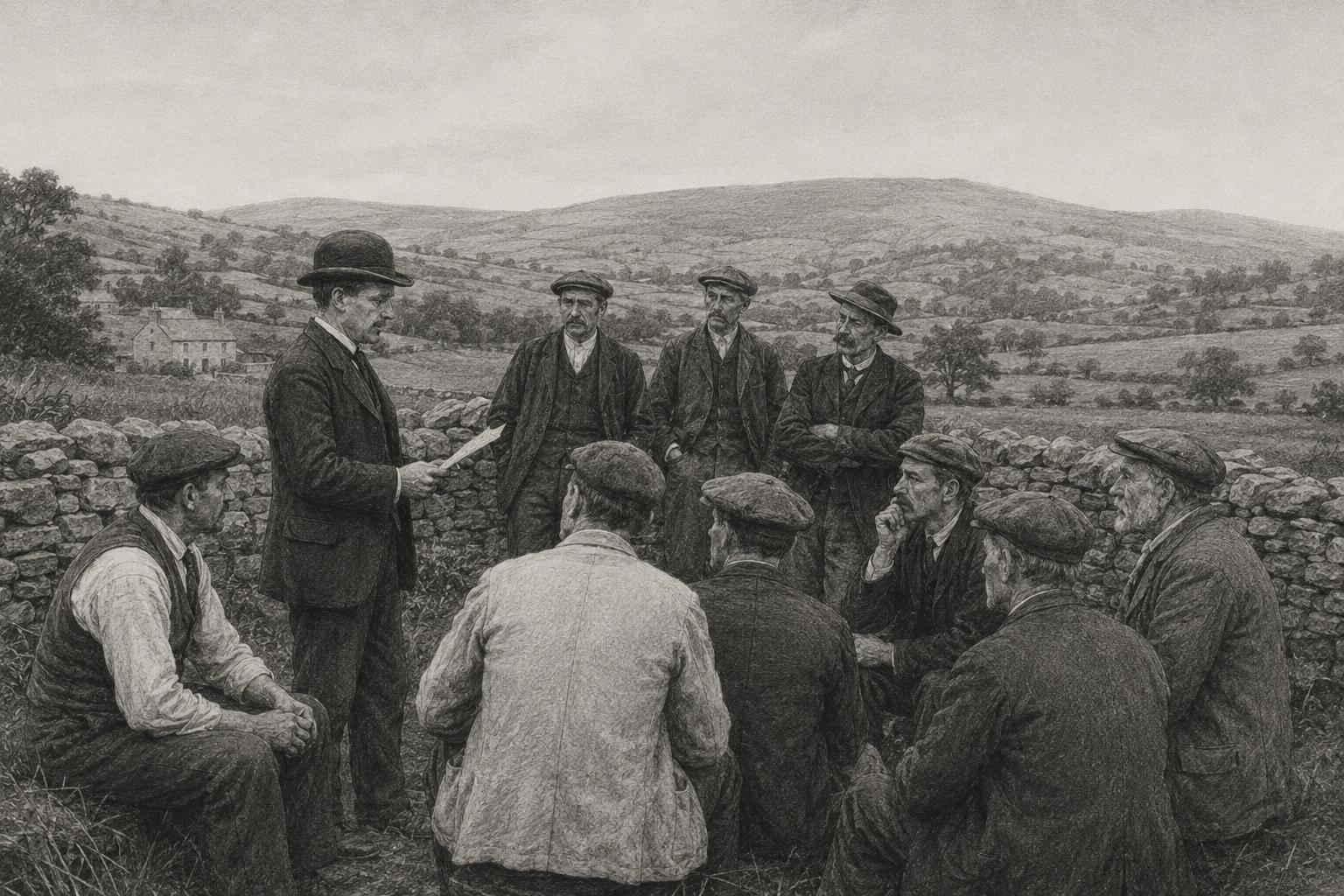
Read Article: Farming DepartmentThe newly established Department of Agriculture and Technical Instruction for Ireland has begun assuming responsibility for agricultural development, scientific instruction and several services previously divided among different public bodies. Created by legislation passed in 1899, the Department is intended to bring greater organisation to farming, fisheries, rural industries and technical education. Its emergence is being closely watched in County Limerick, where farmers, labourers, teachers and local representatives hope that practical instruction and improved scientific knowledge will strengthen agricultural production and create opportunities beyond traditional methods inherited within families.
The new authority has inherited responsibility for collecting agricultural statistics, supervising measures against destructive insects and regulating fertilisers and feeding stuffs. It will also assume functions connected with fisheries and important agricultural institutions, including the Munster Institute. These powers give the Department an unusually broad influence over rural development. Rather than dealing solely with crops and livestock, it is expected to encourage technical knowledge, local industries and better methods of production. Supporters believe that Irish farming can become more efficient when practical experience is reinforced by scientific testing, organised instruction and reliable information about markets and agricultural conditions.
County and local committees are expected to play an important role in shaping programmes suited to their districts. In Limerick, where dairying, cattle raising, tillage and agricultural labour remain central to economic life, instruction may include improved breeding, butter production, poultry keeping, horticulture and the treatment of plant or animal disease. Travelling instructors and demonstration schemes could bring new methods directly to farmers who cannot attend distant colleges. Technical classes may also benefit young people seeking employment in trades or rural industries, although much will depend upon funding, local participation and the availability of qualified teachers.
The Department’s creation reflects years of concern that Ireland lacked a coordinated system for developing its agricultural and industrial resources. Reformers associated with the Recess Committee studied systems operating abroad and argued that education must be connected directly with the realities of Irish economic life. Horace Plunkett, appointed vice-president of the new Department, has long promoted agricultural cooperation and practical self-help. His involvement has encouraged hopes that creameries, farming organisations and educational bodies will work together, although political opponents remain suspicious of any institution administered under British authority.
For ordinary Limerick families, the Department will be judged by visible results rather than administrative promise. Farmers require healthier livestock, dependable seed and better access to technical advice. Labourers need secure employment, improved housing and opportunities to acquire useful skills. Young men and women need instruction capable of opening livelihoods at home rather than preparing them only for emigration. The Department now possesses powers extending across agriculture, fisheries, statistics and technical education. Whether those powers can improve incomes and daily conditions throughout rural Ireland will become clearer as its programmes move from legislation into farms, classrooms, creameries and local communities.
- Agriculture and Technical Instruction (Ireland) Act, 1899, 62 & 63 Vict., c. 50, granted Royal Assent on 9 August 1899. The Act established the Department and transferred to it functions concerning agriculture, statistics, fisheries, technical instruction and agricultural institutions.
- Department of Agriculture and Technical Instruction for Ireland, Agricultural Statistics of Ireland with Detailed Report for the Year 1900, Dublin: His Majesty’s Stationery Office, 1901. Exact table and page should be confirmed before formal citation.
- Department of Agriculture and Technical Instruction for Ireland, Journal, Volume I, Dublin: His Majesty’s Stationery Office, 1900–1901. Exact issue, article and page should be confirmed before formal citation.
- Report from the Recess Committee on the Establishment of a Department of Agriculture and Industries for Ireland, Dublin, 1896. Exact edition and page should be confirmed before formal citation.
- Limerick Chronicle, 1900, reports concerning agricultural instruction, local technical-education schemes, farming organisations and the new Department’s activities. Exact issue, page and column should be confirmed before formal citation.
-
Labourers Organise
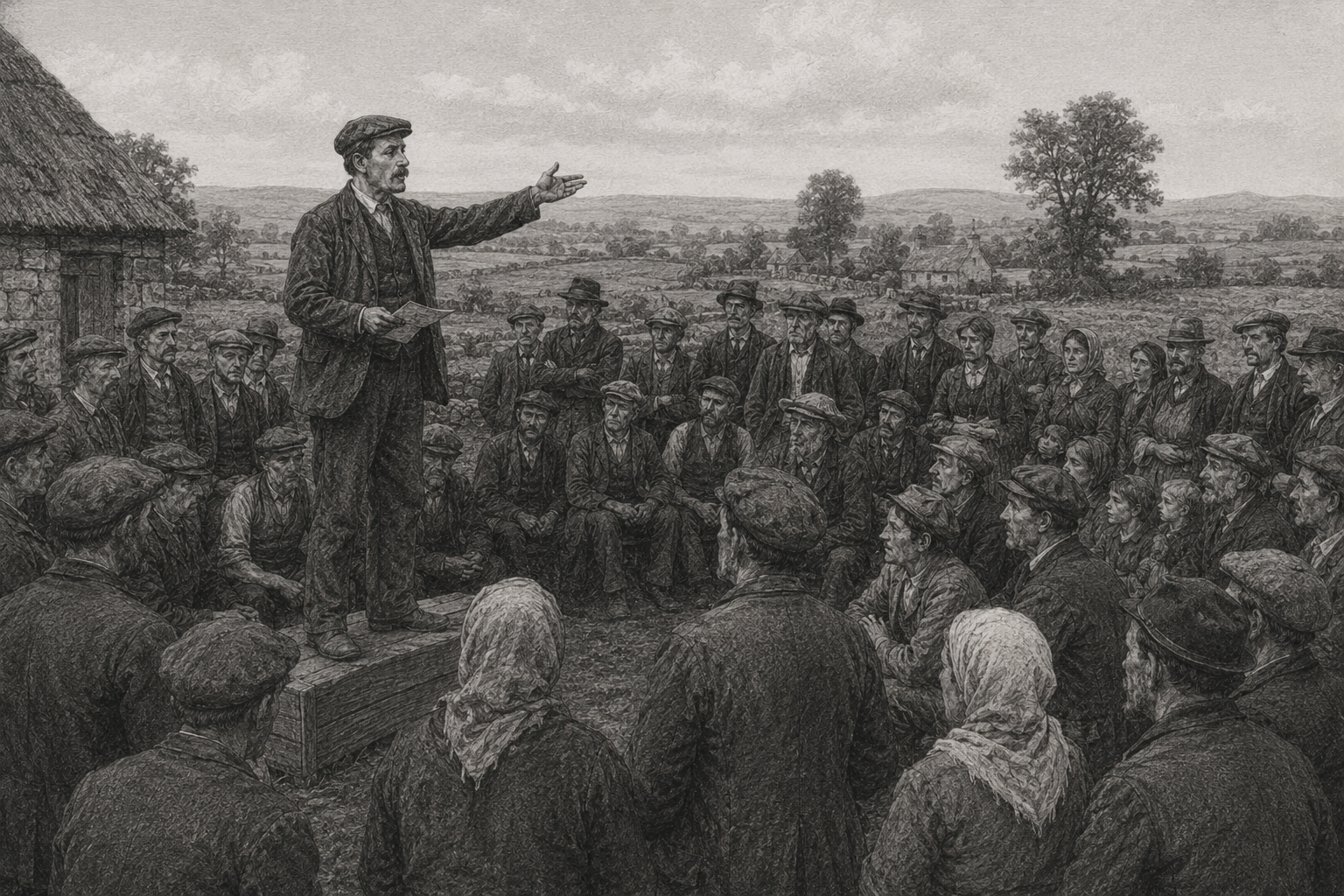
Read Article: Labourers OrganiseAgricultural labourers throughout County Limerick and the wider Munster countryside continue to campaign for better cottages, fairer wages and access to small plots of land. Their position remains distinct from that of tenant farmers seeking ownership of the farms they occupy. Labourers frequently possess neither secure employment nor property, depending instead upon seasonal hiring, daily wages and accommodation controlled by farmers or landlords. Public meetings increasingly insist that any settlement of the Irish land question must include the men and women whose labour sustains agriculture but who remain among the countryside’s poorest inhabitants.
Housing is one of the campaign’s most urgent concerns. The Labourers Acts introduced since 1883 permit local authorities to build cottages with small allotments, yet provision remains uneven and applications may be delayed by disputes over sites, costs and local opposition. Many families continue living in damp, overcrowded or poorly maintained dwellings attached to employment. Losing work may therefore mean losing a home as well as wages. Reformers demand cottages offered at affordable rents, with enough ground for potatoes, vegetables and perhaps a pig or poultry, giving labouring households a modest measure of independence.
Wages remain uncertain and vary according to district, season, skill and the demand for workers. Employment may be plentiful during planting and harvest but scarce during winter, forcing households to depend upon credit, temporary road work or migration. Labourers argue that wages have not kept pace with the cost of food, clothing, fuel and rent. Their bargaining position is weakened when many men compete for limited work or when an employer controls both employment and accommodation. Organisation through land-and-labour associations and public demonstrations offers workers a collective means of pressing their grievances before elected councils and parliamentary representatives.
The establishment of county and rural district councils under the Local Government Act of 1898 has created new opportunities for agitation. Labourers can now direct petitions and electoral pressure towards representatives responsible for cottage schemes, roads and other local works. In County Limerick, the question is becoming a test of whether the new councils will serve landless workers as readily as farmers, merchants and property owners. Labour representatives insist that suitable cottage sites should not be rejected merely because neighbouring landowners object, while councillors must balance urgent need against borrowing costs and administrative delay.
Access to land remains inseparable from housing and wages. Even a small allotment can provide food, reduce dependence upon shop credit and allow a family to survive periods of unemployment. Campaigners therefore seek not great farms but secure cottages, gardens and sufficient ground to supplement earned income. Their demands reveal an unresolved division within rural reform: tenant purchase may transform farmers into owners while leaving labourers without property or security. Unless their claims receive equal attention, those who cultivate Ireland’s fields may remain excluded from the benefits promised by land reform and representative local government.
- Labourers (Ireland) Act, 1883, 46 & 47 Vict., c. 60. This legislation empowered sanitary authorities to develop schemes providing cottages and allotments for agricultural labourers.
- Labourers (Ireland) Act, 1885, 48 & 49 Vict., c. 77. This measure amended the earlier legislation governing rural labourers’ housing and land provision.
- Local Government (Ireland) Act, 1898, 61 & 62 Vict., c. 37. The Act established elected county and rural district councils with important responsibilities for local administration and labourers’ cottage schemes.
- Census of Ireland, 1901, County of Limerick tables concerning housing, occupations, agricultural labour and rural population. Exact volume, table and page should be confirmed before formal citation.
- Limerick Chronicle, 1900, reports concerning labourers’ cottages, agricultural wages, rural district councils and land-and-labour meetings in County Limerick. Exact issue, page and column should be confirmed before formal citation.
-
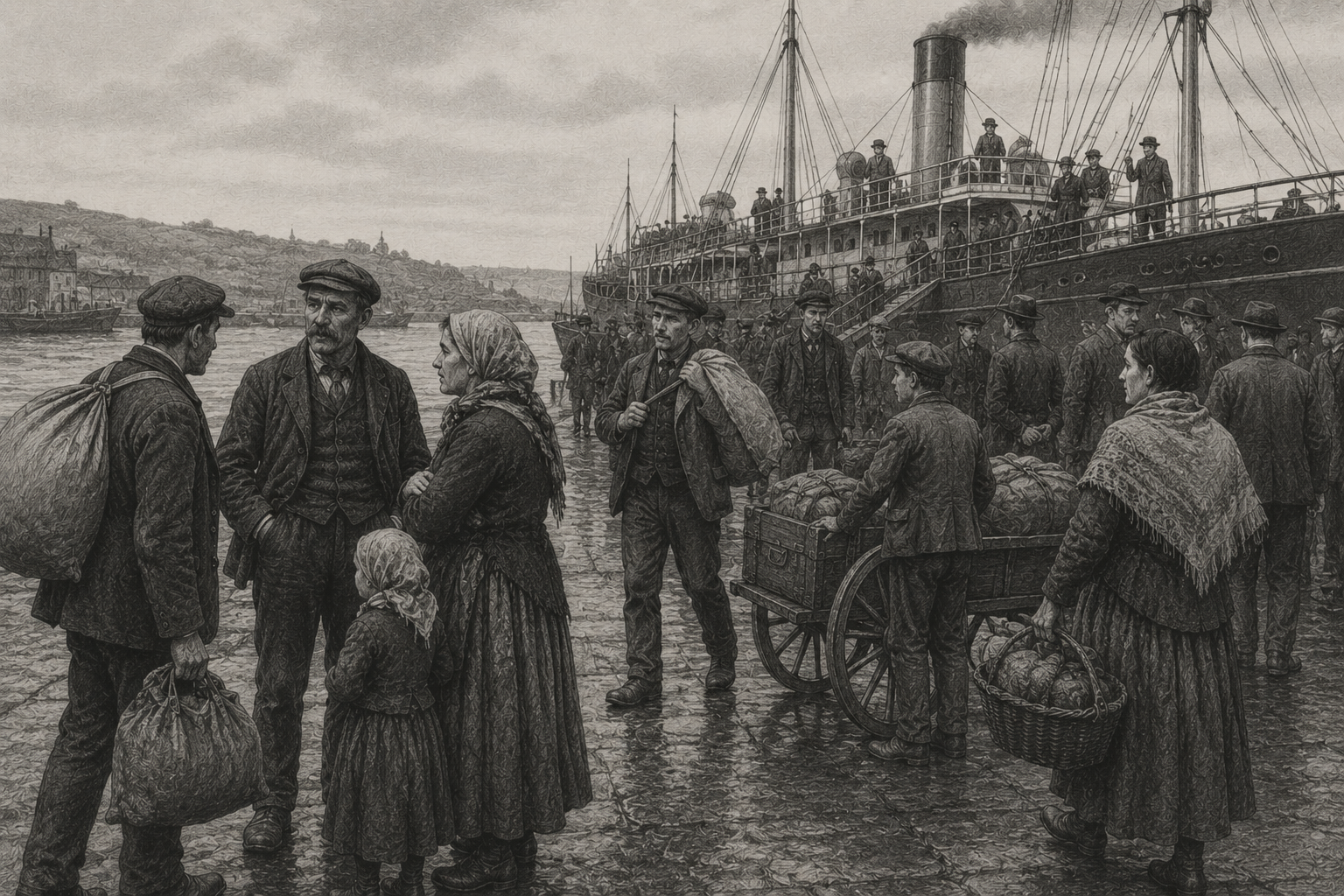
Harvest Journeys
Read Article: Harvest JourneysSeasonal migration remains essential to many small farming and labouring households across western Ireland and the poorer districts of Munster. Each year, men and women leave holdings incapable of supporting a family and travel towards districts offering temporary employment during sowing, haymaking or harvest. Others cross the Irish Sea to work on farms in Britain before returning home with wages needed to pay rent, settle shop debts, purchase seed and maintain relatives through the winter. What appears to be an individual search for work has become an established part of rural survival.
The movement is strongest where farms are small, fragmented or situated upon poor land. A household may possess a cabin, several scattered plots, a cow and a potato crop, yet still lack enough income to meet its annual expenses. Seasonal earnings provide the money that subsistence farming cannot produce. Migrants frequently travel in groups formed through family and neighbourhood connections, relying upon experienced workers to identify employers, arrange transport and bargain over wages. Their absence removes valuable labour from the home, leaving wives, children and elderly relatives responsible for animals, turf, crops and household management.
County Limerick occupies an important position within this pattern. Its more productive agricultural districts attract temporary workers at busy periods, while labourers from poorer parts of Munster may also travel eastwards or overseas in search of higher earnings. At fairs, railway stations and market towns, the seasonal movement of workers can be observed in the bundles, tools and hurried farewells accompanying departure. The expanding railway system has made longer journeys easier, but the cost of travel reduces already modest wages. Workers may face uncertain hiring, crowded accommodation, long days and little protection if illness or injury prevents them from completing the season.
The money carried home often determines whether a family can remain upon its holding. It may prevent arrears, replace a dead animal, repair a leaking roof or allow food to be purchased before the next crop is ready. Shopkeepers in rural towns commonly extend credit in expectation of harvest wages or remittances. Yet dependence upon migration also reveals the weakness of the local economy. Families are separated for weeks or months, children may leave school to replace absent adults, and young workers become familiar with opportunities beyond Ireland. A journey intended as temporary employment can therefore become the first stage of permanent emigration.
Agrarian reformers argue that seasonal migration will continue while families remain crowded upon holdings from which no adequate living can be obtained. The Congested Districts Board has attempted to enlarge farms, reorganise estates and encourage fishing or cottage industries, but its operations reach only part of the population in need. For thousands of households, the annual departure remains unavoidable. Their labour enriches distant farms while the wages return to sustain Irish homes. Seasonal migration is therefore not merely a feature of the agricultural calendar; it is evidence of a rural system requiring families to leave their own land in order to survive upon it.
- Congested Districts Board for Ireland, Report for the Year Ending 31 March 1900, Parliamentary Papers. Consult the sections concerning congested holdings, migratory labour, agricultural improvement and rural employment. Exact command-paper number, page and appendix should be confirmed before formal citation.
- Census of Ireland, 1901, General Report, occupation tables and county returns concerning agricultural labourers, small farmers and population movement. Exact volume, table and page should be confirmed before formal citation.
- House of Commons Debates, “Irish Congested Districts Board,” 14 March 1902, vol. 105. The debate describes households living upon holdings from which no adequate livelihood could be obtained and discusses the Board’s efforts to move families onto better land.
- Limerick Chronicle, 1900, reports concerning harvest employment, agricultural wages, railway travel, labourers and rural conditions in County Limerick. Exact issue, page and column should be confirmed before formal citation.
- British Parliamentary Papers, Agricultural Statistics of Ireland for 1900, including county information on holdings, crops, livestock and agricultural employment. Exact command-paper number, table and page should be confirmed before formal citation.
-
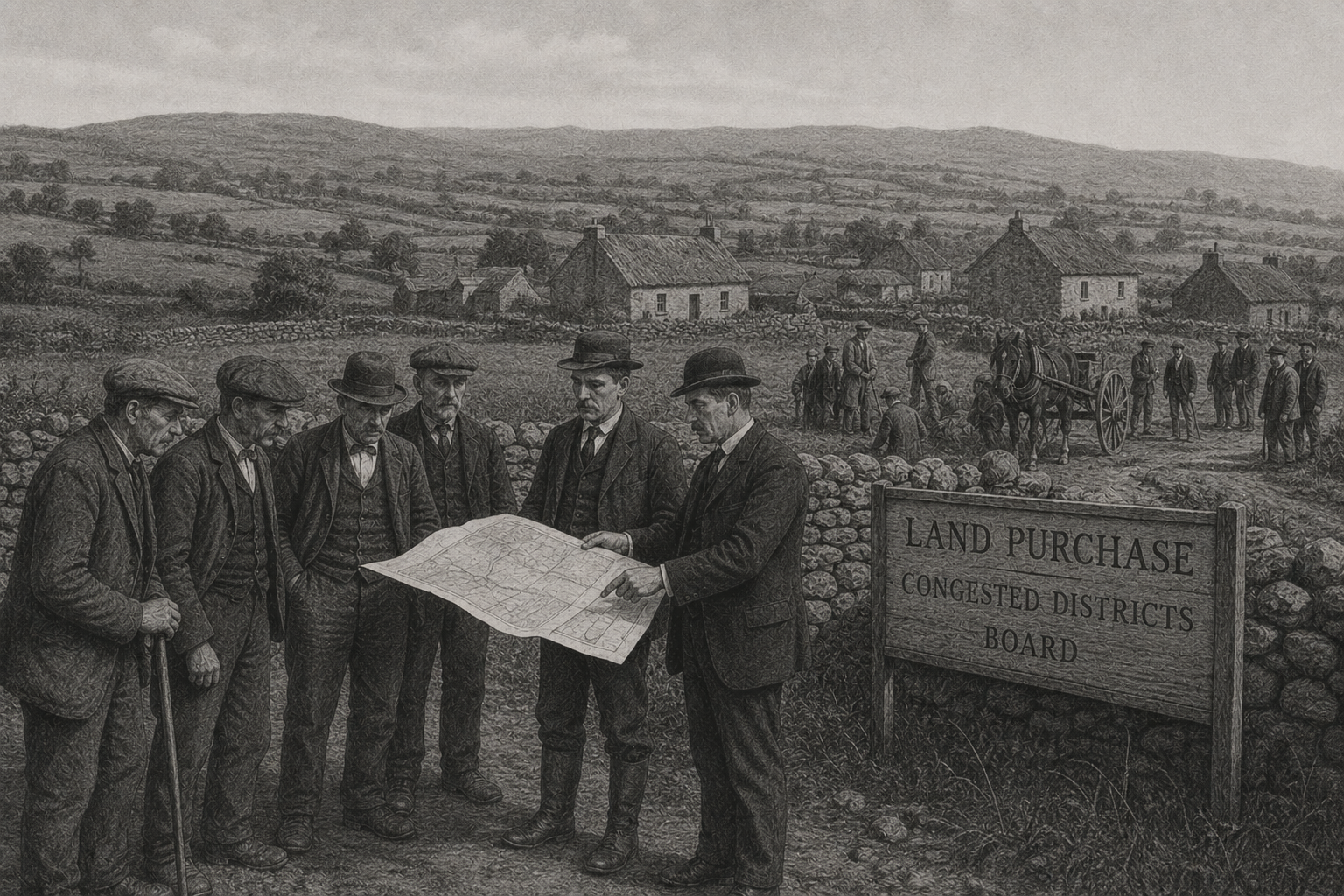
Estates Reorganised
Read Article: Estates ReorganisedThe Congested Districts Board is continuing its efforts to purchase and reorganise estates in the poorest districts of western Ireland. Created in 1891 to relieve chronic rural poverty, the Board has increasingly turned towards land purchase as a means of enlarging uneconomic farms, combining scattered plots and moving selected families from overcrowded districts onto more productive ground. Its work is concentrated principally in Connacht and the western counties, where generations of subdivision have left many households dependent upon holdings too small or infertile to provide a secure living.
The Board’s method involves acquiring an estate, examining the condition of its tenants and then rearranging the land before reselling improved holdings. Boundaries may be altered, fragmented plots consolidated and additional grazing ground attached to farms that cannot support their occupants. Drainage, fencing, roads and houses may also be provided before the tenants assume responsibility for repayment. The policy therefore extends beyond transferring ownership from landlord to occupier. It attempts to reshape the physical organisation of rural communities so that families receive holdings capable of sustaining them without continuous dependence upon seasonal migration, shop credit or assistance from relatives abroad.
One of the Board’s largest undertakings followed its purchase in 1899 of the Dillon estate, extending across parts of Counties Galway and Roscommon. The property contained numerous impoverished tenants living upon wet, divided or inadequate holdings. Its acquisition offered the Board an opportunity to carry out drainage, improve roads and redistribute land on a scale beyond its earlier experiments. The Clare Island and French estates had already demonstrated that carefully reorganised holdings could improve tenants’ circumstances, encourage regular repayment and reduce dependence upon credit. Supporters now argue that these experiments justify a much wider programme throughout the congested western districts.
Progress remains restricted by finance and by the Board’s dependence upon voluntary sales. Although legislation permits it to borrow purchase money from the Irish Land Commission, the expense of improving and rearranging estates must still be met from limited annual funds. Board officials must therefore balance the cost of land against drainage, construction, agricultural assistance, fisheries and local industries. Nationalist representatives complain that deserving districts remain neglected while negotiations continue slowly. Landlords may refuse acceptable terms, and the Board cannot yet compel the sale of estates whose acquisition might relieve surrounding congestion.
The programme is closely watched in County Limerick, where the contrast between large grazing farms and small or insecure holdings has also encouraged demands for redistribution. The western estates present the most severe examples of congestion, but the principle involved reaches across rural Ireland: ownership alone cannot rescue a family when the land purchased remains scattered, exhausted or too small. By combining estate purchase with physical reorganisation, the Congested Districts Board is testing whether public intervention can replace inherited poverty with viable farms. Its achievements remain limited in scale, yet they have strengthened demands for a broader settlement of the Irish land question.
- Congested Districts Board for Ireland, Report for the Year Ending 31 March 1900, Parliamentary Papers, presented to Parliament on 2 July 1900. Consult the sections concerning land purchase, migration, estate improvement and agricultural reorganisation. Exact command-paper number, page and appendix should be confirmed before formal citation.
- Congested Districts Board for Ireland, Sixth Annual Report, Parliamentary Papers, 1898. The report describes borrowing for land purchases intended for migration or the amalgamation of holdings and explains the financial limitations affecting improvement work. Exact page and appendix should be confirmed before formal citation.
- Congested Districts Board (Ireland) Act, 1899, 62 & 63 Vict., c. 18. The Act strengthened the Board’s position when offering to purchase estates from the Land Judge for resale to occupying tenants.
- House of Commons Debates, “Congested Districts Board (Ireland),” 23 February 1898, vol. 53. The debate reproduces the Board’s explanation of estate purchase, enlargement, improvement and the reorganisation of holdings.
- Ciara Breathnach, The Congested Districts Board of Ireland, 1891–1923: Poverty and Development in the West of Ireland, Dublin: Four Courts Press, 2005. This study examines the Board’s land, agricultural and rural-development programmes.
-
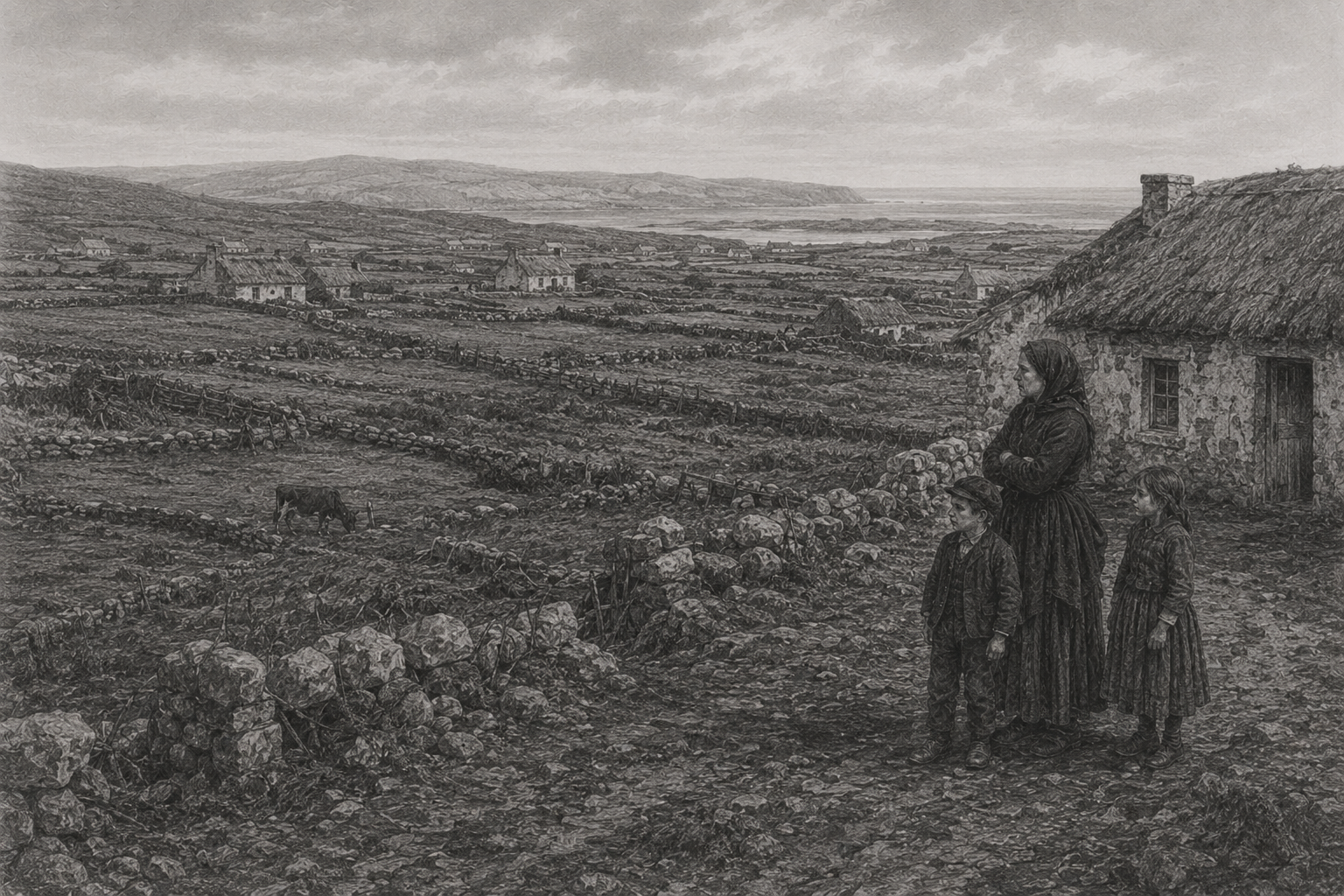
Western Hardship
Read Article: Western HardshipCongestion, fragmented holdings and poor soil continue to govern the lives of thousands of families throughout western Ireland. In large districts of Galway, Mayo, Roscommon, Donegal, Kerry and western Cork, households depend upon small and scattered plots that cannot reliably support those working them. A family may cultivate several separate strips divided by neighbours’ land, bog or rocky ground, making improvement difficult and wasting valuable time. Similar hardship is familiar in poorer coastal and upland parts of Munster, where limited employment and uncertain harvests leave communities dependent upon fishing, seasonal labour, credit and remittances from relatives abroad.
The official meaning of congestion extends beyond crowded housing. It describes districts in which too many people depend upon land too poor or holdings too small to provide a reasonable livelihood. Potatoes, oats and a few animals may sustain a household during favourable seasons, but wet weather, animal disease or declining prices can quickly expose its insecurity. Subdivision between generations has reduced many farms to uneconomic proportions, while rundale arrangements and unfenced strips complicate drainage, grazing and cultivation. Families remain attached to their townlands, yet the structure of landholding repeatedly forces younger men and women towards migratory labour or permanent emigration.
The Congested Districts Board, established in 1891, has attempted to relieve these conditions through land purchase, improved farming, drainage, roads, piers, fishing assistance and the development of local industries. Its work has brought visible benefits to selected communities, but critics argue that its resources remain far below the scale of the problem. Parliamentary representatives have complained that entire districts receive little attention while families continue to occupy holdings from which no dependable living can be obtained. Experiments involving the enlargement or rearrangement of farms have strengthened demands for more extensive intervention, particularly where fertile grazing land lies near densely settled communities surviving upon poorer ground.
The consequences are carried within family life. Men travel to Britain or more prosperous Irish districts for seasonal work, leaving women to manage children, animals, crops and household debts. Shopkeepers frequently extend credit until wages, harvest money or remittances arrive. Children contribute through turf gathering, herding, fishing and domestic labour, while schooling may be interrupted whenever household survival demands additional hands. Poor roads and isolated settlements restrict access to markets, doctors and public services. A failed crop or damaged boat therefore becomes more than an individual misfortune, spreading pressure through neighbours, traders, landlords and relatives already living close to poverty.
Western congestion has consequently become central to the Irish land question. Tenant purchase alone cannot rescue families whose farms remain too small, divided or infertile to sustain them. Reformers increasingly demand the acquisition of large estates, the enlargement and consolidation of holdings, improved drainage and the movement of some families towards better land. Others fear that migration schemes may weaken ancient communities without creating secure livelihoods. For Limerick and Munster, the western crisis remains both a warning and a shared concern: political reform will mean little to rural families unless it changes the ground beneath their feet and gives future generations a realistic reason to remain.
- Congested Districts Board for Ireland, First Annual Report, covering operations from 5 August 1891 to 31 December 1892, Parliamentary Papers. The report defines the Board’s purpose and describes its early agricultural, fishing, industrial and public-works programmes.
- Congested Districts Board for Ireland, Ninth Annual Report, 1900, Parliamentary Papers. Consult the sections concerning agricultural improvement, land purchase, fisheries, local industries and conditions within designated congested districts. Exact volume, page and appendix should be confirmed before formal citation.
- House of Commons Debates, “Irish Congested Districts Board,” 14 March 1902, vol. 105. The debate records complaints concerning small uneconomic holdings, neglected districts, migratory labour and demands for wider land redistribution.
- House of Commons Debates, “Irish Land Question,” 23 January 1902, vol. 101. The debate describes severe congestion, threatened evictions and migratory labour on western estates.
- Census of Ireland, 1901, General Report and county tables concerning population, occupations, housing and agricultural holdings in western counties. Exact table, page and county return should be confirmed before formal citation.
-
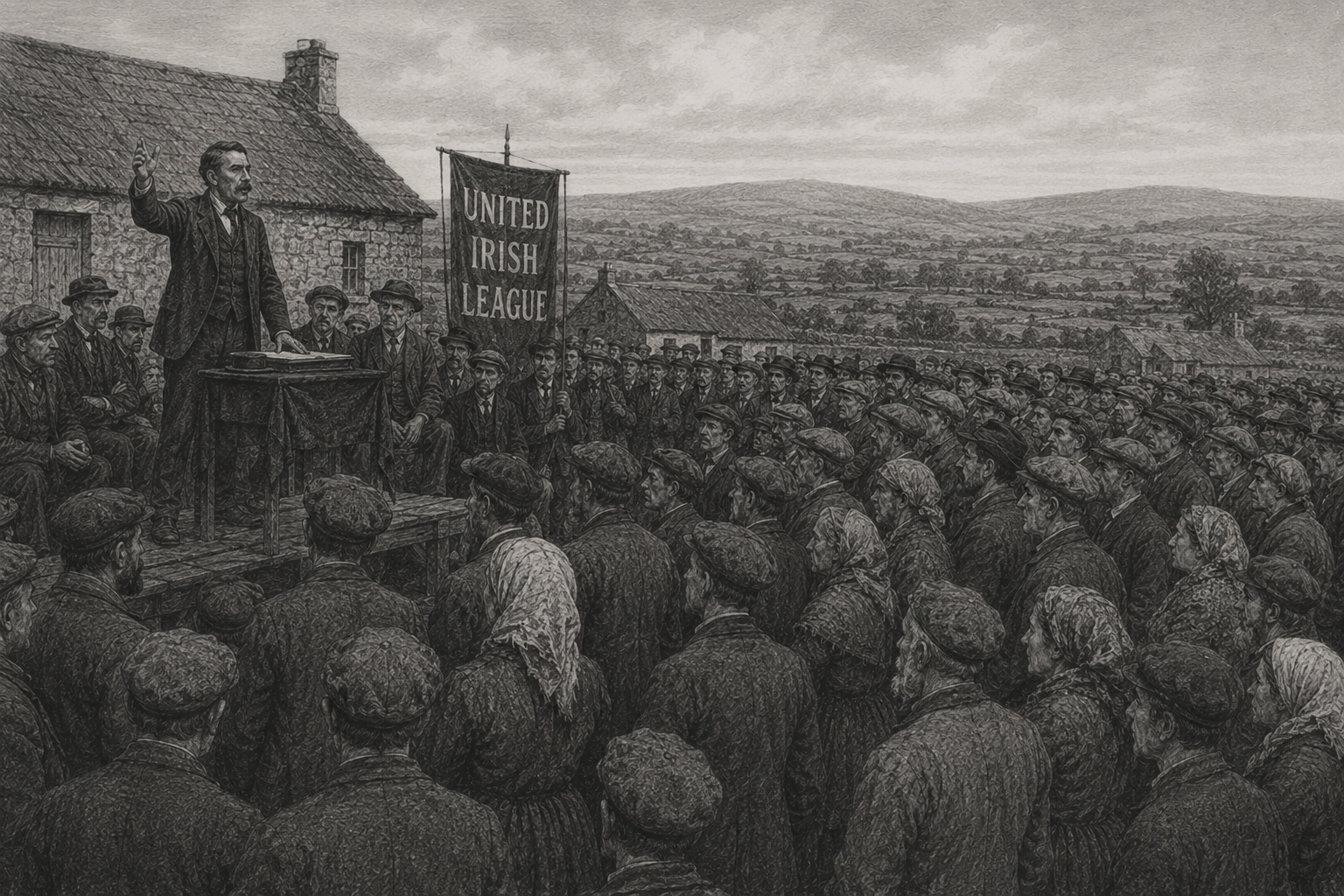
Rural Unrest
Read Article: Rural UnrestAgrarian agitation has become especially influential across Connacht and parts of Munster, where tenant farmers, smallholders and agricultural labourers continue to demand a fairer distribution of Irish land. County Limerick has not escaped the dispute. Rural families living on cramped or uneconomic holdings have watched substantial grazing farms occupy fertile ground while labourers struggle to secure cottages, gardens and dependable employment. Meetings connected with the United Irish League have provided an organised outlet for grievances concerning rents, evicted tenants, disputed farms and the slow progress of land purchase under legislation already introduced by Westminster.
The agitation is strongest where poverty and unequal landholding exist beside extensive cattle-grazing properties. In Connacht, the United Irish League has drawn support from communities seeking the enlargement of small farms through the redistribution of grazing land. Similar arguments carry considerable force in Munster, including County Limerick, where farming conditions vary sharply between prosperous districts and families dependent upon small plots or seasonal labour. Supporters maintain that the land should sustain resident families rather than remain concentrated in large holdings producing cattle for sale. Opponents warn that public pressure may intimidate lawful occupiers and disturb rural order.
William O’Brien’s United Irish League, founded in County Mayo in 1898, has rapidly expanded beyond its western base and linked the land question with the wider reunion of constitutional nationalism. Its branches encourage local organisation, public meetings and collective pressure against those accused of occupying evicted or disputed farms. The movement’s language of land redistribution has attracted tenants and poorer farmers, although agricultural labourers sometimes fear that their own demands will be subordinated to those of established tenant farmers. In County Limerick, labour organisers have insisted that cottages, wages and access to land must remain central to any meaningful rural reform.
The campaign has also revived bitter memories of eviction and the earlier Land War. Families dispossessed during previous decades remain powerful symbols at nationalist gatherings, while men described as land grabbers may face boycotting or social isolation. Such methods divide opinion even among people sympathetic to land reform. Clergy, shopkeepers, farmers and political organisers must decide how far agitation may proceed without becoming coercion. Royal Irish Constabulary officers continue to observe meetings and investigate complaints, while landlords and graziers demand protection for property and contracts. The countryside therefore remains outwardly quiet but politically charged, with old grievances moving into newly organised channels.
For Limerick’s rural communities, the controversy reaches beyond parliamentary speeches and nationalist unity. It concerns whether young families can obtain viable farms, whether labourers can secure decent homes, whether evicted tenants may be restored and whether ownership can replace insecure tenancy. The unequal distribution of land has made agrarian reform inseparable from poverty, emigration and local power. Connacht remains the agitation’s principal centre, but its spread through Munster demonstrates that the dispute is national in scale. Unless the government accelerates land purchase and addresses untenanted grazing estates, rural organisation and confrontation are likely to remain defining features of Irish public life.
- House of Commons Debates, “Irish Land Question,” 23 January 1902, vol. 101. The debate reviews the origins, organisation and methods of the United Irish League from 1898 onward.
- Inspector-General of the Royal Irish Constabulary, monthly reports for 1900 concerning agrarian organisation, United Irish League activity and public order. Exact report, archive reference, page and folio should be confirmed before formal citation.
- Limerick Chronicle, 1900, reports concerning tenant meetings, grazing disputes, evicted tenants, rural labour and United Irish League organisation in County Limerick. Exact issue, page and column should be confirmed before formal citation.
- Freeman’s Journal, 1900, reports concerning the United Irish League, agrarian meetings and the land campaign in Connacht and Munster. Exact issue, page and column should be confirmed before formal citation.
- The Irish People, 1900, reports and political commentary supporting the United Irish League and its programme of agrarian reform. Exact issue, page and column should be confirmed before formal citation.
-
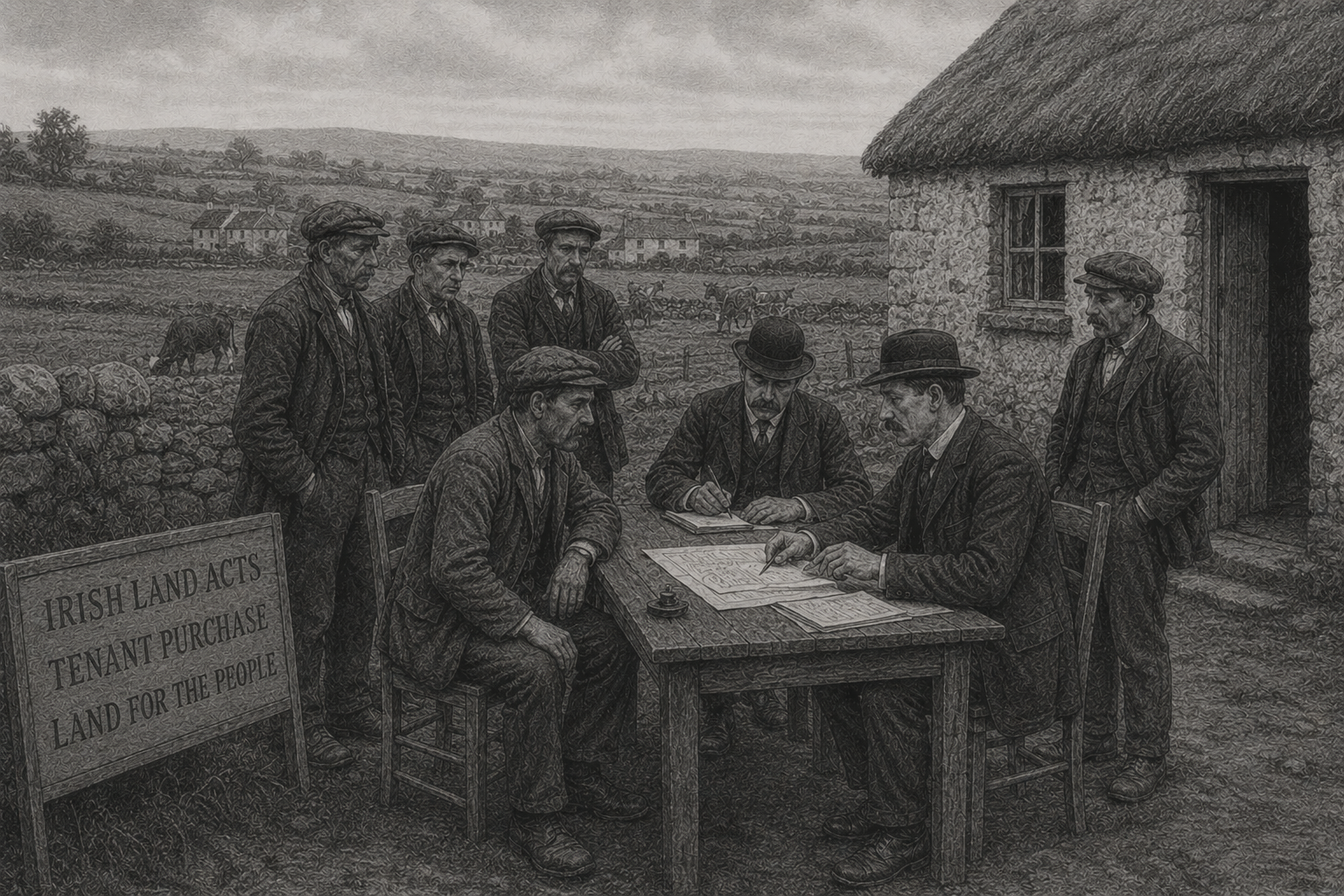
Purchase Delayed
Read Article: Purchase DelayedTenant purchase continues under the existing Irish Land Acts, allowing some farmers to replace rent payments with annual instalments towards ownership of their holdings. The principle has won broad support among tenants who believe possession of the soil would provide greater independence, security and confidence in improving their farms. Yet the number of completed sales remains insufficient to satisfy many rural communities. In County Limerick, farmers continue to wait upon negotiations between landlords, tenants, the Irish Land Commission and the Treasury, while political organisers argue that a reform intended to settle the land question is proceeding far too slowly.
The purchase system depends upon an agreement between landlord and tenant, followed by official examination and the advancement of state funds. Earlier legislation, including the Ashbourne Acts and subsequent measures, enabled tenants to borrow the purchase price and repay it through long-term annuities. Where agreement is reached, the annual charge may compare favourably with the former rent and eventually leaves the occupier as owner. Difficulties arise when landlords refuse to sell, demand prices tenants consider excessive, or possess estates complicated by mortgages, family settlements and other legal interests. Each obstacle can delay negotiations before the proposed sale reaches formal completion.
Farmers complain that voluntary purchase leaves the pace of reform largely dependent upon the willingness of individual landlords. One estate may be sold while neighbouring tenants remain unable even to begin negotiations. Administrative investigation, valuation and the examination of title can prolong the process further, leaving households uncertain whether ownership will arrive within months or remain beyond reach for years. Parliamentary criticism of the existing system continued into 1901, with Irish members arguing that the Land Acts had not provided a sufficiently rapid or comprehensive transfer of ownership.
The delay carries consequences beyond the payment of rent. A tenant unsure of future ownership may hesitate before draining fields, repairing buildings or making costly improvements whose value could later become disputed. Younger family members considering whether to remain upon the farm must judge whether it can support another generation. Shopkeepers, agricultural labourers and local tradesmen are also affected because confidence in farming influences rural spending and employment. In Limerick, the promise of purchase is therefore measured not simply by the number of legal agreements completed but by whether ownership strengthens households, encourages investment and reduces the pressure towards emigration.
Nationalists increasingly argue that piecemeal purchase cannot resolve the wider land question. Existing tenants may become owners while evicted families remain displaced, labourers remain landless and uneconomic holdings remain too small to support their occupants. The slowness of transfer also allows disputes over rent, grazing farms and landlord power to continue. Farmers welcome every completed purchase, but many demand legislation capable of transferring entire estates more quickly and upon affordable terms. Until the machinery becomes faster, broader and less dependent upon voluntary agreement, tenant purchase will remain a valued reform whose limited progress has not matched the urgency felt across rural Ireland.
- Irish Land Commission, Annual Report for 1900, recording purchase agreements, advances and administration under the Irish Land Acts. Exact parliamentary-paper number and page should be confirmed before formal citation.
- Parliamentary Debates, House of Commons, Irish Land Acts, 21 February 1901, vol. 89, debate concerning the operation and limitations of existing land legislation. Exact relevant columns should be confirmed before formal citation.
- Limerick Chronicle, Limerick, 1900, reports concerning estate sales, tenant purchase negotiations, rents and land agitation in County Limerick. Exact issue, page and column should be confirmed before formal citation.
- Freeman’s Journal, Dublin, 1900, reports and editorials concerning tenant purchase, the Irish Land Commission and demands for more rapid land transfer. Exact issue, page and column should be confirmed before formal citation.
- Irish Land Commission purchase records and estate files relating to County Limerick under the Land Purchase Acts before 1903. Exact estate, record number, file and folio should be confirmed before formal citation.
-
Tenants Restored
Read Article: Tenants RestoredEvicted tenants remain at the centre of Ireland’s land agitation, with nationalist representatives demanding that families removed during earlier rent disputes be restored to their former farms. The issue returned prominently to Westminster today during debate upon an Evicted Tenants Bill intended to assist those unable to regain their holdings. In County Limerick, memories of eviction continue to influence political loyalties, public meetings and attitudes towards farms subsequently occupied by others. Nationalists argue that no settlement of the land question can be considered honourable while households that sacrificed homes during organised resistance remain excluded from the soil they once worked.
Many evictions followed rent strikes, the Plan of Campaign and other collective efforts to secure reductions from landlords during the 1880s and 1890s. Families who resisted demands they considered excessive could lose houses, crops and access to land upon which several generations had depended. Some farms remained vacant, while others were taken by new tenants who then faced hostility as “land grabbers”. Restoration therefore presents practical and moral difficulties. A displaced family may claim historical justice, while the present occupier may hold a lawful agreement and have invested labour, money and years of life in the same holding.
The United Irish League has made the cause of evicted tenants central to its rural campaign. Local branches raise subscriptions, organise demonstrations and discourage prospective tenants from taking disputed farms. William O’Brien and other League leaders regard restoration as a test of nationalist solidarity, insisting that those who suffered during earlier agitation must not be abandoned once political unity has been regained. Their campaign connects individual farms with the wider struggle over landlord authority, tenant purchase and national self-government. Restoring an evicted household becomes an act of collective honour as well as a proposed remedy for economic loss.
Government ministers and landlords question how restoration can proceed where farms are already occupied or where the former tenant owes substantial arrears. Compensation, alternative holdings and the voluntary sale of estates have all been discussed, but none provides an immediate universal solution. Nationalists answer that state intervention created and enforced much of the existing land system and must therefore help repair its consequences. They seek powers and funds capable of purchasing disputed holdings, negotiating with owners and providing suitable land where direct reinstatement is impossible. Without such machinery, promises of reconciliation may leave the most visible victims of the land struggle permanently displaced.
For Limerick families, eviction is not an abstract parliamentary question. Removal from a farm can mean loss of livelihood, social standing, inheritance and the possibility of remaining within a familiar parish. Restoration would return more than acreage; it could recover a home and repair a community division that has endured for years. Yet every settlement must consider the rights of present occupiers and avoid creating a second dispossessed household. The continued agitation shows that Ireland’s land problem cannot be resolved solely by improving future purchase terms. The unresolved claims of evicted tenants remain a measure of whether reform can deliver justice as well as legal change.
- Parliamentary Debates, House of Commons, “Evicted Tenants (Ireland) Bill (Second Reading),” 21 February 1900, vol. 79. Exact relevant columns should be confirmed before formal citation.
- Freeman’s Journal, Dublin, February–December 1900, reports concerning evicted tenants, restoration campaigns, disputed farms and United Irish League meetings. Exact issue, page and column should be confirmed before formal citation.
- Limerick Chronicle, Limerick, 1900, reports concerning evictions, former tenants, disputed holdings and nationalist land agitation in County Limerick. Exact issue, page and column should be confirmed before formal citation.
- United Irish League, early branch resolutions, subscription records and meeting reports concerning the reinstatement of evicted tenants, 1898–1901. Exact archive, collection, file and folio should be confirmed before formal citation.
- Royal Irish Constabulary, County Inspector’s monthly reports for Limerick, 1900, concerning evicted farms, boycotting, disputed occupation and United Irish League activity. Exact file, report and folio should be confirmed before formal citation.
-
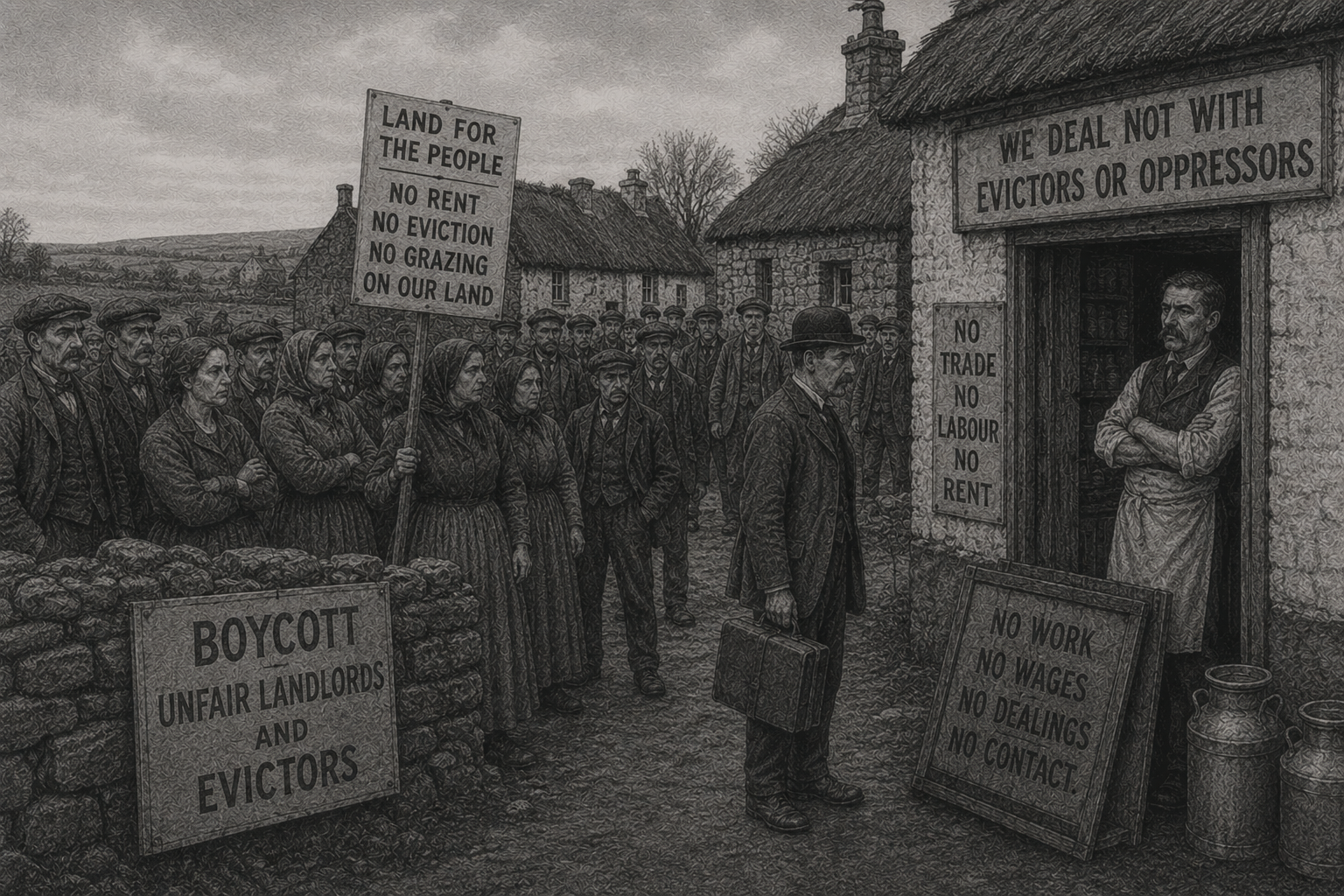
Boycott Pressure
Read Article: Boycott PressureBoycotting and organised public pressure are being employed in some Irish districts against landlords, graziers and tenants whose conduct is considered hostile to the land campaign. The methods range from public condemnation and refusal of ordinary dealings to the withdrawal of labour, trade and social contact. Supporters describe such action as a peaceful means of enforcing communal discipline where legal and parliamentary remedies appear ineffective. Opponents call it intimidation imposed upon people who may have broken no law. In County Limerick, the practice carries particular force wherever eviction, disputed holdings or the occupation of grazing land has divided neighbours.
The boycott entered Irish political language during the Land War, when labourers, tradesmen and neighbours refused assistance to Captain Charles Boycott after he attempted to enforce evictions in County Mayo. The tactic survived because it allowed a community to isolate an unpopular individual without an organised physical attack. A landlord might struggle to obtain labour, supplies or local cooperation, while a tenant occupying an evicted farm could find ordinary relations withdrawn. Public meetings and newspaper reports strengthened the pressure by identifying disputed farms and warning prospective tenants that acceptance would carry consequences extending beyond the rent agreement.
The United Irish League has revived similar methods while campaigning for the restoration of evicted tenants and the division of large grazing farms. Local branches may pass resolutions, organise meetings and discourage people from bidding for land claimed by displaced families or sought for redistribution. Those who resist League demands can be denounced as land grabbers, graziers or enemies of the local cause. Parliamentary debate in 1900 acknowledged that pressure was being applied to holders of grass farms to surrender them, while later discussion described the boycotting associated with League activity.
The consequences can reach beyond the person directly involved. Shopkeepers may fear serving a condemned household, labourers may refuse employment, and neighbours may avoid conversation, worship or market dealings. Wives, children and servants can become isolated despite having played no part in the original dispute. Government officials and unionist critics argue that such pressure substitutes collective punishment for law and leaves individuals vulnerable to local power. Nationalists answer that social withdrawal is less violent than eviction and often represents the only effective weapon available to communities confronting landlords, extensive graziers or unpopular incoming tenants.
For Limerick, boycotting exposes the conflict between lawful possession and accepted local justice. A landlord may rely upon contract, and a new tenant may hold a valid lease, yet neighbours may regard the same arrangement as the product of eviction or unfair concentration of land. The method can strengthen solidarity and compel negotiation, but it may also punish dissent, deepen family feuds and make reconciliation difficult. Its continued use shows that the land question is being decided not only in courts and Parliament but through the daily choices of labourers, traders, farmers and neighbours across the countryside.
- Parliamentary Debates, House of Commons, Evicted Tenants (Ireland) Bill, 21 February 1900, discussion of pressure upon holders of grass farms to surrender them for division among small farmers. Exact columns should be confirmed before formal citation.
- Parliamentary Debates, House of Commons, Civil Service Estimates, 25 May 1900, discussion of United Irish League activity, grazing farms and political boycotting. Exact relevant columns should be confirmed before formal citation.
- Freeman’s Journal, Dublin, 1900, reports concerning boycotting, evicted tenants, disputed farms and United Irish League meetings. Exact issue, page and column should be confirmed before formal citation.
- Limerick Chronicle, Limerick, 1900, reports concerning agrarian disputes, unpopular tenants, landlords and League organisation in County Limerick. Exact issue, page and column should be confirmed before formal citation.
- Royal Irish Constabulary, County Inspector’s monthly reports for Limerick, 1900, concerning agrarian intimidation, boycotting, evicted farms and public meetings. Exact file, report and folio should be confirmed before formal citation.
-
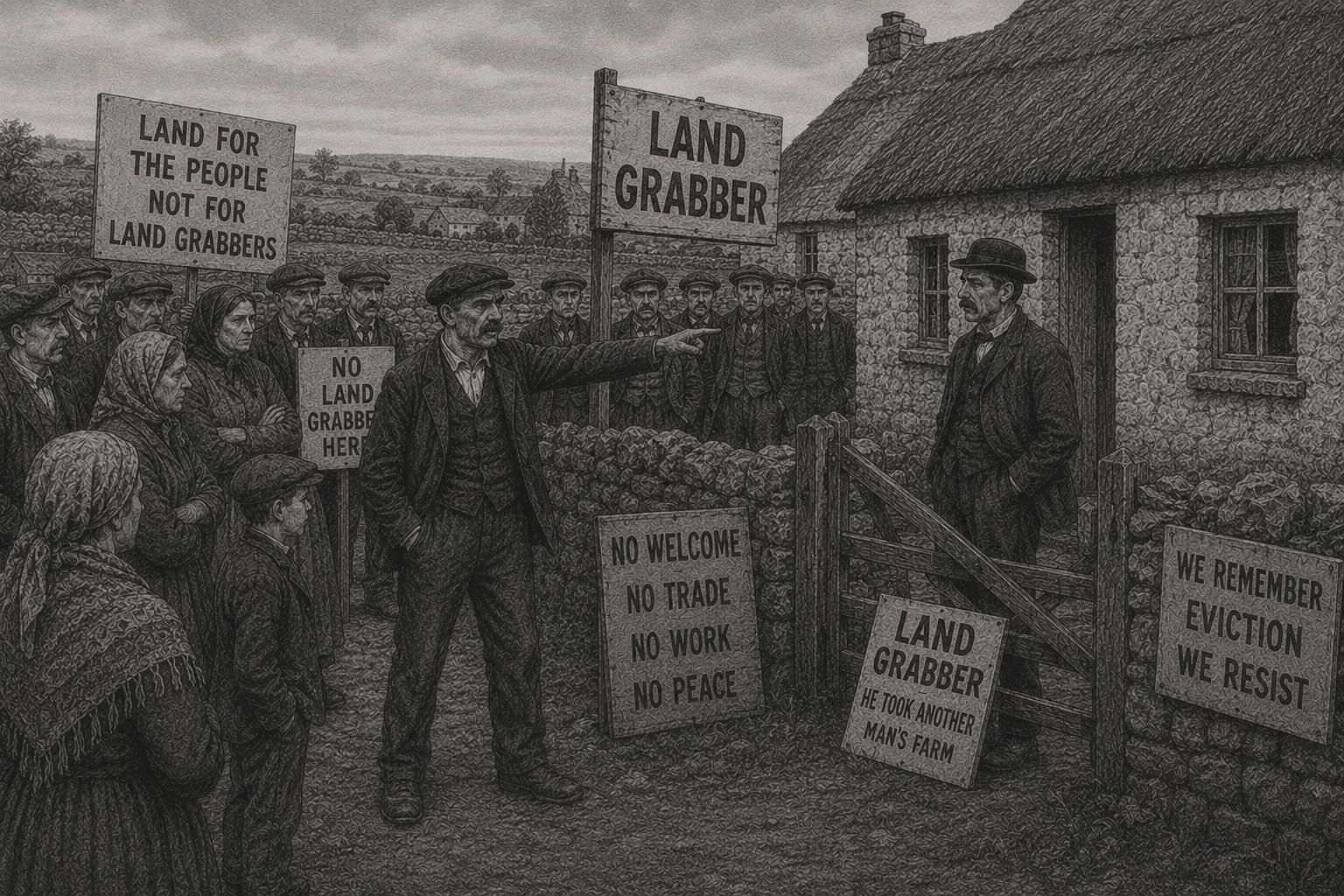
Land Grabbers
Read Article: Land GrabbersThe hostile term “land grabber” continues to be directed against tenants who enter farms from which earlier occupiers have been evicted or otherwise displaced. Across rural Ireland, such men may possess legal agreements with landlords, yet neighbours frequently regard their occupation as a betrayal of the former tenant and the wider land campaign. The description carries consequences extending beyond political criticism. Those branded with it may face public condemnation, social isolation and organised pressure intended to make the disputed holding difficult to retain. In County Limerick, the label remains inseparable from memories of eviction, rent conflict and agrarian resistance.
The expression became particularly powerful during the Land War, when campaigners sought to prevent vacant or evicted farms from being taken by new tenants. A person accepting such land was accused of profiting from another family’s removal and weakening the collective discipline required to resist landlord authority. Branches of nationalist organisations could pass resolutions condemning both the farm and its new occupier, while neighbours might refuse ordinary social or commercial dealings. Supporters compared the land grabber with a strike-breaker who undermined fellow workers. Opponents argued that lawful tenants were being punished for exercising rights recognised by existing land law.
The United Irish League has revived these pressures as it expands agitation over grazing farms, evicted tenants and the concentration of land. League speakers maintain that disputed holdings should be restored where possible and that extensive grasslands ought to be divided among small farmers and landless families. A tenant who competes for land claimed by an evicted family or opposed by the local branch may therefore attract the damaging designation. Public meetings and local resolutions allow communities to enforce an unwritten code governing who may bid for, rent or occupy particular farms, even when no court has prohibited the transaction.
Such methods remain controversial. Nationalists defend social pressure as a peaceful weapon available to communities lacking control over land policy. Government officials, landlords and unionist critics describe the same conduct as intimidation designed to override individual liberty and legal contracts. The consequences may affect a tenant’s ability to hire labour, sell livestock, obtain supplies, attend markets or maintain ordinary relations with neighbours. The term itself functions as punishment before any formal offence has been proved. Once attached to a household, it may also affect wives, children and employees who played no part in the original decision to occupy the farm.
For Limerick farmers, the controversy reveals how deeply landholding remains governed by communal judgement as well as statute and contract. An available farm may promise security to one family while representing dispossession to another. The label “land grabber” compresses that conflict into two bitter words, dividing lawful possession from accepted local legitimacy. Its continued use shows that the settlement of the land question requires more than purchase legislation. Evicted tenants, contested farms and competing claims must be addressed in ways considered just by rural communities, or the occupation of disputed land will continue to provoke resentment, exclusion and political agitation.
- Parliamentary Debates, House of Commons, “Civil Service Estimates, 1900–1901,” 25 May 1900, discussion of United Irish League meetings condemning a “land-grabber or a grazier”; exact relevant columns should be confirmed before formal citation.
- Parliamentary Debates, House of Commons, “Irish Grievances,” 22 February 1901, comparison of the Irish land grabber with the English industrial strike-breaker; exact relevant columns should be confirmed before formal citation.
- Parliamentary Debates, House of Commons, “Irish Land Acts,” 21 February 1901, discussion of hostility and boycotting directed against persons taking evicted farms; exact relevant columns should be confirmed before formal citation.
- Limerick Chronicle, 1900–1901, reports concerning disputed farms, evicted tenants, boycotting and United Irish League activity in County Limerick. Exact issue, page and column should be confirmed before formal citation.
- Royal Irish Constabulary, County Inspector’s monthly reports for Limerick, 1900–1901, concerning agrarian disputes, intimidation, boycotting and United Irish League organisation. Exact file, report and folio should be confirmed before formal citation.
-
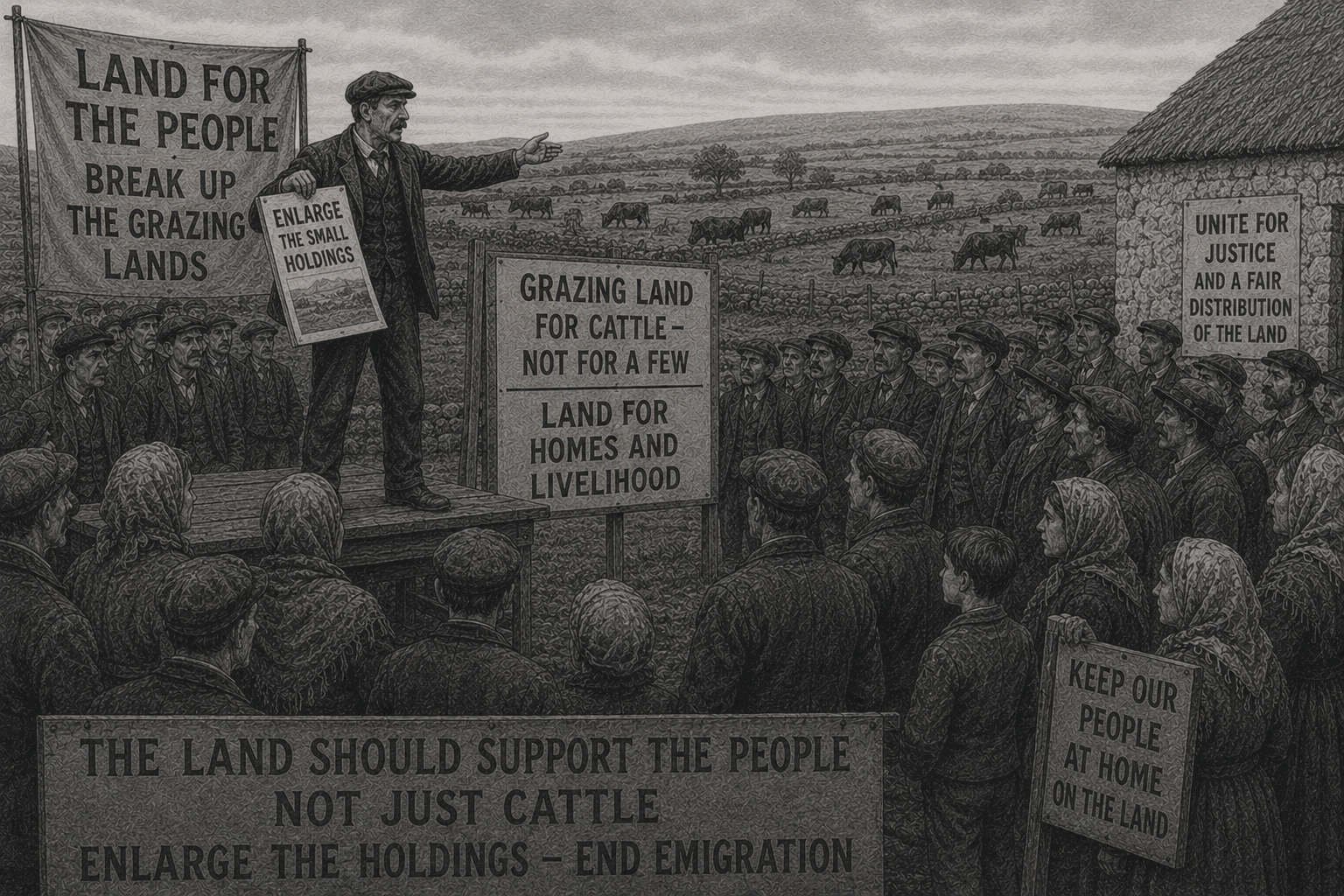
Holdings Enlarged
Read Article: Holdings EnlargedCampaigners are demanding that uneconomic smallholdings be enlarged through the redistribution of extensive grazing land. The United Irish League argues that thousands of rural families remain confined to farms too small or too poor to provide a secure livelihood while nearby grasslands support cattle but comparatively few people. Its organisers want owners and large occupiers to release untenanted land so that neighbouring holdings may be expanded. In County Limerick, where the size and quality of a farm often determine whether a family can remain at home, the proposal will be judged as both an agricultural reform and a defence against emigration.
An uneconomic holding may provide enough ground for a few animals, potatoes, oats and meadow without yielding sufficient income to support a household throughout the year. Families upon such farms often depend upon seasonal labour, remittances or additional work, while younger sons and daughters face little prospect of establishing homes nearby. League campaigners contend that simply transferring ownership from landlord to tenant will not solve this problem if the purchased farm remains incapable of sustaining its occupier. Land purchase must therefore be accompanied by redistribution, allowing smallholders to obtain enough additional acreage to make ownership economically meaningful.
Large grazing farms have become the principal target because they occupy broad tracts requiring fewer workers than tillage or smaller mixed farms. Organisers contrast cattle feeding upon open grassland with crowded families struggling upon fragmented or inferior holdings. They argue that land carries a social responsibility towards the surrounding population and should not be judged solely by the profit it returns to an owner or grazier. Supporters believe enlarged farms would strengthen rural communities, encourage marriage and inheritance, support local trade and reduce the pressure forcing young people from Limerick and other counties towards British or American cities.
Redistribution presents difficult questions of selection and fairness. Small farmers may disagree over which families deserve additional land, while agricultural labourers possessing no holding may fear exclusion from a settlement designed principally for existing tenants. Graziers and substantial farmers insist that their businesses are lawful and economically productive, warning that organised pressure may become intimidation. League officials must also confront the possibility that influential nationalists themselves hold grazing farms. A credible programme will require transparent decisions about who receives land, how compensation is arranged and whether labourers, evicted tenants and landless families receive consideration alongside established smallholders.
The campaign has broadened the land question from ownership alone towards the size, quality and use of individual farms. Its supporters do not merely want tenants to purchase what they already occupy; they want rural society reorganised so that families possess viable holdings capable of supporting another generation. The United Irish League’s agitation for breaking up grazing ranches was closely connected with the relief of congestion and the enlargement of small farms. In County Limerick, the demand will remain powerful wherever extensive pasture stands beside cottages and farms whose occupants cannot live securely from the soil available to them.
- United Irish League, early constitution, National Directory resolutions and branch records, 1898–1901, concerning the redistribution of grazing land and enlargement of smallholdings. Exact archive, file and folio should be confirmed before formal citation.
- Freeman’s Journal, Dublin, 1900, reports of United Irish League meetings and speeches concerning uneconomic holdings, congestion and the division of grazing farms. Exact issue, page and column should be confirmed before formal citation.
- Limerick Chronicle, Limerick, 1900, reports concerning land meetings, smallholdings, grazing farms and United Irish League organisation in County Limerick. Exact issue, page and column should be confirmed before formal citation.
- Irish Land Commission, Annual Report for 1900, concerning tenant purchase, holdings and the administration of Irish land legislation. Exact parliamentary-paper number and page should be confirmed before formal citation.
- Parliamentary Debates, House of Commons, debates and questions concerning grass farms, congestion and redistribution under Irish land legislation, 1900–1902. Exact date, volume and column should be confirmed before formal citation.
-
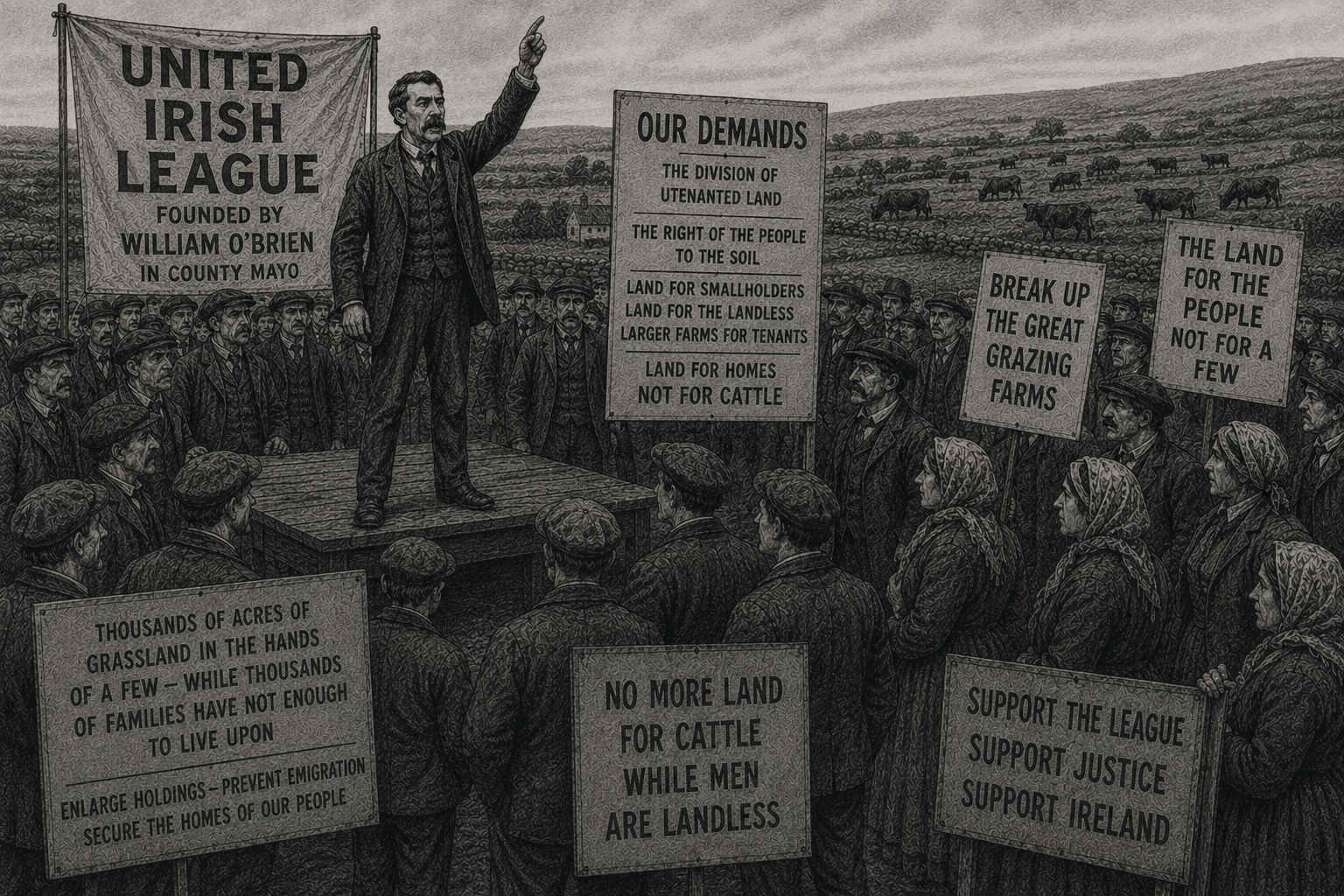
Grazing Challenged
Read Article: Grazing ChallengedThe United Irish League is expanding its campaign against large grazing farms and the concentration of extensive tracts of land in comparatively few hands. Founded by William O’Brien in County Mayo, the League argues that great stretches of grassland should not remain devoted principally to cattle while small farmers struggle upon holdings too limited to support their families. Its programme seeks the division of untenanted land among smallholders, landless families and tenants requiring larger farms. In County Limerick, where agricultural security continues to shape employment, inheritance and emigration, the campaign is likely to command close attention.
The spread of grazing developed partly from the conversion of former tillage land into pasture, particularly where cattle offered owners and substantial occupiers a profitable return requiring fewer labourers. Nationalist organisers condemn the sight of lightly populated grasslands lying beside congested districts and uneconomic holdings. They argue that rural decline cannot be reversed while young families lack sufficient ground upon which to establish themselves. Large ranches have therefore become symbols of a wider imbalance in Irish agriculture: land may be productive in commercial terms while the neighbouring population remains poor, underemployed and increasingly dependent upon emigration.
League branches are expected to identify extensive grazing holdings, discourage competition for disputed farms and press owners or occupiers to release land for redistribution. Public meetings, resolutions and organised social pressure allow local communities to turn individual grievances into a national campaign. Such tactics may revive memories of the Land War and its boycotts, creating unease among landlords, graziers and government officials. League leaders insist that parliamentary speeches alone cannot force reform unless rural organisation demonstrates the strength of popular demand. Their objective is to make the continued concentration of land politically and socially difficult to defend.
The campaign also exposes divisions within nationalist Ireland. Some prosperous farmers and League officials themselves rent or control grazing land, while smallholders and labourers may demand that the same property be divided. Tenant purchase could convert existing occupiers into owners without necessarily providing land for families possessing little or none. Agricultural labourers face an additional concern: breaking up ranches may create smaller farms but will not automatically guarantee cottages, secure wages or access to plots. In Limerick, the promise of redistribution will be judged by whether it benefits substantial tenants alone or reaches those whose poverty leaves them without meaningful influence.
The United Irish League has made the grazing question part of its wider effort to unite land reform with national self-government. Its supporters argue that Ireland cannot prosper while rural communities lose population and extensive land remains closed to families seeking viable holdings. Opponents warn that agitation may produce intimidation, conflict and unjust pressure against lawful occupiers. Whatever methods are adopted, the campaign has placed the ownership and use of grassland under renewed public scrutiny. Across County Limerick, farmers and labourers will ask whether agricultural land exists chiefly for commercial return or carries a wider responsibility towards the communities surrounding it.
- United Irish League, early constitution, National Directory resolutions and branch records, 1898–1901, concerning agrarian agitation, grazing ranches and redistribution of untenanted land. Exact archive, file and folio should be confirmed before formal citation.
- Freeman’s Journal, Dublin, 1900, reports of United Irish League meetings, speeches by William O’Brien and campaigns against large grazing holdings. Exact issue, page and column should be confirmed before formal citation.
- Limerick Chronicle, Limerick, 1900, reports concerning League branches, land meetings, grazing farms and tenant demands in Limerick city and county. Exact issue, page and column should be confirmed before formal citation.
- Royal Irish Constabulary, county inspectors’ reports and confidential reports concerning United Irish League activity and agrarian agitation, 1900, National Archives of Ireland. Exact county report, file and folio should be confirmed before formal citation.
- Parliamentary Debates, House of Commons, questions and debates concerning the United Irish League, grazing farms, boycotting and Irish land reform, 1900–1902. Exact date, volume and column should be confirmed before formal citation.
-
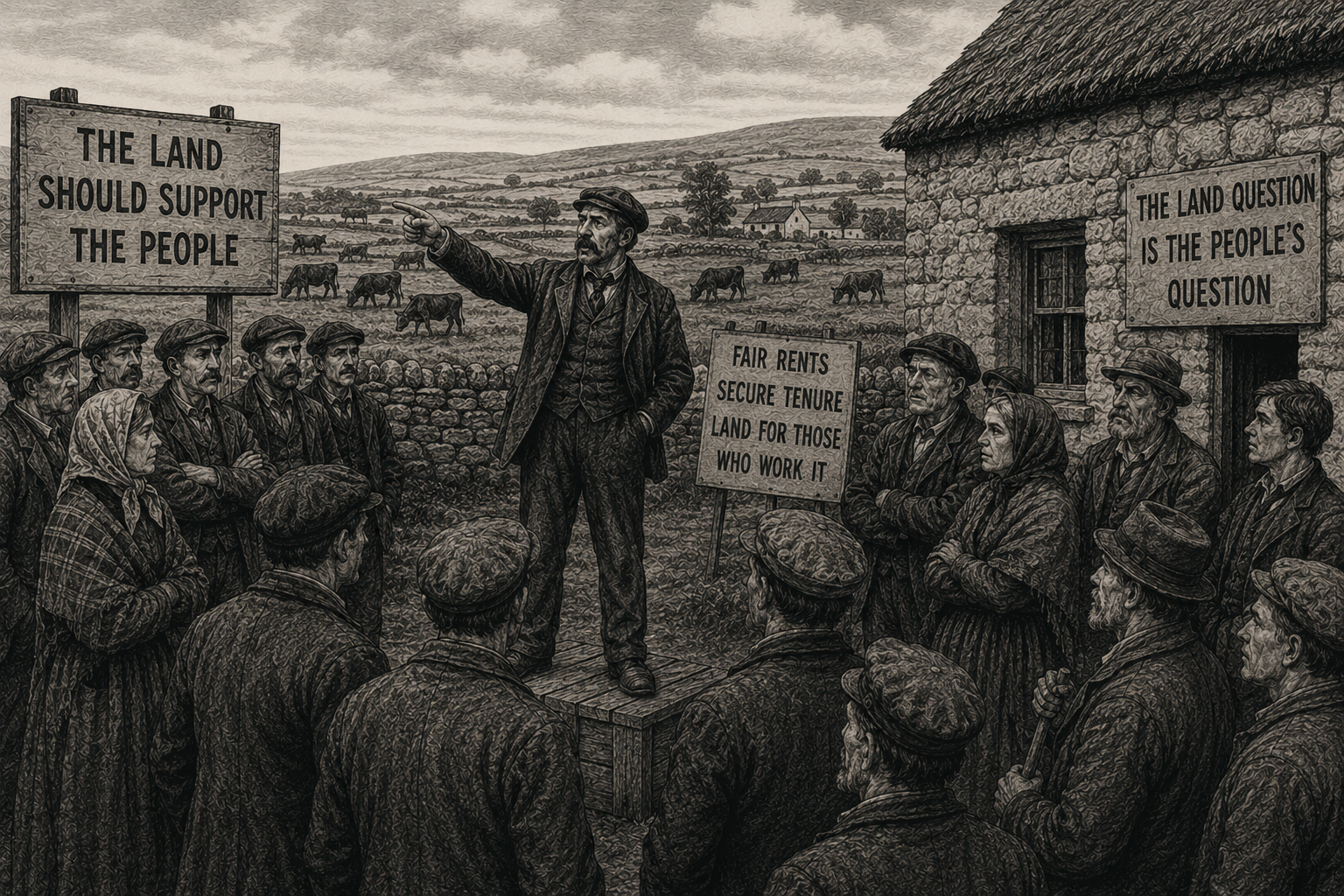
Land Dominates
Read Article: Land DominatesThe land question remains the dominant economic and social issue across rural Ireland, shaping political organisation, family security and relations between landlords and tenant farmers. In County Limerick, holdings vary greatly in quality and size, while rents, arrears, grazing land and the prospect of tenant purchase remain constant subjects of discussion. Earlier Land Acts granted greater protection and introduced limited purchase schemes, but they did not complete the transfer of ownership sought by many farmers. Rural households continue to measure political promises against the practical questions of who owns the soil, who works it and who benefits from its produce.
Tenant farmers have gained important legal protections since the agitation of the Land War, including fair-rent procedures, greater security of tenure and recognition of the tenant’s interest in a holding. Yet many still occupy land owned by estates whose authority reaches into rents, improvements, inheritance and the sale of farms. Purchase legislation has allowed some tenants to become owners through state-supported advances, but progress remains uneven and often slow. In County Limerick, the possibility of ownership carries significance beyond financial calculation. A purchased farm promises independence from rent demands and greater security for children expected to inherit the holding.
The United Irish League has connected the land campaign with the wider demand for national self-government. Organisers argue that political unity must serve tenants, evicted families, labourers and communities weakened by emigration. William O’Brien and other leaders have used the League to rebuild nationalist organisation from the countryside upwards, making local branches important centres of pressure. Meetings concerning grazing farms, reinstatement and purchase frequently become tests of political loyalty. The land question therefore reaches beyond individual contracts between landlords and tenants. It influences parliamentary representation, local elections, public meetings and the authority claimed by nationalist leaders throughout rural Ireland.
Agricultural labourers occupy a more uncertain position within the struggle. Tenant purchase may improve the security of farmers without guaranteeing cottages, steady employment or adequate wages for those who own no land. Labourers depend upon seasonal hiring, local demand and access to small plots, while their families often inhabit cottages vulnerable to damp, overcrowding and poor sanitation. In Limerick, debates over ownership must therefore be considered alongside demands for better labourers’ housing and living conditions. A settlement benefiting substantial tenants alone would leave many rural households outside the promised transformation and could preserve inequality beneath a new pattern of ownership.
The continuing prominence of the land question reflects its place at the centre of rural life. Rent determines household expenditure, ownership shapes social standing, and access to land influences marriage, inheritance, employment and emigration. Government schemes have altered the legal position of tenants, but the broader settlement remains incomplete in 1900. Limerick farmers, labourers, shopkeepers and political organisers will continue judging national leadership by its ability to produce practical change. Until ownership, grazing, housing and rural poverty are addressed together, the land question will remain not merely an agricultural dispute but the principal measure of economic justice across the countryside.
- Irish Land Commission, Annual Report for 1900, recording fair-rent decisions, purchase advances and the administration of Irish land legislation. Exact parliamentary-paper number and page should be confirmed before formal citation.
- Census of Ireland, 1901, County of Limerick tables concerning agricultural occupations, housing, population and rural households. Exact table and page should be confirmed before formal citation.
- Limerick Chronicle, 1900, reports concerning tenant meetings, land purchase, grazing disputes, evicted tenants and rural political organisation. Exact issue, page and column should be confirmed before formal citation.
- United Irish League records and contemporary reports concerning County Limerick branches, tenant agitation and land reform during 1900. Exact collection, file and folio should be confirmed before formal citation.
- Parliamentary Debates, House of Commons, Irish land legislation and tenant purchase debates, 1900–1901. Exact debate date, volume, column and speaker should be confirmed before formal citation.
-
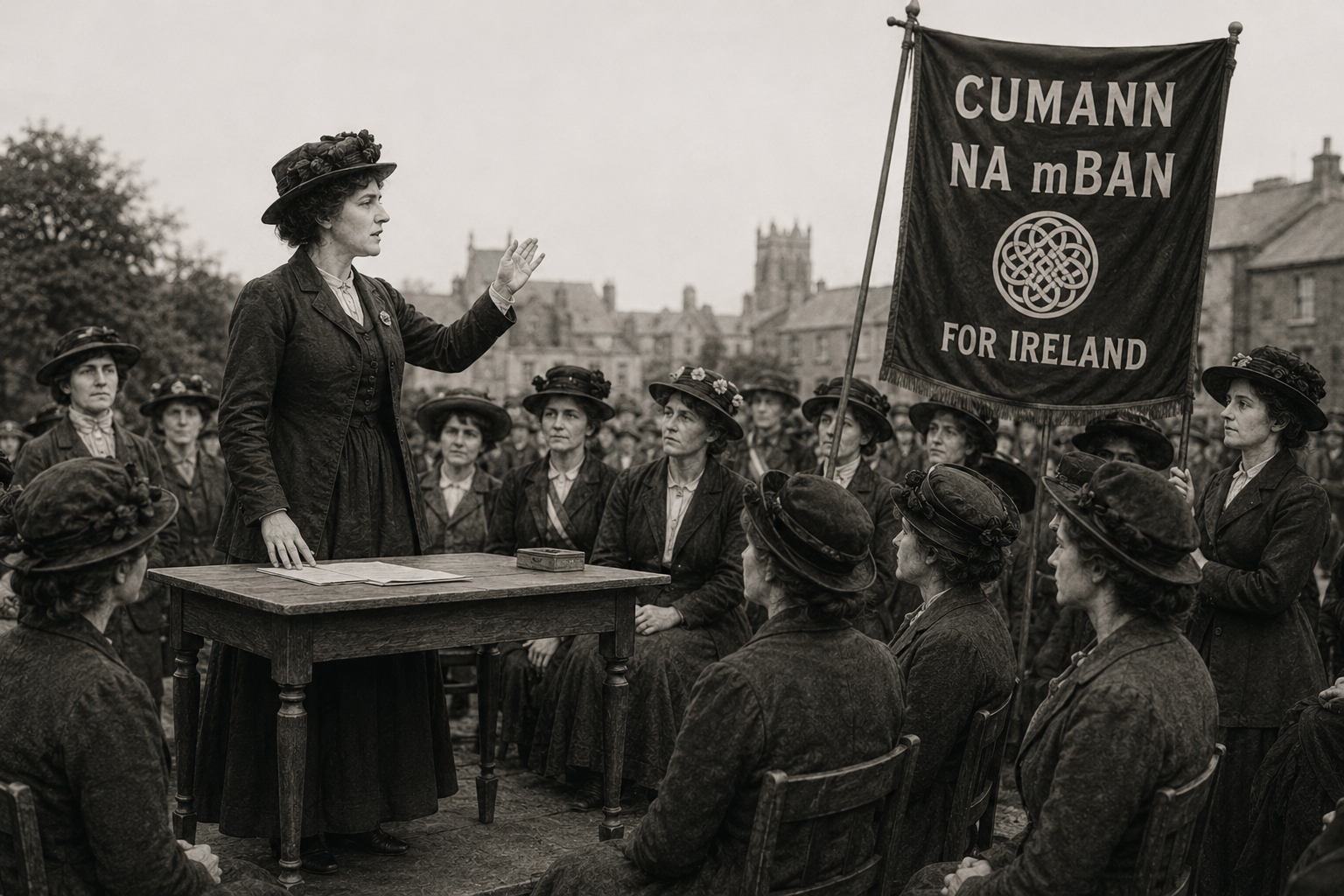
Networks Endure
Read Article: Networks EndureThe establishment of Cumann na mBan has revealed how strongly the women’s nationalist networks created during Queen Victoria’s visit in 1900 have endured. Fourteen years ago, Maud Gonne and her associates organised resistance to the royal ceremonies, arranged an alternative patriotic celebration for children and founded Inghinidhe na hÉireann. Those efforts brought women together as fundraisers, teachers, speakers and political organisers. Many of the relationships, practical skills and separatist convictions formed during that campaign have now entered a broader organisation intended to support the Irish Volunteers and advance the cause of national independence.
Inghinidhe na hÉireann provided women with sustained experience in committee work, public meetings, cultural education, publishing, social relief and political mobilisation. Members organised Irish-language classes, theatrical performances, commemorations, children’s activities and campaigns supporting Irish manufacture. Such work required premises, subscriptions, correspondence, trusted messengers and dependable local contacts. The organisation created opportunities for women who were excluded from parliamentary politics to develop authority within advanced nationalism. Cumann na mBan can now draw upon women already accustomed to working collectively, raising resources and defending separatist principles before audiences that often expected female political labour to remain subordinate and largely invisible.
Personal continuity is equally important. Women associated with the Daughters of Ireland entered later organisations carrying friendships and loyalties formed through years of shared activity. Elizabeth O’Farrell and Julia Grenan joined Inghinidhe na hÉireann before becoming members of its branch within Cumann na mBan. Helena Molony, Constance Markievicz, Jennie Wyse Power and other activists moved through overlapping circles of cultural nationalism, labour organisation, women’s politics and revolutionary agitation. These connections allowed information, practical knowledge and confidence to travel between organisations. The nationalist women assembling in 1914 are therefore not beginning without preparation, even though the new military circumstances demand a different structure and purpose.
The formation of Cumann na mBan follows the creation of the Irish Volunteers in November 1913 amid growing uncertainty over Home Rule and armed unionist resistance. Its branches intend to raise funds, learn first aid, support Volunteer companies and assist the wider national movement. Some male leaders may regard the organisation chiefly as an auxiliary, but experienced women bring ambitions extending beyond supportive duties. Inghinidhe na hÉireann had already asserted that women could determine policy and work for complete independence in their own right. The transfer of members into Cumann na mBan ensures that this autonomous tradition will remain present within the developing revolutionary movement.
Limerick women participating in nationalist, cultural, charitable and labour organisations may find similar opportunities within the new association. The networks begun during opposition to the royal visit show how an apparently temporary campaign can produce lasting political consequences. Meetings arranged for one demonstration created friendships; collections organised for children taught financial administration; cultural classes trained speakers and teachers; public resistance strengthened confidence. Cumann na mBan inherits more than individual members from the organisations preceding it. It receives a body of women already practised in disciplined political work and prepared to carry national organisation from public agitation towards the uncertain demands of revolutionary struggle.
- Maud Gonne MacBride, writings on the history, activities and aims of Inghinidhe na hÉireann, Maud Gonne MacBride Papers, National Library of Ireland, MS 49,531/19.
- Inghinidhe na hÉireann, official reports, membership records, accounts and organisational papers, Maud Gonne MacBride Papers, National Library of Ireland. Exact manuscript numbers and folios should be confirmed before formal citation.
- Helena Molony, Bureau of Military History witness statement concerning Inghinidhe na hÉireann, Cumann na mBan and women’s revolutionary activity. Exact witness-statement number and page should be confirmed before formal citation.
- Elizabeth O’Farrell, Bureau of Military History witness material and contemporary biographical records concerning her membership of Inghinidhe na hÉireann and its Cumann na mBan branch. Exact document and page should be confirmed before formal citation.
- Cumann na mBan, early constitution, manifesto, branch records and organisational papers, April 1914, National Library of Ireland and Military Archives. Exact collection, file and folio should be confirmed before formal citation.
-
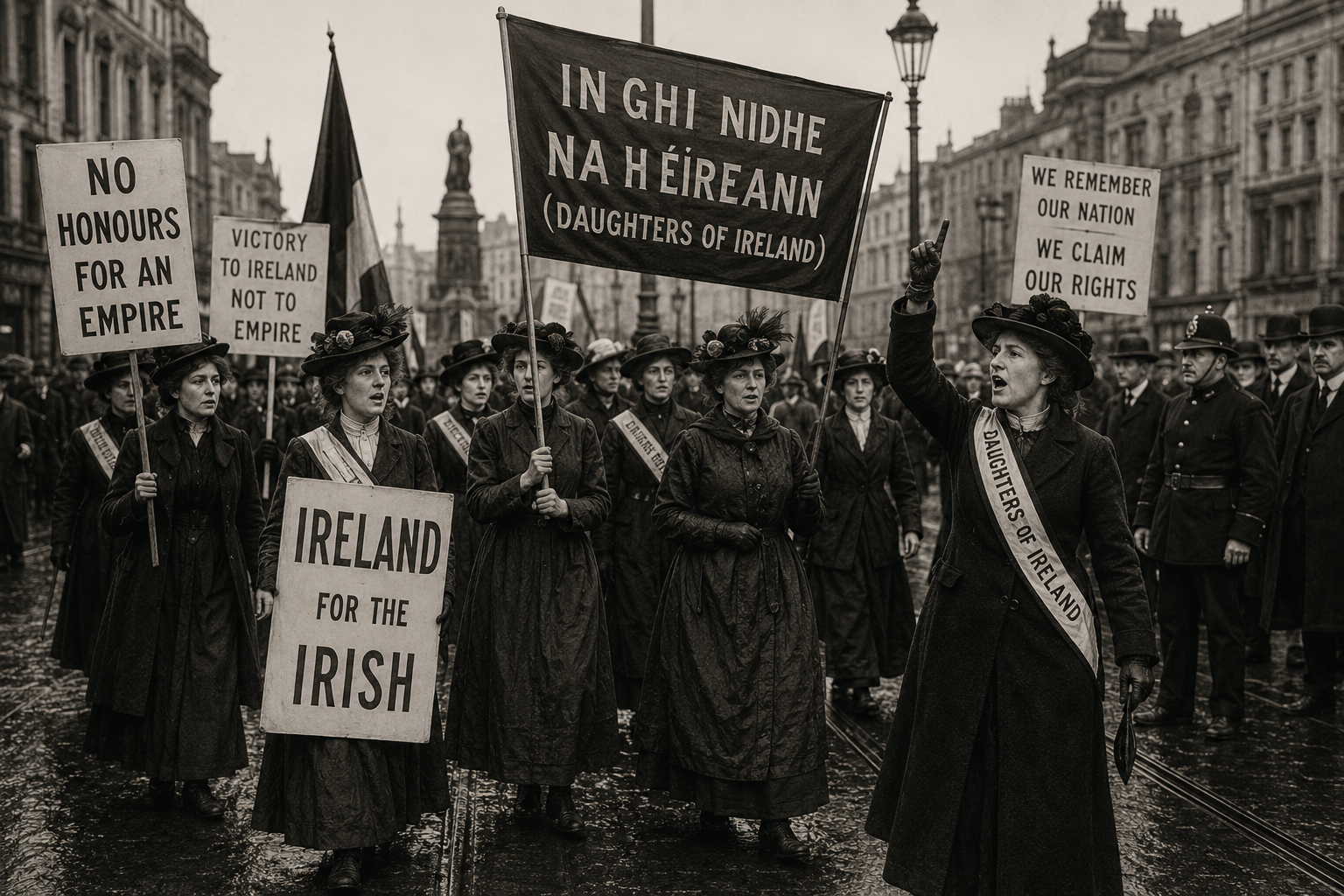
Women Protest
Read Article: Women ProtestWomen have assumed visible roles in the nationalist opposition surrounding Queen Victoria’s arrival in Dublin, moving beyond the customary tasks of collecting money or assisting male political organisers. Maud Gonne and other advanced nationalists have used meetings, public agitation and organised community work to challenge the royal ceremonies and the claim that they represent a united and loyal Ireland. Their involvement will be noted in Limerick, where women already sustain charitable societies, cultural associations, schools and nationalist activity but rarely receive formal recognition as political participants.
The demonstrations arise from opposition to the extensive decorations, loyal addresses, military displays and children’s celebrations arranged during the royal visit. Nationalist women argue that such pageantry conceals poverty, emigration and widespread dissatisfaction with government from Westminster. Gonne’s fierce attack upon the monarch, published as “The Famine Queen,” connects the splendour of the visit with memories of famine, eviction and population loss. Women involved in the campaign have helped circulate nationalist arguments, organise resistance and encourage families to withhold their children from ceremonies intended to associate education and public generosity with loyalty to the Crown.
Their activism extends beyond direct protest. A group of women meeting in the rooms of the Celtic Literary Society has begun organising a Patriotic Children’s Treat as an alternative to the official Phoenix Park celebration. The proposed event will require subscriptions, donated provisions, volunteer stewards and extensive practical organisation. By undertaking this work independently, the women demonstrate that nationalist opposition can provide food, recreation and education rather than merely condemn royal ceremony. The campaign gives women public responsibilities as fundraisers, speakers, organisers and political educators while making childhood itself part of the struggle over national identity.
Women’s participation also exposes limitations within the nationalist movement. They cannot vote in Westminster elections, sit in Parliament or exercise equal authority within most political organisations. Their labour is welcomed, but strategic decisions generally remain in male hands. Gonne and her colleagues are challenging that arrangement by acting publicly and organising in their own name. The activity surrounding the Queen’s visit is helping create the conditions for Inghinidhe na hÉireann, the Daughters of Ireland, an exclusively female organisation committed to complete independence, Irish culture, social reform and a larger civic role for women.
The significance for Limerick extends beyond the immediate royal visit. Local women working in homes, schools, shops, factories, religious societies and charities already possess the skills required for political organisation, though public authority seldom acknowledges them. The Dublin demonstrations suggest that women may bring those abilities directly into national debate and organised protest. Constitutional nationalists may consider the campaign too severe, while unionists will reject its hostility to the Crown. Nevertheless, women have become visible political actors rather than silent symbols, asserting their right to influence how Ireland defines loyalty, citizenship and national freedom.
- Maud Gonne, “The Famine Queen,” United Irishman, 3 April 1900, opposing Queen Victoria’s visit and linking royal ceremony with famine memory and British rule. Exact page and column should be confirmed before formal citation.
- United Irishman, Dublin, March–April 1900, reports and editorials concerning nationalist opposition, public demonstrations and the royal visit. Exact issue, page and column should be confirmed before formal citation.
- Dublin Castle and Dublin Metropolitan Police records concerning the policing of Queen Victoria’s visit and nationalist opposition, April 1900. Exact collection, file and folio should be confirmed before formal citation.
- Maud Gonne MacBride Papers, National Library of Ireland, records concerning opposition to the royal visit and the organisation of the Patriotic Children’s Treat. Exact manuscript number and folio should be confirmed before formal citation.
- Margaret Ward, Irish Nationalist Women, 1900–1918, Manchester: Manchester University Press, 1983; consult the discussion of women’s participation in demonstrations against Queen Victoria’s 1900 visit.
-
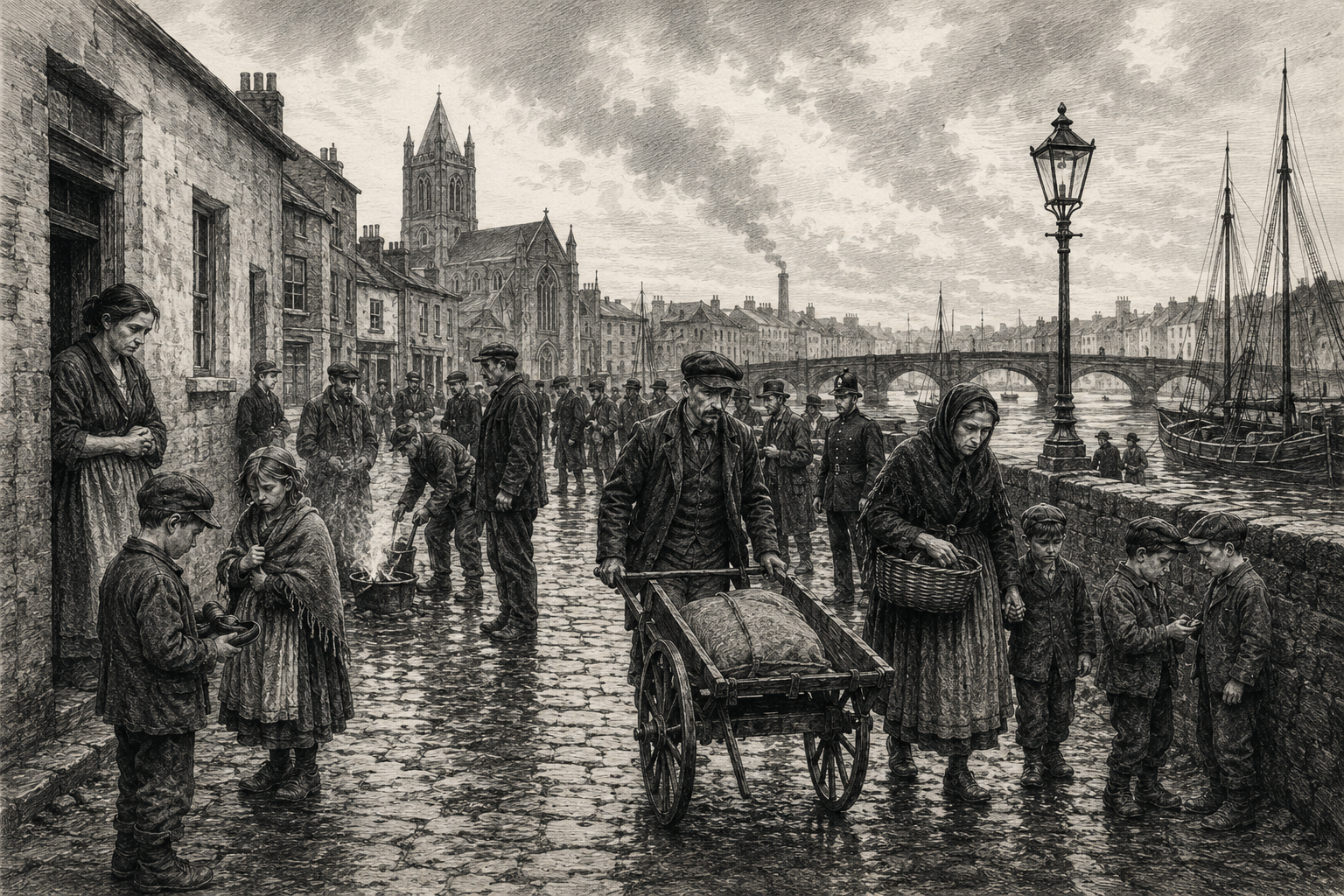
Cold Continuation
Read Article: Cold ContinuationJanuary came into Limerick without ceremony for most of the people who had to live through it. The arrival of a new century did not lift rent from a labourer’s door, provide sound boots for a schoolchild, warm a damp room, settle a shop debt, clear a fevered lane or make an uncertain wage secure. Across the city and county, families entered the year carrying the same burdens that had shaped the closing decades of the nineteenth century. Public celebration meant little where survival continued to depend upon bread, coal, credit, employment and the health of children.
The city awoke around its quays, bridges, churches, markets, barracks, schools, convents, courts, public houses and municipal offices. Traders opened their shutters, labourers searched for work, dockers watched the river and small shopkeepers calculated what could be sold before another bill became due. In poorer districts, overcrowded houses and damp rooms offered little protection against winter illness. Newspapers carried reports of political affairs and events overseas, but domestic attention remained fixed upon rent, food prices and the possibility that sickness or unemployment might unsettle an already fragile household.
Beyond the city, County Limerick entered January through roads, townlands, farms, market towns and scattered cottages shaped by land, weather and agricultural prices. Tenant farmers considered rents, livestock and the condition of winter fields, while labourers depended upon irregular employment and the willingness of local farmers to hire. Parish schools, police barracks, fairs and chapels connected rural communities, but distance and poor roads could leave families isolated during severe weather. The new century reached such households not as a dramatic beginning, but as another season requiring careful management of food, fuel, animals and money.
Public institutions continued their ordinary work. Limerick Corporation dealt with streets, sanitation, markets and local administration, while Poor Law guardians confronted sickness, poverty and dependence within the workhouse system. Schools received children whose ability to learn could be weakened by hunger, cold or inadequate clothing. Barracks and police stations reflected the continuing presence of British authority, while churches and charitable bodies attempted to relieve hardship that public provision often failed to address. Each institution recorded the city through minutes, notices and statistics, yet the full weight of poverty remained most visible inside homes.
For many people, January offered no sense of a clean historical beginning. The year’s first notices, accounts and newspaper editions appeared beside the same private arithmetic of survival that had governed December: how much coal remained, whether credit would be extended, whether work could be found and whether illness might be avoided. Limerick entered the twentieth century through continuity rather than transformation. Its people carried inherited pressures into the new year, measuring time not by ceremony but by wages, rent, bread, weather and the daily effort to preserve dignity.
- Census of Ireland, 1901, General Report and County and City Tables for Limerick, recording population, housing, occupations and household conditions. Exact table and page should be confirmed before formal citation.
- Thom’s Official Directory of the United Kingdom of Great Britain and Ireland, 1900 edition, entries for Limerick institutions, streets, public offices, businesses and civic administration. Exact pages should be confirmed before formal citation.
- Limerick Chronicle, January 1900, local reporting on municipal affairs, markets, weather, employment, public health and daily life. Exact issue, page and column should be confirmed before formal citation.
- Limerick Board of Guardians minutes and Poor Law records, January 1900, concerning poverty, workhouse administration, illness and relief. Exact volume, meeting date and archival reference should be confirmed before formal citation.
- Limerick Corporation minutes, January 1900, concerning streets, sanitation, markets, public health and municipal administration. Exact volume, meeting date and archival reference should be confirmed before formal citation.
-
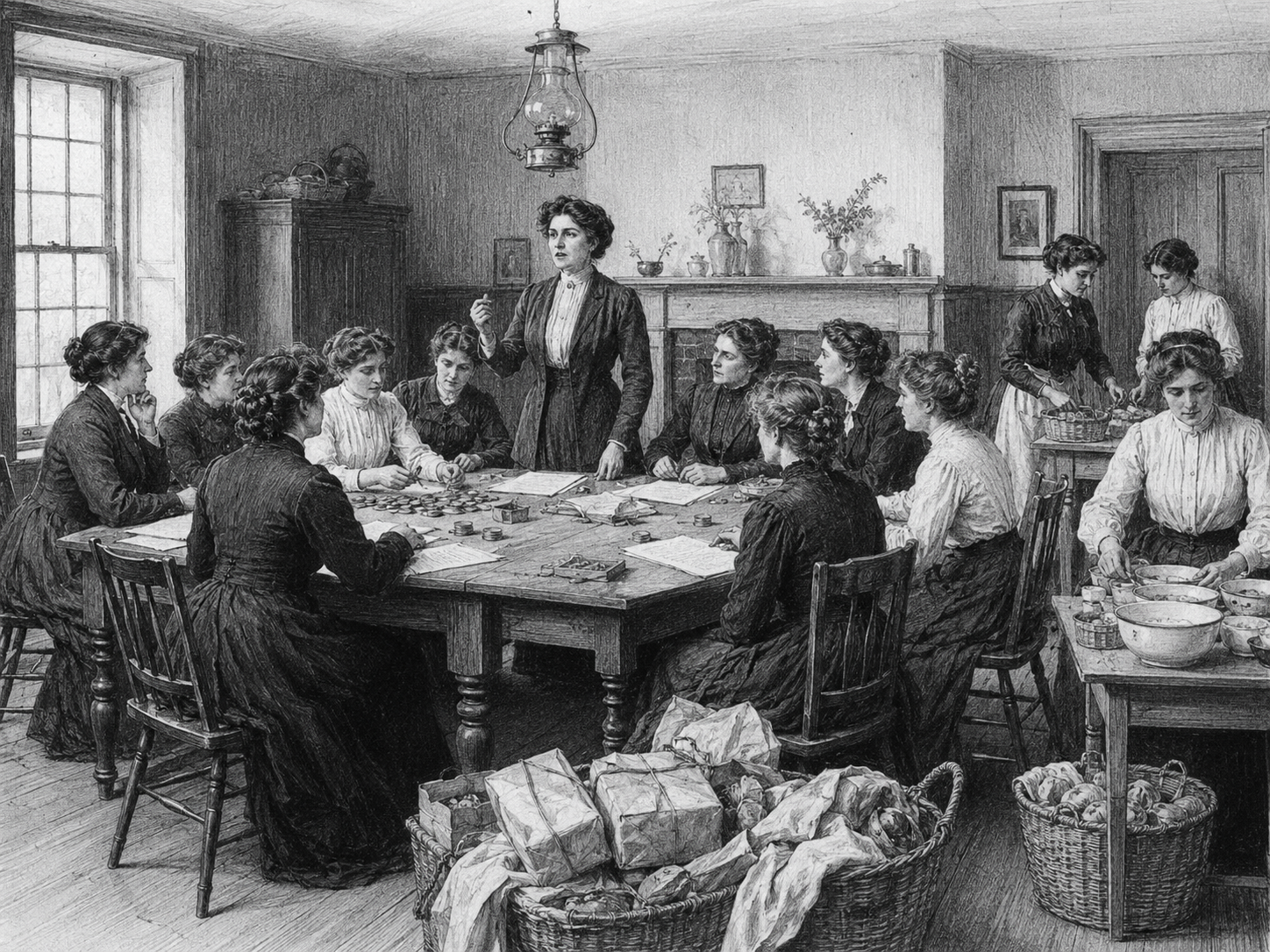
Women Participate
Read Article: Women ParticipateInghinidhe na hÉireann has declared that women must take an active part in Ireland’s political and civic life rather than remain auxiliaries to movements led entirely by men. Established under Maud Gonne’s leadership, the organisation gives women responsibility for deciding policy, addressing meetings, raising funds and arranging public campaigns. Its exclusively female membership provides a political space in which women may develop confidence and organisational experience despite their exclusion from parliamentary elections. The Daughters of Ireland therefore challenges British rule while also questioning conventions that restrict women’s influence within nationalism, local affairs and public debate.
Members intend to participate through education, cultural activity, social relief and political mobilisation. They will organise lectures, language classes, dramatic performances, commemorations and children’s events while encouraging Irish manufacture and complete national independence. Such work places women before audiences as teachers, organisers and speakers rather than as decorative symbols of the nation. The National Library of Ireland describes the organisation’s programme as political, social and feminist, noting its support for women’s suffrage alongside independence and school meals. Its activities helped transform private labour and community service into recognised forms of public action.
Women remain unable to vote in Westminster elections or sit in Parliament, while many nationalist associations offer them only subordinate duties. Inghinidhe na hÉireann rejects those limitations by creating offices, committees and campaigns controlled by women themselves. Its members may determine priorities, publish political arguments and train younger activists without awaiting permission from male parliamentary leaders. Historian Margaret Ward identifies the organisation as the only explicitly nationalist and feminist body in early twentieth-century Ireland. Its emergence marks a significant advance from women being represented symbolically as Ireland towards women acting as practical participants in the struggle over Ireland’s future.
The organisation’s civic work extends beyond speeches and constitutional demands. Its members plan charitable, educational and cultural undertakings that bring them into direct contact with poor families, schoolchildren, workers and local communities. Organising meals, classes and public gatherings requires negotiation, bookkeeping, fundraising and the management of volunteers. These responsibilities provide political training while demonstrating that citizenship includes practical service. The women are not waiting for formal voting rights before contributing to public life. Instead, they are building experience through activities that expose social need, encourage collective action and make female leadership visible within communities usually governed by male officials.
For women in Limerick, the development offers a model of participation suited to existing local experience. Women already manage households, teach children, operate businesses, labour in factories, support charities and sustain religious and cultural associations, yet their authority seldom receives political recognition. The Daughters of Ireland suggests that these skills may be brought directly into national organisation and civic debate. Not every woman will share its separatist programme, but its example challenges the belief that public affairs properly belong to men. By organising independently, its members claim a voice in defining Ireland and in deciding how political freedom should affect the lives of its people.
- Maud Gonne MacBride, writings on the history, activities and aims of Inghinidhe na hÉireann, Maud Gonne MacBride Papers, National Library of Ireland, MS 49,531/19.
- Inghinidhe na hÉireann, early rules, objectives, membership records and annual reports, Maud Gonne MacBride Papers, National Library of Ireland. Exact manuscript numbers and folios should be confirmed before formal citation.
- Helena Molony, Bureau of Military History Witness Statement No. 391, recollections concerning women’s organisation and political activity within Inghinidhe na hÉireann. Exact page should be confirmed before formal citation.
- Bean na hÉireann, Dublin, 1908–1911, articles concerning women’s suffrage, nationalist politics, social reform and female civic participation. Exact issue, page and column should be confirmed before formal citation.
- Margaret Ward, Irish Nationalist Women, 1900–1918, Manchester: Manchester University Press, 1983; consult the chapter “Daughters of Ireland”.
-
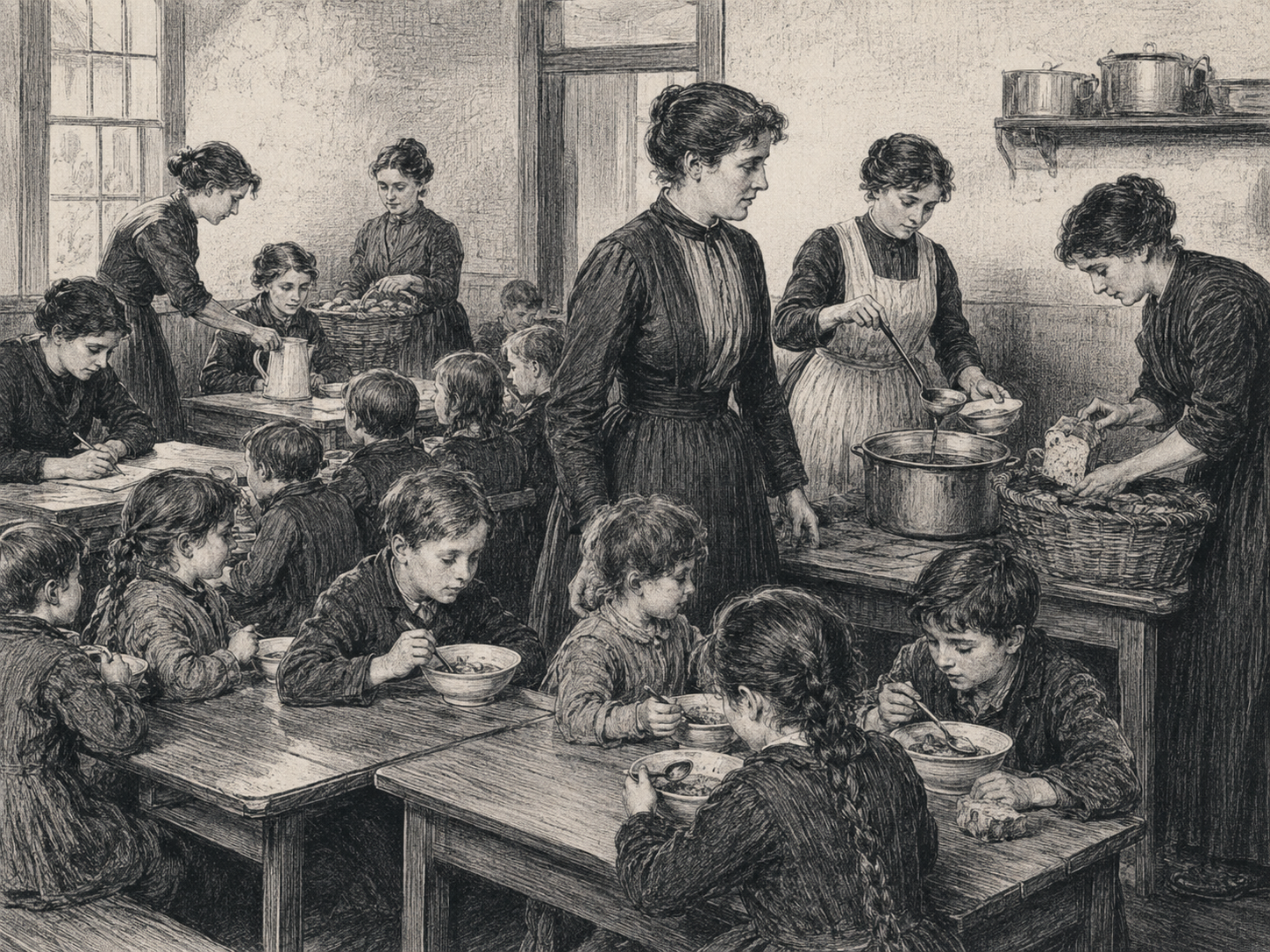
Children Fed
Read Article: Children FedInghinidhe na hÉireann has linked its demand for national independence with practical concern for poor children, arguing that political freedom must include protection from hunger, neglect and unequal education. Members of the women’s organisation have drawn attention to children arriving at school without adequate food and have pressed for organised meals in the poorest districts of Dublin. Their campaign places social welfare beside language, culture and sovereignty. For the Daughters of Ireland, a nation claiming the right to govern itself must also demonstrate that it can care for children whose health and education are damaged by poverty.
Maud Gonne’s interest in school meals developed from direct encounters with hungry children in Dublin. Inghinidhe na hÉireann established a school dinner committee and helped provide nourishing meals in impoverished districts, while also pressing Dublin Corporation and other authorities to accept greater responsibility. Hot stew, vegetables, milk and other simple food could determine whether a child remained attentive in class or struggled through the day weakened by hunger. The women treated malnutrition not as an individual moral failing but as a public problem requiring organisation, funding and political pressure from those willing to confront the conditions of urban poverty.
The campaign broadened the meaning of nationalist work. Irish independence was not presented solely as the transfer of authority from Westminster to an Irish government, but as a means of improving ordinary life. Children living in overcrowded rooms, attending school hungry or leaving education early could not be expected to benefit from cultural revival alone. The organisation therefore combined Irish-language classes, patriotic education and social assistance. Its members believed that national dignity required practical service, particularly where official institutions had failed. Feeding children became both humanitarian relief and a declaration that the Irish nation should assume responsibility for its most vulnerable members.
Women carried much of the daily labour behind the scheme. They raised subscriptions, purchased provisions, arranged cooking, distributed meals and collected evidence of need. This work gave female nationalists experience in administration and public campaigning while challenging the belief that politics belonged only to parliamentarians and councillors. Helena Molony and other members later became closely associated with the school meals campaign, pressing for meals of genuine nutritional value rather than token charity. Their activism connected women’s political organisation with labour conditions, housing, childhood health and educational opportunity, helping to make social reform part of advanced-nationalist discussion.
The campaign will be understood in Limerick, where poor families also face irregular wages, overcrowding and the difficulty of sending children to school properly fed. Teachers, charitable workers and parents know that hunger enters the classroom before lessons begin. Inghinidhe na hÉireann’s work suggests that national independence must be measured not only by flags, speeches or constitutional change, but by whether children are healthier, better educated and treated with dignity. Its members have placed a demanding principle before the nationalist movement: a free Ireland must be capable of feeding its children as well as celebrating its history.
- Helena Molony, Bureau of Military History Witness Statement No. 391, recollections concerning Inghinidhe na hÉireann, poor children and the school meals campaign.
- Bean na hÉireann, October 1910, articles concerning hungry schoolchildren, school dinners and the responsibility of public authorities. Exact page and column should be confirmed before formal citation.
- Maud Gonne MacBride Papers, National Library of Ireland, records concerning Inghinidhe na hÉireann’s social, educational and children’s activities. Exact manuscript number and folio should be confirmed before formal citation.
- Dublin Corporation records concerning school meals, poor children and municipal responsibility during the early twentieth century, Dublin City Archives. Exact volume, committee and meeting entry should be confirmed before formal citation.
- Margaret Ward, Irish Nationalist Women, 1900–1918, Manchester: Manchester University Press, 1983; consult the discussion of Inghinidhe na hÉireann, social welfare and school meals.
-
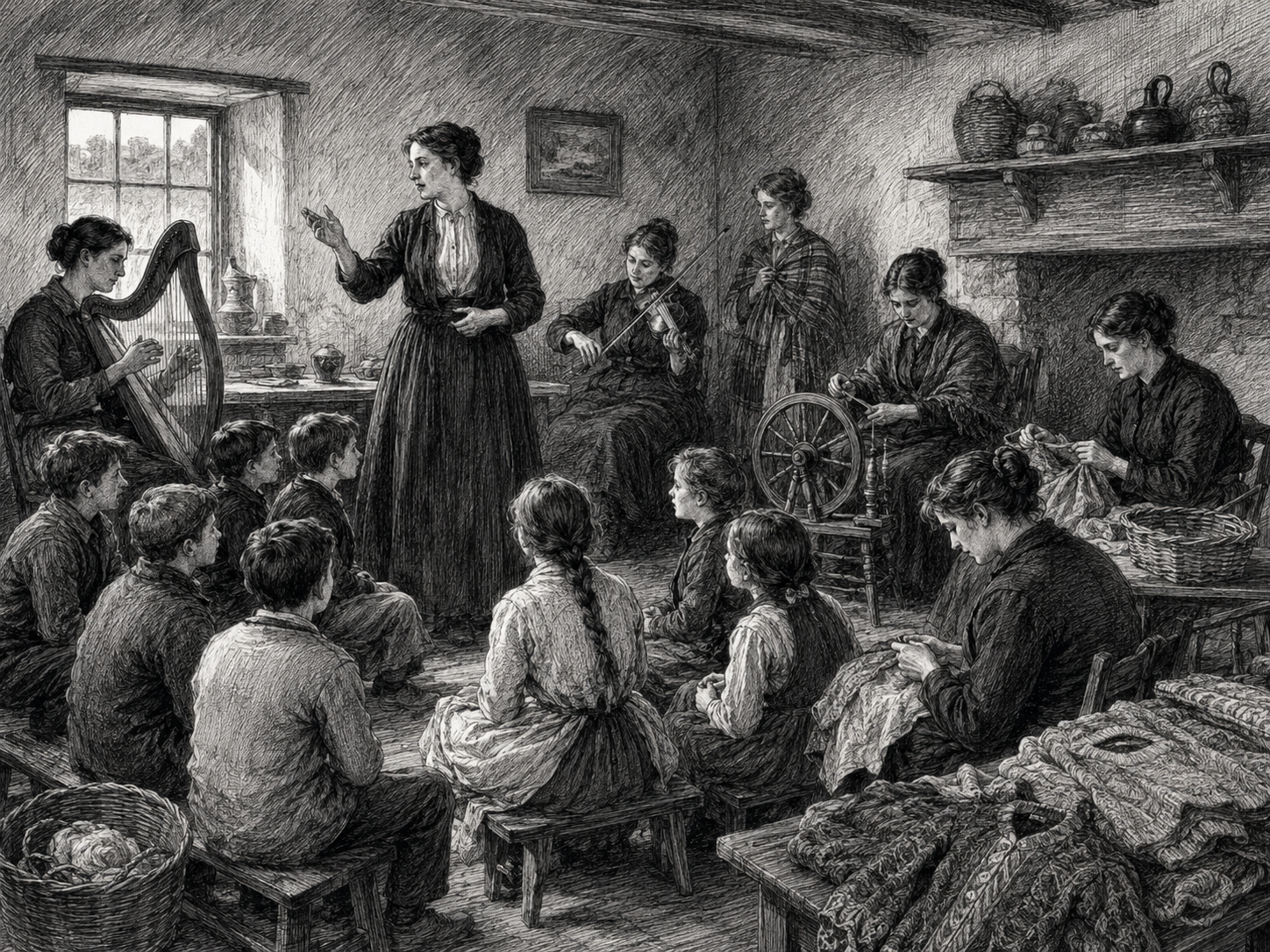
Culture Revived
Read Article: Culture RevivedInghinidhe na hÉireann has placed the Irish language, national culture and economic self-reliance at the centre of its programme for complete independence. Established under Maud Gonne’s leadership, the women’s organisation argues that political freedom cannot be secured by parliamentary action alone while Irish people continue to neglect their own language, history, literature and industries. Members intend to cultivate national confidence through education and practical organisation, especially among children. Their approach joins separatist politics with everyday choices concerning speech, reading, entertainment and household spending, giving women a direct role in shaping the cultural foundations upon which an independent Ireland might eventually stand.
The organisation proposes classes in Irish language, history, literature, music and art, with particular attention given to younger people. Members believe generations educated principally through English institutions have been separated from important parts of Ireland’s inherited culture. Public lectures, dramatic performances, historical commemorations and children’s gatherings will therefore be used to make national learning accessible beyond formal schools. These activities resemble aspects of the Gaelic revival but carry a more openly political purpose. For the Daughters of Ireland, recovering the language and cultural memory is not antiquarian work. It is a means of weakening dependence upon Britain and strengthening belief in Ireland’s capacity to govern itself.
Irish theatre, music and storytelling will also form part of the movement’s cultural campaign. Members plan to encourage plays based upon Irish history and legend, promote Irish songs and challenge entertainments they consider degrading or excessively imitative of English popular culture. Their performances will allow women to write, act, organise and speak before audiences at a time when most formal political platforms remain controlled by men. The organisation’s cultural work may appear less confrontational than street protest, yet its leaders regard it as equally important. A population familiar with Irish achievement, they argue, will be less likely to accept political inferiority or dismiss independence as impractical.
Economic self-reliance provides another important element of the programme. Inghinidhe na hÉireann intends to support and popularise Irish manufactures, encouraging households to purchase goods produced by Irish workers whenever possible. This policy connects national independence with employment, trade and consumer choice. Money spent upon imported products is viewed as strengthening outside industries while Irish craftspeople, dressmakers and manufacturers struggle for markets. Women exercise considerable influence over household purchases, clothing and provisions, giving them practical power within such a campaign. Supporting Irish goods therefore becomes both an economic measure and a daily expression of national commitment rather than a principle confined to public speeches.
The programme may carry particular relevance in Limerick, where language revival, local manufacture, employment and cultural identity touch city and county life directly. Teachers, shopkeepers, craftspeople, musicians, writers and mothers could all participate without waiting for parliamentary permission or membership in male political organisations. Constitutional nationalists may question the separatist purpose behind these activities, while unionists will reject attempts to portray British cultural influence as harmful. Nevertheless, the Daughters of Ireland has defined national freedom broadly. Independence, in its view, requires political authority, cultural confidence and the practical habit of supporting Irish work, Irish learning and Irish creativity within ordinary life.
- Inghinidhe na hÉireann, early rules, stated objectives, membership records and annual reports, Maud Gonne MacBride Papers, National Library of Ireland, including MS 49,531/33. Exact folios should be confirmed before formal citation.
- Máire Ní Chinnéide O’Brolcháin, Bureau of Military History Witness Statement No. 321, describing the foundation and early work of Inghinidhe na hÉireann.
- Maud Gonne MacBride, Bureau of Military History Witness Statement No. 317, recollections concerning the organisation, its members and nationalist activities.
- Bean na hÉireann, Dublin, 1908–1911, articles promoting Irish language, culture, children’s education and Irish manufacture. Exact issue, page and column should be confirmed before formal citation.
- Margaret Ward, Irish Nationalist Women, 1900–1918, Manchester: Manchester University Press, 1983; consult the chapter concerning the cultural, educational and economic programme of the Daughters of Ireland.