-
Pery Foundations
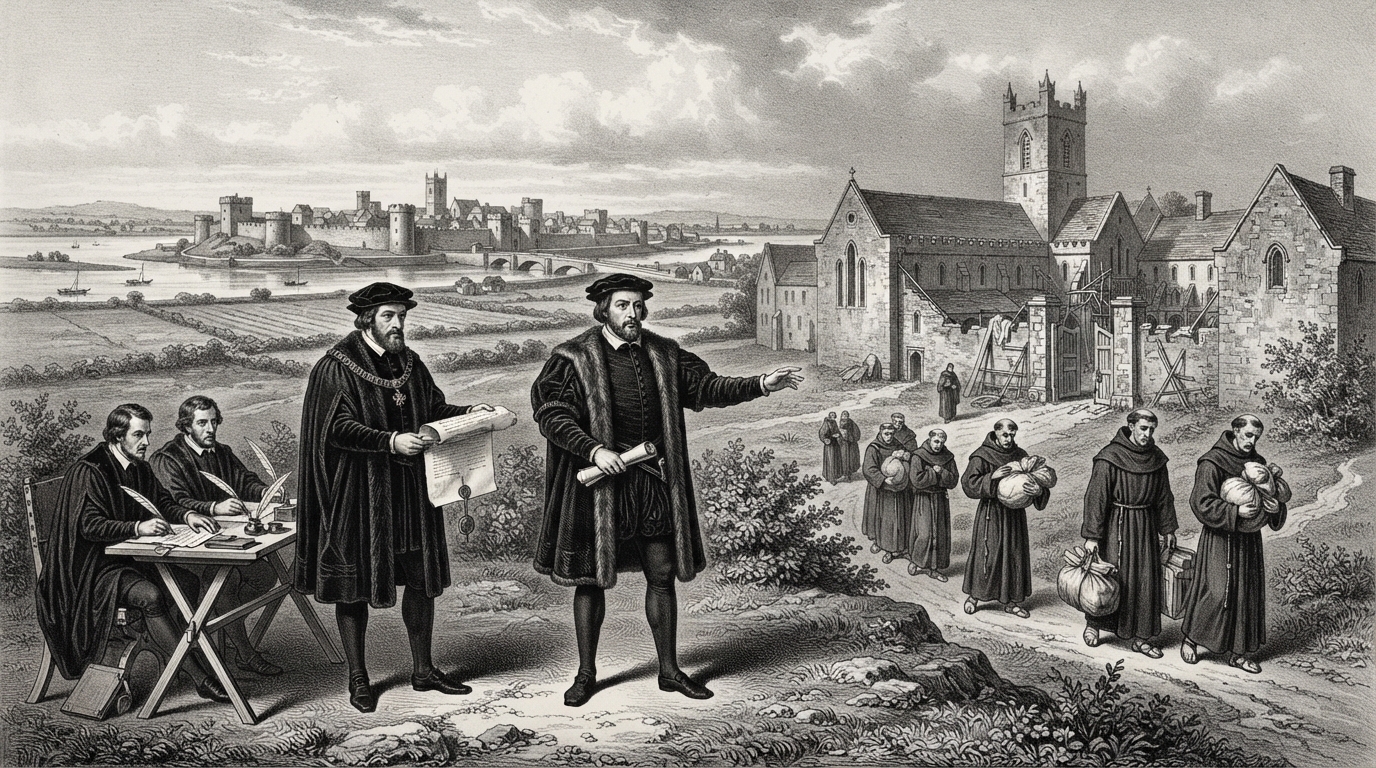
Read Article: Pery FoundationsThe Pery family’s rise in Limerick began not with the Georgian streets that later carried its name, but with land accumulated during the Tudor dissolution of Ireland’s religious houses. William Pery, who died in Limerick around 1635, appears to have been the first member of the family to settle permanently in Ireland. The more consequential ancestor, however, was Edmond Sexten, mayor of Limerick in 1535. Through political skill, royal service and his relationship with the English court, Sexten obtained property that would remain within his descendants’ inheritance and eventually shape the physical expansion of Limerick city.
Sexten belonged to a family already established in Thomond, but his advancement depended upon his usefulness to Henry VIII’s government. Appointed Sewer of the Chamber, he became one of the Crown’s principal local agents during the dissolution of monasteries and friaries in Munster. The policy transferred religious property into royal hands before granting or selling much of it to individuals whose loyalty could strengthen English authority. Sexten’s role placed him at the meeting point of local ambition, religious upheaval and Tudor administration. The property he acquired gave his family influence extending far beyond the mayoralty he held in Limerick.
In 1538, Henry VIII granted Sexten the lands and privileges belonging to the dissolved Franciscan friary commonly known as St Francis’s Abbey. Its property stood outside Limerick’s walls and formed part of the county rather than the tightly enclosed medieval city. Five years later, Sexten received possessions formerly belonging to the religious house of the Blessed Virgin Mary. St Mary’s property included land within Englishtown, but much of its estate lay farther south. Known as the South Prior’s Land, this extensive tract would become one of the most historically significant inheritances in the development of modern Limerick.
The grants represented more than a change of ownership. Monastic estates had supported religious communities, tenants, workers, charitable activity and patterns of worship established over centuries. Their dissolution redirected land, rents and privileges towards families aligned with the Tudor state. Through marriage and inheritance, the Sexten property eventually became associated with the Pery family. What began as a sixteenth-century redistribution of church land therefore continued to influence Limerick’s social hierarchy and urban geography long after the friaries had disappeared. The origins of later Georgian wealth were rooted in a turbulent period of religious suppression, political loyalty and private acquisition.
From 1769, Edmund Sexton Pery used the South Prior’s Land to begin developing the planned Georgian district that became Newtown Pery. Engineer Christopher Colles prepared a grid of broad streets and regular plots beyond the older city, allowing Limerick to expand southwards from its medieval boundaries. Streets later associated with the Pery family transformed former religious property into a commercial and residential centre. The surviving Georgian quarter therefore preserves a visible connection between Tudor confiscation and eighteenth-century urban ambition. Beneath its ordered terraces lies the much older history of dissolved religious houses, Edmond Sexten’s royal grants and the inheritance carried into the Pery estate.
- National Library of Ireland, The Limerick Papers, Collection List No. 121, introduction and family history of the Pery family, Earls of Limerick.
- National Library of Ireland, Manuscript 41,673/8–12, records concerning royal grants to Edmond Sexten of the dissolved properties of St Francis’s Abbey and St Mary’s religious house in Limerick.
- University of Limerick, Special Collections and Archives, Pery Family Archive, records concerning Edmond Sexten, the Pery inheritance and estates in Limerick city and county.
- Tudor Crown grants and enrolments from the reign of Henry VIII concerning dissolved religious property in Limerick and Munster.
- Limerick local authority historical records concerning Edmund Sexton Pery, Christopher Colles and the planning and development of Newtown Pery from 1769.
-
Statistician Dies
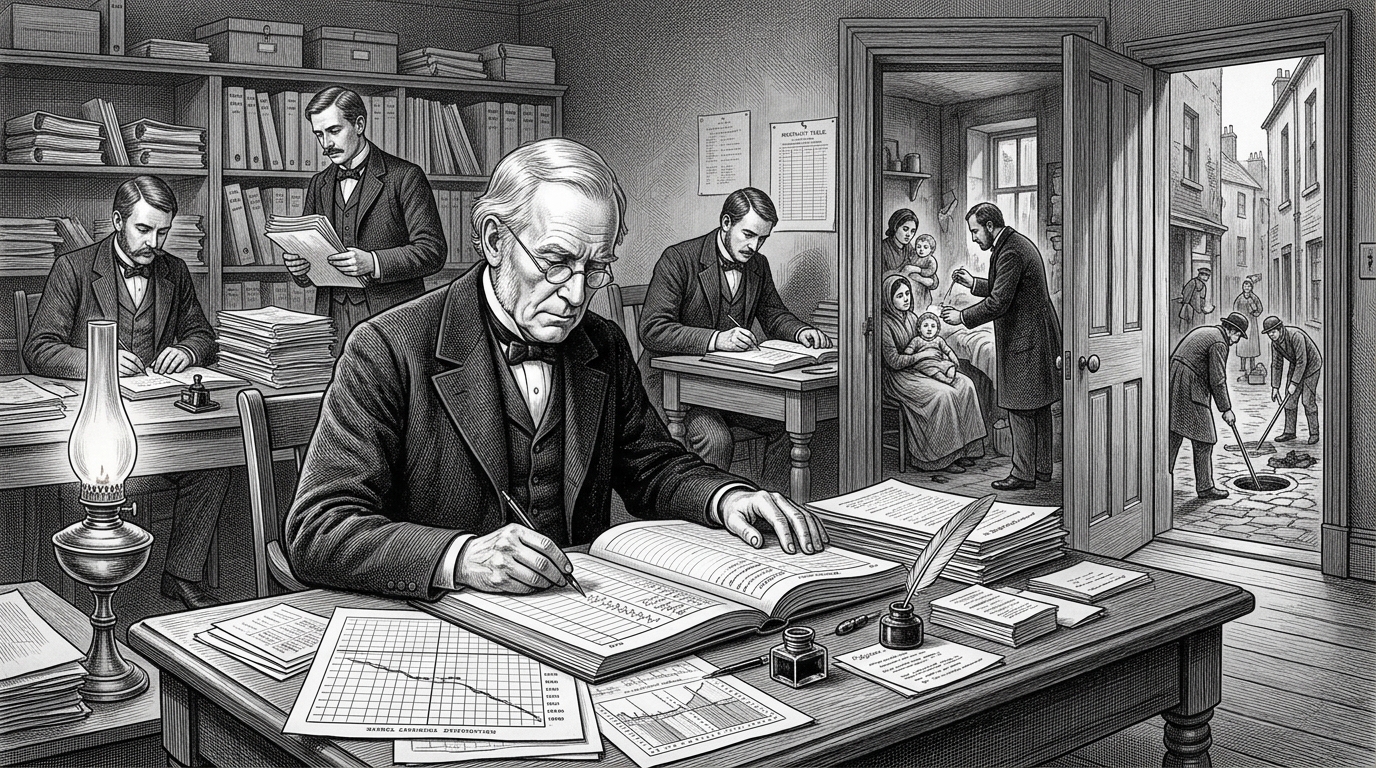
Read Article: Statistician DiesThomas Wrigley Grimshaw, physician, public-health reformer and former registrar-general for Ireland, died at his residence in Carrickmines, County Dublin, on 23 January. Born near Belfast in 1839, he had spent much of his professional life examining the relationship between disease, poverty, housing and mortality. His death removed one of the country’s most influential medical statisticians at a time when Irish towns still faced recurring epidemics, tuberculosis, overcrowding and poor sanitation. Grimshaw believed that accurate records of births, deaths and illnesses could reveal conditions that anecdote, prejudice and political argument often concealed.
Educated at Trinity College Dublin and trained in several leading hospitals, Grimshaw worked as a physician, lecturer and medical administrator before his appointment as registrar-general in 1879. That office collected and analysed Ireland’s civil registration records, producing annual reports on marriages, births, deaths and causes of mortality. Grimshaw used these figures to compare regions, identify patterns of disease and demonstrate the human consequences of inadequate housing and public sanitation. He became particularly concerned with infectious illnesses and chronic pulmonary disease, arguing that reliable statistics were essential for understanding the health of communities and directing effective public action.
His work carried direct relevance for Limerick, where municipal authorities, doctors, Poor Law officials and charitable organisations confronted overcrowded housing, contaminated water, fever and high levels of poverty. The registrar-general’s reports supplied national and local figures through which Limerick’s mortality could be compared with that of other Irish towns. Such records did not cure disease, but they made suffering harder to dismiss as isolated misfortune. For families living in congested courts and lanes, the patterns documented by Grimshaw reflected everyday realities: children lost to illness, adults weakened by tuberculosis and households repeatedly disrupted by fever and insecure employment.
Grimshaw also participated in organisations concerned with sanitary reform, social inquiry and improved housing. He helped establish the Dublin Sanitary Association and supported efforts to provide healthier accommodation for working families. His interests extended beyond immediate medical treatment towards the environmental causes of disease, including ventilation, drainage, water supply and the density of urban dwellings. In public lectures and statistical studies, he treated health as a social condition shaped by employment, housing and administration. His approach encouraged officials to regard preventable illness not merely as a private tragedy but as evidence of wider failures requiring coordinated civic action.
During his career, Grimshaw served as president of the Statistical and Social Inquiry Society of Ireland and later as president of the Royal College of Physicians of Ireland. He produced extensive analyses of Irish population, agriculture, trade, taxation and mortality, demonstrating that public health could not be separated from economic and social conditions. His reports remain valuable records of late-nineteenth-century Ireland, preserving evidence about communities whose experiences were rarely described in personal memoirs. Grimshaw’s death at Carrickmines ended more than two decades of national statistical service, but the methods he advanced continued to influence how Irish disease, poverty and urban life were measured.
- Thirty-sixth Detailed Annual Report of the Registrar-General for Ireland, containing abstracts of marriages, births and deaths registered during 1899, Parliamentary Papers, 1900.
- Thomas Wrigley Grimshaw, “A Statistical Survey of Ireland, from 1840 to 1888,” Journal of the Statistical and Social Inquiry Society of Ireland, volume IX, 1888–1889, pages 321–361.
- Thomas Wrigley Grimshaw, annual reports and statistical analyses issued by the General Register Office for Ireland during his tenure as registrar-general, 1879–1900.
- Royal College of Physicians of Ireland, presidential and biographical records concerning Thomas Wrigley Grimshaw.
- Caoimhghín S. Breathnach and John B. Moynihan, “Thomas Wrigley Grimshaw (1839–1900): Registrar General 1879–1900,” Ulster Medical Journal, volume 78, number 1, January 2009, pages 43–50.
-
Painter Born
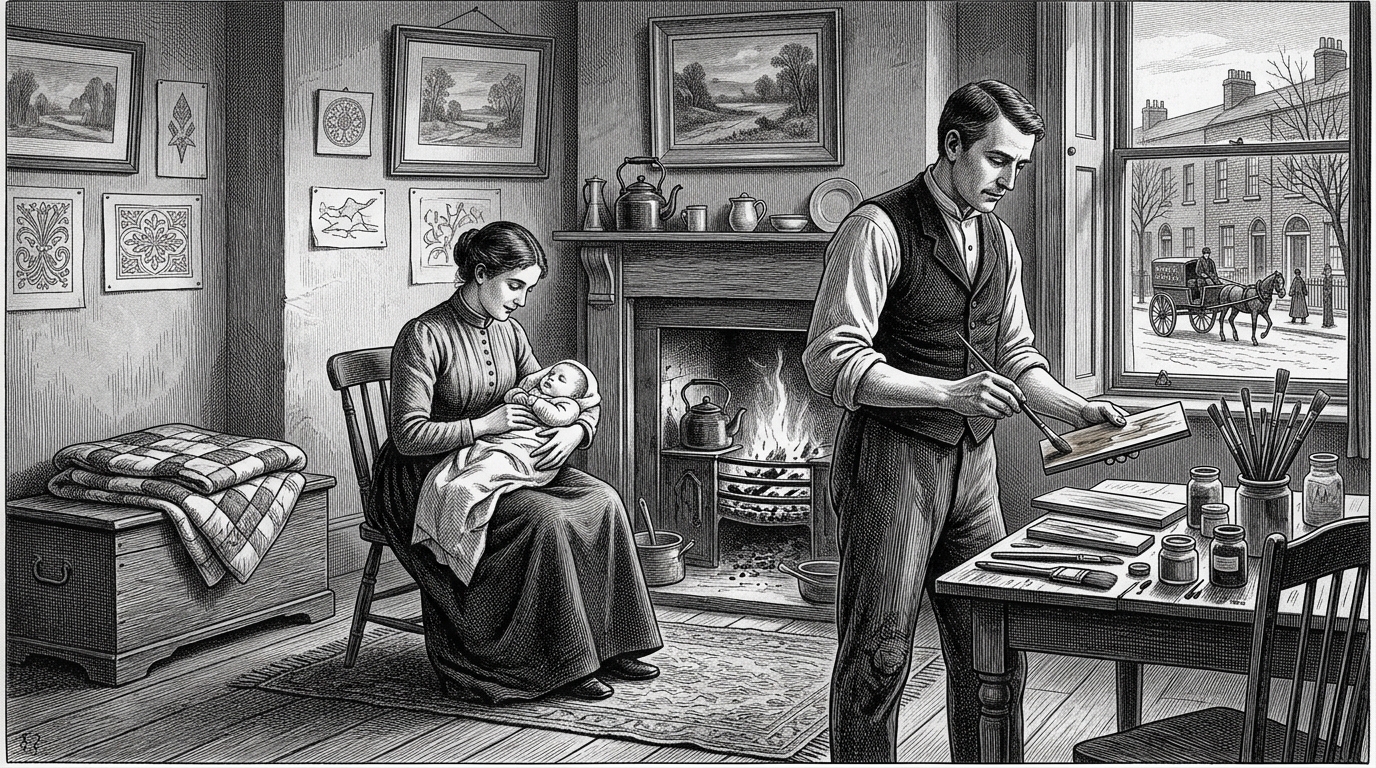
Read Article: Painter BornMaurice Joseph MacGonigal was born in Ranelagh, Dublin, on 22 January 1900, the only son and third child of Francis MacGonigal and Caroline Lane. His father was a painter and decorator from County Sligo, while his mother belonged to a family already connected with Irish craftsmanship and art. Growing up within that environment exposed him to colour, design and skilled manual work long before he entered formal training. The child born in suburban Dublin would eventually become an influential painter, teacher and administrator whose landscapes, portraits and scenes of Irish life secured him a prominent place in twentieth-century Irish art.
MacGonigal attended Synge Street Christian Brothers’ School before beginning an apprenticeship in 1915 at the stained-glass workshop of his maternal uncle, Joshua Clarke. There he worked alongside his cousin Harry Clarke, whose richly detailed windows and illustrations became internationally admired. The workshop gave MacGonigal practical experience in drawing, decorative composition, colour and the careful preparation required for stained glass. He also attended evening classes at the Dublin Metropolitan School of Art. Although he later concentrated upon painting, these early years established the discipline and technical control that remained visible throughout his work as an artist and teacher.
His youth was also shaped by Ireland’s revolutionary struggle. MacGonigal joined Na Fianna Éireann, served as a dispatch rider during the War of Independence and was interned in Kilmainham Gaol and Ballykinlar Camp. After his release in 1921, he withdrew from republican organisations and devoted himself more fully to art. A Taylor Scholarship enabled him to study as a day student from 1923 under painters including Seán Keating, Patrick Tuohy and James Sleator. Visits to the Aran Islands and the west of Ireland deepened his interest in coastal landscapes, fishing communities and the hard physical character of rural life.
MacGonigal began exhibiting with the Royal Hibernian Academy in the 1920s and later became one of its central figures. He was elected an associate, advanced to full membership and served as the Academy’s president from 1962 until 1977. His long teaching career at the National College of Art allowed him to influence generations of Irish students while defending a disciplined figurative tradition. He produced landscapes, portraits, murals, illustrations and theatrical designs, often concentrating upon western scenery and working communities. His art combined academic training with close observation, preserving places and occupations undergoing profound social and economic change.
Limerick retains an important connection with MacGonigal through works held by Limerick City Gallery of Art, including a self-portrait and the large group painting Studio Interior. These paintings allow local audiences to encounter both the artist himself and the educational world in which he taught. His landscapes have also appeared in exhibitions drawn from the Gallery’s permanent collection, placing his work within Limerick’s continuing presentation of modern Irish art. MacGonigal died in Dublin in 1979, but the works preserved in Pery Square ensure that his artistic legacy remains visible to generations of Limerick visitors, students and painters.
- Lawrence William White and Carmel Doyle, “MacGonigal, Maurice Joseph,” Dictionary of Irish Biography, Royal Irish Academy, biographical account of his birth, family, education, revolutionary activity and artistic career.
- Royal Hibernian Academy, membership, exhibition and presidential records concerning Maurice MacGonigal, including his service as president from 1962 to 1977.
- National College of Art and Design, student and teaching records relating to MacGonigal’s artistic education and subsequent career as a professor.
- Hugh Lane Gallery, collection and curatorial records for Maurice MacGonigal, including biographical material and paintings associated with his career.
- Limerick City Gallery of Art, permanent collection and exhibition records for Maurice MacGonigal, including his self-portrait, Studio Interior and landscapes exhibited from the municipal collection.
-
Broadcast Pioneer
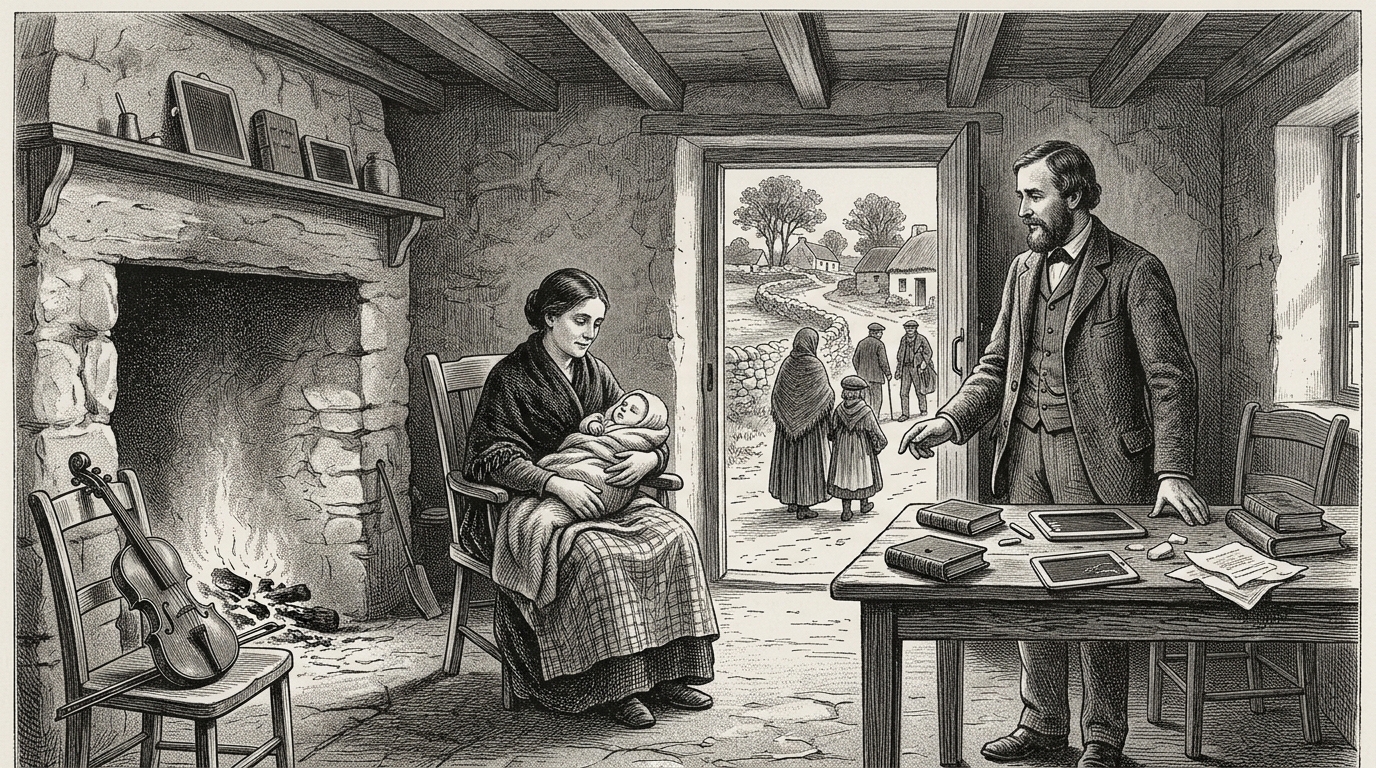
Read Article: Broadcast PioneerSéamus “Clan” Clandillon was born near Gort, County Galway, on 6 June 1878 into a household closely connected with education. His father, William A. Clandillon, was a national school teacher, while his mother, Joanna Little, also came from a family shaped by work, migration and service. The countryside surrounding Gort preserved a strong inheritance of Irish-language speech, traditional singing and local storytelling. These influences entered Clandillon’s life early and later guided his work as a teacher, musician, civil servant and broadcaster. The child born in rural Galway would eventually help determine how the newly independent state presented Irish culture through radio.
Clandillon attended St Flannan’s College in Ennis before entering university in Dublin during the closing years of the nineteenth century. His education brought him into contact with students and teachers involved in the Gaelic revival, which sought to preserve and restore the Irish language after generations of decline. He became fluent in Irish, joined the Gaelic League and developed a reputation as a singer and pianist. Clandillon did not regard traditional music as a decorative remnant of the past. He believed that Irish songs contained language, memory and emotional experience capable of strengthening national identity within a rapidly changing society.
His musical interests were shared by Máighréad Ní Annagáin, whom he later married. Together they collected, arranged and published traditional Irish songs, drawing attention to melodies and lyrics that might otherwise have disappeared. Their work required travel, careful listening and cooperation with singers who had learned music through oral transmission rather than printed notation. Clandillon’s knowledge of regional performance styles later distinguished him from administrators who approached Irish culture chiefly through official policy. He understood that traditional music depended upon individual voices, local communities and subtle variations that could not easily be reproduced by formal choirs or standardised arrangements.
Clandillon combined his cultural interests with careers in teaching and the civil service. He worked in educational institutions before entering government employment and continued performing at cultural gatherings throughout Ireland and Britain. His experience as a singer, organiser and Irish-language advocate eventually brought him to the attention of those planning the new national radio service. In 1925 he was appointed the first director of broadcasting at 2RN. When the station began transmitting on 1 January 1926, Clandillon was responsible for shaping programmes within severe financial and technical limits while trying to serve listeners whose expectations of radio were only beginning to form.
As broadcasting director, Clandillon promoted Irish-language speech, traditional music, public ceremonies, sport and national cultural life. He persuaded Douglas Hyde to deliver the address that opened the station and sought to make radio a meeting place for Gaelic culture across Ireland and neighbouring Celtic regions. His decisions were sometimes criticised, yet his influence upon the early character of Irish broadcasting was considerable. The child born near Gort entered a world without electronic broadcasting, recorded sound in most homes or a politically independent Irish state. By adulthood, he had helped place traditional voices and music at the centre of a new national medium.
- Shaun Boylan and Lesa Ní Mhunghaile, “Clandillon, Seamus (‘Clan’),” Dictionary of Irish Biography, Royal Irish Academy, recording his birth near Gort, County Galway, on 6 June 1878 and outlining his career in music, public service and broadcasting.
- General Register Office, Ireland, civil birth registration for Séamus Clandillon, County Galway, 1878.
- RTÉ Archives, “Séamus Clandillon, 2RN First Director of Broadcasting 1925,” biographical and broadcasting records concerning his appointment and the establishment of Irish radio.
- Séamus Clandillon and Máighréad Ní Annagáin, An Londubh: Dhá Amhrán Déag, Dublin, 1904, collection of traditional Irish songs.
- Nicholas Carolan, “From 2RN to International Meta-Community: Irish National Radio and Traditional Music,” Journal of Music in Ireland, examining Clandillon’s cultural policy and commitment to traditional music.
-
Champion Born
Read Article: Champion BornJoseph Francis Devlin, later known throughout international badminton as Frank Devlin, was born at 11 Wellington Place in Dublin on 19 January. He was the son of Joseph Edmund Devlin, a government official, and his wife, Elizabeth. Nothing surrounding the arrival of the child suggested that he would become one of the most successful competitors in the history of his sport. Badminton remained largely associated with private clubs, schools and middle-class recreation, but the game was developing rapidly. Devlin’s extraordinary ability would eventually carry an Irish player from domestic competition to sustained success at the most prestigious championship in the badminton world.
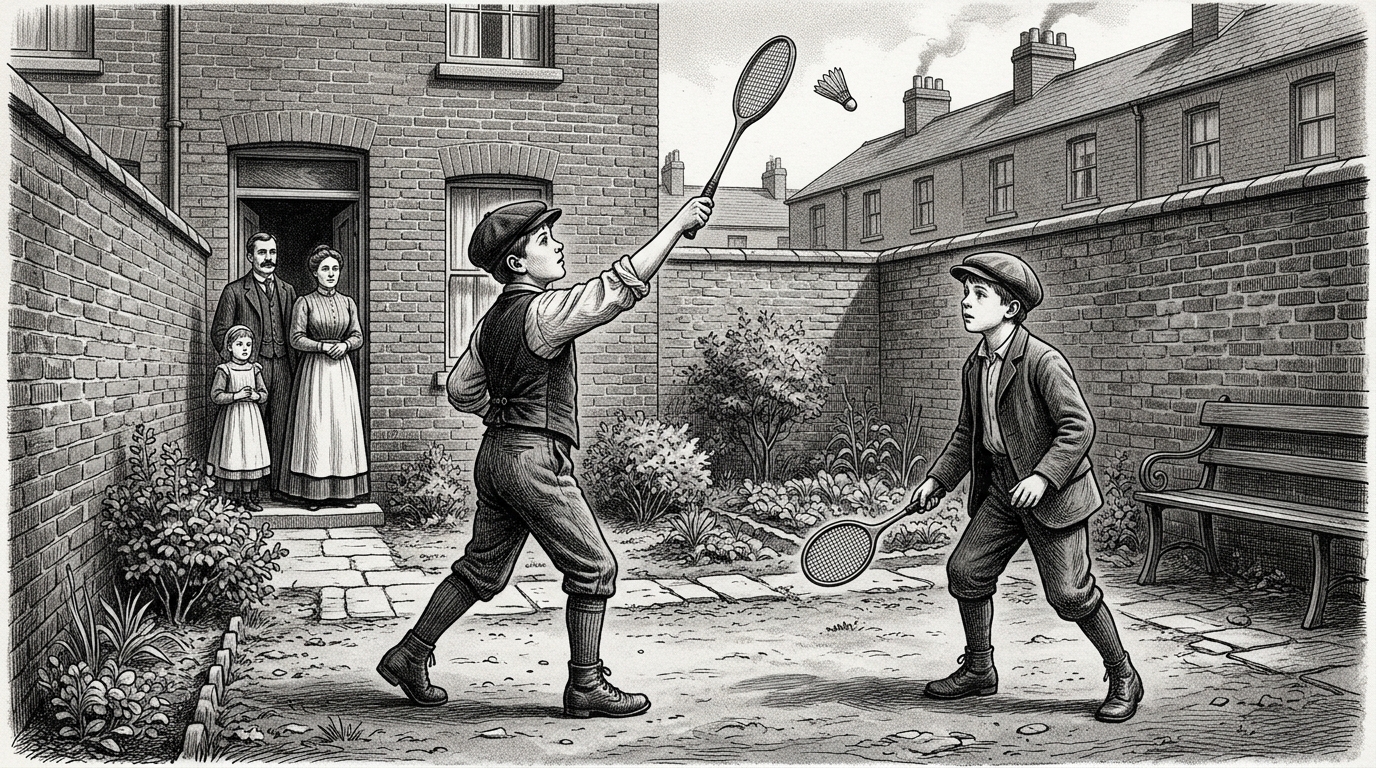
Devlin first encountered badminton informally in the family garden, where he played from childhood with relatives and his friend Gordon Bradshaw Mack, commonly known as Curly Mack. The two boys developed their control and timing without the specialised coaching, equipment or indoor facilities available to later generations. Garden play encouraged quick reactions, accuracy and improvisation, qualities that became central to Devlin’s competitive style. Mack also became an accomplished player, and the friendship formed during childhood later developed into a formidable doubles partnership. Their progress illustrated how a recreation practised within an ordinary Dublin household could provide the foundation for international sporting achievement.
Devlin emerged as a leading competitor during the 1920s, when the All England Championships were regarded as badminton’s unofficial world championship. Between 1922 and 1931 he accumulated eighteen All England titles across men’s singles, men’s doubles and mixed doubles. He won six singles championships and achieved the exceptional feat of securing all three available titles in 1926, 1927 and 1929. His success depended upon speed, control, stamina and tactical intelligence rather than physical power alone. During an era dominated largely by English competitors, Devlin’s repeated victories gave Irish badminton unprecedented visibility and established him among the outstanding racket-sport players of his generation.
His international influence extended beyond tournament victories. Devlin travelled to Canada with touring teams during the 1920s and 1930s, helping to demonstrate and promote badminton while organised associations were developing overseas. He later settled in North America and continued to teach, coach and encourage the sport. His understanding of stroke production, positioning and efficient movement influenced players beyond Ireland and Britain. Badminton remained amateur, meaning that champions received limited financial reward, yet Devlin devoted much of his life to its advancement. His achievements reflected a period when personal reputation, club competition and international exhibition tours were central to the growth of organised sport.
Devlin’s sporting legacy continued through his daughters Susan Devlin and Judy Devlin, both of whom became international champions. Judy developed into one of the greatest women’s badminton players of the twentieth century, while Susan also enjoyed major success in doubles and international competition. Frank Devlin lived until 1988 and was inducted posthumously into the International Badminton Federation Hall of Fame in 1997. His eighteen All England victories left him among the championship’s most successful competitors. The child born at Wellington Place entered Irish sporting history not merely as a prolific winner, but as the founder of a remarkable family tradition that influenced badminton across several countries.
Frank Devlin, Joseph Francis Devlin, Irish badminton, Dublin sport, Wellington Place, All England Championships, badminton champions, Curly Mack, Gordon Bradshaw Mack, Irish sportsmen, racket sports, international badminton, men’s singles, men’s doubles, mixed doubles, Devlin family, Judy Devlin, Susan Devlin, January 1900, Irish sporting history
-
Folklorist Dies
Read Article: Folklorist DiesWilliam Larminie, poet, scholar and collector of traditional Irish stories, died from pneumonia at his home in Bray, County Wicklow, on 19 January. He was fifty years old. Born in Castlebar, County Mayo, in 1849, Larminie had devoted much of his later life to literature, philosophy and the preservation of oral storytelling. His death removed an important figure from the developing Irish cultural revival at a time when scholars and writers were turning increasingly towards the Irish language, mythology and folklore. He was survived by his elderly mother and was buried in the churchyard at Enniskerry.
Larminie was educated at Kingstown School before entering Trinity College Dublin, where he studied classics and graduated in 1871. He later moved to London and worked for the British India Office between 1873 and 1887. Retirement from government employment allowed him to return to Ireland and concentrate upon writing and research. Settling in Bray, he produced poetry influenced by Irish legend while pursuing wider interests in philosophy and language. His life combined the disciplined habits of a civil servant with the imagination of a poet and the patience required to listen carefully to stories preserved through generations of spoken tradition.
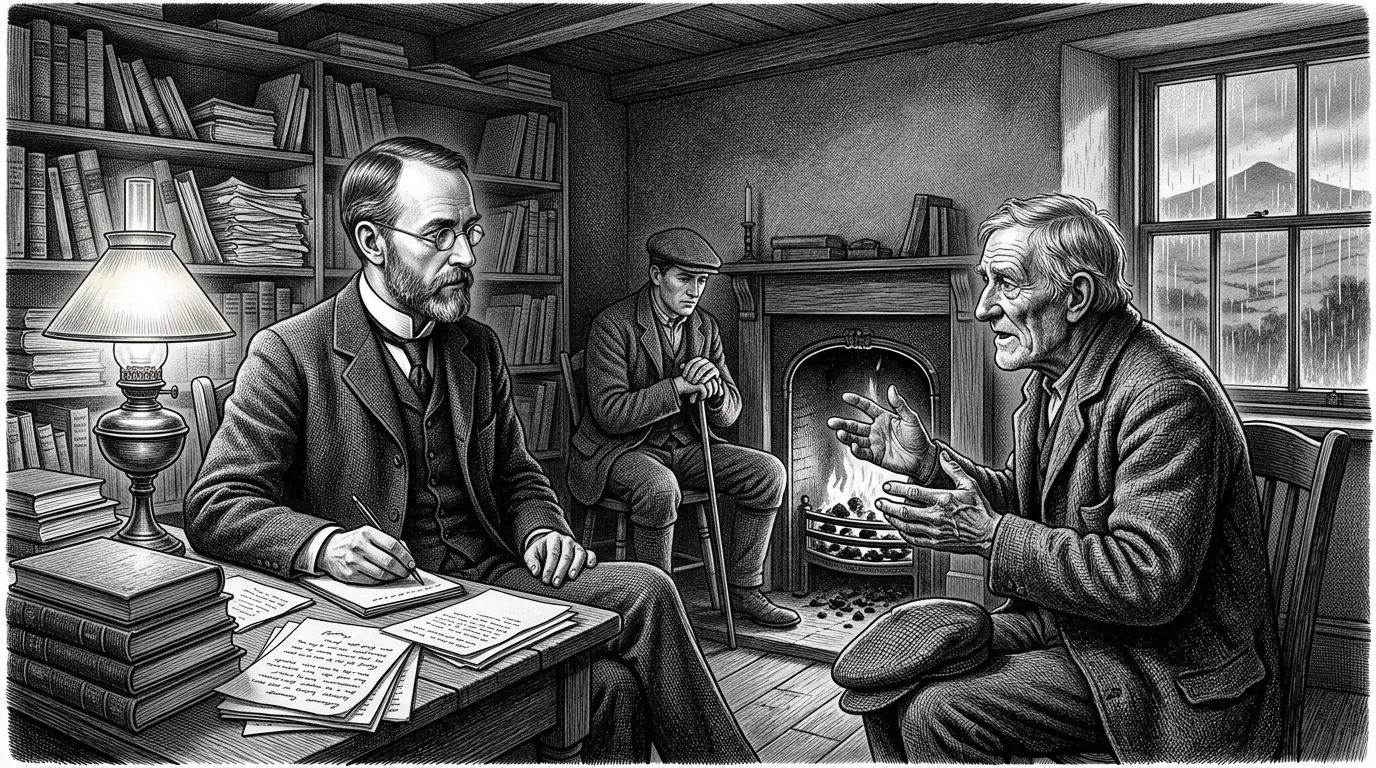
His most enduring achievement was West Irish Folk-Tales and Romances, published in 1893. Larminie gathered the stories from Irish-speaking narrators in counties Mayo, Galway and Donegal, recording tales of enchanted kingdoms, heroic journeys, supernatural encounters and dangerous transformations. He translated the narratives into English while also preserving examples of the original Irish in phonetic form. At a time when the Irish language was declining rapidly, his method helped retain not merely the plots of the stories but traces of the voices and speech patterns through which they had been transmitted. The collection later became an important source for folklorists.
Larminie also published two volumes of poetry, Glanlua and Other Poems in 1889 and Fand and Other Poems in 1892. Drawing upon mythology, landscape and traditional forms, he experimented with assonance and other features associated with Irish-language verse. Like several writers connected with the emerging literary revival, he believed that Ireland’s inherited stories could provide material for modern literature. His work appeared before folklore collecting became a fully organised academic discipline, and he often travelled personally to meet storytellers. These journeys required linguistic knowledge, trust and an ability to preserve material without stripping it of its local character.
During his final years, Larminie worked upon an English translation of De divisione naturae by the ninth-century Irish philosopher John Scotus Eriugena. The translation remained unpublished, but it reflected the breadth of his intellectual interests and his determination to connect Ireland’s philosophical and literary inheritance with contemporary readers. Larminie did not achieve the public fame later enjoyed by some figures of the Irish revival, yet his careful collections preserved stories that might otherwise have disappeared. His death in Bray closed a career devoted to poetry, thought and the spoken imagination of the western Irish countryside.
- Dictionary of Irish Biography, Royal Irish Academy, “Larminie, William,” recording his birth, education, literary career, death from pneumonia in Bray on 19 January 1900 and burial at Enniskerry.
- William Larminie, West Irish Folk-Tales and Romances, London, Elliot Stock, 1893.
- William Larminie, Glanlua and Other Poems, London, Kegan Paul, Trench & Company, 1889.
- William Larminie, Fand and Other Poems, London, Kegan Paul, Trench, Trübner & Company, 1892.
- National Library of Ireland, William Larminie manuscripts, including his unpublished translation of John Scotus Eriugena’s De divisione naturae.
-
League Endorsed
Read Article: League EndorsedThe United Irish League’s campaign for nationalist unity received an important endorsement from parliamentary representatives gathered at Dublin’s Mansion House on 17 January. By appearing together and advancing negotiations for reunion, members of the rival nationalist factions acknowledged the popular demand that had grown around the League since its establishment by William O’Brien in 1898. The organisation had begun chiefly as a campaign for land reform and the enlargement of uneconomic holdings, but its branches increasingly called upon politicians to end the quarrels created by the fall of Charles Stewart Parnell and restore a united parliamentary movement.
The endorsement demonstrated how greatly the balance of influence within constitutional nationalism had changed. During the 1890s, the rival parliamentary groups had maintained separate leaderships, organisations and loyalties while claiming to represent the same national electorate. The United Irish League developed outside those exhausted divisions and gathered support among tenant farmers, rural organisers and local political activists. Its rapid growth gave it an authority that established politicians could no longer dismiss. Representatives attending the Mansion House conference understood that reunion was required not merely to improve their position at Westminster, but to retain the confidence of supporters organising independently throughout Ireland.
William O’Brien had presented political unity as necessary for pursuing the land question with sufficient strength. The League opposed the concentration of extensive grazing lands in relatively few hands and demanded measures that would allow small farmers and congested communities to obtain viable holdings. These economic grievances gave the campaign for unity a practical foundation. Local members were not being asked simply to forget past political quarrels; they were being promised that a reunited movement could exert greater pressure for land purchase, redistribution and national self-government. The Mansion House proceedings indicated that parliamentary representatives were prepared to recognise that argument.
Support for the League did not mean that every politician accepted O’Brien’s methods, programme or growing personal influence. John Redmond, John Dillon, Timothy Healy and their respective followers retained different views about leadership, discipline and the future organisation of the nationalist movement. Some feared that the League might challenge sitting members or allow local activists to control parliamentary selection. Nevertheless, the public endorsement of its appeal for unity strengthened the League’s claim to speak for a broad body of nationalist opinion. The organisation had succeeded in making continued factional conflict appear increasingly indefensible before voters tired of political weakness and personal recrimination.
The development helped prepare the reunion of the Irish Parliamentary Party under John Redmond later in January. It also anticipated the League’s emergence as the principal grassroots organisation supporting the reunited party. The relationship would not remain free from disagreement, but the events of 17 January showed that popular organisation could shape decisions made by parliamentary leaders. The United Irish League had turned land agitation into a broader demand for national political discipline. Its endorsement at the Mansion House represented a significant victory for activists who believed that constitutional nationalism could recover its influence only by reconnecting parliamentary action with organised opinion across Ireland.
- Freeman’s Journal, 18 January 1900, report of the Mansion House conference and negotiations among the nationalist parliamentary factions.
- Philip Bull, “The United Irish League and the Reunion of the Irish Parliamentary Party, 1898–1900,” Irish Historical Studies, volume 26, number 101, May 1988, pages 51–78.
- John Redmond Papers, National Library of Ireland, correspondence and political papers concerning nationalist reunion and the United Irish League.
- United Irish League, Constitution and Rules Adopted by the Irish National Convention, 19–20 June 1900, Dublin, Swan & Company, 1900.
- F. S. L. Lyons, The Irish Parliamentary Party, 1890–1910, London, 1951, discussion of the League’s expansion and its influence upon parliamentary reunion.
-
Rivals Reconcile
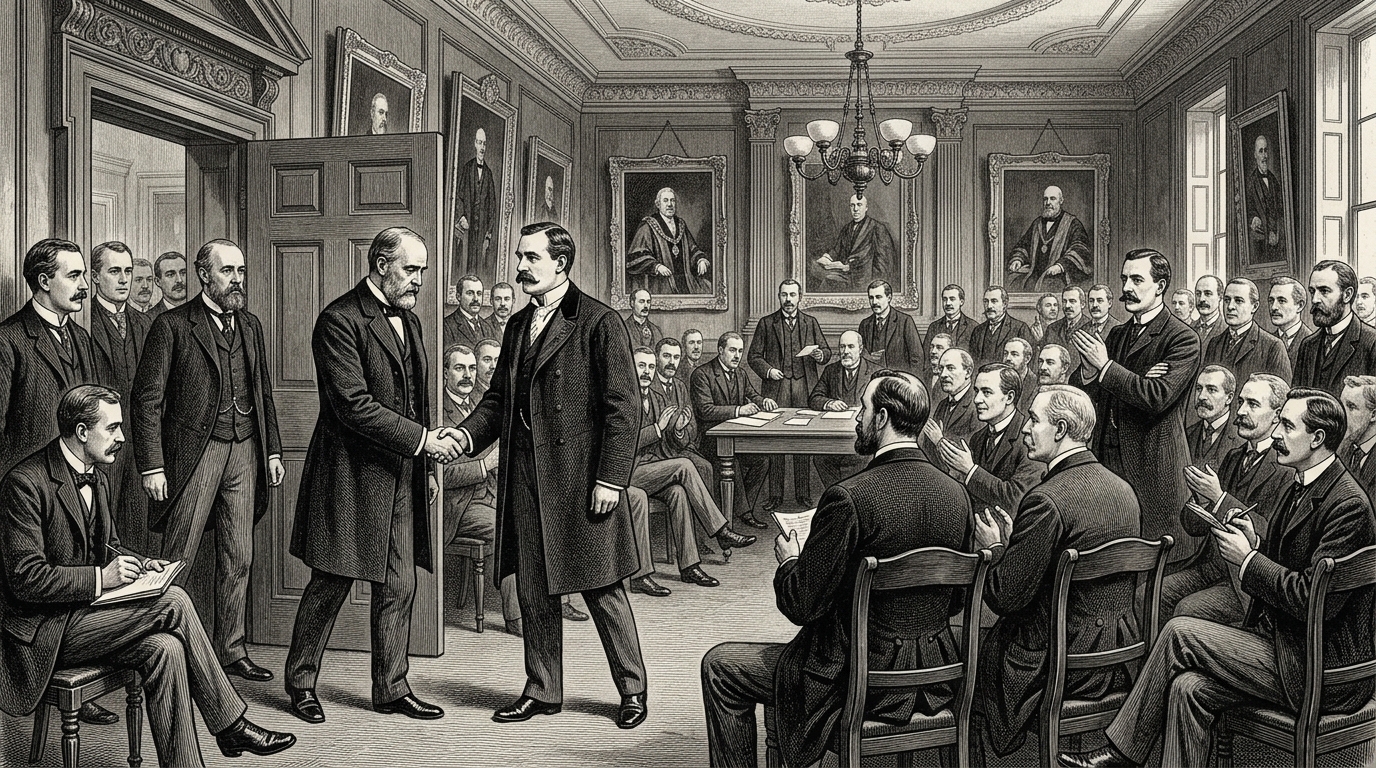
Read Article: Rivals ReconcileParnellite and anti-Parnellite representatives appeared together at Dublin’s Mansion House on 17 January in the most important public demonstration of nationalist reconciliation since the political rupture of 1890. Men who had spent nearly a decade attacking one another from platforms, newspapers and election committees now entered the same civic chamber under intense public scrutiny. Their presence did not erase the bitterness created by the fall of Charles Stewart Parnell, but it offered supporters visible evidence that reunion had become possible. The gathering converted private discussions and cautious approaches into a public acknowledgement that continued division was damaging the wider nationalist cause.
The split had produced competing parliamentary factions, rival political organisations and repeated contests between candidates who professed the same commitment to Irish self-government. John Redmond led the principal Parnellite group, while John Dillon remained influential among the anti-Parnellites and Timothy Healy commanded a separate following. Their disagreements involved leadership, clerical influence, parliamentary discipline and personal loyalties that had hardened through years of controversy. Appearing together therefore required more than ceremonial courtesy. Each faction risked criticism from supporters who regarded reconciliation as surrender, betrayal or an attempt to conceal unresolved disputes beneath a temporary display of unity.
The public character of the gathering carried significance beyond the formal negotiations. Nationalist voters throughout Ireland had grown weary of quarrels that weakened representation at Westminster and diverted attention from Home Rule, tenant purchase and land redistribution. Reports that former opponents had met peacefully allowed local organisers to argue that the divisions were finally being overcome. The Mansion House supplied an appropriately prominent setting, linking the reconciliation effort with Dublin’s civic life and ensuring that newspapers could present the encounter as a national political event rather than another private consultation among parliamentary leaders.
William O’Brien’s United Irish League had created much of the pressure behind the display. Its rapid growth demonstrated that nationalist organisation was reviving outside the established parliamentary factions, particularly among tenant farmers and rural communities demanding action on the land question. League supporters wanted representatives to cooperate rather than preserve disputes inherited from the Parnell crisis. The appearance of the rival groups together suggested that parliamentary leaders understood the danger of becoming separated from popular opinion. Reconciliation offered them an opportunity to reconnect Westminster activity with the expanding network of local branches, public meetings and agrarian campaigning.
The demonstration did not guarantee that every disagreement had been settled, nor did it restore the authority once exercised by Parnell over a disciplined parliamentary movement. It nevertheless marked an unmistakable change in public behaviour. Politicians who had defined themselves through opposition to one another now accepted that national unity required visible cooperation. Their joint appearance helped prepare the formal reunion completed shortly afterwards under the compromise leadership of John Redmond. For supporters who remembered the recriminations of the previous decade, the scene at the Mansion House offered the first convincing public evidence that constitutional nationalism could again act through a common parliamentary organisation.
- Freeman’s Journal, 18 January 1900, reports concerning the Mansion House conference and the joint appearance of Parnellite and anti-Parnellite representatives.
- Irish Daily Independent, January 1900 editions, reports and political commentary concerning nationalist reconciliation and parliamentary reunion.
- John Redmond Papers, National Library of Ireland, correspondence and political material relating to negotiations for reunion in January 1900.
- Philip Bull, “The United Irish League and the Reunion of the Irish Parliamentary Party, 1898–1900,” Irish Historical Studies, volume 26, number 101, May 1988, pages 51–78.
- F. S. L. Lyons, The Irish Parliamentary Party, 1890–1910, London, 1951, discussion of the Parnell split, competing nationalist factions and the reunion of January 1900.
-
Reunion Advances
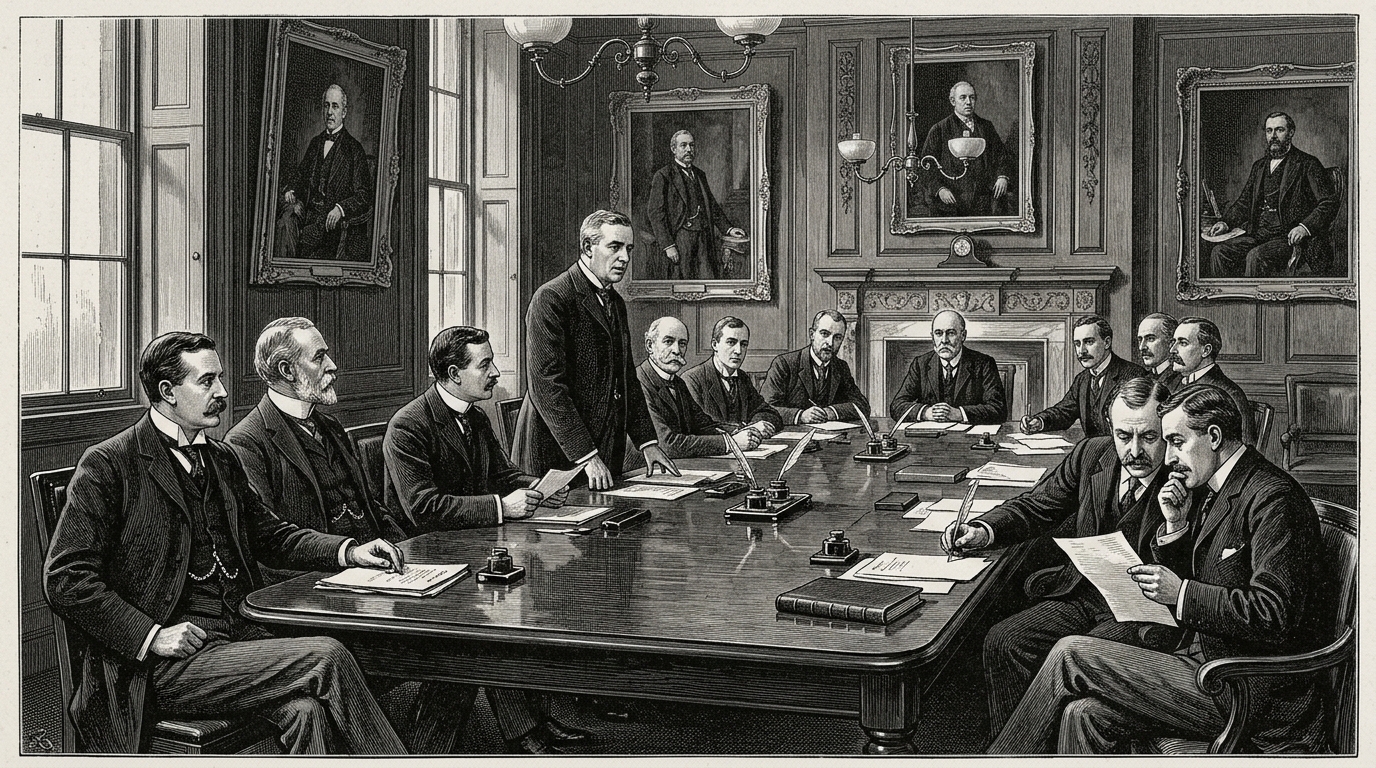
Read Article: Reunion AdvancesNegotiations to reunite Ireland’s divided nationalist parliamentarians advanced formally during the Mansion House conference held on 17 January. Representatives associated with the rival factions created by the fall of Charles Stewart Parnell met in Dublin to consider practical terms for restoring a single parliamentary organisation. Nearly a decade of internal conflict had weakened nationalist influence at Westminster and exhausted many supporters throughout Ireland. The conference did not instantly remove the personal distrust, political grievances and competing ambitions that had accumulated since 1890, but it transformed informal appeals for reconciliation into a structured negotiation between recognised representatives of the opposing groups.
The divisions had originated when Parnell’s leadership became untenable following the divorce crisis involving Katharine O’Shea. Nationalist members divided into Parnellite and anti-Parnellite camps, while rival organisations, newspapers and candidates continued the quarrel after Parnell’s death in 1891. John Redmond emerged as the principal parliamentary leader of the Parnellites, while John Dillon and other prominent figures exercised influence among their former opponents. By the beginning of 1900, many voters regarded the continuing feud as an obstacle to Home Rule, land reform and effective representation. The Mansion House discussions reflected mounting pressure upon the factions to subordinate old resentments to common political objectives.
William O’Brien’s United Irish League provided much of the momentum behind the movement towards reunion. Founded in 1898, the League organised tenant farmers, local activists and nationalist supporters around land redistribution and the revival of disciplined political organisation. Its rapid expansion demonstrated that popular nationalism was no longer prepared to wait indefinitely for parliamentary leaders to resolve their differences. Local branches supplied energy, membership and a programme capable of reconnecting constitutional politics with everyday rural grievances. The parliamentary factions therefore entered the conference knowing that failure to reunite could allow the League and its organisers to exercise increasing authority over nationalist strategy throughout Ireland.
The negotiations required more than expressions of goodwill. Representatives had to consider leadership, parliamentary discipline, relations with the United Irish League and the treatment of organisations created during the split. Each side feared that reunion might involve surrender to former opponents or the abandonment of loyal supporters. The formal progress made at the Mansion House indicated that these difficulties were no longer considered insurmountable. Delegates recognised that a reunited party could contest elections more effectively, speak with greater authority at Westminster and prevent three rival nationalist candidates from weakening one another in constituencies where the broader electorate supported Home Rule.
The conference helped establish the conditions for the formal reunion of the Irish Parliamentary Party later that month, when John Redmond was chosen to lead the combined parliamentary body. Unity did not erase ideological differences or personal hostility, and later disputes would reveal the limits of the settlement. Nevertheless, the negotiations of 17 January restored a framework within which nationalists could act collectively after years of fragmentation. The proceedings represented an important recovery for constitutional nationalism, strengthened the relationship between parliamentary representatives and the United Irish League, and prepared the movement to enter the new century with a recognisable leadership and renewed organisational purpose.
- Freeman’s Journal, 18 January 1900, reporting the nationalist conference and reunion negotiations held at Dublin’s Mansion House on the previous day.
- Irish Daily Independent, January 1900 editions, reports and political commentary concerning negotiations among the nationalist parliamentary factions.
- John Redmond Papers, National Library of Ireland, correspondence and political material relating to the reunion of the Irish Parliamentary Party in January 1900.
- Philip Bull, “The United Irish League and the Reunion of the Irish Parliamentary Party, 1898–1900,” Irish Historical Studies, volume 26, number 101, May 1988, pages 51–78.
- F. S. L. Lyons, The Irish Parliamentary Party, 1890–1910, London, 1951, chapters concerning the Parnell split, the United Irish League and the restoration of parliamentary unity.
-
Nationalist Reunion
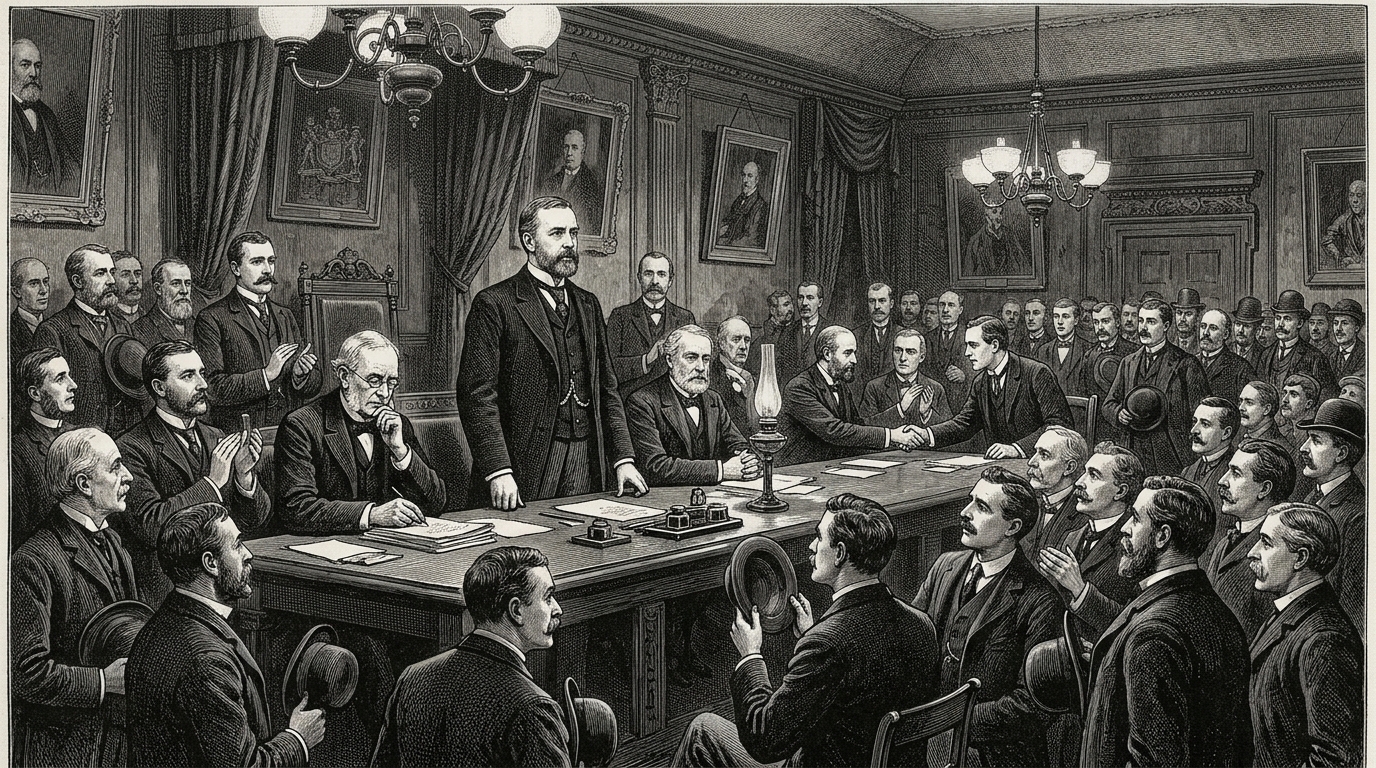
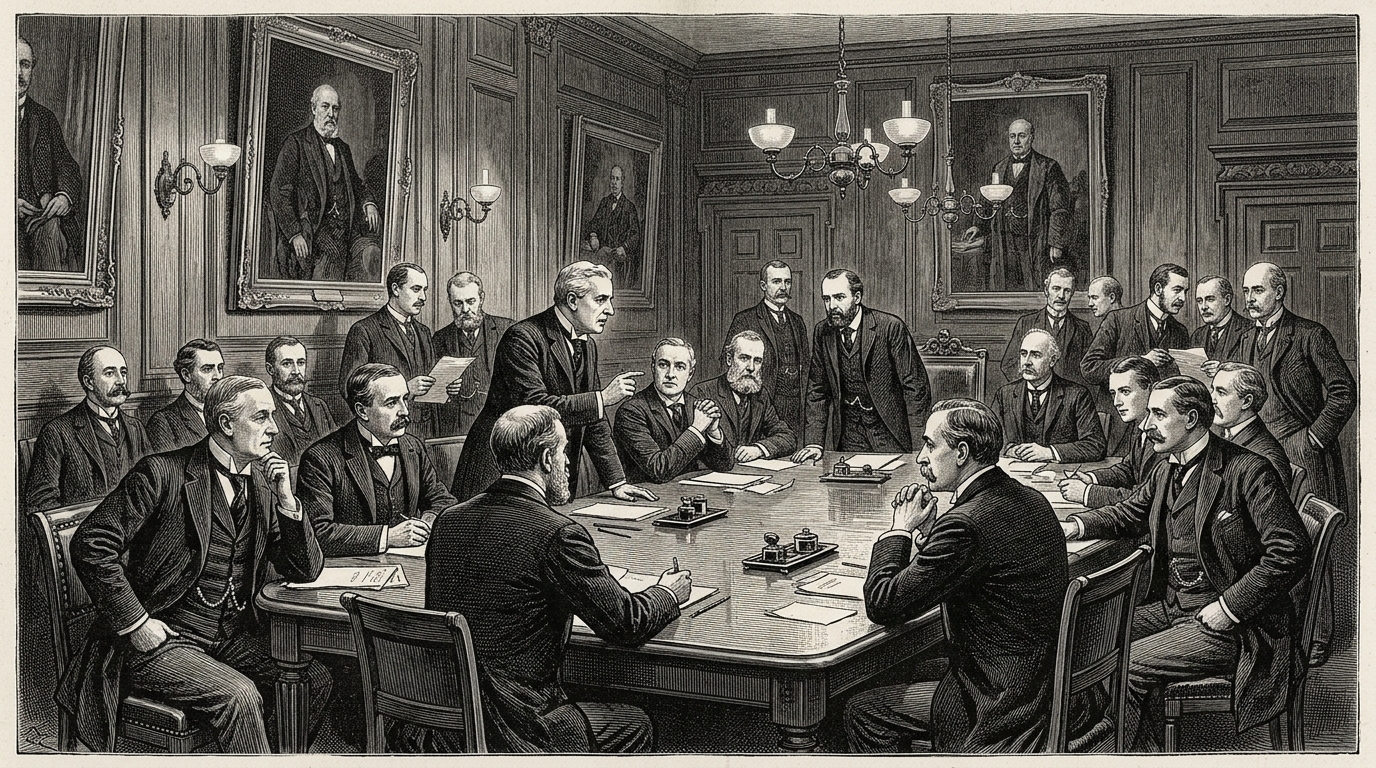
Read Article: Nationalist ReunionRepresentatives of Ireland’s divided nationalist factions assembled in the Oak Room of Dublin’s Mansion House on 17 January in an attempt to restore political unity after nearly a decade of bitterness. The split created by the fall of Charles Stewart Parnell had weakened nationalist organisation, divided parliamentary representatives and produced competing loyalties throughout the country. Those entering the oak-panelled civic chamber carried memories of denunciation, broken alliances and election contests fought between men who claimed to serve the same national cause. Their immediate purpose was to determine whether cooperation could replace factional rivalry before the divisions inflicted further damage upon the Home Rule movement.
The gathering brought together figures associated with the Parnellite and anti-Parnellite traditions, including supporters of John Redmond, John Dillon and Timothy Healy. Agreement was difficult because the dispute had become personal as well as political. Rival newspapers, local organisations and parliamentary groups had sustained the quarrel long after Parnell’s death in 1891. Many nationalists nevertheless feared that continued separation would leave Ireland’s representation at Westminster ineffective. The Mansion House discussions therefore required delegates to distinguish between grievances they considered matters of principle and those that could be set aside for the sake of coordinated political action.
Pressure for reunion had increased through the rapid expansion of William O’Brien’s United Irish League. Founded in 1898, the organisation mobilised tenant farmers, local activists and supporters of land reform while presenting itself as a national movement rooted beyond the parliamentary factions. Its growing influence demonstrated that ordinary nationalist voters were becoming impatient with leadership disputes. The League’s campaign against large grazing farms and its demand for broader land purchase gave political organisation an urgent social purpose. Parliamentary representatives understood that unless they reunited, the popular movement developing outside Westminster might dictate the future direction of Irish nationalism without them.
The choice of the Mansion House carried considerable symbolic weight. Dublin’s official mayoral residence had long served as a setting for civic receptions, political gatherings and expressions of national opinion. The Oak Room, lined with historic panelling and portraits, offered a formal environment in which former opponents could meet without appearing to surrender completely to one another. No single conference could erase the anger produced by the Parnell split, but the assembly allowed competing groups to explore terms for cooperation. Its significance rested less upon immediate declarations than upon the willingness of previously hostile representatives to occupy the same room and negotiate.
The meeting helped prepare the way for the formal reunion of the nationalist organisations in February, when John Redmond was selected as compromise chairman of a reunited Irish Parliamentary Party. Unity did not remove every disagreement, nor did it guarantee lasting harmony among ambitious and strongly opinionated leaders. It did, however, restore a recognisable parliamentary organisation before the approaching general election and reconnect elected representatives with the expanding United Irish League. The Oak Room gathering marked an important stage in the recovery of constitutional nationalism, demonstrating that political necessity and pressure from supporters throughout Ireland could compel divided leaders to seek common ground.
- Freeman’s Journal, 18 January 1900, report of the conference involving the nationalist parliamentary factions at Dublin’s Mansion House.
- Irish Independent, January 1900 editions, reports and commentary concerning negotiations for nationalist reunion.
- United Irish League, resolutions, reports and organisational records concerning the movement for national unity, 1899–1900.
- John Redmond Papers, National Library of Ireland, correspondence and political material relating to the reunion of the Irish Parliamentary Party.
- F. S. L. Lyons, The Irish Parliamentary Party, 1890–1910, London, 1951, discussion of the Mansion House negotiations, the United Irish League and the restoration of party unity.
-
Unlikely Nurse
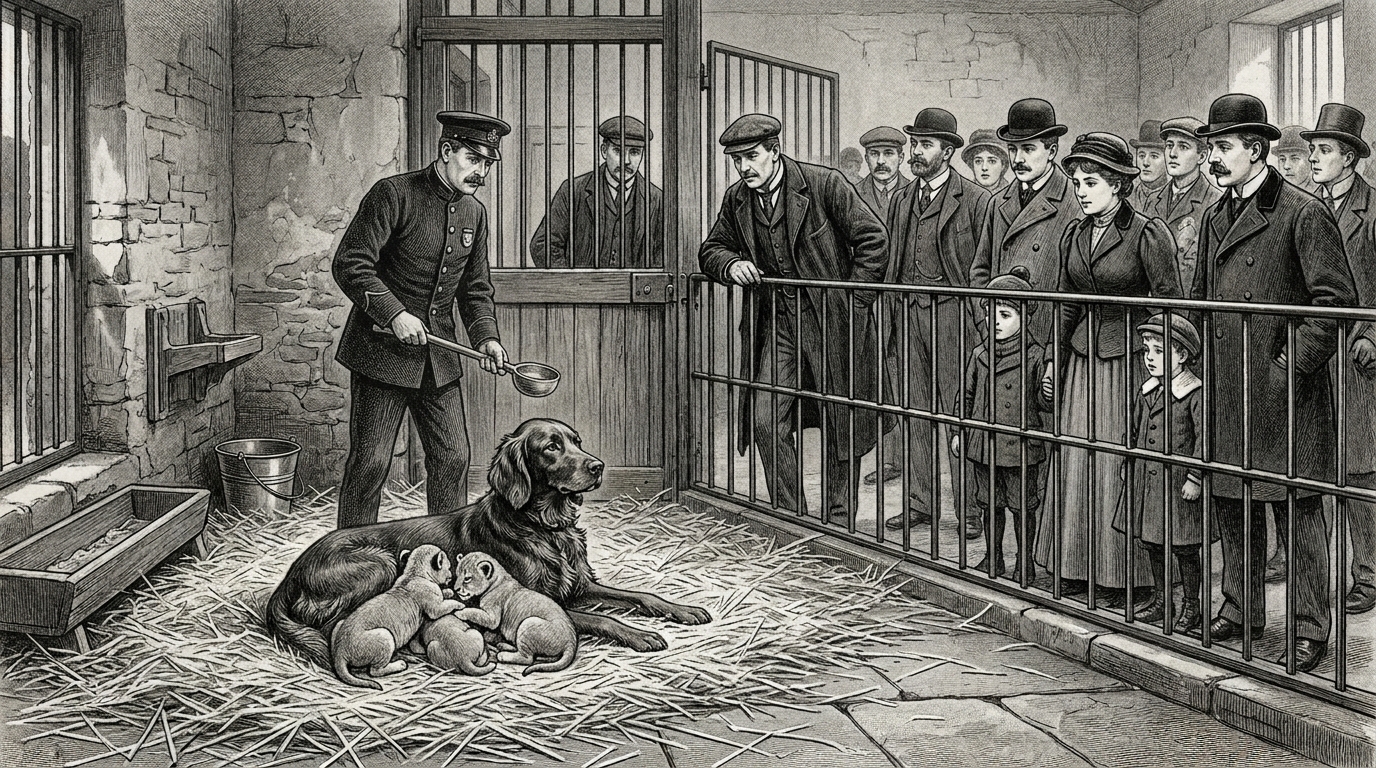
Read Article: Unlikely NurseThree young lion cubs raised with the assistance of an Irish red setter were placed on public view at Dublin Zoo on 16 January, attracting attention to one of the most unusual episodes in the Gardens’ long breeding history. The cubs had been born to the lioness Hypatia, but she refused to nurse them. Keepers were therefore forced to seek another source of milk if the litter was to survive. A goat was first employed for several days before the setter assumed the role of foster mother, accepting the vulnerable cubs and feeding them alongside the close supervision of zoo staff.
The sight of a domestic dog nursing lions brought together animals rarely associated within the same enclosure. Visitors were able to observe the cubs at close quarters while the setter remained calm and protective in their presence. Her success demonstrated the practical improvisation required in zoological collections before specialised artificial feeding methods became widely available. Keepers depended upon experience, judgement and the willingness of suitable foster animals when mothers rejected their offspring. The setter’s temperament made her particularly valuable, since the cubs required regular feeding, warmth and tolerance during the earliest and most dangerous period of their development.
Dublin Zoo had already earned an international reputation for breeding lions, an activity that began during the nineteenth century and supplied animals to zoological collections and travelling exhibitions abroad. Successful litters brought prestige and income, but the survival rate among newborn cubs could be uncertain. Lionesses sometimes failed to rear their young, illness could spread quickly, and keepers possessed only limited veterinary knowledge by modern standards. The birth of three cubs therefore represented both an achievement and a challenge. Their appearance before the public allowed the Society to display the results of its breeding programme while drawing visitors during the quieter winter season.
The episode also reflected contemporary attitudes towards zoological gardens. Animals were presented for education, scientific observation and popular entertainment, although standards of care differed greatly from those expected today. Visitors came to the Phoenix Park to see creatures otherwise known chiefly through books, engravings, imperial exhibitions and travellers’ accounts. The fostered cubs offered an especially memorable spectacle because their survival depended upon an ordinary Irish dog. The contrast between the familiar setter and the exotic lions gave the display its appeal, transforming a difficult problem of animal care into a story readily understood by adults and children alike.
Behind the public curiosity lay the persistent labour of keepers responsible for feeding, cleaning and watching the young animals. The cubs required attention beyond the setter’s nursing, including protection from cold, observation for weakness and careful management as they grew stronger. Their display testified to a rescue effort that had begun when Hypatia rejected them and continued through the temporary use of a goat and the setter’s successful fostering. On 16 January, the unusual family became one of Dublin’s most discussed attractions, offering visitors a striking example of dependence crossing the boundary between domestic animal and wild predator.
- Royal Zoological Society of Ireland, Annual Report for 1899, including the contemporary account and photograph of the Irish red setter nursing the three lion cubs.
- Royal Zoological Society of Ireland, council and animal-register records for 1899–1900 concerning the birth, fostering and exhibition of the lion cubs.
- C. J. Cornish, The Zoological Gardens of Europe: Their History and Chief Features, London, 1902, account of Hypatia’s three cubs being nursed first by a goat and then by an Irish red setter.
- Contemporary Dublin newspaper reports dated 16 and 17 January 1900 concerning the public exhibition of the fostered lion cubs at Dublin Zoo.
- National Library of Ireland, Dublin Zoo annual-report holdings and Royal Zoological Society of Ireland published records.
-
Student Honoured
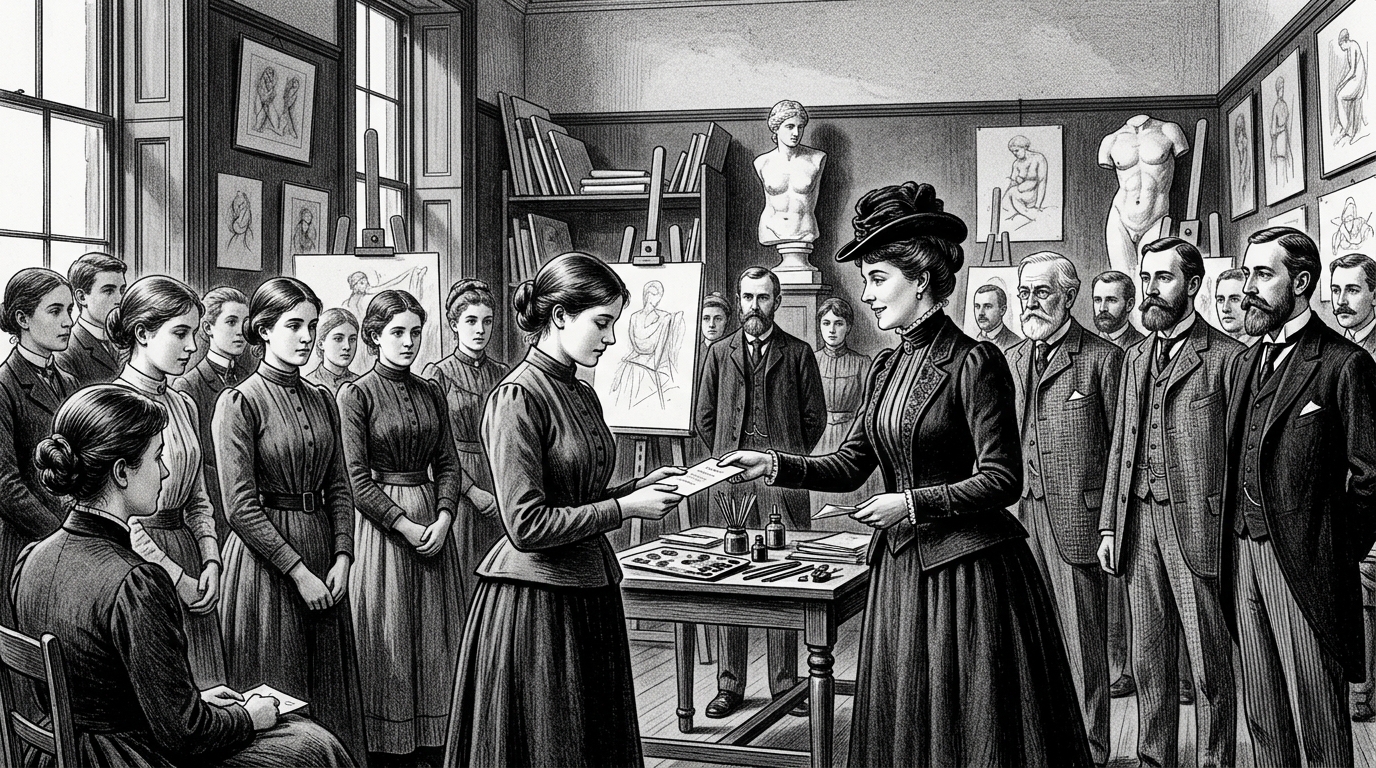
Read Article: Student HonouredDublin art student Eileen Elizabeth Janet Barnes received a prize on 10 January, presented by Countess Beatrix Cadogan, wife of the lord lieutenant of Ireland. The award recognised Barnes’s developing artistic ability during her studies at the Dublin Metropolitan School of Art, one of the country’s principal centres for formal instruction in drawing, painting, design and applied art. Such ceremonies linked student achievement with the highest levels of the administration at Dublin Castle, while providing young artists with public recognition. For Barnes, the presentation marked an early distinction in a career later devoted to exceptionally detailed scientific and botanical illustration.
Born in Dublin in 1876, Barnes was the youngest of ten children of Edwin Barnes, a grocer and wine merchant, and his wife Elizabeth. She attended the Rutland School for Girls before enrolling at the Metropolitan School of Art during the closing years of the nineteenth century. Women were gaining increased access to formal artistic education, although professional opportunities remained limited and often differed sharply from those available to male students. Barnes completed an art teacher’s certificate in 1899, giving her a practical qualification that could support employment while allowing her to continue developing the disciplined observational skills for which she later became known.
The presence of Countess Cadogan gave the prize ceremony additional prominence. As wife of George Cadogan, lord lieutenant from 1895 to 1902, she occupied a highly visible position within Ireland’s viceregal establishment. Women of her rank frequently lent their patronage to education, charitable activity, domestic industries and the arts. Such involvement reflected the social hierarchy of the period, but it could also draw attention to student work and institutions dependent upon public respectability and official support. Barnes’s prize placed a young Dublin woman briefly within that ceremonial world, although her later reputation would rest upon patient work rather than aristocratic patronage.
Barnes eventually developed a specialised career combining artistic skill with natural history. She produced botanical illustrations and three-dimensional models for museum collections, working with leading Irish naturalists and botanists. Accuracy was essential: the shape of a leaf, the arrangement of petals, the colour of a specimen and the smallest structural detail had to be faithfully recorded. Her work helped make scientific information understandable to museum visitors and researchers. Unlike gallery paintings intended primarily for aesthetic appreciation, these illustrations and models served education, classification and public knowledge, demonstrating how artistic training could be applied within scientific institutions.
The prize awarded on 10 January provides an early glimpse of a woman whose contribution remained less celebrated than that of many conventional painters. Barnes later became associated with the National Museum of Ireland, where her precise craftsmanship supported the study and presentation of Ireland’s natural world. Her career occupied the meeting point between art, science, education and museum practice. Each carefully rendered plant or constructed specimen required close observation and technical control. The young student honoured in Dublin would ultimately leave a body of work valued not for fashionable display, but for its accuracy, usefulness and enduring contribution to Irish natural history.
- Niav Gallagher, “Barnes, Eileen Elizabeth Janet,” Dictionary of Irish Biography, Royal Irish Academy, recording the prize presented on 10 January 1900 and Barnes’s subsequent career.
- Dublin Metropolitan School of Art student and examination records, 1898–1900, documenting Eileen Barnes’s enrolment, teacher-training qualification and artistic studies.
- John Lucey, “Eileen Barnes (1876–1956): The Contributions of a Gifted Artist, Scientific Illustrator and Model-Maker to Irish Natural History,” Irish Naturalists’ Journal.
- Patricia Butler, Irish Botanical Illustrators and Flower Painters, Antique Collectors’ Club, 2000, discussion of Barnes and the development of Irish botanical art.
- National Museum of Ireland, Natural History and Antiquities Division records, accession material and staff documentation concerning Barnes’s illustrations, models and museum work.
-
Artist Born
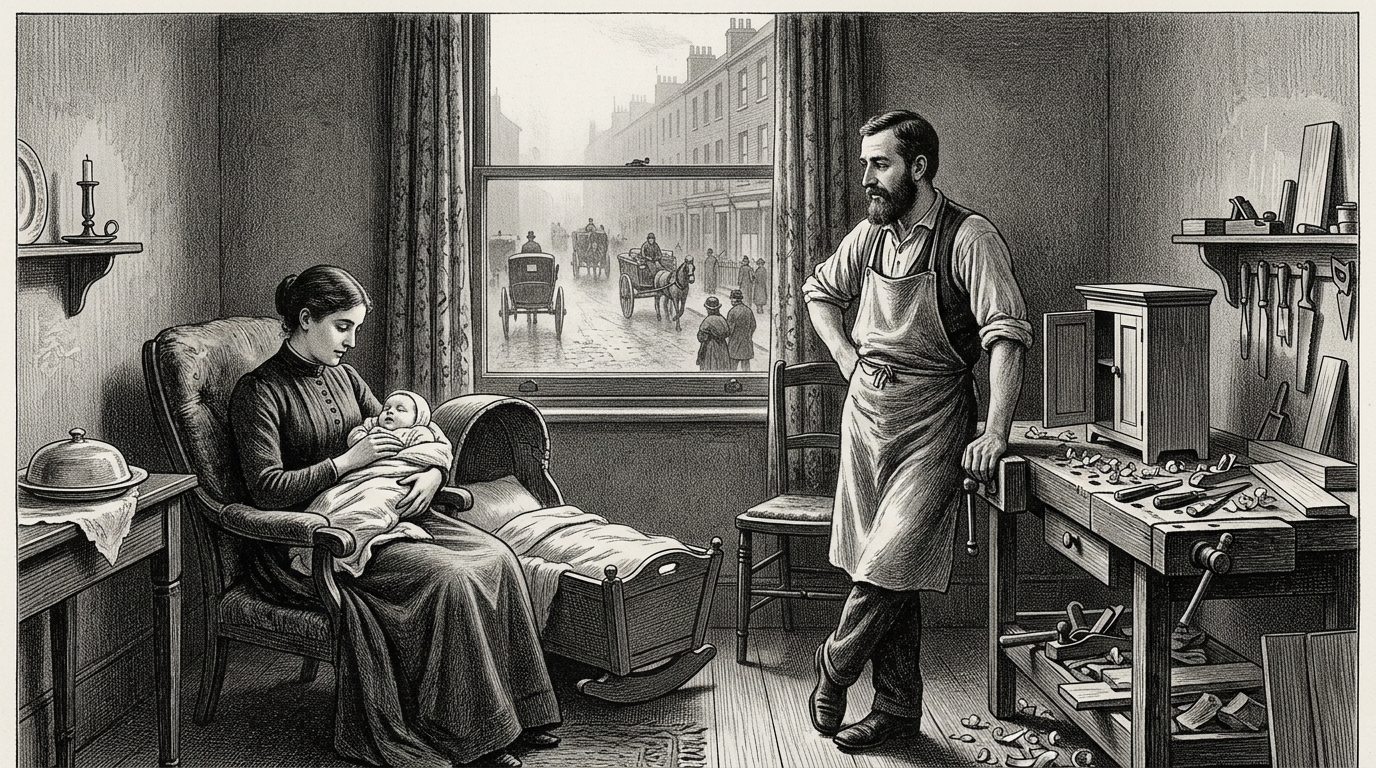
Read Article: Artist BornHarry Aaron Kernoff was born in London on 9 January 1900 into a Jewish family whose origins reached across eastern and southern Europe. His father, Isaac Kernoff, was a furniture maker of Russian-Jewish background, while his mother, Katherine, came from a Sephardic Jewish family. The household combined skilled craftsmanship with the experience of migration, placing the future artist within a world shaped by manual work, cultural inheritance and adaptation. Although born outside Ireland, Kernoff would become closely associated with Dublin and would eventually be recognised as one of the most distinctive visual chroniclers of Irish urban life during the twentieth century.
The craft practised by his father later provided Kernoff with both employment and an early understanding of shape, surface and construction. As a young man, he served an apprenticeship in cabinet-making, learning to work carefully with wood before establishing himself as a professional painter and printmaker. His family moved to Dublin in 1914, when he was fourteen, and settled within the city’s Jewish community. The move brought him into direct contact with streets, markets, public houses, theatres and working neighbourhoods that would supply him with subjects throughout his career, particularly the everyday people and places often overlooked by more formal artistic traditions.
Kernoff studied in evening classes at the Dublin Metropolitan School of Art while continuing to work in the family furniture business. His teachers included artists associated with the changing character of Irish art, and his formal education helped him develop skills in drawing, composition, painting and design. He later received the Taylor Scholarship, an important award for art students, and gradually established a professional reputation. Kernoff exhibited at the Royal Hibernian Academy for the first time in 1926 and continued to show work there regularly, placing scenes of ordinary Irish life within one of the country’s principal artistic institutions.
His paintings, drawings and woodcuts became especially valued for their direct observation of Dublin. Kernoff depicted streets, public houses, theatres, docks, cafés, musicians, labourers and familiar public figures without separating them from the social environments they inhabited. He showed sympathy towards unemployed men waiting for work and recorded the character of places undergoing political, economic and architectural change. His subjects also extended beyond Dublin to landscapes, portraits and scenes encountered during travel. Rather than presenting Irish life as picturesque decoration, he preserved gestures, expressions, occupations and gathering places with humour, precision and sustained interest in ordinary human experience.
Kernoff’s Jewish heritage formed an important part of his identity within Irish cultural life, while his career demonstrated how an artist born abroad could become deeply connected with the streets and people of an adopted city. He produced paintings, theatrical designs, illustrations and three collections of woodcuts, creating a substantial body of work before his death in 1974. Many of his images now serve as visual records of mid-century Dublin, preserving buildings, interiors and social encounters that later disappeared. The child born in London on 9 January 1900 would ultimately become one of Ireland’s most recognisable painters of everyday urban existence.
- Linde Lunney, “Kernoff, Harry,” Dictionary of Irish Biography, Royal Irish Academy, biographical entry recording his birth in London on 9 January 1900 and his family background.
- National Library of Ireland, Harry Kernoff Papers, Collection List No. 2090, containing sketchbooks, correspondence, photographs, exhibition material and records of his artistic career.
- National Gallery of Ireland, collection and curatorial records concerning Harry Kernoff, including his Dublin street scenes, portraits and Sunday Evening, Place du Combat, Paris.
- Irish Jewish Museum, “Harry Kernoff,” biographical account describing his parents, Jewish background, move to Dublin, cabinet-making apprenticeship and artistic education.
- Royal Hibernian Academy exhibition catalogues and annual records from 1926 to 1974, documenting Kernoff’s sustained participation in the Academy’s exhibitions.
-
Battalion Arrives
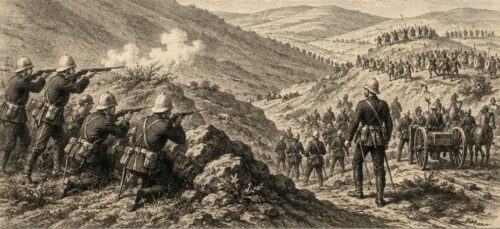
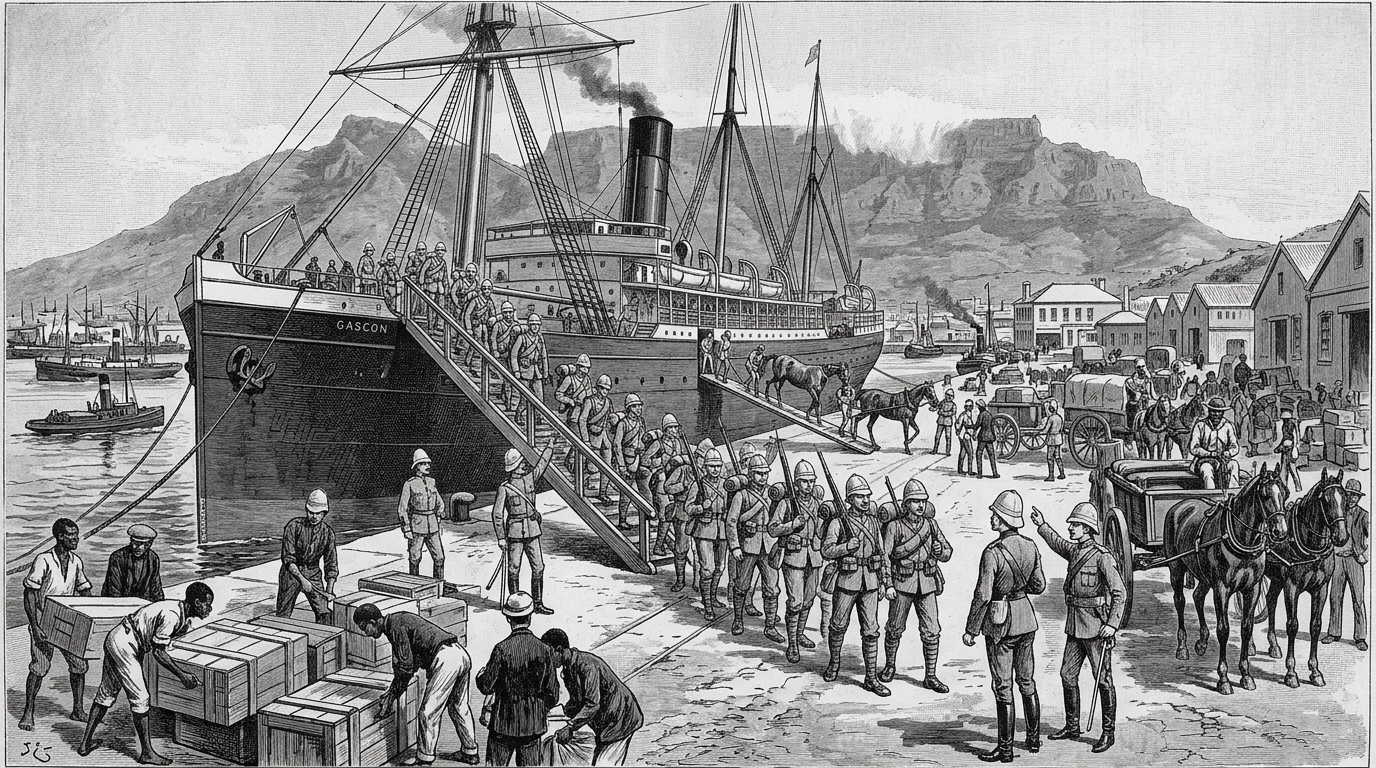
Read Article: Battalion ArrivesThe 1st Battalion of the Royal Irish Regiment reached the Cape aboard the troopship Gascon on 7 January, completing a voyage that had begun on 14 December. Its arrival formed part of Britain’s accelerating military reinforcement of South Africa after the serious reverses suffered during the opening months of the war. The soldiers disembarked into an unfamiliar summer climate after spending more than three weeks at sea, carrying rifles, uniforms, personal kit and the expectations of a campaign whose duration remained uncertain. Their landing transformed the battalion from a home-based regiment into an active component of Britain’s expanding field army.
The Royal Irish Regiment maintained its depot at Clonmel and recruited principally from Tipperary, Kilkenny, Waterford and Wexford. Its officers and men therefore carried strong connections with towns, farms and working families throughout the south-east of Ireland. News of the battalion’s safe arrival would have been followed closely by relatives awaiting letters and newspaper reports. The passage aboard the Gascon represented only the beginning of a much more demanding journey. Before confronting Boer forces, the soldiers required equipment checks, fresh supplies, transport arrangements and orders directing them from the Cape towards the inland operational districts.
The battalion was assigned to the 12th Brigade alongside the 2nd Bedfordshire, 2nd Worcestershire and 2nd Wiltshire regiments. Major-General Ralph Clements commanded the brigade, which was initially associated with the newly organised 6th Division. British commanders were attempting to recover from defeats that had exposed weaknesses in tactics, reconnaissance and mobility. The arrival of trained infantry offered badly needed strength, but the conditions of the campaign differed sharply from conventional European warfare. Boer commandos travelled rapidly across open country, used the landscape effectively and could direct accurate rifle fire from concealed positions before withdrawing beyond immediate pursuit.
For the Irish soldiers, arrival brought relief from the confinement of the voyage but introduced harsher uncertainties. Long marches, intense heat, cold nights, limited water and irregular supplies would become familiar features of service. Disease presented dangers alongside enemy fire, while horses, wagons and railway lines determined how quickly troops and provisions could move. Many men had joined the army for regular pay and security rather than any deep attachment to imperial policy. Their service nevertheless placed them inside a war that divided Irish opinion, with some nationalists openly sympathising with the Boer republics while Irish regiments continued to fight for Britain.
The battalion would soon take a prominent part in operations around Colesberg and later serve during the advance into the Orange Free State. Its arrival aboard the Gascon therefore marked the opening of a difficult campaign rather than a ceremonial landing. Behind the military record stood hundreds of individual lives, each linked to families waiting in Ireland for uncertain news. Letters might take weeks to arrive, casualty reports could be incomplete, and newspaper accounts rarely conveyed the ordinary strain of service. On 7 January, however, the immediate fact was simple: the battalion had reached South Africa safely and was preparing to enter the war.
- W. H. Ferrar, The Campaigns and History of the Royal Irish Regiment, Volume II, chapter “In South Africa: Colesberg and Bethlehem,” recording that the 1st Battalion sailed aboard the Gascon on 14 December 1899 and reached the Cape on 7 January 1900.
- War Office, The Monthly Army List, January 1900, entries for the Royal Irish Regiment, its officers, battalions and regimental depot.
- War Office, South African War medal rolls for the Royal Irish Regiment, The National Archives, series WO 100.
- Military Archives of Ireland, Information Document on the Irish Regiments of the British Army, Royal Irish Regiment entry identifying Clonmel as its depot and Tipperary, Kilkenny, Waterford and Wexford as its principal recruiting counties.
- Australian War Memorial, photographic records of the 1st Royal Irish Regiment serving in South Africa during 1900, including the battalion at Slingersfontein and soldiers preparing ammunition for outpost duty.
-
Scholar Remembered
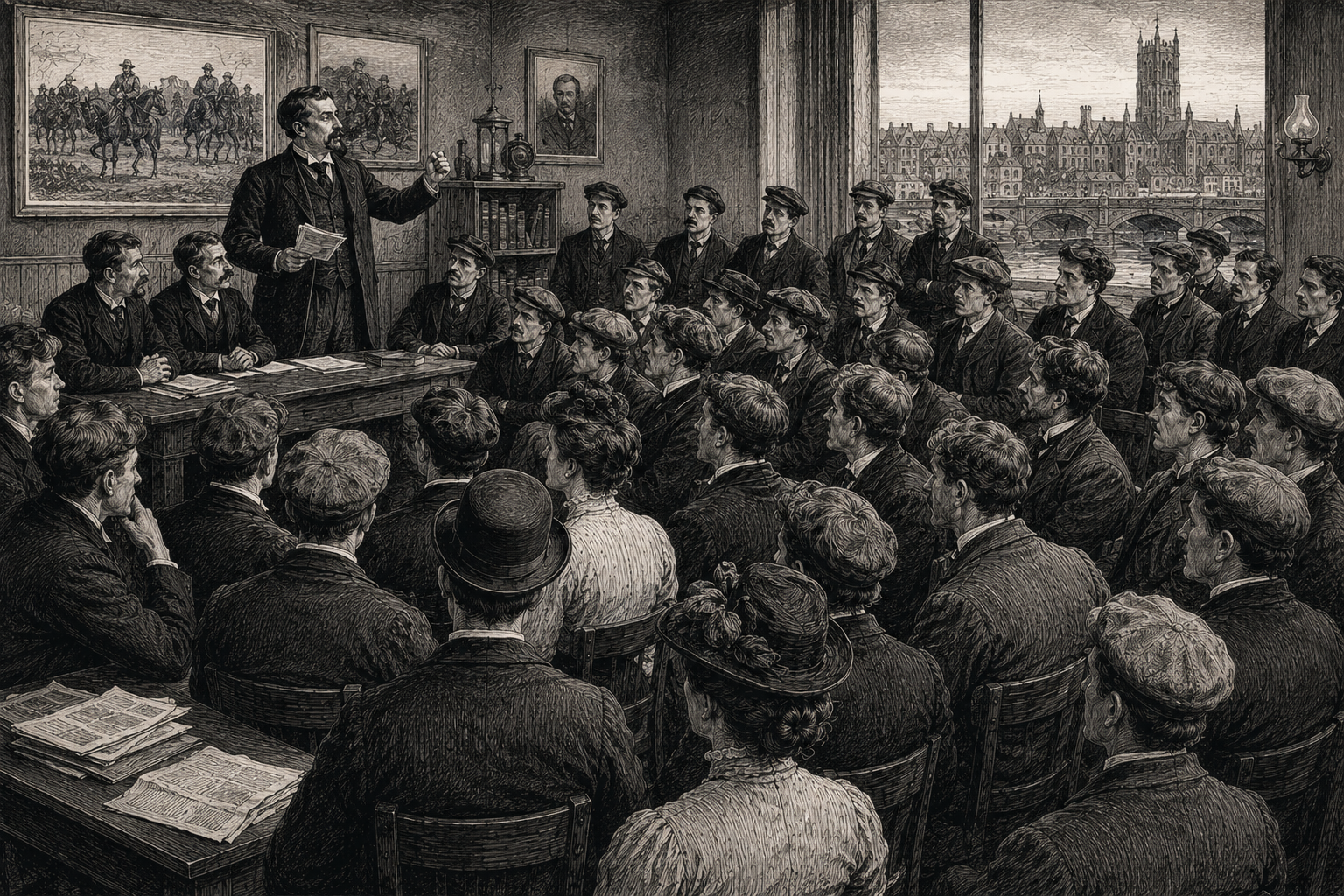
Read Article: Scholar RememberedThe Reverend Robert King, clergyman, teacher and respected historian of the Irish church, died on 4 January after several years of declining health. Born in Cork in 1815, he had spent more than four decades in County Antrim, where he served as headmaster of the diocesan school at Ballymena. His death ended a long career combining parish work, education, historical research and Irish-language scholarship. King was buried at Broughshane, a village closely associated with the final period of his life, while former pupils, clergy and readers were left to assess the unusual range of his intellectual labour.
King received his education at Trinity College Dublin, where he distinguished himself in mathematics, Hebrew and divinity. Elected a scholar in 1835, he graduated with high honours three years later and entered the ministry of the Church of Ireland. His clerical appointments brought him through several counties before he settled in Ballymena in 1858. There he assumed responsibility for the diocesan school of Armagh and Connor, an institution intended to provide a classical and religious education. King remained its headmaster until his death, even as enrolment declined and plans developed for the school’s eventual reorganisation.
His reputation extended far beyond the classroom. King devoted much of his life to the history of Christianity in Ireland, producing studies that examined early churches, ecclesiastical authority, religious institutions and the development of Irish Christianity. His best-known work, A Primer of the History of the Holy Catholic Church in Ireland, appeared in three volumes between 1849 and 1855. Although written from a Protestant perspective, the study drew upon manuscripts, earlier histories and ecclesiastical records at a time when Irish church history was becoming an increasingly serious field of scholarship.
King also possessed a sustained interest in the Irish language. He prepared educational and devotional works in Irish, produced a grammar and participated in the revision of an Irish version of the Book of Common Prayer. His engagement with the language was significant during a century when Irish was declining rapidly in many districts and was often neglected by Protestant institutions. King believed that clergy working among Irish-speaking communities required some knowledge of the language. His scholarship therefore connected religious history, linguistic study and practical ministry, even though many of his conclusions reflected the theological controversies of his time.
The school King directed had only a small number of pupils by the end of his life, and an official reorganisation was already anticipated. After his death, the institution developed into what became Ballymena Academy, giving his educational career a lasting connection with one of the town’s principal schools. He left a widow, Harriette, and a large family, including sons who entered professional and clerical life. His books, notes and surviving papers preserved decades of work on Irish religious history, while his burial at Broughshane marked the close of a life shaped by scholarship, ministry and teaching.
- Linde Lunney, “King, Robert,” Dictionary of Irish Biography, Royal Irish Academy, biographical entry for Robert King (1815–1900).
- Calendar of Wills and Administrations, District Registry of Belfast, 1900, probate entry for the Reverend Robert King of Ballymena, County Antrim, who died on 4 January 1900.
- Robert King, A Primer of the History of the Holy Catholic Church in Ireland, three volumes, Dublin, 1849–1855.
- Church of Ireland Representative Church Body Library, manuscripts and papers of the Reverend Robert King, including notes on Irish church history and correspondence concerning his scholarly and educational work.
- George Dames Burtchaell and Thomas Ulick Sadleir, editors, Alumni Dublinenses: A Register of the Students, Graduates, Professors and Provosts of Trinity College Dublin, Dublin, 1935, entry for Robert King.
-
Recruitment Intensifies
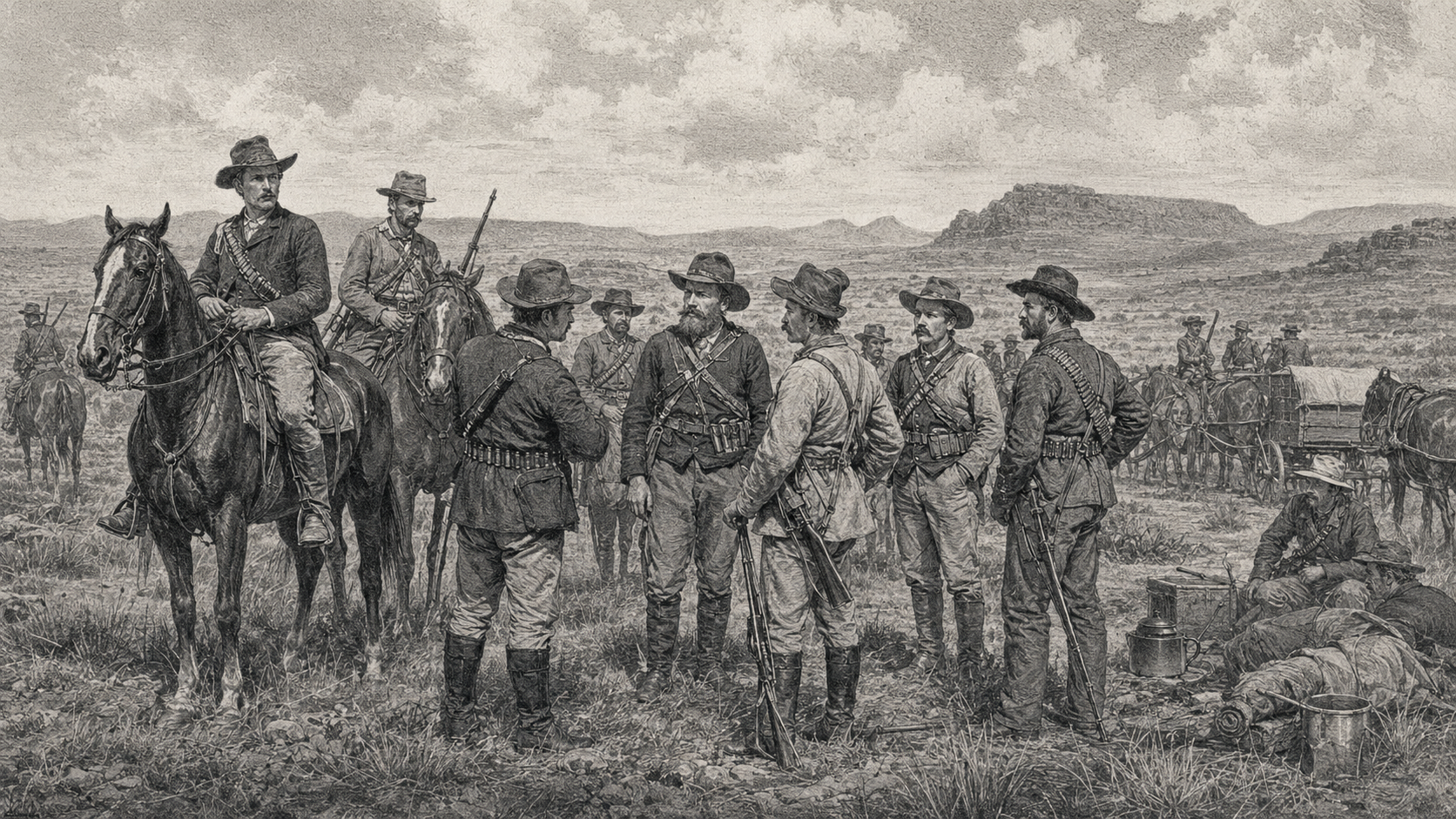
Read Article: Recruitment IntensifiesA fresh sequence of enlistments was entered for the Royal Irish Regiment as recruiting activity increased during the South African War. The new names reflected the widening demand for soldiers after the British Army suffered heavy reverses during the closing weeks of 1899. Recruiting offices were encouraging suitable men to enter regular service, while reservists were being recalled and additional forces prepared for overseas deployment. For many Irish families, the war was no longer a remote imperial struggle reported from distant battlefields. It had begun to influence employment decisions, household income and the movements of young men across towns and rural districts.
The Royal Irish Regiment drew much of its manpower from Tipperary, Waterford, Kilkenny and Wexford, with its regimental depot established at Victoria Barracks in Clonmel. Its location placed the regiment within easy reach of men travelling through Munster in search of military employment. Recruits did not always enter the regiment most closely associated with their home county, as vacancies, recruiting arrangements and personal connections could determine where they were accepted. The enlistments recorded on 2 January therefore formed part of a broader military system that moved men between local recruiting offices, regional depots, training establishments and battalions preparing for active service abroad.
Recruitment had acquired greater urgency following the British defeats of December 1899, a period widely remembered as Black Week. Boer forces had demonstrated unexpected strength, mobility and marksmanship, while British commanders faced the difficulties of reinforcing armies operating across vast distances. The 1st Battalion of the Royal Irish Regiment had already sailed for South Africa and was approaching the Cape when the latest enlistments were entered. New soldiers could not be transformed immediately into experienced infantrymen, but each attestation strengthened the reserve from which the regiment could replace casualties, maintain home duties and prepare future drafts for overseas service.
For working men, enlistment could represent both danger and opportunity. Army service offered regular pay, food, clothing and accommodation at a time when secure civilian employment was difficult to obtain. The decision to enlist was rarely individual in its consequences. Parents could lose a son’s contribution to the household, wives might depend upon military allowances, and younger relatives could find themselves carrying additional responsibilities. Letters and newspaper reports linked Irish homes to military camps and battlefields thousands of miles away. Recruitment was therefore shaped not only by patriotism or imperial enthusiasm, but also by poverty, uncertainty, family tradition and the practical search for a dependable livelihood.
The new entries also revealed the complicated relationship between Ireland and the British Army. Nationalist opposition to the South African campaign existed alongside a long tradition of Irish military service. Men could criticise British policy while relatives wore British uniforms, and communities could oppose the war while supporting soldiers’ families. Such contradictions were especially visible in Munster, where military barracks, recruiting routes and generations of army employment formed part of everyday life. The enlistments recorded on 2 January were modest administrative entries, yet behind each name stood a personal decision capable of altering a household and carrying an Irish recruit into the expanding conflict.
- British Army service and attestation records, Royal Irish Regiment enlistments dated 2 January 1900, War Office personnel series.
- War Office, The Monthly Army List, January 1900, entries for the Royal Irish Regiment and its Clonmel depot.
- War Office, South African War medal rolls and battalion records for the Royal Irish Regiment, The National Archives, series WO 100.
- Royal Irish Regiment campaign records concerning the 1st Battalion’s departure for South Africa in December 1899 and arrival at the Cape in January 1900.
- Contemporary Irish and British newspaper reports from December 1899 and January 1900 concerning recruiting, mobilisation, reservists and military reverses in South Africa.
-
Grazing Dominance
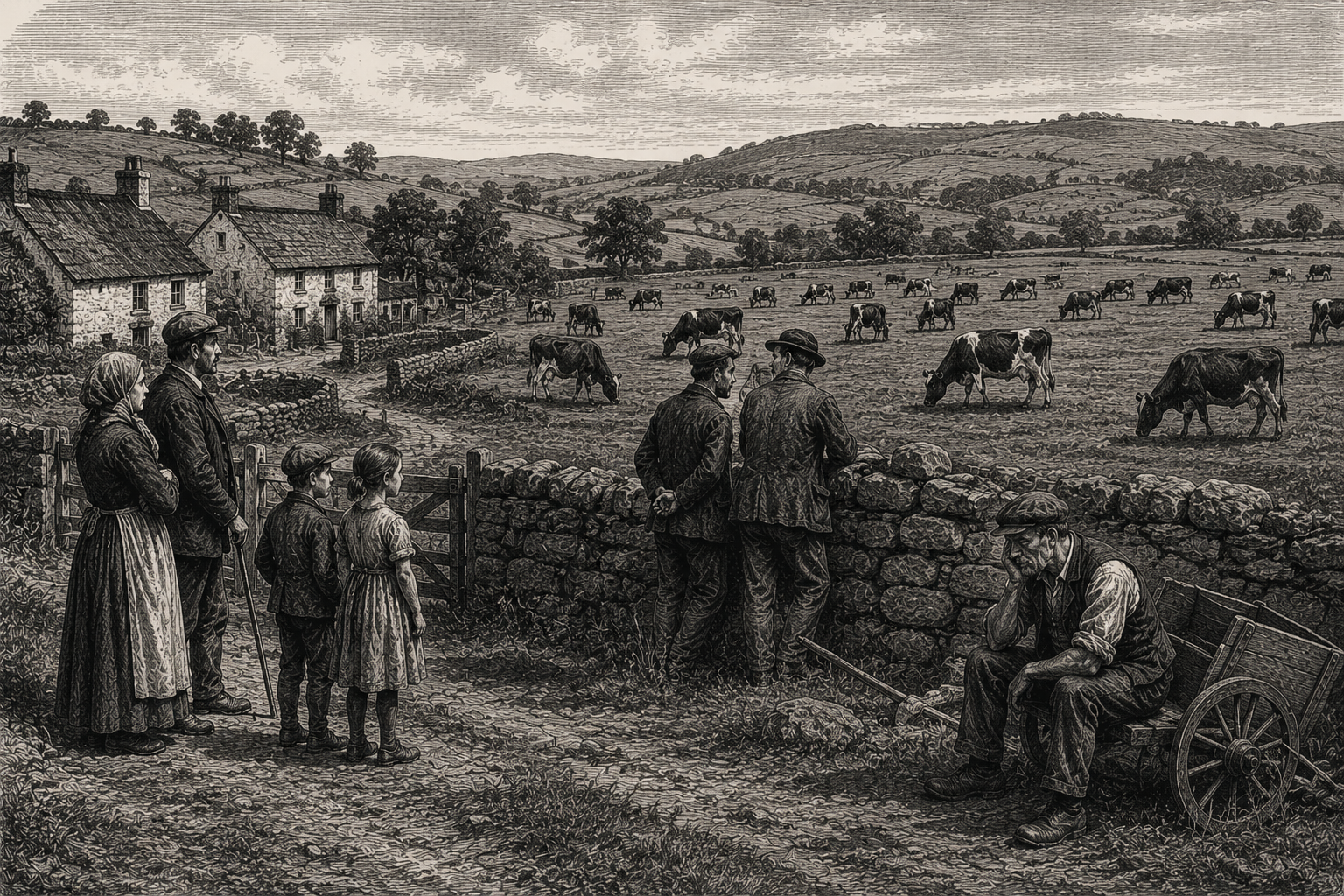
Read Article: Grazing DominanceCattle grazing remains more profitable than tillage in many Irish districts, encouraging landowners and substantial occupiers to devote extensive farms to livestock rather than labour-intensive cultivation. The difference is keenly felt in County Limerick, where broad grasslands can support valuable cattle while requiring comparatively few permanent workers. Families dependent upon agricultural wages find fewer opportunities wherever ploughing, sowing, weeding and harvesting give way to grazing. Supporters of the existing system point to dependable livestock markets and lower operating costs, but critics argue that profitable land is failing to sustain the number of people it once employed.
Tillage requires labour throughout much of the agricultural year. Fields must be prepared, planted, maintained and harvested, creating work for ploughmen, labourers, carters, women and seasonal hands. Grazing demands fewer workers once fences, water and pasture are properly maintained. A large cattle farm may therefore produce a satisfactory return for its occupier while providing little employment to neighbouring households. The contrast has strengthened complaints that agricultural profitability is being measured without sufficient attention to the number of families supported by the land or the condition of labourers left dependent upon irregular hiring.
The expansion of grazing is also connected with changes in markets and farming practice. Irish cattle can be raised upon grass and sold for finishing or slaughter in Britain, offering producers access to a large commercial market. Tillage farmers face uncertain weather, fluctuating grain prices and competition from imported produce. Many occupiers consequently regard livestock as the safer investment. Yet land campaigners maintain that private calculations have created a wider public injury, particularly where extensive grass farms stand near cramped holdings whose occupants require additional acreage to achieve even modest security.
Rural unemployment contributes directly to migration and population decline. Labourers unable to obtain sufficient work may travel to other counties or cross the Irish Sea for seasonal employment. Younger men and women frequently conclude that permanent emigration offers greater security than remaining in districts where agricultural work continues to contract. Their departure weakens local trade, reduces school attendance and leaves ageing relatives responsible for farms and households. County Limerick’s market towns may still benefit from cattle fairs and livestock commerce, but prosperity measured through sales does not necessarily reach cottages in which employment has disappeared.
The conflict between grazing and tillage has therefore become part of the broader Irish land question. Campaigners seek the division of large grass farms and the enlargement of smallholdings, arguing that land should support families as well as cattle. Graziers answer that they are using their farms according to market conditions and cannot be expected to maintain uneconomic cultivation merely to provide employment. The dispute places commercial freedom against social necessity. In Limerick, its consequences are visible wherever fertile pasture produces valuable livestock while labouring families confront unemployment, seasonal absence and the continuing loss of population from the countryside.
- Department of Agriculture and Technical Instruction for Ireland, Agricultural Statistics of Ireland with Detailed Report for the Year 1900, Dublin: His Majesty’s Stationery Office, 1901. Consult the county tables concerning tillage acreage, pasture, livestock and agricultural production. Exact table and page should be confirmed before formal citation.
- Census of Ireland, 1901, County of Limerick Tables, Dublin: His Majesty’s Stationery Office. Consult the returns concerning population change, agricultural occupations and rural districts. Exact volume, table and page should be confirmed before formal citation.
- Irish Agricultural Organisation Society, Annual Report for 1900, Dublin: Irish Agricultural Organisation Society. Consult the reports concerning livestock farming, rural employment, agricultural organisation and population loss. Exact page and section should be confirmed before formal citation.
- House of Commons Debates, 1900, debates concerning Irish agriculture, grazing farms, congested districts and rural depopulation. The precise debate, date, volume, column and speaker must be identified before formal citation.
- Limerick Chronicle, 1900, reports concerning cattle fairs, grazing farms, agricultural employment, tillage and rural conditions in County Limerick. Exact issue, page and column should be confirmed before formal citation.
-
Creamery Rivalry
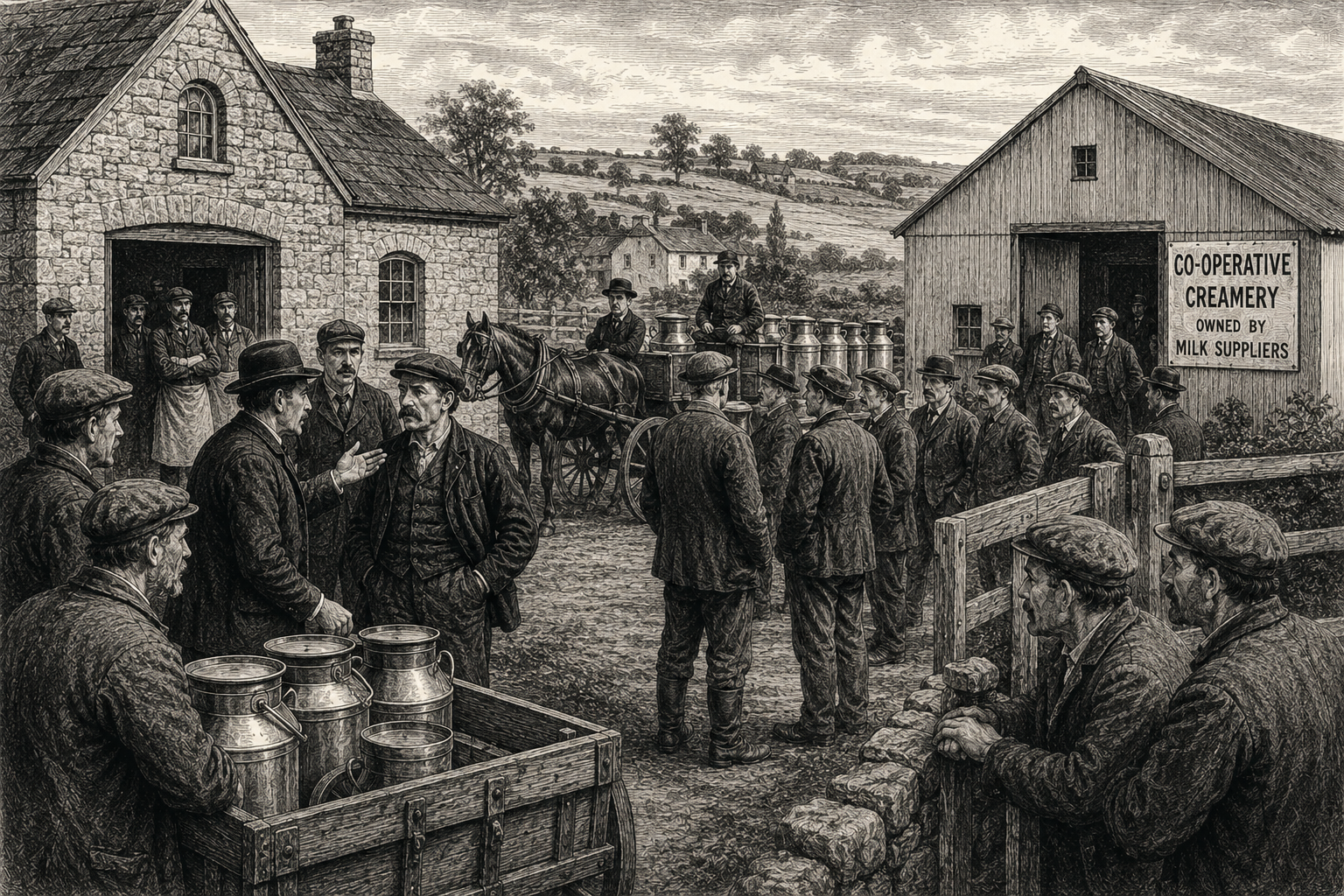
Read Article: Creamery RivalryLocal disputes are arising between co-operative creameries owned by milk suppliers and privately operated concerns seeking to retain control of established dairying districts. The rivalry is especially significant in County Limerick, where cattle, milk and butter provide income for farmers, labourers, carriers and merchants. Co-operative organisers argue that producers should collectively own the machinery through which their milk is processed and marketed. Private proprietors answer that independently managed businesses can offer efficient service without requiring farmers to invest capital, accept committee authority or assume responsibility for commercial losses.
Competition centres upon the daily supply of milk. No creamery can operate successfully without obtaining sufficient quantities from neighbouring farms, and rival establishments may offer different prices, collection arrangements or credit terms to attract suppliers. A private proprietor may raise payments when a co-operative society opens nearby, while co-operators warn that such inducements may disappear once their organisation has been weakened. Farmers must decide whether immediate returns outweigh the longer-term advantages claimed for collective ownership. Their decisions can divide families and neighbours whose milk travels along the same roads but reaches competing churns.
The Irish Agricultural Organisation Society assists communities wishing to establish farmer-owned creameries, providing advice on rules, shareholding, accounts and management. Its supporters regard each new society as an attempt to return commercial power to those producing the milk. Private firms and established butter interests may regard that intervention as an organised attack upon legitimate enterprise. County Limerick has already played an important part in the development of co-operative dairying, although individual establishments have not always remained under co-operative ownership. The movement’s progress has therefore involved reversals, conversions and continued competition rather than an uninterrupted advance.
Disputes may extend beyond prices into access to machinery, transport routes, skilled managers and markets for finished butter. A creamery losing suppliers can quickly become uneconomic, while farmers who have purchased shares may fear that desertion by neighbours will leave them responsible for debt. Private businesses also possess capital and trading connections that newly formed societies may lack. Co-operative committees must demonstrate that democratic control can coexist with discipline, technical competence and prompt payment. Poor accounts or inferior butter can damage the movement as seriously as external opposition, giving private competitors evidence that collective ownership is impractical.
For rural Limerick, these struggles concern more than rivalry between neighbouring buildings. They determine who controls the value created from milk, who bears commercial risk and how much authority farmers exercise over the sale of their produce. A successful co-operative may retain profits locally and teach members to manage shared business affairs. A successful private concern may offer dependable employment and purchasing without requiring collective investment. The continuing disputes reveal a countryside testing two competing forms of enterprise, with milk suppliers deciding whether their future lies principally with proprietor-led commerce or with organisations owned and governed by farmers themselves.
- Irish Agricultural Organisation Society, Annual Report for 1900, Dublin: Irish Agricultural Organisation Society. Consult the creamery statistics, affiliated-society lists and organisers’ reports. Exact page and table should be confirmed before formal citation.
- Irish Homestead, 1900, contemporary reports and editorial commentary concerning co-operative creameries, private competition, milk supplies and butter marketing. Exact issue, page and column should be confirmed before formal citation.
- Horace Plunkett, Ireland in the New Century, London: John Murray, 1904. Consult the chapters concerning agricultural co-operation, creamery organisation and resistance from established commercial interests.
- Department of Agriculture and Technical Instruction for Ireland, Agricultural Statistics of Ireland with Detailed Report for the Year 1900, Dublin: His Majesty’s Stationery Office, 1901. Exact livestock, dairying and butter-production tables should be confirmed before formal citation.
- Limerick Chronicle, 1900, reports concerning creamery ownership, milk prices, butter markets and agricultural organisation in County Limerick. Exact issue, page and column should be confirmed before formal citation.
-
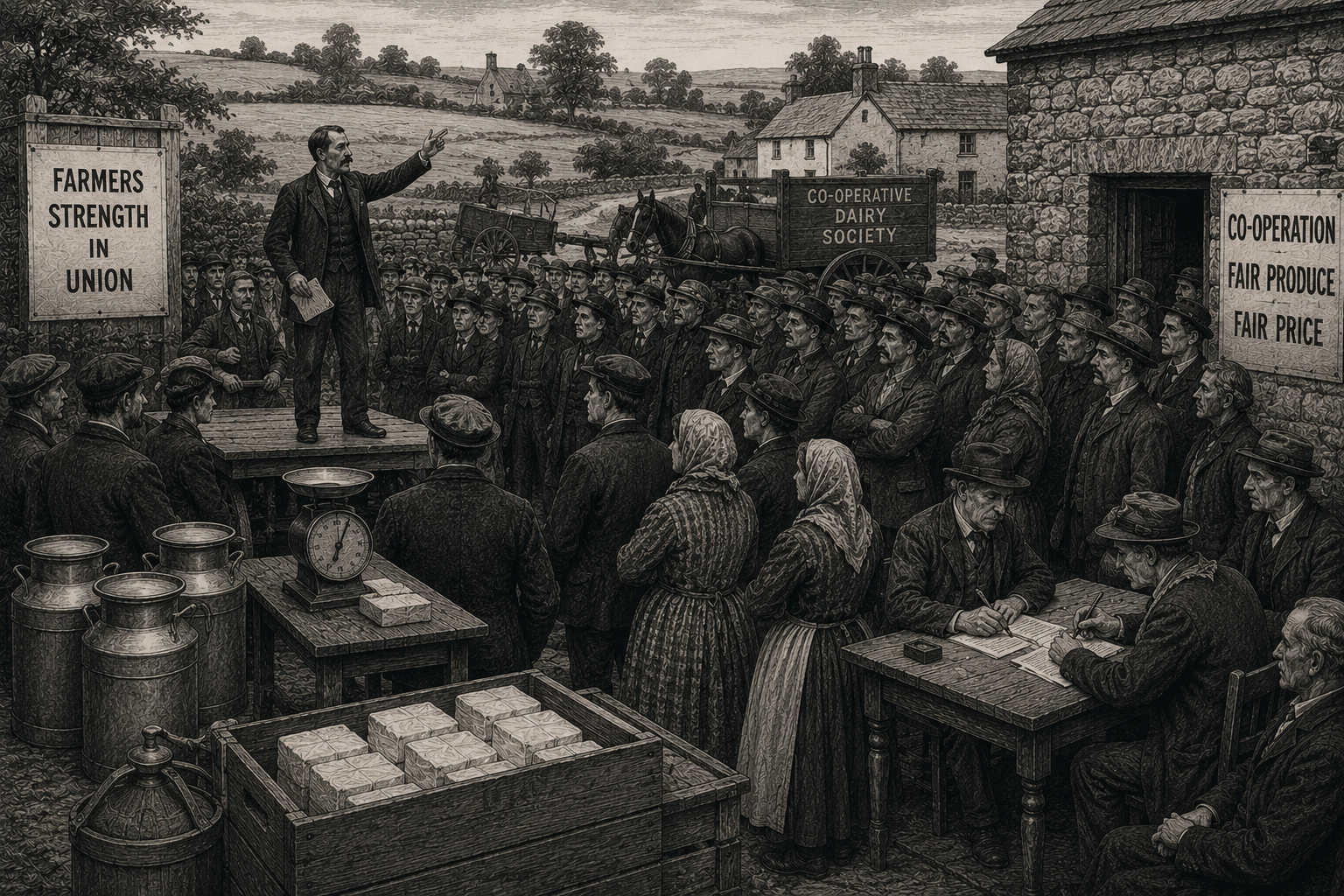
Creamery Contest
Read Article: Creamery ContestAgricultural co-operation is challenging the private commercial control long exercised over Irish butter production and marketing. Farmer-owned creameries allow milk suppliers to combine their resources, process milk by machinery and sell butter through organisations answerable to their members. The movement carries particular importance in County Limerick, where dairying supports farmers, labourers, carriers, merchants and rural households. Supporters argue that producers should receive a greater share of the value created from their milk instead of remaining dependent upon private creamery proprietors, butter buyers and commercial intermediaries whose interests may not coincide with those of farming communities.
Under the co-operative system, local farmers purchase shares, elect a committee and undertake to supply milk to a central creamery. Mechanical separation and organised churning can produce butter of more consistent quality than scattered household production, while collective marketing may strengthen the farmers’ position when negotiating prices. Surpluses remain within the society rather than passing entirely to an outside owner. Success nevertheless demands competent management, accurate accounts and loyalty from suppliers. A society can be weakened when members divide their milk between competing establishments or accept temporary inducements offered by private firms seeking to preserve control of a district.
The Irish Agricultural Organisation Society, founded in 1894, has encouraged the formation of creameries and other farmer-owned enterprises under the influence of Horace Plunkett and his fellow organisers. Travelling representatives convene meetings, explain the principles of shared ownership and assist communities in drawing up rules. Limerick has become closely connected with this work through early societies formed in its dairying districts. Co-operation is presented not merely as a new method of manufacturing butter but as a means by which farmers may learn collective business management, scrutinise expenditure and exercise greater authority over the route their produce takes to market.
Private proprietors and established butter interests have not surrendered their position without resistance. Rival creameries may compete aggressively for milk, raise payments in districts where a co-operative society appears and reduce them when that threat has passed. Merchants accustomed to controlling purchase and resale may regard farmer-owned marketing as an intrusion into legitimate commerce. Co-operators answer that individual suppliers possess little bargaining power when dealing separately with larger concerns. The dispute therefore concerns not only machinery or butter quality but the ownership of rural enterprise, the distribution of profits and the authority to determine how agricultural produce is sold.
For County Limerick, the outcome may shape the economic life of entire communities. A successful co-operative creamery can create employment, encourage improved cattle breeding, support transport services and provide a regular gathering place for farmers. It can also retain locally a portion of the income formerly absorbed by private intermediaries. Failure, however, may leave members burdened by debt and restore control to commercial competitors. Agricultural co-operation has consequently become both a practical business experiment and a challenge to inherited trading relationships, asking whether those who supply the milk can also own the machinery, supervise production and share the proceeds of the butter market.
- Irish Agricultural Organisation Society, Annual Report for 1900, Dublin: Irish Agricultural Organisation Society. Consult the creamery statistics, affiliated-society lists and reports of organising activity. Exact page and table should be confirmed before formal citation.
- Irish Homestead, 1900, contemporary reports and editorial commentary concerning co-operative creameries, private competition, butter production and agricultural organisation. Exact issue, page and column should be confirmed before formal citation.
- Horace Plunkett, Ireland in the New Century, London: John Murray, 1904. Consult the chapters describing the origins, commercial purpose and difficulties of agricultural co-operation.
- Department of Agriculture and Technical Instruction for Ireland, Agricultural Statistics of Ireland with Detailed Report for the Year 1900, Dublin: His Majesty’s Stationery Office, 1901. Exact dairy, livestock and butter-production tables should be confirmed before formal citation.
- Limerick Chronicle, 1900, reports concerning creameries, butter markets, milk prices and agricultural organisation in County Limerick. Exact issue, page and column should be confirmed before formal citation.
-
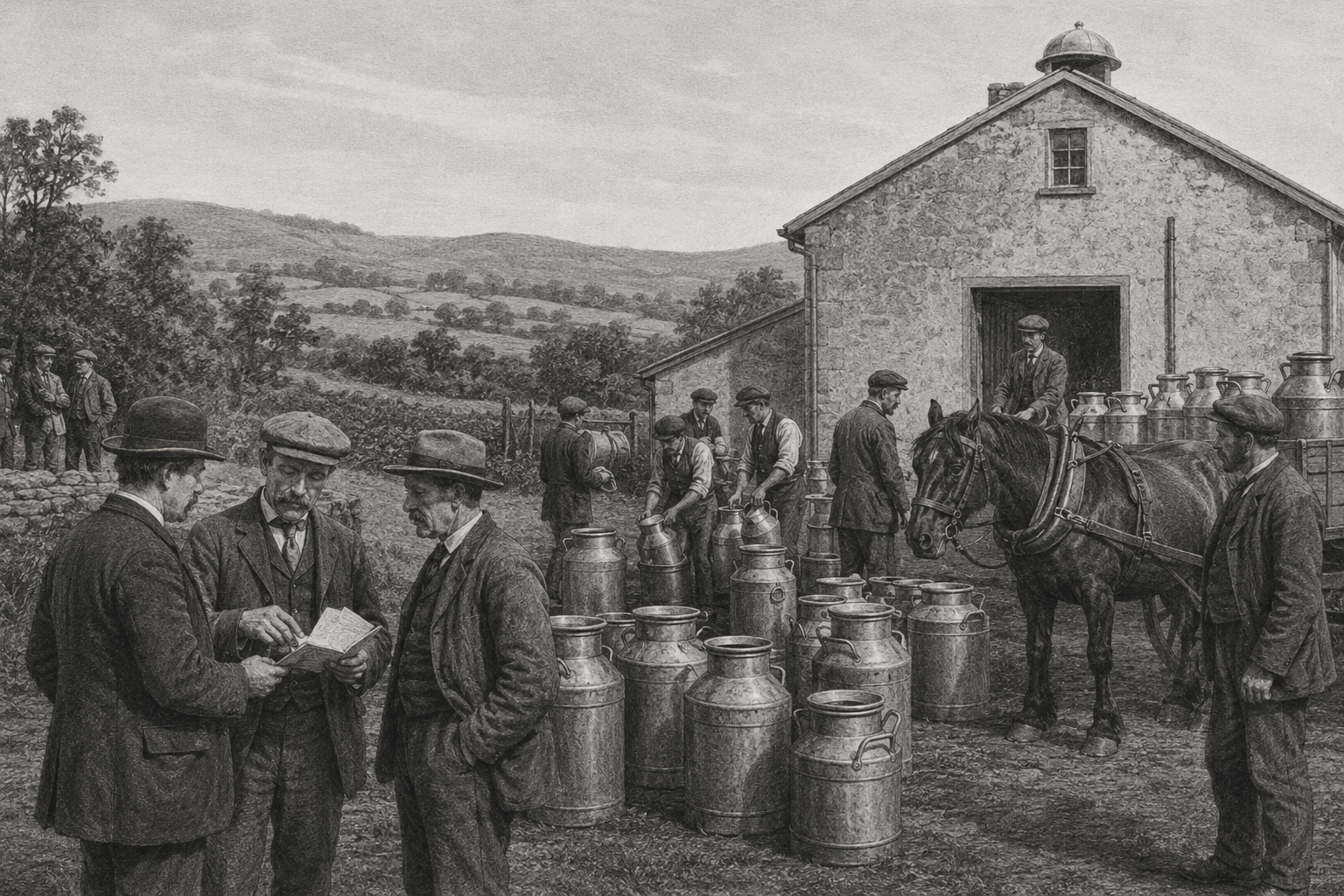
Creamery Expansion
Read Article: Creamery ExpansionCo-operative creameries continue to spread across rural Ireland under the influence of Horace Plunkett and the Irish Agricultural Organisation Society. The movement encourages farmers to combine their milk, capital and labour so that butter can be produced by modern machinery, graded to a consistent standard and sold through an organisation owned by the suppliers themselves. County Limerick, with its strong dairying tradition and growing network of creameries, occupies an important place in this agricultural transformation. Supporters argue that co-operation allows small farmers to overcome disadvantages that none could manage alone.
A co-operative creamery is established when local farmers purchase shares and agree to supply milk to a central facility. Mechanical separators remove cream more efficiently than many household methods, while trained managers supervise production, cleanliness, accounts and marketing. After operating expenses are met, the value created by the business belongs to its members rather than an outside proprietor. The system requires trust, regular milk supplies and careful administration. A poorly managed society can fail, but a successful creamery may secure better prices, improve butter quality and provide a dependable commercial centre for the surrounding countryside.
Plunkett has promoted agricultural co-operation since the late 1880s, arguing that rural prosperity requires better farming, sound business practice and stronger community organisation. The Irish Agricultural Organisation Society, founded in 1894, sends organisers into the countryside to explain co-operative principles, assist farmers in drafting rules and advise newly formed societies. Its annual reports record the expansion of affiliated creameries, agricultural societies, credit associations and other rural enterprises. The organisation’s purpose is not to operate every creamery directly but to help farmers establish and govern businesses capable of serving their own districts.
The movement faces determined commercial opposition. Privately owned creameries and butter merchants fear the loss of milk supplies and local influence, while the British Co-operative Wholesale Society has also established Irish creameries to serve its own extensive market. Rival businesses may compete for suppliers by adjusting prices or opening facilities near existing societies. Co-operative organisers warn that temporary inducements can weaken farmer-owned ventures before outside buyers regain control. Political and religious disagreements may also divide communities, although Plunkett insists that practical economic interests should unite farmers regardless of party or denomination.
In Limerick, the spread of co-operative dairying may influence far more than butter production. Creameries create employment, encourage improved cattle breeding, increase demand for transport and bring farmers into regular commercial contact. Meetings and shared accounts also teach members how to conduct collective business, elect committees and scrutinise management. The wider significance lies in transferring economic power towards local producers, although success depends upon loyalty, competent administration and access to markets. The co-operative creamery is becoming both an agricultural institution and a rural meeting place, offering farming families a means of strengthening their position through organised self-help.
- Irish Agricultural Organisation Society, Annual Report for 1900, Dublin: Irish Agricultural Organisation Society. Consult the lists and statistical tables concerning affiliated co-operative creameries, membership and trading activity. Exact page and table should be confirmed before formal citation.
- Horace Plunkett, Ireland in the New Century, London: John Murray, 1904. Consult the chapter concerning agricultural co-operation and the work of the Irish Agricultural Organisation Society.
- Irish Homestead, 1900, reports and commentary concerning co-operative creameries, dairy farming and agricultural organisation. Exact issue, page and column should be confirmed before formal citation.
- Department of Agriculture and Technical Instruction for Ireland, Agricultural Statistics of Ireland with Detailed Report for the Year 1900, Dublin: His Majesty’s Stationery Office, 1901. Exact dairy and livestock tables should be confirmed before formal citation.
- Limerick Chronicle, 1900, reports concerning creameries, butter markets, milk suppliers and co-operative organisation in County Limerick. Exact issue, page and column should be confirmed before formal citation.