Networks Endure(c.1900s)
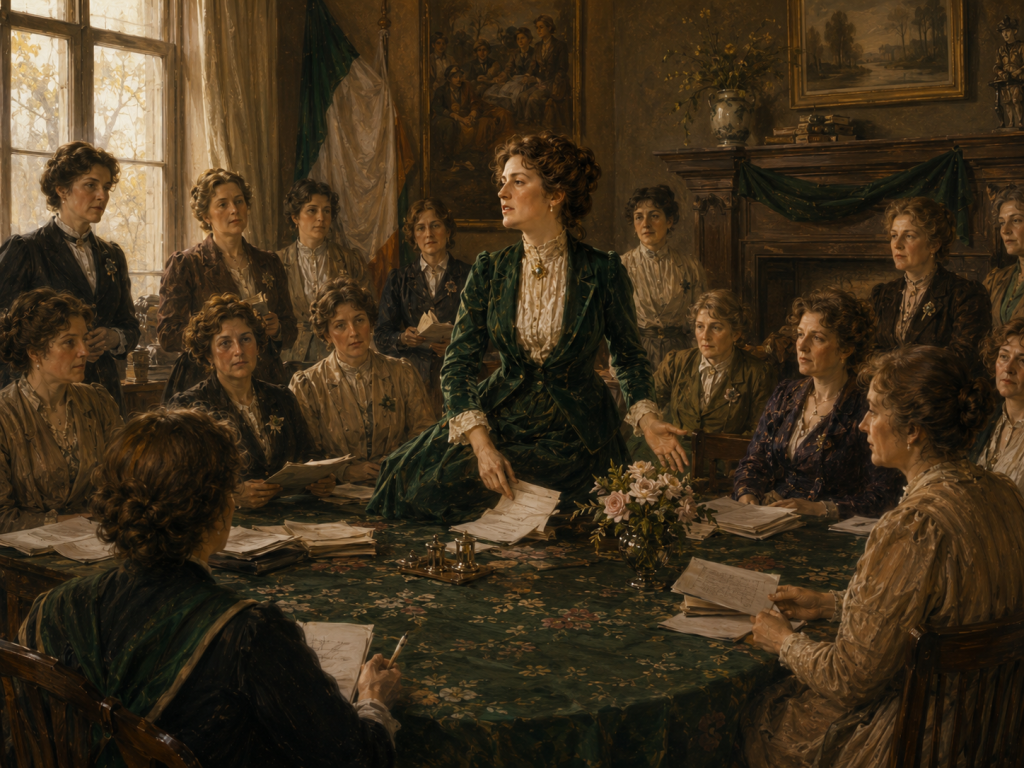
The establishment of Cumann na mBan has revealed how strongly the women’s nationalist networks created during Queen Victoria’s visit in 1900 have endured. Fourteen years ago, Maud Gonne and her associates organised resistance to the royal ceremonies, arranged an alternative patriotic celebration for children and founded Inghinidhe na hÉireann. Those efforts brought women together as fundraisers, teachers, speakers and political organisers. Many of the relationships, practical skills and separatist convictions formed during that campaign have now entered a broader organisation intended to support the Irish Volunteers and advance the cause of national independence.
Inghinidhe na hÉireann provided women with sustained experience in committee work, public meetings, cultural education, publishing, social relief and political mobilisation. Members organised Irish-language classes, theatrical performances, commemorations, children’s activities and campaigns supporting Irish manufacture. Such work required premises, subscriptions, correspondence, trusted messengers and dependable local contacts. The organisation created opportunities for women who were excluded from parliamentary politics to develop authority within advanced nationalism. Cumann na mBan can now draw upon women already accustomed to working collectively, raising resources and defending separatist principles before audiences that often expected female political labour to remain subordinate and largely invisible.
Personal continuity is equally important. Women associated with the Daughters of Ireland entered later organisations carrying friendships and loyalties formed through years of shared activity. Elizabeth O’Farrell and Julia Grenan joined Inghinidhe na hÉireann before becoming members of its branch within Cumann na mBan. Helena Molony, Constance Markievicz, Jennie Wyse Power and other activists moved through overlapping circles of cultural nationalism, labour organisation, women’s politics and revolutionary agitation. These connections allowed information, practical knowledge and confidence to travel between organisations. The nationalist women assembling in 1914 are therefore not beginning without preparation, even though the new military circumstances demand a different structure and purpose.
The formation of Cumann na mBan follows the creation of the Irish Volunteers in November 1913 amid growing uncertainty over Home Rule and armed unionist resistance. Its branches intend to raise funds, learn first aid, support Volunteer companies and assist the wider national movement. Some male leaders may regard the organisation chiefly as an auxiliary, but experienced women bring ambitions extending beyond supportive duties. Inghinidhe na hÉireann had already asserted that women could determine policy and work for complete independence in their own right. The transfer of members into Cumann na mBan ensures that this autonomous tradition will remain present within the developing revolutionary movement.
Limerick women participating in nationalist, cultural, charitable and labour organisations may find similar opportunities within the new association. The networks begun during opposition to the royal visit show how an apparently temporary campaign can produce lasting political consequences. Meetings arranged for one demonstration created friendships; collections organised for children taught financial administration; cultural classes trained speakers and teachers; public resistance strengthened confidence. Cumann na mBan inherits more than individual members from the organisations preceding it. It receives a body of women already practised in disciplined political work and prepared to carry national organisation from public agitation towards the uncertain demands of revolutionary struggle.
Primary Sources
- Maud Gonne MacBride, writings on the history, activities and aims of Inghinidhe na hÉireann, Maud Gonne MacBride Papers, National Library of Ireland, MS 49,531/19.
- Inghinidhe na hÉireann, official reports, membership records, accounts and organisational papers, Maud Gonne MacBride Papers, National Library of Ireland. Exact manuscript numbers and folios should be confirmed before formal citation.
- Helena Molony, Bureau of Military History witness statement concerning Inghinidhe na hÉireann, Cumann na mBan and women’s revolutionary activity. Exact witness-statement number and page should be confirmed before formal citation.
- Elizabeth O’Farrell, Bureau of Military History witness material and contemporary biographical records concerning her membership of Inghinidhe na hÉireann and its Cumann na mBan branch. Exact document and page should be confirmed before formal citation.
- Cumann na mBan, early constitution, manifesto, branch records and organisational papers, April 1914, National Library of Ireland and Military Archives. Exact collection, file and folio should be confirmed before formal citation.